Your ShelfYour Projects

Review and Herald, Vol. 80, No. 51.

Bethlehem!
Earlier text: The Week of Prayer Continued

Venturing in Missionary Work

D. T. BOURDEAU
He who ventures nothing has nothing; he who ventures little has little; he who ventures much has much. This is true in temporal things; it is also true in spiritual things, even in missionary work. We receive the truth that we may communicate it to others. If we do this, we shall have more truth, and more strength to communicate it to those to whom we owe it, and in this case we are debtors to all those who are within our reach, and whom we can bless with the light God has given us.
We should love our fellow beings as we love ourselves. If we do this, and have experienced the saving power of the truth for these times, we shall do all that in us lies to lead others to do the same, and to experience this same saving power that we have experienced; and thus our talents and abilities, with those of such as we can lead to walk in the way of truth and salvation, will be utilized, and the result will be an increase of talents and abilities as seen in an increase of souls saved through the grace and truth of him who died for us.
This means missionary work, and venturing to do all we can of it, both for ourselves and for others; for in this we are to co-operate with Christ. By grace divine we are to work out our own salvation, and labor for the salvation of others, knowing that it is God who worketh in us and in others to will and to do of his good pleasure. We must venture more by faith and by earnest endeavors to form right characters. As we labor to overcome the defects in our imperfect characters, we shall labor for the salvation of others; for the two are inseparably connected. We can not labor to form righteous characters without laboring for the salvation of our fellow beings. To neglect doing all we can to lead others to comply with the conditions of salvation, is to be selfish, and to withhold equal love from those who need salvation, and from God love supreme. And how can we be truly said to be forming holy characters while selfishly doing this?
On the other hand, in laboring for the salvation of others, our love for them and for God increases. While presenting to those for whom we labor the love of God, as seen in the gift of his Son and through his offers of salvation, we are reminded of what God has done for us in freely forgiving us our sins and in saving us from the power of sin, and we are led to ask him for grace to love him more; and he graciously grants us our request. We remember that he loves our fellow beings who are still in their sins as he loved us when we were in the same condition, and we are led to ask him for more of the love wherewith he has loved us and those who are still in the bondage of sin, and for whom we are laboring. In his great love and mercy he grants us our desire, even to giving us bowels of mercy for those who are perishing in their sins, and enabling us to love them as we love ourselves. In seeing the sins of those for whom we labor, we are led to examine our own characters to have their defects removed, that our example may be worthy of imitation, and that we may be successful in winning souls to Christ. And what is this but forming holy characters?
Christ ventured all when he came to our world to save those who would truly believe in him; and we should venture all, even our very lives, if need be, in laboring for those for whom Christ died. To do this we need not all go to the heart of heathendom to evangelize the heathen. We can venture in doing missionary work in our own families, home churches and localities, and in laboring for those around us with our literature, in visiting and giving Bible readings; and we can venture more in doing missionary work on our knees, praying for those needing light, truth, and salvation, and for the messengers of the cross who are bearing to those in darkness the glad tidings of salvation.
Let us not wait until every obstacle is removed to engage in missionary work. To do this would be to evince unbelief and selfishness, not giving the Lord a chance to work, and drying up spiritually. It would be to become guilty of the blood of souls around us who are perishing in their sins, and to be found unprepared for the things that are coming on the earth. Let us venture more in doing missionary work, that our faith and love may be increased, that we may see God's mighty workings in the conversion of souls to God, to the encouragement of his people, that the work of the Lord may soon be cut short in righteousness, and we may soon realize the blessedness of greeting the Saviour with joy at his coming.

“Ye Must Be Born Again”

If it be true, as some assert, that it is not now common to hear sermons on the new birth, the pulpit is ignoring its high calling, and the power of its message is a diminishing quantity. To preach mere culture, it matters not how enticing; or philosophy, it matters not how profound; or ethics, it matters not how exalted, instead of the gospel of the new birth as proclaimed by Jesus Christ, is to degrade the ancient and holy office of the pulpit, and to cast the imputation of hypocrisy upon the Saviour of men. When the doctrine of the new birth is preached by men who thoroughly believe in it because they thoroughly know it by personal experience, the pulpit rises to its rightful and exalted place; the minds of sinful men are stricken; their hearts are touched, and they give evidence of the need of spiritual regeneration through Jesus Christ and the Holy Spirit, by crying out, “Men and brethren, what shall we do?”
The doctrine of the new birth is not worn out; it can not be discarded; it has vitality and potency in it; the propagation of the faith once delivered to the saints depends upon it; the establishment of the divine kingdom in the hearts of men throughout the world is contingent upon it. The church that desires to hold itself steadfast to the divine ideals, and to prosecute its mission in accordance with God’s purposes for the regeneration of men, will magnify the doctrine, believe it, experience it, sing it, and live in harmony with it; while from its pulpits men of consecration, baptized by the Holy Spirit, and unwearying in a holy purpose to lead their fellows out of darkness into light, out of bondage into freedom, out of sin into righteousness, will point them to the Lamb of God, which taketh away the sin of the world, and declare, “Ye must be born again.”—New York Christian Advocate.

Unholy Tempers

HEAR ye this, all ye that are called Methodists! You, of all men living, are most concerned herein. You constantly speak of “salvation by faith;” and you are in the right for so doing. You maintain (one and all) that a man is justified by faith, without the works of the law. And you can not do otherwise, without giving up the Bible and betraying your own souls. You insist upon it that we are saved by faith; and, undoubtedly, so we are. But consider, meantime, that let us have ever so much faith, and be our faith ever so strong, it will never save us from hell unless it now saves us from all unholy tempers; from pride, passion, impatience; from all arrogance of spirit, all haughtiness and overbearing; from wrath, anger, bitterness; from discontent, murmuring, fretfulness, peevishness. We are of all men most inexcusable, if, having been so frequently guarded against that strong delusion, we still, while we indulge any of these tempers, bless ourselves, and dream we are in the way to heaven!—John Wesley.

What Have We Done To-Day?

WE shall do so much in the years to come, But what have we done to-day? We shall give our gold in a princely sum, But what did we give to-day?
We shall lift the heart and dry the tear, We shall plant a hope in the place of fear, We shall speak the words of love and cheer, But what did we speak to-day?
We shall be so kind in the afterwhile, But what have we been to-day?
We shall bring to each lonely life a smile, But what have we brought to-day? We shall give to truth a grander birth, And to steadfast faith a deeper worth, We shall feed the hungering souls of earth; But whom have we fed to-day?
We shall reap such joys in the by and by, But what have we sown to-day? We shall build us mansions in the sky, But what have we built to-day?
'Tis sweet in idle dreams to bask, But here and now do we do our task? Yes, this is the thing our souls must ask— “ What have we done to-day? ” — Nixon Waterman.

The Feeding of Infants

EULALIA S. SISLEY, M. D.
IT is a significant fact that one half of the infants born into this world die before they reach the age of five years. It may be safely said that a large per cent of this infantile mortality is due to errors in feeding. A few suggestions may be helpful to inquiring mothers.
Many mothers, in feeding their little ones, adopt the plan of “meals at all hours.” No plan could be fruitful of more pernicious results, as a baby’s digestion must suffer from irregular or too frequent feeding.
As a general rule, an infant should be fed once every two hours during the daytime, and once or twice at night, until one month old. After this time the baby should be trained, as far as possible, to do without feeding from ten o’clock at night until five or six in the morning. The little one may cry the first night or two; but he can usually be quieted with a little warm water. After a short time he will learn to sleep through the night without waking for food.
From one to four months of age, the child should be fed once every three hours during the daytime. From the fourth to the eighth month, the intervals between feedings may be gradually lengthened to four hours.
Happy the little ones who are nourished in nature’s own way. Statistics show that such babies, as a class, are healthier than bottle-fed infants, and the mortality among them is far less.
Of artificial foods, modified cow’s milk is usually the best. For a young infant, the milk should be diluted one half, the proportion of milk and cream being gradually increased as the child’s stomach is able to bear it. Plain water, barley water, or thin, strained, well-cooked oatmeal gruel may be used to dilute the milk. Enough milk may be modified and sterilized each morning to last through the day. A teaspoonful of lime-water may be added to each feeding.
If a prepared infant food is used, select one which contains as little starch as possible, as an infant is unable to digest starch.
In selecting nursing bottles, choose those that are smooth inside, without angles or depressions, which, by collecting milk, render cleansing difficult. Provide the bottle with a plain rubber nipple. The long tube attachments should be discarded, as it is impossible to maintain the necessary cleanliness. Any particle of milk remaining in the bottle or nipple from one feeding to another, will be likely to contain the germs which cause fermentation in the stomach; hence the necessity of absolute cleanliness. Immediately after nursing, the bottle should be thoroughly rinsed, then submerged in a soda solution (one teaspoonful of soda to a pint of water). The nipple, after being thoroughly cleansed, should also be immersed in the soda solution until required for the next feeding, taking care to rinse before using. The busy mother may think these precautions unnecessary, but be it known that neglect to observe these requirements is largely responsible for the great mortality among infants.
The healthy infant, whether bottle or breast-fed, should be gradually weaned at about the age of twelve months, or as soon as he possesses sufficient teeth to begin masticating solid food. It is best, if possible, not to wean a child during the warm summer months, as this is the time when gastric and intestinal disorders are most prevalent. The custom followed by some mothers of greatly prolonging the nursing period is detrimental to both mother and child.
A suitable diet for a child one year old would consist of thoroughly cooked grains (such as whole-meal bread, zwieback, browned rice, and the flaked wheat preparations), stewed fruit, and fresh fruits which are thoroughly ripened. Milk and cream may also be used.
Avoid fried or highly seasoned foods, stimulants (including tea and coffee), coarse vegetables, unripe fruit, pastry, and excessive sweets.
It is a mistaken kindness to feed babies on sweetmeats. By thoughtlessness in this matter the foundation may be laid in infancy for lifelong dyspepsia.

Home Life

THERE is something peculiarly beautiful in the pure and calm life of a home in no wise prominent and celebrated. There stands a house, just like the dozen others in the same block, or on the same village street. No newsmonger ever lingers in its doorway. The man who looks out of its windows and crosses its threshold has never led an army or sat in the senate hall; but his life may be perfectly heroic, and as beneficent as only a pure heart has the gift to be. He may, by being the pure priest of his own house, be performing a ministry that only God and his unseen angels are acquainted with, in the instruction of his family in the ways of God, in quietly contributing to the relief of the needy nearest him, and, most of all, in the eloquent sermon of a spotless Christian life. There are many homes pervaded from cellar to garret by such a spirit. Like the ointment with which an adoring woman anointed the weary feet of Jesus, its odor fills the whole house.
The atmosphere of a home will be decided by its strongest spirit, and this is as apt to be a woman as a man. The most delightful home in real Christian grandeur that we have ever known was where a noble woman gave tone and character to the group. She was a priestess whose utterances carried more weight than any ever heard in a pagan temple.
The Epworth rectory would have been just like many others, and Methodism would never have been born, but for the woman who was composed when all about were excited; who taught more and put more great granite blocks in the temple of God’s church in one day, by her molding influence upon two plastic minds,—her sons John and Charles,—than her husband, with all his sermons and hymns and tirades against the government could have done in fifty lifetimes.
Many of the criticisms of “Memorials of a Quiet Life,” by Hare, and the opinions expressed concerning its good influence and tendency, seem to have arisen from different modes of looking at the work. Some have commended the style, others have called attention to the general characteristics of the Hare family, while others have thought that the greatest service of the book is the light it throws on the state of religion and literature in England during the period covered by the lives which it unfolds. But what has struck us most is the simplicity, sweetness, and intensity of virtue in that quiet Christian home at Hurstmonceaux. These were people who visited, and were visited, in turn, by their friends; kept a journal, each for himself, of what seemed the doings of the monotonous days; made plans for life and work; had their bereavements and joys; passed into serene old age, and left children behind them of whom they could only hope well because those who had loved them best had prayed well for them. Such a life has nothing striking in it, but it is the life of a real home. There is no rush, no grand ceremonial, no brilliant entertainment. All is unpretending and utterly devoid of the gross aspiration for renown. Such an untoward event as public prominence given to the circle of the Hares would have sent them all blushing into the Highlands. They thought nothing of it, and the beauty of their life was their living right straight on, from day to day, a pure and elevated life. There were ambitions, expectations, but they were legitimate and pure, and were fulfilled.
We are sometimes disposed to complain that our American home is beginning to suffer sadly. The excitements and whirl of our common business life get within it. The ostentation that comes from a desire to have the stranger become a guest for a few hours, and entertain a most excellent opinion of our finances and tastes, is too much the fashion. The young fledglings leave the old nest, here in America, very soon, and prefer to live in another atmosphere than their first. Our households are hopeless mutilations. We stand in danger of growing into the feeling that we are living in a vast boarding house, where nothing suits us but the expectation of something better. The excitements of our temporal life, the disappointment of our worldly hopes, should never be allowed to affect the feeling of the loved at home. If the members must separate, let us have them often recalled. Let the correspondence with them be faithfully sustained. Let all the ties be continued. Let the entire life be such that even the youngest at the fireside will never be able to forget, in all his later life, the temper and spirit of that charity and cheerfulness in which he grew, and from which he went out into the chilly world.
If a foreign duty is performed, let the nearest not be left undone. Let us, if we would look to the great future, both here and beyond, have a home where the loving and unifying spirit is supreme, and where religion absorbs all other interests. The good home here is the best type we have of the household above.—Bishop J. F. Hurst.

True Peace of Mind

TRUE peace of mind does not depend, as some seem to suppose, on the external incidents of riches and poverty, of health and sickness, of friendships and enmities. It has no necessary dependence upon society or seclusion, upon dwelling in cities, or in the desert. . . . Let the heart be right, let it be fully united with the will of God, and we shall be entirely contented with those circumstances in which providence has seen fit to place us, however unpropitious they may be in a worldly point of view. He who gains the victory over himself gains the victory over all his enemies.—The Lutheran.

Deer Hunting in Wisconsin

WM. COVERT
THE deer-hunting season in Wisconsin embraces the time between November 10 and 30. This season is now in the past, and the result is as follows:—
Twenty men have been killed in the woods, and a good many others seriously wounded. This is less than the average annual loss of human life due to these Wisconsin hunts. About four thousand poor, innocent deer have been captured this year. On an average, about one man in three who took out license succeeded in capturing a deer. The average cost in time and money to each individual who took part in this enterprise was not less than twenty-five dollars. This, of course, would not include the cost of gun and ammunition. The total cost would, therefore, be not less than three hundred thousand dollars, or seventy-five dollars for each deer taken. But this does not include all the cost, nor all the destruction wrought; for a large number of horses, cattle, and sheep were slain by the careless and reckless men who went into the woods.
I wish to ask if this kind of business pays. What effect does it have upon the spirituality of those who engage in it? Should professed Christians spend time and means in this way? I have been listening to the recital of these things, and hoping all the time that Seventh-day Adventists would not be numbered among the sportsmen in the hunting season. But how is this? Will I give a truthful report if I say that our brethren have all withheld themselves from this business?
Just a few days ago, a deer hunter accidentally killed himself in the woods only about half a mile from my home. Our neighbors were greatly distressed because of the sad termination of this hunt. He left a wife and five children to mourn their loss, besides many other relatives and friends. I was told that before he left home, his wife had pleaded with him not to go into the woods. But still the desire for the exciting chase overcame all the remonstrance of wife and children. Now he is dead, and his family left alone to battle with the cares of this life as best they can. He is only one out of the twenty who were killed in this way during the annual hunt in Wisconsin this year.
But that which has taken place this season is only a sample of what is being done every year in this savage business which men are pleased to call sport. But for my part I can not see how any Christian can call it sport, or feel that he can regard himself as following the Master's footsteps while engaged in this kind of pastime. I wish that we could imbibe the tender spirit which actuated Goldsmith when he wrote the lines:—
“No flocks that roam the valley free to slaughter I condemn; Touched by the love that pities me, I learn to pity them.”
But if we can not enter into the spirit of the poet, we certainly ought to enter into the spirit of the Saviour who died to save men, and therefore refrain from engaging in a business which annually destroys a score or two of human beings, and is, to say the least, questionable in many other ways.

Women Should Have Money to Spend

Having the bills paid is all very well. It's much better than not having them paid. But women like the handling of money as well as do men. They like to pay for their own purchases, and open their own parcels. If you men can not sympathize with this eccentricity, consider how well you like to open your own mail. Consider how well you'd have liked going through college with all your bills paid, but not a cent in your pocket. Consider, while you are considering, how you would like being asked to a banquet, and having somebody else eat for you. I have known women whose fathers were millionaires, and whose bills were paid without question, who were compelled to wait for the carriage, whatever their errand or its distance, because they never had car fare. Invariably these women were reckless in extravagance. They rarely asked the price of things ordered, as it was a matter of no concern to them. Yet with the rare and precious cash dollars that came their way, they were economical to the verge of stinginess. The moral whereof is plain.
If you would have your womenfolk economical, let them handle money, and learn to respect its value.
When a father gives his son an allowance, he should do the same for his daughter; not as a matter of material favor,—for the daughter's bills might double the son's allowance,—but as a matter of discipline, of financial experience and education. The girls who dress and keep themselves within the limits of a stipulated allowance are usually the best dressed; yet their bills are invariably smaller. It is to their interest to get all they can for their money, and their dollars go twice as far as do those of the girls whose bills are paid. And these are the girls whose training is fitting them to be good wives and helpmates of men, provided the men they marry have sufficient shrewdness to share their confidences and their incomes, and to trust their wives to aid in making the family fortunes solid. In the humbler walks of life, where the husband's earnings are so scant it is incredible that they can cover the mean necessities of life, those households are uniformly more thrifty where the husband turns over his entire earnings to the wife. Somehow she always manages to supply the wants, and keep the bills paid; and somewhere, though he can not see just how she does it, there's a nest-egg growing by hard-saved dimes and dollars for the inevitable “rainy day.”— Susan H. Martin.

O Love!

O Love! how cheering is thy ray! All pain before thy presence flies; Care, anguish, sorrow, melt away, Where'er thy healing beams arise; O Jesus! nothing may I see, Nothing desire or seek but thee! — John Wesley.

The Love Within the Deed

“ ‘Tis not the deed we do, Though the deed be never so fair, But the love, that the dear Lord looketh for, Hidden with holy care In the heart of the deed so fair.”

The Educational Problem in Rome

CHARLES T. EVERSON
THE papal See is not only located in Rome, but here also is the seat of the educational interests of the Roman Catholic Church. Not only one college is located here, but a score of them. From all over the world the students for the Catholic priesthood come to Rome to study. Not all the priests graduate from the schools here, many receiving their training in their native country; but a certain number from each country take their degrees here. There is a college for the American students, one for the English, one for the Canadian, and one each for the French, German, Spanish, Scotch, Austrian, etc. In each of these schools the students are taught in their respective languages, but come together at least once a day for general lectures. These lectures are delivered by the most learned professors of the Catholic Church, who are generally Jesuits. Here the darker doctrines of Romanism are poured into the minds of the young students, and they are inoculated with anti-heresy virus to keep them from catching the disease of Protestantism. And the teachers generally do their work well, as can be testified by those who are working for the conversion of Catholics in every land.
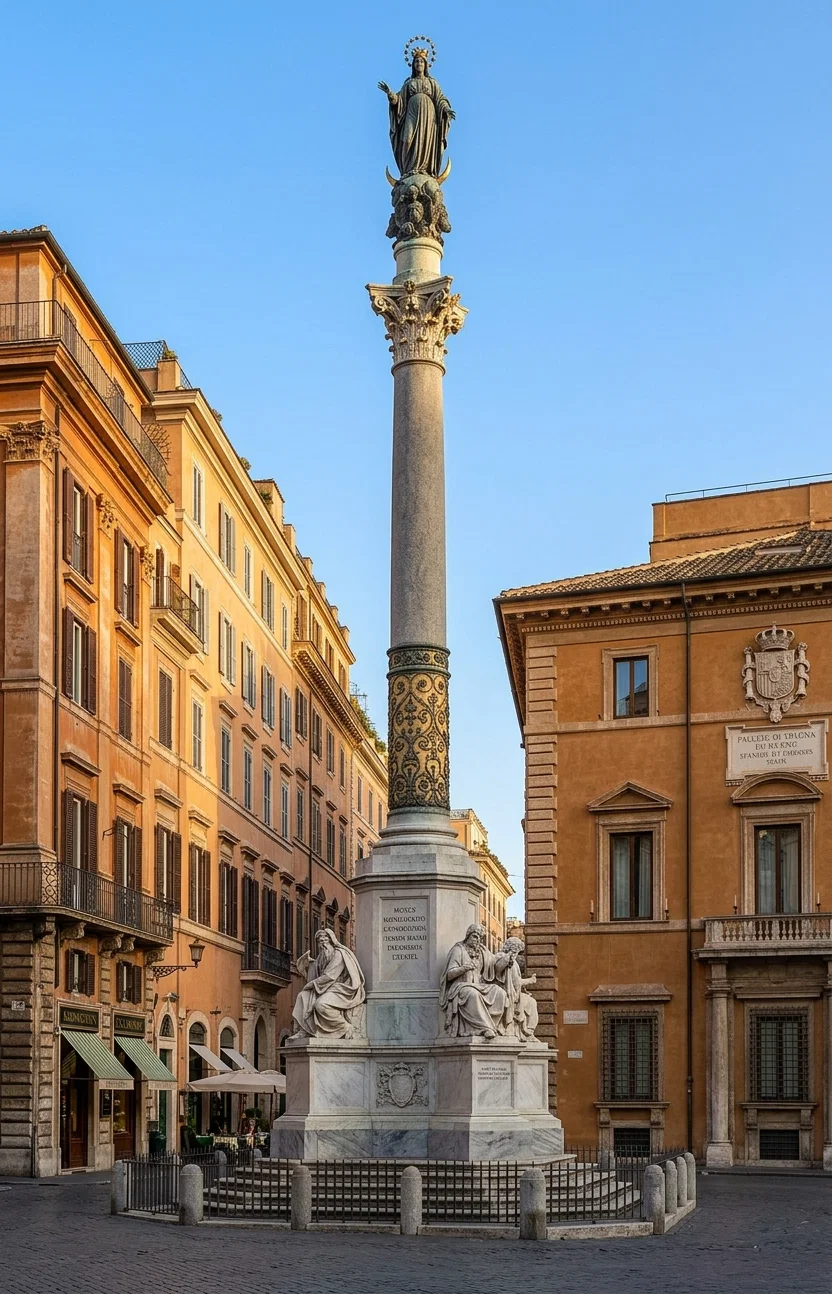
The accompanying picture gives a front view of the building called “The House of the Propaganda,” where these lectures are given, and where several thousand students can be accommodated at one time. The monument in the foreground is a pillar that was erected to commemorate the institution of the dogma of the immaculate conception, which was voted by the Roman Church in 1854. The figure on top is supposed to represent Mary; but any student of the Revelation will recognize in it a representation of the symbol of Revelation 12,—the woman, clothed with the sun, and the moon under her feet, and upon her head a crown of twelve stars.
HOUSE OF THE PROPAGANDA," ROME
One can not fail to be struck with the companies of these students that are a familiar sight in the streets of Rome, going to and from their schools; for they are all robed in vestures of various colors, some in bright red, others in blue, black, and violet, and girded with girdles of as many or more colors. In a place like this where there are brought together several thousands of students from all parts of the world, may we not hope to do something toward winning some of these students for the truth if our efforts are based on correct principles? Many of these students are going as missionaries to difficult places in Africa, India, China, and other fields. Can we say that in this they are all dishonest? May not some be misguided, who would become missionaries for a good cause if they once became converted? There must be some honest ones among so many young men, and the fact that there is a number of ministers preaching the gospel in Rome who were once Catholic priests indicates that there are some who can be converted.
In one of the Catholic churches of Italy there was a parish priest that had a good position, but became convinced that the Catholic Church is not the true church, and his conscience gave him no rest until he left the church; and now he travels over the country with a pack of books on his back, as a canvasser, in order to work for the Lord. There are many who despise the canvassing work, but here is a priest leaving a good position for the self-denying one of canvassing, in order to work for God. So we see that even among the priests there are those who are conscientious, and I believe that some will step out to give the message in these last days to their former congregations. Luther stepped out from the church of Rome, and became a mighty factor in giving the truth to the world in his day. But a greater day than the day of Luther is here, even the day of the Lord. And have we not need of Luthers in this greater day who will leave their priestly robes, and become reformers of righteousness and heralds of the coming of the King?
Not only is one struck in walking along the streets of Rome by the sight of the students for the priesthood, but he can not help but notice the many groups of uniformed children that march in regular order with a Sister of Charity or a Jesuit priest following them. They range in ages from small children to young men perhaps eighteen years of age. They are of both sexes, the boys being in charge of Jesuit priests, while the girls are in care of the Sisters. They march back and forth from their schools and for outings. But they are always in charge of their teachers; for the Catholics have learned that it pays to take good care of the children, and keep them away from adverse influences by watching them closely. On this work of teaching the children, their future prosperity in a country like this depends. They have nothing to expect in way of converting the men and women; for they are already Catholics, or else Protestants that can not be moved. So their great problem is the work among the children. The Catholic education among the children is largely conducted by the Jesuits, who are the deepest-dyed Catholics. They implant in the young, tender minds an everlasting hatred for everything that savors of Protestantism, and consequently the work among Catholics is made very difficult.
This situation shows us the necessity that exists of giving some attention in these Catholic countries to the educational problem among the children. The Methodists have turned their attention in this direction with splendid results. They are conducting a school in Rome where they have about two hundred and fifty students, many of whom are from the finest families in Rome, who are tired of Jesuitical influence over the children. The superintendent of the Methodist work here told me that last year the school paid all its expenses from the receipts from the students, including the salaries of thirty teachers, and then they had a surplus of three thousand dollars to be applied on the debt incurred in building the school. He also said that they had another school of fifty students in another part of the city, and the work was growing on their hands, and this year they expect to use a part of their mission building, where they reside, in which to conduct another school for smaller children.
God has given to us advanced light on education; and shall we hide this light under a bushel? Here at the fountainhead of the false system of education, should not the light of educational reform have an opportunity to shine forth? Surely the educational work in Rome merits our attention and earnest effort; for it will certainly be a strong factor in developing the work in this place. So successful has the educational work proved among the Methodists, that Dr. Burt told me that the Methodists of America became so enthusiastic about it that they wanted all the missionary efforts bent into this channel; but of course that would be getting the work one sided, and he would not listen to that proposition. But it goes to show that this work is one that should be given serious attention by our people. Let those that are especially interested in this work pray about it, and decide if God is not calling them to the work in “the Eternal City.”
Rome, Italy.
Continue reading: Laboring in Nyassaland