A Menace to Life, Property, and Character—Society
Has a Right to Protection Against It
By G. D. BALLOU
IN his article this week, Mr. Ballou shows how the liquor business invades our personal rights. Next week he will have an article in which he will show that Sunday laws are also a violation of the principles of personal rights that are herein enumerated.
THERE are many people not among the intemperate class who look with disfavor on every legal effort to suppress the liquor traffic, because they say that such suppression would be an interference with the personal rights of others.
PERSONAL AUTHORITY OF THE INDIVIDUAL
All just civil law is an authoritative expression, by civil government, of personal human rights. Every true law exists first of all in the personal authority of the individual. No political, social, or religious organization can create or generate or secure any new rights or authority which did not first exist in the individual persons constituting the organization. So all human rights and rights of human organizations are the personal, God-given rights that come as a birthright to every soul. No individual or association of individuals, because of organization, has any excess of rights or privileges, before the law, over any other individual or class, no matter what their social, financial, or religious standing may be.
What, then, are these inalienable human rights?
DEFENSE OF LIFE
First of all, every person has a right to preserve, make secure, and defend his own life or the life of any other person. Failing in this, he becomes guilty before his Creator and his fellows. Especially is this seen in the matter of defense. If one fails to defend the helpless when life is endangered, he is scorned and detested by his fellows. In some cases, if he fails to defend his fellows, he is accounted a partaker of the crime.
DEFENSE OF PROPERTY
Every one has a full and perfect right to defend his property from any and all attacks. "If a thief be found breaking up, and be smitten that he die, there shall no blood be shed for him," says the law of Moses. If the neighbors' property, or community property, be endangered, the obligation is none the less imperative. Again, under some circumstances, failure to defend would make a man partaker in the crime. A man shot down in the act of putting the torch to his neighbor's house or barn would not be mourned by the community, and the slayer would be commended for his deed.
It is the prerogative and duty of every man to defend his own family or the family of another from all impure attacks. The man who fails to defend in either case would be counted either a villain or a weakling, for whom no good word would be spoken. In all these cases, the individual right of defense is paramount to all action of the civil powers, and the unwritten law justifies the avenger.
DEFENSE OF REPUTATION AND CHARACTER
Here is a field of defense over which there is no chance for argument. It is not permissible to do bodily injury in return for slander or reproach, but every man's best defense is a correct life and the setting forth of the facts of his good behavior. Then the civil law permits the levying of damages where it is shown that the slander has proved a financial loss to the assailed. This line of defense lies very close to defense of property, for the best business asset any man can have is a good reputation and character.
THE BASIS FOR ALL CIVIL LAW
These rights to defend life, property, chastity, and reputation form the basis for all civil law. There are no personal rights that may not be legitimately classified under these four heads, and hence there can be no proper civil laws that do not find their authority resting on this basis. Anything that in any way endangers any of these relationships becomes a subject for just legislation. In representative government, we elect men to go to the halls of legislation, and we delegate to them the personal authority that we possess by reason of the inherent, natural rights already specified. These legislators, thus clothed with the personal authority of all the citizens, are empowered to make authoritative laws for the civil state or community.
EXTENT OF THE RIGHT OF DEFENSE
The sale of dangerous toys and weapons and poisons is prohibited, or ought to be, because these things are a menace to life and property. How about the sale of intoxicating drinks? Do they endanger the life and comfort and happiness of the people in the community where sold and used? Be fair with yourself in answering this question. Has that woman down there in the hovel, with her helpless babes, any right to the necessities of life which could be purchased with the money her drunken husband squanders on liquor? Where is her defense when her husband loses control of himself through having the drink constantly placed within his reach?
Must I as an individual be made responsible to use my time and means to supply the starving, chilling, wretched ones made so through failure to keep the bottle out of reach of the poor weaklings who are permitted to drink or let it alone, as they please? It may be noticed they seldom let it alone.
DOES IT MAKE THEM DANGEROUS?
Does the drink in any way endanger the lives of the poor uncontrolled creatures who never know when to let it alone? Does it make them dangerous in their families and in the community? How many murders have been committed by men who took the intoxicant to nerve them for the bloody deed!
Is the sale and use of intoxicants dangerous to life and property? Are drunken men fit to run railroad trains and automobiles and to drive horses? Are they fit to act as night watchmen? Are they fit to act as policemen to guard the lives and property of waking and sleeping citizens?
If you can answer these questions affirmatively, why, then let the liquor flow. Employ the drunken night watchman for your property, or a drunken chauffeur for your automobile, or a tipsy dude to chaperon your family to the seashore, or employ a drunken doctor when you are sick. But the writer would prefer a leave of absence from the vicinity of such surroundings.
Is the sale and use of intoxicants dangerous to life and property and chastity? Would you send your family to a resort where half the guests were drunk all the time? Would you consider your sister or your daughter safe in the company of a man who led her to places where drink is sold, and especially if he drank himself and urged her to drink? Where does the downfall of many a young man and woman begin? Is it not in the wine cup or the beer bottle? Will you tell me truly, is the sale and use of liquors that will make men and women drunk a menace to chastity and virtue?
And last of all, what do you think of the reputation and character of a town where nine tenths of the people drink strong liquors,326and where half of them get drunk? Compare this town with another where not one in ten touches the drink, and a drunk man is only seen in the town when he and his chums come over from Treeville to do a little advertising and show the dull, slow "drys" what kind of citizens they ought to have to make life interesting and keep the courts busy and the jails full.
If you had a case in court involving your life or your property or your reputation, would you want a judge who drank freely, or a jury of tipplers, or would it even please you if your witnesses were just noticeably under the influence of liquor?
A PERPETUAL MENACE
What, then, is the matter with this whole liquor business? The strongest impeachment against it is that it is a perpetual menace to life, property, chastity, and reputation. Every principle of law involved in human rights may be justly invoked against it.
To prohibit its manufacture and sale is no infringement of any man's rights; for no man has a moral right to damage himself with the drink habit, and no man has a civil right to force the community to repair the damage and sustain the losses he inflicts on it when he brutalizes himself and debases others with strong drink.
Who is the brave, wise man,—the one who bars out the enemy, or the one who lets him in and then battles with him and endures the damage he inflicts?
Brother, what will you do when the opportunity is offered you to help cast out this giant evil that is doing more to debauch human society than are all other forms of sin? Many a weakling will bless you for having helped to put the temptation out of his reach, by voting to exclude the liquor business from your state and from the nation.
"If thou forbear to deliver them that are drawn unto death, and those that are ready to be slain; if thou sayest, Behold, we knew it not; doth not He that pondereth the heart consider it? and He that keepeth thy soul, doth not He know it? and shall not He render to every man according to his works?" Prov. 24:11, 12.
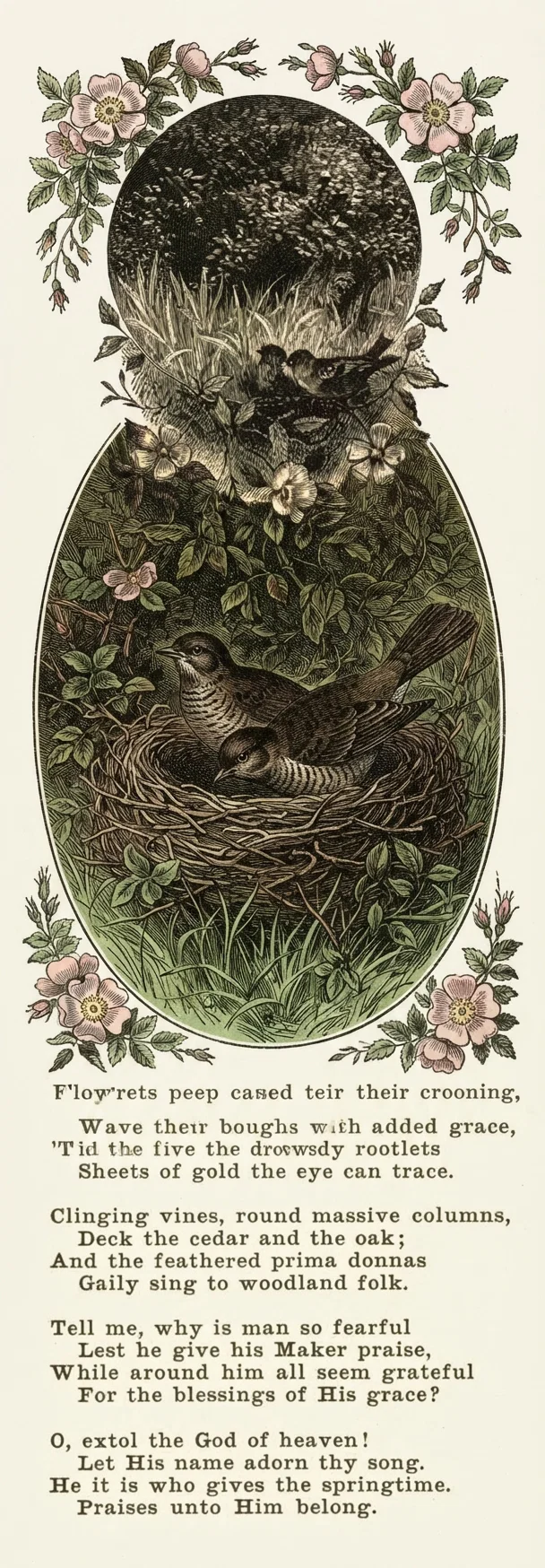
Spring
Spring
By Mabel Corinne Craker
By
Mabel Corinne Craker
Why is Mother Earth so restless?
She is stirring up her bed,
And displays a patchwork quiltlet
From beneath the snowy spread.
Why have brooklets ceased their crooning,
Hushed their drowsy lullaby?
'Tis a lively air they're humming,
Waking countless sleepers nigh.
Flow'rets peep from out their dwellings,
Close, thatch-roofed, and water-proof;
And the liverworts are raising
Their quaint parasols, forsooth.
Those brave sentinels, the pine-trees,
Wave their boughs with added grace,
While above their sturdy rootlets
Sheets of gold the eye can trace.
Clinging vines, round massive columns,
Deck the cedar and the oak;
And the feathered prima donnas
Gaily sing to woodland folk.
Tell me, why is man so fearful
Lest he give his Maker praise,
While around him all seem grateful
For the blessings of His grace?
O, extol the God of heaven!
Let His name adorn thy song.
He it is who gives the springtime.
Praises unto Him belong.
Immortality Universally Desired
By E. HILLIARD
Do We Have It by Nature?—What We Receive at the Resurrection—Will a Merciful God Eternally Burn the Wicked?
By E. HILLIARD
THE word "immortal" is defined by Webster as follows: "Having unending existence; exemption from death; not mortal."
Exemption from death is what every sane person desires. All, naturally, have a dread of death. The cold, dark tomb, where the body crumbles to dust and the victim rests in unconscious slumber, holds the human family in abject fear.
It is through Christ, the first-fruits of them that slept, that we have the promise of the resurrection. "The dead in Christ shall rise first." This promise removes the dread of the tomb from those who believe the word of God. "For if we believe that Jesus died and rose again, even so them also which sleep in Jesus will God bring with Him." 1 Thess. 4:14.
DELIVERED FROM FEAR OF DEATH
Christ clothed Himself in sinful flesh, that He might pass through the tomb, and thereby "deliver them who through fear of death were all their lifetime subject to bondage." Heb. 2:15.
If it be true that the souls of men are immortal, and pass directly to heaven when the breath leaves the body, then we might covet death rather than life. Death, in such case, would be our best friend. But the Bible teaches the contrary. It says, "The last enemy that shall be destroyed is death." 1 Cor. 15:26. Anything that deprives us of life is our enemy. If Christ had not brought immortality within the reach of man, through the gospel, death would be an eternal sleep. But thank God that through the plan of redemption, death is to be abolished. 2 Tim. 1:10.
Immortality was promised to man on condition of obedience. Adam disobeyed, and therefore could not transmit to his posterity immortality, for he did not possess it. Had not God sacrificed His Son, there would have been no hope for the transgressor. This great, wonderful sacrifice was made that death might be swallowed up in victory.
A BARRIER AGAINST SPIRITUALISM
There are many who do not seem to understand the nature of man and his condition in death. The Lord does not want us to be ignorant concerning our dead. Paul says, "I would not have you to be ignorant, brethren, concerning them which are asleep." 1 Thess. 4:13.
A correct knowledge of the condition of man in death will prove a barrier against the inroads of Spiritualism; for that whole superstructure is built upon the doctrine of inherent immortality. The Scriptures teach us that the dead are asleep in the tomb, therefore they can not appear in spiritualistic seances. Those who purport to be our departed friends, are but the personification, by evil angels, of those whom we knew and loved in life.
This representation is a clear-cut counterfeit; for David declares of man, when he departs this life, that "his breath goeth forth; he returneth to his earth; in that very day his thoughts perish." Ps. 146:4. His son Solomon testifies to the same. He says: "The living know that they shall die: but the dead know not anything. . . . Their love, and their hatred, and their envy, is now perished." Eccl. 9:5, 6. Such texts of Scripture ought to leave none in ignorance concerning the dead. It is the soul in man that thinks and knows in life, that ceases to think and know in death. It is the intelligent man—the real man—instructed by the divine word of God, that knows when death takes place. He becomes unconscious, and not his body, which knows nothing in life or death.
THE RESURRECTION AND THE CONSCIOUS DEAD
The belief that the souls of men depart at death, the righteous to heaven, and the wicked to hell or some intermediate place, has relegated the doctrine of the resurrection to the background, and is largely responsible for the silence that prevails upon this subject, so clearly set forth in both the Old and the New Testament.
The martyr Tyndale, in defending the doctrine that the dead sleep, declared to his papist opponent: "Ye, in putting them [departed souls] in heaven, hell, purgatory, destroy the argument wherewith Christ and Paul prove the resurrection. If the soul be in heaven, tell me why they be not in as good case as the angels be. And then what cause is there of the resurrection?"
Of course, if the soul departs to heaven or hell at death, there remains no cause for a resurrection. This is patent to all, and is the fundamental reason for the silence from the pulpit upon this doctrine. Dr. Adam Clarke said concerning the resurrection, "There is not a doctrine in the gospel on which more stress is laid; and there is not a doctrine in the present system of preaching which is treated with more neglect."
"IF THERE BE NO RESURRECTION"
Paul declared that "if there be no resurrection of the dead, then is Christ not risen: . . . then is our preaching vain, and your faith is also vain. . . . Then they also which are fallen asleep in Christ are perished." 1 Cor. 15:13-18. Now if for four thousand years the souls of the righteous had gone directly to heaven at death, how could the apostle truthfully have said that if there is no resurrection, they "which are fallen asleep in Christ are perished"?
THE FALSE SUPPRESSING THE TRUE
It is evident that when a false doctrine is promulgated, and almost universally accepted, it leads to the suppression of true doctrines, and also breeds other false teachings. He who believes that man is naturally immortal, must, to be consistent, deny the resurrection, and also hold to the repugnant, unreasonable, anti-Scriptural dogma of eternal life in misery; for if man is now in possession of an "unending existence," the sinner must writhe in the flames of hell forever. Let us thank God that we are not naturally immortal, but that immortality is the gift of God, to be received at the resurrection of the just.
WHAT ABOUT THE WICKED?
Adam was barred from the tree of life, after his disobedience, "lest he put forth his hand, . . . and eat, and live forever." Gen. 3:22. What a blessing to the human family that the tree that perpetuates life was guarded by the flaming sword! This was done that there might not be, in all of God's universe, an immortal sinner. Our heavenly Father was too kind to immortalize sin, and then torture, to all eternity, its victims.
It is true that He is also a God of justice, who will by no means clear the guilty. Such can clear themselves through repentance, confession, and faith in Christ, during the probationary period; but if found in sin in the final day, they will be punished327according to their works, and then destroyed. "All the wicked will He destroy." Ps. 145:20. "The transgressors shall be destroyed together." Ps. 37:38. "The day that cometh shall burn them up, saith the Lord of hosts, that it shall leave them neither root nor branch." Mal. 4:1. "And they shall be as though they had not been." Obadiah 16.
NO CLAIMS ON GOD
The wicked who reject proffered mercy until they pass away in their iniquity, will have no claims upon a merciful God at the resurrection of the unjust. To say that God will plunge them into eternal misery in a burning hell, would be a shameful impeachment of His character of mercy and love. Is God a tyrant? Are the blasphemous shrieks of the wicked to ring in the ears of the redeemed saints, and the ears of the Lord of hosts, to all eternity? Must all heaven listen to the screechings of demons for countless ages?—No, never! Such, however, would be the case if man were naturally immortal—in possession of an unending existence.
THE TIME OF CHARACTER FORMING
At the coming of our Lord to bestow immortality upon His faithful people, their characters are not changed. Character is formed, through Christ, in the mortal body, and remains the same. Immortality pertains to the body, and is put on at the resurrection, in the twinkling of an eye. 1 Cor. 15:51-54. The saints then, with their bodies changed from mortality to immortality, will enter heaven, to dwell forever in the presence of God. They will be continually advancing in the knowledge of their Creator and Redeemer.
Blessed day, indeed, when the last great trump shall reverberate throughout this lost dominion, calling forth the dead, who for centuries have slept in the tomb, to life and immortality. Then will he who through Christ has sought, by patient continuance in well-doing, for glory, honor, and immortality, realize the full fruition of his hope. Then will King David arise in the likeness of his Lord, and "be satisfied." Who is there in this vale of tears but that longs for the dawning of that day, when disease and death will be abolished? All who love their Redeemer can but say, Hasten on, glad day of deliverance.
World's Fairs
By Robert S. Fries
One of the Greatest Held 520 Years Before Christ
By ROBERT S. FRIES
THE opening of the Panama-Pacific International Exposition is set for February, 1915, and the accompanying photograph shows the front of one of the buildings that are nearing completion.
ENTRANCE TO MACHINERY HALL, PANAMA-PACIFIC EXPOSITION — THE WORK IN PROGRESS
The view includes part of the main entrance to the Machinery Hall, which is nearly finished. Some idea of its size may be had by comparing the wagon driving through the door, with the height of the columns flanking the entrance.
We may think that international expositions are products of our modern civilization; but as Solomon says, "There is no new thing under the sun."
The prophet Daniel, speaking of the four kings that should reign on the Persian throne, says, "The fourth shall be far richer than they all." Dan. 11: 2. This was Xerxes the Great, spoken of in the Bible as Ahasuerus, whose kingdom extended "from India even unto Ethiopia." Esther 1: 1.
The book of Esther tells how Xerxes decided to show "the riches of his glorious kingdom and the honor of his excellent majesty" by holding the first world's fair in the history of man.
With the wealth of the world at his command, the king held an international exposition that compares more than favorably with the ones of the present day. The glory of that world's fair has not been surpassed by its modern prototypes.
This first international exposition was held at Shushan, the capital of Medo-Persia, in the year 521 B. C. That it was not a small affair is shown by the statement that it took six months for the people to see all the exhibits from the different parts of the kingdom.
The climax in the display of the riches of the king was the great feast given in the palace of Xerxes. Thousands of sightseers from different parts of the world were invited. No one was barred. The banquet was given "both unto great and small."
Even the couches on which the guests reclined as they ate and drank, were "of gold and silver"; and notwithstanding the multitude who accepted the king's invitation, the account states that the cups from which wine was drunk were all of gold of different patterns.
"And the drinking was according to the law; none did compel." This shows that there must have been some "white ribboners," who refused wine, even in those days.
After reading the account of this first world's fair, we can appreciate the wisdom of Solomon, who said, "Is there anything whereof it may be said, See, this is new? it hath been already of old time, which was before us." Eccl. 1: 10.
"What Is Wrong with Our Colleges?"
By F. D. Starr
THIS is the heading of an article in the Review of Reviews for April, 1914. Statements made in this article indicate unmistakably that leading educators see there is something wrong in the colleges and universities.
Speaking of wrong ideals and wrong standards that have been finding their way into these institutions, one writer says:
"We had indeed gone far towards making social and athletic Chautauquas of what should, indeed, be institutions of learning. . . . A youth with lanky legs or good wind was a hero, whereas another with intellectual ideals and with the faculty of hard mental work was an 'old maid.' Our A. B. more and more became an empty bauble, an unmeaning, nondescript thing."
Woodrow Wilson is quoted as having said, in 1907:
"You know that with all our teaching we train nobody; you know that with all our instructing we educate nobody." "Some things discipline the mind and some do not. Some things are difficult and some things easy; and nothing so disciplines the mind as that which is difficult."
The article closes with a very suggestive statement of what constitutes true education:
"We desire strong and vigorous bodies, not with the avowed purpose of becoming professional acrobats, but for all the contingencies of coming life. So the training of our mental bodies is for all the contingencies of coming life,—the higher and leading forms of life and labor. We must return from the scattering and the dilution of these last decades to these simple but essential truths."
It would be well for parents, and all who have the responsibility of providing education for youth, to look about to find schools where "simple" and "essential truths" are taught. We may thank God that there are some schools of that kind. We will not select the school where football, or some other barbarous sport, has a conspicuous place, and the "youth with lanky legs or good wind" is counted a hero, to the disparagement of useful and intellectual pursuits.
The Lord "taketh not pleasure in the legs of a man. The Lord taketh pleasure in them that fear Him." Ps. 147: 10, 11. Instead of patronizing institutions where empty baubles may be obtained, but where training and education in the essential truths and duties of the present time are not to be expected, how much better to select a school where the fear of the Lord, the beginning of wisdom, is the motto in every endeavor!
F. D. STARR.
Education's Weakness and Strength
By Sunday School Times
TRAINING of the mind never strengthens a man's moral character. "The greatest failure is an educated failure," a philosophy teacher has said. Sin and education can, and often do, go hand in hand to unreckoned limits. And the reason is that the overcoming of sin is never possible to the natural man, no matter how highly educated he may be. It is possible only to God; and God works this overcoming of sin only in such human lives as have, by receiving Christ as Saviour, let the Spirit of God bring to birth a new life, even the life of God, where only the natural and hopelessly sinful life existed before. Then education can indeed come into its own with mighty results, as God intended. With Christ as our sole moral strength, it is our duty to put into His service all the education that He makes it possible for us to gain.—Sunday School Times.
THE MASTER'S USE OF THE WORD
By L. A. R.
Satan Quoted Scripture to Christ—The Purpose Was to Deceive—The Lord Quotes a Text That Exposes the Satanic Interpretation—Principles of Interpretation Thereby Made Plain
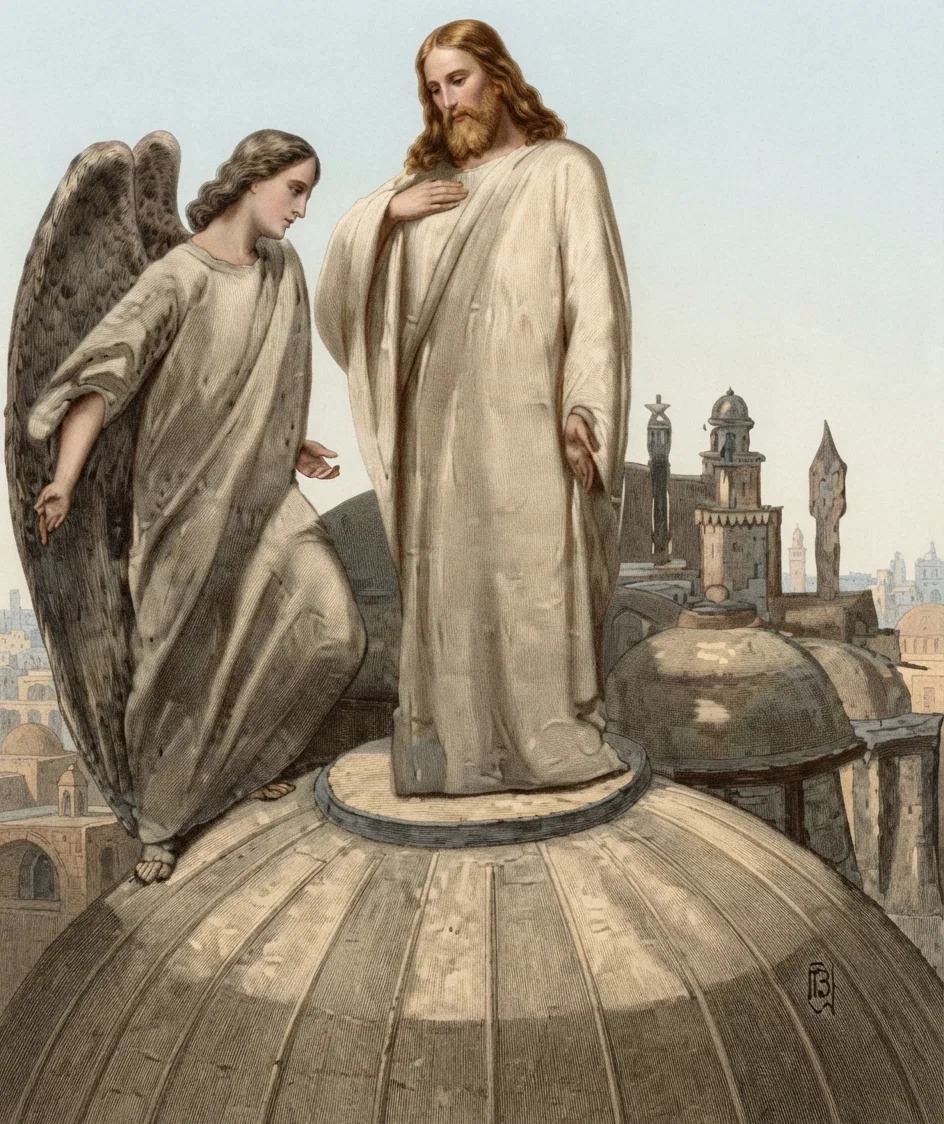
WHEN seeking to tempt Christ, the devil deliberately quoted Scripture to sustain a false position. He suggested that Christ cast Himself down from the pinnacle of the temple, by way of asserting His inherent divinity; and to sustain this evil suggestion, he repeated the scripture, "He shall give His angels charge concerning thee: and in their hands they shall bear thee up."
SATAN'S PRESUMPTUOUS SUGGESTION
God never gave the promise for any such presumptuous conduct as Satan suggested that Christ take at this time. So the verse is entirely perverted as the evil one quotes it. He presents it as an evidence that presumption would be proper, and that God's care would be continued under the circumstances suggested. This was a lie, an entire perversion of the intention of the promise.
Every promise of God is upon conditions, and these conditions are plain and explicit. If one violates the conditions of the promise, he thereby forfeits the promise. It is just as Jesus said,—that it is not he who says, Lord, Lord, that shall enter the kingdom of heaven, "but he that doeth the will of My Father which is in heaven."
THE CONDITIONS MADE PLAIN
In this particular promise which Satan quotes, we have the condition very plainly laid down: "Because thou hast made the Lord, which is my refuge, even the Most High, thy habitation, . . . He shall give His angels charge over thee, to keep thee in all thy ways." "Because he hath set his love upon Me, therefore will I deliver him." And the very first verse of this ninety-first psalm tells who it is to whom God has made this marvelous promise. It is "he that dwelleth in the secret place of the Most High," the one who says of the Lord, "He is my refuge and my fortress: my God; in Him will I trust."
Far different from this trust, this making God a refuge, this dwelling in the secret place of the Most High, this setting the love upon God, was Satan's suggestion that one do a presumptuous act, that which would have doubt in it, that which would question God, that which would see if God would preserve when man goes his own presumptuous, headlong way.
MISUSE OF SCRIPTURE CORRECTED
This misuse of Scripture, Christ clearly corrected; and He shows, to the end of time, the way in which all perversions of Scripture are to be met. When the evil one quotes the Scriptures to sustain his evil principles, his evil suggestions, his rebellious, presumptuous ways, the remedy is, to use the words of Christ, "It is written again." Matt. 4:7. While Satan could find a scripture that, wrested from its context, seemed to bear him out in his evil plan, Christ could find another scripture that struck squarely across the way suggested by Satan.
Satan is still at work giving men scriptures separated from the context, changed from their intention, that seem to bear out the doctrines men desire to teach or believe; but the remedy, every time, is to turn to the other passages of Scripture that throw the full light of God's lamp upon the problem.
"IN THE SPIRIT ON THE LORD'S DAY"
For example, the observer of Sunday will read Rev. 1:10, "I was in the Spirit on the Lord's day," and offer it as an evidence of Sunday sacredness; but there is not in this scripture one whisper of Sunday, and there is not a scripture anywhere that teaches that the Lord's day is Sunday. This text is just as foreign to Sunday observance as the scripture Satan quoted was foreign to the idea he suggested; and the answer to those who quote Rev. 1:10 in support of Sunday is the answer that we get by following Christ's example: "Again it is written," "The seventh day is the Sabbath of the Lord thy God." Ex. 20:10. And "again it is written," "If thou turn away thy foot from the Sabbath, from doing thy pleasure on My holy day." Isa. 58:13. Thus the Bible tells us, as we find the places where "it is written again" that the seventh day is the Lord's day, it "is the Sabbath of the Lord thy God." Ex. 20:10.
CHRISTIAN SCIENCE INTERPRETATION
Another example: The system of religion known as Christian Science, quotes texts of Scripture which seemingly support some of its doctrines. True, some of these quotations have to be only partial quotations, for the whole quotation would deny the statements which Christian Science makes. For example, Christian Scientists love to quote, "Work out your own salvation"; but I never yet knew of one quoting the whole of it.—"Work out your own salvation with fear and trembling." The words "fear and trembling" are absolutely out of harmony with the self-complacency of the Christian Scientist. Nevertheless, they are a part of the text; and wo to him who takes from the word of God, or adds thereto. Rev. 22:18, 19. "I know that, whatsoever God doeth, it shall be forever: nothing can be put to it, nor anything taken from it: and God doeth it, that men should fear before Him." Eccl. 3:14.
"IT IS GOD THAT WORKETH IN YOU"
In quoting the text, "Work out your own salvation," the very scripture that follows it (for here once more we must adopt the example of Christ, and say, "Again it is written"), explains it: "It is God which worketh in you both to will and to do of His good pleasure."
Let us remember that "no prophecy of the Scripture is of any private interpretation"; and when any person sets himself up to give private interpretations of the Bible, he is not following the divine plan. When we discover the scripture that seems to bear a certain construction, we should at once look for other scriptures; for "again it is written." And thus by comparing spiritual things with spiritual, we shall be led by the Spirit into all truth.
SUBSCRIPTION RATES
By Editor
Three months .......................$0.50
Six months ......................... .90
One year (50 numbers) ............... 1.75
With "Questions and Answers" ........ 2.00
With Bible Atlas (maps only) ........ 2.25
With Bible Atlas (maps and text) .... 2.50
With Bible Dictionary ............... 2.50
One new yearly subscription and one renewal, or two new, sent at one time, $3.00.
Two new yearly subscriptions and one renewal, or three new, sent at one time, $4.00.
Three new yearly subscriptions and one renewal, or four new, sent at one time, $5.00.
Five or more copies to one person, six months, each $0.60.
Five or more copies to separate addresses, six months, each $0.65.
Weekly and Monthly SIGNS one year, $2.25.
G. C. HOSKIN, Circulation Manager.
A WORD TO OUR READERS
By Editor
We send no papers from this office to individuals without pay in advance. When persons receive copies without ordering them, they are sent by other parties, and we can give no information in regard to them. Persons thus receiving copies of the SIGNS are not indebted to the office, and will not be called upon to pay for them. Please read the papers you may receive, and hand them to your friends to read.
DATE OF EXPIRATION
The SIGNS wrapper bears date of last issue due on your subscription. Unless renewed in advance, paper stops with expiration date.
If herewith is an order-blank, you will know you have overlooked sending renewal. You will not wish to miss a single issue. Back numbers often can not be furnished.
SCRIPTURE QUOTATIONS
Our authority for the doctrines we teach is the Bible. Quotations are usually from the King James Version or the American Standard Revised.