Public Measures and the Free Individual Conscience
Page 1
The American Sentinel
Nov 25, 1897
Pacific Press Publishing Company · New York · Nov 25, 1897
Public Measures and the Free Individual Conscience
Any public measure that tends to stifle the free sway of the individual conscience, tends to degrade the individual to the level of a machine, and to make him fit only to serve the purposes of despotism.
Some Absolute Certainties.
It is certain that the great majority of people in this world, even in enlightened and civilized lands, are not moving in the pathway of righteousness.
Jesus Christ said that the pathway to life would be followed by but few, but that the way to destruction would be filled with many. If his words are true, it is certain that the many to-day are traveling in the broad way, which leads downward and away from goodness and from God.
And that these words of the Saviour of men are true, is a fact abundantly confirmed by observation. The only ones who can think differently are those who mistake the polish and veneer of civilization for genuine goodness of heart.
It needs only an average election to demonstrate the fact that the majority of the people do not really want good government. If they did, they would eliminate the saloon, which is universally recognized as a curse to society, and with which good government is wholly incompatible. But the people who vote for government without the saloon are usually a small minority.
It is certain that the minority cannot eliminate the722majority from the government. They must, on the contrary, acquiesce with the majority’s decisions.
It is certain that the minority cannot convert the majority by their votes. There is no power in the ballot to reform the heart.
It is a fact nevertheless that the minority,—the good people (assuming all the church people to be of this character)—have undertaken to reform the government, to put righteous government in the place of unrighteous government, by the ballot. And this minority is strong enough to be able to secure a compromise from the worldly majority.
It is certain that such a compromise will be the result of the reform efforts of the minority who represent the church in politics to-day.
This compromise will set up the forms of righteousness without the spirit; for the world has never objected to the mere forms of righteousness. These in fact are useful to world lovers as a means of respectability.
It is certain that a government in which the forms of righteousness are administered by a majority who have not the spirit of righteousness, will not be a righteous government. It is certain that it will be altogether unrighteous.
And it is certain that nothing else than this can be the ultimate outcome of the church in politics, as concerns the government of the United States.
Less State Religion, More Home Religion
LET us have less state religion, and more home religion.
Invasion of One Man's Rights Denies All
WHATEVER invades the rights of one man, denies the rights of all.
Patriotism Should Not Become Idolatry of the State
To be patriotic does not mean that an individual shall make the state his god.
Reverence and Respect for Individual Rights
TRUE reverence cannot exist in the mind that has not learned respect for individual rights.
Secular Education and Free Public Schools
THE secular system of education is the only system that is incompatible with free public schools.
Remedying Social Evils Without Invading Individual Rights
It is useless to try to remedy an evil in society by any measure which invades individual rights.
Parental Influence and the Modern Child
It is a sad feature of our modern civilization that it tends more and more to circumscribe the sphere of the parent's influence upon the child.
Religious Liberty and the Guidance of the Holy Spirit
ANY man who essays to force people in a matter of religious belief and practice, sets himself in the place of the Holy Spirit, to which alone men can safely look for guidance in the religious life.
Conscience and Loyalty to One's Country
No person can be a traitor to his country who has not first been a traitor to his conscience.
On Being True to Thine Own Self
“To thine own self be true,
And it must follow, as the night the day,
Thou canst not then be false to any man.”
What Is the Christian's True Patriotism?
WHAT is the patriotism of the Christian? Is it love of country? If so, then of what country? Is it of that country which Abraham and the faithful worthies of old sought, as mentioned in Hebrews 11? That, and that alone, is the Christian’s country.
Publisher's Notice on Unsolicited American Sentinel Copies
By Editor
The American Sentinel is published in the interests of religious liberty—Christian and Constitutional.
Any one receiving the American Sentinel without having ordered it may know that it is sent to him by some friend. Therefore those who have not ordered the Sentinel need have no fears that they will be asked to pay for it.
(Entered at the New York Post-office.)
Teaching the Pagan Conception of the State.
In Carnegie Hall, New York City, on the morning of Sunday, the 14th inst., an assembled congregation listened to a seriously uttered plea by the president of the Society of Ethical Culture, Felix Adler, to put the state in the place of God. The subject of Mr. Adler’s discourse was, “What has religion done for civilization?” and in concluding his remarks he said:—
“Religion has aided civilization, then, by raising the standard of morality, and it has done this by personifying its ideas. But now the personification is going. Men are gradually passing from the belief in a personal God. What shall take its place? In the passing of the belief in this personification, men’s lives have become flexile and dry, because they have no longer a personal God. Their ideals are gone. What course remains open to them? They may go back to the fountain head of these ideals. They may remember for what those ideals stood. They may try to lead the good life. They may have the reality back of the ideality. They may have the knowledge of the reality first hand; instead of a second-hand knowledge of the personification.”
“This course presupposes a perfect race. Ah, friends, we’ve got to advance or sink to the level of the beasts. In most things we have advanced. In morality the most of us remain dunces.”
At this point the speaker made an impressive pause of several minutes’ length, and then continued:—
“I could well stop here, my friends, as my main argument is closed, but I have something else to say, and it may as well be said now as at any time. Religion has done another service for civilization in influencing politics. The first civic state was a religious state. In the old city states the words ‘fellow citizens’ had a different meaning from what they have now. ‘Fellow citizens’ then meant those who worshiped the same God, for each city had a god. Later, we remember that the idea of the king was that he was sacred; that he ruled by divine right.”
“To-day we care nothing for kings. I fear we are losing our care for the state. In the old days the state was for the common weal. Each sacrificed something for the other. In the moral night that fell upon the city after the late election, we may think that men care nothing for the state. The morning after election I met persons who said they were going to move away from New York. They were the hasty, peevish ones. What we should do is to stay here and learn a holier feeling for the state. Let politics take the place of religion. If we care nothing for kings, let us devote ourselves to the state. In the state let us find the personal deity which is passing out of men’s lives. Let the state be the object of our worship. Let us make it sacred, and when we have done so, the state will have taken the place of the personification. Let the state be that personification.”
This proposal to deify the state is of course nothing less than pure paganism, out and out. In itself, as the outspoken plea of a teacher of modern ethical culture, it is significant enough. But it is vastly more so in view of the circumstances and conditions in which it finds support. “Men are gradually passing from the belief in a personal God.” Candid observation confirms the truth of this statement; and for those of whom it is true the deification of the state cannot be an altogether strange and illogical measure. For it is human nature to deify something; and the state, more readily perhaps than anything else in the present age, furnishes the ideals which human nature is prone to worship.
“Let politics,” said the speaker, “take the place of religion.” Here again, the proposal to deify the state finds support in the tendency of the times. For it is a well-observed fact that politics is taking the place of religion, not only in the home, but in the pulpit. It is being taught that “Christianity is essentially political”—as was said by Rev. C. P. Mills at a recent Christian Endeavor convention in Massachusetts—and that it is the proper business of the church to “make politics go.” Religious legislation, another marked tendency of the times, constitutes another force working directly to put the state in the place of God. With all these evident facts and tendencies, the idea of deifying the state is in perfect accord. They could have no other logical result.
Do the American people want this kind of a deity? The state as a deity becomes no merciful, loving, and forgiving Father, but an exacting despot. Do the American people prize their liberties enough to repudiate this pagan conception, with the despotism that is inseparable from it?
Eternal Vigilance Is the Price of Liberty
“ETERNAL vigilance is the price of liberty.”
Religion in the Public Schools in Colorado.
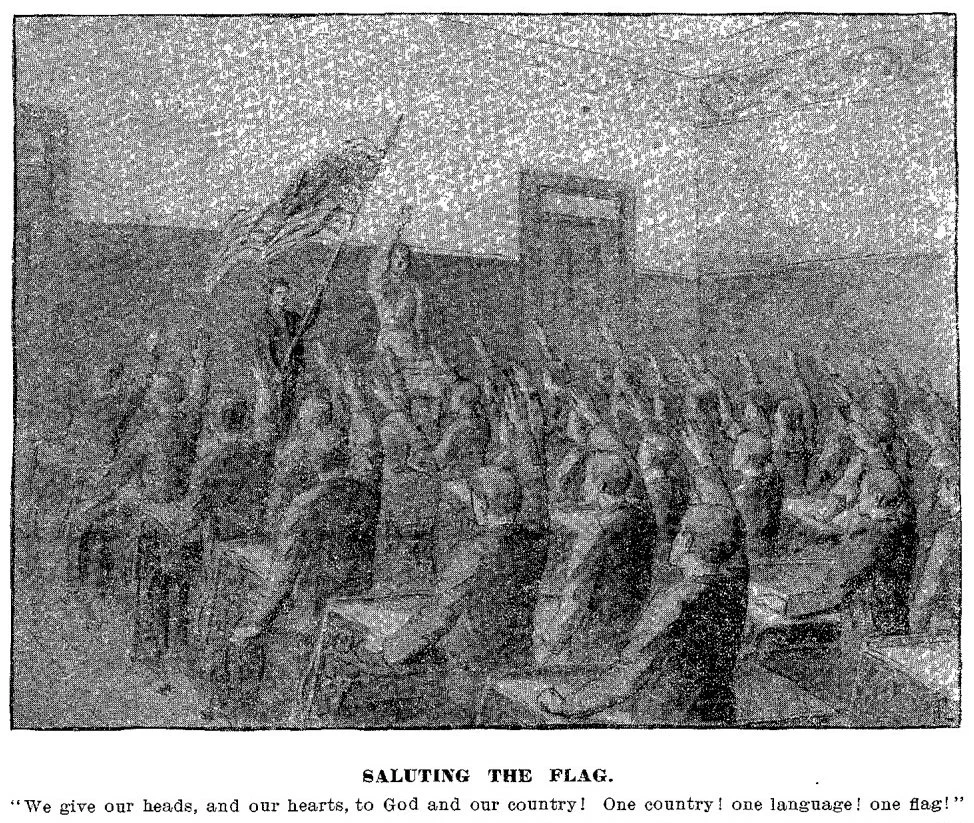
There has been introduced into the school exercises of the public schools of Boulder, Col., by the school board, a feature which is very significant when considered in its relation to the fundamental principles of American government. It is called the “American Patriotic Salute.”
The words of this salute are, “We give our heads, and our hearts, to God, and our country! One country! one language! one flag!”
SALUTING THE FLAG.
“We give our heads, and our hearts, to God and our country! One country! one language! one flag!”
This salute is given by the pupils in a body, standing, and with appropriate gestures. It is delivered facing an American flag, which is held before the school during the giving of the salute by some one chosen as standard bearer. At given signals the pupils rise in their seats extend the right arm toward the flag, then bend it back so as to touch the forehead with the tips of the fingers, and at this point exclaim, “We give our heads;” then as the hand is carried to the breast and laid over the heart, come the words, “and our hearts.” Next the head is thrown slightly back and the arm outstretched, pointing upward; and with the countenance assuming an expression of reverence, the words are uttered slowly and in reverential tones, “to God and our country!” The arm is then dropped to the side, and after a brief pause the pupil exclaims, with emphasis, “One country! one language! one flag!” at the last word extending the arm so as to point directly at the flag; after which the pupil resumes his seat.
This salute is made obligatory upon all the pupils. Those who refuse to give it are suspended from the school; and this action has already been taken in a number of instances.
Let us consider, therefore, for what cause, in reality, pupils are now suspended from the public schools in the city of Boulder, Col.
In this salute the pupil says that he gives his heart to God. Now, no one knowing anything of the requirements of Christianity will deny that giving the heart to God is anything less than conversion. “Son, give me thine heart,” is the invitation of the divine Word by which God would draw the soul of the sinner to himself. He who gives his heart to the Lord, gives himself. The heart controls the life.
It is, therefore, beyond any contradiction, now required by the school authorities of the city of Boulder, that a pupil in the public schools must either profess conversion or be suspended from school!
And this, too, in the face of a provision of the fundamental law of the State, which declares the following (Art. 9, Sec. 8, of the General Statutes of Colorado):—“No religious test or qualifications shall ever be required of any person as a condition of admission into any public educational institution of the State, either as teacher or student; and no teacher or student of such institution shall ever be required to attend or participate in any religious services whatever.”
Beyond all controversy, the act or profession of giving the heart to God is a religious exercise. It is the very essence of religious devotion. It is a matter between the individual and his Creator. Into the sphere of this sacred relationship, comes the State, and with forceful hand assumes to dictate to the individual an act of devotion to God, taking the matter out of the hands of both the individual and God. And into the sphere of the sacred individual rights guaranteed by the law of the State, steps the school board of the city of Boulder, and in plain contravention of that law, compels public school pupils to engage in a religious exercise, under penalty of suspension if they refuse!
Do the pupils in the public schools of Boulder indeed give their hearts to God? They are required to say that they do. If they do not, they are required to utter a falsehood; and that, too, of the most damaging nature. But whether the pupil is sincere or not in his statement,724or comprehends the meaning of what he says, is a question of which the mandate of the school board takes no account whatever. The salute is obligatory upon all, and like any compulsory school regulation, can make no allowance for the beliefs or preferences of the pupils whom it affects.
Will those in favor of this religious requirement seriously claim that all the pupils who are thus made to say each day that they give their hearts to the Lord, do in reality make that consecration of themselves to him which the words imply? Is there any probability whatever, even the remotest, that the pupils of the public schools of Boulder, Col., are all consecrated in heart to the Lord? If they are, they were so of their own free will, and not because they have been made to say that they are; for a form of words has no power to convert the heart. But it is needless to propound the question, for it is perfectly evident that it must be answered in the negative. No; the children who thus say that they give their hearts to the Lord, are, many of them, not converted to God at all. This is absolutely certain. And therefore it is absolutely certain that in the public schools of the city of Boulder, Col., many of the pupils are compelled week after week to utter a falsehood, under penalty of suspension if they refuse!
Do the school board of the city of Boulder believe in God? Evidently they do. What, then, they may well inquire, does God himself think of this “patriotic salute?” Does he take account of such things? Does he take notice when an individual gives his heart to him,—when he does that in truth to secure which God sacrificed his only begotten Son, and poured out all heaven to mankind? Verily, he is well pleased with the gift of the heart of even the poorest and humblest individual on the earth. He is well pleased with the gift of the heart of “one of these little ones.” But how does he regard a profession of dedication to him which is not made in truth? What does he think of a lie spoken upon that point in which centers all his interest in humanity? And what does he think of a school regulation which compels children to utter such a lie before him?
There is a text of scripture which says that it is better for a man that he should be cast into the sea with a millstone around his neck than that he should cause one of “these little ones” to offend. There is opportunity for an application of this text in the city of Boulder.
But this is not all there is in this “salute.” It is a “patriotic salute.” There is the American flag held before them, as an emblem of patriotism, and the school children are required to say that they give their hearts also to “our country.” The gift creates a partnership, in which the parties are God and the United States Government! Can such a partnership be? Would the Almighty for a moment recognize it? Does the Creator claim anything less than the absolute right to the whole heart of every one of the human race? Who will seriously answer these questions in the negative?
If these words mean anything, they mean that the individual gives his life to his country, as he does to God. They mean that he will do as his country desires him to do. But when country calls, it is the government that speaks. The voice of government is taken for the call of country by the vast proportion of citizens. There is, indeed, a vital distinction between them; but it is not recognized by the many. And when the individual says that he gives his heart to “our country,” it may safely be taken as meaning that he stands ready to do the bidding of the government, whatever that may be. Of the bidding of God no account is taken; for the government speaks with an audible command which no citizen can possibly mistake; and having given his heart to the government, he can but feel bound to act as the government directs; and the government is not the mouthpiece of God. So that in the partnership which this gift assumes to set up, it is the government, and not God, that receives what is given.
God and civil government are parties that cannot always proceed in unison. This is because civil government is the creation of finite, sinful men; while God is infinite and altogether righteous. God’s ways are always just. Civil government often does that which is unjust.
God has said, “Thou shalt not kill.” But at the command of the government, the individual who has given his heart to the government, ignoring the command of God, takes his rifle and goes forth to kill as many of his fellow beings as he can. He seems to suppose that in some way the two commands can be harmonized; and feeling bound to obey the command of the government, he leaves it with the government to answer for the rightfulness of his course. He does not stop to ask himself where earthly governments will be in that day when every one shall give account of himself before God for the deeds that he has done in the body.
God has said, “Remember the Sabbath day to keep it holy.” But at the command of the government, men go forth to spend the Sabbath day in shooting down one another in battle.
God has said, “Thou shalt have no other gods before me.” But in the very act of giving the heart to another power than God, the individual chooses another god; for there is no point in worship if it be not supported by obedience. We cannot worship one power and obey another.
And therefore, since it is certain that in some things at least this government will proceed contrary to the laws of God, as all civil governments have since the world began, it is certain that in being required to say that they give their hearts to “our country,” the pupils of the public schools of Boulder, Col., are required to pledge themselves to act, at some time, contrary to the will of God!
Let it not be thought strange that the government should not act in all things in harmony with the will of God. The very nature of civil governments is unchristian. They are selfish, each seeking only its own interests, and that, too, very often, at the expense of the725others. They cast covetous eyes upon possessions that are not theirs. They never forgive an insult, but demand an apology and satisfaction; and if these are not forthcoming, there is war. Or if war does not follow, it is only because the aggrieved party feels too weak to risk the venture. These are facts which no one can dispute. In the very nature of things, therefore, it is not to be expected that civil governments will long act in harmony with the will of God.
And thus, in the light of truths that are self-evident, it is plain to the astonished gaze of every lover of liberty that in the city of Boulder, Col., in this latest year of American progress and enlightenment, the pupils of the public schools are compelled, by the constituted school authorities, to profess religion; to utter, in many cases at least, a direct falsehood; and to pledge themselves to the service of a power that is by nature contrary to God; they are forced to do all this under penalty of expulsion from the schools; and this is done in direct contravention of the provisions of the fundamental law of the State, forbidding any religious test, or forced participation in “any religious services whatever”!
What do the board of public schools of the city of Boulder, Col., propose to do about it? What will the people of Boulder do about it? What will the people of the State do about it? And what will the people of the United States, and of the civilized world think about it? These are things that remain to be seen.
Reverence and Patriotism.
By Editor
WE wish it to be understood that we are in entire sympathy with the desire which many excellent people feel, in this country, for the inculcating of a greater degree of reverence in the minds of the young.
If there is one feature more conspicuous than another in the lives of the youth in this land, it is their fast-growing irreverence for any power and authority higher than themselves.
It is perfectly proper that the situation should be viewed by good people with genuine alarm. The spirit of irreverence is essentially the spirit of lawlessness. It is certain that it bodes no good, but great evil, to the future welfare of society and the prosperity of the nation.
Something ought to be done, and that as speedily as possible, to check the growth of this baneful feature of our modern civilization; which is, indeed, becoming so widespread a feature of that civilization as to constitute a sign of the times. Everything should be done to this end that can be done by all lovers of good government. And unquestionably there is much that might be done by judicious planning and effort.
Our only want of sympathy in all that relates to this matter is with the misconceived—though doubtless well-meant—efforts that are being made to remedy the situation by people whose views are not broad enough to take in the full scope of what it demands. Such efforts do not get down to the root of the difficulty, and by their superficial work only aggravate the evil which they are meant to cure.
Such, for instance, is the effort which finds expression in the “patriotic salute” innovation in some of the public schools, which is noticed at length on another page. For it is not difficult to believe that a desire to inculcate reverence in the minds of the youthful pupils of the public schools is the real motive from which this innovation has sprung. We are heartily in sympathy with the motive; but as we have pointed out elsewhere, we are most heartily opposed to the means through which it is sought to be carried into effect.
The trouble is not one which lies with the public school system of education. It is not one which any change in that system can eradicate. It is an evil which lies primarily at the doors of parents. Parents have not taught their children to be reverent toward the things which can of right command their reverence. They have not conducted themselves in a manner to command the reverence of their children; and the latter have grown up to acquire and use such expressions as “the governor” and “the old man,” in the place of “father.” There can be no real and permanent remedy for the evil until parents take up this long-neglected duty. The influence of the parent upon the child is one which cannot be ignored, and which will produce its effect for good or ill upon the character in spite of any system of public education that can be devised.
The spirit of reverence is essentially the spirit of religion. As this spirit has become lost out of the hearts of the people, in the great spiritual declension of these times, the natural result has been the loss of the reverential spirit by those who should be teachers of reverence to the rising generation.
We are in the great spiritual declension of “the last days,”—of the time when, because of abounding iniquity, the love of many should wax cold. See Matt. 24:12, 13; 2 Tim. 3:1-4. Without religion, there cannot be reverence; and without Christianity, there cannot be reverence for that to which reverence rightfully belongs.
Christianity, and that alone, will reach the root of the difficulty. The wider diffusion of Christianity is the pressing need of the hour. And there is but one way for this diffusion to be accomplished, and that is by faith in the Word of God.
We are also heartily in sympathy with the desire to foster the sentiment of true patriotism in the minds and hearts of the people. But what is patriotism? Is it something which makes people belligerent,—which fills them with the idea that their country can whip any other country on the earth, and with a desire to demonstrate their ability in this line at the earliest opportunity? Is it an altogether selfish sentiment, which ignores right and justice in the endeavor to gain some advantage for the object on which it is bestowed? If it is, then we have no wish to see it fostered; for there is selfishness726enough, and much more than enough, in the world at the present time.
But this is not patriotism in its true sense. There is a sentiment which leads men to seek the welfare of their fellows, regardless of condition, belief, or color, and even of nationality. The Declaration of Independence sounded forth the words of freedom for all the world. And under the system of government for which it stood, the oppressed of all nations found a haven of refuge. Under the operation of the principles of liberty which it enunciates, there arose in a single century one of the greatest nations upon the globe. Cannot the nation continue to prosper under the inculcation of these same principles? Is it not in them that the truest patriotism is to be found?
Let us have a patriotism which reaches out beyond the boundaries of the American continent, even to the afflicted people of other lands; not to seek to kill as many of them as our armaments will enable us to do, nor to cripple the interests of other countries that those of our own may be enhanced; but one which seeks to further the welfare of a sorrow-laden humanity in all lands; and which stands in defense of the God-given rights and liberties of the people, whether at home or abroad.
The Place of Liberty.
By John D. Bradley
BY JOHN D. BRADLEY.
(Concluded.)
LIBERTY is divine, and it is found in Christianity alone. Christ is the great Emancipator, for he was “sent to proclaim liberty to the captives, and the opening of the prison to them that are bound.” “I am the way, the truth, and the life.” “Ye shall know the truth, and the truth shall make you free.” In the language of Bancroft, “The voice in Judea was the first to vindicate religion for the conscience of the individual,” and in vindicating individual liberty on that point, he vindicated it upon every point. He was the living expression of the one law in the universe, the observance of which insures liberty. This one law is the “royal law,” “the perfect law of liberty,” the only charter of equality. “I will walk at liberty, for I seek thy precepts.”
Through Christ alone can the life be brought into conformity with that law, for “without me ye can do nothing.” Therefore, Christianity is the place of liberty; the conservator of liberty; the only source of liberty; “If the Son shall make you free, ye shall be free indeed.” “Stand fast therefore in the liberty wherewith Christ hath made us free.” Here no less than elsewhere “eternal vigilance is the price of liberty.”
When I say that Christianity is the place of liberty, I do not mean that it is the place of a certain kind of liberty, or of a certain phase of liberty. It is the place of liberty in every respect, both spiritual and social. It is the place of all liberty, except the liberty of despotism. Politics do not enter into it, yet it is a fact that without the principles of the Christian religion there can be no political liberty. The measure of freedom that has been enjoyed under any system of government has been exactly in proportion to the influence that these principles have had upon the lives of the individual citizens. Acting upon other principles, their imagined freedom has been made to minister to tyranny, their liberty serving the flesh only as a cloak of maliciousness. It does not alter the truth a particle to make the words of the Master read: Despotism is from beneath; liberty is from above; despotism is of this world; liberty is not of this world.
Nor do I mean that the spirit of democracy is foreign to Christianity. It is not, when it proclaims the equality of man and the principle of government by consent. In this sense Christ has been properly called the first true democrat. The Christian church, in which each member is obedient to the command of the Master, in humbleness of mind esteeming others better than himself, is the only true democracy that can exist. In it there is neither Greek nor Jew, Barbarian nor Scythian, bond nor free, for “all are brethren.” The first is last, and the greatest is servant. Vox populi, vox Dei,—the voice of the people is the voice of God,—was a favorite maxim in the republic of Rome. It is safe to say that there was never uttered a greater falsehood. In the Christian church, conducted upon its original principles, the voice of the people is the voice of God, for “whatsoever ye shall bind on earth shall be bound in heaven, and whatsoever ye shall loose on earth shall be loosed in heaven.”
A community such as would be produced if conducted upon these principles, is described by Longfellow in that beautiful picture of life in the village of Grand Pré:—
“Thus dwelt together in love these simple Acadian farmers,—
Dwelt in the love of God and of man. Alike were they free from
Fear, that reigns with the tyrant, and envy, the vice of republics.
Neither locks had they to their doors, nor bars to their windows;
But their dwellings were open as day and the hearts of the owners;
There the richest was poor, and the poorest lived in abundance.”
It has always appeared to me that Longfellow was here describing the ideal rather than the actual; the ideal becomes the actual only in Christianity.
In conclusion, remember that love is the law of liberty. “Perfect love casteth out fear,” “that reigns with the tyrant;” and “envy, the vice of republics,” has no place, for “love suffereth long and is kind, love envieth not.” This liberty is conferred not by might nor by power; not by the proclamation of consuls and the elevation of the eagle; but by the proclamation of the gospel and the quiet and peaceful influence of the Spirit. It is not found in the storm nor in the whirlwind; but is revealed by the still, small voice. It is my sincere desire that we shall so heed that voice that it may lead us into that soon coming kingdom, where the marks of despotism shall have no place,—where there shall be no more death, nor sorrow, nor pain, for “sorrow and sighing shall flee away, and everlasting joy shall be the portion of the redeemed.”
“Where the Spirit of the Lord is, THERE is liberty.”
Compelling the Youthful Conscience.
By Editor
A NOTICEABLE feature of the situation which has arisen in the public schools of Boulder, Col., in connection with the enforcement of the “patriotic salute,” is the refusal of some of the school children to participate in the exercise because contrary to the dictates of conscience. At least five children have been suspended from the Boulder schools as the result of this effort to inculcate “patriotism.”
In two instances, we are informed, conscience asserted itself in the tender minds of the children in opposition to the commands of both teachers and parents. The innate iniquity of the thing is apparent even to the conscience of childhood.
In one case, upon refusal to participate in the salute, the teacher exclaimed, sharply, “Why do you not salute the flag? are you a traitor?” To which the youth replied: “No; I am not a traitor, but I understand that the flag is an emblem of liberty. Now, if you use it to compel a person to do a thing he does not consider to be right, it is no longer an emblem of liberty.” Another, in reply to a like question from his teacher, said: “I am willing to salute the flag twenty times a day; but as to repeating the words of that salute, there is no power on earth that has any right to compel me to take that oath.” These were good answers, and their force could not but be felt.
A clipping from the Daily Camera (Boulder), of November 9, which a friend has sent us, gives the views of one apologist for this new feature of the school exercises, and among them we note the following;—
“No; a pagan or an infidel in this enlightened age, and in this country, should not and does not get the same consideration as a Christian.”
This is certainly a frank expression, but it is not the sentiment which has been supposed to pervade the American system of government. Such expressions may be only straws, but they show which way the wind is beginning to blow.
As we have said elsewhere, we are not at all disposed to criticise the motives which lie back of the introduction of this “patriotic” feature of the school exercises. Let us have patriotism, and let us have reverence; but let it not be sought to inculcate these by measures which disregard sacred rights, and force children to leave the public schools in order to be true to the dictates of conscience. Such a system has its condemnation written upon its face.
Questions and Answers.
By Fannie Bolton
BY FANNIE BOLTON.
When was the Sabbath made for man?
Answer the question ye who can.
Hear the universe all around
Answering now with terrific sound,
“When the heavens and the earth were finished, then
The Sabbath was made for the sons of men.”
Why was the Sabbath made for man?
Had it a purpose? Was there a plan?
Hear the angels ten thousand sing,
“For a token that Christ is the Lord and King.
It was set apart as an outward sign
Of the rest of the soul in His love divine.”
How was the Sabbath made for man?
Was it by blessing? Was it by ban?
“It was set apart by the blessing of Him
Who commands the worship of seraphim.
’Twas the day of His rest in the love divine,
That all through creation’s works doth shine.”
Who was He who this rest began?
That made a Sabbath of peace for man?
“It was God the Father and God the Son
Who rested in joy when the work was done,
And set the day of their rest apart
As a sign of the joy of God in the heart.”
Who should keep holy the holy day?
“Those who rejoice in their God alway.
Those who believe in a God above
Who looks on his children in tender love;
Those who can keep it as day divine,
Of invisible grace an outward sign.”
What would its keeping be to God,If men enforced it beneath a rod?
And what to him if devoid of awe,
Men kept it because compelled by law?
Answer that question ye who can?
“An insult to heaven, a curse to man.”
Then shall the rest be the rest God saith—
An outward sign of an inward faith?
A jewel that’s chosen to deck the soul,
And not the chain of a forced control?
Master or workman, ye are free
To do the thing that God saith to thee.
Captain Barker Denies Romish Practices on the Oregon
CAPTAIN BARKER, of the U. S. battleship “Oregon,” has communicated to the secretary of the navy a general denial of the story published a few months since by the Herald and Presbyter, and which was widely copied by other journals, in the form of a letter written by a minor officer on the “Oregon” to a “minister of unquestioned standing,” giving an account of certain Romish practices observed on board the “Oregon” on Good Friday, and which, the letter states, were made obligatory upon the crew. The genuineness and truth of the letter seemed at the time of its publication to rest upon the best of authority; but the explicit denial of Captain Barker seems at least equally entitled to credence. We certainly hope the facts are just as the “Oregon’s” captain states.
But the very fact that the letter was so widely credited and copied by other journals affords unmistakable evidence of the extent of Rome’s actual encroachments into the sphere of civil authority. Had there been nothing in the nature of an alliance with the government heretofore, such a letter as the one in question would have been wholly discredited from the start.