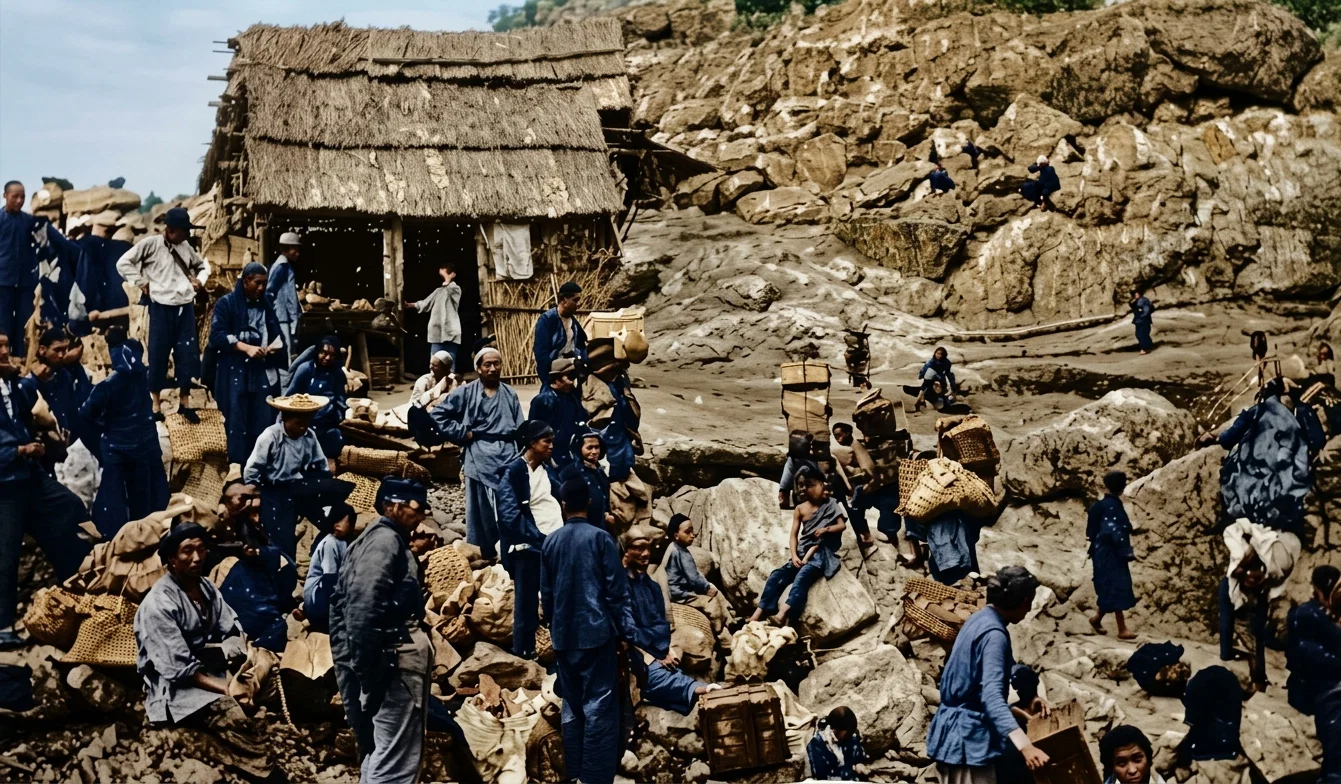
April 6. About 7 A. M. this morning we began to ascend the Shin Lung rapid, which we passed in about half an hour. Now we are over the worst of the rapids, in fact the captain tells us that the others are of no importance. We are indeed glad, for we have seen no less than thirteen wrecks thus far. Nearly all these were boats that were11going downstream. We had hoped to reach Wan-hsien today, but the wind is not favorable. We have not made over twenty-six miles today.
April 7. We arrived at Wan-hsien about 12:30. This city is beautifully situated on the left bank of the Yang-tze-kiang. It is the finest city that we have yet seen in Szechuan. In the evening we anchored at 9 P. M. at a small place called Yang Ho Gi. We have made only thirty miles today.
April 8. About 5 P. M. today we passed a place called Hsi Giai. This is a district that is infested with robbers, owing to the fact that four counties meet here, and, as the magistrate of one county has no jurisdiction over the other counties, the robbers when chased by the police simply cross to another county and are safe. Such is the system that China is still using.
We anchored about three miles above Shi Bao Dzai (Precious Stone Refuge). This is a very interesting place, for here is a massive rock, the top of which is crowned with a series of temples. The only way to get to these temples is to climb the many flights of steps in the nine-story wooden tower which reaches to the top of the rock. This is the most striking thing we have yet seen. The place was originally one of the cities of refuge where the people could hide from any danger that might threaten the community.
We found on climbing this hill that all the idols in the temples had been thrown down and destroyed by the soldiers during the revolution. While at this place our evangelist sold twenty copies of the Chinese paper.
April 9. Today I have an attack of malaria, the first since leaving I-chang. It makes me feel tired, but I am glad it is not severe.
Our boat with men pulling it past a rocky point.
Since leaving the Shin Lung rapid, the river along these stretches is as quiet as a mountain lake. Now and then there is a small rapid, but they are not dangerous. In many places we see Chinese searching for alluvial gold, and the river is now called the Gin Sha, or Golden Sands. However, owing to the crude methods used, they do not make much money from their mining, although they work very hard in their search for gold. Thank God we are in search of better gold, and our prayer is that he will give us the persistence of the Spirit needed to lead Chinese people in finding the souls that are to our Heavenly Father more precious than gold, which will some day perish.
April 10. Friday evening we anchored at a busy market town, called Gao Gia Djen. Here we stayed over Sabbath. How thankful our weary trackers must be for the Sabbath rest. Friday evening was spent in a social meeting held by our second evangelist, Shi Yung Gwei. He brought out some helpful thoughts in the course of his remarks, and my soul was stirred as I listened to his earnest prayers.
April 11. Today we had our Sabbath school on the boat, and then entered the market town, and from the steps of an old temple, now used as a school, we spoke to more than two hundred people. The Lord gave us liberty, and we had good attention. While the evangelist was speaking, I entered the school and asked the teacher's permission to speak to the students. This was given, and I found that there were forty boys and twenty girls in attendance. After concluding my remarks I asked them to repeat John 3:16 after me, which they willingly did. May God's Spirit care for the seeds of truth sown in these young hearts.
Removing our goods after the experience at the Tsin Tan rapid from the boat to a point above the rapid. (The experience here shown is told on page 13 of Review, July 23.)
April 12. We left our Sabbath resting place early. Our trackers are in fine spirits and are the most willing lot of men that I have ever had in China. We hope to reach Chung-king this week. Then we shall get our mail, and have a change in our diet. Our bread is now seventeen days old. It has got moldy several times, but we have held it over the flame of the fire until the mold was burned off. This was our only method, for our oven did not arrive in I-chang in time for us to take it along with us. We are also running short of provisions. However, we have nothing to complain of; for our God has been very good to us.
We reached Feng Tu Hsien about noon. A little below this city is a picturesque mountain about five hundred feet high, which is literally covered to the top with temples and large trees. We spent about an hour looking at the place. Some of these temples are very old, and some of the monuments are said to have been erected more than a thousand years ago. There are more than twenty large-sized temples on the mount. The gods of these temples are said to control the fires of hell. Perhaps in the remote past this place was visited by an earthquake, which may account for the idea that it is the door to the lower regions.
A very peculiar form of worship is noticed in one temple. There are nine large serpents, carved out of wood and painted, hanging from the beams, which receive special worship.
The goddess of mercy is shown in another temple, with a thousand hands and eyes, which represent her ability to see and help those in need. Here, and in other temples, we see thousands of carved feet hanging from the beams of the temples. These have been placed there by women who are said to have been cured by the goddess.
Before the king of Tartarus, Yen Lo Wang, were numerous representations of eyes, hands, arms, feet, hearts, lungs, etc., which had been placed there by those who had been healed in any particular organ by his satanic majesty.
We finally climbed to the top of the last temple, and there saw two celebrated worthies of the Han dynasty seated at a table playing chess. The story is that one of them gave the woodchopper boy, who is intently watching the game, something in the form of a date stone, and the boy became oblivious to time and watched the12game for over two hundred years. At last one of the worthies touched the boy and suggested that he return home. On coming to himself he found that his clothes had rotted away, and that his hatchet was consumed with rust. And further, on returning to his home he found that no one knew him. Thus you see the Chinese also have a Rip Van Winkle.
April 13. We anchored tonight a little above Fu Chow.
April 14. We anchored below the fine pagoda at Chang So Hsien. A few miles below this city we see a Chinese coal mine that is being worked according to Chinese methods. The Chinese miners wear no clothing except a cap, to which they attach a lamp. They have cars with iron wheels, but the cars run on wooden rails. They obtain a good quality of soft coal.
April 15. At evening we reached a town called Mu Tung. We are now within thirty miles of our destination.
April 16. We arrived at the custom station, which is ten miles from Chung-king, about 4 P. M., and by 6:30 we anchored at Chung-king. The long journey of 1,500 miles is now over. It has taken over five weeks to make the journey from Shanghai to Chung-king, Szechuan. That is, it takes longer to go from Shanghai to Chung-king than it would take to go from Shanghai to New York. And yet all say that we have made a quick trip from I-chang to Chung-king. From Mackenzie and Company, a firm which handles nearly all the foreign goods shipped to these parts, we learn that during the month of April they had eight thousand taels' worth of goods damaged, and three thousand taels' worth totally lost by wrecks on this river. (A tael equals about sixty cents.) Fortunate indeed is he whose boat escapes all the perils of this rock-bound river. Personally we realize that our safe journey is due to the fact that we have a God that is mighty to save.
Sao Paulo (Brazil) Mission
By John Lipke
JOHN LIPKE
Our last Sabbath was indeed a day of rejoicing for us, because we could baptize twenty believers as the first fruits of our work in the town of Santo Amaro, in the state of Sao Paulo. About fourteen have declared their desire to take part in the next baptism, and many others are interested.
We consider this remarkable, because the work has been done in a strictly Catholic town, where other Protestant churches have tried for years to gain a foothold, but could not do so. We were told that even their services were attacked by people of the place. Some of these very ones who threw stones, have attended our meetings. In the beginning, the priest of the place asked the chief of the police to drive us out of town, but he declined. Almost every Sunday the priest thundered from the pulpit against us, giving us as bad names as he possibly could. In private he worked against us, calling the people to the church vestry, and visiting them from house to house. But in spite of all these efforts, the work has progressed in a marvelous way.
Cargo junk, lifeboats, and the Tung Ling Rock, where the German steamer was wrecked. (Description of this is given on page 13 of REVIEW, July 23.)
The Lord, through the spirit of prophecy, has said: “When properly conducted, the health work is an entering wedge, making a way for other truths to reach the heart.” — Testimonies for the Church, Vol. VI, page 327. “The principles of health reform will be received with favor; and many will be enlightened. The influences that are associated with health reform will commend it to the judgment of all who want light; and they will advance step by step to receive the special truths for this time. Thus truth and righteousness will meet together.”— Id., page 379.
We have experienced the truth of the preceding statements in our work here. For the first time in our public efforts in Brazil we have connected the health reform with the third angel's message. I am sure that if it had not been for this, we should have been driven out of the town, or the people would have avoided us after the curiosity wore off, and we should have had no results. Of the twenty baptized and the fourteen to be baptized, only one was a Protestant. All the rest were very devoted Catholics. The priest and his helpers argued that the people should not go to our meetings. The people asked, “Why should we not go? We receive good every time we go.” As a result of our health lectures, many came for treatment, and with the blessing of the Lord, excellent results followed. The people found out in this way that we were their friends and had come to Santo Amaro to do them good. The influence of our meetings has extended far; for from great distances some have come to attend them. One man not belonging to our church has given us a lot for a church building. Another has offered a lot outside of the town. The most remarkable part of it all is that those baptized are mostly of the better class of people, and that there are as many men as women.
As you would perhaps like to know about the method of work we have followed, I will say that in the beginning we held a workers' institute. After the institute our union conference meeting came on. The evening meetings were well attended. One health lecture was given before the close of this conference. But after the union conference the attendance did not drop off, as it generally does when the curiosity of the people is satisfied. The people kept coming, and meetings were held but three times a week, so as to give time in the evening to hold Bible readings in the homes of the interested ones. This we found worked well, for the men were not at home during the day. So on the evenings when we had no meeting we found them at home, and could do some heart-to-heart work. One of the three services during the week was devoted to the consideration of health topics. After the lecture, a demonstration of simple treatments was given on the platform, also lessons in cooking. We are glad that the General Conference sent us two faithful nurses. They do Bible work, treat the sick, and aid in demonstrating treatments and cooking after the health lectures. Besides all this, the town was worked from house to house with tracts, which we lent to the people. From the beginning, we used the stereopticon.
We believe a good work can be done if, in connection with a tent effort, the nurses who do not devote their time to bedside nursing, give treatments and do Bible work, aiding in the tent work, and going from house to house teaching the people.
Two months of this work brought the people to the question of baptism. After the sermon on baptism, we asked them how many wanted to be baptized. More than thirty arose. We then appointed two evenings out of every week for the instruction of candidates. In these meetings we gave a review of the life by faith through Christ. Thus more than two months passed in preparing the candidates for baptism. We went slowly because we wanted to baptize only those who had been well instructed beforehand.
As soon as possible we shall build a church. We are firmly convinced that the method recommended by the Lord through the spirit of prophecy, of combining the teaching of health reform principles with the third angel's message, is the best method to use in bringing souls to Christ. We have decided to follow closer than ever the instruction that the Lord has given us through the spirit of prophecy.
Self-Control and Noble Character
By J. R. Miller
THE key to all noble character is masterly self-control.—J. R. Miller.
As Little Children
By Mrs. Mary H. Williams
MRS. MARY H. WILLIAMS
THE inspired record reads, “And Jesus called a little child unto him, and set him in the midst.” I like to picture that scene: the Master and the disciples, and in their midst a little child. No lines of sin or care on the smooth brow, innocence and trustfulness mirrored in the frank and open eye, while the little, upturned face seems to say obediently, “What wilt Thou?” How characteristic of Christ’s method of adapting the deepest spiritual truths to human understanding! Having come in the flesh to reveal the Father’s great love for his children, he chooses the little child to represent our part in the tender relationship. How often he dwells on the fatherhood of God, as though he would answer the yearning of his own heart along with the helpless cry of humanity!
“Except ye . . . become as little children,”—I want to put emphasis on the little when I think of their simple faith and loyalty, even to an earthly parent. Have you ever witnessed the grief of a little child on learning that it had been tricked by some convenient falsehood? O, the pity of it, that parents should ever destroy that faith, typical of the relation of God’s children to him! But the Father’s words are all true and call for the response of perfect faith; nor will a loyal child remain where his name is lightly spoken.
Obedience follows as a natural consequence of the child’s implicit confidence in the father’s love and wisdom. The little one runs with willing feet to do his father’s bidding; and every parent knows that willing obedience is the only kind worth having. An older child may be so absorbed in his own affairs that he yields at best but a reluctant consent. Our relation of parents to children, and children to parents, may teach us many a valuable spiritual lesson if we but take it to heart.
It is the busy preparation day in the household; and as the mother hurries to and fro with her work, a daughter asks, “Do you want me to help?” The tone plainly says, “I hope you don’t.” Should you be surprised if the assistance were declined?
Neither can God’s children give acceptable service in this conscience-smitten attitude, nor while secretly hoping they will not be called upon to give up their own petty affairs for the work of God’s great preparation day.
“He’pin’ mamma,” lisps the dimpled baby with a happy smile. Perhaps the more experienced members of the household may be annoyed by the bungling attempts; but the mother’s fond indulgence finds only praise for the helpful spirit, as she trains the little one for real helpfulness. Is God less patient or willing to teach? “O, if I could only work in the harvest field!” cries the little lad whose task it is to weed the garden. He thinks of the joy of “bringing in the sheaves.” All unknown to him are the sharp stubbles that would lacerate the tender bare feet, or the heavy bundles that would make his young back ache; but the father knew the scorching heat and the burning thirst to be endured, when he chose men for the laborers. Then should we be unwilling to allow him who gave us our talents to choose our places for us?
Born of the Spirit into the kingdom of grace, becoming as humble as a little child, is the Master’s teaching of the way of life eternal. The grace of true humility is greatly to be desired; for he is not easily offended who does not think of himself “more highly than he ought to think,” nor will he mar his work by attempting to do it his own way. If we possess the docile, teachable spirit of a little child, even the unskilled hand may do acceptable work when the Great Teacher guides and directs it.
A mother with her two children is proceeding down a crowded city thoroughfare. Both cling to her hand at the dangerous crossing, but as soon as it is safely passed the older child snatches away his hand. Perhaps she smiles at the independent spirit, but there is a little heartache withal; and then I think she likes the touch of the clinging little hand. In the pressing throng the older child loses sight of mother, and there is anxiety and delay until he again holds her hand. Even so the work of God and our progress toward the eternal home are hindered because we, his children, do not hold to the guiding hand, or seek it only for the rough and dangerous places.
What pangs of grief the parents suffer when a child becomes wayward and self-willed. Yet in all his perversity, the parent’s love follows the child, yearning to receive him again, willing to forgive. If human love fails in forbearance, divine love still holds out hope to the outcast. “When my father and my mother forsake me, then the Lord will take me up.” Witness the anguish of the Saviour as he stretched out his arms toward Jerusalem! How he longed to save his willful children from the consequences of their stubborn unbelief! In the parable of the good shepherd we see with what infinite tenderness he regards the lambs of the flock. He carries them in his arms, he bears them in his bosom. It is not necessarily the young in years, but the weak and inexperienced, those most likely to fall a prey to the wolves, who are the objects of his special love and care. Years later the disciple who leaned on his breast, like a faithful undershepherd, writes to “my little children” of the love of God.
While we love God supremely and exercise faith, loyalty, and obedience toward him, let us not forget the childlike grace of simplicity in relation to our fellowmen. How the speech of a child commends itself to us for simple directness! No child of God need blush because his unsophisticated mind fails to grasp the jests or slang which are current among worldlings. Wealth of vocabulary or polished phrases cannot clothe nor make presentable an unkind or impure thought; and divine approval is pronounced on him in whose mouth is found no guile.
With what reverence we contemplate the great Creator — his power, his wisdom, his holiness! We are humbled to the dust, and exclaim, “What is man, that thou art mindful of him!” Yet this glorious One whom all the hosts of heaven worship and adore, has taught us to say, “Our Father.” Listen to his promises to his loyal children, who honor his name while here in the enemy’s country: They “shall be like him,” shall “be called the sons of God,” shall be “heirs of God, and joint heirs with Christ;” and O, crowning honor! they shall see his face and in their foreheads bear his name.
Charles City, Iowa.
An Answer to Prayer
By M. G. S.
M. G. S.
THE Lord is good. He heard my prayer,
And pitied every groan;
Long as I live and troubles rise
I’ll hasten to his throne.
After listening to the frivolous talk of my unconverted, worldly daughter, of how she would like to have a diamond ring, a certain kind of dress, and be popular14in society, my heart was heavy and my mind disturbed. I told her how alarmed I felt to know that her ambition and her heart were fixed on the perishable things of this world at such a time as this, when the Lord Jesus is preparing to make a short work in the earth.
I sought the Lord, imploring him to give me wisdom to know what to say and do, and how to help her. While I was yet meditating, several scenes were presented to my mind, such as the sinking of the “Titanic,” the earthquake of San Francisco, the tidal wave at Galveston, and the recent floods in which fortunes in finery, such as jewels, clothes, and elegant homes, were destroyed with the owners. In my imagination I could see those doomed people, blanched with terror, as they faced death with no thought of their possessions at that awful moment; and I wished that my daughter could be made to see them as they were presented to me.
It was not long before I had an occasion to say to her, after relating my experience: “My dear, in the case of those very wealthy victims whom death was staring in the face, how much thought do you suppose they gave to their gems, costly raiment, and position? ‘All that a man hath will he give for his life;’ and if this mortal life is so sweet, how should we regard the immortal life?” She seemed thoughtful, but made no reply. The next day she said to me: “Mother, you remember what we were talking about yesterday? Well, I had a dream which I am sure was the result of that conversation. I thought I was on some great thoroughfare and my hands were decked with jewels of all kinds. I saw a great concourse of people moving rapidly, screaming with fear and horror, and as I looked I saw a great cloud of fire rolling toward us and the earth trembling under our feet, making fissures into which people were falling; and we all knew that the end of all things was at hand. I fairly stripped those rings from my fingers and cast them among the debris that was rolling together.” She tried to laugh off lightly the impression it was making on her mind; but I knew that it was an answer to my prayer, and that she would not be able to throw it off as she would an ordinary dream.
Huntsville, Ala.
Conducted by Mrs. C. C. Lewis, Takoma Park, Washington, D. C
By Mrs. C. C. Lewis
Through the columns of this department, hints will be given on all matters pertaining to the home life. Short articles and letters are solicited from home makers, telling of their everyday experiences,—their joys and sorrows, their failures and successes.
There Is Always a Way
By Richard Burton
THERE is always a way to rise, my lad,
Always a way to advance;
But the road that leads to Mt. Success
Does not pass by the way of Chance.
It goes through the stations of Work and
Strife,
Through the Valley of Perseverance;
And the man that succeeds while others
fail,
Must be willing to pay most dear.
For there's always a way to fail, my lad,
Always a way to slide;
And the men you find at the foot of the hill
All sought for an easy ride.
So on and up, though the road be rough
And the storms come thick and fast;
There is room at the top for the fellow who
tries,
And victory comes at last.
—Richard Burton.
Discipline in the Home
By MRS. J. L. SHAW
MRS. J. L. SHAW
In the mission field appointed to mothers, comes the encouraging counsel, “If we will open our hearts and homes to the divine principles of life, we shall become channels for currents of life-giving power.” It is therefore very important in the discipline in our homes that we ourselves shall be in living touch with the Source of life and power; for without this our service will be fruitless.
The following instruction will prove an aid in our daily run of service:—
“By gentle discipline, in loving words and acts, mothers may bind their children to their hearts.”—Ministry of Healing, page 388.
“Let the sunshine of love, cheerfulness, and happy contentment enter your own hearts, and let its sweet, cheering influence pervade your home. Manifest a kindly, forbearing spirit; and encourage the same in your children, cultivating all the graces that will brighten the home life.”—Id., page 387.
“A word of caution or reproof spoken at the right time will be of great value. By patient, watchful love she can turn the minds of the children in the right direction, cultivating in them beautiful and attractive traits of character. Mothers should guard against training their children to be dependent and self-absorbed. Never lead them to think that they are the center, and that everything must revolve around them.”—Id., page 389.
“Some mothers are not uniform in the treatment of their children. At times they indulge them to their injury; and again they refuse some innocent gratification that would make the childish heart very happy.”—Id., page 390.
“Rule your children with tenderness and compassion, remembering that ‘their angels do always behold the face of my Father which is in heaven.’”—Id., page 394.
“Home should be a place where cheerfulness, courtesy, and love abide: and where these graces dwell, there will abide happiness and peace.”—Id., page 393.
While in South Africa my father sent me, soon after my mother’s death, her scrapbook, which contained among its treasures some “Rules for Mothers” and suggestions for home education. I can certainly say that my own dear mother fully practiced these principles in her home training. I can distinctly remember how she sought the Lord’s help in her “bower of prayer,” a room that was set aside for communion with God. I remember one instance in particular. I had deceived mother. She first went away and prayed in her accustomed place. Then she took me with her and read from the Bible how God regarded this sin, and then together our hearts sought help and forgiveness from a dear, loving Father. This was the only time I ever received a whipping from my mother, and it was with tears and anguish of heart that it was given. This experience was so indelibly impressed upon my mind that I never willingly deceived my mother again.
I pass on the following rules from my mother’s scrapbook, hoping they may be an inspiration to some other parent:—
Rules for Mothers
“1. First give yourself, then your child, to God. It is but giving him his own.
“2. Always prefer virtue to wealth; the honor that comes from God to the honor that comes from men. Do this for yourself; do it for your child.
“3. Let your whole course be to raise your child to a high standard. Do not sink into childishness yourself.
“4. Give no needless commands; but when you command, require prompt obedience.
“5. Never indulge a child in cruelty, even to an insect.
“6. Cultivate sympathy with your child in all lawful joys and sorrows.
“7. Be sure you never correct your child until you know it deserves correction. Hear it first and fully.
“8. The knowledge and fear of the Lord are the beginning of wisdom.
“9. Never mortify the feelings of your child by upbraiding it with dullness; but do not inspire it with self-conceit.
“10. Pray with and for your child often and heartily.
“11. Encourage all attempts at self-improvement.
“12. Never deceive, nor break a promise to a child.
Rules for Home Education
“1. From your children’s earliest infancy inculcate the necessity of instant obedience.
“2. Unite firmness with gentleness. Let your children always understand that you mean exactly what you say.
“3. Never promise them anything unless you are sure you can give them what you promise.
“4. If you tell a child to do anything, tell him how to do it, and see that it is done.
“5. Never let your children see that they can vex you, or make you lose your self-command.
“6. Never smile at any of their actions of which you do not approve, even though they are somewhat amusing.
“7. If they give way to fretfulness and temper, wait till they are calm, and then quietly reason with them on the impropriety of their conduct.
“8. Remember that a little present punishment when the occasion arises, is much more effectual than the threatening of a much greater punishment should the fault be renewed.
“9. Never give your children anything because they cry for it.
“10. On no account allow them to do at one time what you have forbidden under the same circumstances, at another.
“11. Teach them that the only sure and easy way to appear good is to be good.
“12. Accustom them to make their little recitals the perfect truth.
“13. Never allow talebearing.
“14. Teach them that self-denial, not self-indulgence, is the appointed and sure method of securing happiness.
“15. Above all things, instruct them from the Word of God, taking Jesus for their example of patience, meekness, and love, teaching them to pray as they grow up as the only preservative against error, weakness, and sin.”
Takoma Park, D. C.
Wesley’s Training of Children
IN regard to the training of children, the mother of John Wesley said: "First and foremost, the will of the child must be subject to the parents' control, because this is the only strong and rational foundation of a religious education, without which both precept and example will be ineffectual."
Wesley Family Rules for Children
In the family of the Wesleys it was a rule, not to be modified in any case, that no child was to have anything it cried for. Likewise it was useless to expect a permission once denied, to be granted because teased for.
Weakness in Character
“A MAN is no stronger than the weakest point in his character.”
New Life in Jesus
By N. W. VINCENT
N. W. VINCENT
Christ is the hope of fallen man,
He saves from wrath and sin;
Christ can atone, and he alone;
Through him we heaven win.
God’s gifts are we to his dear Son;
When contrite we believe,
Though all undone, with merit none,
We his free grace receive.
Christ is our strength to do his word,
To walk in wisdom’s ways;
Baptized we show to Christ we owe
Our life, a life of praise.
In prayer by faith to him we come,
His Spirit’s help we share;
Born of his word, what we have heard
To others we declare.
Christ bears us up above earth’s strife,
Our refuge, boast, and joy.
He helps us win dear souls from sin;
We thrive in his employ.
We daily pray for friend and foe;
Our Saviour we adore;
In him we grow, his virtues show,
Praise Christ forevermore.
Caney, Kans.
Home Missionary Report
By E. M. GRAHAM
This report shows an encouraging increase in the amount of work reported. Forty-five of the sixty-nine conferences in the North American Division are represented in this report, and two union conferences, the Southeastern and the Northern, show every conference as reporting. We are glad to see the Massachusetts Conference represented this quarter, because it was in that part of the field that this home missionary movement was first started. It is good to see that the old-time missionary spirit still lives there.
This report has grown into large figures, and as I look upon them I see, not merely figures, but that which they really represent16—channels through which the Holy Spirit may reach souls. The Lord has so planned the work of salvation that it is done through human agents. On one side is the Holy Spirit, waiting to impress hearts with their need of a Saviour, and on the other side are perishing sinners, longing for such a Saviour. The Lord is pleading with his people to become the connecting links between these two, and so open ways for the Holy Spirit to do its work upon hearts. When we remember that each of these figures means a channel opened by which at least one soul may be reached, and probably more than one, we cannot but rejoice when we see so many of them. We know that every channel opened does not mean a soul saved, but it does mean a soul warned and given the opportunity of being saved.
The report of the European Division is an excellent one, but would have been even better had the Scandinavian Union not failed to get its report in on time. In view of the sudden outbreak of war, we are sure that our European believers are thankful they circulated so much literature while they still had opportunity to do so. Their opportunities now will be greatly cut down, and what they do will be done amid difficulties and privations of which we have no conception. We should take warning by this, and push our work forward as rapidly as possible in all countries that are still at peace, for how long peace will continue no one can say.
The South African Union appears in this report for the first time, and shows that a good beginning has been made. The Asiatic Division has added two fields this quarter, Japan and the Philippine Islands, and it is good to see that the message creates the same missionary spirit in the hearts of these Eastern people as it does in the Western lands.
While we rejoice in this large array of figures, we sorrow that there are not many more of them. Compare the membership with the number reporting and see how many idlers there must be in the ranks, even allowing for some who work but neglect to report. In the armies of the world which are calling their men into service, those who do not at once respond are considered traitors, and if caught, are given no mercy. What are those who have enlisted in the army of the Lord but are taking their ease in this time of strenuous warfare with the enemy of souls? This is a serious question, for “there will be no idler, no slothful one who neglects the work of the Lord, found inside of the kingdom of heaven.” — “An Appeal to Our Churches,” page 13. Men are rushing from the ends of the earth to battle for their countries. Should not Sabbath keepers everywhere show equal enthusiasm in the service of the Lord? Shall we not all unite in making the next home missionary report a far larger one? The night comes on fast, when no one can work.