Your ShelfYour Projects

Review and Herald, Vol. 93, No. 21.

Starved into the Work
Earlier text: The Haverhill Riot

Progress in Manchuria

BERNHARD PETERSON
It is with grateful hearts that we note the steady progress in our work among the Manchurian people. A little more than a year has now passed since we began public effort in the city of Mukden. At that time we had but an imperfect command of the Chinese language, having been in China only a little more than a year; but our trust was in God, that he would make up for our inefficiency, and truly he has not disappointed us. We greatly rejoice in being coworkers with him in bringing the glad tidings of a soon-coming Saviour to these benighted heathen, who still worship gods made by their own hands.
Last summer we had the joy of seeing the first converts follow their Lord in baptism, and the first Chinese church in Manchuria was organized. During the last few months a series of public meetings has been conducted in the city of Mukden, and a number are now preparing to go forward in baptism and unite with the church the coming summer. At the present time the meetings are carried on in a rented chapel, but we are planning soon to obtain our own quarters, as near the center of the city as possible, where a continual stream of people pass. We have been offered a large piece of ground at a very low price, but it is not so centrally located as we should like, so we are looking at other properties more favorably located.
We were glad to be able to open two new stations last year, one in the province north of Mukden, and the other about fifty miles south. A letter just received from the brother south of here is very encouraging, as he states that a fair audience is attending his meetings. Last week we had a visit from an elderly man who came from a large city about sixty miles north of Mukden. He had walked all the way, to tell us that there were many in that city who were anxious that we should soon open a chapel there. This was the third time he had come to see us and to make this request. Last summer one of the canvassers went there to sell papers, and now an interest has been awakened. One day we received four letters from that place, urging us to come. We are planning to start our work there soon.
While the Lord is thus opening the way before us, Satan is also busy hindering the work; but we know it will all work out to the glory of God. When an interest had sprung up at the above-mentioned city, a man began to warn the people against us. After warning those in his own town, he started to another large city to sound the warning against us, but on the way his cart turned over, his leg was broken, and he had to go to the hospital. When the Chinese heard about it, they said, “The Lord is in this; he would not permit him to speak against this people.” Shortly afterward the Lord opened the way for us to begin work in that city.
This is not the only place where the Lord is going before us to open the way. Last summer while we were attending the general meeting in Shanghai, a business man came to Mukden from a place about one hundred miles west. He had heard of us and had come to visit us. When he left he was given some literature, which he, with others in his home town, has been studying, and now an interest has sprung up. About two weeks ago he visited us again, and urged us to come to his place soon. We have just received a letter from him, signed also by several persons there, entreating us to come.
And so we could go on mentioning other places where the people are entreating us to come. We are impressed with the importance of selling our literature, for wherever it goes, there is soon awakened an interest, and a call for an evangelist follows. When we look out upon the great field where the Lord has placed us, and listen to the cries for the bread of life, our hearts are made glad that the brethren in the homeland have sent us another family, Brother and Sister Gjording, to help in the work. We were very glad to welcome them to our field, and they are now busily engaged in the study of the language, that they may soon be ready to assist in the work of saving souls for God's kingdom.
Mukden.

Our Training School for South India

G. G. LOWRY
JUST one year ago we landed in India after a furlough of two years at home. It has not been because we have had nothing to report, nor because of a lack of interest, that we have not reported before. The past year has been a very busy one for us, one in which God has blessed in many ways.
Immediately after our arrival we began hunting for a suitable place to open a new station and start our training school for south India. We finally decided that Coimbatore, a town of considerable size, near the mountains and almost in the center of the South India Mission territory, would be a suitable place, as it is quite cool there the year round. We moved to this place the first of March, 1915, and I immediately began scattering literature, and holding Bible readings with those who became interested. We found a great deal of opposition on the part of Christians as well as Hindus. We believe, however, that the seed sown will bring a harvest sometime.
In July we opened our training school. For some years we have felt the need of a school in this part of the field that could take the students who have finished our lower schools and carry them a little farther in their work, and that could also accommodate young people, educated perhaps in other schools, who have just come into the truth, and train them for some line of work in the Master's vineyard. The attendance began with fourteen, but has now reached thirty. All except four of these are Christians, most of whom have been baptized and belong to our mission.
It is our purpose not only to give good, thorough work in the common branches, but to establish them in all points of the truth, keeping ever before them the Lord's work and their duty toward him and their people. To create and keep alive the missionary spirit in their hearts, we have planned to spend the vacations in going to the villages round about us, selling Bibles, tracts, etc., and holding open-air meetings with the people. We have done some of this in the past, and have had some rich experiences. This not only gets the truth before the people, but gives the students some idea of what will be expected of them after they finish their schooling.
During the Christmas holidays I had the privilege of baptizing four of our students and the wife of one of our teachers. Two of the boys baptized are Telugus. They plan to go back to their country during the summer vacation and do colporteur work. The following Sabbath we celebrated the ordinances. The Lord by his Spirit came very near, and we were all strengthened and encouraged for the duties and responsibilities of the new year.

Night School in North India

NEAR the Najibabad station, in north India, we have a night school for the village people, conducted by our Indian workers under the direction of Brother R. P. Morris. This school was started only a few months ago, and more than one hundred within the village claim to have ceased idol worship. On first approach the villagers were distinctly hostile, but today they welcome every effort to help them.

Solusi Mission School Reaches Capacity

The central school of our oldest South African mission station, at Solusi, has reached the limit of its capacity for students, more than one hundred, and is now compelled to turn applicants away. A good work is being accomplished at this place, the influence of the mission extending for many miles around.

Our Greatest Duties

We “God puts our greatest duties nearest to us.”

Make Your Home Beautiful

THERE is a time between the passing of winter and the coming of spring—a brief pause—when the dreariness of this old world, especially around the habitations of men, seems its most prominent characteristic. Last year's leaves, sodden and unlovely, mingled with straw, twigs, scraps of paper, bits of pasteboard, shreds of cloth, and other rubbish, disfigure the fence corners. Tin cans that have outlived their usefulness are scattered here and there, with empty bottles, broken china, and other odds and ends. There is no tint of green on the earth, no hint of spring's revivifying breath in the air. The outlook affects the inlook—and discouragement is apt to creep in. Old sorrows add their weight to later troubles in overburdened hearts.
But it is always a mistake to look on the dark side, and never more so than at this particular season.
“The skies may meet in sadness, The blustering winds may blow, But if our hearts are cheery, There's sunshine where we go.”
The time for every one of us to look persistently on the bright side is the time when things look darkest. The coming days will bring the warming sun and refreshing rain. The bare branches of the trees will be clothed again, the earth will be carpeted with green. Nature will do much, it is true, but let us not leave nature to work alone. Instead of yielding to depression and gloom, get busy with rake and bonfire and rubbish cart. Use spade and fork and muscle until your own little patch of earth is ready and waiting for the beautiful renewal of the coming weeks.
No matter how poor the home, how thin the purse, there are few who cannot have tidy surroundings, and, for a portion of the year at least, make their home and grounds a little reminder of heaven.
A small town in Pennsylvania has become famous for its chrysanthemums, not because large greenhouses are given over to growing these flowers, but because the women of the town love them and care for them,—“look after them,” as they say. Against each house a low, “homemade” framework is built, with removable curtains, where, when the cold weather comes, the plants are protected from the biting frosts. It is said that the beautiful “globes of white, of soft pink, of ivory and lemon and bronze,” raised in these sheltered spaces, fully equal in beauty those of a prominent commercial florist who does a flower business of well toward half a million dollars a year, and who has twenty acres under glass devoted to chrysanthemums alone.
A large amount of money is not needed in order that the home surroundings may be attractive, or that the children may have flowers to brighten their lives and to sweeten their memories when they are older. One of the earliest pictures imprinted on my mind is of a little girl placing sturdy red peonies—very short-stemmed, and innocent of foliage—about the home on a quiet Sabbath morning. Never since that day have those plebeian posies failed to awaken tender memories of that long-past spring and of “grandmother's garden.” So, too, with the spicy perfume of June pinks. They have held their own sweet message since a sunny morning long ago, when my eager fingers helped to place them in welcoming readiness for the coming of a beloved member of the family. So may you, mothers in poor and humble homes, make fragrant memories for your little ones.
Begin now, if you have not already done so, first to “clean up,” then to prepare the soil, and plant, “keep,” and train a few flowers, vines, and shrubs. Let the children help; and both you and they will find happiness and health in this God-appointed work.
MRS. I. H. E.

Flowers and the Children

LORA E. CLEMENT
A tiny little lass of four, with golden “turls” and eyes like the sky, went to town with me one day. Entering a large department store, we passed the flower stand, where long-stemmed roses, fragrant carnations, sweet peas, gay jonquils, modest violets, and shy arbutus nodded and smiled a welcome.
“O-o-o-o!” she cried, enraptured, and the dainty feet fairly danced up the aisle, “tould we buy some of those, and those, and those?” pointing from one to another.
“Well, let’s see if we don’t find something you would rather have,” I suggested, and at last she reluctantly turned away.
Tempting candies and cakes were passed with casual notice. Gay doll babies, resplendent in spring attire, seemed to have lost their charm, and the dimpled little hand that clung to mine pulled persuasively toward the south entrance. A pleading little voice coaxed, “Let’s do back. Do you tink the flowers might all be done?”
And when at last we made our purchase, her cup of happiness was almost full. With a contented sigh she fairly hugged the fragrant blossoms, and murmured as she touched the delicate petals lovingly, “I dest wish I could teep them always!” Later, I noticed the dried-up stalks and withered blooms carefully planted in a window box.
Frequently during the winter, when Margaret came to pay me a call, she chattered of “the darden daddy and me are doin’ to make.” Then one day we saw the first robin, and I heard an excited tap upon my door. A dancing little lady, blue eyes shining, stood outside.
“Tan’t you tum out and see my bul-lubs? They’re tummin’ up to blossom in our yard!”
And sure enough the “darden” had become a reality.
Does a neighbor’s yard tempt our girlie? Indeed! No grass is so soft, no shade so tempting, no flowers so “bootiful,” as those at home. One afternoon I heard her cordially inviting a little friend to “tum over and play.” “Be-tause,” she explained later, “the poor little dirl hasn’t dot any drass or trocuses at her house, and her touldn’t have a dood time there, tould her?”
To a few people all life is dreary and commonplace, but not to the child. He will pick out the brightness that comes his way, stand radiant in a small patch of sunshine, and make the most of it while it lasts. Margaret is not an exceptional child, but she is a merry little girl, laughing, playing, and helping “muver” the livelong day. Often I have wondered if she did not catch this spirit from the things-beautiful in nature which she has been taught to admire and appreciate.
Little people naturally enjoy pleasant surroundings, and the influence of such environment can hardly be overestimated. Isn’t it lots more fun to make mud pies on the green grass, in the shade, than by the roadside in the boiling, stabbing sun? What youngster would not rather hold a tea party or a menagerie, swing, play ball or hobbyhorse, or do almost anything, among grass and trees than anywhere else? Such surroundings must prove a help toward comfort, good nature, and in solving some of the problems of discipline.
And flowers! what yard was ever complete without them! It is not necessary to break the stretch of green, velvety lawn in front, but at the sides and back of the house, there, “when it’s blossom time in springtime,” we may provide for a perfect riot of color all the summer through.
An all-summer bulb bed offers large possibilities. Those that begin the summer—snowdrops, scillas, daffodils, hyacinths, tulips, and puschkinias—must of course be planted in the fall; but there are many bulbs which can be put out in the spring, and continue the procession from June until September. Lilies—regal, white and pink; elegans, red and yellow; candidum, white; canadense, yellow; Henryi, orange; auratum, white spotted with red—will give you this constant wealth of blossoms. Some of these early spring bulbs bloom surprisingly soon after being set out, among them these dainty zephyranthes, often called fairy lilies. If these bulbs are planted about the middle of May, they bloom in two or three weeks. This is also true of the ismene.
“Most people are familiar with calla lilies as house plants, but do not expect to see them in the garden. Of course the common calla is not suited to outdoor culture in the North, but the newer yellow calla (the Elliottina of the catalogues) is a splendid garden flower. The blossoms are a deep golden yellow in color, while the foliage is green, spotted with white in a most peculiar manner. If the bulbs are planted as soon as danger of frost is past, they will flower most of the summer. In the fall they must be taken up and stored in a dry, cool place. At present the bulbs cost twenty cents each.”
Gladioli are now enjoying a growing popularity, and this is well deserved; for if given plenty of sunlight, they will grow in almost any soil. Before the bulbs are put into the ground, they should be soaked for ten or twelve hours in tepid water, as this will greatly increase their rapidity of growth. With cultivation once a week, and plenty of water, there is practically no uncertainty about obtaining a great mass of bloom, and they are unsurpassed for cut flowers, lasting a week or ten days.
Did you ever have a rose bed? Properly made and tended, it is a thing of beauty and of unending joy. “The rose is a universal plant,” and not only grows in some variety in every climate, but lends itself to a greater number of uses than any other flowering shrub. This is especially true of climbers. They may be used to advantage for hedging, and woe to the person, or dog, or cat, or chicken that tries to force an entrance. As a screen, climbing on porches, etc., they serve admirably, for they hold their foliage till frost time. And when they bloom! As a cover plant for old stumps, eyesores that cannot be removed, and fences as well, these modern climbers serve beautifully. There is the American Beauty, American Pillar, and Aviateur Bleriot; and if you do not care for the Crimson Rambler type, try the Dr. Van Fleet, Mary Lovett, Mrs. Lovett, Silver Moon, Purity, Alberic Barbier; or there are a host of others. A neighbor has in his yard an old tree stump fifteen feet high, now covered with an Excelsa rose. “It is a waving mass of green leafage for seven months of the year, and for nearly four weeks carries its bright crimson load of lovely flowers.” So why not plant roses somewhere this spring, and entertain “the queen of flowers” during the summer months to come?
The modern craze for perennials has relegated many of our beautiful annuals to the background. But nothing can steal the charm of a sociable pansy bed in some damp, cool corner. And how the little folks love to look into their bright faces, and gather the velvet blossoms! A yard without a trellis of Aurora Spencer sweet peas misses such a lot of dainty fragrance; and if you plant these, you may have fresh cut flowers on your table every day, without extra expense, all summer. California poppies, “lovely fairy cups of gold; gay-colored phlox; the reliable and ever-fragrant petunias, which bloom incessantly until late autumn; and for late summer the frost-defying aster,—all these will add much to the attractiveness of any yard or garden.
The lure of spring is in the air. Pure joy is running rampant out of doors, and in every childish heart there is an ardent wish, a genuine longing, to “make garden” with father. For the boy or girl with this ambition, the “Mary Frances Garden Book,” published by The John C. Winston Company, of Philadelphia, will prove of absorbing interest. “In the simplest possible words and style, and in the most fascinating kind of story, this book actually teaches the children how to grow their favorite flowers and vegetables—how to prepare the soil, how to plant the seeds, how to plant the bulbs, the names of parts of flowers, how plants grow by fertilization, how to make a hot-bed, what flowers and vegetables are best for their gardens, and gives an outline of each month’s work for a year.” Along with this it instils a love for the beautiful in nature, and an appreciation of plant and animal life.
Added to these things which contribute beauty and interest to home out of doors, we somehow associate with every yard where children thrive, a sand pile, a swing, and a playhouse (if it is no more elaborate than a large packing box) that the children can claim as their very own. Now is the time to begin to plan; “for it’s springtime, and the blossoms whisper to you everywhere.”

Home Life

Conducted by Mrs. I. H. Evans, Takoma Park, Washington D. C.
Assisted by Miss Lora E. Clement
Through the columns of this department, hints will be given on all matters pertaining to the home life. Short articles and letters are solicited from home makers, telling of their everyday experiences,—their joys and sorrows, their failures and successes.

Spring is Here

O MY dear, the world today Is more lovely than a dream! Magic hints from far away Haunt the woodland, while the stream Murmurs in his rocky bed Things that never can be said.
Starry dogwood is in flower, Gleaming through the mystic woods. It is beauty's perfect hour In the wild spring solitudes. Now the orchards in full blow Shed their petals white as snow.
All the air is honey-sweet With the lilacs white and red, Where the blossoming branches meet In an arbor overhead. And the laden cherry trees Murmur with the hum of bees.
All the earth is fairy green, And the sunlight filmy gold, Full of ecstasies unseen, Full of mysteries untold. Who would not be out of door Now the spring is here once more!
—Bliss Carman.

The Child and His Garden

Do not deplore your lack of special training and equipment for training your little ones if you have a tiny spot of earth that they can dig and water and tend. The earth has no terrors for small fingers, as every mother knows. They love to play with it, and in it, and to feel it, soft and warm, beneath their bare feet in the spring. We shall do well to foster this inborn love of nature, direct it into right channels, and help the children to learn, for themselves, a few of the lessons so attractively set forth, with living, breathing, moving illustrations, in the beautiful, wide-open book of nature.
“Show the child a deserted orchard, where lack of trimming has made the trees degenerate into a wild state,” says Carolyn Sherwin Bailey, in American Motherhood. “Weeds choke the roots; the trees bloom in pink splendor, but the apples are gnarled and small. Dead branches keep the live ones from doing their work. Here, again, nature shows how she punishes neglect with death. A garden overgrown with weeds has the same lesson to teach a child, as an uncultivated field.”
“There is a great deal of moral training for little children in laying out a garden, keeping it free of insect pests, and digging out the weeds. If the small gardener is careless in planting his garden paths, if he plants in uneven rows, and sets out shoots and clippings crookedly, every day that the garden grows he will have a more and more vivid reminder of his carelessness. He reaps exactly as he sows; the crooked rows of peas grow more and more crooked; the bent cutting grows into a bent tree. The potato bug that is allowed to remain in the garden breeds until it is almost impossible to eradicate his family. One weed left unpulled, spreads to a hundred.”
“A garden is a very honest place; it teaches a child, every day, the unbreakable law of cause and effect. If the child was careless about sorting his seed before he planted, and bad seeds are dropped in the ground, he loses just so much in his harvest. And this garden honesty is shown conversely as well. No force in life rewards honest dealing so lavishly as does nature; the good seed multiplies into a thousand; last year’s vine, carefully pruned, bears a greater harvest of grapes than it ever did before; and all along the line of exact gardening the plant that is given a chance of free growth is apt to double its buds and fruit. . . .
“A garden is not only an honest place, but a generous place as well. The child should tend his garden for others. He should realize that he is working in order to have something to give to others as a result of his labor. To give a bunch of fresh flowers to some one who is ill or who loves them, or to fill a vase every day for mother; to pack a dainty basket with crisp lettuce and radishes every morning for some one who needs them; or to supply the home table with vegetables, berries, and fruits, is to make a child unselfish and generous.”

A Happy Home

A HAPPY home is the single spot of rest which a man has upon this earth for the cultivation of his noblest sensibilities.— F. W. Robertson.

The Last Call

ISABEL MC INNES
When Jesus to his Father's home Ascended up on high, Two men in shining robes appeared, And to the saints drew nigh.
“Ye men of Galilee, why stand Ye gazing heavenward so? This Jesus will so come again As ye have seen him go.”
The years have swiftly come and gone, And all the signs are here; And now the saints with patience wait For Jesus to appear.
God's messengers to all the world Are hastening to and fro; To every nation, tribe, and tongue, The message now must go.
“Fear God, and glory give to him,” Is sounding far and near. Let all who hear, repeat the cry, The judgment hour is here.
Go quickly, ’tis the Lord’s command; Why stand ye idle here? To cities and the highways go, Proclaim the end is near.
Come, all things now are ready; Bring in the maimed and blind. The Master still is pleading The cause of all mankind.
“How long, O Lord, how long?” The weary pilgrims cry; The answer comes, “Look up, look up, Salvation draweth nigh.”
Behold he cometh quickly, Join in the swelling cry; Let all the earth be lightened With glory from on high.
Port Townsend, Wash.

Seen and Heard in Cuba

CUBA is full of stir and business. The war has created an extra demand for cane sugar, and “sugar is king” in Cuba. In normal times the island claims the largest volume of trade per capita of any country in the New World.
We landed at Santiago, from the Jamaica steamer—Brother J. J. Ireland and I. While he went at once to the auditing work, in the mission office, I accompanied Elders F. G. Lane and A. N. Allen to various places where the work is established.
We then held a week’s workers’ meeting in the central part of the island, where a large building was kindly granted for the purpose by an American fruit company. It was a profitable time. The work is just getting a fair start in Cuba. The prospect is encouraging. There are young people in the truth who are ready to toil and struggle to get a training for service. After the short school held last year, several of these youth went into the Bible and evangelistic work, and had good experiences to report at the meeting. Those going on with the book work have been doing well. Cuba’s hope is in setting its youth into service, and our brethren are earnestly hoping to be able to hold another five-months’ workers’ school and institute this year.
You should have seen the response of the young people to the school proposition. They are hard at it now to get the ways and means. They helped us list thirty names on the blackboard, of young Sabbath keepers in Cuba who ought to be under training for the work. It was an enthusiastic young people’s meeting that we had that afternoon.
“Is there a Spanish young people’s song to close with?” I asked.
“Yes,” they said; and they sang with a will a hymn that certainly stirs the pulse,—
“Oh! jóvenes, venid, su brillante pabellón Cristo ha desplegado ante la nación A todas en sus filas os quiere recibir, Y con él a la pelea os hará salir!”
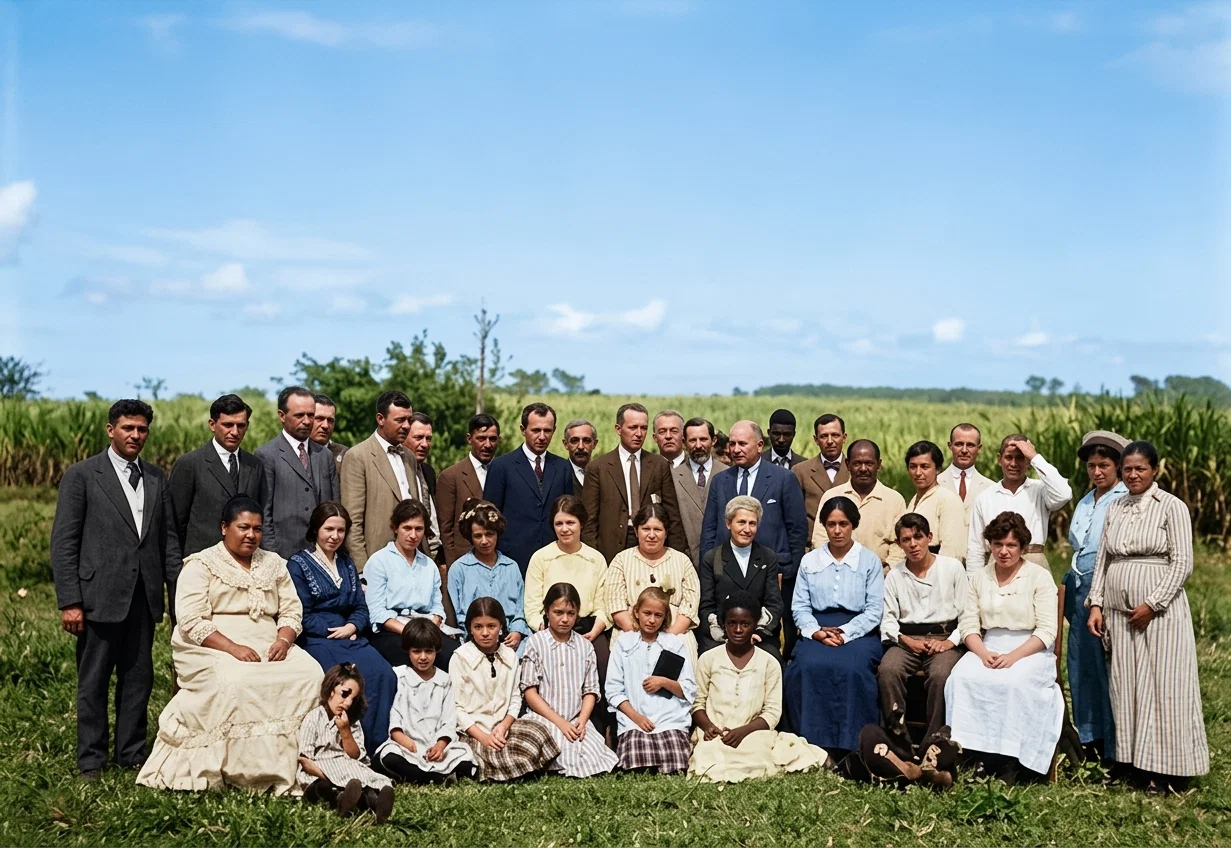
CUBAN WORKERS' MEETING
For the benefit of our English-speaking young people I give a free rendering of this first stanza and the chorus, translated by Miss Amy Robinson, who was my efficient interpreter in all the meetings:—
“O young people, come! Christ’s brilliant banner flies, His flag is now unfurled before the nation’s eyes, ‘All into the trenches!’ he calls without delay, And with him to the battle front we’ll go today! CHORUS: “Come, O come to him, enlisting without fear. Be ready for the fight, for the enemy is near. Young people, we’ll battle, battle for the right; Jesus, our mighty Captain, leads us to the fight.”
A word as to the general workers. Elder F. G. Lane, just arrived from New England, takes the superintendency, and hopes to settle in Havana. Elder A. N. Allen looks after interests in the central part of the island. Elder and Mrs. J. E. Anderson and Sister A. F. Burgos are in Havana, and I was pleased at what I saw developing in a small but encouraging way in that great city. H. S. Mould is in Santiago, with a few keeping the Sabbath, meetings being held for both English-speaking West Indians and Cuban people. A. U. Cochran is field missionary agent, and a small corps of workers are taking orders freely for the Spanish books. In response to a call from Honduras, Cuba is releasing one of its best bookmen, Brother Williams, to lead out in the book work in that country.
Elder H. C. Goodrich is working among the American settlers in the Isle of Pines. At San Claudia, west of Havana, Brother and Sister S. H. Carnahan have a country school, truly—thirty-three miles by automobile stage from the railway. When the work was going hard for them recently, a providential gift came to enable them to get adjoining land that will give them a better chance to keep the light glowing in this region.
Brother G. E. Holmes was at our meeting. He has had an industrial enterprise at Las Minas, round which a little company has grown up. Prof. A. E. Doering with his family drove over to the workers’ meeting from Manacas, where they have developed a fruitful farm. Professor Doering was formerly in the German evangelistic work in Dakota, and went to Cuba for his health. He has now regained his health. He and Sister Doering are of good courage. They rejoice over the conversion of one of their neighbors. The Cuban Mission office is temporarily at Santo Domingo. The brethren feel pleased that the office work is in the efficient hands of Brother S. E. Kellman, who has just arrived from Northern Michigan.
Thirteen years ago I landed in Santiago, Cuba, by a little schooner, from Jamaica, after nearly three days’ voyage. This time it took but eight hours by steamer. Then, as I passed through Cuba, there was not another Sabbath keeper in the island; now there are more than one hundred keeping the Sabbath in Cuba, and recently sixteen new converts have been baptized. While the numbers are few, the signs are cheering, and we see that the plant of truth in Catholic Cuba is really taking root in the soil and spreading, and the workers there ask our prayers and cooperation for a vigorous campaign. W. A. SPICER.

The Message Going to the Jews

KNOWING that our people are interested in every branch of the work of God, I feel sure that a report of the work among the Jews will be read with interest. While the number of converts is not so large as we should like, we are thankful that progress has been made. The past year has been one of special interest in scattering our literature. It has been very encouraging to note the liberal spirit shown by our people in this work. This is as it should be; for the servant of the Lord has made the following statement with reference to the work among the Jews:—
“In the closing proclamation of the gospel, when special work is to be done for classes of people hitherto neglected, God expects his messengers to take particular interest in the Jewish people whom they find in all parts of the earth.”—“Acts of the Apostles,” p. 381.
As surely as we take special interest in these people, so surely shall we awaken an interest in them in our work and in this message, and we shall see progress made. This was illustrated a short time ago.
One of our ministering brethren called on a Jewish rabbi who had bought a magazine from the minister’s wife. The rabbi was asked to sign the petitions against abridging the freedom of the press, and against the District of Columbia Sunday law. The rabbi very freely did this, and at once began to make inquiry concerning our people. In the words of the brother, who relates his experience: “After finding out what people I represented, he [the rabbi] kept me there for over half an hour, asking questions in regard to our number, our organization, how our work is supported, how we get the people to cease work on the Sabbath, the diet question, and many other things too numerous to mention in this letter. As he wanted to know about our organization, I suggested that he get our 1916 Year Book, and he wanted it as soon as possible, and paid me for it.
“Last Friday Mrs. — and I went to his synagogue. . . . His subject was how he had become acquainted with us and what he had learned about the Seventh-day Adventists. In his sermon he put his own people to shame for not keeping the Sabbath as they should. He spoke in highest terms of our people.”
The writer well remembers a beautiful eulogy on Seventh-day Adventists, delivered by a prominent Jewish assemblyman in one of our State assemblies. It was interesting in the extreme. In conversation with him I expressed appreciation for his speaking so kindly of our people; and he replied, “I could have said a good deal more along the same line.” I then said to him, “Is it not too bad that the Lord has had to select a Gentile people, as the Seventh-day Adventists, to do the work which the Jews ought to do?” Bowing his head in a thoughtful attitude, he quietly replied, “Yes, that is so, that is so.”
While it is extremely difficult to get many Jews to attend a religious Christian service, they do become interested in us and in our work when we go to them in a proper manner, and show a special interest in them.
During the past year more than sixteen thousand tracts in Yiddish and English have been sent out for the Jews, and ten thousand Yiddish magazines. We are sure that this literature has done some good, and the seed will fall into honest hearts. A large number of interesting letters have come to us as a result of this work, and many of the Jews are certainly awakening to a realization of what our truth means. I give a few extracts from these letters:—
“Will you kindly send me a New Testament, as you offer in the different booklets [tracts] you send about?”
“I received your pamphlets and read them with pleasure. . . . Should like to get a little more light about Christian faith. . . . Will you kindly forward me a New Testament? I shall appreciate it very much.”
“Send me, I pray thee, your books. I wish to read them . . . and examine them. . . . Mr. — commends to me your books. I would like to have them. From me, yours that hopes to have an answer soon with your books. When you will send them, I will be very thankful for them. . . . Please answer me. Send me only Jewish.”
“I just came across the little pamphlet, ‘The Epistle to the Hebrews.’ I am a reformed Hebrew, and am always open for conviction, for I hold no hatred toward any person or church, no matter what the denomination is. . . . I hope that you will please answer, and kindly oblige.” Although this gentleman is past fourscore years of age, he writes very intelligently, inquiring for the truth of God.
I might continue almost indefinitely quoting from correspondence which comes either from Jews direct, or from our people who have interested themselves in the Jews, especially by handing them our literature. There was such a demand for the latest Yiddish magazine that we had unsupplied orders for nearly two thousand copies after an edition of ten thousand was exhausted. We published another edition, and are glad to tell our people that the magazines can be now supplied to those who desire them.
Very few of our large cities have been touched. In such cities as Boston, New York, Chicago, St. Louis, Cincinnati, Baltimore, Philadelphia, and many others, thousands of these magazines should be scattered. We hope that the brethren and sisters in these cities especially will do what they can to interest their Jewish friends and neighbors in our work and in our literature.
Send for a supply of these magazines to your State tract society, or to the Good Tidings Press, South Lancaster, Mass. The magazines sell to our people for three cents a copy, or three dollars a hundred.
We are glad to learn that several Jews have been baptized and joined us in the Greater New York Conference this winter; one sister has been baptized in western New York, and there are others who we hope will go forward in baptism soon.
Seven Jewish young people have been attending South Lancaster Academy this winter; one brother is a member of the faculty. Jewish young people are also attending some of our other schools. Our courage in God is good. Pray for the work among the lost sheep of Israel.
F. C. GILBERT.
Continue reading: The Pitt Theater Meetings in Pittsburgh