The Youth’s Instructor, Vol. 48, No. 3.

MAKING LUMBER OF CALIFORNIA BIG TREES

The Youth’s Instructor

Jan 18, 1900

Review and Herald Publishing Company · Battle Creek, Mich. · Jan 18, 1900

MAKING LUMBER OF CALIFORNIA BIG TREES
NO DOUBT MOST readers of the INSTRUCTOR have heard or read of the giant redwoods, or “big trees,” of California. The redwood belt does not extend over the entire State, but is confined to comparatively few localities. Two groves of the largest trees have been secured by the United States government, and are protected as national parks. Everywhere else the redwood forests are being rapidly destroyed by the lumberman’s ax,—though the word “ax” is here used figuratively; for that implement is almost entirely replaced by the saw, even in felling the timber. The real instrument of destruction, however, is neither ax nor saw, but fire.
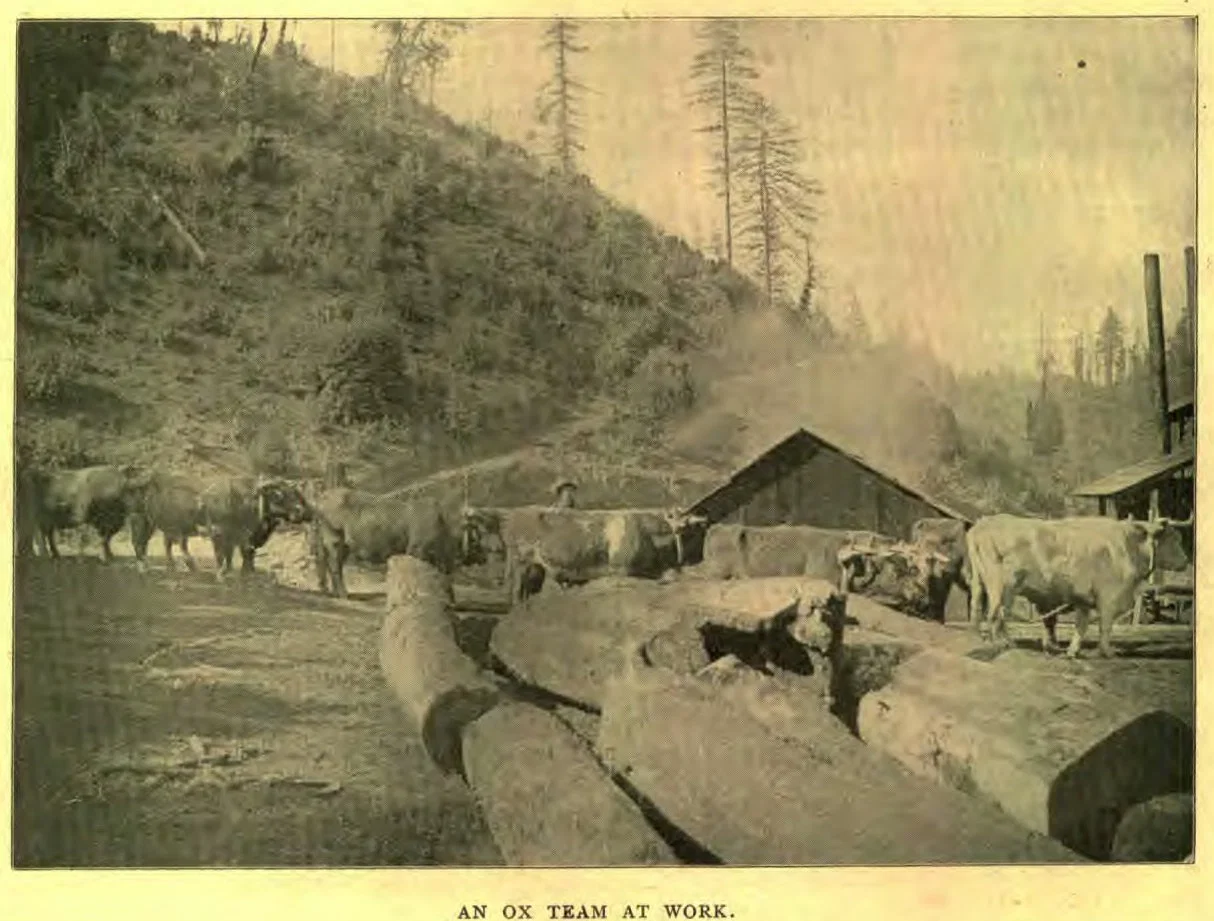
AN OX TEAM AT WORK.
AN OX TEAM AT WORK.
The redwood prefers the valleys, and is seldom found growing at such high altitudes as its cousins, the pine and the fir. It is an evergreen resembling the fir, from which it can, however, be readily distinguished by its bark and needles. The bark is much more deeply creased than that of the fir, and is usually quite soft and spongy. Excellent pincushions are made of redwood bark by cutting it in sections, and mounting it in such a manner that the pins may be thrust in to follow the grain of the wood. In the fir tree the needles are round, and grow all around the twig in an irregular manner. Redwood needles are flat, and grow in two regular rows along opposite sides of the twig, somewhat resembling a feather.
When the forests occupy level valleys, there is seldom any undergrowth to speak of. It is often possible to drive a team and wagon for miles through a virgin forest, without encountering a fallen tree or other obstruction sufficient to turn one aside. It is a rare treat to wander through the cool, refreshing shade of such a forest on some hot summer’s day. The ground is covered with a carpet of needles so thick and soft that you can scarcely hear your own footsteps. Before, behind, to the right, to the left, the forest giants rise as straight and regular as the columns of some mammoth, long-forgotten temple. The silence is often so profound as to be almost oppressive. Not the twitter of a bird, the chirp of a cricket, nor the rustle of a twig is heard. In some spots the foliage is so dense that the sunbeams never penetrate it. During the summer months these forests are favorite camping resorts with the Californians.
If the trees grow on hilly or uneven ground, the conditions are often quite different. Sometimes fir or other trees grow side by side with the redwoods, and often the underbrush is so dense as to be practically impenetrable.
But be the forests on hill or in valley, it is all the same when the lumberman comes. Before him is the wonderful work of God, wrought through the laws of nature; behind are marks of the terrible devastation wrought by man’s insatiable greed.
Into the primeval forest comes a crew of men called “fellers.” They cut down everything as they go. Neither the three-inch sapling nor the twenty-foot tree is spared. Many of the large trees are cut ten, twenty, or even thirty feet from the ground. The “butt cuts,” or lower portions of the tree, are heavy and difficult to work. They are usually made into shingles, and scarcely pay for handling. I have seen “shingle bolts”—as the blocks are called before being sawn into shingles—fall into the water, and sink like a bar of lead. In contrast with the butt, the top of the redwood is, even when green, as light as thoroughly seasoned pine. It is so soft and brittle as to be worthless as lumber.
After the “fellers” come the “peelers,” who strip the bark from all the trees that are large enough to use for lumber. Next comes a gang of men with ox teams or a traction engine. They pile up the saplings, limbs, bark, brush, and top cuts of the trees, preparatory to burning them. When their work is finished, fire is called to their aid, and all this refuse is quickly destroyed. These great heaps of timber make mammoth bonfires; but they burn so rapidly that usually half a day is sufficient to complete the destruction, and leave the ground clear for the handling of the logs.
After the fires have burned down sufficiently to permit the men to go to work again, it is usually found that about one half or one third of the felled trees are on fire. But fire burns slowly in these unseasoned redwood logs, so the loss from this source is small. Big buckets of water and small force-pumps are called into play, and there is seldom any difficulty in extinguishing the fires, unless they have got hold of a log that has been partially split in falling. In the latter case it is sometimes necessary to cut a hole into the log until the burning hollow is reached. Water is turned into this hole until the fire immediately around it is extinguished. Then a man is let down through the hole to play the hose on the fire until he is driven out by the hot, suffocating air,—or perhaps I should say smoke and steam; for when a man is drawn from his unenviable position, he is ready to vow that there is not a mouthful of air in the log. Another promptly takes his place; and, as the fire is beaten back, the stays in the log become longer. But a crew of men will often work an entire day in extinguishing the fire in one log.
When the fires have done their work, the “sawyers” take hold of the timber, and saw each log to whatever length is demanded by the mill. Most of the large trees have what is called a “wind split.” This is a crack running through the middle of the tree to within six inches or a foot of the bark on each side. A wind-split tree will usually split open its entire length when it falls. The trees that do not split in falling, if too large to be conveniently handled, are split with a blast of giant powder. When the logs are sawed and split into the required length and size, one end of each is hewn off like the prow of a boat to prevent it from gouging into the earth as it is being dragged to the temporary railroad, which has been laid as near as convenient to the timber.
A few years ago all the logs were hauled to the track by oxen; and the low flat-cars that carried them to the mill were drawn by horse-power. Now the traction engine has superseded the one, and the cable drawn by a stationary engine at the mill has taken the place of the other. This, however, refers only to the large mills, where timber is plenty, and several hundred thousand feet of lumber are sawed daily. In regions where there is but little timber, the mills are small, and there the picturesque cattle teams and horse-cars are still to be seen. A team of cattle contains from twelve to sixteen, and sometimes even twenty, oxen. It requires two or three men to handle them; but they are patient brutes, usually far more patient than their drivers.
It is an interesting sight to see a monster log drawn along by these oxen. The team is slowly maneuvered into position (for oxen will move slowly, and haste only makes confusion); the great log-chain is fastened to the log; and, with much cracking of whips, the cattle begin to move. The chain tightens, the yokes creak, and presently the log trembles, perhaps rolls a little, and then moves slowly after the patient, tugging oxen.
J. EDGAR ROSS.
(Concluded next week.)

THE FIELD

JANUARY STUDY: PART III

(January 21–27)
_1. Basis of Study._—For Part III read “The Work in Nice” and “Among the Waldenses,” pages 12 and 14 of the January number of the Missionary Magazine. An interesting account of the opening of our work among the Waldenses may be found in “Historical Sketches of Seventh-day Adventist Foreign Missions.” The following notes are compiled from “Great Controversy,” Vol. IV, edition of 1887:—
_2. The Early Waldenses Sabbath-Keepers._—But of those who resisted the encroachments of the papal power, the Waldenses stood foremost. Their religious belief was founded upon the written word of God, and was in marked contrast with the errors of Rome. They were the first of all the peoples of Europe to obtain a translation of the Scriptures. Hundreds of years before the Reformation, they possessed the entire Bible in manuscript in their native tongue. They had the truth unadulterated, and this rendered them the special objects of hatred and persecution. Through ages of darkness and apostasy, there were Waldenses who denied the supremacy of Rome, who rejected image-worship as idolatry, and who kept the true Sabbath.
_3. Waldensian Youth._—From earliest childhood the youth were instructed in the Scriptures and taught sacredly to regard the claims of the law of God. Copies of the Bible were rare; therefore its precious words were committed to memory. Many were able to repeat large portions of both the Old and the New Testament. Thoughts of God were associated alike with the sublime scenery of nature and with the humble blessings of daily life. Little children learned to look with gratitude to God as the giver of every favor and every comfort. Very early they were taught to bear responsibilities, to be guarded in speech, and to understand the wisdom of silence. One indiscreet word let fall in the hearing of their enemies, might imperil not only the life of the speaker, but the lives of hundreds of his brethren; for as wolves hunting their prey did the enemies of truth pursue those who dared claim freedom of religious faith.
_4. Their Education._—While the youth were inured to toil and hardship, the culture of the intellect was not neglected. On the grassy slopes of the valleys, or in some sheltered glen among the hills, the youth received instruction. The Bible was their text-book. They studied and committed to memory the words of Holy Writ. A considerable portion of their time was spent in reproducing the copies of the Scriptures. When they had spent some time in their schools in the mountains, some of the Waldensian youth were sent to complete their education in the great cities, where they could have a wider range for thought and observation than in their secluded homes. The youth thus sent forth were exposed to temptation; but their education from childhood had been of a character to prepare them for all this. In the schools whither they went, they were not to make confidants of any. Their garments were so prepared as to conceal their greatest treasure,—the precious manuscripts of the Scriptures. These, the fruit of months and years of toil, they carried with them; and whenever it could be done without exciting suspicion, they cautiously placed some portion in the way of those whose hearts seemed open to receive it.
_5. Waldensian Missionaries._—The Waldenses felt that God required more of them than merely to maintain the truth in their own mountains; that a solemn responsibility rested upon them to let their light shine forth to those who were in darkness; that by the mighty power of God’s word they were to break the bondage which Rome had imposed. It was a law among them that all who entered the ministry should, before taking charge of a church at home, serve three years in the missionary field. As the hands of the men of God were laid upon their heads, the youth saw before them, not the prospect of earthly wealth or glory, but possibly a martyr’s fate. The missionaries went forth two and two, as Jesus sent out his disciples. These colaborers were not always together, but often met for prayer and counsel. As they went from house to house, they concealed the real character of their mission, under the guise of some secular profession. They were thus received where they would have been repulsed as missionaries. While they exhibited their wares for sale, their hearts were uplifted to God for opportunity to present the treasures of his word. Everywhere they scattered the precious seed. Churches sprang up in their path, and the blood of martyrs witnessed for the truth.
_6. Study Their History._—It would be well for all our workers to study the history of the Waldensian missionaries, and to imitate their example of sacrifice and self-denial.—“Gospel Workers,” page 347.

BEREAN LIBRARY STUDY

Dan. 7: 1-18; “Thoughts on Daniel,” pages 113-123
The regular Outline of these studies is published in the Review and Herald and also in the Missionary Magazine. What is here given is only supplementary, and should be studied in connection with the Outline.

NOTES ON LESSON 8

(January 21-27)
1. History and Prophecy.—The first six chapters of the book of Daniel, excepting a portion of the second chapter, are historical. The last six chapters are almost wholly prophetic. These lessons in prophecy may seem a little harder to learn than the others have been, but they are not so difficult but what we may understand them if we really wish to. Our own salvation, as well as the salvation of others, may depend on our study of these lessons. Shall we not take time for it?
2. Consult the Dictionary.—The first question of the lesson study has some unusual words in it this week, and throughout the lesson are words that should be studied carefully. When you come to a word you do not fully understand, look up its definition, and do not be content with a guess at its meaning. The following words that occur in this week’s study should be defined: literal, figurative, symbolic, consecutive, characteristics, effeminate, usurp, deterioration, significance, rapacious, celerity, nondescript, hierarchy, investigative, votaries, merged, infallibility, prerogative.
3. A Lion with Eagle’s Wings.—The king of beasts with the wings of that bird of highest, strongest flight, was a fitting symbol of Babylon in the time of its strength and power. Habakkuk calls it that “bitter and hasty nation,” whose horses were “swifter than leopards,” and whose horseman should “fly as an eagle that hasteth to eat.” How apt, too, is the representation of the loss of power and vigor, which occurred under the kings succeeding Nebuchadnezzar.
4. A Bear.—The emblem of the Medo-Persian kingdom was an animal less noble and courageous than a lion, but more voracious and savage, thus fitly representing the cruel and rapacious nature of the people. At the time when Media and Persia first made an alliance, Media was recognized as the greater power. Afterward, the relationship became so changed that the Persian element came to be the leading division of the empire. Note the representation of this in the vision, and also the significance of the three ribs in the bear’s mouth, as explained in the text-book.
5. A Leopard.—The sly cunning of the Grecians is well represented by the stealthy, cat-like leopard beast. Ridpath says of this nation: “He was the most capable animal of all antiquity. He was Reynard in the ancient Kingdom of the Beasts. He planned and contrived while others slept. His were the trick and the stratagem. He held up a false appearance, and smiled at his foe for being fool enough to believe it real. He found more pleasure in setting a trap than in taking a city. He made cunning a virtue, and recounted a successful wile with the same pride as if reciting the brave exploits of heroes.”
6. “Which Shall Bear Rule Over All the Earth.”—This is written of the third kingdom, in Dan. 2:39. Historians say of Alexander, that country’s greatest king, that “there was in his time no nation of men, no city, nay, no single individual, with whom Alexander’s name had not become a familiar word.” It is also said that as he sat upon his throne, ambassadors stood before him “from all the extremities of the earth,” and that they were come “to propitiate his anger, to celebrate his greatness, or to solicit his protection.”
7. “To the Strongest.”—Almost the last words spoken by Alexander upon his deathbed were with reference to his successor. He was asked to whom he wished to bequeath his kingdom, and made the characteristic reply, “To the strongest.” But it was not to be that any one man should rule the empire. The prophecy indicates that there would be four divisions, and there were just four.
8. Exercise and Diet.—The physical perfection of the Greeks has been celebrated in story and in song. Solon, a sage and lawgiver of Athens, speaking with pride of the youth of his country, says: “They have a manly look, are full of spirit, fire, vigor; neither dry and withered nor heavy and unwieldy, but of a form at once graceful and strong. They have worked and sweated off all superfluous flesh, and only retained what is pure, firm, and healthy. This perfection they could not attain without those physical exercises and the regimen that accompanies them.”

REQUISITES FOR WORKERS

I

In a personal Testimony from Sister White, am given a charge concerning the youth, in which occur the following paragraphs:—
“Many youth manifest themselves shy of religious conversation. They do not take the matter as it is. They close the windows that should open heavenward, and open the windows wide earthward. But when they shall see the excellency of the human soul, they will close the earthward outlook, they will cease depending on earthly amusements and associations, break away from folly and sin, and open the windows heavenward, that they may behold spiritual things.
“Educate the youth to help the youth. In seeking to do this work, each will gain experience that will qualify him to become a consecrated worker in a larger sphere. Thousands of hearts can be reached in the most simple way. The true, honest work of a son or daughter of God in a service of little things, performed in natural simplicity, will unbolt the door that has long been locked to many a soul.”
How to become that consecrated worker is the one important consideration of many whom I know, and doubtless of many of whom I have never heard.
My whole heart goes out to the children and young people of our church family. All that I have been writing to parents has been in their interest; and now I am going to come directly to them, in a series of short, practical studies with those to whom the call of God, in Rom. 12:1, has already been made so personal that they can not but say, each in his own soul, “That means me.”
In this series we will study those things that must be true of any soul before he can be of use to the work of God.
It is of great importance that we be ready for use; for it is evident that God wants men and women, young as well as old. He must have somebody. He wants you. Are you ready? Let every one of my young readers measure himself by the requisites, and find out, each for himself and not another, just how nearly ready, or how far from being ready, he is.
The solemn march of events, as they are closing up the history of this old world, warns us that it is high time that even the youngest should be ready for the quick, sharp roll-call of duty.
That first verse of Romans 12 is an advertisement. Did you ever think how the advertising of the world is only a perverse copying of the divine method, and is one of those things about which the Lord says, “Neither are your ways my ways”? Isa. 55:8.
One morning many years ago I saw the bulletin-boards and fences dotted with a poster, on which I read, in display type, “A THOUSAND MEN WANTED!” I could not alight from the carriage to read the description that followed, so I fell to meditating in this wise:—
What kind of men? Is any one so anxious to fill up some hospital, that he is advertising for a thousand cripples? Is any one so determined to start a cemetery, that he is calling for a thousand dead men?—Oh, no! That advertisement carries on the face of it that a thousand able-bodied men are wanted. No man, no corporation, could use cripples or corpses. A lame man can not run; a dead man can not work. A man may have cut off his own hands or legs, he may have taken his own life, and gone into the dust of the earth with all the responsibilities of a man upon him; but the fact that he is disabled or dead settles the question as to whether he will ever do any work.
How different from God must the world always be in its advertising: for the world is so limited in resources, but so boastful; while boasting is impossible with God. He could not himself promise more than he is able to perform, although he does seem almost reckless, judged by any human standard, in the call that he makes for men when he says: “I beseech you therefore, brethren, by the mercies of God, that ye present your bodies a living sacrifice, holy, acceptable unto God, which is your reasonable service;” for man has already been pronounced dead,—dead in trespasses and sins (Eph. 2:1), having only at best a name to live (Rev. 3:1); and if Christ “died for all, then were all dead.” 2 Cor. 5:14.
How then, if all are dead, can any man present himself alive—a living sacrifice—to God? How can God expect living servants out of dead men? And yet, “Ordered on duty while dead” might be said of every man who has ever become a laborer together with God; and this because he who has called “shall supply all your need according to his riches in glory by Christ Jesus,” even if that need be life itself. Phil. 4:19.
A great leader in a certain line of philanthropic work, who was, however, not a believer in Christ, was talking with me one day about the conditions of human life; and in reply to a remark of mine she said, “But you know, Mrs. Henry, I believe that every human being has a right to be well born.”
“So do I believe that,” I replied. “You can not insist on that more strenuously than I do; but what are you going to do with a race to whom the opportunity of being well born is lost? They are here, just as they are. You can not go back a hundred years, and reform their grandparents. Who shall undertake for them?”
“As for such people, I shall have to leave them to you,” she said, with a little laugh. “I should be at my wit’s end.”
“Thank you,” I said; “I gladly accept the commission; for I shall go to them, and say that when it had so fallen out that they could not be well born, God was not at his wit’s end, but was able to devise a way by which every badly born son of Adam might be born over again.”
She turned, looked at me, and said: “Can you go honestly and freely, and teach such a thing as that?”
“Indeed I can,” I replied. “If I could not, I would never appear before another audience.”
“Well,” she said, while tears filled her eyes, “if you can go and honestly teach that, you GO!”
I relate this incident to show my readers how hungry even the heart of the worldly philosopher may be for the simple truth that has been made so plain to us in the words of Jesus.
The first requisite for a laborer is indicated in the words: “Abide in me, and I in you. As the branch can not bear fruit of itself, except it abide in the vine; no more can ye, except ye abide in me. I am the vine, ye are the branches: he that abideth in me, and I in him, the same bringeth forth much fruit: for without me ye can do nothing.” John 15:4, 5.
The first thing that the branch gets by reason of abiding in the vine is life; and in these words Jesus taught the same truth that he unfolded to Nicodemus when he said to him, “Ye must be born again.” John 3:3–8.
Before God can make use of any man, he must be alive, and he can be made alive only through the regeneration; for Jesus, who knows, says, “Without me ye can do nothing.”
Do you know what this means? It is one thing to have kept the Sabbath and been in the church all your life, and another thing to be born again. If you have not been born again, you are yet dead, and of no use to God. Let it not be said of you, “Ye will not come to me, that ye might have life.” John 5:40.
MRS. S. M. I. HENRY.

BE GOOD

God does not say, “Be beautiful; be wise; Be aught that man, as man, would praise and prize.” Only, “Be good!” the tender Father cries.
The purposes of life, misunderstood, Baffle and wound us; but God only would That we should heed his simple words, “Be good!”
— Selected.

A FALSE STANDARD

TO TELL a young man that if there is anything in him worthy of recognition, the world is sure to find it out, is to set before him a false standard. In the first place, it directs him to the public eye rather than to the all-seeing Eye. In the second place, it makes popularity the measure of greatness. As a matter of fact, popularity measures nothing. The world is slow to appreciate its best things—a large part of its best things. A light book wins its way in a day; a book born not to die lies a hundred years in its swaddling-clothes. The greater a man is, the longer it takes the world to get his measure. We are figuring on Paul yet; while a thousand lesser men have had their measure, received their honors, worn them out, and gone into oblivion. God has not promised to reward greatness with popularity; we can hardly afford to make the promise on our own responsibility.—Richmond Christian Advocate.

“SHALL WE SMITE THEM?”

In these days of wars and rumors of wars,—these days when we are gravely assured, by the professed teachers of the true religion of Christ, that it is commendable and Christian to fight under certain circumstances,—it is positively refreshing to read the little story so beautifully narrated in the sixth chapter of Second Kings.
The king of Syria warred against Israel. Israel was on the defensive. We are not told just what was the cause of this particular trouble, but the Syrians were at least angry enough with the Israelites to fight them. But when the Syrian king wished to make a fine strategic movement, and instructed his warriors accordingly, behold, in some unaccountable manner, the enemy was apprised of it, and every plan was thwarted. Then Ben-hadad decided that there was a spy, a traitor, in the camp. But the whole affair seemed wrapped in mystery; his plans had been laid very carefully, and none but his most tried and true captains had been intrusted with his secrets. The heart of the heathen king waxed faint. There must be treachery somewhere! Finally, in the midst of his searching to find out the spy, one of his servants assured him there was something supernatural about the affair—there was a God in Israel, who was a revealer of secrets. “Ah,” said he, “there is Elisha. He is the one you are after, I have no doubt. Why, he tells the Israelitish king the very secrets that you whisper in the silence of your bedchamber!”
Somebody suggested that the prophet was in Dothan, and forthwith the Syrian king sent a great host to take him. That was a strange thing to do. We find ourselves wondering why he thought it necessary to send a large army to capture only one man. But even then the army was not large enough to accomplish it. Instead of capturing the Lord’s prophet, they were captured by him! Astonishing! a whole host taken captive by a single man! What was the secret of it?—Ah, “the mountain was full of horses and chariots of fire round about Elisha.”
One angel was enough to work deadly havoc among the hosts of Assyria,—enough to slay one hundred and eighty-five thousand men,—and now the mountain was full of angels. No wonder Elisha knew no fear. The hosts of the king of Syria were smitten with blindness in answer to the prophet’s prayer, and he actually led his would-be captors over to Samaria, the city of their enemy. Then God opened their eyes. No doubt fear and trembling seized them when they saw the trap into which they had been led. And well they might have trembled, had the king of Israel pursued the policy of a nineteenth-century ruler; for they must surely at least have been made prisoners. What a relief it must have been to those frightened men when they heard the decree spoken by the man of God, whom they had so recently sought to destroy.
“My father, shall I smite them?” asked the king. Smite them?—Nay, verily, replied the prophet. Let us return good for evil. Set food before them, and let them eat, and send them away in peace.
And so, behold, the wonderful spectacle of a hostile army being royally entertained at the expense of the victorious enemy, and allowed afterward to return home unharmed.
What was the result of this Christian manner of disposing of an enemy?—We are told that “so,” for this reason, because of this treatment, they came no more to fight with Israel. What an excellent way to make peace! What a glorious revenge! How Christlike! Would it not be a good idea for Christian people to-day to learn a lesson from this wonderful narrative?
“Take, my brethren, the prophets . . . for an example.”
MRS. L. D. AVERY-STUTTLE.
Continue reading: OUTDOOR OBJECTS IN PERSPECTIVE