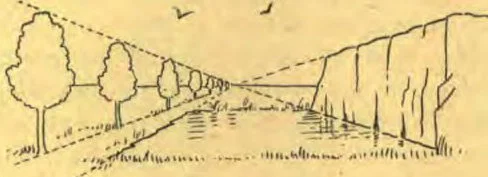
In this lesson we will study more of the objects to be seen in nature, for by so doing it will be easier for us to remember the principles of perspective. In the drawing below, notice how the square pond and cliff seem to be narrower as they converge toward the point of vision on the horizon; also how the trees appear to become smaller and smaller, and closer together, as they go toward the horizon.
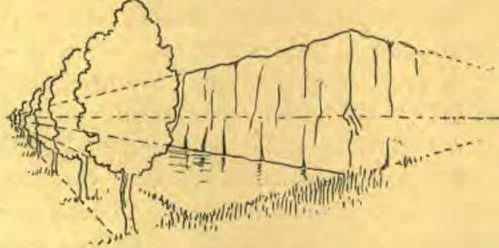
If the observer should stand so the corners faced him, instead of one of the sides, it would then be in two-point perspective, as below:—
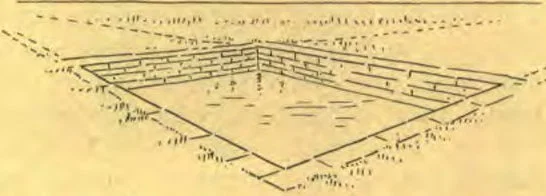
The next drawing will give you an idea of the perspective of a well or cistern in two-point perspective.
If it is impossible for you to get where you can study the perspective of nature in the open country, you can study the subject from indoor objects; for, as has already been said, there is perspective in everything we see.
When drawing some object, it should be drawn in several positions, so that every point may be studied. Draw it not only as it can be seen in one position, but as it would look were you looking at it from above, below, and in other positions. The shed below is drawn in this way.
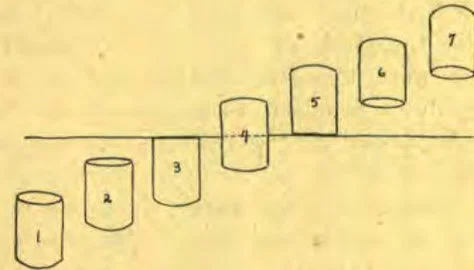
All curved lines above the horizon curve down, and all curved lines below the horizon curve up. For instance, if a cylinder is held opposite an observer, on a level with his eye, which would be on the level with the horizon line, it will be seen that the line formed by the top curves down, and the bottom line curves up, as in cylinder No. 4 in the accompanying illustration. When the top or the bottom comes on a level with the eye, or horizon line, it becomes straight, as Nos. 3 and 5; and the higher it is raised, the more of the bottom we see, as in Nos. 6 and 7. The more it is lowered, the more of the top we see, as in 2 and 1.
In the drawing below, notice how all the lines formed by the stones in the tower curve down above the horizon, and all the lines below it curve up. PEDRO LEMOS.
THE SLEEPY-TIME
Look, dear, the stars are blinking,
The sleepy moon is low,
The little winds among the leaves
Have all forgot to blow.
Come, dear, and say good night;
God keep you all the night!
Good night! Gay words for waking,
Brave words for noon, are best,
But loving words for the sleepy-time,
When the moon is low in the west.
God keep you all the night!
Sweet dreams! Good night! Good night!
—Selected.
PAINTING HER PORTRAIT
“If I could be such an old lady as that, so beautiful, serene, sweet, and lovable, I wouldn’t mind growing old,” said a young girl the other day, speaking of a white-haired visitor who had just departed.
“Well, if you want to be that kind of old lady, you’d better begin making her right now,” laughed a keen-witted companion. “She doesn’t strike me as a piece of work that was done in a hurry; it has taken a long time to make her what she is. If you are going to paint that sort of portrait of yourself to leave to the world, you’d better be mixing your colors now.”
The merry words were true; and whether she willed it or not, the girl was already “mixing the colors” for her portrait, and drawing day by day the outlines of the mature womanhood that shall yet brighten or darken the lives around her. Many a careless, selfish girl has in her inmost heart no higher ideal than “to be like mother,” when she shall have reached mother’s years. But meanwhile she is content to be as unlike her as possible. She has an idea that age brings its graces, and that a beautiful character comes, like silver hair, naturally and without effort.
Girls, you are outlining your future and choosing its coloring now. The woman you wish to be must begin in the girl.—Selected.
AT THE POND
A PRETTY pond there is, all fringed
With trees and flowers gay,
Where many happy creatures live,
And many come to play.
The fishes frolic merrily
Within its waters cool,
And funny little polliwogs
Live in the shining pool.
Along the grassy bank the snails
And turtles slowly creep;
The frogs go splashing in and out
With many a sudden leap.
The insects and the merry birds
Its shining surface skim;
And thirsty cows and horses drink
Along its rippling brim.
THE WATER LILIES’ FRAGRANT CUPS UPON THE WAVELETS LIE.
The water lilies' fragrant cups
Upon the wavelets lie,
And near them float the stately swans,
With proud necks curving high.
And see! here comes the mother duck
With all her yellow brood;
And here are all the goslings, too,
Behind their mother good.
They hurry, scurry down the bank
And in the water go;
They dive, and splash, and with delight
Go swimming to and fro.
Oh, yes! the pond's a merry place,
So busy and so gay,
Where many happy creatures live,
And many come to play.
— Kindergarten Review.
THE GREAT PHYSICIAN
By Mrs. F. A. Reynolds
It had been an unusually hard day, there was no doubt of it, and Helen Belmont passed her slender hand wearily over her hot, aching head, as she wondered how she could possibly endure the long hours until evening, when her mother would be at liberty to spend a short time with her. A sense of desolation and bitterness took possession of her as she thought of herself condemned to helplessness, pain, and solitude; and she fought the rebellious feelings that surged up in her heart, making her eyes fill with tears. With her accustomed patience, she tried to reason herself into peaceful quiet, by recalling her blessings. “For,” as she often said, “I might have been much worse off. I might have been obliged to suffer from hunger and cold as well as from pain. I might have been friendless instead of having the kindest of parents and friends.”
And though all this was true, no one will deny that it was hard for a young, energetic girl to be shut up for two years, and, after trying any number of doctors, and submitting to an operation, which, though it did not kill her, failed to bring the hoped-for relief, to be obliged to give up, daily, bit by bit, the hope of recovery, and try to be willing to be an invalid until released by death.
Still, Helen was usually cheerful, and, when not suffering excruciating pain, glad to see friends. But to-day was Monday, “a blue Monday” literally, with Helen; for no callers had yet been in, and her mother was unusually busy.
Ah! a knock on her door, which opened, as her mother entered with a stranger, a lady, whose sweet smile and delicately sympathetic glance won Helen’s heart before her mother said, “This is our new neighbor, Mrs. Campbell, my dear. My daughter Helen, Mrs. Campbell.”
Mrs. Campbell stepped up to the couch, which Helen occupied during the day, and taking the girl’s hand, said, earnestly, “I have wished to see you, my dear, ever since your mother told me about you, and I came purposely on Monday, because I thought you would not have many callers on that day, and might be lonely. It must help pass away your lonely hours to have people drop in.”
“Oh, yes!” cried Helen, holding the hand so plump and soft and pretty, that had been extended to her; “yes, indeed! And you are quite right in supposing that callers are not plenty on Monday. Please take that low rocker, Mrs. Campbell and sit near me.22Mama, will you not take that other low chair?”
“No, thank you, dear. I must ask you and Mrs. Campbell to excuse me now, as Grace needs me.”
“I wished to see you especially,” said Mrs. Campbell, with a smile, “because I think perhaps I have a message for you. I think God sends us messages by those about us, don’t you?”
“I never thought of it in that light before,” said Helen, “but now that you mention it, I see that it is so; for I have had many comforting thoughts brought to me in that way.”
“You are a Christian?” remarked Mrs. Campbell, half questioningly.
“Oh, yes!” replied Helen, promptly; “not so good a representative of my Saviour as I should be, but surely I am his, and he is mine.”
“You are sure of that?” insisted Mrs. Campbell. “Some people, you know, seem to think it assurance unpardonable to be sure one is saved.”
“I know,” replied Helen, quickly, “but I only take Christ at his word. He has promised that all who trust in his blood are saved, and I do. It is an insult to doubt his word.”
“You are right,” exclaimed Mrs. Campbell, warmly. “Now you are ready for my message: Why are you sick?”
To say that Helen was astonished at the question, is to put it mildly. For a moment she was unable to say a word, although surging thoughts crowded her mind. Finally she stammered, “Because it is God’s will. It is not mine, you may be sure, only as I bring my will into subjection to his. I have tried every way to get well—”
“You have!” exclaimed Mrs. Campbell; “why have you tried to get well, if you think it is God’s will that you should be sick?”
“Why?” echoed Helen, in bewilderment; “how can I know that it is God’s will, unless I have tried to get well, and failed? I have tried every means, and asked his blessing, and that he would make me well if it was his will. How can I think otherwise than that it is his will that I shall be a helpless invalid?”
She sighed, and Mrs. Campbell smiled as she said, “But you are not happy about it. Are you perfectly sure it is his will? If you heard of some great doctor, would you not go to see him, or of some famous medicine, would you not try it?”
“I’ve no doubt I should if I could,” replied Helen.
“Then you are not sure of God’s will in the matter; for I see you are too true to wish to cross his will. The fact is, you have not thought of applying to the Great Physician himself. Yes, to Christ,” she added, in answer to Helen’s questioning look. “He cured the sick as well as forgave sins when on earth. He lives to-day as truly as he did when in the form of man in Palestine, and he has said he will grant us our prayers. He forgives your sins; you have no doubt of it—”
“But,” interrupted Helen, “he said, in his prayer, ‘Not my will but thine be done,’ and we are taught to ask subject to his will. I know it is his will that I should have my sins forgiven, but how do I know that it is his will that I should be well?”
“Ask him. Seek counsel at his word and Spirit. He has said much on the subject. Your discipline is attained if you are now willing to have his will. You are consecrated to him, soul and body?” She looked inquiringly at Helen, who bowed, too agitated to speak.
“Your body is the temple of the Holy Ghost. He wants you to be perfect, and he will grant to you as much as you will take. You can go only in his strength spiritually. He made your body, and you can go in his strength with that, too.”
“That is all to-day,” she added, rising. “Think it over. Ask him to clear your brain, and stop the ache in your head; and when you have sought it out, get up in his strength, and go on in it. For it is written, ‘He sent his word, and healed them.’”
She bent over and kissed Helen’s forehead.
“Come in again, to-morrow!” whispered the girl.
“I will,” promised Mrs. Campbell, softly, and glided out of the room, leaving Helen full of new thoughts.
For an hour or more she lay back, and thought and prayed and read the promises. Then, in faith, she said aloud, with an upward glance, “Lord, I accept it all!” and rose immediately to her feet. She steadied herself for an instant, and then walked to the window and back. The next day when Mrs. Campbell came, she opened the door, and said, “All praise to the Great Physician!”
MRS. F. A. REYNOLDS.
AN ALLEGORY
By Edith E. Adams
ARE you wondering what is the meaning of this word? or do you know already that it is something taught under the image of something else? In this it is like a parable, which is “a tale to teach the truth.” When Jesus taught the people who crowded about him to hear his words, he often used parables to make it easy for them to see and understand the lessons he wished them to learn. Think of all the stories that Jesus told the people; see how many you can remember, and what were the lessons taught in each one. Some, I am sure, you know well,—the Sower, the Ten Virgins, the Good Samaritan, the Good Shepherd. In each of these some precious lesson of truth was hidden, but hidden only that it might be seen. Jesus taught the people the truth by parables, not to hide it from them, but so that the simplest of them, and even the little children, might be able to see and grasp it, and hold it in their minds.
But there were some among those who listened to Jesus who were not willing to be taught as little children. Indeed, they even thought they knew more than Jesus did, because he had never been to any of their schools. And from them the parables of Jesus hid the truth, because they could not receive the kingdom of God as a little child. The parables of Jesus, which made the truth simple enough for babes to understand, hid it from those who were “wise in their own conceits.”
You love to hear the parables of Jesus from the New Testament, and to learn the lessons of truth that he has hidden there for you. But did you know that the Old Testament is also full of the parables of Jesus? He who, when on earth, taught the people by parables, had from the very beginning,—the time of the fall,—been teaching man by object-lessons the good news of salvation from sin through his own sacrifice; and also giving beforehand to those who had “eyes to see” and “ears to hear” the history of his own life upon the earth, his death and resurrection, and the great deliverance that would thereby be wrought for all who believed in him.
Of one of the most familiar Bible stories, the history of Abraham,—his home life with Sarah and Hagar, the birth of Ishmael, and after long years of waiting, the birth of Isaac, the child of promise,—the apostle Paul says, “Which things are an allegory.” That is, we are not to read this only as an interesting, true story. It is this, but much more. We are to learn from it some precious lessons of gospel truth, which God has in this way made plain for us to grasp.
But this is not the only allegory in the Old Testament. This is simply to teach us how we are to look upon all these scriptures, and the stories that they teach us. The life of Jacob, of Joseph, Moses, David, Daniel,—of each of these we may say, as Paul said of the life of Abraham, “Which things are an allegory.”
So let us, as we study these, look for the precious truth which was hidden in them to teach the people of old time the gospel, and which still remains there to make it plain to us.
EDITH E. ADAMS.
The Charity That Thinketh No Evil
“THE charity that ‘thinketh no evil’ trusts in God and trusts in men. The heart that knows itself to be false trusts neither in God nor in man.”
A CONVERT FROM ISLAM
By R. W. Munson
No FIELD for missionary labor presents greater difficulties than Mohammedan countries; and the longer Islam has held sway, the more bigoted are the adherents of that false faith. The natives of the East Indian Archipelago are among the most recent converts to Mohammedanism. It has been only about five or six centuries at the most since the missionaries of the false prophet found their way to these islands; consequently the natives are much milder in their devotion to that faith than are the people of Persia, or even of India.
In the subject of this sketch, Silas Saleh, is a singular mingling of races and religions. He is a Christian whom it was my privilege and joy to baptize five years ago. He was born of Chinese parents in China. During the Taiping rebellion, they were separated from him and killed; and he was sold into slavery, and brought to Singapore. He fell into the hands of a kind old Malay, who adopted him, and sent him to a mission boarding school, where he remained three years, and imbibed considerable Christian doctrine. He then returned to the home of his foster father, and grew up under the instruction usually imparted to a Malay youth, which, of course, means that he became a Mohammedan. Possessing the energy of a Chinaman, with the religious zeal of the Arab, he naturally rose to a position of considerable influence in the community. He was a doctor by profession, and acquired no small degree of proficiency in the art of healing. He had English works on materia medica, and made excellent use of them.
He used to attend our street meetings, and, like other Mohammedans, would raise a controversy, and seek to neutralize the effect of our teaching upon the minds of the crowd; but the Lord willed it that every time he came, he went away with something to think about. He thus gathered grains of truth, which so accumulated that, after about a year of this sort of experience, he began to feel the force of conviction telling him that he was wrong, and the missionary was right.
After two years had expired, the second of which he devoted to a careful study of the Bible and to inquiry concerning the truth, he confessed himself fully persuaded of the truth of the gospel, and of the falsity of the religion of Mohammed. But he hesitated about taking the final step, which would forever cut him off from his friends; namely, the confession of Christ in Christian baptism. However, his hesitation was not due to any lack of courage, or of love for the Master, but was the result of his concern for his children. Should he take the step before he had placed his little son and daughter out of the reach of their Mohammedan relatives, he well knew that they would be stolen, and that he would never see them again. Thus it came about that he delayed taking the final step until our return to the mission field in 1893. We opened an orphanage for Chinese and Malay boys; and then it was that he came to me, and said: “The Lord has opened the door for which I have been waiting so long; I wish you to take charge of my son and daughter, so they will be saved from the designs of their grandmother; then I shall be ready for Christian baptism.” Accordingly, I made out articles of agreement for the two children, by which they were committed to our care for a long term of years; and the following Sunday, Mohammed Saleh made a public confession of Christ in baptism.
Then began a bitter persecution of him by his Mohammedan friends. His wife, who was the stepmother of his children and a bigoted Mohammedan, left his home. The children’s grandmother resorted to every art known to the Oriental mind to induce us to permit the children to go home with her for a short visit. Being refused, she only renewed the effort, bringing her husband, who was a worthy old gentleman, with her. But as much regret as it caused me to do so, I was obliged to refuse them. For several months they continued their persistent endeavor to coax or steal or bribe the children to run away; but their affection for their father and his influence over them prevented this. Finally the poor old woman, with unfeigned sorrow, shed bitter tears, which brought dampness to my own eyes, and left my house with expressions only of respect: but as soon as she had reached the road, and was off our premises, she scooped up the dust of the road in her hands, and cast it into the air and upon her head, uttering the direst maledictions and curses upon me for my heartless cruelty. That was the last I ever saw of her; but I have no doubt that my wife’s illness and our enforced home-coming were regarded by her as the result of her curses.
Brother Saleh subsequently married a woman who was one of the orphan girls in the mission at the same time he attended it.
From the time of his baptism, Brother Saleh was a most faithful and devoted servant of Jesus Christ, much given to the study of the Word. He endured bitter persecution for Christ’s sake; and in the midst of it all, he never flinched nor complained, but bore it with patience, as did his Master before him. A steadfastness and devotion, rare even in Christian lands, marked his daily life. Although I have not heard from him directly for several years, I know that he and his wife are earnestly praying God to send us back again to that field. He was my teacher in the language for some time, and is now a member of the conference, and is spending his whole time in preaching the gospel. R. W. Munson.
[Since this article was written, Brother Munson and his family have returned to this East Indian field to proclaim the light of the third angel’s message.—ED.]
Time: A. D. 31. Place: Near the base of Mt. Olivet. Persons: Jesus, disciples.
QUESTIONS
1. After leaving the Passover room, and while walking toward Mt. Olivet, what did Jesus say to his disciples? Matt. 26:31, 32. Who returned answer? What did he say? V. 33. What positive statement concerning Peter’s future did Jesus then make? V. 34. Instead of accepting the word Jesus had given, what self-confident answer did Peter and his companions make? V. 35.
2. Using one of the flourishing grape-vines at the base of Olivet as an illustration, what did Jesus say of the relation existing between himself and his followers? John 15:1, 2; note 1. Of how great importance is it that one abide in the Vine,—in Christ? Vs. 4–6; note 2. What promise is given to all who do abide in him? V. 7. What is the test of discipleship? V. 8.
3. What is the measure of Jesus’ love for his children? V. 9. In what way is their full measure of constant love toward him to be shown? V. 10. If this rule of love is followed out, what will result? V. 11.
4. What is to be the measure of our love for one another? V. 12. How far-reaching is such love? V. 13. What only is accepted as evidence that we are the friends of God? V. 14. As we thus prove our friendship, what intimate relation will Jesus sustain to us? V. 15.
5. What assurance does Jesus give to all who labor in the gospel? V. 16; note 3. What definite command is left for them? V. 17. What relation must the Christian sustain to the world? Why? Vs. 18–21.
6. What is the effect upon men of Christ’s work on earth? Vs. 22–24. In the hatred of the world what scripture is fulfilled? V. 25. Though the world opposes Christ in his followers, in what way does Jesus continually work for its salvation? Vs. 26, 27.
7. What object had Jesus in thus instructing his disciples? John 16:1.
NOTES
1. Than this one, there is, in all the Bible, no more beautiful picture of man’s relation to his Heavenly Father and Elder Brother. Jesus, the great Vine of eternal life, has at infinite sacrifice been planted in the soil of earth by the Husbandman—God the Father. Jesus became one with man, that, having the same nature as man and at the same time bearing the divine, he might be the channel of life to the lost. Jesus is the connecting link between earth and heaven. The life of the Vine—the Root—is but the life of God. The life of the Husbandman flows into and through the True Vine. As the vine draws its life from the moisture and richness furnished by the work of the gardener, so Jesus drew his life from the Father. But the vine grows not to beautify itself; its life is only to pass on into the branches, that they, in turn, may bear fruit. So, too, Jesus lived not for himself, but for those who, as branches, should be united with him, while they bring forth the fruit of righteousness. The life of the Vine is the life of the branch. All the sweetness, compassion, and tenderness of Jesus will certainly flow into the life of his children—the branches. A true union with Christ makes the life of the Christian a natural, spontaneous outgrowth, not a forced effort to do right. The branch does not have to try to grow; it grows naturally, because of its connection with the root. And the fruit is sure to appear. In the Christian life, when the season arrives, the grand results of inflowing grace will be seen in well-developed acts of love, and Christlike, beautiful habits will adorn the life tree. There come times, however, when the vine-dresser finds it necessary to prune the branches, to cut away the superfluous growth that hinders the development of the fruit. He does this that the vine, instead of degenerating into fruitlessness, may bring forth more fruit. Just so, our Father, in love for those who are growing in Christ, finds it necessary to take the pruning-knife of affliction, adversity, or of other painful experience, and cut away the twigs and useless branches of the heart, which hinder the fruits of grace from appearing in their season. Sometimes the vine branch bleeds as a result of pruning; so with the Christian there may come times when the very life seems to be ebbing. But all will be well; for it is only that he may “bring forth more fruit.” God carefully watches every jot of experience in the life of his child; and lest anything hurt the delicate tendrils of affection as they twine themselves about him, he watches his vine night and day. This is a precious lesson, and should lead all to seek for a living union with Jesus Christ. Profession is good, but nothing short of a possession of the divine life-current will ever satisfy Heaven.
2. To understand what it is to “abide” in Christ, one must fully surrender himself to God. There is such an experience as a constant, daily living in Christ. There are those, many of them, who now know what it is to live without conscious sin. They can bear testimony to the fact that they abide in God, and are having continual victory. But some have said, “I never saw any one who lives thus.” All such should remember that they may not be able to discern rightly. Their own faulty lives hinder them from seeing. But let them, for themselves, lay aside every known sinful practice, and claim, through the gift of the Holy Spirit, the experience as it is for them, and they will each know of at least one person who abides in Christ. Jesus’ words are practical. And to all who abide in him, he says, “Ye shall ask what ye will, and it shall be done unto you.”
3. “I have chosen you.” Jesus knew all the failings of the disciples, but he ordained them for his work, notwithstanding. Thus it is now. He chooses men for gospel service, even though they may fall far short of what God wishes; and he only asks that they submit themselves to his training, pruning process. We should not, therefore, allow our imperfections to keep us from the work. Only be teachable and humble.
Dr. Worst's New Scientific CATARRH INHALER ON TRIAL FREE!
By Dr. E. J. Worst
DR. E. J. WORST, ASHLAND, OHIO.
Dr. E. J. WORST, ASHLAND, OHIO.
It cures Catarrh, Colds, Pains and Roaring in the Head, Bronchitis, Sore Throat, Headache, Partial Deafness, and all diseases of the Air Passages.
CURES BY INHALATION.
Air is the only agent fine enough to carry any medical influence into the small air cells and homes of the living germs, that will effectually destroy the causes of these diseases. It was the agent that carried the disease there, and it must be the one to successfully remove it.
SPECIAL OFFER.
For a short time I will mail to any reader, naming this paper, one of my new Scientific Catarrh Inhalers, with medicine for one year, on three days' trial, free.
If it gives satisfaction, send me $1.00; if not, return it after three days' trial. If you are willing to comply with such reasonable terms (agents wanted), address—
DR. E. J. WORST, 402 Main St., Ashland, O.
ON TRIAL FREE!
To Reach BATTLE CREEK
FROM
CHICAGO, BUFFALO, DETROIT, OR TOLEDO,
Purchase Tickets
Reading over the MICHIGAN CENTRAL
“The Niagara Falls Route.”
A First-class Line for First-class Travel between Chicago and New York and Boston. Elegantly equipped through trains pass Battle Creek in each direction daily.
R. N. R. WHEELER,
Ticket Agent, Battle Creek.
O. W. RUGGLES,
Gen'l P. and T. Agt., Chicago, Ill.