The Youth’s Instructor, Vol. 32, No. 20.

BE YE FOLLOWERS OF CHRIST

The Youth’s Instructor

May 14, 1884

S. D. A. Publishing Association · Battle Creek, Mich. · May 14, 1884

“BE YE FOLLOWERS OF CHRIST.”

JESUS took our nature, and came to our world marred by the curse of sin, because he loved us. That he might rescue us from the pit of destruction into which we had fallen, he drank the cup of human woe and misery to its very dregs. He resisted all the temptations that Satan can bring to bear upon fallen man, yet without sin, thus showing that none, whether young or old, need feel helpless even when sorely tempted. He encircles us in arms of love and pity, while he grasps the throne of the Eternal, thus connecting us in our sinfulness and helplessness with the infinite God. He loves each of you, dear young friends, with a love that is deeper, more fervent, and more changeless than your parents can possibly feel for you; and you may trust in him just as confidingly as you would trust in them. He was made subject to Satan’s temptations, that he might teach you how to resist and overcome him; and he will hear you when you pray, and will help you.
Be careful to follow the example of Jesus. As the sun-flower is constantly turning its open blossom to the sun, so let your heart, your thoughts, ever turn to Jesus, the Sun of Righteousness. Do not make self a center, and your pleasures and your wishes first. Seek the good of others; study to be a blessing to them, and to glorify your Creator. This is the only way to overcome selfishness. If you educate yourself to make your interest first, self-love will become an absorbing passion, and out of it will grow great evils; such as love of supremacy, and the desire to be thought very good, whether you deserve the good opinion you covet or not. These ambitious desires originated with Satan, and are the ruling principles in his character; and through the fall, and through the influence of his continued temptations, men have become like him in character, in motives, and pursuits. Man has steadily declined in moral excellence, until he has almost lost the image of the Lord, in whose likeness he was created.
Young friends, Jesus can renew his image in your soul, but it must be by your consent and co-operation. He rejoices to save all who will come to him, however low they may have fallen. Through him, you may be “partakers of the divine nature, having escaped the corruption that is in the world through lust.” The grace and perfection of Christ make up for our deficiencies; his character and righteousness are imputed to his believing, obedient children.
If you would have a religion that will stand the test of the last great day, or that will not fail you when you are brought face to face with death, you must not take as your standard public opinion even in the Christian world. When the shadows gather about the soul, you will not regret that you attended so few places of amusement, that you took part in so few jovial scenes, and knew so little of worldly dissipation. In that solemn hour, how will your life-work be revealed in the light of eternity! Be careful, dear youth, to make no mistake where eternal interests are concerned. Cherish no uncertain faith, no unsound hope. Move understandingly, in a sure path. Avail yourselves of every means that will help you to become acquainted with Him in whom your hopes of eternal life are centered.
If you abide in Christ, if he is in you, a well of water springing up into everlasting life, you will feast on the manna of a Saviour’s love, and will have little relish for worldly amusements; for worldly things cannot satisfy the soul that is hungering and thirsting after righteousness. Religion will not make you gloomy or sad. How can it, when it brings your soul into harmony with Heaven, and fills the heart with light and peace and joy? Discontent, sadness, and gloom are the result of letting worldly pleasures and exciting festivities separate you from Christ.
Young friends, if you take the name of Christ, seek to be all that your profession implies. Be real in your faith and in your works. The reason that there are so few live, earnest testimonies in favor of Christ and the Christian religion, is because so many profess to be Christians who have never experienced the saving love of Jesus. They are not bound to him by cords of living faith. Dear youth, I invite you to try the whole-hearted way, the surrender of all to God. Cheerfully lift the cross, and if need be, gladly suffer reproach for the dear name of Christ. Then his yoke will not be galling to your neck; it will be easy, and his burden light. MRS. E. G. WHITE.

Prayer Requires Honest Effort Against Temptation

FAITHFUL prayer always implies correlative exertion; and no man can ask honestly and hopefully to be delivered from temptation unless he has himself honestly and firmly determined to do the best he can to keep out of it.—John Ruskin.

THE BROOK.

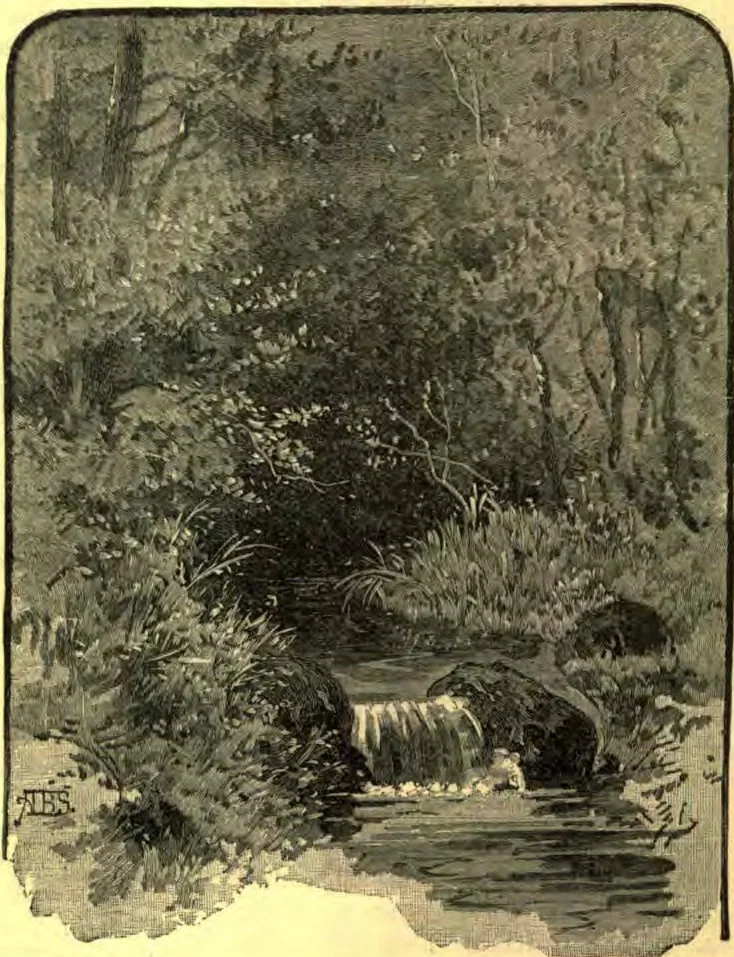
I COME from haunts of coot and hern, I make a sudden sally, And sparkle out among the fern, To bicker down the valley.
By thirty hills I hurry down, Or slip between the ridges, By twenty thorps, a little town, And half a hundred bridges.
Till last by Philip’s farm I flow, To join the brimming river; For men may come, and men may go, But I go on forever.
I chatter over stony ways, In little sharps and trebles; I bubble into eddying bays, I babble on the pebbles.
With many a curve my banks I fret, By many a field and fallow, And many a fairy foreland set With willow-weed and mallow.
I chatter, chatter, as I flow To join the brimming river; For men may come, and men may go, But I go on forever.
I wind about, and in and out, With here a blossom sailing, And here and there a lusty trout, And here and there a grayling, And here and there a foamy flake Upon me, as I travel, With many a silvery waterbreak Above the golden gravel.
And draw them all along, and flow To join the brimming river; For men may come, and men may go, But I go on forever.
I slip, I slide, I gloom, I glance, Among my skimming swallows; I make the netted sunbeam dance Against my sandy shallows.
I murmur under moon and stars In brambly wildernesses; I linger by my shingly bars; I loiter round my cresses; And out again I curve and flow To join the brimming river; For men may come, and men may go, But I go on forever.
—Tennyson.

HOW TOM CHANGED.

“Come, Maggie, let us go down to the creek now, and sail Tommy’s boat; you know he said we might if we would help him weed his flower-bed.”
Little Maggie Adams ran after her sister Kate, as the latter called her, and together they found Tommy. He was at that moment setting out for the creek with his boat, “The Jolly Skipper,” under his arm.
“Go away, girls!” he coolly exclaimed, as he heard his sisters’ request. “I want to play with my boat myself, without having you to bother me.”
“But you promised us, Tom—you know you did; you said we could have it just before dinner.”
“Well, I intended then that you should have it,” said Tommy, firmly, “but now I have changed my mind. People can’t think the same always, and there is no harm in changing a body’s mind; every one knows that.”
Tommy walked off very grandly, as if he had said a fine thing, and his disappointed little sisters felt like crying; they had worked for him a long time that warm morning.
Mr. Adams sat reading his paper near the open window, and he heard the whole talk. He started to call Tommy in, that he might talk to him of his mean and dishonorable conduct. Then he remembered that he had already done this several times before with no good result, and he resolved to try something more effectual than talk.
Tommy sailed his boat for an hour or two, and then condescended to talk to the little girls, who had come down to the water to see him enjoy himself. “Only think,” he exclaimed, “what fun I am going to have! Father is going to get me a velocipede; he almost promised he would bring it from the city to-night. He will, I am sure, for he always keeps his word; and next thing I am going to have some roller-skates.”
“Oh, I wish we had roller-skates!” cried Maggie.
“You? Nonsense!”
“It is not nonsense,” said Kate. “Ever so many girls have them.”
“Well, you won’t, if they do,” returned their brother, roughly.
That night Tom rushed down stairs from his play-room two steps at a time when he heard his father’s voice in the piazza. He pushed past his mother and the girls, shouting, “Where is my velocipede? Father, did you get it?”
“No,” returned his father, quietly drawing out a pair of skates from his coat pocket.
“Oh, you didn’t this time, but you did the next best thing. Hurrah for my skates!” Tom snatched them, and cried, “Why, they are too small! I know they are.”
“Think so, my boy? Then these are not likely to be better;” and Mr. Adams brought out a second pair, smaller still. “Try them on, little girls,” he said kindly, “and don’t be too ambitious and hurt yourselves.”
“Where are mine? Do let me see them! The girls didn’t need skates.”
“I changed my mind, Tom, and concluded not to get you any.”
“Why, father!” groaned Tom.
“And it is all nonsense your wanting a velocipede.”
“But you said I might have one.”
“I intended that you should have one when I said so; but everybody has a right to change his mind, and I changed mine,” said his father indifferently, as he turned to help the little girls fasten their skates.
Tom was too much astonished and grieved fairly to understand the full meaning of his father’s words. Never before had their father given his children the faintest hope of a pleasure or a gift, and then failed to gratify them without some excellent reason. They were proud to believe that their father was a man of honor and truthfulness. But Tom’s eyes were opened in the next two or three days. His weekly pocket-money was not forth-coming, because his father had not the exact amount, and he had changed his mind about giving it to him, anyway. His mother failed to buy him a new suit he was expecting, because she had “changed her mind.”
“Oh, how Tom came to hate those words! He was quick enough to learn the lesson now that it was for him to learn that such mind-changing as his had been was mean and selfish, and contrary to the golden rule.
By Saturday night, Tom was a much meeker and better boy, and from that day he was careful to have good reason for so doing whenever he found it necessary to “change his mind.”—The S. S. Visitor.

ABOVE HIS BUSINESS.

In Scotland there is a branch of the legal profession known as “Writers to the Signet.” A young gentleman was apprenticed to one of these writers. The youth thought himself a very fine sort of person, much above ordinary apprentices.
One evening the master desired him to carry a bundle of papers to a lawyer whose residence was not far off. The packet was received in silence, and a few minutes after, the master saw a porter run into the outer office. Pretty soon the youth walked out, followed by the porter carrying the parcel.
Seizing his hat, the master followed, and overtaking the porter, relieved him of the packet, and walked in the rear of the apprentice. The lawyer’s house reached, and the door-bell rung, the youth called out,—
“Here, fellow, give me the parcel,” and slipped a sixpence in his hand without looking behind him.
“Here it is for you!” exclaimed a voice which caused the youth to turn around. His confusion, as he beheld his master, made him speechless. Never after that was he above his business.— Selected.

EDITOR'S CORNER.

In the Roman Catholic church, a woman who shuts herself away from the world, and vows to devote her life to virtue and religion, is called a nun, or “sister of charity.” The house in which she lives is called a nunnery, or cloister. A man who takes such vows upon himself is called a friar, or monk; and his place of residence is called a monastery. Possibly some of you may have seen a sister of charity. If you have, you will remember her peculiar style of dress. Some of them are called black nuns, and some gray nuns, according to the color of their dress and the number of vows they have taken.
One class of nuns go barefoot a part or the whole of the year, hence they are called barefooted nuns. There are said to be twenty-five orders of barefooted nuns. A contributor to the Paris Figaro writes concerning one little-known order of them called “Barefooted Clares.” He says: “These ladies possess a cloister in Paris, in which there are eighteen nuns and a few lay sisters who act as their servants. Fourteen of the present number of nuns are under twenty-three years of age; and the reason most of them are so young is that the rule of the Clares is so very severe that nearly all the professed inmates die young.
“This order of nuns wear a rough woolen dress, with a rope as girdle; they go barefoot on the cold stone flooring; they never warm themselves at a fire—even the kitchen fire is placed where they cannot come near to it; they eat meat only once a year; they sleep on a narrow board; they must spend ten hours every day upon their knees; they live entirely upon charity; and they are only allowed to speak to one another upon rare occasions. The abbess, who has charge of them, through a grating assured me that more than one of her nuns, by her long silence, had actually lost the power of forming a sentence.”
Dear readers, what do you think of a religion whose teachers, claiming to be Christians, forbid the reading of the Bible by its millions of followers? Individuals are thus kept in ignorance of the true plan of salvation, and are taught that they can live holy lives only by inflicting upon themselves severe torture.
Other millions of the human family worship gods, “the work of men's hands,” which can neither see, hear, nor walk; “neither speak they through their throat.” The heathen are very zealous, and withal very superstitious; and in order to calm the anger, or gain the good will, of their gods, they make great sacrifices, oftentimes giving their own lives to be destroyed.
There are many false systems of religion; and, oh! how many people are “destroyed for lack of knowledge,” who might have life. By contrasting the condition of these deceived persons with our own, we can better appreciate the benefits which come from living in a land of Bibles and Christian institutions. That we are so highly favored when others are groping in darkness, makes our debt of gratitude very great. If we improve our privileges, we may have eternal life; if we overlook or neglect them, many will rise up in the Judgment and condemn us. Let us serve the Lord in his appointed way, and improve every opportunity to extend the light of truth to others. M. J. C.

IN SPRINGTIME.

Oh! I say, have you heard, in the sweet, fragrant woods, The tale which the south wind is telling? How the trees are preparing to put on new robes, And the little, brown buds are all swelling?
How the streamlets are trickling and tinkling along, Set free from the fetters that bound them, And the mosses and grasses are donning their green, A pattern to all things around them?
How the flowers, hid under the blanket of leaves, Are bidding each other good-morning, And smiling and whispering there in the dark, Each weaving her proper adorning?
The violet’s purple, the pink of the rose, The white of the lily are growing; And faintly, methinks, comes the odor of each On the breath that the breezes are blowing.
Oh! come, let us go to the sweet, fragrant woods, And list to the wonderful story; The reign of dark winter is over and gone, And springtime is here in her glory.
—S. J. J., in Arthur’s Home Magazine.

INCIDENTS IN THE LIFE OF SIR ISAAC NEWTON

Written for the Instructor.

INCIDENTS IN THE LIFE OF SIR ISAAC NEWTON.

Newton is said to be “the most remarkable mathematician and natural philosopher of his own or perhaps of any other age.” He was born the year that Galileo, the great Italian philosopher, died.
He was a gentle, affectionate, and thoughtful boy, loved by all who knew him. As a man, he was a believer in God and the Bible.
On the day that Oliver Cromwell died, a great storm raged all over England. It was on this day, when Newton was sixteen years of age, that he made his first purely scientific experiment. To find the force of the wind, he first jumped with the wind, then against it; then by jumping on a calm day, and comparing, he was able to compute the force of the storm.
One time, at a dinner in London, given in honor of the French ambassador, some of the English guests were in doubt which ought to be toasted first, the king of England or the king of France. Then Sir Isaac settled the matter by saying, “Let us drink the health of all honest persons, to whatever country they belong. We are all friends, because we unanimously aim at the only object worthy of man, which is the knowledge of truth. We are also of the same religion, since, leading a simple life, we conform ourselves to what is right, and we endeavor sincerely to give to the Supreme Being that worship which, according to our feeble lights, we are persuaded will please him most.”
When James II. was trying to make England a Catholic country, Newton opposed the measure with much earnestness.
He was a great man, but just before his death he said, “I do not know what I may appear to the world, but to myself I seem to have been only like a boy playing on the seashore, and diverting myself in now and then finding a prettier shell than ordinary, whilst the great ocean of truth lay all undiscovered before me.”
On his monument are these words:—
“Here lies Sir Isaac Newton, who, by a vigor of mind almost supernatural, first demonstrated the motions and figures of the planets, the paths of the comets, and the tides of the ocean; a faithful interpreter of nature, antiquity, and the Holy Scriptures. Let mortals rejoice that there has existed such and so great an ornament to the human race.”
John R. Calkins.

BIRDS ON THE FARM.

Mr. Trouvelot, of Medford, Mass., being engaged in raising silk-worms for the production of silk, had abundant reason to notice and remember what kind of food our American robin redbreast prefers.
His inclosure of seven or eight acres, where the worms were fed, was covered with netting to protect them; but birds would occasionally break in, and of these there were at least ten robins, he said, to one of any other kind. It was the season of small fruits, and huckleberries abounded in the fields close by; but when he opened the crop of each robin killed in his inclosure, he found nothing at all but insects.
To test their destructiveness in this direction still further, he exposed a thousand of his silk-worms on a scrub-oak, which he caused to be watched. In three or four days the worms were all gone. The robins, with some help from the cat-birds, had eaten them every one. Mr. Trouvelot, though a loser himself, gave the result of his experiment for the farmer’s benefit.
The robin belongs to the thrush family, all of whom are enormous insect-eaters; but the redbreast beats them all in the number of kinds he devours.
A son of Mr. Wilson Flagg caught three young robins, and fed them with angle-worms and soaked bread. They soon died. He caught three more, and fed them with angle-worms and a little fruit. Two of these died, and then his father told him to give the survivor insects to eat, and a variety of them. Accordingly, all sorts of beetles, moths, grubs, bugs, vine-worms, chrysalids, and caterpillars were procured, and laid before the bird. He ate them all, and soon recovered his health. He always killed them before he swallowed them, and once when a hard beetle failed to “set well” in his crop, he threw it up, and gave it another thorough pounding, after which he swallowed it again.
It has been proved that a growing young robin requires considerably more than his own weight of animal food every day; and during the season of rearing their young, the old birds forage almost exclusively upon insects. A single one has been known to kill eight hundred in one day.
Farmers and horticulturists who lose patience with the robins, because they sometimes touch their cherries, strawberries, and grapes, can afford to heed the advice of the naturalists before they strike down such pretty birds. “It does no harm to put up scare-crows in your trees and gardens to keep them away, but it hardly pays to kill them.”
The redbreast is not only poetically but literally the friend of man.—Youth’s Companion.

Finding Hidden Blessings in the Bible

The Bible is a great treasury of reserved blessing. There has not been a chapter, a line, or a word added to it, since the pen of inspiration wrote the final Amen; yet every new generation finds new things in the Holy Book. The history is the same also in all individual experience. As children, we study the Bible and count its words, but many of these words have no meaning for us. The light, the comfort, or the help is there, but we do not see it. The truth is, we cannot see it until we have larger experience, and a fuller sense of needs. Every earnest Christian who has lived many years, knows how texts with which he had been familiar from childhood, but in which he had never before seen any special preciousness, all at once, in some new experience of need or trial, flash out like newly lighted lamps, and pour bright light upon his path. The light was not new; it had shone there all the while, but he could not see it until now, because other lights were shining about him, obscuring this one. God's store-houses of spiritual truth never are opened to us until we really need their blessing. They are placed, so to speak, along our life-path, the right supply at the right point. By the plan of God, in every desert there are oases. At the foot of each sharp, steep hill there are alpenstocks for climbing. In every dark gorge there are lighted lamps. At every stream there is a bridge. But we find none of these till we come to the place where we need them.—S. S. Times.

A GOOD FOUNDATION.

Do you want to know what is the first quality of manhood? It can all be told in one little word of five letters; and that word is “truth.” Truth is the only foundation on which can be erected a manhood that is worthy of being so called. Truth must be the foundation on which the whole character is to be erected, for otherwise, no matter how beautiful the upper stories may be, and no matter of how good material they may be built, the edifice, the character, the manhood, will offer no sure refuge and protection to those who seek it, for it will tumble down when trial comes.
The world is very full of such shams of manhood, in every profession and occupation. There are lawyers in this town who know that they have never had any training to fit them for their work, who yet impose upon the people, and take their money for giving them advice which they know they are unfitted to give. I heard of one lately who advised his partner “never to have anything to do with law books, for they would confuse his mind.”
There are ignorant physicians who know that they are ignorant, and who can and do impose upon people more ignorant than themselves. There are preachers without number, pretending to know what they never learned. Don’t you see that their manhood is at best but a beautiful deceit?
Boys, be men, and that you may be such, first and foremost be true, thoroughly true. Scorn to tell a lie; despise all sham, all pretense, all effort to seem to be otherwise than you are.
When you have laid that foundation, then you can go on to build up a manhood, glorious and Godlike, after the perfect image of Him, the perfect Man, who said that he was born that he might bear witness to the truth.—Bishop Dudley.

Verses on Conscience, Duty, and Faith

Know this, too, before you are older, And all the fresh morning is gone: Who puts to the world’s wheel a shoulder Is he that will move the world on!
To conscience be true, and to man true; Keep faith, hope, and love in your breast; And when you have done all you can do, Why, then you may trust for the rest.—Gary.

Sabbath School Notes Referenced in Review

☞ For notes, see the S. S. department in the Review for May 13.

NEW-TESTAMENT HISTORY.

LESSON 137.—PAUL BEFORE AGRIPPA.

1. WHEN Paul was brought before Agrippa, how did the king address him? Acts 26:1.
2. How did Paul respond?
3. Why was Paul especially pleased at being permitted to speak before Agrippa? Verse 3.
4. What favor did Paul ask of him?
5. What had been Paul's manner of life from his youth up? Verses 4, 5.
6. Who among those present could testify to this fact if they would?
7. For what was Paul now called to give account? Verse 6.
8. What was this hope?—The hope of eternal life through a resurrection from the dead.
9. How did Paul show that he was not alone in cherishing this hope? Verse 7.
10. What pertinent question did he ask? Verse 8.
11. What error had Paul formerly cherished? Verse 9.
12. What had this erroneous belief led him to do? Verse 10.
13. To what extreme cruelties did it finally lead him? Verse 11.
14. What distant mission did he finally undertake?
15. While on his journey, what did he see at mid-day? Verse 13.
16. What effect did this brilliant light have upon Paul and all those that were with him?
17. What did he then hear? Verse 14.
18. What question did Paul ask? Verse 15.
19. How was the question answered?
20. What did Jesus tell Paul to do? Verse 16.
21. For what purpose had he appeared to him?
22. From whom had he promised to deliver him? Verse 17.
23. To whom was he to be sent?
24. What work was he to do for them? Verse 18.
25. How did Paul receive this message? Verse 19.
26. Where did he first labor? Verse 20.
27. Where did he afterward go?
28. What did he teach them?
29. What did this cause the Jews to do? Verse 21.
30. How had he, up to that time, been enabled to escape their fury? Verse 22.
31. How had he shown his faithfulness?
32. What only had he taught?
33. What were these things that Moses and the prophets had said should come to pass? Verse 23.
Continue reading: STORY OF THE SEA