“Open thy doors, O Lebanon, that the fire may devour thy cedars. Howl, fir tree; for the cedar is fallen; because the mighty are spoiled. Howl, O ye oaks of Bashan; for the forest of the vintage is come down.” Verses 1, 2.
HERE is foretold a work of destruction. In verse 3 the voices of the howling shepherds and of the roaring lions are heard, because their glory and pride are spoiled.
The remainder of the chapter shows that all this is but a figurative description of a condition which will exist among the people. There are brought to view in the chapter: A flock of the slaughter, two staves which are broken, three shepherds who are cut off, the weighing of the price of our Lord, and a foolish shepherd.
“And I will feed the flock of slaughter, even you, O poor of the flock. And I took unto me two staves; the one I called Beauty, and the other I called Bands, and I fed the flock.” Verse 7.
The staves therefore represent something by which God would feed the flock. In verse 11 where the thought of feeding the flock is repeated, the Septuagint reads: “And the Canaanites or Gentiles, the sheep that are kept for Me, shall know that it is the word of the Lord.” Then both Jews and Gentiles who are God’s children are to be fed. Jesus said: “Man shall not live by bread alone; but by every word which proceedeth out of the mouth of God.” And Peter tells us that we should “as newborn babes desire the sincere milk of the Word that we may grow thereby.” So the Word of the Lord is that with which we must be fed.
The Rejection of Israel.
God chose Israel, and by the mouth of prophets gave them His Word, that they might give this Word to the people of the world. Israel, then, was the first staff by which He proposed to feed the flock. He called the first staff Beauty; and indeed if Israel had met the mind of God it would have become a staff of beauty in His hand, for said the Lord by the prophet Isaiah: “Thou shalt be a crown of glory in the hand of the Lord, and a royal diadem in the hand of thy God.” “And the Gentiles shall see thy righteousness, and all kings thy glory.” “And the Gentiles shall come to thy light, and kings to the brightness of thy rising.” “Mine house shall be called an house of prayer for all people.” And the glory of the Lord shall cover the earth as the waters cover the sea. But as we have seen, Israel was not faithful to the trust. They appropriated the blessings of God to themselves. They came to believe that salvation was for themselves only, and would not feed the flock. So, to carry out His purpose, God was compelled to cut that first staff asunder.
“And it was broken in that day; and so the poor of the flock that waited upon Me knew that it was the word of the Lord. And I said unto them, If ye think good, give Me My price; and if not, forbear. So they weighed for My price thirty pieces of silver. And the Lord said unto me, Cast it unto the potter; a goodly price that I was prized at of them. And I took the thirty pieces of silver, and cast them to the potter in the house of the Lord.” Verses 11–13.
How graphically here is described the offer of Judas to sell the Saviour, the priests and Levites setting a valuation of thirty pieces of silver for the life of the promised Messiah, the Son of God, and the money finally paid for the potter’s field in which to bury strangers.
In connection with these events the first staff is cut asunder, or Israel is rejected as the chosen nation to represent God in the world, and by their fall salvation came to the Gentiles.
“And I took My staff, even Beauty, and cut it asunder, that I might break My covenant which I had made with all the people.” Verse 10.
The covenant which God has with all the people is the covenant of grace in Christ Jesus. It was by virtue of this covenant that God had accepted the Jews as His chosen people, but there is a limit to God’s forbearance in His dealings both with individuals and with nations.
When the Jewish nation openly and wilfully rejected Jesus, the One through whom this mercy was extended to them, it was necessary for God to cut them off, for had He continued to hold them in the same sacred nearness to Himself after that act, He never could, without discriminating and showing respect to persons, set any one aside. Therefore the cutting off of the Jews is an assurance that God will cut off all who finally reject Christ. And again the destruction of Jerusalem and the rejection of that people become a type of the rejection and destruction of the whole world when they shall have rejected Christ. Thus we find that we are brought down to the first advent of Christ, and the rejection of the Jews for the cutting asunder of the staff.
A Prophecy of the Last Days.
That this prophecy includes in its range the end of time will be seen in the fact that the close of probation and the condition of strife and confusion which will follow the withdrawal of God’s Spirit from the world, are brought to view in verses 6 and 9, which read as follows:
“For I will no more pity the inhabitants of the land, saith the Lord; but, lo, I will deliver the men every one into his neighbor’s hand, and into the hand of his king; and they shall smite the land, and out of their hand I will not deliver them.” “Then said I, I will not feed you; that that dieth, let it die; and that that is to be cut off, let it be cut off; and let the rest eat every one the flesh of another.”
In connection with this time of confusion when every man’s hand shall be against his6neighbor, we have presented in verse 8 the cutting off of three shepherds in one month, and in the closing verses of the chapter, the cutting asunder of the second staff, and the raising up of a foolish shepherd. While running throughout these experiences we find “the flock of the slaughter” brought to view, and the assurance given that God will feed them. To assist in the understanding of these symbols we will notice other scriptures which describe the same experiences. After the rejection of the Jews, God sent out the call to the Gentiles, and they, by accepting Christ, became God’s people and the depositories of God’s truth, to be dispensed by them to the world. This was expressed by the apostle James at the great council held in Jerusalem in A. D. 51, as we read in Acts 15:14–17:—
“Simeon hath declared how God at the first did visit the Gentiles, to take out of them a people for His name. And to this agree the words of the prophets; as it is written: After this I will return, and will build again the tabernacle of David, which is fallen down; and I will build again the ruins thereof, and I will set it up; that the residue of men might seek after the Lord, and all the Gentiles, upon whom My name is called, saith the Lord, who doeth all these things.”
Thus we see that the church of believers, composed of both Jews and Gentiles, became the second staff in God’s hand by which He would feed the world with His Word of truth. As we see the Christian church, composed as it was of Jews and Gentiles, Greeks and barbarians, Cythians, bond and free, and yet so bound together that they were one, we can see the force of the expression, “and the other [second staff] I called Bands,” or binders.
What a picture God’s church presented before the world, made up of various nationalities, as it was, and yet so united that no man called aught that he had his own; that all could with gladness and singleness of heart eat bread from house to house. Baptized with the Holy Ghost, the love of God shed abroad in their hearts, and speaking the Word with power—what a revelation of God’s love and truth was seen in that early church. No wonder the knowledge of God in His Gospel spread rapidly among men, when each believer was a living epistle, showing forth the praises of the One who had called them to glory and virtue.
Apostasy in the Christian Church.
But alas! Divisions crept in. Even in Paul’s day every one said, I am of Paul; I of Apollos; I of Cephas; and I of Christ; so that Paul asks: “Is Christ divided? or were ye baptized in the name of Paul?” Thus unity departed, and glory faded away. Man was exalted, and the banner of truth trailed in the dust. The church lost her power, having forgotten her true source, and, to avert the confusion which prevailed, she courted the civil power, that she might be made the head of all churches, and the corrector of heretics. Then the church sought to restore her lost unity by using the civil power to coerce men.
The dungeon, the rack, the fagot, and the sword were employed in the professed service of the Prince of Peace. The cries, the groans, and the shrieks of the tortured and dying reached unto heaven, and the answer came back, “He that leadeth into captivity shall go into captivity; he that killeth with the sword must be killed with the sword.” This plainly foretold the downfall of the church which had turned to the civil power for strength and support. The time came when men saw the inconsistency of wielding the sword, and at the same time claiming to be followers of Him who said, “Put up thy sword into its sheath.” “My kingdom is not of this world; if My kingdom were of this world, then would My servants fight.”
Reformation and the Creeds.
The Reformation of the sixteenth century attacked the tyranny of the Papacy. Its hideous inconsistencies were dragged to the light and exposed; its sanctimonious robes were torn asunder, and its hypocrisy revealed; its claims of divine authority, under which it carried on its inquisition and persecution, were examined in the light of God’s Word, and found to be of Satanic rather than heavenly origin. In the revolution which followed, the church went down under the deadly wound of 1798, when the forces of France entered the eternal city, and led the pope into captivity, in which he died.
The Reformation placed the Bible in the hands of the people, and a flood of light poured out upon the world. But as light was given, men wrote it out as an expression of their faith; and as it was in advance of what they had formerly known, they became satisfied, and adopted it as a creed. Then around that creed they crystallized, and finally fossilized. This shut out the leading of the Holy Spirit, and God was compelled to use new reformers, through whom to bring out more light. But alas! history repeats itself, and a new creed with a new sect is the result. Thus we have to-day creeds by the score, and sects by the hundred, and the world is a babel of confusion.
Once again men are inquiring, How can Gospel harmony be restored? How can that unity, that oneness described by the Master, when He prayed that His children might be one, even as He and the Father were One, be made to prevail among them?
A Union Not of God.
God, by the mouth of the apostle John, in Rev. 13:3, 10, etc., foretold the captivity and deadly wounding of the first beast in one of its heads (union of Church and State), and that there would arise at that time a new power which would make an image to this beast which had received the deadly wound and was healed. This prophecy calls for a restoration of the papal power in the world, so that once more it shall exert the same influence in Catholic countries as formerly, while in Protestant countries there would be found an image to this power.
The head was wounded. A head is defined in Rev. 17:9, where we read: “The seven heads are seven mountains, on which the woman sitteth.” A mountain is a symbol of a government; a woman a symbol of a church. A head of the dragon or beast is a government upon which the church sits to control or guide—a union of Church and State.
As we view the first head we find that the union there existing consisted in the church exerting such an influence that the civil power was used to enforce its dogmas upon the people, and this was carried to such an extent that men were imprisoned, tortured, and put to death.
In the image we shall see the church (not the Catholic, for that would be the beast itself and not an image) influencing the government to use its power to enforce upon men certain doctrines of faith held in common by both Protestants and Catholics, and as these are enforced, men are compelled to worship the first beast.
Rev. 13:15–17 teaches that laws will be enacted so that no one will be permitted to buy or sell, save he that has the mark of the beast, and that all shall be put to death who do not worship the image.
Increasing Influence of the Papacy.
As we look about in the world to-day, we see the Papacy rapidly coming to a place of power and influence. In our own country she is also making long strides toward a leading place among the denominations of the land. The Protestants are seeking to effect a union upon certain common points of faith, and are courting the favor of the Catholics in these efforts. Especially is this noticeable in the matter of enforcing more strict observance of Sunday as a substitute for the seventh-day or Bible Sabbath; and this, too, in the face of the fact that there is no commandment in the Scripture enjoining its observance—a fact freely admitted by the Catholics, who claim Sunday-keeping as a sign of their authority to change the law of God.
When, under the combined influence of Protestants and Catholics, a decree of death shall be passed against all who will not yield to this power, the company thus sentenced will constitute in a special sense “the flock of the slaughter.” This decree will gather together all of God’s people, and at the same time it will sift out from among them all hypocrites. The Lord foretold this in Micah 2:12, 13, where He says:—
“I will surely assemble, O Jacob, all of thee; I will surely gather the remnant of Israel; I will put them together as the sheep of Bozrah, as the flock in the midst of their fold; they shall make great noise by reason of the multitude of men.”
Bozrah signifies not only a sheepfold, but also a place of slaughter, for in Isa. 63:1–3, dyed garments from Bozrah are shown to be garments sprinkled and stained with blood from the slaughter. So the remnant of Israel by this decree will be shut up, as it were, in a slaughter-pen. In this condition, with the multitudes against them, they will make a great noise, crying day and night for deliverance, and they shall be delivered, for in the following verse we read:—
“The breaker is come up before them; they have broken up, and have passed through the gate, and are gone out by it; and their King shall pass before them, and the Lord on the head of them.”
Here a strong one is represented as breaking the pen and letting out the sheep. So Christ, the mighty One, on whom God has laid help, will come, and, bursting the bars, will set free all the sheep of His fold, with those who are in the tomb, and those who are under the sentence of death; and, passing up before them, will lead them to a condition beyond the power of death.
“Then I cut asunder Mine other staff, even Bands, that I might break the brotherhood between Judah and Israel.” Verse 14.
After the revolt of the ten tribes, God’s people in the divided state were called Judah and Israel. Then these terms, as applied in the last days, represent the division of God’s people or Babylon. As we have shown, there is to be effected among them a brotherhood or union, and the power of this brotherhood is to be directed against God’s people. God will cut them off by the withdrawal of His Spirit, and the spirit of confusion will come in, and every man’s hand will be against his neighbor, and this brotherhood will thus be broken up for the deliverance of God’s children.
“Three shepherds also I cut off in one month; and My soul loathed them, and their soul also abhorred Me.” Verse 8.
The three powers leading and controlling the people of the world at the close of time are spoken of under the symbols of the dragon, beast, and false prophet. Rev. 16:13. A study of the preceding chapters will give the following interpretation; dragon, a symbol of Paganism; beast, a symbol of Papacy; false prophet, a symbol of apostate Protestantism. In a brief space of time just before the end, these shall be cut off, and the foolish shepherd will lead the deluded nations in person. This foolish shepherd is Satan himself, for whose coming Spiritualism is even now preparing the way. These points will be considered more fully in the study of the succeeding chapters.
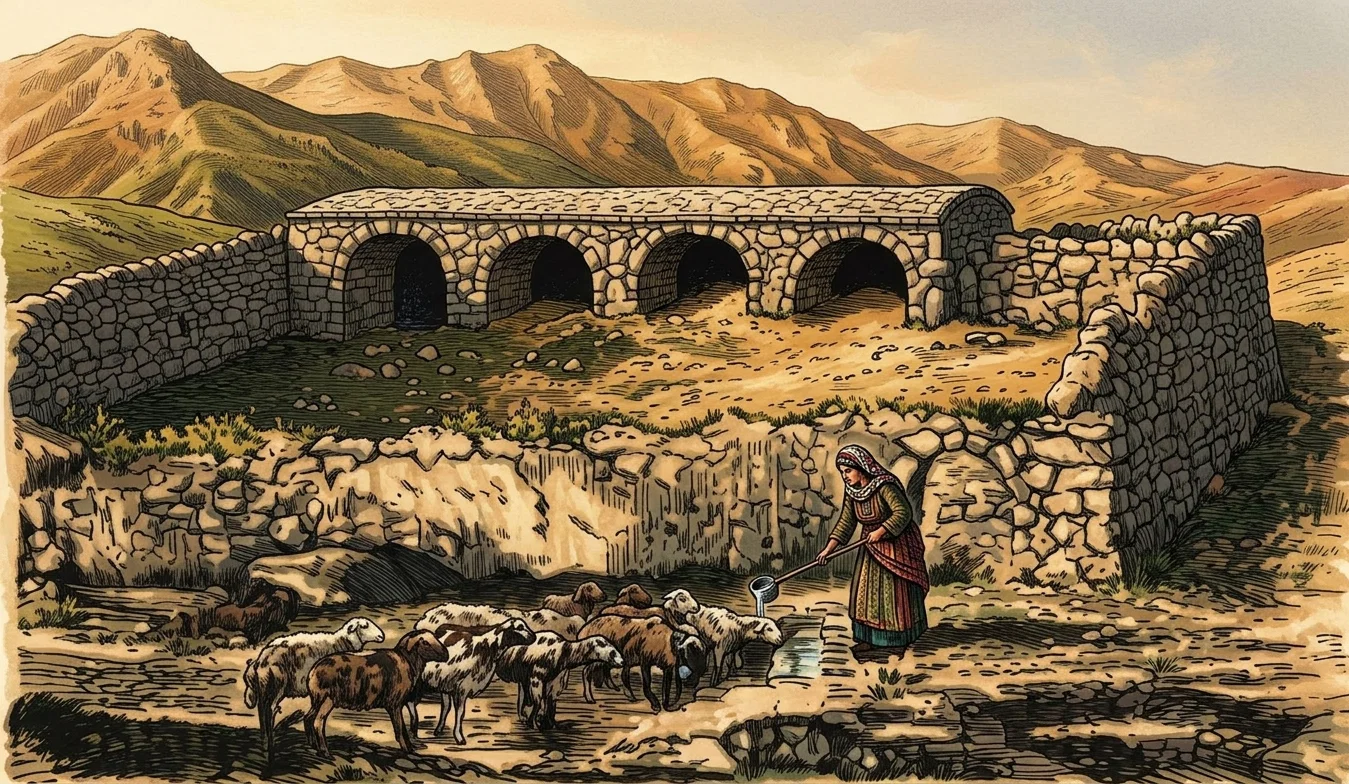
An Eastern Sheepfold.
IS THE BRIDGE-GUARD AWAKE?
By Edison Driver
“Frightful Wreck. Agreeable Stranger Gives Guard Drugged Wine. Tears up Bridge Rails. The Northbound Passenger Plunges to Destruction. An inhuman wretch, for mere personal grudge against the P. & R. R. Co. sacrifices twenty innocent lives.”
These headlines tell truly a terrible story. How our indignation rises against the man who could be led to drink while at the post of duty. We condemn and despise his weakness. The gratification of his own appetite cost the most precious thing in the world—life.
The guard on the bridge, the stranger insane in his anger, and the drugged wine are all tangible things to us, and we grasp them with clearness. But there is more than one bridge-guard, more than one stranger, and more than one bottle of wine. We know that there is a power in the earth that has an insane grudge against God; we know that there are millions of men and women making the journey of life; we know that there are bridges across a thousand chasms; but do we know that God has stationed us as bridge-guards, one and all, saying, “Be sober, be watchful”? And do we know that anything which makes prayer distasteful, or God’s Word insipid, is drugged wine? Do we?
EDISON DRIVER.
ADRIFT ON THE SEA OF LIFE.
By Louis Albert Banks
[Dr. Louis Albert Banks in The Sunday School Times.]
A tree adrift in the middle of the Atlantic Ocean is a rare sight reported by Captain Freeman of the British steamer Sidra, which recently arrived in port, according to the Baltimore American, from a voyage in the Mediterranean. It was early morning, when in 35° 19' North and 38° 22' West, that an unusual-looking object was seen floating ahead of the steamer. Those on the ship’s bridge made out the trunk and limbs of a tree about twenty feet long, canted to one side, and the roots sticking out of the water. The body of the tree had been bleached white by the sun, and it was covered with barnacles. It evidently reached the sea by being washed down some Atlantic Coast river in a freshet. Many months ago a tree with green foliage, standing upright, was seen off Cape Henry, and the captain of the Sidra has no doubt that the bleached and spoiled tree he saw was the same, after having drifted about on the ocean many thousands of miles. There are many men and women like that tree. They live lives without purpose. They do not choose their course, and then with persistent effort and divine help set sail for it. Men who have made great success of life are men who, like Moses and Joshua, have the wisdom to choose their course, and then follow it to the end.
Those Who Act and Those Who Question
THE human race is divided into two classes—those who go ahead and do something, and those who sit and inquire, “Why wasn’t it done the other way?”—O. W. Holmes.
A DOUBTFUL COMPLIMENT.
By G.
In this city recently the Y. M. C. A. managers gave a banquet to business men for the purpose of eliciting their material support of the proposed new building enterprise of the association. Among the speakers was U. S. Senator Perkins, and a striking sentiment of his address was the following:—
Commodore Jack Phillips was a Y. M. C. A. man. His record needs no words of praise. He said that men turned out from the Young Men’s Christian Association made the best fighters. He himself was a proof of that assertion.
Making “the best fighters,” from the standpoint of a naval officer, hardly comports with the inspired idea of Christian qualification. We should hope that such is not the ideal of the Y. M. C. A. The Word of God says: “We [Christians] wrestle not against flesh and blood, but against principalities, against powers, against the rulers of the darkness of this world, against spiritual wickedness in high places. Wherefore take unto you the whole armor of God, that ye may be able to withstand in the evil day.” Eph. 6:12, 13. The armor of God is designated as the “breastplate of righteousness,” “feet shod with the preparation of the Gospel of peace” (not a “preparation” for war), “the shield of faith,” “the helmet of salvation,” “the sword of the Spirit, which is the Word of God,” and these supplemented by persistent prayer. In addition to this positive designation, we have the emphasis of the negative side: “The weapons of our warfare are not carnal, but mighty through God to the pulling down of strongholds.” 2 Cor. 10:4. This refers to spiritual strongholds, as we learn from the fact above stated that we wrestle with “spiritual wickedness.”
Yes, it is a doubtful compliment to a “Christian” association to say that it makes “the best fighters” in the world’s battles, the most expert participants in the work of destroying the lives of men whom Christ gave His own life to save. Luke 9:56, Can it be true that the so-called “Christian nations” are looking to “Christian” associations for recruits in the work of destroying life in these times when universal war is becoming more and more imminent, and that they are looking to these sources of supply because they “make the best fighters”? God forbid! Can it be true that the fighting officials of the government are correct in this estimate of men who receive their training in “Christian” associations? If this be true, is there not something wrong with the professed Christianity of the times? Surely here is something for Christians to think about. G.
HOW THEY MEET IT.
ONCE the evangelical, Christian world, almost to a man, held to the eternity, the perpetuity, the immutability, of the moral law of God, summarily comprehended in the Decalogue. It was taught by creed and council, by pulpit and press. True, they transgressed the Fourth Commandment every week, but ignorantly. They supposed they kept it in observing Sunday. In some not clearly definable way, on the part of the majority, they supposed that the commandment had been perpetuated, tho the weekly Sabbath had been changed. They really observed in spirit the Sabbath of the Lord, and the Lord did not condemn them. See John 15:22.
When the fulness of time came—in these days— God sent forth to the world the great reform message found in Rev. 14:6-14; Isa. 58:1-12, and other scriptures. That message calls attention to the one acceptable service and worship of God, to the departure from truth on the part of His people, and restores again “the commandments of God and the faith of Jesus” among His people. Of course, in this question was involved that of the Sabbath. It was shown that it had been ignorantly trampled under foot, that its place had been usurped by an institution falsely called Christian; and that the observance of the law, the following in the footsteps of Jesus, demanded the keeping of the seventh day. For a time many still tried to hold to the law, and argue for a change of day. But this has grown more and more manifestly untenable. It is not hard to see that, if God’s law demands any duty, it as truly demands the observance of the seventh-day Sabbath.
In this plight but two ways were open before the Sunday-observer: He could accept the obvious truth that still “the seventh day is the Sabbath of the Lord,” as the eternal law declares and Jesus affirmed in teaching and life, or he could fall back on the theory that God’s law is abolished, made null and void,—a theory which leaves the universe without a law, and with a God who is “altogether such an one” as mortal, changeable man.
Not a few have accepted the truth to the peace and joy of their own souls. Many, led by trusted religious teachers, have accepted the latter. Passages which speak of laws and commandments which were necessarily limited, typical, ceremonial, or civil, have been confounded with other passages which refer to the immutable Decalogue; and people have been made to believe that all is abolished because certain laws have expired by limitation. Reader, believe it not. God is King. His unchangeable law still abides. He has not abdicated His throne, nor subjected His holy law to the legislative fancies of imaginative moral world-builders. The death of Christ was not in vain. It is true that He gave Himself for us, that He might redeem us from all iniquity (lawlessness, law-breaking), and purify unto Himself a people “zealous of good works.” He takes the law under which the sinner stood condemned, and writes it in the believer’s heart, a strength, a joy, forever.
Do you wish to learn all about the different systems of law noticed in the Word of God?—Then read E. J. Hibbard’s “Two Laws,” just out by this publishing house. It will, if you are satisfied with Scripture evidence, settle the question forever.
THANKFULNESS
The truly thankful to God will be thankful all the time. His thankfulness will not find expression merely for a moment, or an hour, or a day; it will be a perennial plant, ever blooming, ever bearing fruit, ever striking more deeply its roots into the great subsoil of the constant recognition of God’s goodness and unvarying bountifulness. “What shall I render unto Jehovah for all His benefits toward me?” should be the constant heart-question of those who are daily, hourly, momently receiving His blessings. The inspired answer implies the same constancy on the part of the receiver: “I will take the cup of salvation, and call upon the name of Jehovah. I will pay my vows unto Jehovah, yea, in the presence of all His people.” “In everything give thanks,” writes the apostle Paul; “for this is the will of God in Christ Jesus concerning you.”
The thankful person will be a doer. The thankful Christian will endeavor to please Christ, to seek out God’s will that he may do it; neither will he do this that he may pay God for His rich bountifulness. That can not be done. The Christian will appreciate the great fact that he owes all to God, and that the most and best that he can do is but a token, an expression, of thanksgiving to the great Giver of all.
Then, fellow pilgrim, let us ever recognize God’s goodness, and make each day a day of thanksgiving; “giving thanks always for all things in the name of our Lord Jesus Christ to God, even the Father.”
GIVE OR TAKE.
By S.
THERE is a world of difference between the two—an infinity of difference. Some take, that they may give again; and some give, that they may get again—a world of difference here also. The one is in the order of God. The other is the inspiration of self-service. And still it is right to give, and it is right to take. The right or wrong of the act depends upon what we take and why, what we give and why. We can give that which is good—give it for the good it will do, give it that he to whom it is given may pass it along, so letting the good deed flow on like a silvery stream through a thirsty land, blessing and re-blessing, cheering the dreary wastes of discouragement, and strengthening the heart crushed under a weight of woe. Or we can give that which is evil, and see it take its course down through the world like a withering stream of fiery lava, searing, burning, and burying everything in its path. We can give the unkind word, repeat the unkind story, and see it go on its way like a pestilence stalking through the land leaving behind it desolation, ruined homes, blighted hopes, and death.
And so likewise we can take for good or take for ill. God’s hands with blessings full are reached out to us day and night. Are you taking them to use in helping others, thus giving again what God has given you, making an ever-flowing stream of blessing? or are you hoarding them to yourself to gather the rust of pride and the moth of jealousy, thus choking up the stream of good which God designed should flow from your possession of His gift? Which is it? Ask yourself, and analyze your answer.
Sin is the interference of lawlessness with God’s great purpose of good. If we hoard to our own use and purpose the blessings of which God has made us stewards, we are thwarting the purpose of the Infinite—to do which is sin, and to desire to do which is rebellion. God could brush us out of His way as we brush a gnat from our windowpane; but His purpose is deeper, broader, and holier than that. His purpose includes our triumph over sin as well as His. It includes the formation of a righteous character in us, and that must come by test and trial; and by these means we prove whether we are trustworthy of eternal life.
We are not compelled even to take the good. We can take it if we choose; or if we choose, we can take the evil, and not only take that, but pass it along, as well. Instead of making ourselves fountains of blessing because God’s purpose is flowing through us, we can turn our whole lives into fountains of poison like the death springs of the desert around whose deceptive brinks lie the death-stricken carcasses of those who had gone there to drink. Which shall it be? You can make it which you will. You can choose life or death for yourself, and you can be the minister of either. It depends upon what you take and why you take it; what you give and why you give it.
Ask God to help you to choose aright, both in the taking and the giving. Put yourself on His side, in harmony with His purpose, and so be a power in His hands for good. S.
Question Corner
By Editor
NOTE.—We wish those who ask questions to take particular notice: (1) Only such questions will be answered here as we believe to be of general interest and information. (2) We can not undertake to explain from four to a dozen scriptures, as in one sentence we are often requested to do. (3) Do not ask to “explain” a certain text or passage. State clearly the point in question. (4) Give full name and address, not for publication unless desired, but as evidence of good faith, and to give us the privilege of replying by letter if deemed best. (5) Unsigned communications of any kind find the quickest way to the waste-basket. (6) It is always well to inclose stamp. (7) “Foolish and unlearned questions avoid,” also those that minister to mere curiosity. (8) Study the Scriptures yourselves.
Please explain Gal. 5:14: “For the whole law is fulfilled in one word, even in this: Thou shalt love thy neighbor as thyself.” That does not seem to refer at all to the Fourth Commandment, as we might love others, and still keep Sunday. E. B.
Is it not just as evident that “Thou shalt love thy neighbor as thyself” does not refer to the First, Second, and Third Commandments as it is to the Fourth? Compare with our Lord’s words in Matt. 22:37-40. The context of Gal. 5:14 very clearly shows that it is the law governing one’s duty to his neighbor that the apostle has in mind. And yet in a larger and deeper sense God’s law is one, and he who truly keeps a part keeps the whole in spirit, and will in the letter, if he is instructed in what it teaches. For no man truly loves his neighbor as himself (his neighbor is the man in need) who does not first love God. The test of our love to our neighbor is obedience to all God’s commandments (1 John 5:2, 3); for he that loveth God, loves his brother also (1 John 4:21). Again, only he who is born of God knows what love is; but he who knows what love is will not only love all men, but only such can love all men; and “this is the love of God that we keep His commandments.” See 1 John 3:7-18; 4:7, 8; 5:3. The eternal principle of the love of God is all-embracing.