The city of Jacksonville, Fla., is all astir over the Sabbath question. For several weeks the agitation has been going on. A strong effort is being made to close saloons and stop amusements of all kinds on Sunday. The clergymen are preaching on the subject, and trying to establish divine authority and apostolic example for Sunday observance.
I attended a meeting in one of the large churches in the city, which was held in the interests of Sunday closing, and was invited to speak on the subject. The editor of The Times Union has accepted an article from my pen, which will appear in an early issue. The way is open for me to address all the people of the city, and many in the State. I shall improve the opportunity to the best of my ability.
The idea of enforcing Christian observances and morality by legal enactments savors too much of a policy that has been tried in other ages and other lands, with results which should be far from encouraging to us. The inevitable end of the introduction of religion into legislation has always been religious tyranny. Whenever any law enforcing any religious observance is placed upon the statute books, however good may be the motives of those who make or pass that law, it will be taken advantage of by religious bigots to oppress conscientious people who are not in harmony with it. The religious persecutions of the Dark Ages began with laws even milder than those now proposed by some of the good people of Jacksonville. Overzealous religionists believed that religious legislation was necessary to protect and advance the cause of Christ. They argued just as people do nowadays, that God's will ought to be made law. But it was God's will as interpreted and enforced by the majority, that put to death the early Christians, as well as the untold millions of the Dark Ages.
We believe in the rights of all the people to worship or not to worship, according to the dictates of their own conscience; and in opposing religious legislation, we are advocating the rights of conscience of all the people. We are not only pleading for our own rights to observe the Sabbath “according to the commandment,” in harmony with the dictates of conscience, but we are also pleading for the rights of all our fellow citizens to worship God as they choose, and when they choose, according to the dictates of their own conscience, in harmony with their understanding of the Bible and of God's requirements. We plead that all men be forever free from the interferences and dictation of the state in all matters pertaining to religious faith and practice. And in pleading, we are only asserting the doctrine of the national Constitution.
When the congress of this nation shall begin to legislate upon religious questions, if it ever does, the doom of religious freedom will have been fixed; for the onward march will surely be, step by step, down the road of religious intolerance to religious tyranny; thence quickly to horrors overshadowing even those of the ancient barbarous commune. That this nation tend not at all in that direction, let them forever cherish and practice the patriotic sentiment that “eternal vigilance is the price of liberty.” And let their legislative servants understand that no attempt must be made to “remove the ancient landmarks which thy fathers have set,” by meddling or interfering with the religious freedom which is so firmly grounded in the Magna Charta of these United States.
The Secret of Success
By Edgerton R. Young
“What has been the secret of your marvelous success in India?” was asked not long ago of a fair, delicate young lady missionary, who had been most marvelously owned of God in the conversion of many hundreds of once degraded, benighted Telugus. Her answer is worthy of remembrance by all who are toiling for the advancement of the kingdom of Christ at home as well as abroad. Modestly she replied, but in a way that thrilled all who heard her:—
“I never let the spiritual wants of others get between my own soul’s personal obligations to Christ. I never let my missionary duties, heavy and many though they are, rob me of the time devoted to private devotions and communion with Christ through prayer and his Word. I found it better to limit my time for meals and sleep, rather than the time consecrated to personal communion with God alone. If a sick Hindut came to see me when at prayer, I finished my devotions as usual, and ever felt that I was so much the better prepared to prescribe more wisely for the disease; and in this I have never been mistaken.”
These are words worthy of being pondered over by us all. In these active days, when there is so much fuss and flutter, and we seem to be so busy amid the multitudinous duties of life that come to us, we can not be too careful in guarding our own soul’s interest, and the time when we can go apart from the world and commune alone with him who is the source of our strength, and our God.—Edgerton R. Young, in “The Apostle of the North.”
Physical Habits of John Wesley
By M. E. Olsen
M. E. OLSEN
With John Wesley’s long and fruitful career everybody is more or less familiar, but his physical habits, which doubtless lay at the foundation of his remarkable health and continued usefulness to the very last, are perhaps not so well known. To quote from another, “Wesley does not appear to have inherited a robust constitution, and in his youthful days was certainly not without many illnesses, but after the age of forty he usually enjoyed excellent health till within a few days of his decease. He was exceedingly temperate; rose constantly at an early hour, was of a very cheerful disposition and even temper; took constant exercise of the most active kind, regardless alike of heat and cold, wind and rain, and was a lover of regularity and order in everything.” Wesley’s own words will be interesting on this point.
Writing of himself at the age of sixty-eight, he says: “I can hardly believe that I am this day entered into the sixty-eighth year of my age! How marvelous are the works of the Lord! How he has kept me even from a child! From ten to thirteen or fourteen I had little but bread to eat, and not a great plenty of that. I believe this was so far from hurting me that it laid the foundation of lasting health. When I grew up, in consequence of reading Dr. Cheyne, I chose to eat sparingly and drink water. This was another great means of continuing my health till I was about twenty-seven. I then began spitting blood, which continued several years. A warm climate cured this. I was afterward brought to the brink of death by a fever, but it left me healthier than before. Eleven years after I was in the third stage of consumption: in three months it pleased God to remove this also. Since that time I have known neither pain nor sickness, and am now healthier than I was forty years ago! This hath God wrought!”
Five years later he writes: “I am seventy-three years old, and far abler to preach than I was at three and twenty. What natural means has God used to produce so wonderful an effect?—(1) Continual exercise and change of air by traveling about four thousand miles a year; (2) constant rising at four; (3) the ability, if ever I want it, to sleep immediately; (4) the never having lost a night’s sleep in my life. . . . May I add, lastly, evenness of temper? I feel and grieve, but by the grace of God, I fret at nothing. But, still, ‘the help that is done upon earth’ he doeth it himself; and this he doeth in answer to many prayers.”
As years wore on, Wesley’s health and activity continued, and on his eighty-second birthday we find him writing: “To-day I entered on my eighty-second year, and found myself just as strong to labor, and as fit for exercise of body and mind as I was forty years ago. I do not impute this to second causes, but to the sovereign Lord of all. I am as strong at eighty-one as I was at twenty-one, but abundantly more healthy, being a stranger to the headache, toothache, and other bodily disorders which attended me in my youth.”
At the age of eighty-three he observed: “I am a wonder to myself. It is now twelve years since I have felt any sensation of weariness. I am never tired (such is the goodness of God!) either with writing, preaching, or traveling; one natural cause, undoubtedly, is my continual exercise and change of air. How the latter contributes to health I know not, but certainly it does.”
Wesley’s life is a beautiful example of temperance reaping its own reward. He was not naturally strong and rugged, but by rigid self-denial and strict adherence to the principles that underlie health, he grew more and more vigorous, and his usefulness continued till the close of his remarkably long and fruitful life. “Whatsoever a man soweth, that shall he also reap.” “My son, forget not my law; but let thine heart keep my commandments: for length of days, and long life, and peace, shall they add to thee.”
The Secret of Good Living
By G. C. Tenney
G. C. TENNEY
The secret of long life and of freedom from the ills of life is not hidden away in the recesses of some occult science. Our wise and beneficent Creator would not hide from the eyes and understanding of his children a subject of such vital importance, nor limit the knowledge of its principles to a few learned men. God has written the so-called secrets of health and happiness upon tablets so plainly that the wayfaring man may not err, though he be not a physician.
Here are some prescriptions given by the heavenly wisdom: “What man is he that desireth life, and loveth many days, that he may see good? Keep thy tongue from evil, and thy lips from speaking guile. Depart from evil, and do good; seek peace, and pursue it.” Another is: “Is it not to deal thy bread to the hungry, and that thou bring the poor that are cast out to thy house? when thou seest the naked, that thou cover him; and that thou hide not thyself from thine own flesh? Then shall thy light break forth as the morning, and thine health shall spring forth speedily.” Breaking off evil habits, ceasing to do evil and learning to do well, are the greatest “regulators” on earth. Getting one’s mind off his own troubles, and caring for others who need our help is a mighty tonic.
Here is another recipe for prostration: “Casting all your care upon him; for he careth for you.” This is a wonderful sedative. Another, a stimulant: “Pleasant words are as an honeycomb, sweet to the soul, and health to the bones.” Here is a general prescription: “If thou wilt diligently hearken to the voice of the Lord thy God, and wilt do that which is right in his sight, and wilt give ear to his commandments, and keep all his statutes, I will put none of these diseases upon thee.”
In olden time the presence of Jesus was a boon to sufferers. The unnumbered multitudes who received healing from his hand were but the vanguard of a countless host who have, or might have, since then received strength and comfort from the same pitying Saviour. The conditions upon which he effected his cures were few and simple—a clean, pure life, and faith in God. No better code of healing was ever invented. A life that is right, and a calm, peaceful trust in God as the author and restorer of life and health are still and forever the fundamental conditions of happiness.13
Curative agencies do not lie outside of these conditions. The work of curing the sick is but a work of restoring that which was lost. This is what Jesus came to do. Restoration means a retracing of our wanderings; it may include a re-climbing of our down-hill digressions; it certainly starts where all the rest of the gospel begins, at repentance and reformation.
The Race of the Flowers
The trees and the flowers seem running a race,
But none treads down the other;
And neither thinks it his disgrace
To be later than his brother.
Yet the pear tree shouts to the lilac tree,
“Make haste, for the spring is late!”
And the lilac tree whispers the chestnut tree
(Because he is so great);
“Pray you, great sir, be quick! be quick!
For down below we are blossoming thick!”
Then the chestnut hears, and comes out in bloom,
White or pink, to the tip-top boughs:
O! why not grow higher, there’s plenty of room,
You beautiful tree, with the sky for your house?
Then, like music, they seem to come out together,
The little and big, with a beautiful burst;
They sweeten the wind, they paint the weather,
And no one remembers which was first.
White rose, red rose,
Bud rose, shed rose,
Larkspur, lily, and the rest;
North, east, south, west,
June, July, August, September!
Ever so late in the year will come
Many a red geranium,
And chrysanthemums up to November!
Then the winter has overtaken them all,
The fogs and the rains begin to fall;
And the flowers, after running their races,
Are weary, and shut up their faces;
And under the ground they go to sleep.
“Is it very far down?”—“Yes, ever so deep.”
—Selected.
The Effects of a General Application of Cold Water
WHEN cold water (70° to 50° F.) is applied to the general surface of the body, the action of the perspiratory glands is instantly checked. The blood vessels are contracted, the skin becomes pale, and the blood is diverted to the internal portions of the body. The natural result is a cooling of the surface, and a slight elevation of the temperature of the internal parts. Such a general application would be exceedingly dangerous were it not for the fact that the portal veins are capable of holding all the blood in the body; so that when the blood is prevented from entering the surface vessels, an outlet is found in the large veins of the abdomen. Were it not for this provision, cold applications would be likely to produce rupture of the delicate vessels of the brain, lungs, and other internal parts. Such accidents rarely happen, but there is a possibility that it may happen in certain diseased conditions, as in apoplexy, a state of the body in which the blood vessels have been narrowed and weakened. In such cases the inrush of blood following the application of cold water may be so rapid that a rupture of the blood vessels of the brain may occur before there has been time for compensation through the accumulation of blood in the abdominal veins.
If the cold application is relatively short, that is, if the application is interrupted before the subject has become thoroughly chilled and exhausted, the blood vessels of the skin soon become freely dilated, as shown by reddening of the surface. The skin is filled with blood, which, as it flows into the surface vessels, gives rise to a very agreeable sensation of warmth. If the surface is quickly dried, rubbed, and covered, the reddening of the skin continues for a long time. This great movement of blood toward the skin is, of course, accompanied by a great diminution in the amount of blood in the brain, lungs, stomach, kidneys, and other deep-lying portions of the body.
There are other important effects which follow a general application of cold water to the surface, which should be noted. The most important of these are fuller and deeper breathing, slower but stronger pulse, greater activity of the brain and nerves, increased strength and activity of the muscles, increased clearness of thought, and ability for mental application. In fact, the activity of every bodily function is increased. Every organ, every cell of the body, works more vigorously and efficiently. The stomach is prepared to make more and better gastric juice, the liver does its work more readily and efficiently, the kidneys secrete more freely, the skin is more active, sensible perspiration sometimes occurring; all the vital machinery runs at a more active and energetic rate.
The natural consequences of this are a feeling of buoyancy, exhilaration, energy, and strength, increased appetite, increased power to digest, increased intestinal activity. These effects are truly wonderful, and can not be so fully produced by any drug known to man, nor by any other application than the general cold bath. These effects result, not from harmful stimulation, but through quickened activity of the forces by which the tide of life rises higher, the wheels of life run more smoothly, and all the life processes are facilitated.
The effects of the cold bath are well recognized in our every-day experience. When one is exhausted with labor and heat, simple bathing of the face and hands brings great refreshment. An application made to the whole surface of the body operates in precisely the same way, only on a larger scale, since the surface to which application is made is so much greater. The exciting effect of the cold bath is instantaneous. As soon as the cold water comes in contact with the millions of nerves distributed in the skin, invigorating impulses are sent inward to the nerve centers from which these nerves arise, quickening their activity, and setting into more active motion all the machinery of the body.
A cold bath influences to a remarkable degree the process of heat production in the body, increasing the amount of heat produced, and hence the rate at which the tissues are consumed to two or three times the normal amount during the application. When, however, a cold bath is continued for so long a time that the temperature of the blood is lowered, the production of heat is diminished through the cooling of the muscular tissues and of the parts which are active in heat production.
We may briefly summarize the effects of a general cold bath as follows:—
1. The brain and nerves are excited, and the mind rendered clear and buoyant.
2. The muscular system is energized, the power of the muscles being increased and movement made easier.
3. The heart's action is slowed and strengthened.
4. The breath is deeper and fuller.
5. The circulation of the skin is first lessened, then greatly increased by the return of blood to the surface on reaction.
6. Heat production is increased, and after reaction occurs, heat elimination is also increased, so that the normal balance is quickly regained.
7. A prolonged cold bath (five to fifteen minutes) lowers the temperature of the body by cooling the blood.
8. The general effect of a short cold bath (five seconds to two or three minutes) is tonic and invigorating.
9. The general effect of a very prolonged cool or cold bath (continued from five to thirty minutes) is depressing.
10. The tonic effects of a short, cold bath depend upon the reaction of the body, while the depressing effects of a prolonged cold bath depend upon the abstraction of heat, the lowering of the temperature of the blood, and the exhaustion of the nerve centers upon which reaction depends.
The cold bath is one of the most valuable remedies known to man, but it must be administered skillfully, as it may do harm as well as good. The cold bath should always be followed by a complete reaction. An incomplete reaction is indicated by headache, cold hands and feet, nervousness, chilliness, depression.—Good Health.
Card Playing in the Home
EVIDENCES multiply that card playing in the home is a dangerous form of amusement. It creates a passionate fondness for gambling. The game in all its elements of exciting chance and in its cultivation of skill is exactly the same in the home that it is in the saloon or gambling den. The young man who can beat the home folks starts out with great confidence in himself as a card player. His ambition is to find other fields of conquest. In those other fields he finds an additional incentive in the stakes put up. He leaves home with all conscientious and moral opposition in his mind against the game thoroughly obliterated. Only a day or two ago there came to our notice the case of a lad, whose mother had taught him to play cards in their home. A little further along she allowed him to invite some of his associates into the home to join him in the game. By chance she came into the room or overheard them, and found to her amazement that they were backing their skill with money. Only then did she realize that she had taught her boy how to gamble, and had fed in him the passion which now she so much deplored.—Central Baptist.
The Universal Food
CONSIDER how large a place in the world's history is filled by these two humble things—the fruits and seeds of plants. . . . All animals in the long run depend for food upon fruits and seeds, or upon lesser creatures that have utilized fruits and seeds. Three fourths of the population of the world at the present moment subsist upon rice. Of the other fourth, three fourths live upon grains—barley, wheat, oats, millet. What are these grains?—Seeds, stores of starch or albumen, which, in the perfect forethought of reproduction, plants bequeath to their offspring.
The foods of the world are the foods of the children of plants, the foods which unselfish activities store round the cradles of the helpless, so that when the sun wakens them to their new world, they may not want. Every plant in the world lives for others. It sets aside something, something costly, cared for, the highest expression of its nature.—Professor Drummond.
The Cities of Iceland: Education
By David Ostlund
DAVID OSTLUND
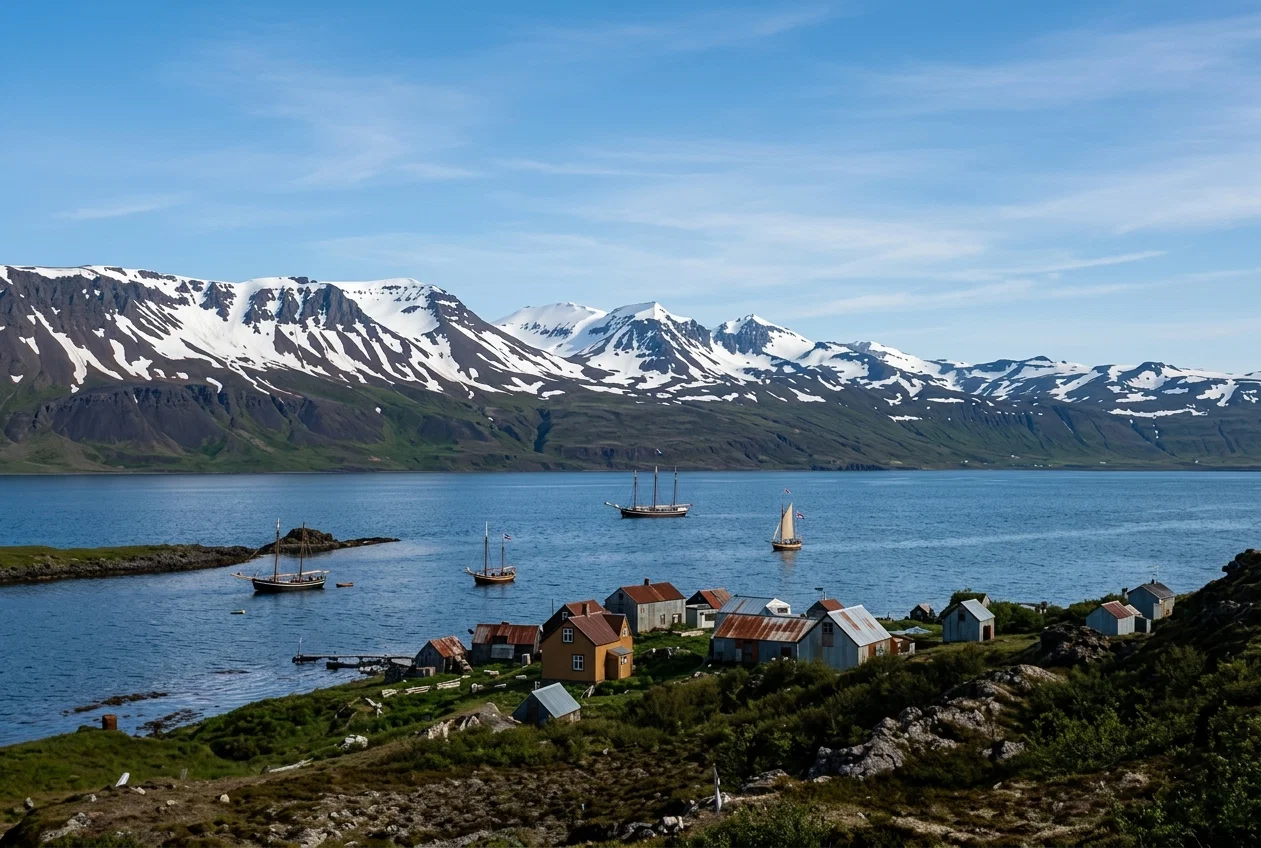
ICELAND has an area of over thirty-nine thousand square miles. It is nearly as large as Ireland, or twice the size of Denmark. But it is very sparsely settled. The population is between seventy thousand and seventy-five thousand. The settlements are mostly on the coast. Large regions in the interior are unsettled, and for the most part they may also be called uninhabitable; for great portions of the land are covered with snow, which does not allow of the growth of vegetation. From the first, the only settlements have been along the coast and in the valleys.
AN ICELAND VILLAGE
The island has very few cities, and they are small. The capital, Reykjavik, the oldest city, was named by Ingolfur, the first settler. In the northwest there is Ísafjordr, with a population of about a thousand. In the north is Akureyri, with about the same number of inhabitants. And in the east is Sedisfjordr, with a smaller population. Besides these there are a few smaller towns, with a few hundred people in each.
Reykjavik has about five thousand inhabitants. The city covers quite a large area. Nearly every house has its little garden. But the cold climate makes the work hard, and their labor is not very amply rewarded.
The seat of congress is in Reykjavik. Here is also the supreme court, school for the ministry, medical college, and high school. It is also the residence of the governor and the bishop. There is a valuable public library, besides others. There are several printing offices in this city.
The houses in the city are one or two stories in height, and most of them are covered with galvanized iron plates. The reason for this is the high price of timber, which has to be imported, there being no forests on the island. The people take very good care of the little timber that grows.
Bricks are not made in Iceland. The houses are built of granite. Among the most prominent houses in Reykjavik are the capitol, the bank, the high school, the public school, and the hospital for lepers. The last two are the largest buildings on the island, and cost from eighty to one hundred and thirty kroner each.
The hospital for the lepers has been erected only a short time. It is a gift to the island from the Odd Fellows in Denmark. Leprosy is a disease very much to be deplored, and it has a great hold in Iceland. There are about one hundred and fifty lepers in this institution, who before were scattered in almost every place in the country, and were a constant menace to others. They are now gathered in the hospital, and the danger of spreading the disease is greatly reduced. The very best care is given these people in the hospital, and they have a pleasant home there for the remainder of their lives.
The new schoolhouse has a history. It is a testimony to the great progress of education in Iceland. Until a short time ago there were no public schools on the island. Parents looked after the education of their own children, many teaching them themselves. But now it can be said proudly that education has made great progress. It is very difficult to find an Icelander who can not read or write. Many, even among the farmers, can speak and write several languages.
Sedisfjordr.
Native Foods of the Tongan Islands
By E. S. Butz
E. S. BUTZ
The chief native foods of the Tongan Islands are bananas, sweet potatoes, yams, breadfruit, pineapples, cocoanuts, and flesh and fish.
There are many different kinds of bananas, which are prepared in a variety of ways, but the natives prefer them boiled in sea water, in the green state. When done, they are very hard and indigestible. Sometimes they are buried in a bed of leaves, with a sort of palm nut, which imparts a very pleasant flavor as they ripen. Some kinds are tied in banana leaves, and hung in a tree to ripen. Still another method is to tie them up in the tough leaves of a native plant, with cocoanut milk, and cook them in what is called an underground oven, which is simply a hole about eighteen inches deep. This they fill with wood; then they pile on stones, and light the wood. When the wood is burned out, the food is put on the hot stones, and covered with leaves and earth. In from one to six hours the food is nicely cooked. Sweet potatoes and yams are very palatable prepared in this way.
Yams are a coarser tuber, somewhat the nature of potatoes: they are the potatoes of the natives. One kind grows very long; I have seen them six feet in length; but they are not usually so long, for the reason that yams grow straight down, and the soil must be loosened by digging the hole six feet deep. I hardly need add that there are fewer six-foot yams than two-foot ones. There is one variety which was introduced by the famous Captain Cook, who, handing it to a chief, said, “I give you this.” The native at once said, “He is telling its name;” so it is still called kivi (pronounced kēvē), which means, “I give you this.”
Probably the breadfruit is the most nutritious of the island products. It grows on a large, beautiful tree with heavy foliage of large lobed leaves. It resembles the osage orange (hedge apple), but is not so rough, and is much larger. It is in season for about three months in the year, when the crop is good. Though called fruit, it is more the nature of grain than of fruit. When roasted, it looks and tastes much like the white breast meat of a turkey. We regard it as excellent food, and use it freely when obtainable, though, like most island foods, we find it a little hard for American stomachs to digest. The natives have a habit of burying breadfruit in deep pits digged for that purpose. After a number of years (seven is the stated number) it is dug up, and, like ripe poultry, eaten with a relish. Your sense of smell warns you15of its presence, even while you are a great way off. I once came upon a party of natives eating their dinner in the woods. They very kindly offered me a portion of this ripe breadfruit with some nicely baked yam. I had wished to see it, so now was my chance. I attempted to taste it, but without very good success. The odor seemed to cling to my hand for days.
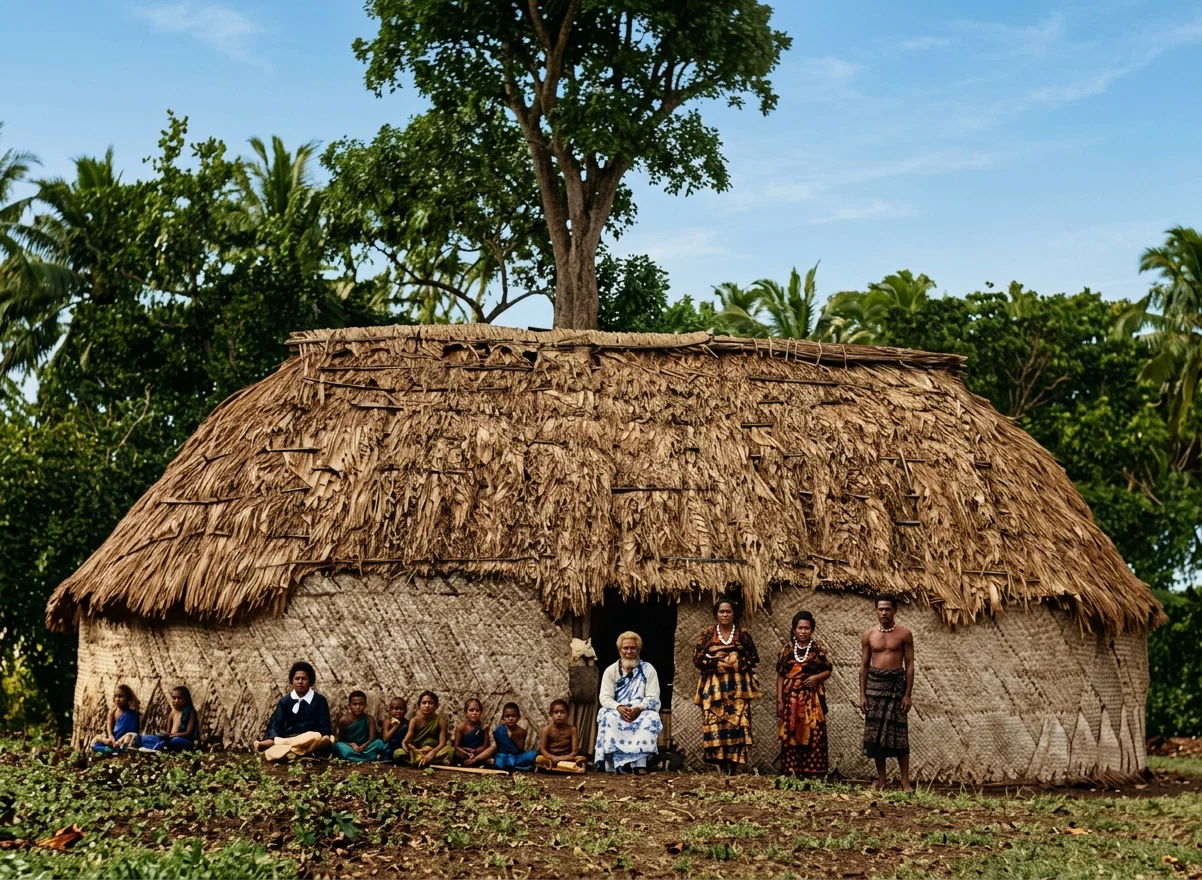
To me the most graceful, as well as the most useful tree in the islands is the cocoanut palm. The effect produced by its great leafy plumes, fifteen feet in length, as they curve and bow in the soft and gentle sea-breeze on a hot afternoon, is delightfully restful. The long leaves are used for roofing and flooring the houses, and for making brooms, baskets, and mats; the coarse, fibrous membrane which encloses the young leaves is used for straining milk and kava; the husk of the nut for making rope, and for fuel; the nut shells for cups, and for making charcoal to burn in the box irons for ironing clothes; and the nut for oil and food and drink for man, and for feeding cows, horses, dogs, pigs, and fowls. Taken at the right stage, the water in the nut affords a most pleasant and refreshing drink, and the meat, which looks much like cooked starch, eaten out of the shell with a spoon, is a dish to tempt any one.
NATIVE HOUSE, TONGA
Oil and milk are made from the kernel by grating it to a pulp, and squeezing out the fatty substance. By adding water, one nut yields about one pint of nice rich milk, which is used in cooking or on porridge, just as cow’s milk and cream are used.
The cocoanut is prized chiefly for its commercial value. The nuts are split open, the meat removed from the shell, and dried in the sun. Thus dried it is called “copra.” As you might suppose, it becomes very rancid while drying, and emits a nauseating odor. The copra is shipped to Australia and Europe, where the oil is expressed, and the residue is pressed into cakes like linseed cakes, and used for feeding animals, cows principally.
We once had the misfortune of traveling in the tropics for five days on a steamer which had as part of her cargo two hundred and fifty tons of copra. The ventilating shaft, extending from the lower part of the steamer, where the copra was stored, through the second cabin, had a split near our stateroom. The heat from the engines caused the foul air, laden with stifling, nauseating stench from the copra, to rise. Finding the crack in the ventilator, it filled the cabin and staterooms with the stench. This, added to the distress caused by the roll of the vessel, was simply beyond description.
The natives are very fond of meat and fish. They keep a great many pigs, for which they have a particular liking. Fish, being easily obtained, is used very freely, especially jellyfish and shell-fish. The people can be seen almost any time on the beach, with baskets made from cocoanut leaf, digging in the sand for shell-fish, or wading in the shallow water after jellyfish. Sometimes a village unites in making a rude net from vines and leaves, hundreds of feet in length. With this a semicircle is formed on the reef, with the end at the beach when the tide is in, and thus the fish are kept from going out with the tide. The fish are then speared, and caught by men, and women, and children by basketfuls, who eat raw fish as they fill their baskets.
The lagoon abounds with a beautiful kind of jellyfish, which looks like a toad-stool or little umbrella of amber floating on its side near the surface of the water. The first time I saw these fish, I was crossing the lagoon with a native in his canoe (a log hollowed out). At first I could hardly believe my eyes; it was such an enchanting sight to see them by scores gracefully floating in the placid water, gently contracting the amber hemisphere with marked regularity, as if breathing in sleep, with no thought of fear. They varied in size from tiny little ones to those in which the hemisphere was four or five inches in diameter, with a stem six inches long. This scene reminded me of a Christian peacefully reposing on the great ocean of God’s never-failing love. I lifted one from the water in my hand, to get a better view of its beautiful form. After returning it to its liquid home, I asked the native its name, and if the people ate them. He answered the last question by taking a good-sized one from the water, and, giant-like, swallowing it down with a smack of his lips. A feeling of pity filled my breast at seeing this little kingdom of peace invaded, and one of its subjects so ruthlessly taken by the enemy and swallowed down while so happily basking in the sunshine, all unconscious of its danger. I thought of the great enemy who “walketh about, seeking whom he may devour.” How little we know when or where or how he will next assault the kingdom of peace. “Wherefore let him that thinketh he standeth take heed lest he fall.”
Nukuualofa, Tonga.
Mission Notes
AN edict promulgated in China that sons of Manchus and Mongols should be sent out of the country for foreign study has led to an extraordinary demand for the Word of God. Rev. John R. Hykes, D. D., the agent of the American Bible Society, states: “One government college has applied for a grant of fifty Bibles for the use of its students.”
AN effort is being made in England to establish a mission among the Bedouins. Mr. Archibald Forder recently penetrated seven hundred and fifty miles into Arabia, and went from tent to tent, and from town to town, in those unknown and mysterious lands, unfolding the story of Jesus and his love, speaking and reading to the people in their own tongue.
SOUTH AMERICA, which covers an area of seven million square miles and contains thirty-four million inhabitants, has been called the “neglected continent.” In Paraguay there are two million Indians who never heard of Christ until 1889, and have only four missionaries laboring among them. In Peru, three million Indians, descendants of the Incas, have never been evangelized.
“THE complete report of the British and Foreign Bible Society for its ninety-eighth year, ending March, 1902, shows that the issues of the society during the year were 939,706 Bibles, 1,364,116 New Testaments, 2,763,599 portions, making a total of 5,067,422, which is considerably in excess of the previous year. The total issues of the society, since its foundation in 1804, amount to 175,038,965 copies. The society is preparing with enthusiasm to celebrate its centennial in 1904.”
A COMPLETE Bible has at last been published for the Eskimos in Greenland. These folk were first evangelized by the Norwegian pastor, Hans Egede, who began work in Greenland as far back as 1721. He began the first translation of the New Testament into their language, which was completed by his son. Another and improved version by Fabricius appeared in 1799. Later on, the New Testament, revised by Moravian missionaries, was printed for them by the British and Foreign Bible Society in 1826. The Danish Bible Society assisted in subsequent editions and revisions. The chief translator of the Old Testament was another Moravian missionary, Klemschmidt, who died in 1886. Now the whole Bible is at last complete, and an edition has been printed at the expense of the Danish government.
J. W. BOYNTON
By J. W. Boynton
Alberta
SINCE my last report we have seen many evidences of God’s love and care for the work and workers in this field. I have been scattering literature and holding meetings and Bible readings as the way opened in different places, and as a result of this work seven adults have promised to walk with the Lord and keep his Sabbath, while as many more are convinced, and I hope will obey. Two have promised to do so, as soon as they can make some business changes, which will take a few weeks.
Brother Hamren’s trial for working on Sunday was called in February before the supreme court. He was discharged on the ground that he was a farmer, and that the law did not apply to farmers. Since then the attorney general at Regina has issued orders to the mounted police not to disturb Seventh-day Adventists or Jews for doing work on Sunday. This order was shown me by the police, with the assurance that we should not be molested. This is toleration only, not liberty, but it will give us opportunity to work more freely for a time, and thus get the message more fully before the people before the final confederation of the powers of this world against the truth. I find that the result of this trial has stirred the pastors of other churches, and they will do all they can to reverse the decision. But we thank God, and take courage to go forward.
I am now working in Wetaskiwin, where the trial was held, using tracts and periodicals, and if the way opens, I shall hold a series of meetings here. We trust we have the prayers of God’s people for the work in this far northern country.