In a recent number of the Herald of the Coming One, Sam Jones is criticized severely because in one of his sermons he said: “God teaches us in his word that he is no respecter of persons. God loves the meanest man in the world as much as he does the best man. God loves the abandoned, wicked sinner as well as the best Christian in Nashville.”
The writer who takes exceptions to this statement, says:—
This is terribly loose preaching. What Universalist is there who would not gladly accept such notions? The serious thing about it is, it is not the truth. The Bible most decidedly teaches that God does love his trustful, obedient people a great deal more than he loves the ungodly ones who persist in disobeying him. There is a sense in which God does love all men, and that sense is a love of pity, a love which yearns to save every sinner from his sins; but such a love is far from being one of pleasure, of delight, of joy, such as God has toward those who obey, honor, and love him.
God is a respecter of persons in a most important sense. His very character is such that he must respect his own dutiful, loving people much more than he does disobedient and wicked rebels. It is as plain as the brightest day, that Christ had far greater respect for his devoted and endeared disciples than he had for those hypocritical Pharisees who opposed him on every hand. Christ never put a premium on hypocrisy and unbelief and stubborn rebellion.
If it were true that God loves “the abandoned, wicked sinner as well as the best Christian,” then what inducement has the most wicked man to become a loving, pure, and obedient Christian? And if God loves a rebellious sinner as greatly as he loves a true Christian, then why will not God give the wicked one as much benefit and blessing as he does his loving child, who gives himself fully to God? O, it is arrant folly to suppose that God loves ungodly men with the same kind and degree of love that he feels and exhibits toward those who have penitently accepted Christ.
This criticism it is that contains the loose preaching, not the words criticized. “God is love.” It is not, God loves; but “God is love.” That is what he is. And he is the same yesterday, and to-day, and forever. He can not be anything else and be God. But he is “the eternal God”—with him to all eternity, past and future, there “is no variableness neither shadow of turning.” He can not love one person more than another. He is the same to all people, because he is God, the eternal God—ever the same. And being ever the same, he is ever the same to all. The sinner does not know him, and does not know his love, and so loses everything in abusing his love. The only inducement the wicked sinner needs is this very fact of the love of God, because he is love.
When God says he is not a respecter of persons, why should mortal man say that God is a respecter of persons? God does not love sin; but he does love the sinner. Jesus was just as willing to help the Pharisee as he was to help the beloved John. He loved them as much, for he came to die for them. He denounced their hypocrisy, because he loved them.
Why were the parables of the prodigal son, the lost sheep, and the lost piece of money,509given, if not to teach that God loves the sinner as much as the ninety and nine that are in the fold?
This nineteenth-century idea that a church-member is more precious in the sight of God than other people is pharisaical, and tends to discourage those who want to be saved.
It is the spirit of “come not near to me; for I am holier than thou.” We church-members, we Christians,—we are good. The Lord loves us more than he loves you; because we are so nice. You bad, low-down, “fallen,” wicked sinners,—you become nice like we are, then the Lord will love you as he now does us. But you are too bad now for him to love you very much. This is the same old pharisaical spirit, that thinks God altogether such a one as themselves. It will never do. Christians are no better than other people, except for the love, the character, of God that is in them, and abides with them. God so loved the world of sinners, lost, fallen, wicked,—us, our individual selves,—God so loved, because he is love, and because of that only. That he is love is the only reason for his loving sinners; and that he is love is the only inducement for the winning of sinners.
It may be that Sam Jones is sometimes loose in his preaching; but if he never misses the mark any farther than he did in the statement so criticized, his preaching will be the very message of salvation. Let us have more of this very sort of “loose preaching.” It is the gospel of Jesus Christ. God is love, and certainly showed it when he willingly gave the choicest gift of heaven, yea, when he gave himself, to save sinners. “God commendeth his love toward us, in that, while we were yet sinners, Christ died for us.”
“WHEN’S” AND “WHY’S.”
WHEN Christ has said, “The Sabbath was made for man,” WHY should any of his professed followers contend that it was made for the Jews only?
WHEN the Sabbath was made, it was to be a memorial of God’s creative work (Gen. 2:2, 3; Ex. 20:8–11); then WHY should it cease to exist as long as his creative works remain? See Ps. 135:13.
WHEN the Lord wished to impress upon man the difference between himself and the heathen gods, he always referred to the fact that he is the One that made the heavens and the earth (Isa. 42:5; 48:12, 13; Acts 17:24; Rev. 14:7), thus giving the facts on which the Sabbath commandment was based. WHY, then, should the memorial be abolished while the facts still continue?
WHEN the Israelites came out of bondage, and before they received the ten commandments at Sinai, they were told that the seventh day “is the rest of the holy Sabbath unto the Lord;” that “this is that which the Lord hath said;” and they were required to “keep” it (Ex. 16:22–30): WHY did the Lord tell them that it was the Sabbath, and require them to keep it, if it did not exist before the law was spoken at Sinai?
WHEN the ten commandments were given, WHY should nine of them be of perpetual obligation upon all the nations of the earth, and one—the Sabbath commandment,—given only to the Jews, and this only from Sinai to Calvary?
WHEN the Scriptures plainly teach us that Jesus Christ is the Creator of all things (John 1:3; Col. 1:16); the Deliverer of Israel from Egyptian bondage (Ex. 23:20–23; 1 Cor. 10:4); the same One who spoke the law from Sinai, (Ex. 20:2); and the Redeemer of the world (Isa. 43:7, 11; 44:6); WHY should not we honor him by keeping as the memorial of his creative work, the Sabbath which he made blessed, sanctified, and KEPT?
BODY AND SPIRIT ARE HIS.
By Uriah Smith
The careful reader of the New Testament can not but be struck with the prominence given to the subject of the body, and the care with which it should be guarded in the service of God. “Know ye not,” says Paul, “that your body is the temple of the Holy Ghost which is in you, which ye have of God, and ye are not your own? For ye are bought with a price: therefore glorify God in your body, and in your spirit, which are God’s.” We have no right to use God’s property in any way contrary to his will. Hence we are further instructed: “Let not sin therefore reign in your mortal body, that ye should obey it in the lusts thereof. Neither yield ye your members as instruments of unrighteousness unto sin.” Rom. 6:12, 13.
Again we read: “I beseech you therefore, brethren, by the mercies of God, that ye present your bodies a living sacrifice, holy, acceptable unto God, which is your reasonable service.” Why does the apostle so earnestly beseech us to present our bodies to God?—Because they have been bought by him, and he desires to make them temples of the Spirit through which he can work. A man seeking a house to live in, finds one which he desires to occupy; but it has long been the abode of tramps and vile characters, and is dirty and dilapidated. But he buys it, and begins the work of renovation. He expels the occupants, and commences the work of cleansing. But will he limit himself to the work of cleansing?—Surely not; but he will repair whatever he finds damaged, and make it whole and serviceable for use. And is it not reasonable to expect that God will do the same with us? In our unregenerated condition, our bodies are palaces for Satan, and his evil hosts. They have defiled them with sin, and damaged them by disease. But these bodies have been bought by God to be the temples of his Spirit, that he may dwell therein. What, then, may we expect him to do?—Just what the man would do to his house: cleanse and repair it—expel the evil tenants from the soul, change and purify the nature, and heal the body.
Is not this why we find the forgiveness of sins and the healing of diseases so closely joined together in the work of Christ while on earth? Matt. 9:5, 6. And that ringing prophecy of Christ in Isaiah 53, which states so clearly that he has borne our iniquities, Matthew interprets as including also our bodily sicknesses: “When the even was come, they brought unto him many that were possessed with devils: and he cast out the spirits with his word, and healed all that were sick: that it might be fulfilled which was spoken by Isaiah the prophet, saying, Himself took our infirmities, and bare our sicknesses.” Matt. 8:16, 17. And this is in accordance with the prophecy itself; for the word “griefs,” in Isa. 53:4, means sicknesses, and is so rendered in Deut. 7:15; 28:61; 1 Kings 17:17; 2 Kings 13:14; and in many other places. After the same tenor reads Ps. 103:3: “Who forgiveth all thine iniquities; who healeth all thy diseases.”
In the light of these statements we need not give Rom. 8:11 wholly to the future, but find therein a present indwelling, and a present quickening, by the Spirit: “But if the Spirit of him that raised up Jesus from the dead dwell in you, he that raised up Christ from the dead shall also quicken your mortal bodies by his Spirit that dwelleth in you.” Indeed, how can the Spirit, dwelling in the heart, help quickening (making alive) whatever in the person’s condition needs quickening, whether it be from a death in trespasses and sins, or from infirmities and diseases of the body, freedom from which may be necessary to enable one best to honor and glorify God.
The apostle gives us the conditions upon which we may become the temple of the Holy Ghost, or, as expressed in 2 Cor. 6:16, “the temple of the living God.” “Wherefore come out from among them, and be ye separate, saith the Lord, and touch not the unclean thing [any idol or lust of the flesh]; and I will receive you, and will be a Father unto you, and ye shall be my sons and daughters, saith the Lord Almighty.” In the next chapter the apostle continues: “Having therefore these promises, dearly beloved, let us cleanse ourselves from all filthiness of the flesh and spirit, perfecting holiness in the fear of God.”
There is a filthiness of the spirit as terrible and defiling as the filthiness of the flesh, and more dangerous; for this is the unseen fountain out of which proceed, as enumerated by Christ (Matt. 15:19), “evil thoughts, murders, adulteries, fornications, thefts, false witnesses, blasphemies: these are the things which defile a man.” These vitiate the moral nature; and moral and spiritual ruin is caused by sins which human wisdom, untaught by revelation, holds to be as innocent as eating and drinking.
We need ever to bear in mind that we are not our own, but are his who has bought us, and should devote our lives to him, not, as Paul elsewhere says, living unto ourselves, but unto him who has died for us. 2 Cor. 5:14, 15. This the apostle shows to be but our reasonable service, everywhere connecting the highest privilege with simple Christian duty.
Where in the whole Bible can be found a loftier description of the Christian’s blessedness, than in 1 Cor. 6:19, 20? Thus the inspired writers ennoble the service to which they call us, and cause us to glory in our work while we are performing it. Here Paul tells us whose the Christian is—he is God’s; how he became God’s—he has been “bought with a price;” what God makes of him—a “temple of the Holy Ghost;” and then what God expects from him—“glory:” “Glorify God in your body, and in your spirit, which are God’s.” Happy would it be for us if we could always maintain an unwavering persuasion of the reality and the greatness of this indwelling of God in us through the Spirit. How it would dignify the whole tenor of our lives. How it would disarm temptation; for we should tremble at the thought of grieving and displeasing One so great and yet so near.510
Until we thus fully acknowledge God’s ownership of us, we are the slaves of our baser nature,—slaves, though the chains that bind us may appear as attractive as rings of diamonds and bracelets of gold. While a passion against which reason revolts, domineers over us; while a lust which conscience rebukes, scoffs at conscience, we are ruled by a tyrant as evil and debased as our own unregenerated deformity.
The price with which we are bought should melt us to a spirit of overwhelming devotion. The price measures God’s estimate of us. He would not pay a price so dear to him for souls that were insignificant. God paid Christ for us—the gold of his heart. Stand at the cross, and there God shows to a wondering universe, his estimate of human souls. That he might win them back, that he might have them again, he paid that price. Shall we not then allow him to make our bodies temples of his Holy Spirit? The price paid has bought us, and we are his. Body and spirit are his.
We can keep him out of his own property, if we determine so to do. But as a man would not keep in repair property which he did not own, so we can not expect God to keep us in repair in body or spirit, if we refuse to let him take possession of that which is his. Our whole being, from center to circumference, developed and undeveloped, all that is involved in the unfolded germ of our being, waiting other influences and other scenes to bring it out,—all are God’s. He has stamped them his.
We are free only when we come into possession of God. Till then we are bond-servants, but free ever after. We lose ourselves in God. “When we allow God to call us his, then he allows us to call him ours. He gains a creature, we gain a Creator. He gains a lost sinner, we gain a redeeming Saviour, and an eternal Father and Friend.” U. S.
Chain Letters.
Recently a chain letter was started by a lady on Long Island, asking for money to purchase ice for an ambulance ship. The chain is formed as follows: The first person writes four letters to four friends asking each to send ten cents to purchase ice, and also write four letters to four friends asking each of them to do the same. Each of these letters is to be a copy of the original, and each person who receives such a letter is earnestly enjoined to prevent the breaking of the chain by complying with the request; or if not, to notify the friend making the request.
The first four letters are each numbered “1.” Each person who receives one of these is expected to write four letters, and all of these sixteen are to be numbered “2.” The next series of sixty-four letters is to be known as “No. 3,” and so on.
Now that we have the scheme, let us consider the results of it. Are they good or are they evil? Not but what good people have a part in this work, for sometimes good people do not see the results of a scheme they are asked to enter into.
Though this particular enterprise was good, the great majority of the persons who are asked to write such letters have no way of knowing the character of the enterprise to which they are asked to contribute. By sending these letters to their friends, they become responsible for recommending the person or enterprise to which they ask contributions. They endorse an enterprise they know but little or nothing about, which is morally wrong.
One particularly notable thing about it is that it is a most extravagant way of collecting funds. Every person who sends ten cents is expected to spend ten cents on postage, and not less than two cents more for stationary. Thus it costs at least twelve cents to collect ten cents for the enterprise.
None of the people who assist in sending these letters have the least idea of what they are attempting to do. They have no conception of the vastness of the scheme. If they had, it is safe to say that but few of them would have anything to do with it.
Usually the letter requests that the chain be continued until the hundredth series. Any one who will think a moment will be astonished at the result of the scheme. When only the twentieth series is reached, the number of letters written would be 1,090,921,693,184. This would make one letter each for every man, woman, and child, in seven hundred worlds, each with a population as numerous as that of our world, and yet only the twentieth series has been reached. If each letter contained the ten cents asked for, this twentieth series would bring in $109,092,169,318.40; and would pay out $111,274,012,705.20 for postage and stationary to bring in the other.
Without making any further calculations on the remaining eighty in the series of the one hundred, it is safe to say that when the ten-cent contributions should reach that series, the person who started it would be prepared to offer the full value of a world of gold like ours for every lump of ice that any soldier could possibly use.
We have said enough to show that it is never safe to take for granted that seemingly the most trivial things are really insignificant. We may also get a suggestion of the tremendous power of the chain of human influences and example, and what marvelous results may be attained by the multiplication of trifles.
Should any of our readers receive one of these chain letters, you will do the person who started them a favor by breaking the chain. The paper that makes a note of the ice fund says that the lady has received the results from only a few of the first series, and it amounts to more than $5,000. She did not realize what she was starting, and is now kept very busy opening the letters that are coming to her. She is more anxious to have the “chain” broken than she was to start it.
If you have a chain of thought or habit which draws you in the wrong direction, do not pass it on to others to help multiply it, but break it at once. Break every chain that would bind you, and be free in Christ.
Sound in the Arctic and God's Hearing
CAPTAIN PEARY speaks of the distance sound can be heard during intense cold. He says: “In the arctic regions we often heard people converse in a common tone at a distance of a mile.” If the human ear can hear at that distance when the surroundings are favorable, why should we not believe that the Creator who made both the circumstances and the ear, can hear our voices when we come to him in prayer, though that prayer may not be heard by the human ear. Then he also can hear those foolish words we speak, those bitter expressions that give pain to our fellow men. If he hears it all, should we not take heed to our words that they be words that we will want to meet in the judgment?
“IT IS EXPEDIENT FOR YOU THAT I GO AWAY.”
By G. C. Tenney
Our Saviour said a good many things to his disciples which to their comprehensions were dark and inscrutable. Many of his plans and suggestions were utterly at variance with their plans and ideas. They were inconsistent with success as the disciples regarded success.
Now he was about to leave them, he had comforted their hearts with the promises of his second coming and of the Holy Spirit. Having pointed out the intimate relation he would still sustain toward them, and assured them of his infinite love, Jesus adds: “These things have I spoken unto you, that ye should not be offended;” for they would be called upon to suffer excommunication, imprisonment, and death.
“But now I go my way to him that sent me.” And more than that, “it is expedient for you that I go away.” Why?—Because the personal presence of Jesus precluded the presence and work of the Spirit. As long as Jesus was here in visible person, people would surely seek for that personal presence, and would neglect to seek for the aid and counsel of that Comforter who would await in vain their call.
It is very difficult for us to get our eyes off the visible, and by the eye of faith behold the invisible. It is a hard lesson for us mortals to learn that the invisible things of God, seen by faith alone, are the only realities, while the things of sense are shadowy, unreal, and momentary. But it is a necessary lesson to every one who would live the life of faith, and walk in the Spirit of God.
It almost seems like a hard thing to say that the visible, personal presence of Jesus on earth was an obstacle to the development of such a life; but the facts forced our Saviour himself to say it. Paul realized the force of this deep truth when he wrote: “Wherefore henceforth know we no man after the flesh: yea, though we have known Christ after the flesh, yet now henceforth know we him no more.”
The disciples began to know Christ after the flesh. They trusted him as a captain, a leader; they anticipated his kingship. He was good, amiable, wise, and powerful. They could depend upon him in an emergency. He could feed them if they were hungry; he could save them from shipwreck; he was all they needed. There was no chance for Heaven to work for them; no chance for them to develop faith, nor indeed any of the graces. Jesus must get out of their sight. The Holy Spirit must do for them what a visible teacher could not do.
These things should be a living lesson to-day. The representative of Jesus Christ should realize that it is enough for the disciple to be as his Master; and if it were expedient for those children of faith to be left to look to Heaven for grace, and to depend upon the Holy Spirit for guidance and comfort, it is just as expedient for the church of Christ now. If it was necessary for the spiritual development of the disciples, that Jesus should take511his sacred person from their view in order that they might perceive and receive spiritual help, how much more expedient it is for the people of to-day, that the messenger disappear in order that the people may receive the Holy Spirit!
Let every minister of the Word say in behalf of his people: “It is expedient for you that I go away.” And then let him disappear behind the cross of Calvary. There is no room to doubt that the eloquence and genius of men are often permitted to exclude the working of God’s Spirit. Amiability, talent, suavity, even pure virtue itself, manifested in the flesh, should never be permitted for a moment to pose as a standard or criterion of spiritual life. These may be used to attract and lead men to God, but when the porter has led the guest to the inner chamber, let him withdraw and leave the soul with the heavenly Teacher.
Soul communion with man, no matter how good the man, can never develop spiritual life and power. As long as the man remains before the mind, the Holy Spirit remains away. But when the “I” departs, God comes in. It is communion with God that the soul needs; and how blessed is the privilege of receiving the weary, heart-sick wanderer at the door, and leading him within where the Holy Spirit waits to welcome and to bless. But then it is expedient that I withdraw. I can still serve in my capacity as a servant; I can be ready to speak a word to him that is faint, but let me keep my place.
There is nothing that the professed church of to-day needs so much and so sadly as personal acquaintance with God through his Spirit. Teachers are plenty,—scores of them,—but where is God? O Saviour, let me get out of the way that thy people may see thee! It is expedient that I go away.
G. C. TENNEY.
GENERAL MEETING IN BRAZIL.
By W. H. Thurston
For some time we have felt the need of calling the workers together for counsel, prayer, and the study of the Word, and at our committee meeting held in March, it was decided to hold a general meeting May 20–29 at Curitiba. According to appointment, the workers all came together, and about half our churches were also represented. All the churches and companies had been notified of the meeting and invited to send representatives; but they are so far apart, and traveling is so difficult, they were not all able to attend. The program for the meeting was as follows: Morning worship, 7–7:30, A. M.; social and instruction meeting, 9–11, A. M.; business meeting, 11:30–12:30, P. M.; topical study 3–5, P. M.; preaching, 7 P. M.
The subjects assigned during the meeting for study and consideration were as follows: Our spiritual, social, and business relations to each other as workers; Spirit of prophecy; best method of prosecuting the health and temperance work in Brazil; tract society and church work; discipline in the school; educational work in Brazil; care and training of children; how to succeed in the book work; practical thoughts and suggestions on what to cook and how to cook it; the colporteur and order his work; relation between the home and the school; between parents, teachers, and scholars; Sabbath-school work, and experiences in the field.
The topics were assigned to different individuals and were discussed with zeal and enthusiasm by all, and sometimes it was difficult to close the sessions on account of the deep interest manifested. Some time was given to practical instruction in treating and caring for the sick, and was much appreciated by all.
The outside attendance was small, but those who came were deeply interested. During the meeting there were ten conversions. The last Sabbath was an exceptionally good day as the result of the presence and working of the Spirit of the Lord. All seemed moved upon to examine themselves, and confessions were made and all were drawn nearer to the Lord, and to one another. Following the social meeting, the ordinances were celebrated with cheerfulness and gladness of heart, and all felt that it was good to be there. During the meeting there was about four hundred dollars tithe paid into the treasury, and the reports show ten churches, and three companies, with a total membership of three hundred.
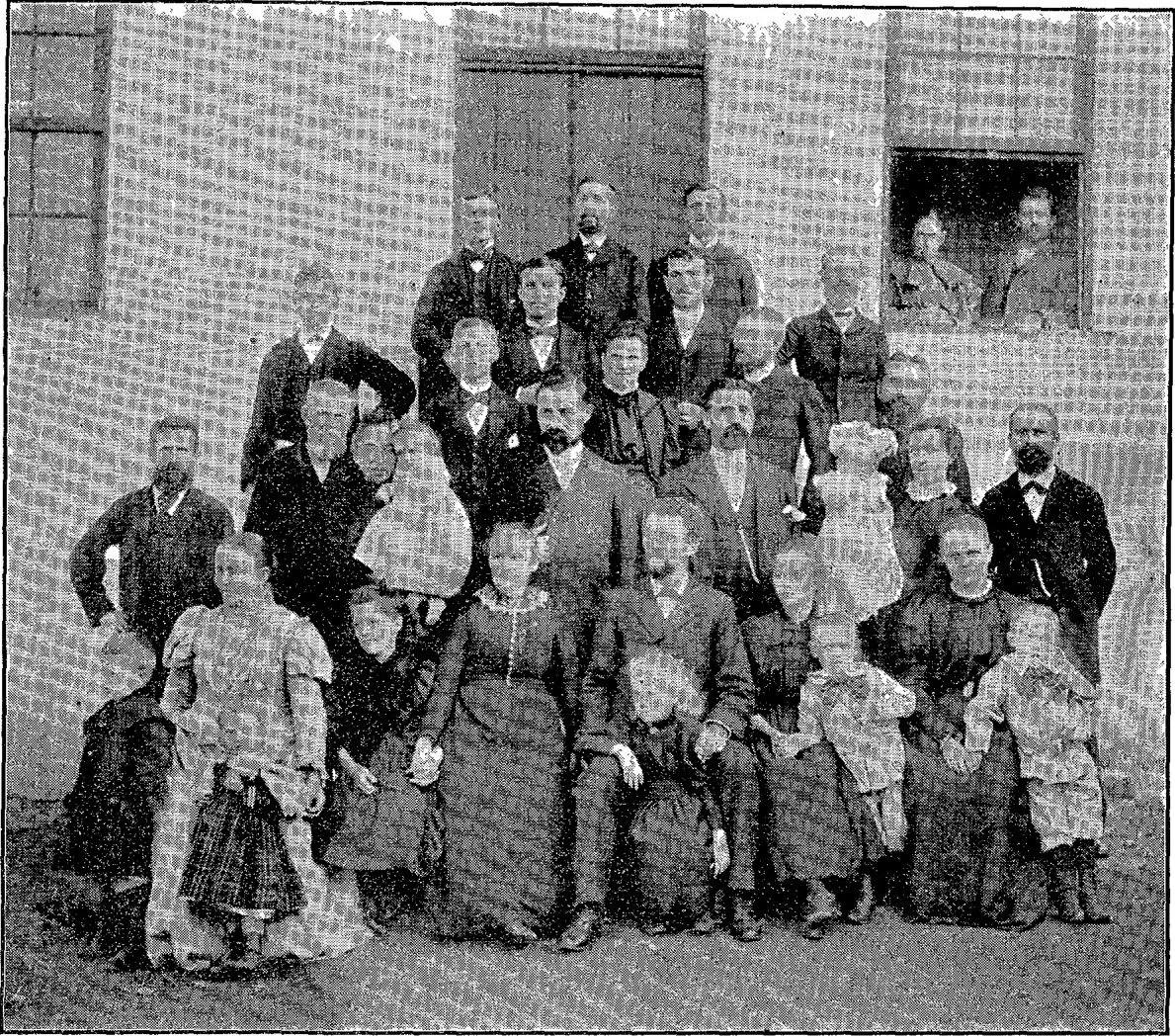
THE WORKERS IN BRAZIL.
On account of having to wait for steamers, we continued the meeting until May 31. The workers all returned to their fields of labor with renewed zeal and courage, thanking the Lord for the privileges and blessings enjoyed at the meeting, and for renewed strength to claim the promise, “Lo, I am with you alway, even unto the end of the world.”
Since the work began in Brazil in May, 1893, there has been nearly seven thousand dollars’ worth of books sold, mostly among the Germans. The average number engaged in selling books during this time was three. The expenses in Brazil are so heavy that none of our workers are getting rich; but the Lord provides enough day by day, and much good is being done. The seeds of truth are being scattered far and wide, some planting, others watering, and God is giving the increase; to him be all the praise now and forevermore. The accompanying picture of our workers, and a few church elders, was taken at the general meeting, and will be spoken of further in Brother Graf’s report.
This is the first time that all our workers have been together since the work began, and it was good for them as well as the work in general. It was gratifying to observe the oneness, the willingness, and the unity with which all go forth to labor. “Behold, how good and how pleasant it is for brethren to dwell together in unity! . . . for there the Lord commanded the blessing, even life forevermore.”
W. H. THURSTON.
HONOLULU CHINESE BOYS' SCHOOL.
By W. E. Howell
The first complete term of our Chinese Boys' School closed June 24, after nine months' session. No formal or public exercises were held either at the end of or during the school year, the demands upon the time and strength of the teachers forbidding it; but the interest in the school and its work did not abate, but rather increased as the term drew to a close. On the opening day of the term nearly forty students were present, while the membership at the close was fifty-seven, the maximum being reached and maintained during the last two months of the year. Even as late as one month before school closed, new students continued to come. The whole number of boys who attended all or a portion of the year, was ninety-six.
In the home, the number of boys averaged twenty-six during the first two thirds of the year. The number was reduced by sickness and pecuniary disability to eighteen for a time during the last three months, but rose again to twenty. The whole number in the home, all or a part of the year, was thirty-one.
As in American schools, much more can be done for boarding students in the care of a consecrated and discreet preceptor, than for day students; but in greater measure, if any difference, can harm be done these people by indiscretion or lack of extreme patience. The Chinese are no exception to the rule that a512people who have been oppressed and maltreated in their own land, are, when brought under conditions of greater individual freedom, less subject to restraint and discipline than those reared under such conditions. The one thing to be kept constantly in mind is that we are seeking the salvation of their souls, and every other consideration must be subject to this.
Bible work was carried on during the entire year, and was quite encouraging in its results. The first four months of the term it was done in connection with the devotional exercises at the opening of the daily school session, to which was added in the primary room the reading of "Gospel Primer," and the committing to memory of Bible texts, which, in fact, constituted the chief work in Bible instruction in that room throughout the year. On the four walls are placed varicolored cardboards, containing the ten commandments and short Scripture texts in letters one and one fourth inches high; also Bible scenes in colors, with appropriate texts. During intermission, or when tired of study, pupils will look at these, and occasionally ask questions about them. The power of illustration avails much with the Chinese. They will look for hours at pictures, whose language they can read, but whose meaning would require toilsome effort to understand from the written characters. The walls of their own homes are often profusely covered with pictures collected from every source, good, bad, and indifferent.
In the advanced room, there was begun in January, a regular class study in Bible, beginning with Christ's second coming, covering the fact, manner, purpose, time, and signs of his coming; and then taking up a study of the life of Moses. Of course all this study must be done in the simplest form and language, and thoughts must be presented very slowly, and constantly reviewed and repeated. The boys do not naturally take very much interest in Bible study, and very rarely can any questions be elicited from them, and but few responses. This renders the task of the teacher a difficult one, inasmuch as he can scarcely ascertain how much of his instruction is comprehended. One may teach earnestly day after day and week after week, with little or no apparent effect. Regular lessons are assigned daily, but it is with considerable difficulty that one succeeds in even having them read over before recitation; so that class work becomes the chief medium of instruction. The boys have made good progress in their study of the common branches.
Yet in the face of these obstacles the Lord has given evidence that his leaven is at work. The Lord's word will prosper in that whereto he has sent it. In the last Sabbath meeting, in response to the question, "How many have fully made up your minds to become Christians and keep all the commandments of God?" eleven raised their hands, and one boy raised both hands. It is perhaps as difficult for them to understand now how much that comprehends, as it is for us to understand how much it means to those who have been without God for centuries. But the giving of the increase is in God's hands.
A REQUEST.
From what is said above the reader will see the value of illustrations and mottoes in work for the Chinese youth. Bible scenes (in colors, if possible), illuminated texts, charts (reading, music, or picture), large-lettered mottoes of suitable wording, etc., would be specially acceptable.
We wish also to open a reading-room, in which our boys can spend some of their spare time. There are doubtless lying unused in the homes of many of our people, illustrated religious, scientific, historical, and generally instructive books, magazines, journals, and papers, that would be of great value for this purpose. Will not those having such send them to us at once, prepaid? All we can offer you is our thanks, and a part in this work for dying souls.
W. E. HOWELL.
Honolulu, H. I., U. S. A.
A VISIT TO THE INDIANS.
By W. R. Matthews
From the Lakeview camp-meeting I was called to labor in Ontario until the Owosso camp-meeting. In answering the call, I came over and began my work in connection with Elder P. M. Howe, and Brother B. Hagle, who were located at St. Thomas. I remained there about two weeks, when, according to previous arrangement, I came to Brantford, where I am at this writing.
My object in coming here was to visit the Indians on the reservation, and become acquainted with their needs, as the Conference committee were anxious to do something to further the work among them. Sabbath, July 30, in company with Brother W. W. Simpson, I went to the reservation, which lies about eight miles to the southeast of the city of Brantford. The reservation is six miles by twelve, and there are six thousand Indians living upon it.
About one year and a half ago, Brother Simpson began work among these people, and was soon joined by Brother W. H. Spear. They were successful in raising up a company of about sixty Sabbath-keepers, among whom are two chiefs. One of these was an interpreter and preacher for the Church of England; the other was an interpreter and preacher for the Methodists. These men can both speak the six languages of the nations that live on the reservation, besides reading and speaking good English.
When I looked over these people upon that Sabbath day, I felt that surely the Lord’s hand is in the work. And when I heard them sing out their heart-felt praise to God in their native tongue, I was melted to tears. Then I knew more fully what the Lord meant when he said that the message should go to every nation, kindred, tongue, and people. They have a new church, twenty-four by thirty-six feet, which has just been erected, where they worship the true God. Since Brother Spear was called away, they have anxiously waited for some one to come and take up the work among them. One young lady of their number is now taking the nurses’ course at the Sanitarium, and when she returns, will be a great help to her people. I hope that some one may be selected to come and live with these people, and educate them in the truth; for surely the harvest is ripe. Jesus died for all, and this seems to be a fruitful field.
W. R. MATTHEWS.
QUEBEC CONFERENCE PROCEEDINGS.
By Mrs. W. J. Blake
THE nineteenth annual session of the Quebec Conference was held at Stanstead Plain, June 1–6. The business was despatched with promptness. Four meetings were held.
Three resolutions were adopted. In harmony with the Testimonies, the Conference pledged itself to raise a special contribution for the advancement of the work in the large cities of our province, especially Montreal. At another meeting the brethren faithfully responded, and nearly three hundred dollars was raised in cash and pledges.
A resolution was passed favoring the release of that part of Ontario formerly controlled by the Quebec Conference, the same to pass into the hands of the General Conference. We expect that this arrangement will soon be made.
It was encouraging to note that after an old indebtedness had been paid, there was sufficient money on hand to pay all the laborers. Thus the Conference begins this year's work free of debt. Credentials were given to three ministers, and one ministerial license was granted.
The following officers were elected: President, E. Leland; Secretary, Mrs. W. J. Blake. Executive Committee: H. E. Rickard, E. Leland, Mrs. W. J. Blake.