Through nature and revelation, through his providence, and by the influence of his Spirit, God speaks to us. But these are not enough; we need also to pour out our hearts to him. In order to have spiritual life and energy, we must have actual intercourse with our Heavenly Father. Our minds may be drawn out toward him; we may meditate upon his works, his mercies, his blessings; but this is not, in the fullest sense, communing with him. In order to commune with God, we must have something to say to him concerning our actual life.
Prayer is the opening of the heart to God as to a friend. Not that it is necessary in order to make known to God what we are, but in order to enable us to receive him. Prayer does not bring God down to us, but brings us up to him.
When Jesus was upon the earth, he taught his disciples how to pray. He directed them to present their daily needs before God, and to cast all their care upon him. And the assurance he gave them that their petitions should be heard, is assurance also to us.
Jesus himself, while he dwelt among men, was often in prayer. Our Saviour identified himself with our needs and weaknesses, in that he became a suppliant, a petitioner, seeking from his Father fresh supplies of strength, that he might come forth braced for duty and trial. He is our example in all things. He is a brother in our infirmities, “in all points tempted like as we are;” but as the sinless One his nature recoiled from evil; he endured struggles and torture of soul in a world of sin. His humanity made prayer a necessity and a privilege. He found comfort and joy in communion with his Father. And if the Saviour of men, the Son of God, felt the need of prayer, how much more should feeble, sinful mortals feel the necessity of fervent, constant prayer!
Our Heavenly Father waits to bestow upon us the fulness of his blessing. It is our privilege to drink largely at the fountain of boundless love. What a wonder it is that we pray so little! God is ready and willing to hear the sincere prayer of the humblest of his children, and yet there is much manifest reluctance on our part to make known our wants to God. What can the angels of heaven think of poor helpless human beings, who are subject to temptation, when God's heart of infinite love yearns toward them, ready to give them more than they can ask or think, and yet they pray so little, and have so little faith? The angels love to bow before God; they love to be near him. They regard communion with God as their highest joy; and yet the children of earth, who need so much the help that God only can give, seem satisfied to walk without the light of his Spirit, the companionship of his presence.
The darkness of the evil one encloses those who neglect to pray. The whispered temptations of the enemy entice them to sin; and it is all because they do not make use of the privileges that God has given them in the divine appointment of prayer. Why should the sons and daughters of God be reluctant to pray, when prayer is the key in the hand of faith to unlock heaven's storehouse, where are treasured the boundless resources of Omnipotence? Without unceasing prayer and diligent watching, we are in danger of growing careless, and of deviating from the right path. The adversary seeks continually to obstruct the way to the mercy-seat, that we may not by earnest supplication and faith obtain grace and power to resist temptation.
If we take counsel with our doubts and fears, or try to solve everything that we can not see clearly, before we have faith, perplexities will only increase and deepen. But if we come to God, feeling helpless and dependent, as we really are, and in humble, trusting faith make known our wants to him whose knowledge is infinite, who sees everything in creation, and who governs everything by his will and word, he can and will attend to our cry, and will let light shine into our hearts. Through sincere prayer we are brought into connection with the mind of the Infinite. We may have no remarkable evidence at the time that the face of our Redeemer is bending over us in compassion and love; but this is even so. We may not feel his visible touch, but his hand is upon us in love and pitying tenderness.
When we come to ask mercy and blessing from God, we should have a spirit of love and forgiveness in our own hearts. How can we pray, ‘Forgive us our debts, as we forgive our debtors,’ and yet indulge an unforgiving spirit? If we expect our own prayers to be heard, we must forgive others in the same manner, and to the same extent, as we hope to be forgiven.
There is necessity for diligence in prayer; let nothing hinder you. Make every effort to keep open the communion between Jesus and your own soul. Seek every opportunity to go where prayer is wont to be made. Those who are really seeking for communion with God will be seen in the prayer-meeting, faithful to do their duty, and earnest and anxious to reap all the benefits they can gain. They will improve every opportunity of placing themselves where they can receive the rays of light from heaven.
Keep your wants, your joys, your sorrows, your cares, and your fears before God. You can not burden him; you can not weary him. He who numbers the hairs of your head is not indifferent to the wants of his children. ‘The Lord is very pitiful, and of tender mercy.’ His heart of love is touched by our sorrows, and even by our utterance of them. Take to him everything that perplexes the mind. Nothing is too great for him to bear; for he holds up worlds, he rules over all the affairs of the universe. Nothing that in any way concerns our peace is too small for him to notice. There is no chapter in our experience too dark for him to read; no perplexity is too difficult for him to unravel. No calamity can befall the least of his children, no anxiety harass the soul, no joy cheer, no sincere prayer escape the lips, of which our Heavenly Father is unobservant, or in which he takes no immediate interest. ‘He healeth the broken in heart, and bindeth up their wounds.’ The relations between God and each soul are as distinct and full as though there were not another soul upon the earth to share his watch-care, not another soul for whom he gave his beloved Son.
Opening of the China Field
By J. O. CORLISS
The Experiences of Former Days—No. 19
Opening of the China Field
J. O. CORLISS
Some time prior to 1880, a bachelor considerably past middle life was living in Honolulu, who, while attending a gospel meeting, was stirred to consecrate his life to the Lord. Shortly afterward he drifted to California, and there received the third angel's message. It took so strong a hold upon him that he meditated almost constantly how he might fit himself to carry to others the message he so dearly loved.
His whole soul was bound up in the thought of the Lord's coming, and he made no provision for anything else but a readiness for that event. This man was Brother A. LaRue. In 1881, while herding sheep in Anderson Valley, in northern California, he pleaded, in his isolation, that a way might be provided for him to carry the truth to his fellow13men. So when Healdsburg College was opened, although he was a gray-haired man, he spent considerable time in the pursuit of knowledge at that institution.
In the latter part of 1884, in company with Brother L. A. Scott, he went to Honolulu, and did house-to-house work with our publications. Quite an interest was raised through the colporteur work done, and the foundation was laid for a good-sized church, which was afterward developed by ministerial labor. As soon, however, as he could be relieved from that post, he set sail for China. On the voyage he worked among the sailors, and upon arrival in Hongkong, one of them, named Olsen, was ready to take hold of the work there with him. The Lord gave him the very help he was about to need, knowing that he would long for human sympathy, in the midst of what he was soon to meet.
At that time (1890) Hongkong was largely dominated by Catholics, who would brook no interference with their plans. They therefore tried to drive Brother LaRue from the colony. At first they offered Brother Olsen profitable employment if he would leave Brother LaRue. When this ruse failed, they threatened to take Brother LaRue's life. But the intrepid septuagenarian refused to depart, knowing that he was called of God to occupy that field, he would be cared for, as God cares for his own. To master the Chinese language was out of the question for one of his advanced years, so he contented himself with laboring for those to whom he could make himself understood.
To one with less courage and tenacity, the task would have been a discouraging one. But nothing daunted Brother LaRue. Through those who knew the Chinese language, he sought to reach that people. Up and down the coast of the country he traveled, handing out literature at the mission stations. He went to Japan; in fact, to every place where he thought he might do good. He was indefatigable in his ship-mission work.
When seventy-seven years of age, he gave up his ship work, only because he was unable longer to climb up the sides of the ships from his boat. But he did not cease his activity. From that time on till the end of his life, he sold health foods, and so continued to meet the people.
During his more active life he formed the acquaintance of a Chinese translator in the law courts. This man translated several tracts, and part of the book “Steps to Christ,” and these were circulated among the people.
Brother LaRue lived in strong conviction that he would not go down in death, but during the last few weeks of his life he was frequently seen walking through the cemetery, with his cheeks bathed in tears. He evidently had become impressed with the idea that he must lie down, and rest from his labors till the Master's return. At last he was smitten with a fever that quickly ended his life.
But his work lives after him. Brother and Sister Anderson and Sister Thompson were soon in the field, and have been doing excellent work in Canton, the largest city of southern China. Brother and Sister Wilbur have also been stationed in the great “yellow” country, engaged in selling health foods, and in following up other interests started by him who fell at his post. Brother and Sister Pilquist, who have been more than twelve years in that country, have been conducting work in the far interior, with some success. Thus the work which was entered upon at first by self-sacrifice, still moves on in China, whence many will come to meet the Lord at his appearing.
An Important Occasion
By W. B. WHITE
W. B. WHITE
THERE is no event in all the year that means more to us as a people than the annual week of prayer, which this year is appointed for December 10-17. If rightly improved, it may be a season of untold value and blessing to this people, a week of great refreshing from the Lord, a time when many will turn to God and be converted. This is the sole object of the week of prayer as we understand it. It should be a time of deep heart searching and self-examination, a time when men and women, young and old, will endeavor to draw near to God, and by prayer, self-surrender, and confession of sin, seek for a better experience and a closer walk with God. If this end can be attained, and our churches generally experience a genuine revival, what an occasion the coming week of prayer will be! But if this point can not be reached, this end attained, we fear that this occasion will pass as many another has passed.
That this people needs a week of prayer, a time of humiliation of soul, confession of sin, and the surrender of the self life is very evident. The whole denomination seems to be undergoing a severe test, and many are failing to endure it, and are falling by the way. The enemy is pressing in his darkness wherever possible, creating doubt, suspicion, criticism, and every evil thing, and nothing but the mighty power of God can save us as a people from being swept from our moorings. Surely we greatly need a mighty reviving as a people, a deep breaking up of heart, and such a turning to God as has not been seen for years among us. Nothing short of this will meet the demands of the hour; and the best of all is that we may have it. Thank the Lord for this. He has not cast off his people, he has not forsaken us, although many times he has been sorely grieved by our hard-heartedness and sins. How good to think that he is a God of mercy, having a disposition to treat us better than we deserve, and is only waiting for us to empty ourselves of self, forsake every evil thing, when he will fill us with his mighty power for service.
But this infilling can not come till first there is an emptying of the heart, and a complete surrender of every sinful thing that has dominion over the soul. But shall we wait until the week of prayer for this work to begin? Shall we not begin now to seek the Lord with all the heart, and by prayer and confession of sins find that experience with God that will make the week of prayer a season when we can relate our victories gained, rather than wait till that time to obtain them? As we view the present situation among this people, nothing but a great revival in all our churches will meet the mind of the Lord for the week of prayer, December 10-17. We should pray for it, expect it, labor for it, and lay our plans for the same; for an intelligent effort along these lines by our church and conference officers will surely bring gratifying results. During this important occasion it would seem best that, as far as possible, our conference laborers meet with the churches in the daily services, and by earnest, careful labor lead the church to a better experience in the things of God. As revivals generally come in answer to prayer, let us pray that this annual occasion may be the best in the history of this people, a time when many shall be turned from darkness to light, from the bondage of Satan to the light and liberty of the children of God.
The eighty thousand dollars asked for by the General Conference as an annual offering for aggressive work in the regions beyond is none too much. Every dollar is needed and much more than this could be used in this great world-wide movement. While the annual offering is not the object of the week of prayer, it is indeed a fitting and appropriate thing for us at the close of a year of great blessing and prosperity to remember the work of God, the cause we love, by a generous gift, freely given. It is the principle of heaven to give, and for years its gifts have been poured at our feet, in bountiful showers. Now, brethren, in recognition of all the Lord has done for us, let us generously respond by a liberal gift at the time of the annual offering. While others are spending their money on self, and for things which do not profit, let us be wise, and remember the struggling work of God in the earth. May God grant that this coming occasion may prove a great blessing to the whole denomination, that we be a blessing to the great, dying, unsaved world around us.
Religious Enthusiasm
By H. Clay Trumbull
If a man gives himself up to money making, or to the pushing of business plans, and drives at it year in and year out, he is a “very enterprising fellow.” If he is carried away with political partizanship, he is “a wide-awake citizen.” If he lives for pleasure, and pursues it recklessly day and night, he may be called “a little fast.” But if he is in dead earnest in his purpose to honor Christ and to save souls, then he is “a religious enthusiast,” or a “fanatic.”—H. Clay Trumbull.
Belize, British Honduras
By H. C. Goodrich
H. C. GOODRICH
About two hundred years ago, as a logwood and mahogany camp of a company of shipwrecked English mariners, British Honduras began its existence. Having been first discovered by Columbus, in 1502, Spain has from the beginning regarded the settlement as an infringement of her sovereign rights. This made the early history of this colony of wood-cutters rather a checkered one, and their life a precarious struggle for existence. Finally, in 1798, the English obtained the ascendancy over their Spanish neighbors, who from the near-by States had made war upon them, and, under the fostering care of the mother country, they have enjoyed uninterrupted peace.
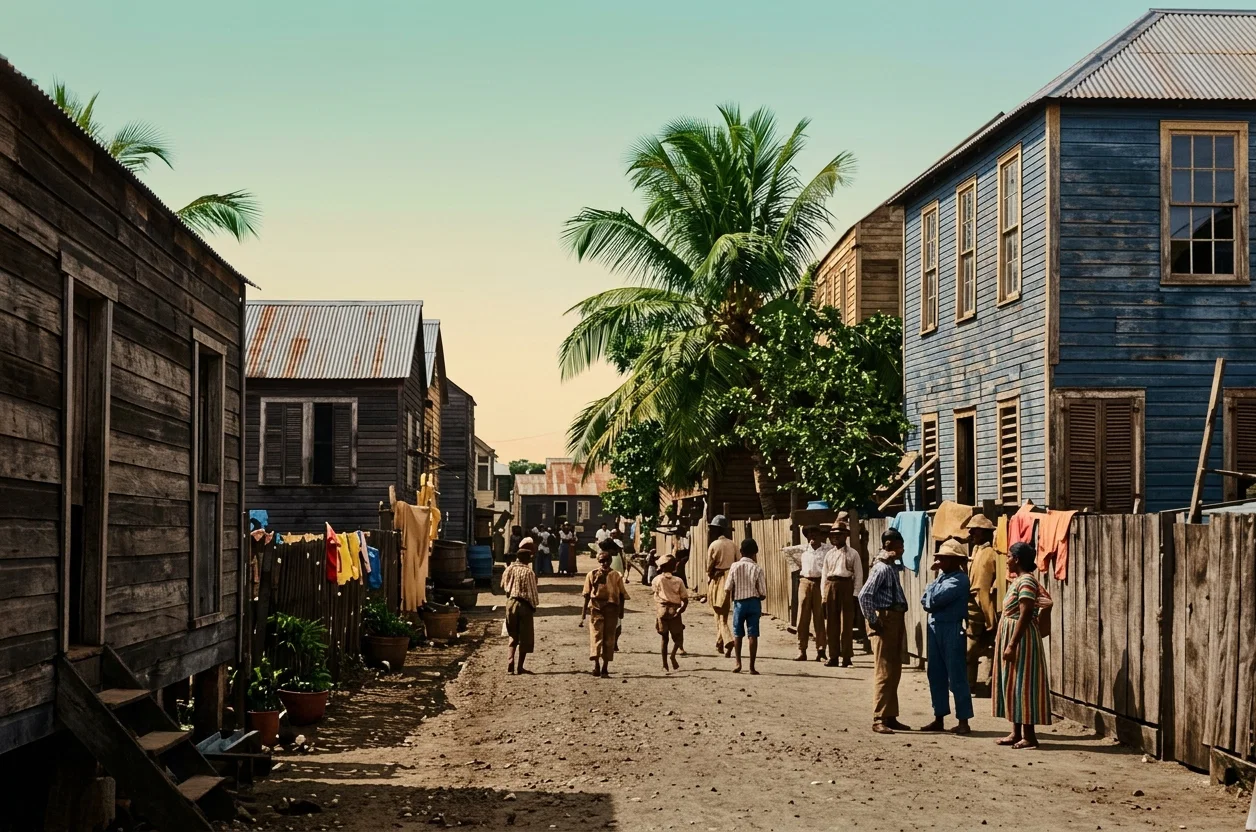
A BACK STREET, BELIZE
Wood-cutting is still the principal industry of the colony, the rivers being the only highways of commerce. The mahogany logs are floated down in rafts, and the logwood, which is too heavy to float, is cut into short pieces, and brought down in the native dory, or canoe, and loaded on to steamers for the English and American markets.
Agriculture has never made much progress in British Honduras, although rich and fertile lands abound. With most of the people, to raise enough for their own use is all that is attempted. The result is, that, not having enough to supply the market, the home product usually brings as large a price as the imported article. Rice grows here abundantly, and is of the finest quality, yet much the greater part of the rice used is American or Indian. The corn of this country commands a better price than that of America, yet much of this grain used here comes from that country; so also with beans. Yet all these grow well, and might more than supply all demands if greater attention were given to tilling the soil.
Most of the vegetables that grow here are scarce, and, at some seasons of the year, difficult to obtain, and about as expensive as American potatoes, which are four cents a pound; yet they might be raised in great abundance. Cabbage does well in the hills; yet very little is raised, and the imported article sells at from twenty to forty cents a head. In the market it is cut into slices, and sold at three or four cents a slice, to eat out of the hand like an apple. Oranges are plentiful, and of good quality, and are selling now at from thirty to fifty cents a hundred.
Grass does well on the lowland near the city, yet most of the horses are fed on hay brought from the United States. One piece of grass, of perhaps two acres, just outside the city, is the largest I know of. This is cut six times a year, and sells at ten cents a bundle the size of a sheaf of wheat.
Broom-corn does well, as has been proved by experiment, but no brooms are manufactured in the colony, nor in this country, that I know of, and brooms of third and fourth class bring the same price that a first-class article does in the States.
Dry hides are shipped in considerable quantities to the States, and then shipped back as tanned leather; while I am told that the red mangrove, which is one of the best tanning barks in the world, and costs here eight or nine dollars a ton, is shipped to America, where it brings forty dollars.
There are three things to discourage agriculture in this country: first, a lack of roads; second, destroying insects; and, third, a great lack of energy on the part of the people. With plenty of the latter, the two former would be readily overcome.
The city of Belize is almost literally built up out of the sea. All the streets are formed by broken coral rocks and mud taken from the sea, then covered with sand to raise them above tide-water. These streets are carefully cleaned every day, and are smooth and hard. The whole city, too, is built up in the same way, only no broken stone is used except on the streets. The condition of the yards is sometimes very bad.
The government has done a great deal to improve the sanitary conditions. Still, in the poorer portions of the city, where the people are closely crowded together, the condition is still bad, resulting in a great deal of sickness. Otherwise Belize is a healthful place. The low-lying land surrounding the city is sometimes overflowed by the tide-water of the sea, but from this salt water there is no danger. It is only when the place becomes filthy, and rain-water is allowed to stand under the heat of the tropical sun, that sickness is sure to result. Most of the diseases of this country are caused by the wrong, intemperate, and vicious habits of the people. The trade winds, or sea-breezes, as they are called here, which for more than ten months in the year blow steadily from the east, are the great health-giving boon of this country.
Belize has a population of about eight thousand. The remainder of the forty thousand people of the colony live along the seacoast, and on the rivers. They are a mixed population of negroes, Caribs, and East Indians, Spanish, English, Scotch, and Americans. Of these, the negroes largely predominate.
The influence of the clergy over this people is very much greater than in America. As a rule, the word of the minister settles a point of doctrine, without reference to the Word of God. And when God's Word is the basis of an unpopular truth, involving a life of self-denial, and often the loss of position, it requires an earnest determination to obey God to accept that truth. A large number who would really love to study the Bible are hindered by a fear of ridicule if seen attending public meetings. I believe this argument of ridicule, or of a sneering manner, or a slurring remark, is of more force here than in any other place I have ever been. For this reason, the work of the colporteur and the Bible worker should occupy a prominent place in our efforts. A Bible worker, in a kind and gentle way, can visit the people at their homes, and teach them the binding nature of God's Word, and the truths of that Word for this time. After one or two readings with a family, neighbors will be almost sure to begin to come in, and so the interest will spread. Since returning to this field, I have given more15prominence to this part of the work than before, and it has proved very successful. At one house where I called, the woman, after the first word of greeting, got her Bible, saying she would like to study it with me. She kept last Sabbath; and when I called on Sunday, I found her hard at work. This sister had never attended one of our meetings.
To show how easy it is to receive the word of man when it is in harmony with our own ideas, I will relate the following incident: A letter is being circulated here, said to have been found under a great stone, eighteen miles from Iconium, sixty-three years after our Saviour's crucifixion. Upon the stone was engraved, so reads the paper, “Blessed is he that shall turn me over.” A child of six or seven years accomplished, without assistance, what all others feared to undertake, and this paper was found. On it, among other things, was found written, “Whosoever shall work on the Sabbath day shall be accursed,” and the command to begin its observance at 6 P. M. Saturday. Hundreds of these are being sold at fifty cents each.
A Protestant family had borrowed one, and presented it as positive evidence from Christ himself that Sunday was the Sabbath. My opinion being asked, I replied that I would answer at our next reading. On that occasion the family were all present, and also the man who owned the paper. The Spirit of truth helped me to make it very plain that Christ was the active agent in the creation, that he rested on the Sabbath and sanctified it, and was also Lord of it; that the disciples kept it, according to the commandment; and that if we would enter the gates of the city of God, we, too, must keep his commandments.
After several objections had been answered, the one who owned the paper said, “This paper says that Christ wrote it with his own hand, and spoke it with his own mouth, and here I take my stand.”
But some are believing and obeying, and we expect a goodly number to be ready for baptism by the first of the year. Thus the Bible work is proving a strong factor in our labors in Belize. And I feel sure that, by the blessing of God, it is the very best way to reach the people here.
While in Michigan last summer, the West Michigan Conference very kindly voted to give an experienced Bible worker, with salary and expenses, for this field; but on account of her poor health, it was thought best for her not to go. Perhaps there is some other Bible worker who has a burden for this southern field, whose conference would esteem it a privilege to send free of expense to the Mission Board. Surely the Lord of the harvest must have some reaper somewhere for this field.
R. W. MUNSON
By R. W. MUNSON
Malaysia
R. W. MUNSON
“Behold my servant, whom I uphold; mine elect, in whom my soul delighteth; I have put my Spirit upon him: he shall bring forth judgment to the Gentiles. He shall not cry, nor lift up, nor cause his voice to be heard in the street. A bruised reed shall he not break, and the smoking flax shall he not quench: he shall bring forth judgment unto truth. He shall not fail nor be discouraged, till he has set judgment in the earth: and the isles shall wait for his law.” Isa. 42: 1-4.
More than twenty-five centuries ago God, by the mouth of his prophet, spoke these words of divine inspiration which have rung down the ages, and to-day are stirring the hearts of his covenant people to nobler efforts for the evangelization of the inhabitants of the island world.
PARK SCENE, PADANG, SUMATRA
These promises are a great inspiration and comfort to those of God's children whose lot has been cast among these emeralds of the southern seas. God is not unmindful of his creatures, and he has a people among these simple island folk whom it is our duty to gather out as jewels for his crown.
Malaysia is of vast extent. Its islands are the largest in the world; indeed, they merit the dignity of the title of continents, as some of them are. It includes in this class New Guinea, Borneo, and Sumatra. Following these are the lesser islands, such as Java, Timor, Bali, Celebes, Luzon, Mindanao, and the groups, Moluccas, Philippines, and ten thousand lesser isles.
Malaysia extends nearly four thousand miles east and west, from ninety-five to one hundred and fifty-five east longitude. Its breadth north and south at its widest part is nearly two thousand miles, from nineteen north to ten south latitude, and includes 1,365,000 square miles of land area, and is spread over about four million miles of the earth's surface.
Its population approximates fifty million, more than half of whom are found in Java alone. This comparatively small island, not more than half the size of New Zealand, has thirty-three times its population. It is difficult to believe that so small a space, only fifty thousand square miles, can maintain in comfort such a mass of humanity; but that is what it seems to do, and the conditions must be very favorable, as the population has doubled once in every twenty-five years since the beginning of last century.
In speaking of the dimensions of the large islands, it is necessary to give something more than figures to aid the imagination in grasping their true magnitude. Both New Guinea and Borneo are more than three times the size of New Zealand, or about one tenth the size of Australia. If we took a steamer, and sailed at the rate of ten knots an hour, it would take us a fortnight to circumnavigate Borneo, providing we did not stop to coal or take in provisions.
The general topography of all these islands is a central backbone of mountains, skirted by gradually descending plains to the sea. A great volcanic belt runs throughout the entire length of the archipelago, containing scores of active volcanoes, and hundreds of extinct ones. On both sides of this line of fire, rich, fertile hills and plains slope away to the limpid waters of a shallow sea. A great part of this region is under cultivation, and produces rich crops of pepper, nutmegs, sugar, coffee, tobacco, rice, rubber, manila, hemp, gambir, rattans, cocoanuts, damar, cinchona, cloves, cinnamon, and other articles of lesser importance. Rattans and rubber are jungle products, and not the result of cultivation.
A missionary who has spent many16years in the East Indies, and who has traveled, says of them: “Taken as a whole, the islands are exceedingly beautiful and fertile. Their beauty is gorgeous, and its like is unknown outside the mid-tropics. The waters amid which they lie are mostly shallow; and the deep-green tints of the ocean, the perennial verdure of the islands, the opaline tints of the lofty mountain tops, and the gloomy azure of the oftentimes cloudless sky present to the eye of the admiring traveler such a scheme of color as the earth can scarcely duplicate.”
There are many considerations that lead to the belief that this entire region was in the remote past connected on the west with the continent of Asia, and on the east with Australia, the dividing line between the two parts being between the island of Borneo and the Philippines on the west, and the Celebes and Moluccas on the east. The chief grounds for this belief are the similarity between the races of men and animals that are found, on the one hand, in Southern Asia and the western half of the archipelago, and between those of the eastern half and Australia, on the other. On the west are the straight-haired Malayan type, and on the east the long, crinkly haired Papuans.
The animal life is abundant and varied. The most important are the elephant, tiger, hippopotamus, rhinoceros, tapir, orang-outang, monkeys of many kinds, armadillo, peccary, deer-pig, moose-deer, and water-buffalo. Of the reptiles there are alligators, pythons, and many species of snakes, the giant lizard, and a vast number of smaller creatures peculiar to this latitude, and of great interest to the naturalist. The lakes and streams, not to mention the sea, swarm with wonderful specimens of the finny tribe, whose gorgeous coloring and fantastic forms outstrip the imagination in its unaided flights. There are prawns, crabs, giant turtles, and shell fish in great variety. The tortoise shell of commerce, if genuine, comes from the back of a large turtle that is common here. It grows in large loose scales, which are removed by pouring hot water over the backs of the turtles.
When the beholder sees these wonderful and weird creatures of the deep, darting in and out among the still more wonderful forests of tiny coral and flowers of surpassing beauty, he is led to exclaim, “How wonderful are thy works, O Lord, in wisdom hast thou made them all.”
Mohammedan Boys in a Mission School
In the Presbyterian mission school at Tabriz, Persia, fifty Mohammedan boys are enrolled, many of them from high families.
British Columbia
By O. E. DAVIS
PORT SIMPSON.—For the past year the work among the Indian people has been carried on against stern opposition, and at great disadvantage. As we did not have a suitable building in which to hold our meetings, the elder opened his house for Sabbath services. But the room was too small to accommodate more than a few at a time; besides, the native people are not inclined to go to private houses to worship.
On my return to Simpson after camp-meeting, a year ago, I found the people willing, and even anxious, to hear present truth. But as I had no place in which to hold meetings, until the president could come and look over the situation, and this step being delayed, the enemy soon stirred up the people against the truth. They called a meeting in the barracks, and considered our work. In this the pastors of all denominations took part. The matter was then brought before the Indian council, and referred to the government, requesting that I should be expelled from the reserve. The spirit of the missionaries and the natives was manifested in warnings and threats if I continued my work. On two occasions the agent of Indian affairs notified me to desist, stating that the law would be enforced to the fullest extent, if disregarded.
On full investigation by the government, the verdict was given that I had not, so far as it could see, violated any portion of the Indian Act, and, therefore, could not be prevented from carrying on my missionary and philanthropic work. Thus we see that God rules in the affairs of earth, and vindicates his truth.
In October, 1903, I organized our first native Sabbath-school, with a full number of native officers. In December following, a church was organized, four following their Lord in baptism, and two more being accepted subject to baptism. There are others who have begun the observance of the Sabbath, and we expect they will be taken into the church soon.
The following is a report of labor among the Indians: Book sales, $104.-85; pages of books loaned, 3,125; pages of tracts distributed, 4,872; periodicals distributed, 507; missionary visits, 792; Bible studies, 131; services, 102. Besides this, much has been done in caring for the sick and teaching the young. Of the eleven adults who accepted the truth, three have not yet fully separated from their former church associations, and two have given up the Sabbath; yet there is hope that with more labor these may be reclaimed.
Working for this people is much different from working for others, as they are not permanently located, but spend much time away from home, in fishing and hunting. So the effort is often interrupted by the absence of the people; and on their return, sometimes they have lost much of their interest. At present our greatest need is the establishment of some enterprise whereby our brethren can procure labor.
The prospects for this work are very favorable, and a remunerative business can be established with a small capital. Are there not some of our brethren in the States who would like to sell their property, and assist in this enterprise, thus helping to start the work in a new field? There are many of the natives in the valley of decision, who would come readily to the house of the Lord if an industry of some kind were started. In this way we could soon build a church and school, and eternity alone would tell the good results.
Elder T. H. Watson, with his family, now has charge of the work at Simpson; and, while laboring under many disadvantages as pioneers here, and having many obstacles to surmount, shall those to whom the Lord has entrusted his means fail to afford them the assistance so much needed just now? Without an industry of some kind, it is little better than useless to maintain workers in this field. May the Lord move some heart to respond quickly to the needs of his work here.17
Interested persons desiring full particulars as to conditions, climate, etc., would do well to correspond with Elder T. H. Watson, of Port Simpson, or with myself, at 757 Prior St., Vancouver, British Columbia.
What we do for this people must be done quickly. We are rapidly nearing the end. Who will come over and help us?
O. E. DAVIS.
Chinese Bibles Distributed to Postal Clerks
One thousand Chinese Bibles and Testaments have been distributed this year among the post-office clerks in China. Each volume was separately addressed, with a personal letter from the members of the International Christian Association of Postal, Telephone, and Telegraph Clerks. The books were distributed through the British and Foreign Bible Society, which paid one half of the cost of the gift.
G. W. HOCKARTH
By G. W. Hockarth
Switzerland
LIESTAL.—This is a place of about five thousand inhabitants. We began work here last August, holding meetings in our tent every evening except Saturday. The weather was fine, and the people came regularly. On Sunday evening we had a congregation of two or three hundred. We have now rented a small hall, where we hold meetings on Sunday and Wednesday evenings. The other evenings we spend in visiting interested ones in their homes. During the day we labor from house to house with tracts and periodicals. God is blessing us and his work here. Three keep the Sabbath with us, and we hope that some others will soon follow their example.
A few weeks ago I was at Sissach, where our conference was held last summer. Three faithful souls are holding up the banner of truth in that place. The Methodists are opposing the Sabbath truth. While I was in Sissach, they held a union meeting of their churches in Basel and the Canton of Basel Land. About three hundred persons were in attendance. A paper entitled “The Origin of the Christian Sunday” was read, after which some one called out, “Let us hold fast to our Sunday.” But no one could produce any proof from the Scriptures for the observance of Sunday. The Lord gave me much freedom in presenting the truth. They asked, “Where is it written?” and as I gave them the texts, they wrote them down. The Spirit of God is working here, and we are praying that the Lord will fill the hearts of all his people with the Holy Spirit.
We love the REVIEW here in Europe, and are indeed thankful when we can read how God is sending his everlasting gospel to all nations.