The Youth’s Instructor, Vol. L, No. 46

The Christian Soldier

The Youth’s Instructor

November 20, 1902

Review and Herald Publishing Company · Battle Creek, Michigan · November 20, 1902

The Christian Soldier
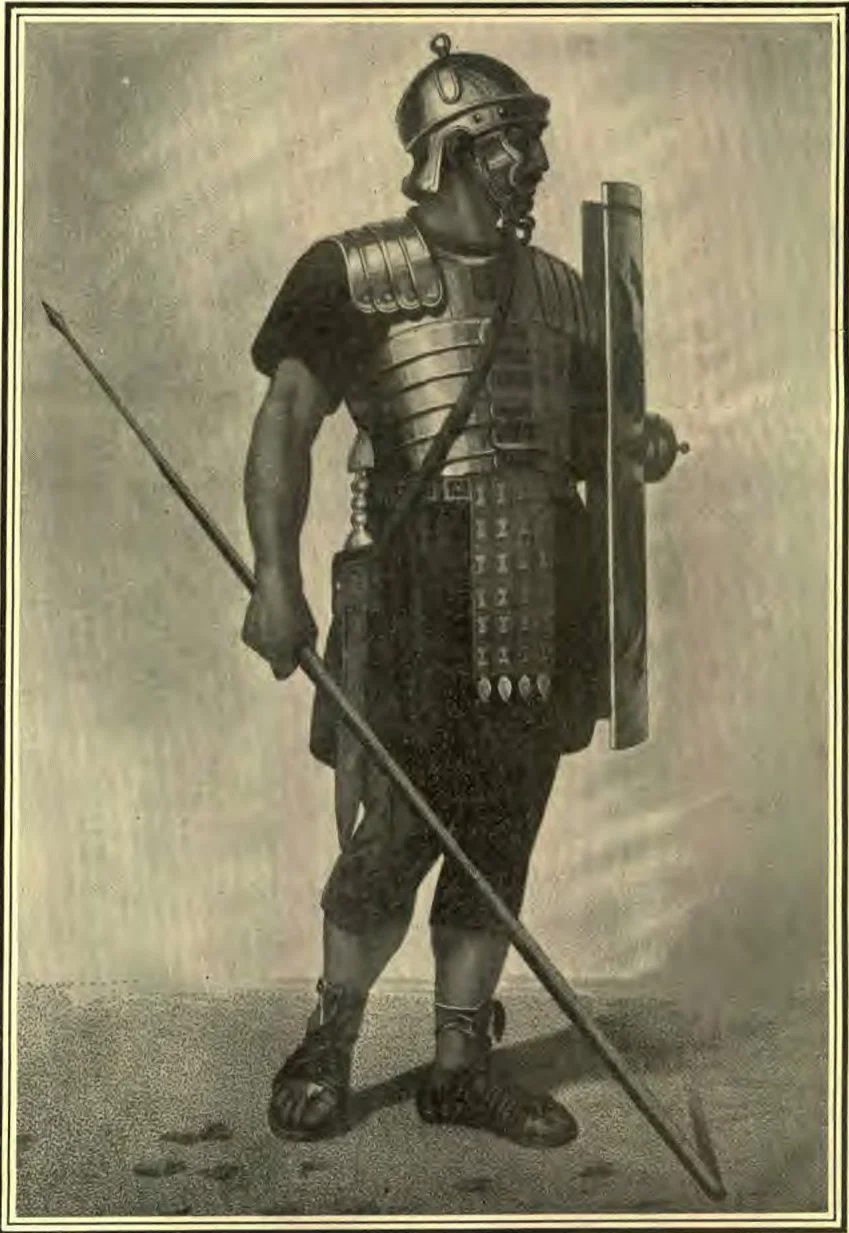
A ROMAN LEGIONARY
A ROMAN LEGIONARY
In the Bible the Christian life is called a warfare. Many texts in both the Old and New Testaments show this. Paul, in writing to young Timothy, exhorts him to “war a good warfare,” and to “endure hardness, as a good soldier of Jesus Christ.” He also says that “the weapons of our warfare are not carnal, but mighty through God;” and that “though we walk in the flesh, we do not war after the flesh.”
In this Christian warfare the Lord Jesus is leader; for he is the Captain of our salvation. And God’s people serve under a banner; for it is written, “Thou hast given a banner to them that fear thee, that it may be displayed because of the truth.” The enemies that we encounter are threefold: Our sinful hearts, the evil world, and Satan himself. For is it not written that “the heart is deceitful above all things, and desperately wicked!” and that, “If any man love the world, the love of the Father is not in him”? Peter also says, “Your adversary the devil, as a roaring lion, walketh about, seeking whom he may devour.”
But for our encouragement it is recorded that Jesus, our great leader, NEVER ONCE FAILED (John 8: 29), and that in his daily conflicts with sin and Satan he was always victorious. So the Christian may ever prevail in the battle for eternal life. It was this thought that led Paul to exclaim, “Thanks be unto God, which always causeth us to triumph in Christ!” and again he declares that in all our struggles “we are more than conquerors through him that loved us.” Are not these very comforting words for both old and young?
But in the lifelong conflict with evil we are not left to carry on a warfare at our own charges; for our Saviour says, “Lo, I am with you alway,” and though the weapons used are not carnal, yet they “are mighty through God,” even to “the pulling down of strongholds” of sin.
There is also a complete armor provided for every soldier of Christ. Read carefully the sixth chapter of Ephesians, where this armor is so minutely described. There we learn that the Christian’s war dress is composed of six different pieces, as follows:—
The Girdle of Truth.
The Breastplate of Righteousness.
The Gospel Sandals.
The Shield of Faith.
The Helmet of Salvation.
The Sword of the Spirit.
In other places Paul calls this “The Armor of Light,” and “The Armor of Righteousness.” But note also that it is “The Armor of God;” for he provides it.
In Ephesians 6 Paul exhorts us to “put on the whole armor of God,” and the reason given is, “that ye may be able to stand against the wiles of the devil.” A “wile” is a snare, or trap, laid for the unwary. And after stating that we “wrestle not against flesh and blood, but against principalities, against powers,” he repeats the admonition, “Wherefore take unto you the whole armor of God,” adding, “that ye may be able to withstand in the evil day.”
Let us now look at the armor provided for the Christian soldier, that he may be battle-proof:—
1. The girdle. Note that this is called the girdle of “TRUTH.” The Saviour refers to this in Luke 12 where he says, “Let your loins be girded about, and your lights burning,” referring to his second coming. And Peter writes, “Gird up the loins of your mind, be sober, and hope to the end.” In the Lord’s girdle of truth there is not one thread of error or falsehood. Of the Saviour, Isaiah says, “Righteousness shall be the girdle of his loins, and faithfulness the girdle of his reins.” And the psalmist adds that the Lord girds his people with strength for the battle. Ps. 18: 39.
2. The breastplate of righteousness. The breastplate of the old Romans was a piece of brass about a foot square to protect the chest. It covered the heart and vital parts. Isaiah, in speaking of our Saviour, says, “He put on righteousness as a breastplate.” Paul also exhorts, “Let us, who are of the day, be sober, putting on the breastplate of faith and love.” Faith and love include all the Christian graces. If we have the perfect righteousness of Christ as our breastplate, we may be very certain that it will stand every test. No fiery dart of Satan can pierce it.
3. The gospel sandals. Modern boots and shoes were not known to the ancients. In olden times the foot-dress of soldiers was made of leather, or metal, and sometimes of wood, and these were often studded with short nails or spikes. But note that the Christian’s foot-armor is “the preparation of the gospel of peace.” Every Christian is a child of peace, and the gospel is a path of peace, and the Lord is the God of peace. In Isaiah it is written, “How beautiful upon the mountains are the feet of him that bringeth good tidings, . . . that publisheth salvation.” Paul instructs to “make straight paths for your feet,” and the psalmist says, “I . . . turned my feet unto thy testimonies.” When this is done, a person may be very sure that he has on the genuine gospel sandals.
4. The shield of faith. Ancient warriors always had a shield to protect them from the missiles of the enemy. This was of various forms and texture. The Christian soldier also has a shield which will turn aside all the fiery darts of the evil one. Paul calls this “the shield of faith.” John says, “This is the victory that overcometh the world, even our faith.” In the psalms we read that God has given his people “the shield of . . . salvation,” and that his “truth” is our shield and buckler. But note Paul’s words, “ABOVE ALL, taking the shield of faith.” This shows the very great importance of this piece of armor; for without faith no one can please God.
5. The helmet of salvation. The helmet is a defense for the head. In Paul’s day the soldier’s helmet was of brass or iron, and served also to protect the neck. When Goliath came out to meet David, he wore a helmet of brass. In a prophecy of the Saviour’s work it says that he had “an helmet of salvation upon his head,” and Paul exhorts to put on “for an helmet, the hope of salvation.” The psalmist in his prayer says that God “covered my head in the day of battle.” One of the precious promises of the Bible is that “the very hairs of your head are all numbered.” How precious is the keeping power of God, and how good it is to hope in his mercy.
6. The sword of the Spirit. Paul says that this is the word of God, and that it is quick and powerful. It is even sharper than a sword with two edges. The word of God is also “a discerner of the thoughts and intents of the heart,” for it points out even our secret sins. Jeremiah says that it is like a hammer that breaks in pieces the flinty rock,—even our flinty hearts. Paul writes that “all Scripture is given by inspiration of God,”—literally, it is God-breathed,—and that by it the man of God “will be thoroughly furnished unto all good works.” The Saviour’s command is to “search the Scriptures,” for through them we gain everlasting life. It is written of the child Samuel that he let none of God’s words “fall to the ground,” and David says that he hid God’s word in his heart, that he might not sin against the Lord. In his forty-days’ conflict with Satan, Jesus repelled him with these three words, “IT IS WRITTEN.”
Clad in this heavenly panoply, may each reader of the INSTRUCTOR go forward to that certain victory which will last through the age of ages.
G. W. Amadon.

Good Words of Counsel—II

“Put away from thee a froward mouth, and perverse lips put far from thee.”
We sometimes hear it said of persons, “O, well, he is not so bad as he seems to be;” or, “His bark is worse than his bite.” That would be a real comfort if it were only true; but it is seldom, if ever, true. It may be true that a person does not really wish to be as bad as he seems; but if one wishes to be really good, he should make that wish appear in his behavior, even in his words and his manner of speaking.
There are those who desire to appear uncouth and rough while they are really kind at heart. But true kindness does not willingly offend, even in appearances. The Saviour said, “By thy words thou shalt be justified, and by thy words thou shalt be condemned.” Again he said, “Out of the abundance of the heart his mouth speaketh.”
Some people take pride in their supposed candor, which manifests itself in speaking out bluntly whatever may come into the mind, without regard to consequences. “It’s my style to speak out whatever I have to say,” says one. “Never spoil a story for relation’s sake,” says another. Sharp, cutting sarcasm, blunt answers to questions, impudent rejoinders, unkind criticisms, covert intimations; in fact, all forms of speech that wound the feelings of others, who hear or may hear, are froward and perverse. The thoughtful youth will seek earnestly to put them far away.
Gentleness is a sign of true greatness. The gentleness of Christ makes us great. This was characteristic of Daniel, who “purposed in his heart that he would not defile himself” with the royal food and drink; and “requested of the prince of the eunuchs that he might not,” do so. Back of the gentle request to be excused was the firm resolution of fixed principle not to deviate a particle from the right. This was certainly far better on his part than to have loudly declared that he would not touch their vile stuff. It was this true Christian courtesy that brought Daniel into “favor and tender love” with the court of Babylon.
Loud, rough talk does not indicate depth of character or firmness of principle. It may generally be taken to indicate the very opposite. While it is true that perverse talkers may have some generous traits that help to counterbalance their rude speech, these do not take away its bitterness. Genteel speech may be a cloak for evil designs, but harsh speech does not pave the way for good deeds. G. C. TENNEY.

The Story of Our Matabele Mission

Some Early Experiences

SUNDAY morning dawned bright and beautiful. The only shadow to cross the vision of the new workers was the black darkness that sin had made in the minds of these their fellow men, and they set bravely to work to dispel it by bringing in the light and life of Jesus. When the doctor opened his door on Sunday morning, he found quite a number of natives lying upon the ground, waiting for his appearance. This was repeated the next morning, when more than twenty greeted him, and begged for treatment. Three weeks after his arrival he wrote that during that time he had already treated one hundred and twenty-seven patients.
When the brethren first went into Matabele-land, they were handicapped, and the work went slowly because of the difficulty of communicating with the people. One day a patient, on starting home, said, “Salagoosly-le-hambra.” The doctor thought that some one was sick at his home, and the native wanted him to accompany him there, so he made preparations to go. But to be positive as to what he wanted, they went by the home of a native, named Solomon, who could speak a little English. To his amusement, the doctor learned that his patient was only saying, “Good-by; I am going home.” To be sure, this same experience never occurred again; for Dr. Carmichael never forgot to say, Salagoosly-le-hambra; neither did he again mistake its meaning. Similar experiences were frequent at first; and although they sometimes caused an expenditure of time, and were often amusing, the lessons learned were never forgotten.
The doctor’s first call into the country was to visit a man’s wife six miles away. He could learn nothing of her condition from her husband, only that she was unable to walk. Fortunately he took with him a lump of castile soap, a sponge, some carbolized vaseline, and a Faradic battery. When he reached the place, he found the woman lying on the ground in a circular hut about eight feet in diameter, with a fire in the center. The only entrance was a hole about twenty inches square. Through this small opening he was compelled to crawl in order to see his patient. She was in a most deplorable condition,—too weak to walk, and only able to crawl on her hands and knees with the assistance of another. He induced her to crawl outside to a pallet of dried grass, which he spread on the sunny side of the hut. He ordered some hot water, and they brought it in a kettle in which porridge had no doubt been made for many months, apparently without cleaning. It was necessary to skim off floating grease and fragments of porridge before proceeding with the treatment. After everything that could be done was done, he left her on a clean bed of long, dry grass, in the hut. When he returned to see her the next day, he found her in the same filthy surroundings as at first, with the addition of a miserable compound of native manufacture spread on the affected parts. Again she was persuaded to come outside, and the treatment of the day before was repeated. The doctor left, feeling that her case was almost hopeless, as she was so emaciated. But he gave directions for continuing the treatments, and to his surprise she recovered.
Another touching case was that of an old man, whom he found suffering from pleurisy and inflammation of the lungs. He was lying on the ground, with every symptom that the disease would prove fatal. After administering some heroic treatment, he instructed the family to continue alternate fomentations to the patient’s spine and chest. They faithfully followed his instructions, and another life was saved. The surprise was that these untrained natives would so readily do what they were directed to do, with such encouraging results. All these things were preparing them to become acquainted with the God of these people who were able to relieve their physical ailments.
About one day’s journey from the mission farm was situated the great religious center for the natives in that vicinity. They had been accustomed to assemble at this place for more than fifty years, whenever they thought any great calamity was about to overtake them, to seek relief and protection from their Mielo, or god. During the first year of our mission they had two such gatherings—one to seek the protection of Mielo from the grasshoppers, which threatened to eat their crops, and the other to ask him for rain in time of drought. The natives built temporary huts, made of poles and grass, and the gathering had the appearance of an old-fashioned camp-meeting. Their worship consisted chiefly in singing their native songs, playing on musical instruments, such as drums, gourd-rattles, tambourines, and some stringed instruments, and fantastic gesticulations and dancing. They wore tall head-dresses made out of ostrich feathers, and carried a stick in the hand, upon which a horsetail was fastened. Withal they presented a weird appearance. They fancied that all these things pleased their Mielo. When asked where he was, they would always point up reverently, and say, “Pasula” (up overhead), showing that they still had a vague knowledge of a Supreme Being who controlled the affairs of men.
Although the work was continuous and taxing, the Lord gave strength, and gradually the wilderness into which our brethren had moved was transformed into a pleasant little village. Comfortable houses were built, or as comfortable as they could be made with grass, mud, and crooked poles. Lumber was thirty-five cents a foot; and as this was beyond their means, the doors and windows of the houses were made from the boxes in which the missionaries had shipped their goods to Africa.
In addition to building houses, a schoolhouse was erected. Thirty-five acres of land, which had been covered with brush and stumps, was cleared and planted, and early in the new year, abundant crops were growing.
The natives had already learned of the Sabbath, and when it came, from seventy-five to two hundred would present themselves for services. They seemed to enjoy these meetings, which consisted of singing, reading a sentence or two from the Word, which was written on the blackboard in English and in their own language, and a short gospel talk. Even thus early there were many evidences that the power of the gospel was having its effect upon some of these darkened minds.
ESTELLA HOUSER.

Hudson Taylor on Chinese Converts at First Preaching

J. HUDSON TAYLOR, who is at the head of the China Inland Mission, states that in his work among the Chinese at a low estimate he personally knows of a hundred persons who were brought to Christ at the first preaching of the gospel they had ever heard,

The Contented Heart

A BLUSH steals o’er the orchard, A laugh leaps from the brook, A finch trills in the elm-tree With a triumphant look.
I loiter ’neath those blossoms, I linger by the stream, My buoyant heart unwilling To leave so fair a dream.
But when that bloom is faded, And though the brook run dry, Summer shall toss me clover, Daisy, and butterfly!
And when the pageant’s ended And winter skies are gray, My heart shall dream of summer, My soul shall sing of May! — Mary M. Barrows.

Nashville: Capital and Largest City of Tennessee

Nashville

NASHVILLE, the capital and largest city in Tennessee, was first settled in 1780, incorporated as a town in 1784, and as a city in 1843. The present population is about eighty-three thousand. It is situated very nearly in the center of the State, on the Cumberland River, which is navigable for small steamboats for fifty miles above the city. Six railroads run into Nashville, one crossing the river over a fine truss bridge having a two-hundred-foot span.
The capitol building, erected in 1845, having a tower two hundred and six feet in height, is built upon a hill five hundred and fifty-eight feet above the level of the sea, and cost the State one million dollars.
Nashville enjoys a large commerce, and has many large manufacturing plants, among them two immense cotton mills. It is called “the Athens of the South,” because of its numerous educational enterprises. It contains a large number of educational buildings, among which are the Nashville University, incorporated in 1785, now divided into three institutions,—the Montgomery Bell Academy; the Nashville Medical College, one of the largest in the South; and the Normal College, which is endowed by the Peabody Fund. Another is the Vanderbilt University, founded in 1872 by the M. E. Church, South, and named after Cornelius Vanderbilt, who gave it one million dollars, his son afterward contributing $250,000 more. Seventy-five acres of land are connected with the six large buildings.
Nowhere are the facilities so great for the education of the colored people as in Nashville. Besides the public and grammar schools of a high standard of excellence, there are the Tennessee Central (Methodist) College; the Roger Williams (Baptist) University, and the Fisk University, with its eight large buildings.
There are two large public libraries, the Watkins Institute Library, occupying a building which cost $130,000; and the State library, containing twenty-seven thousand books.
Our health and temperance work is well represented by two sanitariums, well appointed and well managed. The one for white people on Spruce Street is in a fine building, formerly a private residence. This is in charge of Mr. and Mrs. L. A. Hansen, and is fitted up in first-class style, and furnished with the very best of apparatus, baths, etc. A hygienic restaurant has been opened in the same building, and has a liberal patronage. The sanitarium for colored people is on Cherry Street, in a region where well-to-do colored people reside, is well fitted up, and is doing excellent work.
In North Nashville, about one mile from the capital, is a group of three buildings, owned and occupied by the Southern Publishing Association and the Southern Missionary Society. The original building, fronting on Jefferson Street, is two stories high. The two new ones are each four stories in height, and are the tallest, as well as the largest, buildings in this part of the city. The rear building contains a neat chapel, seating four hundred persons. It is fitted up with comfortable pews, and has chairs for one hundred more.
Twelve miles from Nashville a tract of three hundred acres of land has been purchased, and named Dixiedale. Brethren have bought lots of ten or more acres from this company, built upon their land, and settled there with their families, for the purpose of engaging in truck farming, the raising and canning of tomatoes and other vegetables to be the principal industry. A food factory is also connected with this farm.
W. S. CHAPMAN.

The Gentle Art of Letting Alone

I WAS once a guest in a family of girls and boys whose affection for one another was a marked characteristic, and who were considerate and unselfish. Yet there was an atmosphere of contention in the household that marred its peace and happiness.
At last I ventured on a suggestion (being so much older, and a kinswoman) to the eldest daughter, a lovely and loving girl of eighteen.
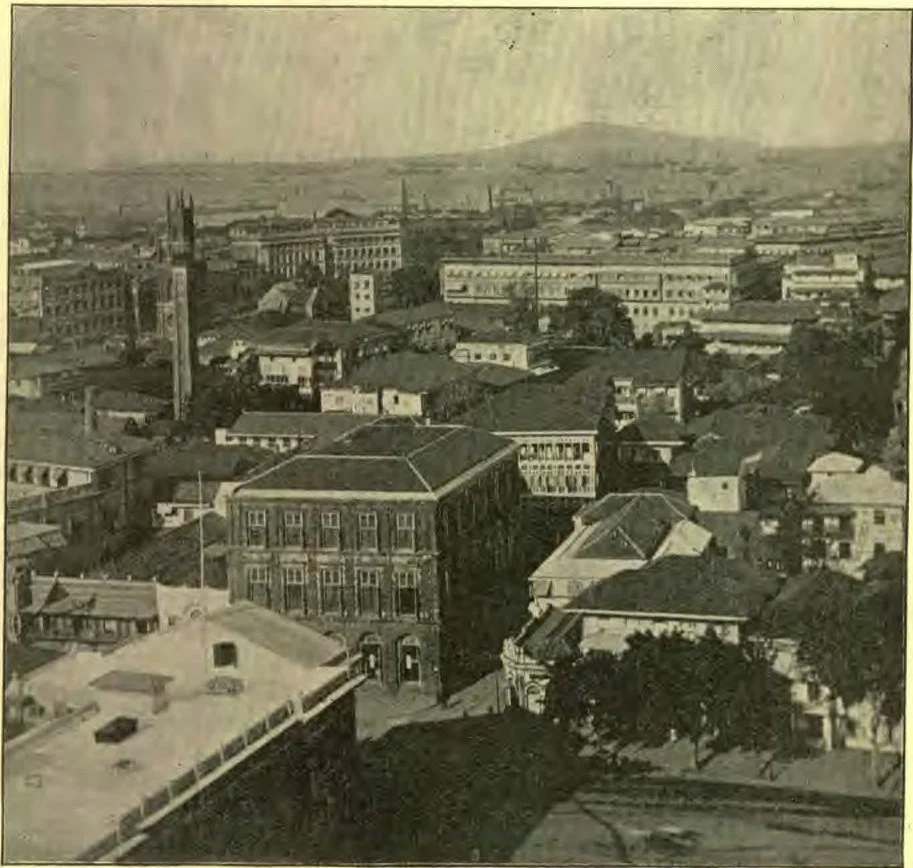
A CORNER OF BOMBAY
A CORNER OF BOMBAY
“Don’t you think, my dear,” I said, “that it would be better to let Fred go his own way sometimes, without any controversy, even if you are sure it is a mistaken way, and will bring him trouble?”
The dear young thing looked at me in wide-eyed surprise. Let Fred take a mistaken course without trying to hold him back! Evidently the suggestion seemed rank disloyalty.
“I do think,” I went on, with some hesitation, “that, next to obeying God and your parents, the very most important thing in your home life is that it should be saturated through and through with the sunshine of love and kindness and perfect sympathy.”
“Yes?” said Fred’s sister, doubtfully.
“It really does not matter lastingly,” I kept on, “whether Fred brings his dog in the house or not, whether he cleans his gun on the back porch or in the wood-shed, whether he wears his patent leathers out in the wet or puts on overshoes.” I stopped, and looked anxiously at the flushing cheeks of my young listener.
“It does matter, infinitely much,” I continued, “whether or not the boy finds home the jolliest place in the world, whether or not he turns to his sister as his best chum and confidant, sure of her sympathy, not fearing any small, stinging criticisms.”
There was no response to my suggestion.
“My dear Ellen,” I said, “I am sure that, nine times out of ten, when we feel impelled—almost compelled—to say ‘Don’t,’ we ought to restrain the inclination; and even that tenth time we should think twice before criticising one who is pretty sure to know his own business better than we do, and quite sure to think he does. Will you not try my plan of letting your brothers and sisters make their own mistakes, and get their own experience, while you make yourself the joy of their lives?”
I am glad to add that I had the happiness of seeing my suggestion take root, and bring forth the peaceable fruits of happiness and sweet content in that household.
And just the other day a friend said to me, complainingly, “You don’t love Jack nearly as much as I do, yet you have twice as much influence over him.”
“Ah!” I said to myself, “it is because I practise the gentle art of letting alone.”—Elizabeth Preston Allan.

“The Eye of India”

So Bombay has been named. I suppose it is because it looks out upon Europe. Or perhaps it is the first window through which the majority of Europeans look in upon India.
It is a splendid city,—fine streets, beautiful buildings, electric street-car service, a spacious harbor, and full of people, eight hundred thousand strong. There are dirt and squalor and overcrowding of the main thoroughfares. The bubonic plague has marked it for its headquarters for the last five years. The afternoon windstorms sift the germ-laden dust from streets and alleys into the eyes and teeth of the traveler. Yet it is a beautiful city, full of life and color, and, we must add, full of sin.
I do not know of a railway station in America more imposing than the Victoria Terminus Station in Bombay. Few schools are better housed than several of the great educational institutions in this city. The Parsees have done much to beautify Bombay architecturally. The Parsee religion lays great stress on acts of benevolence, and wealthy members of this ancient branch of the Persian family have contributed fortunes for school and public purposes.
The government and commercial interests centering here bring in a large European and Eurasian population, perhaps twelve or fifteen thousand. Thousands of the native residents speak English also. It is perhaps the most Europeanized city in India. But it is typically Indian, after all. I know of no other city so full of the glow and color that one associates with thoughts of India. The street scenes seem brighter than in Calcutta. Costumes are more gorgeous and varied than on the Bengal side. Throughout India, however, fashion favors a freedom in the drapery of body and head, which insures variety.
Various missions, educational and evangelistic, are doing good work in Bombay. And still the vast multitude know little of the coming Christ and the gospel of his preparation. Our own workers in India have distributed considerable literature in the city, and we have many readers of The Oriental Watchman there. We hope soon to see permanent work undertaken by us in this, the second city of India in population and influence.
W. A. SPICER.

A Wayside

MORE fair, more rare, than any bower Where flourishes a cultured flower, A little wayside garden-close Where modest kindness sweetly grows. —Frank Walcott Hutt.

Prayer

To stretch my hand and touch Him, Though he be far away; To raise my eyes and see him Through darkness as through day; To lift my voice and call him— This is to pray! To feel a hand extended By One who standeth near; To view the love that shineth In eyes serene and clear; To know that he is calling— This is to hear!
—Selected.

The Weekly Meeting

(November 23–29)
THE story of Daniel yields lessons of encouragement and even thrilling interest for Seventh-day Adventist youth. For the same principles and controversies that were the live issues in Daniel’s day are before us now in these last days when “great Babylon” is to come in remembrance before God.
The study might be outlined as follows:—
Causes of the Captivity in Babylon.—2 Chronicles 36; Jer. 5: 1–5, 25–31; 17: 27. These, and many other scriptures, show the conditions in the latter days of Jerusalem, and the influences amid which Daniel must have grown up.
Daniel, the Student.—Daniel 1; 2: 17–23, 30. His standing as a student before taken captive, his introduction to Babylon, and his moral stamina.
Few things, in so large a subject, can be dwelt upon; but note Daniel’s uncompromising stand for the right in a strange land when a youth, and see how the same decision of character held him true, whether rebuking a king or facing a lions’ den. And note how much of the world heard of the living God by Daniel’s faithful witnessing. If God can so use one youth, how great a work may be done by the youth of this denomination if each one will but join “Daniel’s band” for service.
“In Daniel God placed a light beside the throne of the world’s greatest kingdom, that all who would might learn of the true and living God. At the court of Babylon were gathered representatives from all lands, men of the choicest talents, men the most richly endowed with natural gifts, and possessed of the highest culture this world could bestow; yet amid them all the Hebrew captives were without a peer. . . . While faithful to his duties in the king’s court, Daniel so faithfully maintained his loyalty to God that God could honor him as his messenger.”—“Testimonies for the Church,” Vol. VI, page 220.
Notice that Daniel did not become puffed up by his wisdom. It was a pure and peaceable wisdom, given of God. His is a good example for any of our young men who may have been led by their scientific studies to imbibe the spirit of the Higher Criticism, that turns the story of the creation of man and of the world into fable, and questions whatever can not be comprehended by human reason. “With the heart man believeth unto righteousness.” Daniel had a heart in him, true and loyal to the God of heaven.
Dr. Hilprecht has recently returned from Babylonia, bringing a fresh lot of tablets. This statement by him shows the kind of work Daniel must have done in arithmetic:—
“It seems that the reputation of the early Babylonians as mathematicians was very much underrated. Whereas our multiplication tables stop at 12, the Babylonian tables went as far as 60. The scientific workers in those days had the desire and the means of obtaining swift and large conclusions in numbers, and their system of extended tables, particularly in astronomy, where the results of multiplications of 1300 by 1300 are seen, is a veritable mathematical marvel. Not only in science, but in languages, the Babylonian children, even in schools of the lower grade, were compelled to master two languages—the one a learned, the other a colloquial tongue.”
It was amid culture and fine-spun philosophy that Daniel kept the simplicity of faith. The old Babylonian philosophy still rules the world. It is met to-day in the mysticism and the pantheism of the East. It is the real basis of the modern theories of the evolutionist school, where their doctrines of materialism touch religion and God. The issues that Daniel met are the very same that our youth must meet in the strength of Daniel’s God.
Remember that Eze. 14: 16, 20, was spoken before the fall of Jerusalem, and while Daniel was still a young man in Babylon.
W. A. S.

Notes from the Field

THE Des Moines, Iowa, Society has been actively at work with the Life Boat. They began work with the September number, and expected to use at least one thousand copies of the October number.
There are fifteen members of the Young People’s Society at Salamanca, New York. They hold weekly meetings, using the INSTRUCTOR lessons. The members are engaged in distributing papers. The secretary reports an excellent interest.
Some time ago mention was made of the effort of the California young people to establish a Self-denial Fund, which was to be used in the establishment of an electric-light bath in the free dispensary at San Francisco. The fund has grown by the donation of small amounts until it has reached $32.10.
The students of Mt. Vernon Academy have organized two Young People’s Societies, and have begun work. Miss Laura Hutchinson is leader of the society for the young ladies, and Mr. Harold Cobban for the young men’s society. These Societies held a union meeting on October 11, and an interesting and profitable program was provided.
Those who have been reading the reports from the Young People’s Societies during the last year will doubtless remember several good reports from Chitwood, Oregon. Seven of the young people there were baptized last June. Two of the young men who were active members are now preparing to enter a new territory in Oregon, to canvass for our publications. That is just the work our Societies everywhere ought to do,—prepare laborers for the great harvest-field.
The Salt Lake City young people have devised a good plan of doing missionary work with our periodicals. They have been selling the Life Boat from house to house, and in introducing themselves have stated that they were engaged in the circulation of temperance reading, a portion of which was given away. The little temperance story, “The Name,” a leaflet of the Apples of Gold series, was then given the person, and he was also asked to buy the Life Boat. This plan shows that the worker is not merely interested in the sale of the literature, but in the good it will do, and the people are more ready to look with favor upon that which they are asked to buy. Brother H. H. Hall, in reporting this work, says: “I found this a very good way of getting into houses myself, and am glad to say that the same plan is being followed in other places with the Signs and books.”
There are a large number of isolated young people in Montana, and but one or two churches where there are a sufficient number to organize a Society. The situation has been carefully considered by the Montana Conference Educational Board, and it has been decided to organize a Montana Young People’s Society for those who are so situated that they can not belong to a local company. Simple plans of work have been laid, in which all may have a part. Miss Lulu T. White, the State Sabbath-school Secretary, has the work in charge, and is pushing it energetically. In writing of the plans for work, she says: “A strong effort is to be made all over the conference this fall to get the people to take up the envelope plan of tract work. A good many of the young people will doubtless take this up. I have been thinking of another line of work that seems to me very suitable as a beginning for the younger class of young people who could hardly represent the truth in a public way. I call it ‘Sunshine Work,’ but it is really the beginning of Christian Help work. The plan is for each one to make it a point to do something every day,—something that is not really required of him,—to make some person a little happier. ‘If you’ve had a kindness shown, pass it on.’”

Storm-Tested Trees and Noble Character

THE beautifully grained wood that makes our finest furniture is not taken from trees that grow in peaceful, sheltered situations, but from those that are in exposed places, beaten about by the storms. So it is that the noblest natures are those that have had to contend with many trials. — Christian Endeavor World.

Cast All Thy Care Upon God

Cast all thy care upon God. See that all thy care be such as thou canst cast on God, and hold none back.—E. B. Pusey.

Going to Bed

FRED'S mother was away taking care of sick grandma. Papa would not come home till almost ten. It was past Fred's bedtime already. What should he do?
Bridget was the only other person in the house, and he could tell by the sound of voices that she had company.
Mama had told him to go to bed at eight, but she supposed papa or Bridget would be there to go up-stairs with him. It was cozy in the sitting-room, but how dark and lonesome his little bed-room would be!
He had never been to bed alone in all his life. In the daytime five years seems very old. He felt quite like a big boy. But at night, in the dark, it didn't seem old at all.
What a happy surprise it would be if papa should come home early after all! But Fred heard no welcome footsteps.
“There seems to be nobody looking out for me,” he whispered, in a wee voice.
“Chirp! chirp!” came from outside. Some birds were chattering over their perches for the night.
Fred watched them, peering into the dusk from the window. The little birds did not seem to be afraid. They stayed out in the dark night alone.
“A bed is safer than a tree, anyhow,” Fred thought. “I guess God in heaven wouldn't let anything happen to a little boy any more than to a little bird.”
When papa came home, he found a child fast asleep with a smile on his face.—Selected.

My Two Friends

I HAVE two neighbors who have dwelt For years and years right side by side; There's very little one has seen But that the other, too, has spied. They are congenial in their tastes; In everything they quite agree; And what one loves to look upon The other, too, is pleased to see.
Together they have traveled far, And viewed the sights in many lands; Whatever one can comprehend The other, likewise, understands. Like brothers they have shared their grief, Like brothers joined in their delight; Together roamed the fields by day, And gazed upon the stars by night.
But, strange as it may seem, these friends, Who have been closely linked for years, And in their sympathetic way Have ever shared their smiles and tears, Have never seen each other; yet That fact need cause no great surprise, Because these two observing friends Of whom I speak are my two eyes.
—Nixon Waterman, in C. E. World.
Continue reading: Frisky: The Tame Striped Squirrel