He was only an ordinary striped squirrel, shy as the rest of his woodland companions, until Ralph took the notion to tame him.
With a quick dart he would seize the nut placed upon the ground to entice him, and having carried it to a safe hiding-place, return for another.
One day the nut was not in its accustomed place, but Frisky’s bright eyes made a discovery. Half-way up the leg of the strange-looking creature near him was something resembling the nut he was in search of, and he darted up, tucked it away, and was off like the wind. The next time he got two.
After several of these journeys, the strange object from which Frisky seized the waiting nuts moved a bit, and Frisky vanished, and was not seen again that day. Ralph was not discouraged, however. He did not expect to tame a squirrel in one day or a week.
In less than a month Frisky had become so well acquainted with his two-legged friend that he would wait patiently while Ralph cracked the nut, and hid it inside his collar or up his sleeve.
After Frisky had found the nut, he usually perched upon Ralph’s shoulder, and once upon his head, where Cousin Ned discovered him one day enjoying, with evident relish and in happy security, his noon repast.
Ralph then made the joyful discovery that his little woodland friend really knew him and trusted him.
His cousin Ned, although well supplied with nuts, could not coax Frisky to dive into strange pockets or perch upon strange shoulders.
After school began in the autumn, Ralph used to get up half an hour earlier that he might have time to visit his pretty pet, who was almost always waiting, sometimes upon the stone wall with his bushy tail spread over his back, and sometimes upon the ground, whence a loud chattering call would always disclose his whereabouts.
“Oh, dear!” thought Ralph as he hurried along one morning, “there’s Frisky, and I haven’t a nut.”
Frisky evidently had been waiting some time. “Chut, chut, chut!” he was scolding, as he ran to and fro.
Poor Ralph was at his wit’s end, as the squirrel darted into an empty pocket, whence he emerged scolding louder than ever.
Now what do you suppose Ralph did? He saw an apple on the ground—a little, hard, red apple. He picked it up, and dropped it slyly into his other pocket. When Frisky found it, he seemed to think it a new kind of nut.
So excited was he with his treasure, that he settled himself in Ralph’s trembling little hand, and proceeded to crack his queer nut. It was a long way to the little black seeds, but Frisky found them at last. What he did not lose he ate; and those he ate seemed to satisfy him as well as if their shells had been harder.
As cold weather approached, Frisky’s visits grew less frequent, and he finally went into his winter quarters in the tree trunk.
Ralph intends to be on hand again in the spring, however, with an extra supply of patience—and nuts.—
Sunday School Times.
Some Bible Birds
By Elizabeth Rosser
By Elizabeth Rosser
Loosed from her Master's kindly hand,
And guided by her Lord's command,
Across the waters deep and black,
An olive leaf they brought back.
The King's ship sailed across the sea,
With silver, gold, and ivory,
And spices sweet, and jewels fair,
And precious woods, and rare.
From Jezebel compelled to hide,
The prophet sat by Cherith's side,
And there was by the raven fed,
At morn and even, meat and bread,
Her brood of tiny helpless things,
The hen doth gather 'neath her wings;
“So,” said the Saviour, “Just as she,
Jerusalem, I'd gather thee.”
“Two for a farthing, five for two,”
So they were sold the city through;
Yet not a sparrow ever can fall,
Unseen by Him who noteth all.
The swallow seeking place of rest,
Beside thine altars builds her nest;
Within thy courts to teach her young
To praise thy name with guileless tongue.
First Lessons in Geography
By Floyd Bralliar
Lesson XI
NOTE TO TEACHERS.—This lesson is only suggestive, and several lessons should be given on making maps. Have the pupil make a map of his father's farm or lot. Take the children to a creek, and help them make a map of a portion of it, with its surroundings. Give enough work to insure the pupils' understanding what a map is, and what it is for. Sometimes it is helpful to get a plot of the neighborhood, and study it with the class.
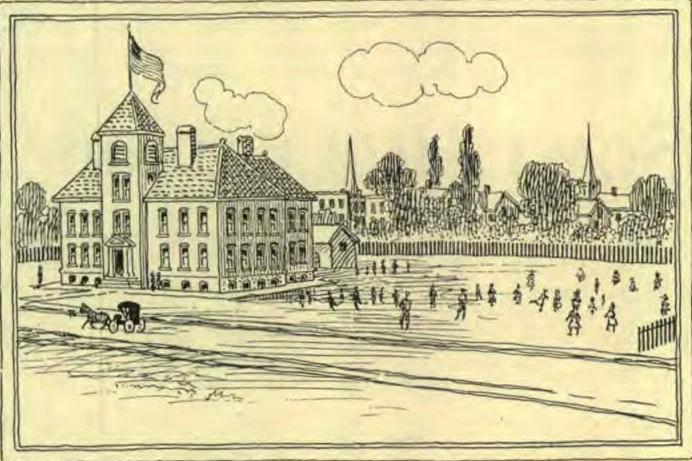
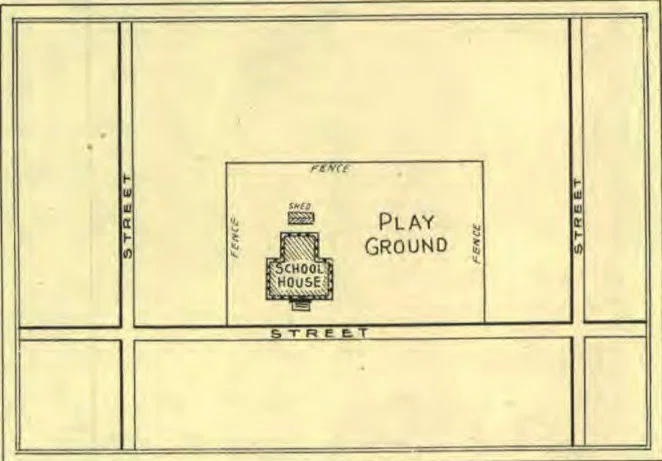
Before studying further, we will need to learn what maps are. No doubt you have seen them many times. Now you will like to learn what they are for, and how to use them. Here is a picture of a schoolhouse, taken from a distance, so that the playgrounds may be seen too. Then here is a representation of the same schoolhouse and playgrounds. You can see the difference,—the picture looks like a schoolhouse, while the map simply shows where it is, and where the other things on the grounds are.
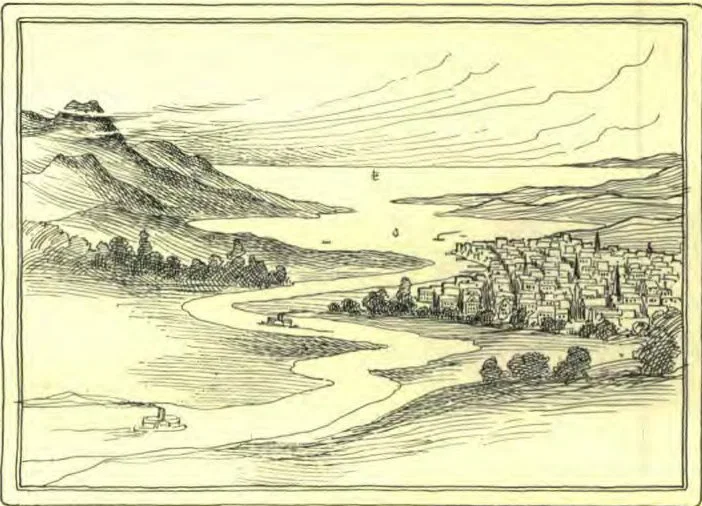
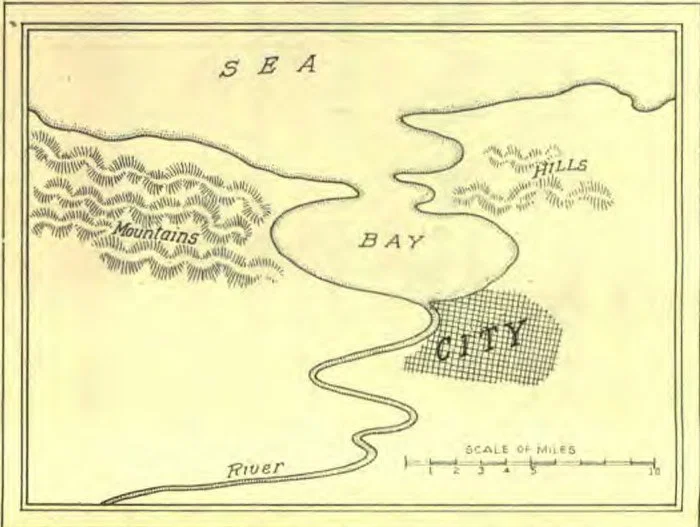
In the next picture are some mountains, a sea, a bay, a river, and a town. Then again, we have these represented on a map, which merely gives the outlines, but is not a picture.
We may have a map of all the world, or of only a part of it. One can look at as many pictures as he pleases, and not know where the places are, but with a map, he can tell just where any place is on the earth.
We can not make a map as large as a place, so we adopt a scale to make the map by, so that everything will be in the right place. To illustrate this, make a map of your school-room. First, measure the size of the room. Suppose the room is 24 feet wide and 36 feet long. Draw the map 4 inches wide by 6 inches long. This would be one inch to each six feet, which is the scale. If you were making a map of a place, you might have the scale one inch to 10 miles, or one inch to 500 miles, or any other distance. As all maps are not the same size, and do not represent the same amount of land, the scale is put on the map, usually in the lower right-hand corner, and is marked as is shown in map No. 2.
Most maps are drawn so that the top is north and the bottom is south, the right side east and the left side west. A person can take a map and a compass, and go anywhere in the world, and know just where he is, if he keeps a record of how far he has gone.
You have seen globes, and know that they are spheres on which maps of the world are placed.
REVIEW.—What is a map? What is it for? Why would not a picture do as well? What is a scale? Where is it placed? Show how it is used by drawing a map of some place. What are the usual directions on a map? What is a globe?
NO. 3 — PICTURE OF MOUNTAINS, SEA, ETC.
FLOYD BRALLIAR.
Second-Growth Timber
I was staying recently with a gentleman who was very largely interested in lumbering, and had recently purchased many thousands of acres of timber-land. Speaking of the timber, he said: “Of course, there is no such timber there now as there used to be a hundred years ago. What there is left is all second-growth timber. And, while it is not so good as the first growth, it makes very fair lumber, and pays well for working.”
NO. 1 — PICTURE OF SCHOOLHOUSE
I could not get his words out of my mind that night after I had gone to bed. I said to myself: “Second-growth timber is very much like some of the opportunities that are left to me. The best I can not do now; the years have taken the chance from me; but the second best is still left. God help me to make the most out of that!”
NO. 2 — MAP OF SCHOOLHOUSE AND GROUNDS
As I have been thinking of it later, it seems to me there is a message in it for many young men and young women. Perhaps through hard conditions of poverty or otherwise you have not had an opportunity to get good first growth in your career. If so, don’t fret about it. Take a second growth. It may be that your sins and follies have taken away the first growth of achievement out of your life. Still, I say, don’t worry. Ask God for forgiveness, and plant again for the new growth.—Selected.
MEMORY VERSE: “All things work together for good to them that love God.” Rom. 8:28.
(The chapter given as the Lesson Scripture is the lesson to be studied. Read this every day, and think over it until you know just what it teaches. Then the following notes, which should be read several times, will help to a fuller understanding of the lesson. Lastly, go over the questions carefully, and be sure that you can answer each in the words of Scripture.)
The chapters between this one and our last lesson tell of the different ways that Joseph tried his brothers to see if they still had the same envy and jealousy in their hearts that had led them to sell him as a slave. He knew that if they had, they would show it to his brother Benjamin. So he tried them to see if they would let Benjamin be left as a slave in Egypt, while they went home to their father without him. But he found that they were willing to take his place, if only Benjamin might be allowed to go back to Jacob. In the years that had passed while Joseph was in Egypt, they had learned to be kind and thoughtful to one another, and tender and considerate to their aged father.
Joseph’s brothers did not know that he could understand their language, so they talked freely before him, and he had a good opportunity to learn what was in their minds. He heard them say: “We are verily guilty concerning our brother, in that we saw the anguish of his soul, when he besought us, and we would not hear. Therefore is this distress come upon us.” Then Joseph knew that they had repented of their sin of selling him as a slave.
Joseph had nothing in his heart but love for his brethren; yet when he made himself known to them, they were terrified. They thought that, now they were in his power, he would punish them. Notice how beautifully Joseph comforted them by showing them that it was God’s plan that he should go into Egypt before them, to save their lives.
We have learned that it was the Spirit of God that gave Joseph such wisdom and success in all his work; and it was the same Spirit that put such forgiving love in his heart. He showed the Spirit of Jesus, of whom he was a type.
His brethren had hated him, because they saw that his life was better than theirs. They said they would not have him to reign over them, just as the Jews—their descendants—afterward said of Christ.
NO. 4 — MAP OF MOUNTAINS, SEA, ETC.
Joseph was sold by his brothers for twenty367pieces of silver, even as Judas afterward sold his Lord for thirty.
Joseph went into Egypt,—the very place to which the infant Jesus was taken, because of Herod’s cruelty.
Joseph was falsely accused and condemned to suffer; Jesus was also falsely accused and condemned.
When Joseph’s brethren thought they had got rid of him, and would never see him again, he was made known to them in an exalted position, with all the world looking to him for help. When the people of Christ’s own nation crucified him, and thought that they had made an end of him, the next thing they heard was that God had raised him up, and exalted him with his own right hand to be a Prince and a Saviour of the whole world. The cross was the way to the throne.
Joseph did not punish his brethren; he spoke kindly to them. He was not ashamed of them, but took them in and presented them before Pharaoh. So Jesus, after he rose from the dead, sent messages of love and comfort to his murderers, and “he is not ashamed to call them brethren.” All who come to him he will present before his Father with exceeding joy.
When Jacob was in trouble because he had lost Joseph, and Benjamin was about to leave him to go into Egypt with his brothers, and he was afraid he would not see him again, he said: “All these things are against me!” But when his sons came home with the joyful news of all Joseph’s glory in Egypt, and how he would care for and comfort him in his old age, he saw that instead of all being against him, God had been working all things for his good.
Questions
1. After Joseph had tried his brothers, to see if they were changed, what did he do? Gen. 45: 1.
2. How did his brethren feel when they knew who he was? How did Joseph comfort them? Verses 4–7.
3. What did he tell them to do? What did he promise to do for them?
4. What had Jacob said in his trouble when Benjamin went into Egypt? Gen. 42: 36.
5. Who was working out all these things? How does God make all things work? Memory verse.
6. How did Pharaoh and the Egyptians feel when they heard that Joseph’s father had come? Verse 16. What did Pharaoh tell Joseph to do for them?
7. Of whom is Joseph’s life an object-lesson? Tell all the ways you can think of in which Joseph was like Jesus.
Kindness Is Love Doing Little Things
“KINDNESS is love doing little things, things that seem scarcely worth doing, and yet that mean much to those for whom they are wrought.”
MEMORY VERSE: “And the vision of the evening and the morning which was told is true: wherefore shut thou up the vision; for it shall be for many days.” Dan. 8: 26.
“And it came to pass, when I, even I Daniel, had seen the vision, that I sought to understand it; and, behold, there stood before me as the appearance of a man. And I heard a man’s voice between the banks of Ulai, which called, and said, Gabriel, make this man to understand the vision. So he came near where I stood: and when he came, I was affrighted, and fell upon my face: but he said unto me, Understand, O son of man; for the vision belongeth to the time of the end. Now as he was speaking with me, I fell into a deep sleep with my face toward the ground: but he touched me, and set me upright. And he said, Behold, I will make thee know what shall be in the latter time of the indignation: for it belongeth to the appointed time of the end. The ram which thou sawest that had the two horns, they are the kings of Media and Persia. And the rough he-goat is the king of Greece: and the great horn that is between his eyes is the first king. And as for that which was broken, in the place whereof four stood up, four kingdoms shall stand up out of the nation, but not with his power. And in the latter time of their kingdom, when the transgressors are come to the full, a king of fierce countenance, and understanding dark sentences, shall stand up. And his power shall be mighty, but not by his own power; and he shall destroy wonderfully, and shall prosper and do his pleasure: and he shall destroy the mighty ones and the holy people. And through his policy he shall cause craft to prosper in his hand; and he shall magnify himself in his heart, and in their security shall he destroy many: he shall also stand up against the prince of princes; but he shall be broken without hand. And the vision of the evenings and mornings which hath been told is true: but shut thou up the vision; for it belongeth to many days to come. And I Daniel fainted, and was sick certain days; then I rose up, and did the king’s business: and I was astonished at the vision, but none understood it.” Dan. 8: 15–27, Revised Version.
Questions
1. As soon as Daniel had seen the vision of the first part of this chapter, what did he see?
2. Who stood before him? What kind of voice did he hear? What did this voice say?
3. Who was the angel that was commissioned to make Daniel understand the vision? Can you recall other instances where this same angel was sent to bear a message from the Lord to one of his people?
4. What effect did his coming near to Daniel have upon the prophet?
5. What was his first statement concerning the vision?
6. How did his speaking to Daniel affect him? What did the angel then do to Daniel?
7. What did the angel say to the prophet? To what time did he say the vision referred?
8. What was represented by the ram? How plainly did he locate the kingdom represented by the he-goat? Who was represented by the great horn?
9. What interpretation was given to the four horns which came up when the great horn was broken? What is said of the power of these kings?
10. What would take place before another king should stand up? How is he described?
11. What is said of his power? How will he conduct himself?
12. How will he cause his deceptive work to prosper? What is said of his self-exaltation?
13. What is the climax of his wicked course? How will he finally be brought to an end?
14. What did the angel say about the vision of days? What did he tell Daniel to do? Why?
15. What effect did this interview have upon Daniel? What did he think of the vision? How many understood it?
Notes
1. In the vision of the seventh chapter of Daniel the whole period of time covered by ancient and modern Babylon is dealt with up to the time when the dominion is taken away, and the saints of the Most High possess the kingdom. Verses 26, 27. From the Scriptures which we have studied, it has been shown that the pagan principles of ancient Babylon are revived under the form of Christianity in modern Babylon, and are taught in the place of the genuine gospel.
2. In the vision of the eighth chapter, ancient Babylon is not mentioned, the whole attention being directed to the outworking of the principles of modern Babylon. Facts are given which locate definitely the territory and time of the working of the little horn. These specifications are more explicit than in either of the other visions which have been studied. We can make no mistake in our application. “The ram which thou sawest that had the two horns, they are the kings of Media and Persia. And the rough he-goat is the king of Greece” (verses 20, 21), with particular mention of the first king, Alexander the Great, and the four kingdoms into which his kingdom was divided soon after his death. In “301 B. C., twenty-two years after the death of Alexander the Great, when all his house, whether relatives or posterity, had perished, the empire conquered by the ‘prince of Grecia’ was divided among themselves by Ptolemy, Seleucus, Lysimachus, and Cassander, ‘toward the four winds of heaven,’ as follows: In the north, Lysimachus [had] Thrace, Bithynia, and some smaller provinces of Asia Minor. [In the] east Seleucus [had] Syria and all the country to the River Indus. [In the] south Ptolemy [had] Egypt, Libya, Arabia, and Palestine. [In the] west Cassander [had] Macedon and Greece.”—“Great Empires of Prophecy,” page 199. If you have access to this book, consult the map in locating these kings.
3. The kingdom of Javan (marginal rendering, verse 21) included Macedon as well as Greece. The conquest of Macedon marked the world-wide supremacy of Rome. “This victory, which destroyed the kingdom of Macedonia, and added that country finally to the Roman Empire, was gained in the Battle of Pydna, June 22, 168 B. C. Thus perished the empire of Alexander the Great, which had subdued and Hellenized the East, one hundred and forty-four years after his death. All the Hellenistic states had thus been completely subjected to the protectorate of Rome, and the whole empire of Alexander the Great had fallen to the Roman commonwealth.” The historian further states that “from the battle of Pydna the full establishment of the empire of Rome” dates. See “Great Empires of Prophecy,” pages 243, 244.
4. By comparing the description of the king of fierce countenance and understanding dark sentences, with the description of the fourth beast of the seventh chapter, including the ten horns, and the little horn, it seems clear that both refer to the same power. To illustrate: “He shall destroy the mighty ones and the holy people;” “he shall magnify himself in his heart, and in their security shall he destroy many;” “he shall stand up against the Prince of princes” (Dan. 8: 24, 25); and, “He shall speak great words against the Most High, and shall wear out the saints of the Most High, and think to change times and laws.” Dan. 7: 25. This is Rome, represented in the eighth chapter in both its phases, Rome pagan and Rome papal.
SOLID THROUGH TRAINS OF
WIDE VESTIBULE COACHES and PULLMAN SLEEPING CARS BETWEEN
Battle Creek and Chicago, Buffalo, New York, Philadelphia, Toronto, Montreal, Boston
For time-tables, descriptive matter, and information, apply to any representative of the company.
SENT ON THREE DAYS’ TRIAL FREE! THE CO-RO-NA MEDICATOR CURES CATARRH
By E. J. Worst
TWO-THIRDS ACTUAL SIZE.
Head-Colds, Pains and Roaring in the Head, Partial Deafness, Sore Throat, HEADACHE, La Grippe, and all Diseases of the air passages by inhalation. The most perfect appliance ever offered.
SPECIAL OFFER.
For a short time I will mail to any reader naming this paper, one of my new improved CO-RO-NA MEDICATORS, with medicines for a quick home cure, on three days’ trial FREE. If it gives perfect satisfaction, send me $1.00 (half price), if not, return it at the expired time, which will cost you only three cents postage. Could any proposition be fairer? Address,
E. J. WORST,
16 ELMORE BLOCK, ASHLAND, OHIO.
AGENTS WANTED.
EDITORIAL NOTE.—If you have the slightest symptoms of Catarrh, or are easy to take cold, you should send for a Co-Ro-Na on the easy terms offered. In writing be sure to name this paper.
Let the Lower Lights Be Burning
It is said that if one could be, at evening, so high overhead that all the waterfront of the United States would appear spread out before him, he would see a beautiful sight. For at the first approach of dusk, the “lights along the shore” flash out in more than twelve hundred lighthouses, in forty-six flagships, and in more than two thousand lanterns and buoys in rivers and harbors.
Every one of these lights is on record, and the sailors who bring their ships into port at night depend on these faithful beacons in guiding their vessels safely to the harbor. Since so much is at stake—human lives and valuable property—the lights are carefully protected, and any one who extinguishes or damages one of these signals is liable to severe punishment.
There are other lights set in the world to be at the same time a warning and a guide to those who might else make shipwreck of their lives. Those who have taken upon them the name of him who is the True Light, are, each in his place, to be lights in the world. Each is responsible for the way his light burns—steadily, clearly, strongly, or fitfully and dimly, or whether it goes out altogether.
It would be a terrible thing if, some night when a fierce storm is raging about the Eddystone Rocks, in the English Channel, the keeper should fall asleep, neglecting to light the faithful beacon in the tower, and the great ship that depended on its warning should be dashed to pieces on the treacherous rocks. Is it any less a crime when, through carelessness, the keeper of one of our Father’s “lights” allows that light to burn dimly, or to go out entirely, and so fail a soul in need?
It is the mission of a light to shine. The darker the night, the brighter its radiance. So the human lamps that are lighted by the True Light, will shine always, but brightest when, for some wise reason that they may not understand, they are set in “a dark place.”
Idleness: Satan's Snare for Idle Hearts
IDLENESS is one of Satan’s most effective snares for destroying souls. It was to the empty heart, swept and garnished, that the evil spirit returned, and brought seven others more wicked than himself.
Character-Forming Habits Learned All the Year
THE character-forming habits of helpfulness, kindness at home and abroad, courtesy, industry, and economy, are lessons that may be learned all the year round, in school and out of it; and in the long run they are the lessons that really “count.”
A Little Girl's Rule for Overcoming the Sulks
“Do something for somebody quick!” was a little girl's wise rule when “things went wrong,” or she was in danger of the state of mind that, in grown-ups, is called by many high-sounding names, but in children is apt to be known as the “sulks.” It is a good rule—none better could have been made by grown-up wisdom. Try it the next time you are threatened with the blues, or are “just plain cross,”—try it once. Then you will want to try it next time.
The Harvest Ingathering
THE following report of the Ingathering Service held by the Des Moines, Iowa, Sabbath-school, will be of interest to readers of the INSTRUCTOR:—
“Another year with its blessings is in the past, and we are brought to the time of the annual Ingathering Service. This was fittingly observed by the Des Moines Sabbath-school, October 18. For the benefit of smaller schools that may not have had experience, we give a short description of the exercises. The church was very tastefully decorated with leaves, branches of trees and vines, potted plants, fruits, and vegetables. A stand of large, beautiful apples and grapes made a pretty appearance; and the pumpkins, sweet potatoes, corn, and other vegetables, which were arranged on the rostrum, about the organ, and in the windows, not only added to the appearance of the room, but reminded us of God’s goodness during the past year in providing for our temporal necessities.
“The regular program as furnished by the State secretary was followed, with some additions and variations. While the congregation sang ‘Bringing in the Sheaves,’ ten of the kindergarten children, each carrying a small sheaf of wheat, marched down one aisle, placed the sheaves on a table in the front of the room, and then marched back through the other aisle. This was done each time the chorus was sung. We could not but trust that the little ones might be as enthusiastic and successful in bringing in sheaves for the Master in the final ingathering service. The young people of the Sabbath-school helped with music and recitations. All enjoyed the services, and we trust that all were led to appreciate more fully God’s wonderful love for us. A collection amounting to $21.26 was taken at the close of the service.”
For the Barbados Sabbath-School
By Editor
WE are glad to record this week a number of generous responses to the recent call for contributions to send a club of fifteen copies of the INSTRUCTOR to our Sabbath-school in Bridgetown, Barbados, and trust the sum required will soon be made up. Following are the amounts already received, with the names of the donors:—
Haskell Thatcher .................................... $ .50
Frances M. Alden ....................................... .50
Grace G. Wryman ........................................ .50
Rex Strom .............................................. .75
Wm. H. Mills ........................................... 1.00
Y. P. S. at Halifax, N. S. ............................. 2.78
Total .................................................. $6.03
Brother Mills also sends one dollar for the India Mission Fund. We hope that others will bear this fund in mind, and that we shall be able to send the club to Miss Abbott’s school in Bombay for another year.
A Disappointing Experiment
A FEW years ago the experimenters who had succeeded in producing liquid air in quantities, asserted that it would shortly supersede steam as a source of power. Recent experiments, carefully conducted at Cornell University, show that the “expenditure of one horse-power continuously for one hour results in the production of just enough liquid air to produce, if utilized in its turn as a source of power, in a perfect machine, one horse-power for one minute.” At that rate it will be a long time before liquid air will become a practical source of power.
Judging a Girl by Her Home Life
“Is she a nice girl?” “I don't know; I have never seen her at home.” It was a short answer, but one worth thinking over, girls.—Sabbath School Visitor.
Universities Shorten Degree Course to Three Years
A NUMBER of universities, recognizing the fact that some students learn more easily than others, have decided to grant certain degrees when the course is completed in three years instead of the four heretofore required.