Your ShelfYour Projects

Signs of the Times, Vol. 39, No. 29.

Question Corner
Earlier text: Drugging and Drinking

Obeying the Spirits

A FEW days ago, a man walked into a doctor's office in a Pacific Coast city and requested that his heart be sounded with a stethoscope. After examining his emaciated figure, the doctor told the man that what he needed was food, and prescribed something for him to eat. The man immediately told the doctor, "I haven't eaten in three weeks, upon the advice I got from the spirit world. The spirits told me not to let food touch my mouth until the coating disappeared from my tongue."
No amount of persuasion could induce the man to eat anything, and he left the doctor's office muttering that he would trust to the spirits' promptings.
It is barely possible that "the spirits" had told him all that he claimed. It is quite as possible and more probable that the man was a bit deranged and had created this spirit communication in his own imagination. But in either case his condition was due to the false belief he holds in regard to the immortality of the soul. If the man did not believe that the spirits of the dead could return to talk with him he would have no confidence in these spirit communications.
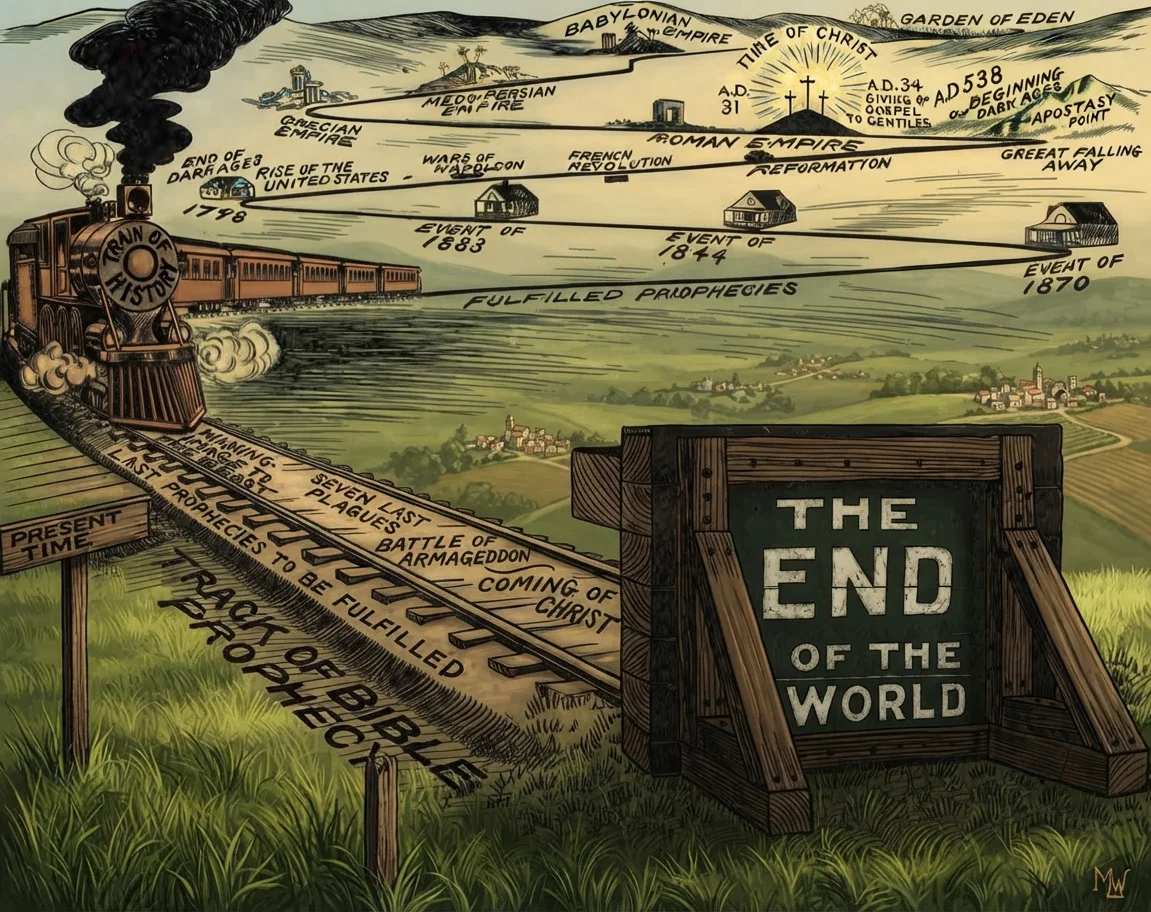
NEARING THE TERMINAL. THE TRAIN OF HISTORY, ALWAYS ON TIME, WILL SOON COMPLETE ITS LONG JOURNEY
When Satan met Eve in the Garden of Eden, he assured her, "Ye shall not surely die." Gen. 3:4. But she did die just the same; and hence, to make it appear that he had not told a falsehood, his satanic majesty had to invent the fiction of the immortality of the soul. He had to lead the world to believe that there is something in man that escapes at death and that knows more after he is dead than it did when the man was alive. It is not strange that the heathen world, that has forgotten God, and that consequently does not know His Word, could be led into such delusions as are embraced in the natural immortality of the soul. But how is it that professing Christians can hold to the doctrine in the face of such plain texts as the following?
"For to him that is joined to all the living there is hope: for a living dog is better than a dead lion. For the living know that they shall die: but the dead know not anything, neither have they any more a reward; for the memory of them is forgotten. Also their love, and their hatred, and their envy, is now perished; neither have they any more a portion forever in anything that is done under the sun." Eccl. 9:4-6.
"Put not your trust in princes, nor in the son of man, in whom there is no help. His breath goeth forth, he returneth to his earth; in that very day his thoughts perish." Ps. 146:3, 4.
Since the dead "know not anything;" and since "their love, and their hatred, and their envy, is now perished;" and since they do not have "any more a portion forever in anything that is done under the sun;" and since, when man dies, "in that very day his thoughts perish,"—how can it be possible, in view of all these Bible statements, for the man to appear to any one after he is dead? How is it possible to believe the Bible and still hold to the doctrine that there is any way by which dead people can communicate with us?
The Bible plainly teaches, however, that there are good angels sent from God that do appear to men. "The angel of the Lord encampeth round about them that fear Him, and delivereth them." Ps. 34:7. And again we read: "But to which of the angels said He at any time, Sit on My right hand, until I make thine enemies thy footstool? Are they not all ministering spirits, sent forth to minister for them who shall be heirs of salvation?" Heb. 1:13, 14.
But we also read of angels that fell.
"God spared not the angels that sinned, but cast them down to hell, and delivered them into chains of darkness, to be reserved unto judgment." 2 Peter 2:4. Another passage reads in almost identical language, "And the angels which kept not their first estate, but left their own habitation, He hath reserved in everlasting chains under darkness unto the judgment of the great day." Jude 6. And still another scripture tells some of the things that these fallen angels will be doing as the great war of Armageddon is drawing on: "And I saw coming out of the mouth of the dragon, and out of the mouth of the beast, and out of the mouth of the false prophet, three unclean spirits, as it were frogs: for they are spirits of demons, working signs; which go forth unto the kings of the whole world, to gather them together unto the war of the great day of God, the Almighty. . . . And they gathered them together into the place which is called in Hebrew Armagedon." Rev. 16:13-16, margin.
The foregoing, as well as many other scriptures, make it plain that God teaches that there are spiritual beings that are unseen visitors to the children of men. These unseen visitors may be either the good or the evil angels. If they are good angels, they bring messages from God and are working in harmony with Him. If they are the evil angels, they can not bring messages from God, neither can they be in harmony with His government.
In the very nature of things, the character of the message must determine the character of the angel, and the source from which it comes.
The texts quoted in the first column of this article teach most clearly that the dead can not communicate with the living. So we may be sure, when "spirits" come to us, that they are not our "departed friends." Then the only thing left that they can be is that they are the angels, either good or bad. We submit this question for the candid reader: Will a good angel come to us with a falsehood, claiming to be a dead friend?
Speaking of Satan, the Master says he "standeth not in the truth, because there is no truth in him. When he speaketh a lie, he speaketh of his own: for he is a liar, and the father thereof." John 8:44. It is in perfect harmony with the author of lying to claim that his fallen companions are spirits of our dead friends.
And in view of the plain testimony of the Scriptures, we are shut up to the conclusion that the only spirits that can visit us with such silly instruction as was given to the man mentioned in the beginning of this article are these spirits of demons. Our dead friends are dead, and hence they can not come to us.
And what a comfort to us it is to know that our dead friends can not know all that is going on in this earth! They are peacefully resting in the tomb, awaiting the call of the Lord Jesus at the resurrection. Time does not drag on their hands, for they are in the unconsciousness of the sleep of death. To them it will seem as if they had but closed their eyes to the things of this life only to have them immediately opened to the scenes of eternity. A thousand years would pass by to them as only a second.
But nothing should cause us to overlook the fact that the "spirits" are very active in this time, and this activity is significant. "Wo for the earth and for the sea: because the devil is gone down unto you, having great wrath, knowing that he hath but a short time." Rev. 12:12. Just before and at the time of the first advent, the spirits of devils were very active. And this prophecy from Revelation shows that Satan is again intensely active when he knows "that he hath but a short time." And in view of this, we should heed the injunction of God's Word, "Beloved, believe not every spirit, but prove the spirits, whether they are of God; because many false prophets are gone out into the world." 1 John 4:1. We "prove the spirits" by God's Word. And if a spirit come to us saying that it is one of our dead friends, we know that such a spirit is that of a demon, for God's Word teaches us plainly that the "dead know not anything."
If we become anchored to this definite truth, we are saved from the fanaticism and superstition into which the spirits lead men continually by trying to make them believe that a dead friend is striving for their welfare.
T.

God’s Place for Thee

"Thou camest not to thy place by accident; it is the very place God meant for thee."

The Referendum Amendment

THE following is the full text of the Referendum amendment to the Constitution of California as adopted last autumn. It should be preserved for reference. We gave the Initiative amendment a few weeks ago.

The Referendum

"The second power reserved to the people shall be known as the referendum. No act passed by the legislature shall go into effect until ninety days after the final adjournment of the session of the legislature which passed such act, except acts calling elections, acts providing for tax levies or appropriations for the usual current expenses of the state, and urgency measures necessary for the immediate preservation of the public peace, health or safety, passed by a two-thirds vote of all the members elected to each house. Whenever it is deemed necessary for the immediate preservation of the public peace, health or safety that a law shall go into immediate effect, a statement of the fact constituting such necessity shall be set forth in the section of the act, which section shall be passed only upon a yea and nay vote, upon a separate roll-call thereon; provided, however, that no measure creating or abolishing any office or changing the salary, term or duties of any officer, or granting any franchise or special privilege, or creating any vested right or interest, shall be construed to be an urgency measure. Any law so passed by the legislature and declared to be an urgency measure shall go into immediate effect.
"Upon the presentation to the secretary of state within ninety days after the final adjournment of the legislature of a petition certified as herein provided, to have been signed by qualified electors equal in number to five per cent of all the votes cast for all candidates for governor at the last preceding general election at which a governor was elected, asking that any act or section or part of any act of the legislature, be submitted to the electors for their approval or rejection, the secretary of State shall submit to the electors for their approval or rejection, such act, or section or part of such act, at the next succeeding general election, occurring at any time subsequent to thirty days after the filing of said petition or at any special election which may be called by the governor, in his discretion, prior to such regular election, and no such act or section or part of such act shall go into effect until and unless approved by a majority of the qualified electors voting thereon; but if a referendum petition is filed against any section or part of any act the remainder of such act shall not be delayed from going into effect."

Can Not Be Vetoed

"Any act, law or amendment to the Constitution submitted to the people by either initiative or referendum petition and approved by a majority of the votes cast thereon, at any election, shall take effect five days after the date of the official declaration of the vote by the secretary of State. No act, law or amendment to the Constitution, initiated or adopted by the people, shall be subject to the veto power of the governor, and no act, law or amendment to the Constitution, adopted by the people at the polls under the initiative provisions of this section, shall be amended or repealed except by a vote of the electors, unless otherwise provided in said initiative measure; but acts and laws adopted by the people under the referendum provisions of this section may be amended by the legislature at any subsequent session thereof. If any provision or provisions of two or more measures, approved by the electors at the same election, conflict the provision or provisions of the measure receiving the highest affirmative vote shall prevail. Until otherwise provided by law, all measures submitted to a vote of the electors, under the provisions of this section, shall be printed, and together with arguments for and against each such measure by the proponents and opponents thereof, shall be mailed to each elector in the same manner as now provided by law as to amendments to the Constitution, proposed by the legislature; and the person to prepare and present such arguments shall, until otherwise provided by law, be selected by the presiding officer of the senate.
"If for any reason any initiative or referendum measure, proposed by petition as herein provided, be not submitted at the election specified in this section, such failure shall not prevent its submission at a succeeding general election, and no law or amendment to the Constitution, proposed by the legislature, shall be submitted at any election unless at the same election there shall be submitted all measures proposed by petition of the electors, if any be so proposed, as herein provided.
"Any initiative or referendum petition may be presented in sections, but each section shall contain a full and correct copy of the title and text of the proposed measure. Each signer shall add to his signature his place of residence, giving the street and number if such exist. His election precinct shall also appear on the paper after his name. The number of signatures attached to each section shall be at the pleasure of the person soliciting signatures to the same. Any qualified elector of the state shall be competent to solicit said signatures within the county or city and county of which he is an elector. Each section of the petition shall bear the name of the county or city and county in which it is circulated, and only qualified electors of such county or city and county shall be competent to sign such section. Each section shall have attached thereto the affidavit of the person soliciting signatures to the same, stating his own qualifications and that all the signatures to the attached section were made in his presence and that to the best of his knowledge and belief each signature to the section is the genuine signature of the person whose name it purports to be, and no other affidavit thereto shall be required. The affidavit of any person soliciting signatures hereunder shall be verified free of charge by any officer authorized to administer oaths. Such petitions so verified shall be prima facie evidence that the signatures thereon are genuine and that the persons signing the same are qualified electors. Unless and until it be otherwise proven upon official investigation, it shall be presumed that the petition presented contains the signatures of the requisite number of qualified electors.
"Each section of the petition shall be filed with the clerk or registrar of voters of the county or city and county in which it was circulated, but all said sections circulated in any county or city and county shall be filed at the same time. Within twenty days after the filing of such petition in his office the said clerk, or registrar of voters, shall determine from the records of registration what number of qualified electors have signed the same, and if necessary the board of supervisors shall allow said clerk or registrar additional assistants for the purpose of examining such petition and provide for their compensation. The said clerk or registrar, upon the completion of such examination, shall forthwith attach to said petition, except the signatures thereto appended, his certificate, properly dated, showing the result of said examination and shall forthwith transmit said petition, together with his said certificate, to the secretary of state and also file a copy of said certificate in his office. Within forty days from the transmission of the said petition and certificate by the clerk or registrar to the secretary of state, a supplemental petition identical with the original as to the body of the petition but containing supplemental names, may be filed with the clerk or registrar of voters, as aforesaid. The clerk or registrar of voters shall within ten days after the filing of such supplemental petition make like examination thereof, as of the original petition, and upon the completion of such examination shall forthwith attach to said petition his certificate, properly dated, showing the result of said examination, and shall forthwith transmit a copy of said supplemental petition, except the signatures thereto appended, together with his certificate, to the secretary of state."

Subdivision of the State

"When the secretary of state shall have received from one or more county clerks or registrars of voters a petition certified as herein provided to have been signed by the requisite number of qualified electors, he shall forthwith transmit to the county clerk or registrar of voters of every county or city and county in the state his certificate showing such fact. A petition shall be deemed to be filed with the secretary of state upon the date of the receipt by him of a certificate or certificates showing said petition to be signed by the requisite number of electors of the state. Any county clerk or registrar of voters shall, upon receipt of such copy, file the same for record in his office. The duties herein imposed upon the clerk or registrar of voters shall be performed by such registrar of voters in all cases where the office of registrar of voters exists.
"The initiative and referendum powers of the people are hereby further reserved to the electors of each county, city and county, city and town of the state, to be exercised under such procedure as may be provided by law. Until otherwise provided by law, the legislative body of any such county, city and county, city or town may provide for the manner of exercising the initiative and referendum powers herein reserved to such counties, cities and counties, cities and towns, but shall not require more than fifteen per cent of the electors thereof to propose any initiative measure nor more than ten per cent of the electors thereof to order the referendum. Nothing contained in this section shall be construed as affecting or limiting the present or future powers of cities or cities and counties having charters adopted under the provisions of section eight of article eleven of this Constitution. In the submission to the electors of any measure under this section, all officers shall be guided by the general laws of this state, except as is herein otherwise provided. This section is self-executing, but legislation may be enacted to facilitate its operation, but in no way limiting or restricting either the provisions of this section or the powers herein reserved. [Amendment adopted October 10, 1911.]"

Attempt to Meet a Decided Need.

The University of California is aiming to give varied instruction in domestic science, dietetics, economics, hygiene, study of fabrics for quality and service; and to aid in this, Miss Mary Lois Kissell has been secured and added to the faculty. The summer sessions will give special help to students in domestic science.

The Case for Vegetarianism

The prices of beef are reported to have gone up four or five cents a pound during the last month, and from eight to ten cents a pound during the last year. When these facts are taken in connection with the evidence that so much diseased flesh is put upon the market, the advisability of vegetarianism should become apparent.

Heat and Sunstrokes

The despatches continue to tell of the intense heat, and consequent prostrations and sunstrokes, throughout the Eastern states.

The Home and Juvenile Criminality

On a recent day in San Francisco nine boys were arrested for robbing a store. In these days we have juvenile courts, and we have schools for correcting these juveniles, and we have all sorts of theories as to how the growing criminality among children may be stayed. Might we not get an authoritative statement from the words of Paul in the third chapter of his second letter to Timothy? He affirms that the "last days" shall be made "perilous" because, among other things, there shall be a lack of natural affection, and also disobedience to parents. When the club, and the pleasure resort, and unhallowed affections, rob the home of its power, it may be expected that the children who are in consequence left to drift may readily develop into criminals. Criminals, either young or old, very rarely come from the home where the true principles of affection are regarded, and where order and morality are maintained. Solomon stated a divine principle when he said, "Train up a child in the way he should go: and when he is old, he will not depart from it." Prov. 22:6.

Prepare War

A GERMAN professor and privy councilor, Baron von Stengel, is publishing a book designed to convince the German people of the absolute necessity for keeping up its preparations for war. He denounces the efforts of the peace party as dangerous to German interests. He does not believe that a European court would do justice by Germany in the event of a conflict of interests.
"Where remote centuries will see an era of 'eternal peace' does not for the moment enter into the question. Clearer is the fact that the peace movement constitutes a revolution as regards present constitutional law, and means the destruction of the independence of individual states, which must enter into a world federation; that, therefore, it opposes decisively the national idea. From this point of view a further spread of the peace movement in Germany must be regretted. . . . The political condition of the German empire is dangerous. Germany may be described as 'ringed round with foes.' . . . For that reason, the German empire must not pursue a peace-loving policy in the sense meant by the friends of peace and by the peace movement. It can not diminish its strong armaments, reduce its standing army to the condition of a police posse, sell its battle-ships as old iron, and oblige itself to submit all disputes which may arise to the International Arbitration Court at The Hague. It were nothing less than political suicide for Germany to disarm in the faith that in case of an international dispute its rights would be assured by The Hague Court."—Present Truth.

A Club Woman on the Dress Question

Says "Dress Violates Decency, Morality, and Economy"

By Mrs. M. Elizabeth Burns-Howell
T the biennial of women's clubs recently held in San Francisco, where were congregated leading women of intelligence and high character from all over the nation, as well as the rank of the fashionables and women of wealth, also many distinguished visitors from abroad, many topics of vital interest to the welfare and progress of humanity were discussed.
None, however, was more pertinent to the crying needs of these times than the address on "Slavery to Fashion," by Mrs. John C. Hessler, of Decatur, Illinois. This speaker did not mince matters, but spoke out bravely, with unfearing frankness and candor. That her remarks were roundly applauded by her audience, shows well for the average woman — that after all, deep down in her heart, she despises much of the folly which she seems forced to follow at the dictate of fashion.
The San Francisco Examiner quotes Mrs. Hessler in full, from which report we have culled the following excerpts, particularly because the sentiments are identical, in the main, with those in our last week's article on "Dress Atrocities," which to some may have seemed rather too strongly expressed. Compare notes, however, and you will find the same spirit of sanity and truth at war with the foolish frivolity and sinful waste of the whole system of fashion as it rules the feminine world to-day.
Mrs. Hessler said:

The Greatest Loss

"The greatest loss in dress is the loss of womanly dignity and stability of character which accompanies the dissipation of time, labor, and thought which is the result of false standards.
"I believe, too, that all womankind, which, as Miss Addams points out in her new book, suffers as a whole from the degradation of individuals, is suffering definite moral degradation from prevalent fashions.
"We used to speak of respectable women who went decently clad. Remembering this, old-fashioned people might challenge the respectability of a large proportion of our sex to-day, as we observe the indecently transparent bodices worn by so many of us, and the gowns which are so swathed about the figure, with no petticoats to blur the outline, as to reveal the person with absolute frankness.

Shuddered at Sheath Gown

"This has come about so gradually that many of us do not realize how our standards of personal modesty have been blunted. I recall the horror of most women at the décolleté daytime bodice with its slight veiling of transparent lace, when it appeared, some fifteen years ago. We shuddered, too, at the first petticoatless sheath gown, when we saw it on the stage, but —
"Vice is a monster of so frightful mien, As to be hated needs but to be seen; Yet seen too oft, familiar with her face, We first endure, then pity, then embrace."
"We need to call a halt upon the wearing of boudoir garments on the street. We have grown too familiar with the public through the intimacies of dress we wear in public. We women have not realized that we have been watching, or, with innocence of evil intent, taking part in the breaking down of barriers between virtue and licentiousness.
This is the very serious reason why I am speaking so frankly on the moral side of dress.
"The problem of the increasing immorality of young girls — schoolgirls as well as working girls — is causing growing concern to those who know of it. Shameful proof of the reality of this situation is startling educators.
"I discussed this matter not long since with a man who is a great scientist — a physician, a cosmopolitan — and asked what he believed to be the cause. He replied: 'And what are their mothers thinking of? Their mothers are wearing the same sort of clothes.' And he went on to say: 'I am ashamed of our countrywomen when I go abroad. They dress as no decent woman dresses in Europe. They go to Paris and see, in public places, beautiful women driving in elegant carriages, wearing lovely and conspicuous gowns. Doubtless they think they are seeing the great ladies of the city, for they hasten to the shops and buy similar garments. They do not realize that these beauties are the demi-monde, and that the clothes they bought were made for the demi-monde — and for Americans. No French gentleman would allow his wife to wear them.'
"We can only hope that the madly accelerated speed at which fashion moves to-day is rushing toward destruction of its empire. As women think for themselves along other lines, they are learning to think independently concerning questions of dress.

Better Standards Are Needed

"We all agree, I think, that we need better dress standards — or at any rate, that other women do. When we think of absurdities in present-day costumes, we call to mind the stout women who outline their figure mercilessly in the sheath skirt; we remember the mushroom hat, so pitiless to the middle-aged women that wear it, since it hides their best features — their eyes and look of intelligence — and unsparingly reveals their faded necks and wrinkled chins; we recall the modish shadow veils which cloud with a semblance of age the face of the wearer.
"We can go nowhere where women congregate, without seeing many of our sex who mince along, bound in tight skirts, tottering on high heels, peering from under an overbalancing burden of hat. Prominent in the list of injurious styles is the tight skirt, which exposes the wearer to accidents; the figured veil, which impairs her sight; the high heels, which rob her of half her activity and injure her nervous system.
"We can make a list of inconsiderate styles, and place in it the rude and publicly inconvenient picture hat, the too familiar and promiscuously caressing aigret, the murderous projecting hat pin, and — I am sure every husband will wish this added — the gown which fastens in the back.

What More Is Required?

"Built on the foundation of an undistorted body, woman's dress is to-day structurally good and artistic. It follows sincerely the lines of the body it clothes. Sleeves conform to the natural shape of the arm. Bodices are easy and comfortable. Collars are comfortably high or can be omitted. Skirts are usually wide enough for freedom of motion. Shoes of sensible shape are on the market.
"Since we can clothe ourselves so comfortably in every particular, what more is required? The question of woman's dress is not only one of physical comfort, but also of that gracious harmony and beauty which gives pleasure to the beholder, and expresses in visible form an inner beauty and orderliness of spirit.

Obedience to Fashion

"In this day of the marvelous intellectual and social growth of women, it is a matter for wonder that so many still unreasoningly obey fashion.
"Fashion grew in the proud desire of the royal princess — or the money princess — to produce by her dress a sharp distinction between herself and inferior mortals. These inferior mortals persistently imitated her as quickly as they could, to destroy this distinction.
"But the growth of intelligence and of a more sympathetic humanity is slowly remedying this. That it has lasted so long is because the fashion mania has been fostered. Women, through their love of change, have been exploited commercially by means of the great foreign dressmakers who make the styles. And these foreign dressmakers have been subsidized by manufacturers who wish to increase the market for textile and ornaments.

New Styles with Seasons

"For many years we have been trained to expect new styles with the season's change. 'Each spring and fall we stand tiptoe, gazing expectantly over seas for the advent of new fashions. While foreign dressmakers are setting the stage for the new production, the air is full of hushed voices. The magazines hazard wild guesses.
"Finally the curtain is drawn. A beautiful and regal figure steps across the stage clad in a gown with — yes, it is — with drapery bunched about her slender hips. A voice, mysterious, sweet, and compelling, says, 'This is the fashion,' and again, 'This is the fashion,' and we who listen, rich and poor, fat and thin, swayed by the hypnotic suggestion, all run to have our gowns made with pannier drapery.
"Few in America know that the inspiration of styles for the last year and a half or two years was the wonderful costumes of the imperial Russian ballet, which has been appearing in the great cities of Europe. For them, Bakst, one of the greatest decorative artists of any time, staged 'Cleopatra,' 'Scheherezade,' and 'Narcisse.' . . .
"They [Bakst styles] were designed to express physical movement and the voluptuous emotions or immoral and decadent scenic productions, and performed their office with transcendent artistic audacity and success. Translated through the dressmakers, they have lost much of their beauty — which, after all, was largely in the ensemble — tho they have lost little of their suggestiveness.

Economic Waste

"Fashion results in tremendous economic waste, first, through the use of perishable material; second, through the discarding of clothing which has not begun to wear out. Women buy new cloaks, for example, annually. The old cloak is as warm as the new, it is as beautiful as it ever was, but it is laid aside because no longer the fashion.
"The willow plume, ardently desired yesterday by every woman, for which they scrimped and saved — or sold their souls — is no longer prized, tho their soft fringes are as graceful as they ever were.
"The articles discarded because out of fashion were produced by labor. The new garments which take their places are also the product of labor. Discarding them results in needless labor.

Labor Worse than Wasted

"It is folly to say that these extravagances give work to some one. Every moment spent in labor which is unproductive of the real needs of the world is worse than wasted. It should be turned to constructive uses. The women who work in trades which minister to the waste of fashion should be freed to tend the neglected children who tug at their skirts. The white slaves of society are not all of them slaves to the vices of men. An appalling number of them are slaves to the frivolity of women.
"The aigret symbolizes to me all that is ruthless in fashionable dress and its manufacture — feathers torn from the quivering, murdered mother, leaving the nestlings to wail and die."
To close, Mrs. Hessler points to education of the young as one remedy. Girls and boys in the grammar and high schools should be taught the quality of textiles, color harmony, proportion as adapted to form and use, a sense of values as to cost of material, etc., and girls should learn dressmaking along sensible lines, also millinery, just as they learn music or mathematics.
She would also have the government take up the matter of wholesome dress as they have taken up that of pure food, and advocates such laws as would make it a felony to manufacture or sell a shoddy quality of material, and further that governmental supervision of styles with reference to limiting extremes and establishing a sensible standard would greatly aid the needed reform.
All this may come in time, just as has the national pure food law, which was unheard of till recent years. It was doubtless advocated long before its passage, but as a working fact is a comparatively recent innovation. So does every goodly plant grow — "first the blade, then the ear, after that the full corn in the ear."
But the main factor in a composite result is the attitude of each individual. Hence you and I, sisters, need not wait for governmental control of our clothing. Let us set about it to see for ourselves that it conforms to the laws of sanity and comfort, of practical usefulness and harmonious effect in color and line. So shall we be arrayed as the lilies, in sweet and perfect purity, our costumes conforming to what our souls should be, all that is truly beautiful and of a righteous character.

BOUND VOLUMES

SIGNS OF THE TIMES

can still be secured as follows:
8 leather 1907 at $2.00 each 9 paper 1907 at 1.75 each 4 cloth 1909 at 2.00 each 6 cloth 1910 at 2.00 each 3 paper 1910 at 1.50 each 21 cloth 1911 at 2.25 each
These prices are post-paid
Those desiring volumes of the SIGNS in this convenient form should write at once with remittance to
SIGNS OF THE TIMES Mountain View, California

Stamp of Approval

The Western Union Telegraph Company officially adopts and installs Ten Thousand

Underwood Typewriters

This decision to equip its thousands of offices throughout the country with Underwoods was reached after an eight months' thoro and impartial investigation of the merits of all machines.
P R E E M I N E N T P R E D O M I N A N T P R E F E R R E D
"The Machine You Will Eventually Buy"
UNDERWOOD TYPEWRITER CO., Inc. Branches in all Principal Cities 133 Sutter Street San Francisco
Continue reading: The Last from China