On the tomb of a celebrated English sculptor, designed by himself, the following original inscription is said to be chiseled: “What I was as an artist seemed of some importance while I lived; but what I really was, as a believer in Christ Jesus, is the only thing of importance to me now.”
How true! And it is sad that any allow the sordid things of life to obscure the great truth here expressed. Character, not reputation, is the essential thing. What we are, not what people think we are, is the important thing.
To be right with God should be our chief concern. To believe in Jesus, and know that his blood atones for our transgressions, is worth more than all the empty baubles of the earth.
We may deceive ourselves; we may seek the approbation of man more than the favor of God; we may hide in the heart some secret sin; we may cherish some evil propensity unknown to even our dearest friends; we may neglect some plain duty enjoined by the Lord in his Word, but in the judgment of the last great day, when the Lord looks into the records of men, it will be found out. Many, as a result, who passed as Christians, as believers in his name, will find the door shut.
The approbation of man may seem to be of value to us here, and many strive to win this at all cost. But the approbation of Jehovah is of more value. When the record of life is made up, when our life-work is done, and our hold on the treasures and fame of earth is palsied by the hand of death, the only thing which will be of value to us will be an abiding faith and trust in Jesus Christ as our Redeemer and Saviour. Let us not be faithless, but believing.
Takoma Park, D. C.
A Friend or Two
By W. D. Nesbit
There's all of pleasure and all of peace
In a friend or two;
And all your troubles may find release
With a friend or two;
It's in the grip of the clasping hand
On native soil or in alien land,
But the world is made—do you understand?—
Of a friend or two.
A little laughter, perhaps some tears,
With a friend or two;
The days, the weeks, and the months
and years
With a friend or two;
A vale to cross and a hill to climb,
The prose of life takes the lilt of rhyme
With a friend or two.
The brother-soul and the brother-heart
Of a friend or two.
Make us drift on from the crowd apart
With a friend or two;
For come days happy or come days sad,
We count no hours but the ones made
glad
By the hale good times we have ever had
With a friend or two.
— W. D. Nesbit, in The Advance.
Dress and Adornment
By U. PRESTON LONG
U. PRESTON LONG
By yielding to the tempter, our first parents became subject to him, and to the evil influences of his spirit. They obtained a knowledge of sin, and became subject to evil natures, dispositions, and inclinations. “And they knew that they were naked.” They were startled by a sense of their downfall, with the appetites and passions which it brought. They did not indulge in outward adornments, but, oppressed by a sense of their dreadful condition, and actuated by shame and modesty, they availed themselves of the first means at hand to form garments for themselves.
Now for sixty centuries the “prince of this world” has been training Adam’s descendants in rebellion, violence, and sin. Impurity, adultery, degradation, disease, and death have made sad havoc with our fallen race. Shall we bedeck ourselves with ornaments, and boast, and plume ourselves, and exhibit our fragile bodies for admiration?—No, no! we are less pure, less beautiful, than were Adam and Eve; and if we sense our real condition, as our first parents did theirs, we shall be actuated by the same principles in selecting our apparel.
A Simple Raiment Provided
Adam and Eve were removed from Eden, and to protect them from heat and cold and other injury the Lord made them coats of skins and clothed them.
Man and woman were the most precious beings on earth. All other lives and things in this world, and the earth itself, were made for man. But now man was fallen! The earth and all things earthly had fallen with him. If necessary for his life and comfort, anything on earth might be sacrificed. So the skins of innocent animals were taken to clothe Adam and Eve. This must have occasioned the first death in the universe, and this was caused by sin. We have heard of the “original diet for man.” Here is the original dress provided by a merciful Father for his fallen children, the parents of our race.
These garments, worn daily, must have been a constant reminder of their humiliation and of their dependence, as well as of God’s forbearance and merciful provision for their protection and comfort. Was there not also in this a pledge that the Lamb of God, himself an innocent, submissive victim, should be slain because of their sins, that they might be clothed with the garments of righteousness in this present life, and with immortality in eternity?
God did not clothe man with showy apparel, or adorn him with gold or pearls. He was clothed comfortably, modestly, simply, soberly, humbly. Change of climate or vocation may justify, or even require, a change of material or style, but never a change in the character or purpose of our apparel. Because of our humiliation and dependence on Christ, our raiment should ever be characterized by the principles illustrated in the dress given by the all-wise Father to our first parents.
The Lesson of Joseph’s Bondage
In the experiences of Jacob (read Gen. 37: 1-3) also we see these principles forcibly illustrated. Jacob was one of the Lord’s chosen servants, but like many others, even in our day, he was in some respects an unwise parent. He loved Joseph more than he loved his other sons, and made him a costly, showy coat of many colors and many pieces, such as was worn by persons of distinction. This act led to envy, hatred, falsehood, and even to thoughts of murder on the part of Joseph’s brothers. It also had a tendency to make Joseph vain, proud, exacting, to develop a love for luxury, and to arouse the baser passions. He was unprepared to meet the serious responsibilities and temptations of life. But the Lord had a watchful care over Joseph. He saw the evil effects of Jacob’s indulgent course, and the ruin it was bringing upon Joseph. So the hatred of Joseph’s brothers was overruled for his good. Joseph’s brothers sold him into Egypt, but the Lord sent him into Egypt. Gen. 45: 5. His flashy, showy clothing gave place to the prisoner’s garb. His life of petted indulgence was succeeded by the rigors of bondage. His experience proves the folly of indulging children in costly, showy clothing.
The Cause of Solomon’s Downfall
The experience of Solomon contains much that is profitable for us in this connection. His prayer for wisdom was granted, and wisdom was given him beyond that of other men. Riches and honor were also given him in greatest abundance. So long as he used these bounties to the glory of God, they were reflected in blessings on himself. But after a time he became so absorbed in outward display and adornment that he neglected to secure fresh supplies of the “tried gold,” the true riches, the wealth of character, “which is in the sight of God of great price.” Read 1 Kings 10: 18-21, 26, 27. Solomon became so vain of his appearance that the glory of his apparel is proverbial to this day. Matt. 6: 29. His love of display led to gratification of sensual inclinations, which finally resulted in his apostasy from the true God and his worship of false gods.
The Lesson of Lucifer’s Fall
But let us look at the career of one wiser even than Solomon—Lucifer. Of him it is said that he sealed up the sum, “full of wisdom, and perfect in beauty.” He was first of the covering cherubs. Next to Christ he had been most honored of God, and was highest in power and glory among the inhabitants of heaven. Sin originated with him, and through his sin he lost his first estate. He possessed glorious brightness and perfect personal beauty, and his heart was lifted up because of his beauty. His wisdom was corrupted because of his brightness. With this condition came haughtiness, a superior attitude, a desire for pre-eminence. But the Lord did not look with favor on this spirit of self-exaltation. Lucifer was cast out of heaven, and now awaits destruction.
An Example to Christians
Probably in no other than the Master himself were the principles of holy living more fully and faithfully illustrated than in the life and teaching of John the Baptist. Jesus said of him, “What went ye out for to see? A prophet? Yea, I say unto you, and much more than a prophet. . . . Among those that are born of women there is not a greater prophet than John the Baptist.” John preached faithfully the doctrine of repentance. He taught by precept and example.
“And the same John had his raiment of camel’s hair, and a leathern girdle about his loins.” He went forth in the spirit and power of Elijah to prepare the way of the Lord. John separated himself from friends and from the luxuries of life. The simplicity of his dress, a garment woven of camel’s hair, was a standing rebuke to the extravagance and display of the Jewish priests and the people generally. He was a representative of those living in the last days,13to whom God has entrusted sacred truths to present before the people to prepare the way for the second coming of Christ. Those who give this message which is to prepare a people for the second coming of Christ are to have the same spirit that animated John the Baptist in his message that was to prepare a people for the first advent of Christ. Luke 1: 17; Mal. 4: 5.
Will we learn the lesson of Lucifer’s fall? These lessons are written for us. If Jacob, the father of the favored nation, erred in clothing his beloved son, may not we err in adorning our children? If Solomon, the wisest of men, from the loftiest faith and the most exalted communing with God, was cast down into the most abominable idolatry,—if Solomon fell through pride, glorious apparel, ivory, gold, pearls,—may not we fall before similar temptations?
Let us sense our real condition, our fallen state, our great need of Christ, our dependence on him, and clothe ourselves with humility, simplicity, and sobriety, as becometh the children of God.
WALTER L. FOSTER
By WALTER L. FOSTER
From the “Far East”—Japan
WALTER L. FOSTER
DAI-NIPPON, or Nihon, is “the great kingdom of the rising sun.” To the Japanese it does seem great. They say, “Japan of yesterday is not Japan of to-day.” Certainly it is not great in size, for its area is a little less than that of California. To get a picture of Japan, let us consider it a range of mountains, with four large peaks and hundreds of little ones appearing above the waters of the Pacific. Fuji-san, Mt. Fuji, is the sacred mountain of Japan. It is considered by tourists to be one of the most beautiful mountains in the world, and is regarded by the people the same as the sun and many other things in nature—an object of worship. The beautiful little islands and the low ranges of mountains clothed with luxuriant green, present a pleasing picture to the eye; but all is not beautiful, and all is not good, for the curse of sin rests heavily upon the people.
For more than two thousand years the most degrading influences of heathenism have filled their sad lives with darkness. Their religions are Shintoism, the national faith, which is largely a worship of ancestors and of the emperor; Confucianism; and Buddhism, whose temples, some of which are very magnificent, are found everywhere, upon every high hill and in every fine grove in the country. Truly, a messenger bearing the last gospel invitation to a fallen world, finds much in this dark land to call forth his deepest sympathy, and cause him to strive more earnestly for the reward that fadeth not away.
One of the great difficulties that immediately confronts a missionary in Japan is the language. To say the least, it is one of the most difficult languages used in the world to-day. Japanese is an interesting study, however; and while it resembles other languages somewhat, it is, on the whole, widely different. With a few exceptions, the words have no accents, and the nouns are without gender or number.
Japan has a large commercial and tourist population. These people are very much disliked by the Japanese, and their influence has a demoralizing effect upon the work of the missionaries, and it serves to sink the people deeper and deeper in sin. At present over thirty societies are at work to evangelize Japan, but only a little has been accomplished. Our work has only a beginning. Climb with me on a clear day to the top of a neighboring peak, and you will see the tile roofs of the simple abodes that contain a million souls without Christ—people that go each day to the temples to make an offering, to bump their heads on the stones, and to offer their prayers to the great Buddha, or perhaps to an idol of wood or stone.
If our brethren in the more favored America could only realize the needs of these dark lands, the greatness of the work, and the shortness of time, they would double their efforts to finish the work. May it be in the near future that the angel of Revelation 18 will unite his voice with the voice of the third angel, and the world be flooded with light.
The South Russian Conference
By GUY DAIL
GUY DAIL
EVERY Russian field in which the third angel’s message is spreading, has its own problems and peculiarities. The South Russian Conference dates from Jan. 1, 1908. It is composed of the governments of Bessarabia, Kherson, Kharkow, Yekaterinoslaf, Taurien, and Don District No. II, with over fourteen million of “Little Russians,” Cossacks, Germans, Armenians, Jews, and Bulgarians. It is in the “black soil” district, and is one of the most productive parts of Russia.
Of the fifteen churches and companies in this field, thirteen were represented at the first annual session of the South Russian Conference (Oct. 21-25), held in Alexandrovsk on the Dnieper. There were one hundred forty of our brethren in attendance. The week preceding the conference was occupied by a workers’ institute, conducted by Elder J. T. Boettcher, assisted by Elders H. J. Loebsack and D. P. Gaede. As there has been little opportunity to give the laborers and church officers such teaching in the past, the institute was beneficial and was appreciated. Church organization, order, and discipline, and methods of work were given careful consideration.
In view of its natural advantages, this field offers many inducements favorable to the location of the Russian union school within its territory. There has already been some attention given to this matter here, and two places were visited by several of the leading men, to ascertain if they would answer our needs. At this meeting, the South Russian brethren raised about nine hundred fifty rubles in pledges and cash toward the enterprise. The young people here are deeply interested in the proposed school, and are showing their earnestness by actual missionary work in the circulation of our literature. Six regular colporteurs are in the field, and four others will devote a part of their time to this department of the Lord’s cause. At the Sabbath afternoon meeting the solemn ordination of our first native Russian minister took place. This is an event we hail with joy, for we have14been looking forward anxiously to such an occasion for years. Besides Brother C. Schamkow, who was thus set apart to the gospel ministry for the Russians, there are four other evangelical workers here, and five hundred sixty-two members, one hundred thirty-eight of whom have accepted the truth during the last nine months. A number were baptized at this meeting.
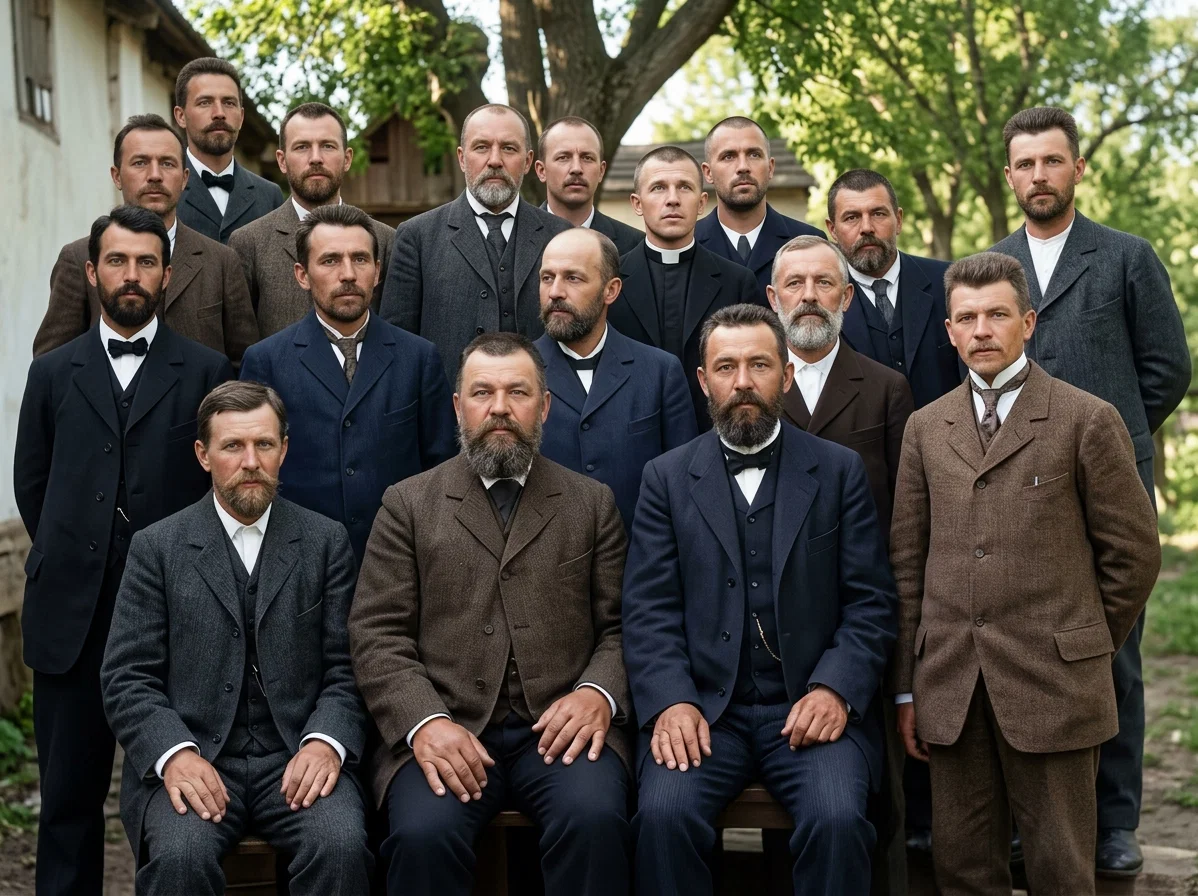
WORKERS ATTENDING THE CAUCASIAN CONFERENCE
The advantages gained for the message by first thoroughly spreading our literature is well illustrated in the experience of our brethren in Sebastopol. The orthodox missionaries came to the people with publications calculated to create prejudice against us, but as some had already read the truth, and tested it by the Scriptures, they did not care to accept the false teaching: it is much better first to sow good gospel seed in the heart than to wait until the tares of unbelief and prejudice have been scattered. We have a young, live, growing Russian church in Sebastopol.
The eagerness of the people to drink in the Word spoken at Alexandrovsk aroused the orthodox clergy to do all they could against us. From three hundred to seven hundred fifty persons not of our faith were in the hall each evening, many of them compelled to stand, and they gave the most earnest attention. The government had approved the subjects we asked permission to consider, but the governor stated that the slightest deviation from the program would warrant the closing of our conference. The four priests and one missionary who came to the public lectures wished to force us into a debate, knowing how easily they could put questions to us that would involve us in trouble, perhaps create a turmoil, and make necessary the closing of our meeting. The third evening they demanded the privilege of addressing the people. This being refused, they tried to compel the already dismissed audience to sit down and listen (they had no legal right to reopen a closed meeting), but were unsuccessful, and so were compelled to take up a discussion of our work in their regular Sunday services. While they were doing this, we held our closing public lecture, at the end of which the strangers warmly thanked the brethren for thus breaking to them the bread of life. One of the officers who had been at the meetings, in addressing small squads of men who had surrounded him, enthusiastically spoke of the difference between our meetings, where the Bible is intelligently expounded, and the formality of the orthodox religious routine.
The owner of the hall we had used was at first rather unfavorable to our having the place, evidently fearing a repetition of the revolutionary experiences the city had in the troublous times through which Russia has been passing; but at the close of the Sunday afternoon service he reduced the rent ten rubles, and told us to come any time we wanted the hall again.
All these omens show that God is at work for his message, and that just now is the time for his people to push the battle to the front more vigorously than ever before.
Brother D. Isaak was again chosen president of the South Russian Conference. He, with suitable help, will follow up the interest awakened in Alexandrovsk. The brethren and workers leave this place, feeling that this meeting has been a blessed experience to them, and they are encouraged to do more than ever to carry the message to those in darkness. May God be with them by his Spirit, and give them still richer rewards for their labors among these people.
Lodz.
A Woman's Best Compliment
THE finest compliment we have ever heard given a woman was by her husband, who said, in speaking of her, “We always think of her as a morning-glory, because she looks so bright and cheery and pretty at the breakfast table.” Very many breakfast tables are presided over by women who make no effort to be dainty, and there are a great number who are at once untidy, and even uncleanly to look at.
The claim that household duties keep women from looking well in the morning is easily disproved; for in many a household where the lady gives a helping hand in the kitchen, a big apron will thoroughly protect her dress, and then, too, cooking, unless one makes it so, is never dirty work.
That woman commits an error who looks uncared for and badly dressed in the morning.
The other woman, who wears any old dress to the breakfast table, is also making a mistake; for that is the time when the members of the home ought to see a woman at her best, and not specially rely on her appearance in the evening, when the soft and charitable light of the gas will hide many defects.—Selected.
The Blessing of Full Hands
“ONE of the things that I am thankful for every day that I live is for my share in the world’s work,” said a wise and busy woman. “I am thankful that my hands are full.” The blessing of the full hands and the full days is one that we sometimes fail to appreciate until illness or some misfortune forces us to stand aside for a time, while the eager, useful procession passes by without us. A vital part of the world we live in, a head and a hand for its work, a heart for its needs, its joys, its burdens, and faith for its outlook—these are the best gifts that can be ours for healthful and happy days.”
Panama
By H. C. GOODRICH
H. C. GOODRICH
One year ago last May I landed in Colon, with my wife and daughter Mildred. We had heard so much of the unfavorable condition here that it was with a great deal of fear and trembling that we accepted the invitation to come to this field. But the work of improvement was well begun when we came, and has gone steadily forward, till the whole town has been changed from a filthy mud-hole, where diseases of every kind were very common, to a clean, healthy city, with streets well paved and lighted, and well filled with earth from the canal-cut. Old houses have been torn down or rebuilt, and all have been put in the best sanitary condition. And with a good system of sewerage there is but little standing of the water, and that is kept covered with crude oil, so there are no mosquitoes, and very few house-flies. Yellow fever is unknown, and there is very little malaria.
Then the Panama Railway, crossing from the Atlantic to the Pacific side, has made this the great business center of the whole West Indian field. A great many ships from America, England, Germany, France, Spain, and from South American ports come into this harbor with cargo and passengers for the Canal Zone or the Pacific coast.
The digging of the canal has brought together thousands of laborers from different nations. The Frenchman, the Spaniard, the Greek, the Chinaman, the negro of the West Indies, and the American, are all here to reap a portion of the benefit from the golden stream that must continually pour into this country till the canal is finished.
This has made Panama a very interesting field of labor, and we have tried to take advantage of conditions to place as many books in the hands of the people as possible. But the conditions for the sale of books and papers are not so favorable as they were several months ago. Much of the canal work, such as house-building and railroad-making, is nearly finished, and, besides, rigid measures of economy are being put in operation all along the line. The wages of the laborers have been cut down, thousands of men have been discharged, and because of this the cry of hard times is heard everywhere.
Still the book work is moving, and our workers are of good courage. The book sales since Jan. 1, 1908, at retail rates, have amounted to $7,812.50 United States currency. This might have been greatly increased if we could have had books, but several cases of books were delayed six and eight months in transit. Yet all arrived safely at last, and now we have plenty of books.
This work has not been followed up as it should have been, as we have no one who could specially labor in the Canal Zone. But we have many faithful brethren and sisters, who are zealous for the Lord's cause, and faithfully do what they can. With God's blessing upon these efforts, during the past year nineteen have been baptized, and ten or twelve are now awaiting baptism in the different churches of the Canal Zone.
There is an opening in several places for labor, but during the rainy season we can not use the tent, and a hall is not to be thought of, as the rent of a room twelve by twelve feet is ten dollars (gold) a month. But we shall soon have a building of our own, where we can give the people of Colon and Cristobal the present truth. A lot was assigned us one year ago by the Panama Railroad Company. Six weeks ago we began the construction of a building thirty by eighty-two feet, two stories high. The front half will be for our chapel, thirty by forty-one feet. The rear, which opens on another street, is to be the home of our Caribbean Watchman15and El Centinela. Above will be four suites of rooms for the workers. This is made necessary because of the excessive rent here. We hope to have this building ready for occupation by the first of January.
There are many calls for evangelical effort all along the Panama railway, but at present we have no one to send. We pray that God will raise up laborers for the Canal Zone.
While visiting Costa Rica and Bocas del Toro some weeks ago, both Mrs. Goodrich and myself contracted malarial fever by staying in a house where one died of the disease. The fever ran very high, and we both became very weak, but we are able now to resume our work, and hope soon, by the blessing of God, to be as strong as ever. We thank the Lord that we are still able to have a part in his work.
Cristobal.
The Kolo and Maranatha Missions
By W. S. HYATT
W. S. HYATT
Early in September, in company with M. E. Emmerson and wife and my daughter, I left Cape Town for the Kolo Mission, in Basutoland. We were two days by rail and one by wagon in reaching the mission.
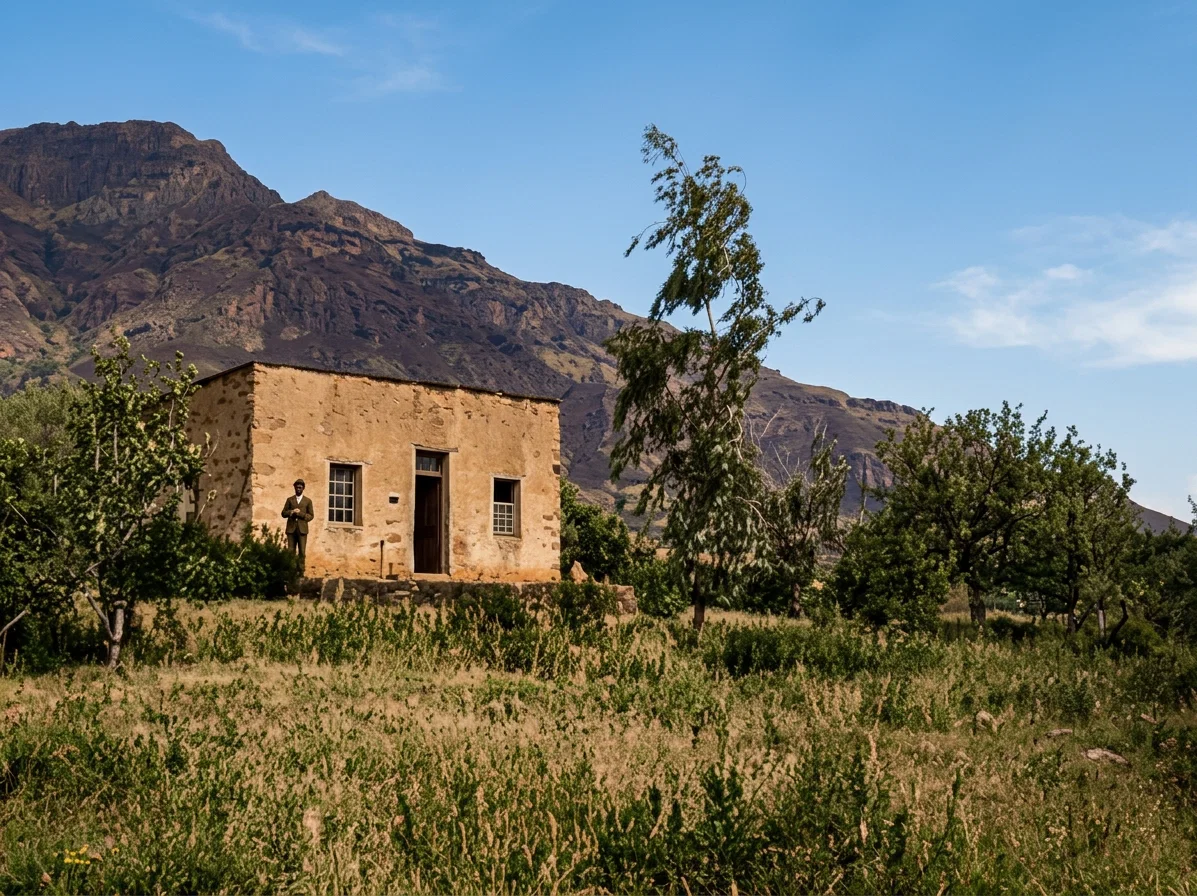
KOLO MISSION HOUSE, BASUTOLAND
The mission is a comfortable, homelike spot, located on the western slope of Mt. Kolo. To the west is a beautiful, undulating plain extending far over into the Orange River Colony, while to the north is a large range called the Maluti Mountains.
The mission is well provided with fruit, and has an abundance of good mountain water. Two horses and a new American wagon are a great help to the workers as they travel from place to place in their labors for the people, or scatter literature, which is read with deep interest by many of the natives.
I remained one month with Brother and Sister Emmerson, and did all I could to help them get started in their new field, which is a vast one. There are over two hundred fifty thousand Basutos, and perhaps no tribe in South Africa is further advanced, or comes so near having a government conducted on civilized methods. We are sure that zeal and consecration, with the blessing of the Lord, will yield an abundance of fruit in that country.
THE NEW CHURCH AT MARANATHA MISSION
Brother H. C. Olmstead was compelled to leave Barotseland on account of the climate, so we invited him to assist Brother Emmerson for a time. Basutoland being a healthful place, he could help in the work, and regain his health at the same time. We trust that the blessing of the Lord will attend the labors of these brethren as they enter upon the great work before them.
October 4 I left Kolo, and started for the Maranatha Mission, to assist in the dedication of the church which was recently completed. For good reasons the dedication was postponed two weeks, so Elder F. B. Armitage and I took the covered spring wagon and six bullocks, and started out on a trip among the natives. Our plan was to visit, scatter literature, and hold magic lantern lectures.
We found openings in abundance, and we were well pleased with the results of our effort. At one place we were granted the use of a church that would seat fully three hundred persons. The native minister who was in charge asked me if I remembered him, and I replied that I did not. He said that he met me in Cape Town about nine years ago. He told his people that the way we had treated him was quite different from the way white people usually treat a native. He urged his people to listen to what we had to say to them.
It seemed strange that we should meet the results of our influence after so many years, and so far away. The native never forgets, and he is always searching for what he considers to be true Christianity. We held four services with the people, and had good congregations. Many were deeply impressed with the truth. Brother Moko had labored there before, and our efforts strengthened his work, and many said they were sure that we told them the truth. Brother Moko writes that many of these people are now under deep conviction as the result of our labors in that vicinity.
The dedication at Maranatha was a profitable occasion for that mission. The church is built of stone, and is twenty-four by thirty-six feet. Considerable interest was shown in our work by the European farmers living near. The building was crowded with both white and native people, who listened eagerly as we told them of our work and the purpose for which this mission was located among them. In the evening we conducted a successful lantern service. The Bible scenes deeply impress the native mind. Many of them think that the gospel story is only a white man's lie.
We arrived at the Cape, November 2, and went directly to the docks to meet Elder R. C. Porter and wife. Their boat from Australia arrived that morning, and we were thankful to God that he had given his faithful workers a safe journey, and had sent them to assist in the work. We believe that heaven's blessing will crown their labors with success.
Kenilworth, Cape.
Opening Tibet
THE late visit of the dalai-lama (the high priest, and really highest civil power in Tibet) to the late empress dowager of China, is full of significance as to the opening up of Tibet to the missionary. Dr. H. W. Miller writes that the empress had ordered that the dalai was not to be consulted with reference to the organization of the government to be formed for Tibet, as that would be arranged for by the grand council at Peking, and that they were already proceeding with the formulation of plans for the governing of Tibet. This will place the heretofore closed country, which was really without government, in the hands of China; and this will mean that missionaries in Tibet will have the same protection they have now anywhere in China itself.
Another Forward Step for Japan
By W. D. Burden
The time of Elder I. H. Evans's stay with us was crowded full of interesting meetings, which all enjoyed. The various needs of the work were carefully gone over, and plans were laid which will, I believe, help very much in carrying on the work.
One thing in which I feel especially interested is the plan for a training-school. Such an institution we have needed for a long time; but for lack of means and facilities, the work has had to wait. It is now planned for the school to begin one year from this fall; and for the present year we have arranged a three months' special school, to begin December 7.
As soon as plans were agreed upon, we sent out notices to a number who would, we thought, be glad to attend, and also put a notice in our missionary paper. We hoped to be able to gather in as many as sixteen for our first class. Brother H. Kuniya and I visited some of the believers in the southern part of the country, and talked the school question to them. We were surprised to see how readily they took hold of it. Not only our own people, but several from outside, who came in to attend the special meetings which we were holding, became interested, and decided to attend, for the sake of the advantages that would be given them for Bible study. Some whom we have never met have written that they are coming. Already we have thirty prospective students, and there may be yet others before the time to begin arrives. Surely the people are arousing to study the Bible. The Lord has gone out before us; and if we do not follow his leadings, the blood of souls will be on our garments. We thank him for the present prospects, and expect to see greater manifestations of his Spirit in the future.
W. D. BURDEN.
Bolivia
By Ed. W. Thomann
COCHABAMBA.—I have just returned from a six-weeks' trip to La Paz, the capital of the republic, and to Puno, on the southern border of Peru. During this time I received many blessings from the Lord, and in the little time I could devote to colporteur work I had good success. In La Paz in eight days I obtained one hundred fifteen subscriptions to the Señales de los Tiempos, all yearly but one. I also sold many single copies, and some books and tracts. Among the subscribers are many prominent persons, including several high military officers, the governor of La Paz, government employees, congressmen, etc., and many prominent business men. A gentleman paid me also for a yearly subscription for the president of Bolivia, Mr. Ismael Montes. All this shows that the Lord is working.
In Puno is a little band of new believers. I was invited there by Brother F. L. Perry, superintendent of the Peru Mission, and stayed a little more than two weeks, holding a meeting every night, and three each Sabbath. The Lord began the work there, and I hope a church may soon be organized. A Sabbath-school of more than twenty is already organized. One sister, a widow, fitted up a good hall, and gave it for our meetings. The hall was dedicated Sabbath, September 26, forty-two persons being present.
Near Puno is an Indian school-teacher,17who has accepted the truth, and is teaching what he understands of the gospel to his sixty students. These Indian boys who received the gospel through him seem as earnest and truth-loving as any people I ever saw. Some of them come twelve miles to attend the Sabbath-school in Puno. This is a good lesson for some in other countries who live only a few miles from the church and yet think it too far to go in order to meet with other believers.
On my way from La Paz to Puno I spent half a day in Guaqui, a new port on Lake Titicaca. I used the time as well as I could, and before the boat started, I had nineteen subscribers to the Señales, and had also sold a great many single copies, some books, and a few tracts—altogether amounting to about thirteen dollars in United States money. One can see by this and the experience in La Paz that colporteurs could easily be self-supporting missionaries here. In Puno I canvassed twenty-five hours, and sold about thirty-seven dollars' worth of literature. I would be very glad if two or three consecrated, faithful, persevering colporteurs would come here to help. The time I can devote to this work is so limited that it does not amount to much; but whenever I can get to it, the Lord blesses so that I think colporteurs should take courage by it to come.
Ed. W. Thomann.