Pacific Press Publishing Company · New York · Apr 23, 1896
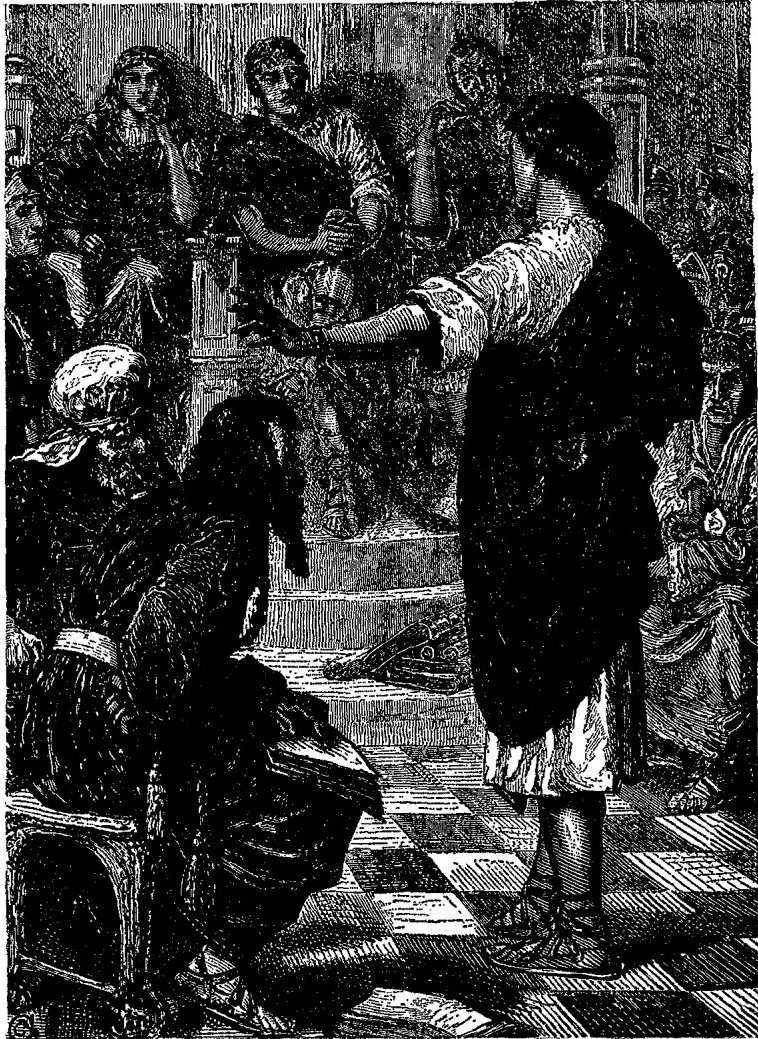
PAUL BEFORE AGRIPPA.
In Paul's day Rome ruled the world, paganism was intrenched in the laws and customs of the people, and new religions were proscribed.
Paul Before Agrippa.
All gods were then regarded as national deities, and while the gods of Rome were held to be superior to all others, even to Jehovah, Rome permitted conquered nations to maintain their accustomed worship; hence Judaism was tolerated.
But Rome forbade innovations in religion. The law was:—
“No man shall have for himself particular gods of his own; no man shall worship by himself any new or foreign gods, unless they are recognized by the public laws.”
“Whoever introduces new religions, the tendency and character of which are unknown, whereby the minds of men may be disturbed, shall, if belonging to the higher rank, be banished; if to the lower, punished with death.”
Christianity, while only the perfect development of the religion of the Hebrews, was regarded by both Jews and Gentiles as a new faith, and therefore prohibited; but the apostle argued that Christianity was simply the faith of the fathers, and consequently within the “law,” that is, not prohibited by “law.”
Paul a Roman Citizen.
Paul, though a Jew, was a Roman citizen; and this fact imparts a peculiar interest to the record of his life, because his relation to the State corresponded more nearly to that of most men of to-day than did that of any other of the apostles.
Not every Roman subject was a citizen. There is a wide difference even to-day between residence and citizenship; and there was very much more difference then. “The early law of Rome,” says the “Encyclopedia Britannica,” “was essentially personal, not territorial. A man enjoyed the benefit of its institutions and of its protection, not because he happened to be within Roman territory, but because he was a citizen,—one of those by whom and for whom its law was established.”
Paul, on three recorded occasions, availed himself of the privileges that were his by virtue of his Roman citizenship. And once did he plead that he was “a citizen of no mean city,” Tarsus. This, however, was not tantamount to Roman citizenship, for we subsequently find the chief captain, to whom this statement was made, apparently ignorant of the fact that the apostle was a Roman.
Paul’s first appeal to his Roman citizenship is recorded in the 16th chapter of Acts. “And it came to pass,” writes Luke, “as we went to prayer, a certain damsel possessed with a spirit of divination met us, which brought her masters much gain by soothsaying: the same followed Paul and us, and cried, saying, These men are the servants of the most high God, which shew unto us the way of salvation. And this did she many days. But Paul, being grieved, turned and said to the spirit, I command thee in the name of Jesus Christ to come out of her. And he came out the same hour. And when her masters saw that the hope of their gains was gone, they caught Paul and Silas, and drew them into the market-place unto the rulers, and brought them to the magistrates, saying, These men, being Jews, do exceedingly trouble our city, and teach customs, which are not lawful for us to receive, neither to observe, being Romans. And the multitude rose up together against them: and the magistrates rent off their clothes, and commanded to beat them. And when they had laid many stripes upon them, they cast them into prison, charging the jailer to keep them safely: who, having received such a charge, thrust them into the inner prison, and made their feet fast in the stocks.”
Proper Dignity Maintained.
“When it was day, the magistrates sent the sergeants, saying, Let these men go.” “And the keeper of the prison told this saying to Paul.” “But Paul said unto them, They have beaten us openly uncondemned, being Romans, and have cast us into prison; and now do they thrust us out privily? nay verily; but let them come themselves and fetch us out. And the sergeants told these words unto the magistrates: and they feared, when they heard that they were Romans. And they came and besought them, and brought them out.”
Roman law guaranteed to the citizen a trial130before condemnation or punishment; and in taking the course the apostle did he only insisted that the proceedings should be according to the law which the magistrates professed to respect and enforce.
We are not warranted in attributing to Paul any improper motive in thus demanding his rights under the law. He must have had in view the glory of God and the spread of the truth; and doubtless the influence upon all concerned was salutary. “Paul and Silas felt that to maintain the dignity of Christ’s Church, they must not submit to the illegal course proposed by the Roman magistrates. . . . They had been publicly thrust into prison, and now refused to be privately released, without proper acknowledgments on the part of the magistrates.” It was seen that the apostle and his companion were not unreasoning fanatics, but rational, thinking men, who knew their rights and were neither afraid nor ashamed to maintain them by proper means. It was also demonstrated that they were not revengeful, for while demanding at the hands of the magistrates such acknowledgment as would vindicate them from the unjust charges made against them, they sought no revenge for the indignities they had suffered.
We cannot doubt that in all this the apostle acted wisely. It is not only the Christian’s privilege but his duty to take such a course under all circumstances as will place him in a favorable light before the bar of public opinion. Silence and abject submission are sometimes mistaken for confession of the truth of unjust changes; while a calm, dignified defense and assertion of civil rights commands respect and secures attention to the principles involved. To the manly stand taken by the apostle upon this occasion is largely due under God the freedom enjoyed in the world to-day in matters of conscience.
“They enslave their children’s children who make compromise with sin.”
Unlawful to Scourge a Roman Uncondemned.
The second recorded instance in which the apostle availed himself of his rights as a Roman citizen was when on the occasion of the uproar at Jerusalem, “the chief captain commanded him to be brought into the castle, and bade that he should be examined by scourging, that he might know wherefore they cried so against him. And as they bound him with thongs, Paul said unto the centurion that stood by, Is it lawful for you to scourge a man that is a Roman, and uncondemned? When the centurion heard that, he went and told the chief captain, saying, Take heed what thou doest; for this man is a Roman. Then the chief captain came, and said unto him, Tell me, art thou a Roman? He said, Yea. And the chief captain answered, With a great sum obtained I this freedom. And Paul said, But I was freeborn. Then straightway they departed from him which should have examined him: and the chief captain also was afraid, after he knew that he was a Roman, and because he had bound him.” But in this instance, as upon the former occasion, Paul sought no revenge. He was a Roman, but was also a Christian.
The Apostle Exercises the Citizen’s Right of Appeal.
The third, and so far as we know, the last occasion upon which Paul asserted his rights as a Roman, was when “Festus, willing to do the Jews a pleasure, answered Paul, and said, Wilt thou go up to Jerusalem, and there be judged of these things before me? Then said Paul, I stand at Cæsar’s judgment seat, where I ought to be judged: to the Jews have I done no wrong, as thou very well knowest. For if I be an offender, or have committed anything worthy of death, I refuse not to die: but if there be none of these things whereof these accuse me, no man may deliver me unto them. I appeal unto Cæsar.”
The appeal of a Roman citizen to the emperor could not be disregarded, and Festus answered, “Hast thou appealed unto Cæsar? unto Cæsar shalt thou go.”
Festus really had no option in the matter; but there being no clearly-defined charge against the apostle, he was in doubt as to the account of the case which he ought to send to the emperor. Festus therefore kept Paul in prison until Agrippa and Bernice came unto Cæsarea. He then brought the apostle before them, and briefly recited the facts in the case, concluding thus:—
When I found that he had committed nothing worthy of death, and that he himself hath appealed to Augustus, I have determined to send him. Of whom I have no certain thing to write unto my lord. Wherefore I have brought him forth before you, and specially before thee, O king Agrippa, that, after examination had, I might have somewhat to write. For it seemeth to me unreasonable to send a prisoner, and not withal to signify the crimes laid against him.
“Then Agrippa said unto Paul,” continues the record, “Thou art permitted to speak for thyself. Then Paul stretched forth the hand, and answered for himself.”
Paul’s defense is recorded in the twenty-sixth chapter of the Acts, and being of easy access, we shall only call attention briefly to it.
Christianity Not a New Religion.
Paul established by a circumstantial statement the fact that he was not only a Jew but a Pharisee; and then anticipating the only charge that could lie against him on religious grounds under Roman law, namely, that he had introduced a new religion or worshiped a God not recognized by Roman law, he declared: “And now I stand and am judged for the hope of the promise of God unto our fathers, unto which promise our twelve tribes, instantly serving God day and night, hope to come. For which hope’s sake, king Agrippa, I am accused of the Jews.”
As before remarked, Christianity was not a new religion; it was simply a new phase of that religion given to our first parents at the fall, cherished by the patriarchs, and restored to Israel through Moses; and as such it was not a violation of Roman law to teach it, nor was it an offense under the law to worship the God it revealed. But as previously stated, neither Jew nor Gentile recognized this fact. In the eyes of both, Christianity had its origin in the life and teaching of Jesus of Nazareth, and was no part of any previously-existing system of religion; and, as they viewed it, was consequently prohibited by the law of the empire.
Recounting before the king his trip to Damascus, his experience in being stricken to the earth by a light from heaven, the voice speaking to him, his conversion, etc., the apostle declared that he witnessed none other things than the prophets and Moses did say should come—in short, that he was not a setter-forth of strange doctrines.
The Apostle Labored to Save Men.
Paul’s words on this occasion were not, however, merely, nor even chiefly, a defense of his own rights; nor was it his chief object to convince Agrippa that he had violated no law. His defense of himself was rather a means to an end. It was the apostle’s life work to preach the gospel; and his motto was: “Whether ye eat or drink, or whatsoever ye do, do all to the glory of God.” His heart burned within him for the salvation of his royal auditors.
Most graphically did he depict the scenes attending his conversion on the way to Damascus, and most eloquently did he present the claims of the gospel and unhesitatingly declare his relation to it.
“Having therefore obtained help of God,” concluded the apostle, “I continue unto this day, witnessing both to small and great, saying none other things than those which the prophets and Moses did say should come: That Christ should suffer, and that he should be the first that should rise from the dead, and should show light unto the people, and to the Gentiles.” “King Agrippa, believest thou the prophets? I know that thou believest. Then Agrippa said unto Paul, Almost thou persuadest me to be a Christian. And Paul said, I would to God, that not only thou, but also all that hear me this day, were both almost, and altogether such as I am, except these bonds.”
Forgetful as he ever was of himself, willing to endure all things that he might save some, the apostle was nevertheless conscious of the value of that physical liberty which was his by divine right; and in the words, “except these bonds,” we discover something of the yearning after freedom which God has implanted in the human breast that he might gratify it by giving the glorious liberty of the children of God; for without such aspirations the message which proclaims “liberty to the captives, and the opening of the prison to them that are bound” would fall upon ears dead alike to calls to human progress or to spiritual growth; and Christ would have died in vain.
KING MENELEK AND CHRISTIANITY.
By Editor
WHILE the secular and religious press have been full of expressions of indignation concerning the attacks upon Armenian Christians by the Turks, we have seen little or nothing in condemnation of the equally unjustifiable attack of the Italian forces upon the Christian king and people of Abyssinia. The partition of Africa among the nations of Europe is evidently regarded as almost, if not quite, a Christian proceeding; for is it not being carried on by “Christian” nations? Doubtless the Italian government has as good reasons for its efforts at national aggrandizement at the expense of king Menelek and his subjects, as have any of the other “Christian” nations for their wars of conquest upon the African natives elsewhere; but there is no justification for any of them, more than there would be for a war between two of these “Christian” nations themselves.
The following letter from king Menelek to a missionary named Clarke, printed in the Washington Post, of April 3, breathes a spirit quite in contrast with that which led to the attack upon his country by the Italian forces. Menelek said:—
You are mistaken in believing that I do not care for your prayers. All prayers of believers are dear to me, even when they come from the children of Europe. Not all are aggressors in my kingdom; not all commit the iniquity of attacking those whom they hope to find weaker than themselves; not all have bent the131knee before Baal, the god of destruction and the slaughterer of brothers. Many, I am sure, still truly adore the God of the cross, the God of justice and of peace. With them I feel in perfect communion of faith, and I am happy that they pray for me, for my household, and my people.
I only wish that they would make truth dwell in the sanctuary, and that instead of a mutilated gospel, which explains the confusion and the infidelity of the peoples of Europe, they would return and lead others back to the true gospel, which began with the creation of the world.
By what right do they efface the whole portion of it which precedes the coming of Jesus Christ, and have they done away with that God established for all time?
What you call the Old Testament is as true as the New, and what is contained in it must be respected and observed by those who follow Jesus and the apostles, announced by the prophets.
There are more than 300,000 of them [Jews] in my kingdom, and, though they enjoy almost complete independence, they are obedient and industrious subjects. They never conspire, pay all tributes, and respect our abunas as much as do the Christians. If they are worse in Europe it is because the Christians, too, are worse. Our Lord Jesus forgave them on the cross. Why should we persecute them? You, at least, do not persecute them. May the other Christians of Europe imitate you.
What you need is to return to our God, to observe all his ordinances, to no longer separate Moses and the prophets from the apostles, or St. Peter from St. Paul. Whoever wishes to serve God must humble himself and obey. You know that, envoy of God. Teach it in Europe and Asia. I am having it taught in Africa.
May the grace of our Lord Jesus Christ be with you.
MENELEK.
Of course, the fact that the Abyssinians are (professedly) Christians does not make an attack upon them any more wicked than it would be if they were heathen. The selfish grabbing for African territory at the expense of the property and lives of the natives, is altogether unchristian and wicked. Evidently all king Menelek desires of the “Christian” nations of Europe is to be let alone.
SUNDAY ENFORCEMENT IN MASSACHUSETTS.
A LETTER received April 14, from Mr. W. T. Gibson, of Everitt, Mass., shows how the spirit of Sunday enforcement is manifesting itself in that section of the country. Mr. Gibson relates that on Sunday, April 5, he was doing some work on a chimney on the top of a building located at the intersection of Thorndyke and Robbins Streets, Everitt, when he was hailed by a policeman from the sidewalk on Robbins Street, and an interesting dialogue followed. We quote from Mr. Gibson’s letter:—
Officer.—Gibson, do you build chimneys Sundays?
I said, I am pointing it.
O.—Been working all day?
Yes, sir.
O.—How long have you worked Sundays?
For eighteen years.
O.—Well, you must stop this Sunday work.
I said, I think not; I am not disturbing any one. I cannot keep two days, and am not going to.
O.—You come down here.
I kept at work all the time.
He walked around to the front entrance on Thorndyke Street, and with loud voice demanded, “Gibson, come down here,” several times.
I made no reply.
He then came up, as I suppose, to the top floor, and said, “Gibson”!
I said, What, sir?
O.—You must stop work.
I said, I think not. You have no right to stop my working.
O.—Do you think so?
I said, Yes, sir; and if it were a matter that I considered you had a right to demand of me, I would willingly obey you. I have a right to earn my living.
O.—Will you stop work?
I said, I do not think so.
O.—Well, if you don’t, I will put you in court tomorrow.
I replied, Well, I cannot help it if you do.
He went down, and I finished my work.
Mr. Gibson expected to be summoned before the court on the following day, but up to the time of writing had not been informed of any legal proceedings against him.
Mr. Gibson was prosecuted in December, 1894, for keeping a small store open on Sunday. He was fined fifty dollars and costs on that occasion, but no effort has been made to collect the money, nor has Mr. Gibson been imprisoned in lieu thereof.
EACH HAS ITS SPHERE.
By H. W. Bowman
[By H. W. Bowman, in A. P. A. Magazine for April.]
The church and civil society are two vast organizations, essentially different as to their origin, the object they have in view, and the means of obtaining that object. The church is drawn together for moral improvement and spiritual benefit; the State is a necessary mutual association to promote the civic welfare of the people.
The church instituted by Christ Jesus is founded upon revelation. The sense in which every civic society acknowledges God as its author is—it was the original will of God that men, for their own happiness and protection, should unite themselves and form the various civil societies such as exist in the world. The papal dogma that makes the church, as the exponent of God’s will, the basis of civil society, is false and pernicious. The true origin of civil society is the compact of union, and submission to a supreme power; and it is from this compact that all the rights of civil society arise. Or, in the words of the wise statesmen of America, “All governments derive their just powers from the consent of the governed.”
The principles of church government and State government are dissimilar. The institutions are fundamentally so unlike that they cannot be blended without destroying the nature of one or both. For the civil ruler, the great and only essential qualification is to be able to wield the chief physical force of the community, whether by means of moral influences, or otherwise; for the church a superiority in spiritual graces—love, humility, wisdom and disinterestedness—is needed. In short, church authority and State authority rest on essentially different bases, require different qualifications, are recognized on different principles. Hence a union of church and State works an injury to both.
The chief object of the church is the moral reformation of sinners, and the establishment of believers in virtue. The discipline of the church relates to internal sentiments of the soul, rather than to any external actions. Now, as physical force does not produce internal sentiments, it follows that the church, in order to obtain its object, has no other means than instruction, exhortation, exercises of piety, and sometimes the exclusion from spiritual privileges of contumacious or refractory members. The use of physical coercion does not belong to the sphere of its operation. Rome, in claiming the right to use force, violates a fundamental law of the Christian religion.
Civil society has for its object the preservation of public order, the attainment of justice, the establishment of law and the acquisition of the greatest temporal happiness to the individuals composing it. To obtain this object it refers solely to external acts, not to the internal sentiments of individuals. Civil laws, not moral ones, are the only kind it can enforce. The civil power is obliged to use force in obtaining its object. Policemen do not depend on moral suasion, nor preachers of the gospel upon the use of a club. Religion is not a subject of legislation by civil government, nor civil government a province of the church. Religious freedom does not mean religious despotism. If the church is left free to worship God according to the dictates of the individual conscience, it is not thereby granted the right to usurp the powers and prerogatives of the State and exercise them. God’s law covers the realm of thought, man’s law that of action. Covetousness is forbidden by God, yet the State cannot punish for it. But let one reach forth his hand and steal, and the State will punish him. Religious morality does not come under the cognizance of State law, and cannot be punished before an earthly tribunal. The State can punish incivility, it cannot punish immorality. It does not enact laws because they are revealed by God, but because they are expedient to human society. Therefore a civil government is not a moral government. Its laws are civil, not moral. The church deals with morals—the State with civics. Civic “righteousness” is a duty owed to the State; morality involves our obligation to God.
THE MOVEMENT GROWS.
By H. F. Phelps
Adherents Numbered by Millions.
WHAT movement grows?—The movement that looks to the enthronement of Christ by religio-political methods; the movement that proposes to bring in a reign of “righteousness” by force of civil law and the policeman’s club; the movement that proposes to make the polling places “holy ground,” and turn politicians into “saints;” the movement that is now, even as in the earlier centuries, instilling the virus of the poisonous doctrine of a false theocracy into the minds of the masses; the movement that proposes to make a legal Christianity easy by removing all obstacles and crosses, and the road to ruin so hard that no sinner will dare to go in the broad road; and so bring in the temporal millennium.
The organ of the National Reformers, in 1887, said:—
The political aim of Christianity is to bring forth a time in which Christianity shall control the caucus, religion shall control the politics, the politicians shall be saints, and the polls, holy ground.
In the same year, the Woman’s Christian132Temperance Union voiced the same thing in national convention, as follows: “The kingdom of Christ must enter the realm of law [force] through the gateway of politics.” And in 1886, they said: “A true theocracy is yet to come, and the enthronement of Christ in law and law-makers.” At that time the movement attracted little attention.
According to the statement of Mr. Buell, Chief of Church Statistics in Eleventh United States census, at this time nearly all the religious organizations in the land have allied themselves to the movement, so that its friends from these sources may be numbered by many ten thousands. And, as a sample of how the so-called Protestant churches are voicing the same thing, and giving their influence to the movement, we give here a quotation from a sermon recently delivered by a minister of St. Paul, Minn., as follows:—
The millions of Christian people in this country and the other millions of patriotic people allied with them in spirit, if not in name, are coming to see as never before, that the kingdom of God, which is the reign of law, of reason and of righteousness, is not to be postponed to some far celestial future, but is to be realized here and now in just laws, honest politics, clean business, and a social state in which all shall get their rights and none shall be wronged.
This is an alluring picture; one to be cherished if only it were true. But it is the one song of “peace and safety” from first to last. And the word of the eternal One is that “when they shall say peace and safety, then sudden destruction cometh upon them, . . . and they shall not escape.” And the rapid increase and present volume of the movement gives evidence that the great crisis is very near at hand, and the destruction even now pending.
H. F. PHELPS.
St. Paul, Minn.
SIGNIFICANT.
[Southern Sentinel, Melbourne.]
OCTOBER 31, 1895, the following motion was introduced in the Anglican Synod at Auckland, N. Z.:—
That this synod welcomes with thankfulness the kind expressions towards the British people, and the call to prayer for unity, contained in the letter of His Holiness Pope Leo XIII., and in response to his wishes and of those of the Archbishop of Canterbury, now respectfully requests the bishop to take such steps as he shall see fit, and call all the people in this diocese to pray to the great Head of the church for the unity of Christendom.
Although the motion did not pass, that such a motion should be introduced in an Anglican Synod is significant. It indicates a drift toward Rome.
A PERNICIOUS FALLACY.
By Ellet Joseph Waggoner
BY E. J. WAGGONER.
Vox populi, vox Dei,—“The voice of the people is the voice of God,”—is a very popular saying. This might be expected from the very nature of the case; for anything which tends to give “the people” a good opinion of themselves is sure to be popular. At the same time, no saying was ever invented that was farther from the truth. It is one of the most dangerous of Satan’s lies. Its effect is to lead people to ignore the plain commandments of God, which are revealed in his word, and to put themselves in the place of God. It is taken for granted that what “the people” say and do must be right, even though there may be a command of God to the contrary. And thus this mischievous saying leads “the people” to exalt themselves above God, by making them think that by their united action they can change the decrees of God.
Men ought to be able to learn something from history; if they do not, history is written in vain. The lessons which we learn from the history of the past are equivalent to lessons concerning the future, for, “The thing that hath been, it is that which shall be; and that which is done is that which shall be done.” This is true because human nature is the same among all people, and in all ages. Let us recall a few of the things that have been.
The People Corrupted Their Ways.
Within a thousand years after the creation, God saw that “the people” had corrupted their way on the earth, and so nearly universal was the downward tendency, that only one man was found who followed the expressed commandment of the Lord. Yet, although the people were so nearly unanimous in their choice of evil, it did not cease to be evil, neither did they change the mind of God. Every man who followed the way that was “right in his own eyes” was destroyed by the flood.
It was “the people” who, shortly after the flood, thought to make a name for themselves by building a city and a tower whose top should reach to heaven; but God frustrated their plan to exalt themselves above him, and their city was destroyed and they were scattered.
God Selected a People.
Coming down to later times, we find that when God would have a people for himself, who should honor him and keep the knowledge of his will alive in the earth, he found only one man, Abraham, whom he could select as the father of his people. And when that people had become great and were being conducted to the land which God had given to them, they were told, “The Lord did not set his love upon you, nor choose you, because ye were more in number than any people; for ye were the fewest of all people.” Deut. 7:7. The majority of “the people” ignored God, and did as they pleased. Surely, if it were true that “the voice of the people is the voice of God,” God would not have rejected the bulk of mankind for a comparatively insignificant race.
Leaving out the great world who had rejected God, and had in consequence been rejected by him, we find that “the people” whom God chose as his own peculiar people were, as a people, more often in opposition to God than in harmony with him. It was “the people” who said to Aaron, “Make us gods, which shall go before us;” and when the golden calf was made, “the people” worshiped it. It was “the people” who said, “Let us make a captain, and let us return into Egypt;” and it was “the people” who time and again murmured against the Lord’s chosen prophet, and were often on the point of stoning him to death.
The People Cry, “Crucify Him.”
In the days when Christ was on earth, it was his own people to whom he came, who rejected him. When he was accused before the Roman governor, it was “the people” of Israel—God’s own chosen people—who cried, “Crucify him!”
Still later, when the disciples of Christ were many thousands in number in Jerusalem, they were still a poor, despised sect, and so few in number in comparison with “the people” who constituted the State Church, that they were compelled to flee for their lives. Then Herod the king stretched forth his hand to vex certain of the church. And he killed James with the sword; and when he saw that “the people” were pleased, he proceeded to take Peter also. This same Herod it was who a short time afterwards made an oration to a vast concourse who had assembled to do him honor. “And ‘the people’ gave a shout, saying, It is the voice of a god, and not of a man.” In this case “the voice of the people” was immediately shown to be not the voice of God, for God rebuked their impiety, and caused the vile creature, whom they called a god, to die a loathsome death.
Still later we find that “the people” whom God had taken out from among the Gentiles, became so great that they were deemed worthy of State “recognition.” In the Great Empire of Rome, which filled the world, the “Christians” were so numerous that the crafty and worldly-wise Constantine saw that it would be greatly to his advantage to favor them rather than his pagan subjects. So “the church” was “recognized” by the civil power, to the extent that “its ordinances and its laws” were enforced by “a statutory arrangement.” The State undertook to “regulate the administration” of the ordinances, customs, and laws of the church “in conformity with its [the church’s] constitution and object.” Thus the sect, which in the days of Paul was “everywhere spoken against,” now sat in the high places of the earth, and all nations were flowing unto it. See Isa. 2:2, 3. Surely now the voice of the people must have been the voice of God, because Rome, which was then only a synonym for “the world,” was a “Christian nation.” Mark you, this had not been brought about by a mere legal enactment without the concurrence of “the people,” but Christianity was exalted to the throne of the world because the majority so willed it. Constantine was too wise a ruler to make laws that would not receive the commendation of the majority of his subjects. The voice of the people was to him the voice of God, and when Christianity became the religion of the empire, it was simply the recognition of the prevailing sentiment.
But was the voice of the people in that case really the voice of God? Far from it. This expression of the will of “the people”—the church—was only the last step but one in that great apostasy of which Paul had written (2 Thess. 2:1-8), and which culminated in the Establishment of the Papacy, that “man of sin,” “the son of perdition,” who opposed and exalted himself above all that is called God or that is worshiped; so that he as God sat in the temple of God, showing himself to be God. This was the practical working of the adage, “The voice of the people is the voice of God.” The falsity of that claim is shown by the fact that “the people” who have impiously exalted themselves above God by claiming that their voice is his, are to be consumed with the spirit of the Lord’s mouth, and destroyed with the brightness of his coming.
In the brief description of the rise of the Papacy, the reader cannot fail to recognize the words which the “National Reformers” use to describe their movement. It is a significant fact that the same language which they use to describe what they are working for, most accurately describes the establishment of the Papacy, that professedly Christian power that persecuted Christians to the death. There is not a plea which the National Reformers use in behalf of their proposed amendment to the Constitution, which will not apply exactly to the setting up of the Papacy. They say, This movement is wholly in the hands of the Christian Church. So was the great apostasy of the first three centuries. National Reformers say, We do not want an amendment to the Constitution until it will be the natural outgrowth of the sentiment of the Christian people of the country. All Constantine and his successors did was to make laws voicing the sentiments of “the Christian people” of the empire. Say the “Reformers,” “The success of this movement will make the United States a Christian nation.” That is what Rome became. Say they, We will never persecute. So said “Christian” Rome under similar circumstances, but time will in this case demonstrate the fact that like causes always produce like effects.
“Woe unto you, . . . because ye build the tombs of the prophets, and garnish the133sepulchres of the righteous, and say, If we had been in the days of our fathers, we would not have been partakers with them in the blood of the prophets. Wherefore ye be witnesses unto yourselves, that ye are the children of them which killed the prophets. Fill ye up then the measure of your fathers.” Matt. 23:29-32.
And like effects bring like punishments. Let those who are inclined toward so-called “National Reform” take heed and beware.