I RECENTLY talked with some of the members of a Protestant family about the Sabbath. After starting on, a woman from the other side of the street called me back, and asked if I had good books. I said “Yes,” and showed her a Testament, and read some to her. The old lady got a large Catholic volume to show me. I then showed her a Bible, and called her attention to the third of Genesis, which records the first sin, also to the prayer Christ gave to his disciples; she offered me seventy-five cents for a forty-cent Bible. In this city, two poor women gave their rosaries, and another her finger-ring, in exchange for a Testament.
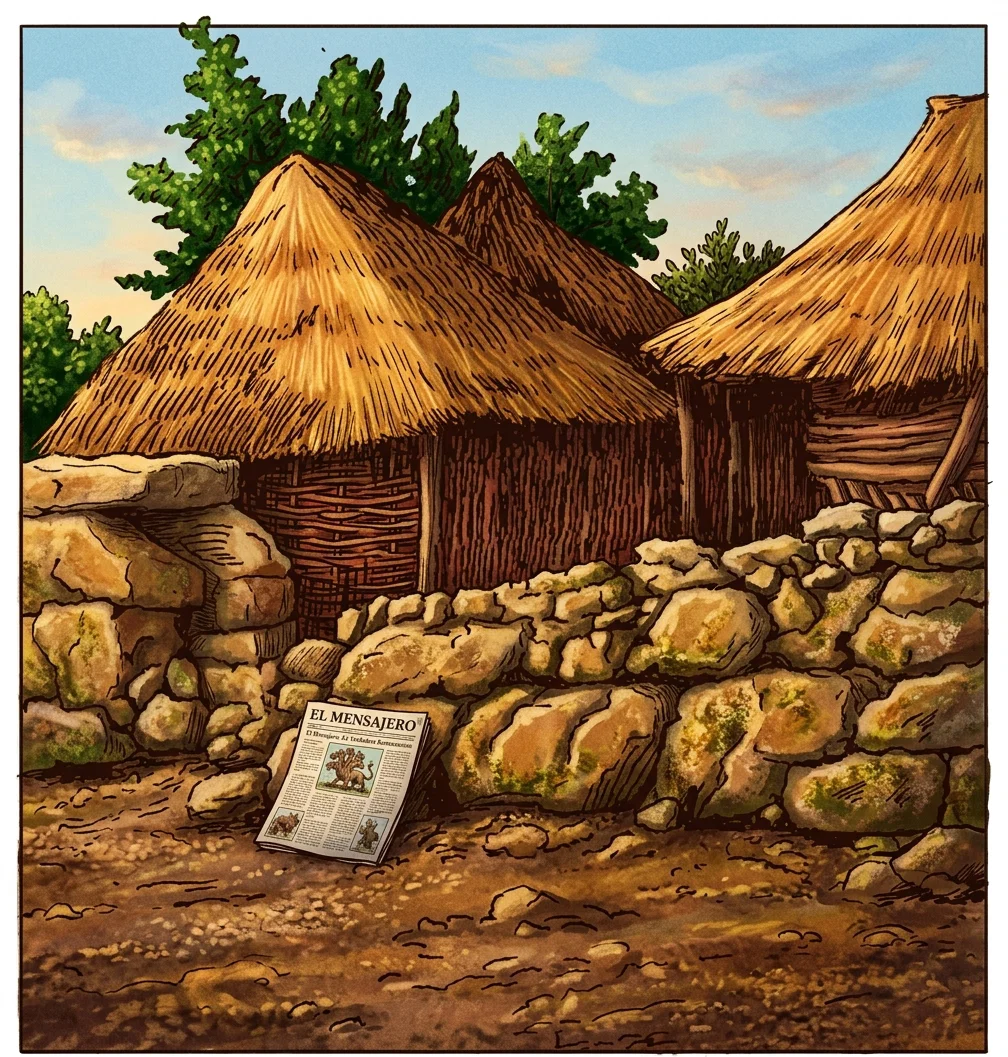
A COUNTRY VILLAGE
Yesterday a Protestant lady teacher, when I showed her El Mensajero, containing the pictures of the beasts referred to in Daniel 7, wanted the paper very much. At one house the woman said: “We have the Bible, and are Christians.” I asked which day the Bible teaches us to keep as the Lord’s day. At first they said Sunday, and afterward they said Sabbath. I read and quoted texts, and told them how the day had been changed, and asked them who had a right to change the Bible, and they said, “No one.” One of them was moved to tears; she wished her people in another part of the republic could be told about the true Sabbath. Another woman said, “I will repent and keep the Sabbath.” I might mention many other interesting experiences. When I see the people eager to hear what I have to say, I feel anxious to give my whole time to proclaiming the third angel’s message.
Yesterday morning a woman came to my room and wanted the paper, El Mensajero, containing the explanation of the beasts; she said she would bring money for a subscription. Later, while canvassing, I had a long talk with an old lady (a Baptist) who thought the law had been abolished, but after reading with her she seemed anxious to know the truth. An English-speaking man told me that the authorities were looking for me, and that I had better go to see them and pay a license; for if I did not, and if he caught me again, he would put me in jail. But I went on selling books.
To-day I sold twenty Testaments, and traded two for rosaries. One woman, after buying a Testament, tore it up and threw it at my feet, near the door of another house; she then stepped into that house and talked as if she was angry, and of course spoiled my sale there. But at the next house I stopped and read to two well-dressed women standing in the door. They liked the book, but said they had no money, and asked me to come again. So I related the parable of the ten virgins, and told them that they were like the five foolish ones; and they immediately bought a Testament for twenty-five cents (it is almost the universal custom to lie). I had quite a talk with an elderly man who was much interested. He has a Bible, but subscribed for the paper. He does not attend any of the Protestant missions.
I went into a store kept by a Presbyterian, and had a long talk with the owner and his wife and children. He said he had been taking the paper for a year. I visited the young men’s boarding-school of the Methodist mission, and was invited to talk to the students.
I feel it my duty to leave a Testament wherever possible, for the people need the Bible. This will prepare their hearts for the reception of the closing message. The darkness here is intense, but God’s Word can penetrate it.
Saltillo, Mexico.
Ecuador
By Thomas H. Davis
THOS. H. DAVIS
Ecuador, meaning “equator” in Spanish, is properly named, as its territory lies directly under the equator. It is the only country in the world that has its capital directly under the equatorial line. Although Quito (the capital) has the direct rays of the sun, being elevated over nine thousand feet above sea-level, it has a temperate climate.
Many persons have a vague idea of all the South American republics. Such, with whom the writer has talked, almost invariably think that the people spend their time in drunkenness and laziness.
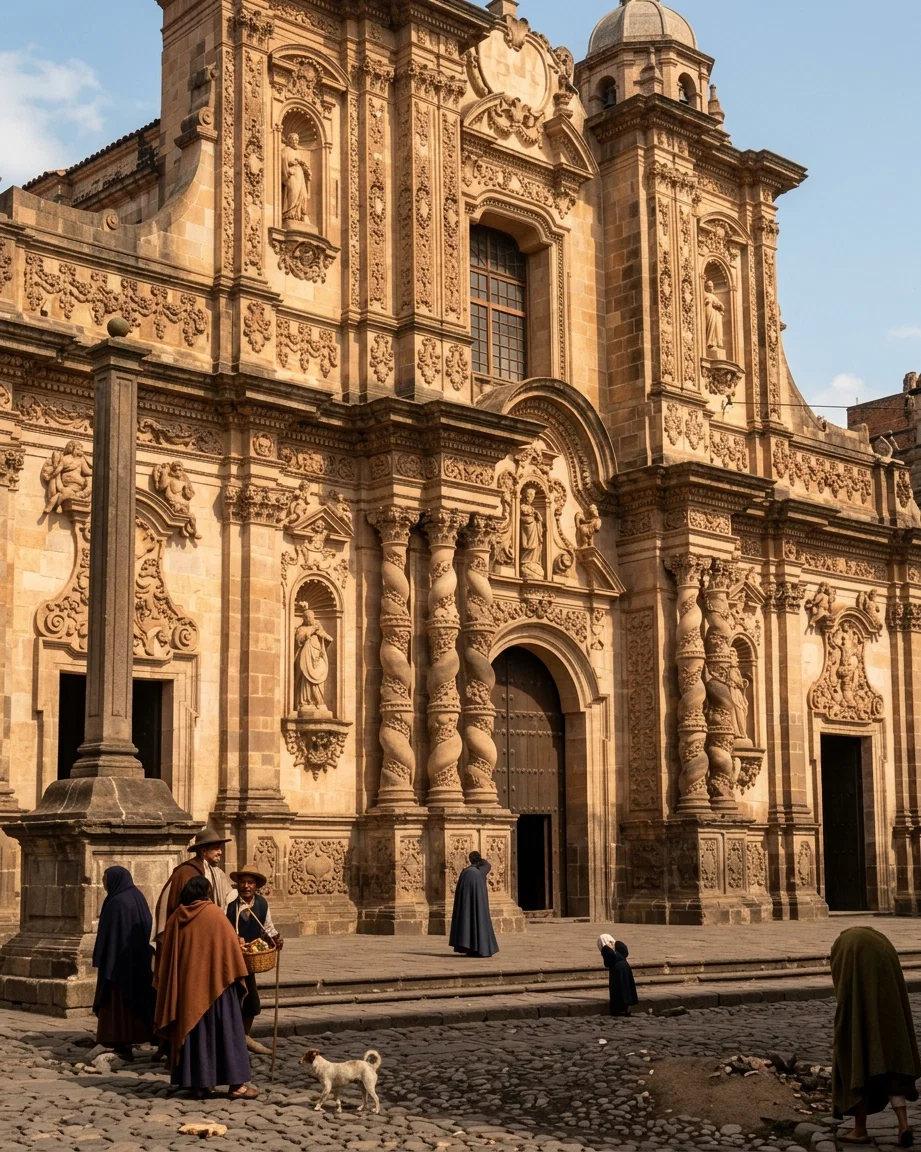
JESUIT CHURCH, QUITO
True, this is carried on to a great extent.
There is a strong effort in Ecuador to throw off the Roman yoke, which has so long held them in darkness and superstition. Should not the people who have the direct warning against the beast be as willing as other denominations, who have already entered this field, to come here and aid in this work?
To tell a Californian that Ecuador has a larger population than his State, would hardly be believed. Yes, it has more16people than California, and a greater population than Washington, Oregon, Nevada, Arizona, Utah, Idaho, and Wyoming all put together. Are these souls as precious in God's sight as those in the States? If the California Conference should send all of its workers into Ecuador, it would be meagerly manned, for there are nearly eighty thousand more inhabitants in Ecuador than in California. That, of course, would not be wise; but if more would go, greater interest would be taken in the foreign work. If any are planning for the West Coast field, the writer would be glad to give all information possible. Do not stop to study the Spanish language three or four years. To learn it as one goes, has proved to be the best way. . . .
On returning to California for a rest, it seemed that a company could easily be got together for South America. Several have expressed their desire to go. I am sure that many will go, as the people of God are made willing in the day of his power. What a precious thing it is to find in these new fields persons who are hungry for what we term “present truth.” But it has always been with a degree of shame that I tell them that the Adventist Church began over fifty years ago, for it always causes expressions of surprise, as though to say, “Why have you been so long coming this way?” Thank the Lord that there is to be delay no longer.
Esmerelda, Cal.
India
By R. S. Ingersoll
CALCUTTA.—The Lord has blessed in the work here, but we know that he will do infinitely more as rapidly as we allow him to work through us, that his work may not be hindered by our awkward attempts to help him. We realize his presence and care over the work, and are confident that it will triumph gloriously.
We are working hard to get a training-class well established. We are sure the Lord wants us to carry on this work. We are happy in our work here, and hope to go with it to its final triumph. We know that we shall not have long to wait now. The coming of our Saviour seems very near. We only need to take a glance around us to see the conditions which indicate its approach. We are sure that India will have a representation in the kingdom.
R. S. INGERSOLL, M. D.
Cook Islands
By G. F. Jones
RARATONGA.—Knowing, as we do, that there will be no more delay, we are forced by the inspiration of the message to make bare our arms to finish the work, as God has made bare his holy arm; because as he is, so are we in this world. We have a burning desire to enlarge the places of our tents, and hope soon to carry out our wish.
Learning the Tahitian language has been a help to the Raratongan, and also a key to many of the island languages. We get along fairly well in speaking, and are continually improving.
The establishment of the work in Washington causes us to rejoice, as it says, “Finish the work.” There is a short, severe, determined battle before us, and there is joy in the conflict; for the battle is the Lord’s. We are glad that it has begun, that we may learn the power of victory. We see here a dark storm about to break upon us. Were we to see nothing else, our hearts would fail. But our eyes are fixed on the Lamb of God, and so we are more than conquerors through him that loved us. Our health is good. G. F. JONES.
Spain
By Frank S. Bond
BARCELONA.— A good interest is manifested in our meetings, and several seem to have taken a firm stand for the truth. Our Sabbath-school is growing in interest and numbers. The enemy is hard at work in Spain. He is not only working with individuals, but is taking an active part in the affairs of the Spanish government. That you may appreciate how this is being accomplished, I quote a part of a Sunday law which appeared in a Sunday newspaper, March 6:—
“The king has sanctioned, and the ‘Gazette’ has promulgated the law of Sunday rest, which says thus:—
“‘ARTICLE 1.—Physical dependent labor is prohibited on Sunday, also that of a public nature for one’s self; in factories, workshops, warehouses, stores, fixed or transient business, mines, stone-quarries, ports, transports, . . . constructions, reparations, demolitions, farming, state, provincial, or city establishments or services, and other occupations similar to those mentioned. . . . No exception shall be made to women nor to minors; . . . it provides that the one who, on account of the nature of his position, can not rest Sunday, shall be given time for the fulfilling of his religious duties.’
“‘Art. 2 is given to exceptions, but these are few.
“‘ART. 3.—There will be need of civil force to oblige every stipulation contrary to the prohibitions of work established by this law, although the agreement may have preceded its promulgation. . . .
“‘ART. 5.—It shall be taken for granted that the employer is responsible for the infractions of this law, unless there is proof to the contrary, . . . and17in individual cases they shall be punished by a fine of from one to twenty-five pesetas; when the number of employees does not exceed ten, by a fine of from twenty-five to two hundred and fifty pesetas. . . . The first repetition of the violation of this law, within a year, shall be punished by public reprimand and a fine of two hundred and fifty pesetas. The action of correcting or punishing said infractions shall be public.
“‘ART. 6.—The ordinance for the execution of this law will be published and put in force within six months, counting from the publication of the same.
“‘ADDITIONAL ART.—In everything concerned in this law, it shall be understood that Sunday will begin at midnight of Saturday and end at the same hour of the following day, thus the duration of the rest being twenty-four hours.’”
We feel that a special effort should be made at this time to let the people of this country know the meaning of these things. In order that we may not incur the ill will of the authorities, and thus be publicly reprimanded and heavily fined, heavenly wisdom must be employed in every undertaking.
Surely, this is the time for every one of God’s people to arise in the name of King Emmanuel and enter this last great conflict between good and evil. The present national perplexities very clearly reveal that the last prophetic event just prior to the second coming of our Lord is about to be realized. There is now no time to be sleeping on guard. Pray for the advancement of this message in Spain.
FRANK S. BOND.
Samoa
By W. E. Floding
APIA.— We have just received four hundred and seventy copies of “Christ Our Saviour,” and in the last mail I received three thousand tracts—“We Would See Jesus.” I have been working with these since they came, but will not be able to reach many places until the dry weather sets in. As it is, I have waded from fifteen to twenty streams to the east of us, and the roads are so muddy to the west that twelve miles is as far as I can go on foot.
I have been showing the natives a copy of the book which I received by mail, and I am sure it is going to take well. They are pleased with it. I shall not be able to sell very many until the dry season. At present copra is not being made, and this is about the only means the people have of earning money. Later I believe I shall have good success in selling the books. A blacksmith here is reading our literature, and has accepted the Sabbath.
W. E. FLODING.
Porto Rico
By B. E. Connerly
MAYAGUEZ.—I am home again from another trip through the island. Thus far this month I have visited fifteen towns. But how few I find who are seeking for the truth! I found more interest in the paper than before, and had the privilege of talking with some ministers, two of whom confessed that the Sabbath of the fourth commandment should be kept. I also met a number of Catholic priests. All treated me cordially, and one admitted that the signs indicated an early return of the Lord. I am so glad that I am now able to converse with the people and to read to them from the Bible, though it is still very difficult for me to talk. I had many precious experiences during this trip. I found the Americans far more susceptible to the truth than ever before. The time of seed-sowing is indeed a glorious privilege, and we are anxious to try our hands at cultivating the springing blades.
B. E. CONNERLY.
*A View of the Field***
IN the great mission fields of India, China, Japan, and Korea are massed seven hundred and sixty million idolatrous heathen, or about one half of the world's population. To enlarge the picture so as to embrace the vast aggregation of human beings in Southern and Eastern Asia, we have a vision that shocks our Christian sensibilities, fires our Christian consciences, and makes the blood of Christian sympathy leap in our veins.
Of every two infants in the world, one first sees the light in heathen Asia: to what instruction is it born?
Of every two brides, one offers her vows there: to what affection is she destined?
Of every two families, one spreads its table there: what love unites their circle?
Of every two widows, one is lamenting there: what consolation will soothe her?
Of every two orphan girls, one is wandering there: what charities will protect her?
Of every two wounded consciences, one is trembling there: what balm, what physician, does it know?
Of every two men that die, one is departing there: what shore is in his eye? — Selected.
Time Spent in Communion with God
By Wilder
He that saveth his time from prayer shall lose it; but he that loseth his time in communion with God shall find it in a life of multiplied blessings.— Wilder.
The Pacific Union Conference
By W. T. Knox
THE second session of the Pacific Union Conference is in the past. The delegates met in Healdsburg at the time appointed, March 18, and although the coast was visited during the entire time of the meeting with stormy weather, almost a full delegation was in attendance, besides a goodly number of visitors. Elders A. G. Daniells and W. W. Prescott, of the General Conference, and Elder Smith Sharp, of the Southern Union Conference, and Mrs. E. G. White were also present.
The business of the conference was conducted each day in morning and afternoon meetings, and each phase of the work was given careful consideration, the one most notable characteristic in all these meetings being the unity and harmony existing among all the delegates, nothing occurring during all the session to mar this sweet spirit. No important changes were made in the organization. Elder W. B. White, of Montana, was elected president. One important action taken was the recommendation to all denominational institutions to pay a tithe of their net income to the support of the work, each being left free to determine where its tithe should be paid.
The Pacific Union Medical Missionary and Benevolent Association which met after the adjournment of the conference, voted that all medical institutions should pay their tithe into the union conference treasury. The unity and co-operation existing between the union conference and the medical work is a source of great encouragement to all.
From 8 to 9:15 A. M. each day was devoted to prayer and social meeting, and from 11 A. M. to 12:15 M. to Bible study conducted by Elder Prescott. In these studies the truth of God stood out clearly and distinctly, and its presentation brought courage and joy to all hearts. These meetings were also attended by the students of the Healdsburg College.
The evening hour was occupied by preaching services; and considering the stormy weather, these meetings were well attended by the citizens of the town, many of whom seemed to be greatly interested. It appeared as if a permanent work might be accomplished in Healdsburg if the interest was followed up by proper efforts. Sister White spoke on two occasions, and enjoyed much freedom in presenting her messages.
Without doubt many attending this meeting obtained advanced experiences, and returned to their home fields with renewed courage, better prepared for the Master's service.
W. T. KNOX.
Canvassers’ Institutes in the Atlantic Union Conference
By F. E. Painter
WE believe that the time has come when the truth of God is to go forth as a lamp that burneth, and since it is largely by means of our publications that the last message is to be given, we have planned for a strong forward movement this spring and summer in the Atlantic Union Conference, which has for its object the scattering of the pages of truth “like the leaves of autumn.”
In order that we might begin in a practical way we have planned for as many canvassers’ institutes as we can arrange for. These institutes will be short, and as practical as it is possible to make them, the object being a brief, but comprehensive study of the most essential principles and methods to be employed in the work of selling our publications, and a thorough drill in their practical application.
It seemed necessary that I should be present at each one to assist with the instruction, and, as it is desired to have them all as early as possible in the spring, we had to cut them a little shorter than we otherwise would have done.
The first one is now in progress in the academy at South Lancaster, Mass. A class of between twenty-five and thirty bright, earnest young men and women are taking the instruction, and we believe that many of them will become good, permanent workers in this branch of the Lord’s cause. Brother H. C. Wilcox, canvassing agent for the New England Conference, is assisting in giving the instruction. His help is much appreciated.
The principal and faculty of the academy are also lending their influence, counsel, and good-will to help on the good work. This institute was planned to continue three weeks, but owing to the fact that the students are so busy with their regular studies that they can not give as much time to this work as desirable, Brother Wilcox will doubtless remain with them a week or two longer.
The next institute will be a short one at Lincklaen Center, N. Y., beginning April 17. Arrangements for this are being completed by Elder S. H. Lane, conference president.
This will be followed by one of about ten days, in North Wolcott, beginning April 25. Then Elder Hottel has arranged for one to be held in Richmond, the capital city of Virginia, to begin May 13.
May 24 to June 3 is the date set for the institute in the Eastern Pennsylvania Conference, to be held at Pottsville, Pa. Brother F. F. Fry, the State agent for this conference, has been, and is still, working hard to arrange for this meeting, and to secure a good attendance, and reports that already quite a number have promised to be present, and then enter the work.
The Western Pennsylvania Conference has arranged for an institute to be held in connection with and immediately following their camp-meeting in June, and the local State agent, Brother T. D. Gibson, as well as the other officers of the conference, is very confident there will be a good attendance of those who desire to fit themselves for a part in this work.
Other institutes to be held later in the season may be arranged for by some of the other conferences, and will be reported later. I am certain that in all the conferences where these institutes are to be held, there is a large number of young people and of those more mature who ought to be in this work, and who would be benefited by the instruction given at these meetings; and I sincerely trust that all such will appreciate the opportunity which these institutes afford them to prepare for service, and will arrange to attend. Those who desire to do so, should write at once to the officers of the local conference, or to the writer.
F. E. PAINTER.
Wilkinsburg, Pa.
Missionary Program for 1904
By H. H. Hall
The following definite plans for missionary work were enthusiastically received and discussed at the recent meeting of the Pacific Union Conference held in Healdsburg, Cal.
“We recommend, That as conference officers and laborers, we earnestly seek to impress upon the minds of all our people the importance of their each taking a part in carrying this message to the world, and that we assist them to do so by,—”
“(a) Explaining the particular fields of each of our periodicals, and urging our people to subscribe for, study, and circulate them.”
“(b) Presenting the advantages of a systematic circulation of tracts on leading points of present truth.”
“(c) Urging them to study carefully the principles of true medical missionary work.”
“(d) Encouraging one or more in each church to canvass for our forty-per-cent books, beginning with their own18members and extending their efforts as experience will permit.”
“(e) Directing the attention of all our people to the importance of their circulating such books as ‘Christ’s Object Lessons,’ ‘Story of Joseph,’ and ‘Ministry of Healing.’”
“(f) Aiding suitable persons to follow up the foregoing efforts with Bible readings and cottage meetings.”
“(g) Inviting our church officers to call the attention of the conference to such openings for meetings as they feel unable to fill themselves.”
“We further recommend, That to make the preceding suggestions practical and permanent, classes be organized in connection with general meetings,—or in such other ways as may be thought best,—at which these methods of work may be thoroughly taught by precept as well as by example; and that we urge each church to elect to the office of librarian the person who will the most successfully lead the members into actual missionary service.”
Here are a number of suggestions concerning actual field work. Our periodicals, our tracts, the principles of medical missionary work, the encouraging of members to circulate books around their homes, the continuation of the campaign for “Christ’s Object Lessons,” the new work with “Ministry of Healing,” and the need of following up such efforts with Bible readings and cottage meetings, are all given prominence. And then, to make these suggestions practical instead of theoretical, it is proposed that permanent classes be organized, and definite instruction, connected with practical work, be given; also that an effort be put forth to secure as the librarian of each church a real missionary leader.
It is proposed that a missionary school be held in connection with, or at the close of, each teachers’ summer school. Librarians and others having church responsibilities will be invited to attend, and to spend half the day in study, and the other half in actual work in the vicinity.
By these and other means we expect to encourage our churches to greatly increase their missionary work. Do not these recommendations contain suggestions that will be helpful to you, dear reader? H. H. HALL.
New York
By A. O. Burrill
BUFFALO.— The church at this place was much encouraged at the last Sabbath meeting. We saw manifestations of how God works through the Sabbath-school and the church-school. Five of the youth, of their own accord, asked for baptism. The Spirit of the Lord moved those who witnessed the ceremony. It was highly gratifying to see these uniting with the church by baptism. There are still others whom we confidently expect to see baptized soon. One man for whom we have long labored has decided to keep the Sabbath. His wife is much rejoiced. There is a great field opened before us here.
A. O. BURRILL.
The Work in Paris, France
By B. G. Wilkinson
THE following letter from a captain of the Salvation Army at Paris will doubtless be of interest to the readers of the REVIEW. This officer has been studying present truth for some time, and has attended our meetings from time to time here at Paris and in the provinces of France:—
“I believe that the moment has at last come when I am called to put into practise the new light which for some time has been for me a subject of profound meditation. I indeed feel that to postpone or to reflect more would be a loss of time. I realize more and more clearly that the Saviour invites me to observe the seventh day, since he has blessed and sanctified it.
“Since Christ himself has thought good to give us an example of the importance of baptism by being baptized himself in the watery grave, I desire also to invite Christ to give me a larger measure of his Holy Spirit by first receiving the baptism of water. It is striking to notice how God arranges all things so as to enlighten the sincere soul. In the worship this morning we were reading the twelfth chapter of Luke, and in the fiftieth verse Christ said: ‘But I have a baptism to be baptized with; and how am I straitened till it be accomplished!’
“I do not yet know by what paths the Saviour will call me to pass. I can see only one thing; that is that I have arrived at the turning point of my life. But I wish to trust in him for all things. I see that I am on the eve of giving in my resignation as officer of the Salvation Army; for in accepting the Sabbath and the sacraments and no longer believing in everlasting punishment, I am not in accord with the principles of the Salvation Army. And by another little incident it seems to me that God himself is now preparing my dismissal.
“Yesterday I was at the office of the General Staff, where I had promised to assist another officer, and you know that out of the abundance of the heart the mouth speaketh. I could not refrain from saying that that day was the seventh day, which God had marked with the seal of his benediction, and that we ought to sanctify that day instead of Sunday. Now as our head men know that I have certain leanings toward the Seventh-day Adventists, it will come to pass one of these days that I shall be called to a station in the provinces (it is well known that this is always done when the faith of an officer is in danger). I can not see that it is my duty to accept a request to leave Paris.
“I do not yet know what I shall do. I feel greatly my need of the direction of God. I hold in joyful memory the Sabbath day, March 19; that date will ever rest graven on my heart as being the starting point of a life more consecrated and more in harmony with the Word of God. Receive, dear friend, my Christian salutations.
“F. SCHEURRER, Captain.”
It is now three weeks since this letter was written. The Sabbath following its reception, the captain publicly declared himself for the truth at our Sabbath service. The next Sunday night as he went to conduct his staff in the regular Sunday evening service, he found a new captain there to take his place. However, he found a place to work with the Roth brothers in their health food manufactory. He is now studying to prepare himself for baptism. At a Bible study given in our house last Saturday night he was present with another Salvation Army captain. He invites them also to our public meetings.
The last two weeks our hearts were made glad by four new additions to the company of those who honor as God’s sign the day that “was made for man.” This makes about twelve in Paris who have decided to walk after this manner.
Our work at Paris is blessed by the presence of the Lord. Those who assemble each Sabbath day to worship before the Lord are of one mind and of one spirit. The Brethren Roth are a great help to us in the evangelical work. And they are much encouraged in their efforts to place their health food products on the Parisian market. Their health food plant has now grown to a considerable size, and they find an increasing interest in the city in the reform diet.
Our little store in which we hold our meetings is becoming quite crowded, and if the work continues to grow at the same speed as lately, we shall soon be forced to find other quarters. A large circle of interested friends encourages us to believe that the future will add many others to the number of those in Paris who look for the revelation of the Saviour from heaven.
B. G. WILKINSON.
8 rue Belloni, Paris, France.
How Can the Ten-Cent-a-Week Plan Be Made General and Effective?
By W. A. Colcord
I AM quite thoroughly convinced that the ten-cent-a-week plan will not be generally adopted by our people until all our churches use the little mission envelopes provided for the purpose by the General Conference Mission Board. These are neat, handy, and admirably adapted to the purpose, and cost those who use them nothing. And I am quite as much convinced also that all in our churches will not use these envelopes regularly until provision is made whereby each individual church-member attending church can get one of these envelopes each week without fail, and in the easiest and handiest possible manner; and this is by having a supply of the envelopes placed in a little pocket or receptacle directly in front of the individual, or at least in convenient places about the church or place of meeting, and the envelopes containing the offerings collected regularly each week.
To talk of each individual handing the church treasurer $1.30 each quarter is foolish; first, because probably not one in five of our people would ever adopt this way of giving; and second, because the ten-cent-a-week plan as stated in the recommendation adopted by the last General Conference, does not contemplate that each individual shall give just ten cents a week, but that each church shall aim to give an average of ten cents a week per member, some giving more and some less than this amount. Ten cents a week is the average gift aimed at by the church as a whole, but not by any means the amount specified which each one should give. Some can easily give more, while to others it might be a hardship or even an impossibility to give this amount regularly.
And, except perhaps in very small churches or companies, to ask the church officers to go around each week and distribute the envelopes, and then go around again and collect them, or to attempt to do both at the same time, is an awkward, undesirable, and time-killing way of doing things. The little envelope pockets relieve all this extra work and embarrassment. If local zeal in world-wide mission work, or local ingenuity, is not sufficient to supply these, then I am confident that it would pay the Mission Board of the General Conference many times over, and in a very short time, too, to supply these to our churches.
The little envelopes will accomplish nothing unless they are used; and they will not be used unless the people get them; and the way to have the people get them is to place them where they can see them and can get hold of them, and where their very presence and proximity will be a constant reminder of their purpose and use. This, to my mind, is the common-sense way of looking at this matter, and the only logical solution to the successful carrying out of the ten-cent-a-week plan.
W. A. COLCORD.
Did It Pay?
By Bunnie Lytton Leigh
A FEW Sabbaths ago the writer had the privilege of listening to one of the “old-time” sermons on the tithing question. Before the close of the meeting opportunity was given to those present to speak of their experiences in paying tithe. There were many interesting experiences related, one of which will doubtless be of special interest to the readers of the REVIEW.
One good sister who had been a nurse stated that her first case away from home was a very serious one, and she was obliged to remain for many months; consequently, she became exceedingly “homesick.” She was a long distance from home, and it required quite a little money to pay the railway fare. When her patient had recovered, she was very desirous to go home for a time. She counted the money she had saved, and found that when she drew her next wages, she would have just enough to take her home, if she did not pay her tithe. She hardly thought that it would be right for her not to pay her tithe, and yet she was so homesick that she felt she must go home. She prayed earnestly over the matter several times, but found no relief. Finally she told the Lord that she would do right, pay her tithe, and give up going home. She thought that settled the question. However, when she drew her pay, she received the full amount, a “pass” all the way home, and for a few extra bills besides. She thought it paid to follow the Lord’s instructions in regard to paying tithe, as well as in other things. Should not this experience be an encouragement to all to be honest with the Lord and pay a full tithe, leaving the results to him who careth for us?
BUNNIE LYTTON LEIGH.
Field Notes
A STATE meeting for Ohio workers will be held in Cleveland, April 22-28.
THE church at Burlington, Iowa, has been strengthened by the recent addition of four adults.
THE church at Los Angeles, Cal., now numbers over four hundred members, most of whom reside in the city.
BROTHER V. B. WATTS, who is holding meetings near Gentry, Ark., reports two Sabbath-keepers as the result of his efforts thus far.
AN encouraging outlook is reported from Algona and Ruthven, Iowa, where several of substantial character have recently taken a stand for the truth.
SEVEN tents are to be in the field in Oklahoma the coming summer. The annual camp-meeting will be held at Guthrie, August 25 to September 4.
AN exchange affirms: “An interesting item in connection with the school work in the South is the fact that thus far every church-school established has resulted in a church being organized.”
ELDER R. C. HORTON writes from Bangor, Mich., where he is holding meetings, that the prospect is good for the raising up of a church there, a number having already decided to obey the truth presented, whose example he feels sure will be followed by others.
SISTER ANNA KEMSTRA, who is engaged in Bible work in Grand Rapids, Mich., reports: “I have an interesting company of readers, two of whom have begun the observance of the Sabbath. One of these is a Catholic, who, while searching for truth, said if the Lord told her in the Word that the seventh day was the right day, she would drop everything and keep that day. When the truth was made plain to her, she accepted it fully.”
WRITING from our mission station in Honan, China, Sister Pilquist says: “The Lord is very dear to us. We have had the privilege of seeing wonderful things done in our midst through Jesus Christ, our Saviour. Truly, he has poured out his Spirit upon each of us in a great measure, and we realize as never before that his second coming is at the door.” Sister Pilquist has written an account of her recent personal experiences. We expect to have this for our REVIEW readers very soon.
IN a published report of plans for the work in Texas the coming summer, we note the following:—
“That Elder E. B. Hopkins’ resignation as superintendent of the eastern district be accepted, and Elder D. U. Hale fill the vacancy.
“That Brother and Sister Cably and Sister Minnie Robbins connect with Elder Etheredge in a tent effort in the western part of the State.
“That Elder Andrew Nelson labor with Elder T. W. Field in the central district. Also that Brother and Sister Robert French labor in the central district, as self-supporting missionaries.
“That Brother Felter and Brother and Sister Neff engage in a tent effort in Centerville, a village in Elder French’s district.
“That Elder C. W. Miller visit all the German churches before the close of school, and then in company with Elder J. P. Lorenz go to a German settlement with a tent.
“That Sister Kittie Stevenson’s resignation as secretary of the Sabbath-school Department be accepted, and that Ida A. Nelson fill the vacancy.
“That a church-school teachers’ institute be held the last few weeks of school; arrangements to be made by Professor Hughes.”