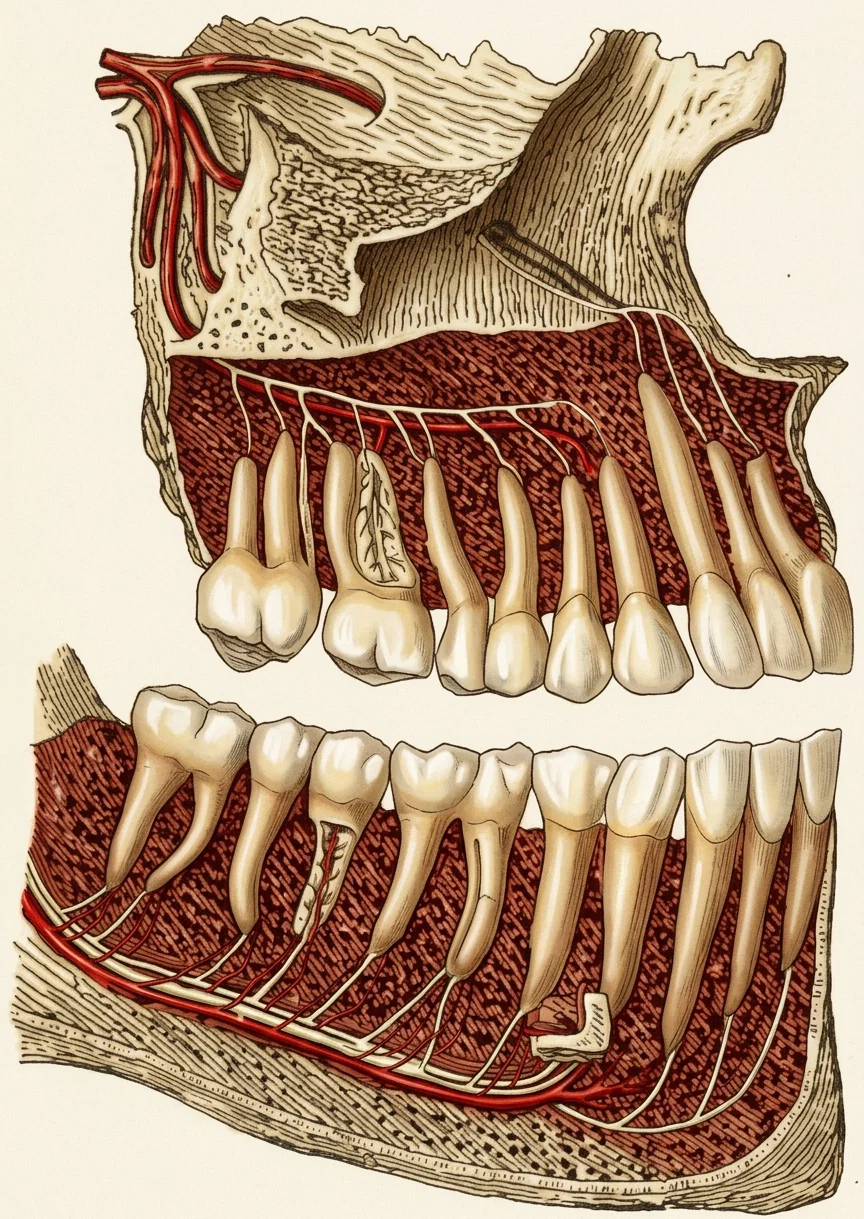
The teeth really should be classified among the vital organs of the body, for disease there soon affects the entire system.
MAN has been provided with a wonderfully efficient chewing organ. As a mill for shearing and grinding natural foods it is a masterpiece of engineering. Every little curve on the surfaces of the teeth has a scientific reason for being just so. The way food is distributed over the teeth by the action of tongue and cheeks, the strength of the muscles of mastication, the coordination between the joints of the jaw and the chewing surfaces of the teeth, the emptying of saliva at the most convenient points for distribution, and many other features of the mouth that space does not permit of mention are too wonderful to have just evolved or happened so. And, would we be provided with such a machine showing infinite wisdom in every detail of its design were it not a necessity to our health?
LOW CHEWING EFFICIENCY
In the clinic of my employment I see many semi-wrecked mouths. Along with other data, the percentage of chewing efficiency of every patient is estimated; the figures being arrived at largely by the number and position of teeth that meet. What do we find? The large majority of patients who have not had more than 60 per cent chewing efficiency for several years are majoring in stomach and intestinal complaints.
Such people have to live on soft foods, as their stomachs soon get so they can not handle coarse foods improperly chewed; and in time they rebel against everything. The whole alimentary system needs just what the teeth and gums need, something to exercise them. Exercise is one of the requirements of life that will not be ignored forever; and how else can our digestive system get exercise, but through coarse and bulky foods? When mouths are put in condition to handle such foods, we frequently see the patient secure a new lease on life.
DETECTING PYORRHEA
Pyorrhea is responsible for more wrecked mouths than all other causes combined. It is a disease of the investing tissues of the teeth (bony process and gums) that earnestly invites your investigation, it being so destructive, so prevalent, so easily prevented.
The early beginning of pyorrhea may be easily recognized from the appearance of the gums. In the healthy mouth the gums are of a light pink color and hug the teeth tightly, tapering off to meet them in a sharp margin. Early symptoms of pyorrhea are the gums between the teeth showing a swollen and puffy condition and a dark red color, and bleeding of the gums on regular brushing. Looseness of the teeth is a later symptom, appearing at a time when in many cases it is too late for a satisfactory arrestment of the condition. X rays are an aid in diagnosis.
The possibility of a cure lessens in direct ratio to the advancement of the disease. Only incipient and slightly advanced cases may ever be considered cured, in the sense that we speak of a broken arm or leg being cured—the parts returning to a condition as good as normal. If not too far advanced, the pyorrhea may be “arrested,” and the teeth do good service for a long time with proper care.
THE CAUSES CLASSIFIED
As in other diseases, the cure of pyorrhea is dependent upon the removal of its causes. The causes, according to the understanding of the writer, may be classified as follows:
The germs in the mouth
Lowered general tissue vitality
a. Unhygienic living
b. Systemic disease
c. Senility
3. Lowered local (mouth) tissue vitality
a. Faulty occlusion of the teeth
b. Gum irritants, such as calculus, and overhanging fillings or crowns
c. Lack of exercise of the chewing organ
Food remaining around the teeth invites the rapid multiplication of germs. Pyorrhea is an instance of lowered resistance (vitality) of tissue plus germs equaling disease. There are no germs common to pyorrhea, so far as known, that may not be found in the average mouth, and there are sufficient germs in the average clean mouth to cause pyorrhea in the presence of lowered resistance of tissues. Hence the importance of treating pyorrhea by raising the vitality of the tissues involved, although keeping the mouth scrupulously clean to lower the number of the involving germs will always remain a first consideration in allaying the disease. The chewing of coarse foods and natural foods is all-sufficient for the cleaning of the ideal mouth. The additional intelligent use of the toothbrush, however, is indicated when such food is not eaten, when teeth have not been put in an ideal condition of repair, and especially in the presence of pyorrhea.
BLOOD AND CIRCULATION
Low tissue vitality is caused by either poor blood or poor circulation, or, as in many cases, a combination of the two. The treatment to bring up tissue vitality and resistance is directed toward stimulating good end-circulation of good blood. By end-circulation is meant the flow of blood into the finest capillaries in the end tissues, that is, those nearest the outside. Such a circulation of healthy blood readily combats disease, through the activity of the white cells, called “the little soldiers of the blood.”
The importance of general measures in treating pyorrhea is obvious. That which affects the circulation of the whole affects that of the part. In some cases improvement in the circulation and quality of the blood is the only treatment necessary for pyorrhea.Page Ten
One patient told me that the “run around the block” that he took every night he thought did his pyorrhea more good than anything else. Exercise, tonic water baths, sun baths, air baths, and a general hygienic routine of living are more important measures in curing pyorrhea than any highly colored medicine one can use on the gums.
Systemic disease is a common cause of pyorrhea. This is especially true of the diseases influencing most the quality of the blood and the circulation. Diabetes and tuberculosis are good examples. People so affected are highly predisposed to pyorrhea, and should consider the treatment of their systemic disease the most important phase of their treatment for pyorrhea.
With few exceptions, young people are free from pyorrhea. In fact, it has been called a disease of old age. Age, however, may be measured by tissue vitality; and lowered general tissue vitality is, in the opinion of many, the greatest predisposing factor to pyorrhea. Hence the appearance of pyorrhea may well impress one that man is not immortal, and that the human machine requires a life well conformed to the principles of natural law if it is to last the allotted threescore and ten years. Therefore we must look upon pyorrhea as a symptom, as well as a disease, and advise the early correction of all stresses predisposing old age (unhygienic habits and disease) along with local treatment.
In many cases we find sufficient cause for pyorrhea in the mouth itself. These cases may expect improvement only when the local causes are removed.
The way teeth meet each other in chewing is spoken of as “occlusion.” “Faulty occlusion,” so called, is considered a cause of much pyorrhea. Because of cavities, uncomfortable dental work, unsupplied spaces, and in many instances for no apparent reason, many if not most people chew on one side of the mouth, almost to the exclusion of the other side. Thus the wear is not evenly distributed. The cusps will be longer on the side not used, and the lateral movement of the jaw, tending to conform with the flatter surfaces of the other side, will cause the teeth with the longest cusps to “rock” and thus loosen each other. If you do not know already that you do most of your chewing on one side, have a friend watch you at the table when you are unconscious of your chewing. Dentists can always tell which side is used the most, if either, by the cleanliness of the teeth and the comparative lack of pyorrhea. The secret is also revealed by an overdevelopment of the face on the side that does most of the work. By grinding off a small fraction of the enamel it is possible for dentists to even up on the wear of the teeth.
Gum irritants, such as deposits of calculus and overhanging fillings and crowns, invite pyorrhea. The gums become inflamed, red and swollen, around such irritants; the circulation is congested from the excess of blood to the area; and infection and breaking down of the underlying bone is to be expected. Overhanging fillings and crowns and restorative work of certain types may make the mouth difficult to keep clean, and the often ever-present débris is very nourishing to the many hard-working germs. It is the part of the dentist to remove all such irritants.
OF UTMOST IMPORTANCE
Chewing is of the utmost importance in preventing and curing pyorrhea. If one refused to use his arm, and just let it hang loose by his side, we would expect it soon to become a sick member of the body. Just so with the teeth and gums. Every chewing movement makes the teeth give a little in their sockets, and stimulates circulation in the pad of elastic tissue between the root and its socket. Also the food passing over the teeth scratches on the gums. The gums are poorly supplied with nerves, to allow for this. It is their way of getting exercise. From this we see that our diet should be made up of foods that will require muscular effort in chewing and that will be coarse enough to stimulate the gums. Primitive tribes of people who live on such diets have been found to be 100 per cent free from pyorrhea. The American diet of mashed potatoes, fresh bread, and pudding and pies, is an insult to the wonderfully efficient chewing organ we possess, and it robs it of its needed exercise. Eat more natural foods and raw foods, such as carrots, cabbage, celery, hard bread, nuts, and the like.
It will be found difficult to chew food properly if there are missing teeth, or if spaces have been filled with unsatisfactory restorations, or if food can be forced between the teeth in chewing. The mouth should be put in fine condition for chewing, as a step in caring for pyorrhea, a point which patients frequently overlook because they are expecting to lose all their teeth some day. If it is too late to save them, they should be out and dentures fitted.Eleven
To raise the resistance of the mouth to pyorrhea, next in importance to chewing is correct brushing. Only chewing is correct brushing. A stiff brush, and preferably one with bristles set far apart and fairly short, is advised. Brush from the teeth toward the gums. Keep in mind the thought of reaching in between the teeth with the bristles with each stroke.
There are good reasons for recommending this stroke. It has been scientifically demonstrated to clean the teeth more efficiently. It is the direction that food is naturally forced in its excursions in chewing, and the tissues are so built to resist this movement, and respond to its stimulation.
People affected with pyorrhea might well spend five minutes morning and evening brushing their teeth and gums in a systematic manner. Generally speaking, the more gums bleed, the more they need to be brushed. If all gum irritants are removed, after faithful brushing for several weeks, bleeding may be expected to entirely subside. If gums are tender, begin brushing lightly for the first few days. Gradually tone the gums so you can brush harder, and after several weeks, you may be able to brush as hard as you can with the stiffest brush without bleeding; and it may even feel good. You are then getting results.
It is advisable for patients to have two brushes, and use them alternately. This gives them time to dry out thoroughly. Then they will be harder and more efficient instruments for cleaning and massaging. Incidentally, it is economy. It is the continuously moist brush that wears out fastest. A dry brush will last indefinitely.
JUST ORDINARY SALT
Ordinary table salt is a superior dentifrice, and is especially recommended to those having pyorrhea. After brushing, wash out the brush, shake partially dry and press in cup or glass of salt. Then hang to dry in an airy place. The salt will cake on the brush and it will be kept reasonably sterile for the twenty-four-hour period, when next to be used. Salt inhibits the growth of bacteria, and is excellent as a tonic when applied to gums, as well as to the skin. A powder dentifrice may be substituted if the teeth are too sensitive for salt, or used alternately if it proves to remove stain better.
The treatment of pyorrhea should be rational. Reason from effect back to cause, and the treatment should suggest itself. Avoid fads of treatment. The enthusiasm of faddists, if carried into a well-balanced course of treatment, is excellent.
If you are threatened or bothered with pyorrhea, analyze carefully, with the aid of physician and dentist, what are the main and contributory causes in your case. Be content with nothing short of an efficient mouth for chewing, and beware of cooks who have sought out many soft inventions.
Did You Know That—
An advanced case of pyorrhea, the great health wrecker
Most people do not have more than 60 per cent chewing efficiency? A diet of soft foods destroys the teeth? Pyorrhea is responsible for more wrecked mouths than all other causes combined? Pyorrhea can be cured if taken in time? Many people chew mostly on one side of the mouth? Chewing is one of the best preventives of pyorrhea? Brushing should not only clean the teeth but should stimulate the circulation in the gums? The stiffer the toothbrush the better? Two brushes, used alternately, are the best plan? Table salt is one of the best dentifrices?
Rediscovering Christ
By Keld J. Keynolds
Shall we stop with the modernists at Calvary, or go on with the fundamentalists to Pentecost?
KELD J. KEYNOLDS
THE rediscovery of Christ is the greatest task to which the church of to-day can dedicate itself. But it is a task which the church as an institution can never hope to accomplish. It must be an individual discovery, a personal achievement of the individual Christian. No amount of legislation can bring Christ to the church; neither can any elaborate plan of church union or coöperation. Only the Spirit of God working in human hearts can bring them to Christ. And that is being done.
Call it what you will,—the latter rain, a spiritual quickening, a mighty layman's movement,—it is here. We are seeing a revival of religious interest among the laity such as has not been since the sixteenth century Reformation. Just as the eve of that great spiritual revolution witnessed the formation of Bible classes over Central and Northern Europe, which did much to give purpose and direction to the movement, so to-day, at the threshold of a new and more significant reformation, laymen are searching for and studying religious questions with a zest as gratifying as it is unusual.
But, at the same time, religion is being reëxamined by the experts. Literary criticism is retelling, or attempting to retell, the story of the origin, the collection, the transmission, and the interpretation of the Bible. The psychology of religion is studying the laws of the inner life. Comparative religion is seeking the least common denominator of the faiths and cults of the world. The philosophy of religion is seeking the meaning of all religious experience. In short, Christianity is being “modernized.”
To date, the mighty laboring of the experts has brought forth little more than a colorless, insipid Christianity. Religion, in their hands, has come to mean believing in the existence of a God or going to some church or engaging in some form of social service or, sometimes, simply being a decent, respectable, and reasonably law-abiding citizen.
This kind of teaching is a skimpy diet for hungry souls. There is therefore a growing conviction that the shepherds are climbing the heights for the sake of the æsthetic satisfaction the view affords them, and not for the grass needed by their flocks. But in the same way that a bad ruler is a public good if only he is bad enough, the present state of affairs, because it is recognizably bad, serves a good purpose. It leads to criticism, and criticism serves to clarify the issues.
It is coming to be felt that the churches which claim to speak for God are failing to produce men and women who act as if they had heard God speaking; or who, having heard, can repeat what God has said to them in ways that can carry conviction to others.
Religious lines are being redrawn. Of two who have been occupying the same pew, the one is being taken, the other left. The one is seeking civic salvation in social service and legislation; the other is finding personal regeneration, in an indwelling Christ. The one knows only the Jesus of history; the other knows the Christ of experience.
Out of the criticism and disappointment on the part of the laity with reference to modernist leadership is emerging the fact that that leadership has failed to meet the world's crises and the people's need, because it knows only the Jesus of history. Its efforts are expended on the study of the psychology of the Man. It has found in Him a religious philosopher, a social reformer, a man of genius,—but nothing more. Its biographical studies end at Golgotha.
Were the modernists to continue their studies as far as Pentecost, their whole philosophy would have to be changed; for Pentecost presents a climax in the history of redemption. The Old Testament is the record of the dealings of God with men and the forecast of the God-among-men of the Gospels. But Pentecost presents a new bond, a closer and a more intimate bond between God and man. The Pentecost experience can be explained only as a manifestation of God in man. And this is a different, a new, relationship. Peter's words, This Jesus whom ye crucified is risen, linked with Jesus' own promise, “I will dwell in them, and walk in them,” presents this experience of the believers as the point of convergence and divergence of all history. The Jesus of history here becomes the Christ of experience.
Those who stop at Calvary and those who go on to Pentecost are of totally different camps, separated by an age-old line of cleavage. It is the difference between believing in God as an idea and experiencing Him as a fact. It is the difference between the philosopher and the man of prayer. It is the contrast between knowing about Jesus and knowing the Christ as a personal Saviour. It is preaching a creed as against living the gospel. It is a church tepid and hesitant as against the church militant and triumphant.
He who belongs in the camp of the latter, and he only, can know what Jesus meant when He told of the man who gladly sold all that he had to possess himself of the pearl of great price. For this is the pearl, that the church may have the Christ of experience, the indwelling Spirit of God.
Religious Freedom Fundamental in AMERICA
By Milton C. Wilcox
KEYSTONE PHOTO
If there ever was a time in the world’s history when men tried to establish a free government and frame a fundamental law to secure and guarantee fullest liberty and “unalienable rights” to the citizens thereof, and forever leave behind religious legislation, and debar its recrudescence, it was at the time of the American Revolution. American statesmen of that time made them glorious living principles of the great Republic in basic charter and in fundamental law,—in the Declaration of Independence and in the Federal Constitution, which the Hon. William Ewart Gladstone declared to be “the most wonderful work ever struck off at a given time by the brain and purpose of man.”
1. The Constitution was “ordained” to “establish justice, insure domestic tranquillity, . . . to secure the blessings of liberty to ourselves and our posterity.”
2. “The citizens of each state shall be entitled to all privileges and immunities of citizens in the several states.”—Art. IV, Sec. 2, Clause 1.
3. “No religious test shall ever be required as a qualification to any office or public trust under the United States.”—Art. VI, Sec. 1, Clause 3.
4. “This Constitution, and the laws of the United States which shall be made in pursuance thereof; and all treaties made, or which shall be made, under the authority of the United States, shall be the supreme law of the land; and the judges in every state shall be bound thereby, anything in the Constitution or laws of any state to the contrary notwithstanding.”—Art. VI, Sec. 1, Clause 2.
5. “As the government of the United States of America is not, in any sense, founded on the Christian religion, . . . it is declared by the parties, that no pretext, arising from religious opinions, shall ever produce an interruption of the harmony existing between the two countries.”—Treaty with Tripoli, 1797. A part of “the supreme law of the land.” (Section from Article VI, Sec. 2, quoted above.)
MILTON C. WILCOX
6. These provisions, it was felt by some, securely guarded the sacred rights of every citizen. But after their adoption in 1787 many felt that something more specific and definite must be given to protect the religious rights of the people; therefore the Amendments. The First Amendment was adopted by most of the states before it was adopted by Congress in 1791: “Congress shall make no law respecting an establishment of religion, or prohibiting the free exercise thereof.”
INTERPRETED BY ITS FOUNDERS AND FRIENDS
Thus was the Federal ship of state launched for freedom. But it is held that because unrighteous inherited laws still existed in some of the individual states, the Constitution must be thereby interpreted. Let us see:
1. It is a principle of jurisprudence that “Constitutional provisions must be interpreted with reference to the times and circumstances under which the . . . Constitution was formed—the general spirit of the times and the sentiments prevailing among the people. Every constitution has a history of its own which is likely to be more or less peculiar; and unless interpreted in the light of this history, is liable to be made to express purposes which were never within the minds of the people in agreeing to it.”—Per Cooley, Chief Justice, in People versus Harding, Vol. 53, Michigan Reports, page 481.
Furthermore, the Constitution “is to be interpreted and effect given to it as the paramount law to which all other laws must yield. . . . It is not always necessary, in order to render a statute invalid, that it should contravene some express provision of the Constitution; if the act is inhibited by the general scope and purpose of the instrument, it is as much invalid as tho prohibited by the express letter of some of its provisions.”—Vol. 12, Corpus Juris, page 699.
Let us then look at the Federal Constitution in the spirit and sentiment of the times that gave it birth as shown in the expressed purpose of the very men who made it.
GEORGE WASHINGTON
We call for a witness George Washington, the “Father of Our Country,” its first President and the presiding officer in the Convention which gave form to the great document.
About twenty miles southwest from Reading, Pennsylvania, is the town of Ephrata, near which is the Ephrata Community, observers of the seventh-day Sabbath. In 1789, when the Constitution was in process of formation, these people feared that the new government might bring to them persecution, and they wrote to Washington, whom they knew personally. His reply, dated August 4, 1789, follows:
TO THE EPHRATA COMMUNITY
“If I had had the least idea of any difficulty resulting from the Constitution adopted by the Convention of which I had the honor to be president when it was formed, so as to endanger the rights of any religious denomination, then I never should have attached my name to that instrument. If I had any idea that the general government was so administered that the liberty of conscience was endangered, I pray you be assured that no man would be more willing than myself to revise and alter that part of it, so as to avoid all religiousPage Twelvepersecution. You can, without any doubt, remember that I have often expressed as my opinion, that every man who conducts himself as a good citizen is accountable alone to God for his religious faith, and should be protected in worshiping God according to the dictates of his conscience.”
This was Washington’s word to the Ephrata Community of Seventh-day Christians. He felt that the Constitution did or should secure their rights to worship God in their own way, doing their six days’ work in the week, and worshiping God on the seventh day. George Washington held to their right to do this. The first copies of the Declaration of Independence in foreign languages were printed on the Ephrata printing press.
JAMES MADISON
We call James Madison a lover of liberty, a stickler for human rights, a deeply educated man, a believer in Christianity, a Presbyterian, if we mistake not, by profession. He and Patrick Henry helped to frame Virginia’s “Declaration of Rights,” adopted June 12, 1776, twenty-two days before the Declaration of Independence was voted. Section 1 declares that “all men are by nature equally free and independent, and have certain inherent rights, of which, when they enter into a state of society, they can not, by any compact, deprive or divest their posterity,” among which are named life and liberty, etc. Section 16 reads:
REASON AND CONVICTION
“That religion, or the duty which we owe to our Creator, and the manner of discharging it, can be directed only by reason and conviction, not by force or violence; and therefore all men are equally entitled to the free exercise of religion, according to the dictates of conscience; and that it is the mutual duty of all to practice Christian forbearance, love, and charity toward each other.” Drawn up by Henry, modified by Madison. According to Appleton’s Cyclopedia of American Biography, Madison objected to the “fullest toleration in the exercise of religion, according to the dictates of conscience” proposed as a part of the Federal Constitution, and declared that “the free exercise of religion, according to the dictates of conscience, is something which every man may demand as a right, not something for which he must ask as a privilege.”
“In matters of religion no man’s right is abridged by the institution of civil society, and that religion is wholly exempt from its cognizance. . . . If religion be exempt from the authority of the society at large, still less can it be subject to that of the legislative body.”—“Memorial to the General Assembly of the Commonwealth of Virginia Against Paid Teachers of Religion.”
“We revere this lesson too much soon to forget it. Who does not see that the same authority which can establish Christianity, in exclusion of all other religions, may establish, with the same ease, any particular sect of Christians, in exclusion of all other sects? . . . What a melancholy mark is the bill, of sudden degeneracy! Instead of holding forth an asylum to the persecuted, it is itself a signal of persecution. It degrades from the equal rank of citizens all those whose opinions in religion do not bend to those of the legislative authority. Distant as it may be in its present form from the Inquisition, it differs from it only in degree. The one is the first step, the other the last in the career of intolerance.”—Id.
“It [the bill] is a contradiction to fact, for it is known that this religion both existed and flourished, not only without the support of human laws, but in spite of every opposition from them.”—Id.
Truly did Macaulay say:
“The whole history of the Christian religion shows that she is in far greater danger of being corrupted by the alliance of power, than of being crushed by its opposition. Those who thrust temporal sovereignty upon her, treat her as their prototypes treated her Author. They bow the knee, and spit upon her; they cry ‘Hail!’ and smite her on the cheek; they put a scepter in her hand, but it is a fragile reed; they crown her, but it is with thorns; they cover with purple the wounds which their own hands have inflicted on her; and inscribe magnificent titles over the cross on which they have fixed her to perish in ignominy and pain.”—Essay on “Southey’s Colloquies.”
THOMAS JEFFERSON
Thomas Jefferson, one of the greatest of American statesmen, the writer of the Declaration of Independence, and witness in the “Act for Establishing Religious Freedom” for Virginia, said:
“All men shall be free to profess, and by argument to maintain, their opinions in matters of religion; and the same shall in nowise diminish, enlarge, or affect their civil capacities.”
“Equal and exact justice to all men without regard to state or persuasion, religious or political.”—Jefferson.
Much more might be quoted from both Madison and Jefferson of the same import.
CHRISTIANS SPEAK—PRESBYTERIANS, BAPTISTS, QUAKERS
The Presbytery of Hanover, joined by the Baptists and Quakers, entered mighty protest against the bill to support teachers of Christianity in the public schools. Among many other good things they said is the following:
“In this enlightened age, and in a land where all of every denomination are united in the most strenuous efforts to be free, we hope and expect our representatives will cheerfully concur in removing every species of religious as well as civil bondage. Certain it is, that every argument for civil liberty gains additional strength when applied in the concerns of religion; and there is no argument in favor of establishing the Christian religion but that may be pleaded with equal propriety for establishing the tenets of Mohammed by those who believe in the Alkoran; or if this be not true, it is at least impossible for the magistrate to adjudge the right of preference among the various sects that profess the Christian faith, without erecting a chair of infallibility, which would lead us back to the Church of Rome.”
And there is much more from these witnesses and many others of that “time that tried men’s souls,” men and women who gave themselves to die, if need be, for the cause of religious as well as civil liberty.
(Continued next week)
That's Heaven!
By Orva Lee Ice
ORVA LEE ICE
MEN of power, of power-filled lives, have marched over the pages of history, and many times at the crest of their power have surrendered to the “grim reaper.” The power they might have been is left forever untold.
I heard a wail not long ago. It came from the heart of a distracted daughter, soul weary and full of remorse. With tears of anguish she said: “Oh, if only my mother were living! She could tell me what to do now.” But mother was gone. She was a tower of power while she lived.
A rich merchant, having made his fortune in “life’s little day,” lies dying. He calls to him his only son, and he says: “My boy, carry on. Keep the business. Attain more and more success.” And, gasping for that last elusive breath, he passes away.
His son, soft and inexperienced, soon dissipates the fortune and loses the business; and, in that heart-riven hour when the ravens of defeat have croaked “Nevermore,” seated among the ruins and bitter ashes of defeat, he cries out: “O dad! Poor old dad! If only you could have lived!” Yes, the power he might have been!
Think for a moment on the power of an endless life! Jesus was made not after the law of a carnal commandment, but after the power of an endless life.” Hebrews 7:16.
How weakly we can talk of its power! We witness the power of a mere mortal, but the life that never ends means power that never ends. Who can know it? The opportunities it affords! The chance to get an education! The opportunity to get wisdom—“the principal thing!” The chance to work, and see that work abide! The time to build “more stately mansions!” The planning for things that live forever, and the ecstasy of delight!—to live ourselves right with them.