Your ShelfYour Projects

Review and Herald, Vol. 76, No. 18.

MRS. E. G. WHITE
Earlier text: THEIR DEBTS WERE ALL AMONG THEMSELVES

Gratitude to the Review and Herald

“I WANT to write a few lines expressing our gratitude to the good old REVIEW AND HERALD. It has been like a father and mother to us for eighteen years. I know it gets better and better every year. I can not find words to tell the good it has done to my family. We hand it on to others, praying that it may refresh their souls also.”

MICHIGAN CENTRAL

“The Niagara Falls Route.”
Corrected January 29, 1899.
EAST 8 12 6 10 14 20 36
*Night Express1 †Detroit Accom. †Mail & Express *N. Y. & Bos. Spl. †Eastern Express *Jackson Ac'm't'n *Atl'tic Express
Chicago pm 9.35 am 6.50 am 10.30 pm 3.00 pm 11.30
Michigan City 11.25 8.18 pm 12.08 4.40 am 1.20
Niles 12.40 10.15 1.00 5.37 2.30
Kalamazoo 2.10 am 7.15 12.01 2.08 6.52 pm 6.00 4.10
Battle Creek 3.00 7.56 12.50 2.42 7.28 6.43 5.00
Marshall 8.25 1.20 3.09 7.51 7.10 5.27
Albion 3.50 8.50 1.45 3.30 8.11 7.30 5.50
Jackson 4.40 10.05 2.35 4.05 8.50 8.15 6.30
Ann Arbor 5.55 11.10 3.47 4.58 9.43 7.45
Detroit 7.15 pm 12.25 5.30 6.00 10.45 9.15
Falls View am 5.18 pm 4.13
Susp. Bridge 5.38 4.33
Niagara Falls 5.53 4.43
Buffalo am 12.20 6.45 5.30
Rochester 3.13 9.55 8.40
Syracuse 5.15 pm 12.00 10.45
Albany 9.05 4.20 am 2.50
New York pm 1.50 8.55 7.00
Springfield 12.16 8.34 7.40
Boston 8.00 11.35 10.34
WEST 7 15 3 5 23 13 37
*Night Express1 †N. Y. Bos. & Chi. Spl. †Mail & Express *News Express *Western Express †Kalam. Accom. *Pacific Express
Boston am 10.30 pm 3.00 pm 6.00
New York pm 1.00 6.00 am 12.10
Syracuse 8.45 am 2.10 pm 12.25
Rochester 10.55 4.15 pm 2.25
Buffalo am 1.05 5.35 pm 3.50
Niagara Falls 6.18 4.32
Falls View 6.49 5.05
Detroit pm 8.20 am 7.55 am 7.15 pm 12.40 4.35 11.25
Ann Arbor 6.43 9.10 8.40 1.38 5.45 am 12.30
Jackson 11.15 10.10 10.30 am 3.45 2.40 7.30 1.35
Battle Creek 12.40 11.25 12.08 5.00 3.50 9.08 3.00
Kalamazoo 1.40 pm 12.01 1.10 5.40 4.28 10.00 3.35
Niles 3.15 1.22 3.15 6.00 5.05
Michigan City 4.26 2.18 4.30 7.00 6.01
Chicago 6.30 3.55 6.35 8.55 7.50
Daily. †Daily except Sunday.
Trains on Battle Creek Division depart at 3.05 a. m. and 4.15 p. m., and arrive at 12.40 p. m. and 6.20 p. m. daily except Sunday.
O. W. RUGGLES, General Pass. & Ticket Agent, Chicago.
R. N. R. WHEELER, Ticket Agent, Battle Creek.

GRAND TRUNK RAILWAY SYSTEM.

Time Card in Effect February 5, 1899.

C. & G. T. DIVISION.

WEST-BOUND FROM BATTLE CREEK.

LEAVE.
No. 11, Mail and Express, to Chicago 12.00 M.
No. 1, Chicago Express, to Chicago 9.00 A. M.
No. 3, Lehigh Valley Express, to Chicago 3.40 P. M.
No. 5, Pacific Express, to Chicago, with sleeper 12.55 A. M.
No. 75, Mixed, to South Bend 7.30 A. M.
Nos. 11 and 75, daily, except Sunday. Nos. 1, 3, and 5, daily.

EAST-BOUND FROM BATTLE CREEK.

LEAVE.
No. 10, Mail & Exp., to Pt. Huron, East, and Detroit 3.45 P. M.
No. 4, Lehigh Express, to Pt. Huron and East 8.27 P. M.
No. 7, Atlantic Exp., to Pt. Huron, East, & Detroit 2.25 A. M.
No. 8, Lehigh Express, to Saginaw, Bay City, Pt. Huron, and East 6.50 A. M.
No. 74, Mixed, to Durand (Starts at Nichols) 7.35 A. M.
Nos. 10 and 74, daily, except Sunday. Nos. 4, 6, and 8, daily.
E. H. HUGHES, A. G. P. & T. Agt., Chicago, Ill.
A. S. PARKER, Ticket Agent, Battle Creek.

“I am the resurrection and the life.”—Jesus

Obituaries.

“I am the resurrection and the life.”—Jesus

Rogers.—Died near Needmore, Ind., of stomach trouble, Peter Rogers. Funeral services were conducted by Elder David White (Union). Carrie Rogers.
Shay.—Died at Orient, Ore., March 4, 1899, Brother Silas Shay, aged 86 years. For fifty years he had been a follower of the way of truth. Mrs. E. M. Carpenter.
Hackney.—Died at St. Helena, Cal., of quick consumption, Zina Hackney, aged 30 years. She accepted the truth, and was baptized, about fifteen years ago. J. A. Burden.
Culver.—Died near Chesaning, Mich., March 30, 1899, of consumption, Sister Margaret Culver, in the sixtieth year of her age. She was a devoted Christian, and rests in hope. C. G. Howell.
Wright.—Died at Walnut Ridge, Ark., April 5, 1899, of pneumonia, our son, Ora Earnest Wright, aged 17 years, 8 months, 13 days. He had kept the Sabbath for several years, and gave evidence of a connection with the Saviour. E. B. and Nora Wright.
Crane.—Died in Eagle, N. Y., Feb. 17, 1899, Sarah Lucinda Crane, wife of Dr. D. H. Crane, aged 62 years. In 1868 she accepted the Adventist faith by reading, and afterward united with the Ellicottville church. She passed away in the triumphant hope of eternal life. Mrs. E. L. Crane.
Wood.—Died at the home of her sister, Mrs. Kate Babcock, in Afton, Iowa, Feb. 11, 1899, Mrs. Mary A. Wood, aged 58 years, 8 months, 15 days. She loved the truth, and read the REVIEW as long as she could hold it. All who knew her loved her for her kind and Christian consideration of others. Words of comfort were spoken from Rev. 14:13, 14, by G. A. Larson. Thos. J. Roache.

THE PERMANENT ACRE-GARDEN.

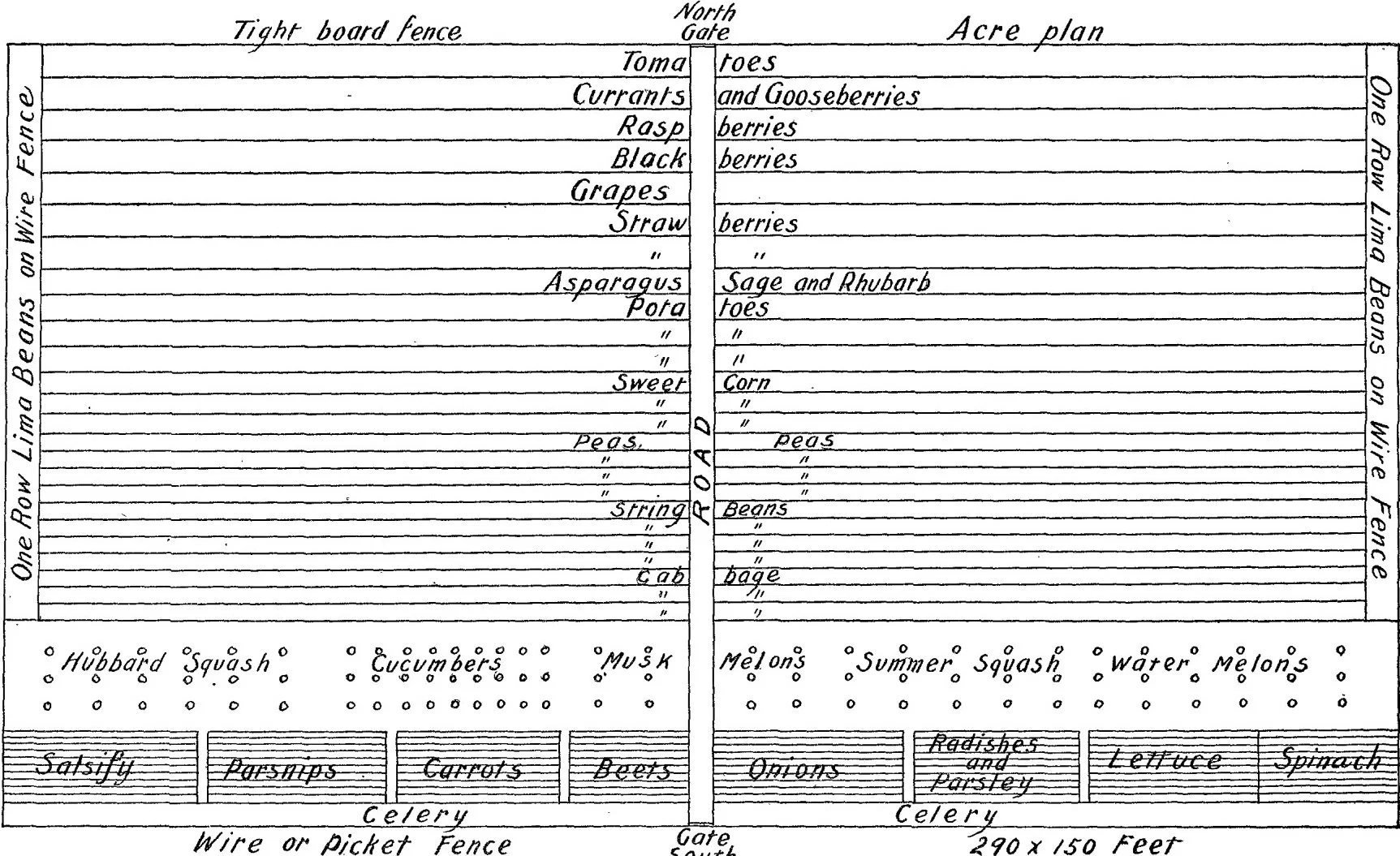
LAST week we gave directions for making a small, temporary garden. Now let us who live on the farm see what we can do for the Lord with a permanent acre-garden.
Tight board fence Celery Wire or Picket Fence North Gate Acre plan 200 x 150 Feet
Where should the garden be situated?—If possible, it should be near the house, as it can then be given more attention. The way many gardens have been neglected is a good reason for hiding them in the corn-field. A well-cultivated garden is an ornament, and something that its possessor can justly take pride in. If it is neglected, and the weeds are allowed to grow, and hide the crooked rows, it is an eyesore to the owner and a byword among the neighbors.
Concerning the nature of the soil and the slope of the ground, but little need be said. The richer the soil, the better. A sandy loam and a southern slope are to be preferred. Have a tight board fence on the north side, if possible, to protect the garden from the cold winds. The other sides may be surrounded either with picket or close wire fence. The fence should be made tight enough to keep out chickens. This acre is to be for the Lord; therefore it should be a pleasure to keep it free from weeds, and in the best condition.
The methods of gardening have advanced during the last fifty years. Horse-power has taken the place of the spade, hand-rake, and hoe; and garden-drills are rapidly taking the place of hand sowing.
For a modern garden of one acre, make the rows longer one way than the other, so it can be easily cultivated with horse and plow. If a horse is used, the tomatoes, currants, gooseberries, blackberries, raspberries, grapes, strawberries, asparagus, rhubarb, and sage may be planted in rows about four feet apart. Sweet corn, potatoes, cabbages, and beans may be planted in rows three and one-half feet apart. If you do not have a horse, and wish to cultivate your garden by hand, all these may be planted one foot nearer together, thus saving considerable land. Melons, squashes, and cucumbers require the same distance under any kind of culture. The narrow rows to the south will have to be tilled by hand. If farm animals are running loose, the Lima beans on the north and south should be changed to some other place; corn should not be planted close to the fence. Celery needs some shade, so it would be well to plant it near the south fence. This arrangement of the garden is not arbitrary, but may be varied to suit the taste.
Many small gardeners raise all their plants; and as it is not yet too late to plant tomatoes and cabbages, let us see what we can do. Fill an open box, about twelve by eighteen inches in size, three fourths full of mellow soil. With the finger or a small stick, make small trenches half an inch deep, and two inches apart. Into these trenches drop ten or more seeds to the inch. Cover and “firm” (press the soil over the seed) with the palm of the hand. The boxes may be carried out-doors during sunny days. Never plant seed of any kind without firming the soil. This is absolutely necessary. Many persons carelessly drop seeds into the ground; and when they do not come up, they begin to accuse the seedsman of selling worthless seed. Much poor seed is sold; but in many cases the real fault is with the careless planter, and not with the seed. If buying seed in small quantities of your grocer, ask him to supply you from some well-known firm, that takes back all unsold seed in the fall, and brings fresh seed every spring. Next week I will tell you how we can set out tomatoes and cabbage plants in the field. This week we will mention only those that ought to be planted early.
Beets may be planted in rows from twelve to eighteen inches apart. Into trenches about one inch deep drop the seed one fourth of an inch apart. Draw the soil over the seed, and firm with the feet. Carrots, parsnips, salsify (vegetable oyster), and turnips may be planted the same as beets. Spinach may be planted according to the directions given last week for planting lettuce.
Almost every person has a way of his own for planting potatoes. Some cut the potato, leaving but one eye to the piece; others leave more; while some of the largest potato-growers claim an increase of thirty bushels an acre by planting the whole tuber. Drop the pieces, or whole tubers if you wish to experiment, in a trench previously prepared, sixteen inches apart, cover with the hoe two inches deep, and firm the soil with the feet. If you wish to fertilize the soil before planting, scatter well-decomposed stable manure in the trench; a wagon-load would not be too much for four rows of this length.
If you wish, you can have a succession of such vegetables as radishes, lettuce, beets, spinach, etc., by planting every two or three weeks until the middle of July. In like manner you can have a succession of sweet corn, beans, and peas.
The following amount of seed and plants will be required for this acre-garden, to keep it cropped as it should be:— Four qts. extra smooth peas; 4 qts. early dwarf wrinkled peas; 1 pkt. later wrinkled peas; ½ lb. spinach; 1 oz. celery; 4 qts. onion-sets; 1 oz. early cabbage; 1 oz. late cabbage; 4 ozs. early beets; 4 ozs. Blood Turnip Beet; 1 oz. carrot, Early Scarlet Horn; 1 oz. carrot, Chantenay or Danvers; 1 oz. tomatoes, early; 1 oz. tomatoes, late, Ponderosa; ¼ lb. radish, Early Turnip; ¼ lb. radish, Long-rooted; ¼ lb. lettuce; 4 qts. beans, Green String; 4 qts. beans, Wax String; 4 qts. beans, Bush Lima; 4 qts. sweet corn, Extra Early Cory; 4 qts. sweet corn, medium; 4 qts. sweet corn, late; 4 qts. cucumbers; 3 ozs. muskmelons; 3 ozs. watermelons; 3 ozs. squash, summer; 3 ozs. Hubbard squash; 1 pkt. sage; 1 bu. early potatoes; 800 strawberry plants; 100 asparagus roots; 20 rhubarb roots; 45 gooseberry bushes; 45 currant bushes; 90 raspberries; 35 grapevines.
Buy your seed in bulk for a garden of this size, or, in fact, for a smaller garden, if you are sure the seed is as good as that in sealed packages. There is usually about half an ounce in the small packets, and the seed so bought costs two or three times as much as if purchased by the ounce or pound.
I have avoided naming the varieties, except such as are known and planted almost the world over, as some varieties that do well in one section would not do well at all if grown in another. ARTHUR F. HUGHES.

Ink-Bottle and Fountain-Pen Filler Combination Offered by Mail

This picture represents an ink-bottle, a fountain-pen filler, and the wooden carrying case for the filler, all in one. And the whole combination, with the ink-bottle full of ink, will be sent by mail, post-paid, to any address in the United States or Canada, for only thirty cents. Everybody who uses a fountain pen, and especially every minister or other person who travels, can not well do without it.
Address Review and Herald, Battle Creek, Mich.

LED BY SATAN.

Sunday, April 23, near Newman, Ga., a negro was taken by a mob of three thousand men, chained to a tree, mutilated, and burned to death, with details too horrible to commit to type. That the victim, although legally unidentified and uncondemned, was guilty of the crimes charged is probably true; but that this disposal of his case, almost paralyzing to one unaccustomed to such acts of violence, will have the desired restraining effect upon others of his class is very doubtful. Such public exhibitions of extreme brutality, such unrestrained acts of undiluted satanic fury, can only result in benumbing the sensibilities of all classes connected with them. “Familiarity breeds contempt.” Familiarity with human suffering in such ways as this will inevitably breed contempt for human woe and agony.
One can hardly conceive how human beings can bring themselves to the point where they can inflict such torments and punishments on their fellow men. Indeed, this case can be accounted for only by the fact that for centuries the perpetrators and their ancestors have ruled the colored race without compassion, and whipped them without mercy, instigated and controlled by the devil himself. Some say these crimes of negroes can be effectually punished only by severe measures of this kind; but it must be evident to all observers that instead of diminishing the offenses, the opposite effect is being brought more and more to public notice. To prove that this is so, we only have to notice the record of crimes in the United States, for 1898. This record, when compared with statistics of former years, shows an alarming increase of crime, especially in the section of country where this event took place. The number of legal executions was one hundred and nine, while the number of persons put to death by lynching was one hundred and twenty-seven. Of these illegal executions, one hundred and eighteen took place in the South, and one hundred and two of the victims were negroes!
Americans may well look to England for lessons in the matter of dealing with criminals. With all the horrors of her foreign and colonial policy, so often justly condemned in this country, Great Britain knows nothing of lynch-law. Crimes like those charged to the victim in this case are also rarely met. The proposal in England to send a commission to this country to protest against lynching is well founded, and by this unfortunate affair has received another incentive to action. It is by no means certain that a committee of “native” Filipinos could not give the so-called “Christian people” of Georgia some good “lessons in civilization,” by showing them how to “take up the black man’s burden.”
It seems impossible that any one can fail to see in this event a striking sign of the times. This statement of Holy Writ can not escape notice: “The devil is come down unto you, having great wrath, because he knoweth that he hath but a short time.” We are told that in the last days wicked men and seducers shall wax worse and worse. It seems that the extreme in this direction has now been reached, and the inevitable conclusion must be that the end is near. With such happenings as this in mind, the desire for the soon coming of Christ is stimulated more by the thought that with that event such scenes as these will cease, than even with the promise of participation in the glories of that better life. H. E. S.

THAT COUPON

Which appeared in the REVIEW of April 4 is still bringing in many orders for the Christian Educator. And it ought to, at only twenty-five cents for a yearly subscription if sent before this offer expires. By special request of some of the State Conference papers, the limit has been extended to May 15, in order to give time to secure additional clubs with the local paper. This combination, if used at once, furnishes a good means of extending the circulation of your Conference paper. This offer will not be continued beyond May 15. The regular price of the Educator is fifty cents a year.

Cyclone Destroys Kirksville and Newtown, Missouri

A CYCLONE swept through Kirksville and Newtown, Mo., and near Ute, Iowa, last Thursday, destroying four hundred buildings in Kirksville, and killing about fifty and injuring about eighty persons.

Nations Build Warships While Talking of Peace

THE government of the United States of America and Asia has forty-eight war-ships in course of construction. And so while the nations may talk of preparing for peace, they actually prepare for war.

American and British Capitalists Win Szechuen Mining Rights

AMERICAN capitalists are associated with British in “mining rights in the province of Szechuen,” China, the concession of which has just been confirmed by the imperial authority of China. It is said that the province will be administered “on the same lines as those followed by Cecil Rhodes in South Africa.” Thus the United States of America and Asia goes on, hand in glove, with the other powers of the East.

Anonymous Gift for Battle Creek College Debt

Some good friend, without giving any name, has sent us five dollars, and the following words: “This is sent in the name of the Lord. Please put into the fund being raised to pay off the indebtedness on the Battle Creek College. From a believer in the third angel’s message.” As no name is given, this is the only way in which the receipt of the money can be acknowledged. And now why should not thousands of other persons all over this country do likewise, only in larger amounts, for all our colleges?

Captain Predicts China's Collapse and Coming Tempest

The captain of the war-ship “Raleigh,” which returned two weeks ago from Manila, says that “the East is big with the coming of great events. I believe China will soon be going to pieces, and that it is our duty to ourselves to be on the spot, and protect our own interests. We must stand shoulder to shoulder with England. . . . Combined with Great Britain, and probably with Japan, we can tranquilly await the bursting of the tempest.” It is worth specially noting that the world expects nothing short of the bursting of the tempest. And indeed that is the only thing to be expected. Are you waiting for that?

H. E. S

THE March number of the Michigan Dairy and Food Commission Bulletin, like the February issue, which was noticed in the REVIEW of April 11, contains valuable matter for all those who take an interest in the question of pure foods. The report of dairy inspections in this month’s issue contains a list of the milk dealers and dairymen in Fenton and Port Huron, with statements concerning condition of cows, stables, etc., that must be serviceable to residents of those places. Following this is another fearless exposure of adulterated food supplies, with the names of manufacturers and dealers; and also an abstract of the State laws enacted to prohibit and prevent adulteration, fraud, and deception in the manufacture and sale of articles of food and drink. The work of this department of the State should receive the moral support of all honest people.

H. E. S

Aguinaldo Appeals to Japan for Intervention

AGUINALDO has appealed to Japan for “friendly intervention” between the Filipinos and the United States of America and Asia. Why not? When the Cubans were fighting Spain for independence, the United States intervened (in not altogether a friendly way at last); why should not some power now intervene when the Filipinos are fighting the United States for independence? Why should not the United States welcome now what she herself did two years ago and since?

NOTICE

IN response to a call from Australia, to attend the Australasian Union Conference, which convenes at Cooranbong, New South Wales, the latter part of June, I expect to leave this country, May 4, on the steamer “Aorangi,” from Vancouver, British Columbia, and in all probability will be gone during the entire summer; hence all communications in reference to the work in North America should be addressed to Elder L. A. Hoopes, secretary of the General Conference, who will have charge of the general correspondence during my absence.
GEO. A. IRWIN, Pres. Gen. Conf.

LET ALL TAKE NOTICE.

On and after June 1 the address of the International Religious Liberty Association will be Room 760, Monon Building, Chicago, Ill. We take this means of calling the attention of those interested in the work of the association to the removal of the office and headquarters, instead of writing a personal letter to each member. Copy or cut out this address and preserve it. Allen Moon, Pres.

You have reached the end of this edition.

Review and Herald · May 2, 1899