Your ShelfYour Projects

Signs of the Times, Vol. 37, No. 11.

Gifts of Christ
Earlier text: The Sabbath Through the Ages

Why the Preparations to Fight?

The Spirit of War
WHY war and war preparations? Why do enlightened nations so deeply engage in the great strife of war preparation? Why train more and more men, expend more and more money, build more and larger battle-ships, devise and invent and manufacture and multiply more death-dealing guns, more powerful explosives, and lade the people with more unbearable burdens?
Folly and madness, isn't it? So utterly inconsistent that men do not attempt to solve the mystery, but go on in the preparation for Armageddon. In the light of what men are constantly doing, in the light of what governments have done in arbitration, the wretched inconsistency of the course of the nations is indescribable. Yet it goes on.
As illustrative of this, read the article in the "World's Work" for February, entitled, "England and Germany: Will They Fight?" by William Bayard Hale, who is personally acquainted with the facts he sets forth. He has visited England and Germany. He has talked with Englishmen and Germans, high and low, officials and common people. Everywhere the same thought is expressed: We want no war. We want no war with Germany. We want no war with England. No one of responsibility wants war. No political party desires war. All this is everywhere expressed. English officials visit Germany, and are warmly received and highly honored, and vice versa. King and kaiser — uncle and nephew — meet, embrace each other, declare eternal peace, while their respective governments are preparing for war at a rate unprecedented. Rapidly as England has built Dreadnoughts and cruiser battle-ships, Germany bids fair to be her equal, and on present plans will be England's superior in ships of modern design, equipment, and effectiveness, in three years.
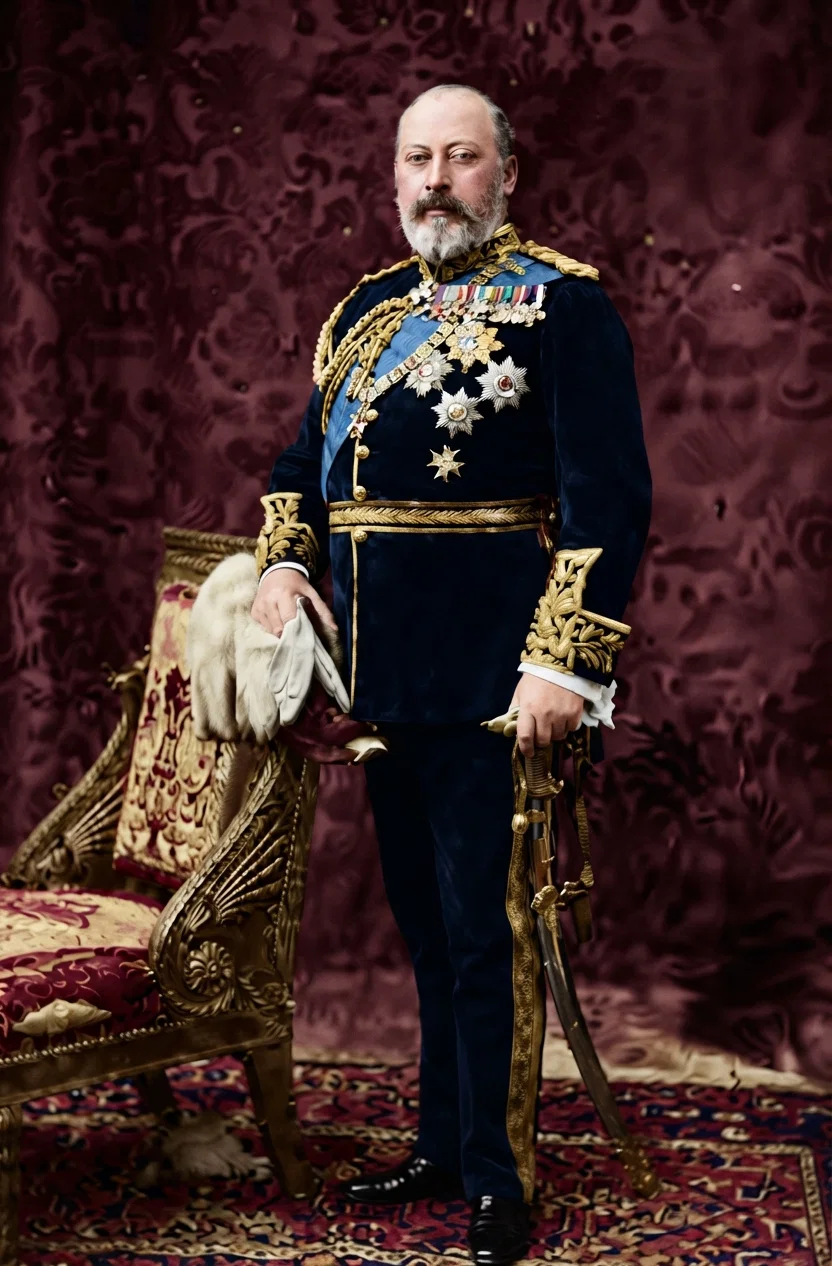
H. B. M. Edward VII
H. B. M. Edward VII
Germany's army is far superior to England's home army; and it is thought that in case of war with Germany, England's colonies and dependencies would prove a source of weakness instead of strength, because they would scatter her navy, and some of them, like India, might prove a fearful menace. Viewed in the candid light in which Mr. Hale has considered the matter, Germany seems altogether England's superior. It seems to us, however, that he has not taken into account the tremendous aid England would receive from her loyal children in Australasia and Canada.
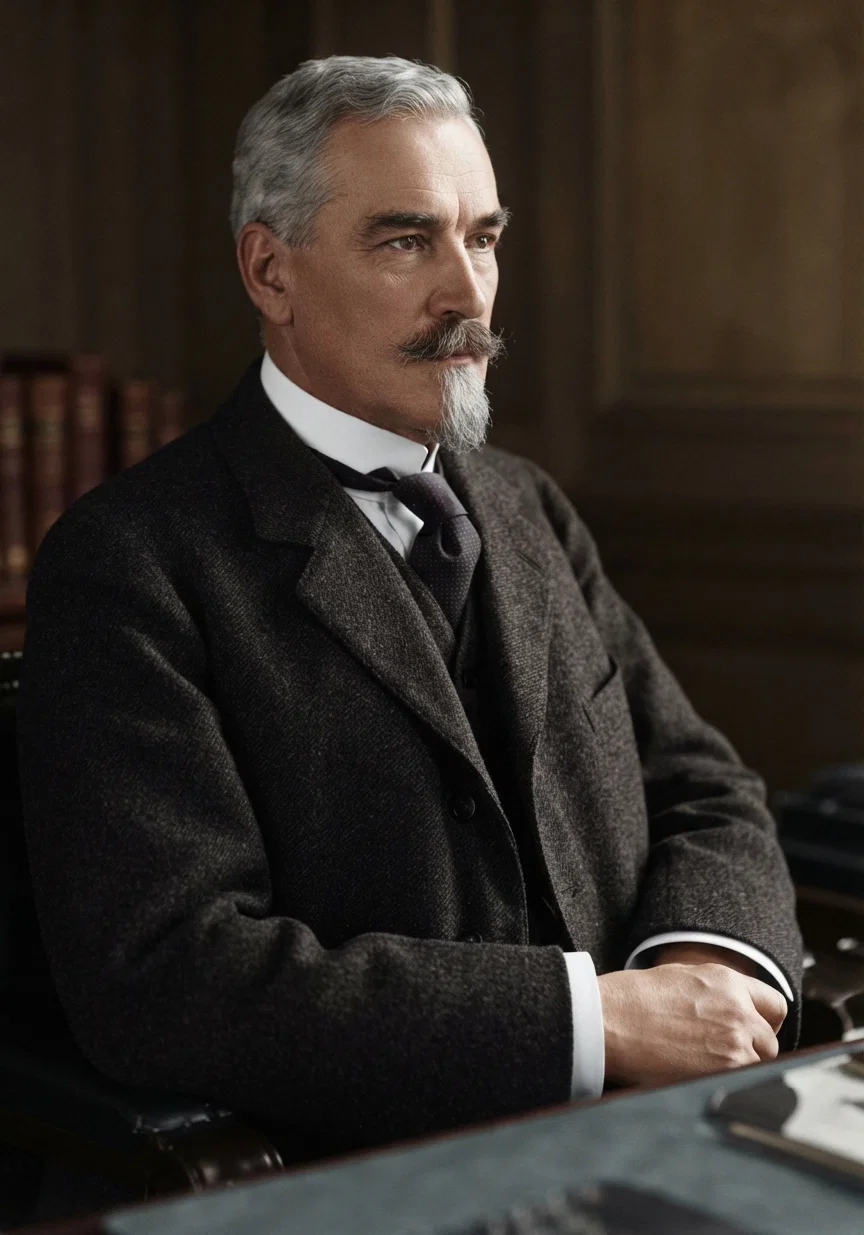
The German Chancellor, Dr. Theobald von Bethmann-Hollweg
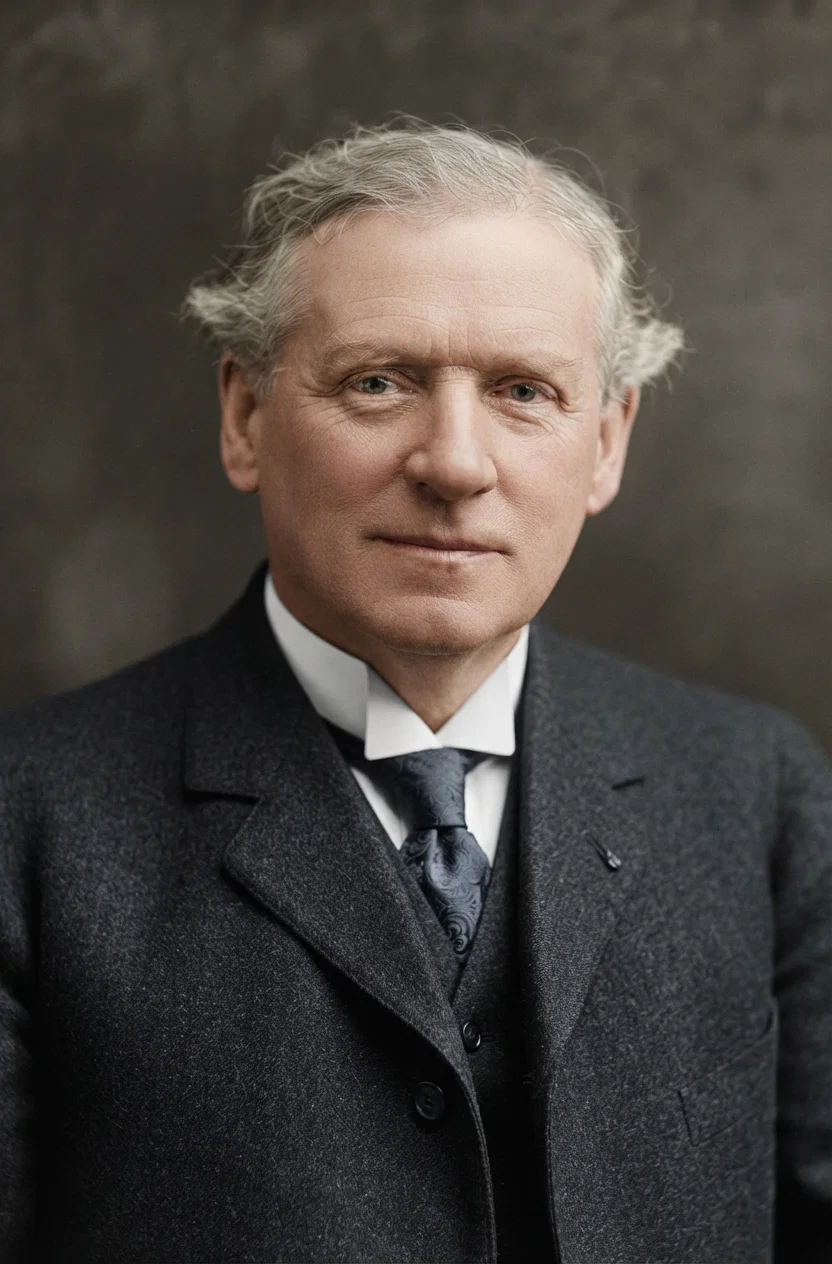
The Rt. Hon. H. H. Asquith, Prime Minister of England
But no one could imagine that such a war could be fought out to a finish between two such mighty empires, and not involve other
powers. Mr. Hale feels this. He says in closing:
"It is almost quite certain that the first half of the conflict, the half which all the rest of it would be a struggle to atone for, would be a bolt out of the darkness on a surprised enemy — a mere moment of agony while the world's heart stopped beating. Then might follow — but who dare prophesy the course of an epic conflict?"
Every other writer who has reviewed the situation sees in it world conflict. Just how the other great powers would line up, it is hard to say. Would France unite with England? Would Russia cast her hopes with the British lion, or the German eagles? Austria would doubtless stand with Germany. Which way would Italy turn? Would the yellow men of the Orient become involved? Would England's present ally of the Rising Sun Island Empire aid her in her conquest for existence, or would Japan's astute statesmen see that the wisest course to pursue would be to let the big giants of the West exhaust themselves, and then that she and China could avenge their slights of centuries from the hands of the western powers? Then, too, what would the United States do when her great neighbor to the north was vitally involved? No one knows.
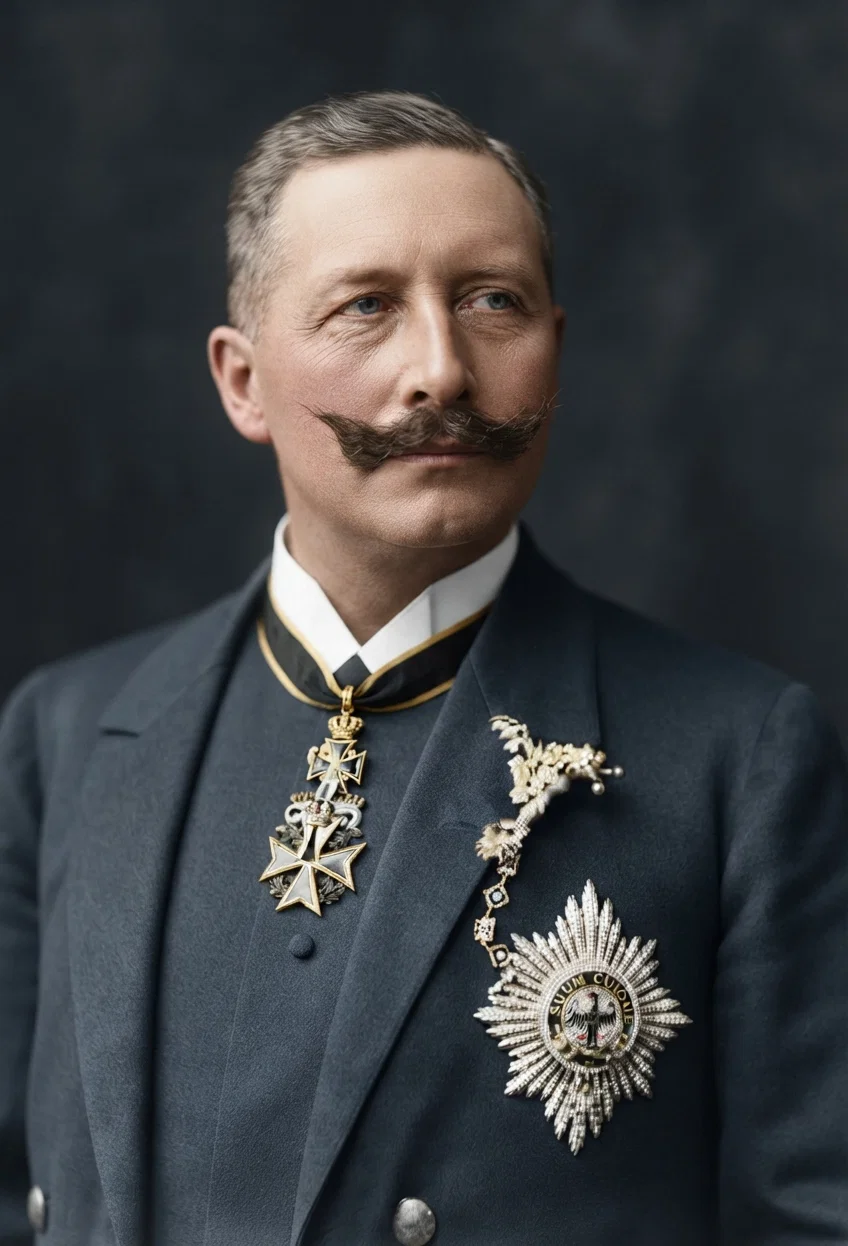
The Emperor of Germany, Wilhelm II
Yet with all the antipathy against war existing in both Great Britain and Germany, Mr. Hale thinks that war is inevitable; that the very fact that it is continually talked of in both nations, is bound to bring it about. He says:
"The most serious possible ground for fearing that Germany and England are about to fight is — the belief of the people of Germany and England that they are about to do so."
There is another reason, given eighteen centuries ago by the prophet of God on the Island of Patmos, who dared to prophesy the epic war and its outcome. We know that many will not consider it worthy of second thought; but it is in the Old Book which foretold the division of empire of which England and Germany were once constituent parts, and many other events which have passed into record as great salient facts of history. It gives a far more reasonable reason than Mr. Hale can give apart from that Book, as to why the nations, related races, Christian professedly, Protestant nominally, should go to war when neither nation nor the people of the nation desired so to do.
This visible world is not the entire universe, nor are material men and kings and thrones and armies all that have to do with shaping this world's kingdoms and policies. There are invisible armies, powers for evil and good, who influence men. Jesus Christ, as Michael the Archangel, with His holy angels, met the revolted hosts of spirits under the leadership of Lucifer, and defeated them, and holds that victory for every soul who will grasp it by faith. Rev. 12:7-11. But the councils of nations and kingdoms who are not submitted to God, spirits of evil influence and control. Even so they influenced apostate kings of old. 1 Kings 22:20-23. In these last days when the world never needed peace so much, when it never talked peace so much, and yet knew its vital element, righteousness, and its Source, Jesus Christ, so little, Satan will send his deceiving spirits for the subversion and destruction of the blinded governments of earth. Read:
"And the sixth [angel] poured out his bowl, . . . and I saw coming out of the mouth of the dragon, and out of the mouth of the beast, and out of the mouth of the false prophet, three unclean spirits, as it were frogs: for they are spirits of demons, working signs; which go forth unto the kings of the whole world, to gather them together unto the war of the great day of God, the Almighty. . . . And they gathered them together into the place which is called in Hebrew Harmageddon." Rev. 16:12-16.
THERE IS THE SECRET OF THE WORLD PREPARATION FOR WAR. It is of the devil; and the devil has sent his messengers into all the earth to stir up the nations to suicidal strife. Thus speaks Jehovah through another prophet:
"Take this cup of wine of wrath at My hand, and cause all the nations, to whom I send thee, to drink it. And they shall drink, and reel to and fro, and be mad, . . . all the kings of the north, far and near, one with another; and all the kingdoms of the world, which are upon the face of the earth: and the king of Sheshach [confusion, Babylon, Satan, Lucifer, Isa. 14:4, 12] shall drink after them. . . . Ye shall surely drink. . . . Thus saith Jehovah of hosts, Behold, evil shall go forth from nation to nation, and a great tempest shall be raised up from the uttermost parts of the earth. And the slain of Jehovah shall be at that day from one end of the earth even unto the other end of the earth." Jer. 25:15-33. See also chapter 4:19-26.
While men and nations are raising the false cry of hypothetical, baseless peace, God's prophet reveals the real spirit, or animus, of the nations in the last day:
"Proclaim ye this among the nations; prepare war; stir up the mighty men; let all the men of war draw near, let them come up. Beat your plowshares into swords, and your pruning-hooks into spears: let the weak say, I am strong. Haste ye, and come, all ye nations round about, and gather yourselves together: thither cause Thy mighty ones to come down, O Jehovah. Let the nations bestir themselves, and come up to the Valley of Jehoshaphat [Jehovah judgeth]; for there will I sit to judge all the nations round about. Put ye in the sickle; for the harvest [Matt. 13:39] is ripe: come, tread ye; for the winepress is full, the vats overflow; for their wickedness is great. Multitudes, multitudes in the valley of decision: for the day of Jehovah is near in the valley of decision." Joel 3:9-14.
Burke it, suppress it, ignore it as men will, the great conflict is coming. Men will not have the peace of God in righteousness; Jehovah leaves them the only other alternative, destructive war.
But His work is not yet done. As long as there is one soul who will be saved, God will hold the winds of bottled strife, stirred by the demons of hell. Rev. 7:1-3. When all of His — and that may be you, reader; "God is no respecter of persons" — are gathered unto Him in righteousness, then will the strife come. And the day draweth on apace.
— —

Tobacco and Degeneration

THE Rev. Mr. McIntyre, a Methodist pastor in Chicago, is quoted as saying: "This nation is destined to be a Spain; and the pity of it is, there is nothing can be done about it. The tobacco habit has gotten such a hold upon the people, that it is going to be resistless; not only men and boys, but women and girls are going to be increasing users of tobacco, and especially the cigaret."
This was uttered some time ago, and we see the fulfilment of his prediction, for tobacco-using is increasing, and the sad thing is that men and women and girls are forming the habit. We sympathise with the Anti-Cigaret League and the societies that are working against the evil, and we are glad in God of all that they can save from the foolish habit; but appetite and companionship are tremendously strong factors in pulling down the mass.
Lucy Page Gaston declares truly that "the cigaret is only the beginning, the door-step to vice. It is the seed of the drink habit, of impurity, of the most horrible practises that are prevalent to-day; and when you see the innocent cigaret in the hand of a boy, I want you to think to what it may lead. I visited a cigaret factory in New York, and stood by machines that turned out three hundred cigarets in a minute; and as I heard that click, click, click, click, click, it seemed to me it was drip, drip, drip, drip, drip, the life-blood of the nation. I was in one factory that turns out six million cigarets a day. You have no idea of the tremendous growth of this thing, and how it is sweeping this land."
— —

Germany Ready

In an article in "The Nineteenth Century" the writer, Herr Charles Tuchman, while vehemently denying that Germany has any ambition to attack Great Britain, declares, nevertheless, in response to the question, "Now is Germany ready for war?"
"Most assuredly she is. And I do not hesitate to aver that if war were declared to-morrow, Germany's intimate knowledge of this country, and this country's ignorance of Germany, would astonish even those bellicose critics of naval preparedness who are continually crying Danger. But having said this much, I wish to show that altho Germany is ready for war with any country, war was never further from her intentions. . . . Is it not the duty of a great nation like Germany, surrounded as she is on one side by Russia, on the other by France, and on the sea by England, to prepare herself for any emergency, including that of war?"
In response to the question, "Is Germany clearly desirous of annexing new lands?" he replies:
"Of course she is. How could she be otherwise with a population of seventy millions which in time to come will, with an increase of one million annually, be nigh unto one hundred millions confined within narrow limits? She is like a boiler on the point of bursting with somebody sitting on the safety-valve. She finds England in her way everywhere. Germany must find an outlet for her surplus, just as Japan is finding an outlet for her people; but whither can she go?"
Mr. Tuchman disavows any idea of attack upon any of Great Britain's dependencies, but expresses another opinion as follows:
"The day is not far distant when Asia Minor will fall, figuratively, to pieces. It would be a contretemps to the liking of Germany. Who could prevent annexation in that direction when Germany would have only to walk through Austria in order to plant her flag on the desired spot?"
Surely the outlook does not forebode peace.

Mystery of Comets

Mystery of Comets.—Prof. E. L. Larkin, of Mount Lowe Observatory, as well as other scientists, tells us that the mystery of comets is still to be solved. All sorts of theories are set afloat regarding them. There are certain things that are known and well known, but there are a great many other things that are not known at all. Professor Larkin thinks that were it not for the planets no comets would return at all. They would dash around the sun and that would be the last; but the planets hold them to the solar system, or at least many of them. There is great difference regarding the nuclei of comets. In some, the nucleus seems to be a solid body; in others, stars have been seen through them. The magnitudes of these nuclei or heads of comets range, we are told, from 40,000 to 100,000 miles in diameter. The comet of A.D. 1811 was 1,200,000 miles in diameter. That is with a diameter a half larger than that of the sun, and yet the matter in it was of such small amount that the planets were not disturbed by its approach. Sometime we will know very much more of these things than at present. Then we can look upon them with immortal eyes.

An Ominous Sign

SIGNS of weakness and old age are very apparent in the churches, says Rev. J. Morgan Gibbon. "The very worst sign I see in the churches as I go up and down the country is not that the congregations have dwindled, or the revenues fallen, but that passion has so largely gone out of men. The spirit and the fire have cooled. We hear a sort of invalid talk — the kind of thing you hear in invalidish lodging-houses at the seaside. People will not go to church, because it is so cold, so dark, so wet! Nobody expects anybody to make sacrifices. Religion has become very reasonable, very tolerant, very broad, and it has the world's benediction. The world never said nicer things about the church than it does to-day. Men call us broad-minded and progressive. . . . Let us turn away from this worthless benediction of men, and seek the benediction of the Master, and at His feet learn a wiser, braver, stronger, manlier Christianity. Let us cease to be hypochondriacs." — Present Truth.

The United Kingdom’s Most Common Names

In the United Kingdom of Great Britain and Ireland, according to the last census, there are in England 18,404,421 souls. Of these the Smiths number 253,000; Jones comes next with 242,000; Williams third with nearly 160,000; and then follow, in the order named, Taylor, Davis, Brown, Thomas, Evans, Roberts, Johnson. Smith also leads in Scotland, while in Ireland the name Murphy stands at the head. Smith stands sixth in Ireland. The army of Smiths in the whole United Kingdom numbers 330,900.

Accidents

Accidents.—On February 11 the French Trans-Atlantic Company's steamer General Chanzy was driven on the reefs of the Island of Minorca, in the Mediterranean Sea, in the wildest storm which for forty years has swept that sea. Lives lost, 156; saved, one, and he a maniac.—January 29, in England, on the Brighton Railway, 7 killed and 30 injured; the first serious wreck on English railways since 1907. It was caused by a mid-train coach leaving the rails.—It is said that it will cost $7,000,000 to repair the damages caused by washouts on the Harriman lines alone west of Ogden.—Fifteen thousand pounds of powder exploded at the Trojan Powder Works, near San Leandro, Cal., February 17, killing 8 men, and fatally injuring one. Many others escaped with slight injury. Most of the buildings burned. Loss about $50,000.

Shiloh: the Man of Sorrows

Chapter III—Seeking the Messiah
THE rising sun had scarcely appeared above the hilltops of Bethlehem, and the shadows in the valleys were still heavy, when the family of Sylvanus was astir.
"Come, Bar-jona," said Sylvanus, "didst thou not journey from Bethsaida to learn somewhat of the Messiah? Come, then, we will seek the young Child this day. Mayhap we shall find Him still in Bethlehem. If not, we will go to Jerusalem."
"Hand thy father his staff, Perpetua, my child," said Esther; "and mind, Sylvanus, that thou return by set of sun."
"Surely, my Esther; the storm of last night is gone, and I think the day will be fair; so thou shalt see me ere the red sun hideth his face. Heber, lad, thou shalt keep the sheep this day without thy father. Young David kept his flocks alone in these same hills and valleys; and look you, the son of Achbor will be near you; he keepeth watch by day while Achbor sleepeth."
"Verily, my son," exclaimed Eliah, as he offered the parting salutation, "verily, if thou bring me news of Shiloh when thou returnest thou shalt receive warm welcome."
"List, Sylvanus," cried Esther, following her husband and young guest to the outer gate, "if thou goest at all up to Jerusalem, thou shouldst visit the aged Simeon; thou knowest his house is near the temple."
"Good, my Esther; it shall be even as thou sayest," returned Sylvanus, as they hurried down the street.
Straight to the one inn in the little town they made their way. This structure was a small one-story building entirely of limestone, which bore even then the marks of great age.
"Canst thou tell us of Joseph the carpenter of Nazareth?" they inquired of Jason the host.
"Truly," replied the man; "there was scant room at the inn, and I believe the carpenter of Nazareth hath his lodgings with Cleopas, the merchant. I was indeed loath to turn him away with his young wife when first they came from Nazareth to be taxed, for verily they be of the royal house of David."
"It is well; Bar-jona and I will visit the house of this merchant." Saying this, they turned from the inn, and soon paused before the door of one of the better houses of Bethlehem. In answer to their knocking, a maid opened the door, and led them into an inner room.
"How art thou, Abigail?" inquired Sylvanus of the merchant's wife. "Dost thou know the whereabouts of Joseph the carpenter? doth the family of Nazareth still bide with thee?"
Bar-jona bent his head eagerly to listen to the answer:
"Nay, friend Sylvanus, they have departed. Last night in the darkness they left us. Last evening before departing," continued the woman sociably, "they gave me this chain of pure gold, for they had many ornaments of great value. See! is it not fine enough for Cæsar's bride—and more than enough to pay me for their food and lodging?" and Abigail displayed a beautiful necklace of Persian workmanship.
"Yet," she continued, "the wife of the carpenter was plainly clad, as were her husband and little Babe."
"But had they no visitors while they tarried here?" questioned Sylvanus, glancing at Bar-jona, with a nod.
"Visitors? O yes; some princely strangers from the Far East. They came one day, and I saw them bow before the Babe, which slept in its mother's arms. But I trow, Sylvanus, they could not have been of the seed of Israel, for they worshiped Him as a god, and gave Him many gifts. I wondered, tho my heart beat joyfully, when I heard them call Him Shiloh—the Messiah—the King of Israel. They abode with us for some time, but they too have gone again to their own country, even yesterday."
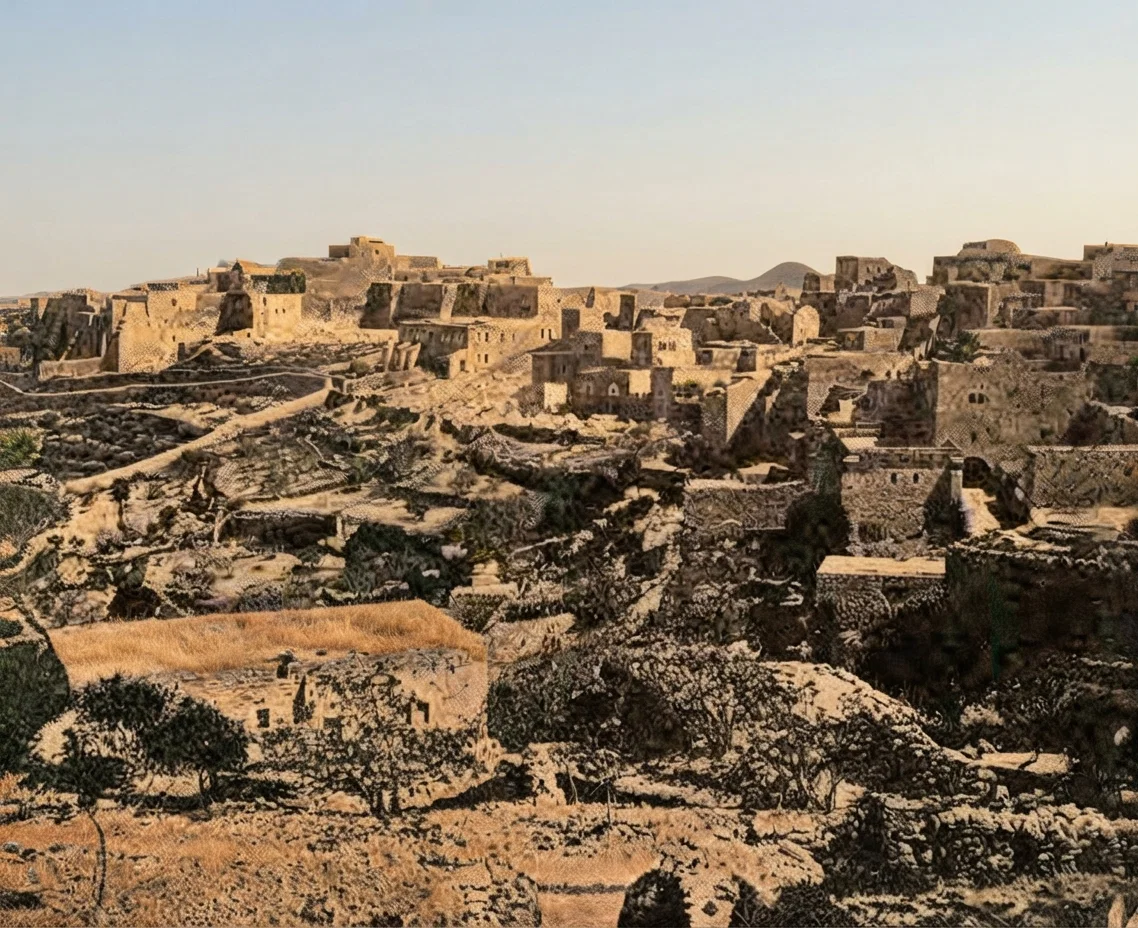
Modern Bethlehem — the city which of old was the human birthplace of Him "whose goings forth have been from . . . the days of eternity."
"Believest thou not that He is the King of Israel—our long-promised Saviour?" interrupted Bar-jona impulsively.
"Verily, I did believe, and my good husband also, until I went but yesterday up to Jerusalem, and conversed with the learned Jozarus, the high priest. He saith that when Messiah appeareth, He will come in splendor; and he exhorted me to study the prophets, for they do prophecy of the glory and power of His coming."
"Suppose thou tellest this daughter of Israel what thou sawest in the fields of Bethlehem, and of the singing of the heavenly messengers, and of the words they spake to thee," exclaimed Bar-jona, turning his face appealingly toward Sylvanus.
"Surely thou forgettest, my young friend, that every ear in Bethlehem hath heard the tale already," answered Sylvanus; "but the words of Jozarus, the high priest, have more effect than mine."
"Nay, say not so," corrected Abigail courteously, while a crimson blush overspread cheek and brow; "only thou knowest that the business of the shepherd is with sheep, but the work of the priest is the study of the prophets."
"Thou sayest well," agreed Sylvanus; "but we must not forget that if any, howsoever wise, speak not according to the law and to the prophets, it is because they have no light in them."
"But is it not quite fitting that we pay heed to the words of our teachers, those who better understand the meaning of the prophets? But of a truth," continued the woman, "the story which the strangers told was indeed wonderful. They declared that a shining star led them all the way, and that it hung over our roof as they entered. Indeed, I myself noticed a strange light in the heavens the same hour we gave them lodging. Some of my neighbors saw it with me; but as we looked, it melted away."
"Verily it was the Star of Jacob," declared Bar-jona.
"But even this also I asked of Jozarus," replied the woman; "and he assured me it was but some wandering comet, or peradventure it might have been the afterglow of the sun already set, or mayhap it was the shining of the fires the shepherds sometimes build at night upon the hills hereabout; so spake the high priest at the temple yesterday."
Sylvanus only sighed as he replied quietly: "'There shall come a Star out of Jacob, and a scepter shall rise out of Israel.' But," he continued, "sayest thou that the carpenter of Nazareth departed in the night?"
"Yes; when we wakened in the morning, behold, they were gone, and we have been much troubled thereat."
"Whither went they, thinkest thou?"
"I know not for a certainty; to their home in Nazareth as I suppose, and by way of Jerusalem, where they perchance still tarry."
"Then must we also journey thither," replied Sylvanus, rising.
In a large upper chamber in Jerusalem, lying upon a couch in the center of the room, was an old man, while two or three attendants passed noiselessly about the apartment.
The draperies were pushed aside, and the lattice was open, that the cooling air might fan the broad, white brow of the dying prophet. The old man's silvery locks lay upon his shoulders, and his lips moved in prayer: "I thank Thee, O God of Abraham, that Thou hast verified Thy promise toward me, Thy servant, for that mine eyes have seen Thine Anointed. And now, Lord, what wait I for? Now lettest Thou Thy servant depart in peace."
Even before the prayer was finished, the attendants ushered two visitors into the room, the elder in the dress of a shepherd, the other, of a fisherman. The dark eyes of the dying man lit up with joy.
"What, Sylvanus, is it thou? and this young man—"
"Bar-jona, a fisherman of Bethsaida. He cometh up to Jerusalem that he may bear more certain word back to his godly father. For they of Bethsaida have heard somewhat of the rumors concerning the Messiah's birth. Tell us, O Simeon, prophet of the Lord, what thinkest thou? Is the time almost fulfilled when Shiloh must appear?"
"Listen, my sons. When last the flowers of springtime covered the hills and valleys of Benjamin, I lay, even as now, upon this cot. My attendants said that I must die. By study of the prophets I was certain that the Messiah must soon be born; and I desired to live, so that I might behold Him. To this end I prayed that I might live. One night, when death seemed very near, I prayed again more earnestly. The windows of my chamber opened toward the holy temple, as ye see them even now. The full moon rode high through the cloudless heavens, for it was the time of the Passover. The gold and silver vine over the entrance of the temple, emblem of the prosperity and fruitfulness of Israel, the workmanship of cunning men, glinted and glimmered as the rays of the moon bathed it with mellow light. That night the heaven of heavens seemed very near. And as I opened my mouth in prayer, while I was yet speaking, the angel of the Lord stood by me, and the messenger of the Most High spake unto me: 'Fear not, O Simeon, for God shall put His Spirit upon thee, and thou shalt not see death until thou hast seen the Lord's Messiah,—the Anointed.' Then the angel departed from me, and I slept. In the morning I arose, and my strength came into me. When my attendants came to me in alarm, I said unto them, 'I shall live, and not die; behold, I shall see the Lord, even the Messiah, in the land of the living.'"
"But tell me, O Simeon, seer of the Most High, hast thou in very deed behold Him—the Shiloh of Israel—the holy Babe—didst thou behold Him?" cried Bar-jona, while an expression of intense eagerness lighted his youthful countenance. Then he continued impulsively: "We go to seek Him, Sylvanus and I, even now. Tell us, hast thou seen Him? Where is He, that I may hasten unto Him?" and the young man arose as if to depart from the room hurriedly.
"Trouble not thyself, young man," cried the prophet, mildly. "Come here by my side, that I may lay mine hand upon thy head; for already mine eyes wax dim; my days are numbered, and I must sleep with my fathers. But first I would tell thee, Sylvanus, thee and the young man, what the Lord hath graciously shown me; for I know ye are true Israelites."
"Fear ye not the rage of Herod; for behold, the young Child and His parents have departed into the land of Egypt. Even thus said the angel unto me. Verily, Sylvanus, thou knowest the words of Hosea the prophet,—'Out of Egypt have I called My Son;' and it shall be fulfilled the second time when the cup of the iniquity of Herod is full, and he be dead who seeketh the life of the young Child. Then shall Shiloh return from the land of the Pharaohs, and shall dwell in Nazareth of Galilee. For even as God called Israel from Egypt, so shall He call this His Son."
"Verily, O Simeon," exclaimed Sylvanus, "thou speakest with assurance concerning the Messiah. But dost thou know that already the priests and the rabbis of Jerusalem have rejected Him? They scorn alike the testimony of us—the shepherds who have seen Him—and of the magi."
"But tell us, tell us, O thou seer," interrupted Bar-jona, "when sawest thou the Babe? For behold, thou art old, and thy strength faileth. Perchance thou sawest Him in a vision of the night."
The pallid face of the man of God lighted up with a holy radiance. "I will tell thee, Bar-jona, where and when I beheld Him who is the Desire of Israel. As soon as I had received the assurance of the angel that I should not see death until I had seen the Christ, I began more earnestly and carefully than ever in my long life to search the books of the prophets, that I might know of a surety when the time was fulfilled."
"I know not that the prophecy was so definite," said Bar-jona, moving a little nearer the aged man. "I would that thou wouldst make it plain unto me, O Simeon; for surely the words of the prophets must be fulfilled tho the heavens fall."
"Thine ambition is a laudable one, and thy words are true, young man. Hear me; I will read the words of Daniel, the holy seer, tho mine eyes are dim," replied Simeon, taking from beneath his bolster a roll of parchment, and indicating the place with his trembling finger:
"Know thou and understand, that from the going forth of the commandment to restore and to rebuild Jerusalem, unto the Messiah, the Prince, shall be seven weeks and threescore and two weeks.' My sons," continued the aged speaker, producing another roll, "my sons, it was about four hundred fifty and three years ago, and in the seventh year of Artaxerxes, since this great king of Persia gave command to Ezra, the priest of the Most High, to restore and to rebuild this city, even Jerusalem; for it was then laid waste and desolate. Seven weeks of years, and threescore and two weeks, are sixty-nine weeks of years, or four hundred eighty and three years which must pass away from the time Ezra received this command, which, my sons, is here given in the Chaldaic tongue, exactly as it was penned by the Persian king. Four hundred eighty and three years from that time must pass away before Shiloh, the Messiah, is anointed. Of this time, four hundred fifty and three years have already passed, leaving still thirty years before the anointing."
"But, Sylvanus," continued the speaker, "thou knowest that no Israelite is anointed, or set apart, for the ministry of the Most High, until he be thirty years old. Hence, the Messiah, the holy Babe, must have been already born, or the promise of Jehovah faileth."

IN THREE DAYS

Overland Limited

TAKES YOU

To Chicago

ACROSS GREAT SALT LAKE AND HIGH SIERRA BY DAYLIGHT
Luxurious High-class Equipment Electric Lighted Throughout
Pullman Drawing-room Stateroom Vestibuled Sleeping Cars Careful and Attentive Dining Service Parlor Observation Car with Library and Cafe Ladies' Reading Room Gentlemen's Smoking Room Daily News Bulletins Latest Papers and Magazines

SOUTHERN PACIFIC

Help Wanted

WE are desirous of securing the services of ten graduated or trained nurses at once. Apply St. Helena Sanitarium, Sanitarium, Cal.

California Medical Missionary and Benevolent Association

Annual Meeting

THE thirteenth annual meeting of the California Medical Missionary and Benevolent Association, for the purpose of electing four or more members of the Board of Directors, and transacting any other business that may properly come before the meeting, will be held at Sanitarium, Napa County, Cal., on Wednesday, March 9, 1910, at 12 o'clock M.
L. M. BOWEN, President. H. E. RANDALL, Secretary.

Notice

THE next class in the St. Helena Sanitarium and Hospital Training School for medical missionary nurses will be organized Monday, April 4, 1910.
Owing to the large number and great variety of cases that flock to this institution for relief, and the wide experience thus offered the students both in surgical and general hospital nursing, the course is especially strong from a practical missionary standpoint. In addition to the opportunities for missionary work at the sanitarium, the San Francisco Dispensary, which the institution has taken over, affords training in city mission work. The institution has also undertaken to open up mission work in China the present year, thus giving those who desire, a definite foreign mission field for which to prepare and upon which to enter when their course is completed.
Twenty-five consecrated young men and women, whose desire it is to enter the work for the sake of fallen humanity and not for profit, are wanted to join this class.
There are also classes in Bible, history, and music for the regular workers.
Send for the training school catalog by addressing: Dr. H. F. Rand, superintendent, or Mrs. S. J. Whitney, secretary, Sanitarium, Napa County, Cal.

Good Homes for Sale

Two good farms for sale in a rich section of the Northwest adjoining the new Cedar Vale Academy, conducted under the auspices of the Upper Columbia Conference of the Seventh-day Adventists. May be exchanged for city or suburban property in California. Prices and terms reasonable. For further information, address J. W. Shields, Viola, Idaho.

SEWING MACHINES AND PIANOS

I am agent for the Singer and Wheeler & Wilson machines and also a very fine, high grade piano. I am selling to our people at a great reduction. Will deliver any place in the United States. If interested, write me.
S. H. Colvin, Turlock, Cal.
Continue reading: Free