“The drink of flowers,
Distilled in bowers,
Is just the drink for you.”
“When a person is thirsty, he wants a drink, and I’d like to know what he is to drink,” said Ned to Cousin Flora.
“Well, Ned, you have answered your own question, if you only knew it.”
“How?”
“You said, ‘When a person is thirsty, he wants a drink,’ and of course you mean that you want to get rid of your thirst by drinking something, don’t you?”
“Well, yes; what then?”
“The thing you drink must take away thirst; and there is only one thing in all the world that quenches thirst, and that is water. The cleaner, the purer, it is, the sooner it quenches thirst. Many drinks are used to quench thirst, but some only add to it. I know what you are thinking of. I saw that large blue and gold sign down by the new store, with that foaming glass pictured on it. And I saw quite a number of boys standing around, and peeping in, and talking, and edging off and coming back. Why do you suppose that sign, ‘Thirsty? Take a drink!’ is there?”
“Because hot weather is here, and we are all of us thirsty and looking for something to drink.”
“Yes, and I’ll tell you this; that sign will deceive many, especially boys; but you don’t need to be one of them.”
“Why?”
“Because you know that water quenches thirst, and beer only makes one more thirsty.”
“I wonder why that is.”
“Because water was made by Him who made the human body, and he always makes everything to match. Water is a natural drink, and thirst is a natural condition of a human being, especially on a warm day; and one just fits the other.”
“I suppose that is so.”
“Of course it is. Water cools the mouth and the throat, as it passes into the stomach. It dissolves the food, and it enters the blood, carrying nourishment with it, for you know that our blood is about three fourths water. When you drink it, your thirst is gone. It does its work; so you see you have answered your own question—a drink, a natural drink, quenches thirst.”
“Do not other drinks, like beer and wine, quench thirst?”
“Just think a minute; when your thirst is quenched, it is really gone, and you don’t want to drink any more; is not that so?”
“Yes, that’s so.”
“But when you drink beer or wine, you always want more and more and more; what does that prove?”
“That it does not quench thirst, of course; but why is that?”
“Because of the alcohol that is in these drinks; and one of the dangerous and most peculiar properties of alcohol is that it creates a craving or unnatural desire for itself.”
“I don’t see why that is.”
“No more does any one else, but we all know that it is a fact. Alcohol is the product of decay, and hence a poison, and all poisons have their peculiar properties, and that is one of the properties, or effects, of alcohol.”
“What a lot of sense there is in natural things!”
“Of course; now tell me why anything with alcohol in it is not a natural drink.”
“It was not made a part of our bodies, like water.”
“Good! go on.”
“It smells bad, and it tastes bad, and it burns the mouth and throat, and does not quench thirst.”
“Very good! what else?”
“It makes one sick, and more thirsty, besides hardening the food that ought to be dissolved.”
“There, that will do for to-day. Now go and tell all you have learned to all the boys you know, and you may win out ahead of the new sign. Who knows! You can try.”
Oakland, Cal.
What the Spirit of Sunshine Means
“How’s business, Eben?”
The old man was washing at the sink after his day’s work.
“Fine, Marthy, fine.”
“Does the store look just the same? How I’d like to be there again with the sun shining in so bright! How does it look, Eben?”
“The store’s never been the same since you left it, Marthy.” A faint flush came into Martha’s cheeks. Is a wife ever too old to be moved by her husband’s praise?
For years Eben and Martha had kept a tiny notion store, but one day Martha fell sick and was taken to the hospital. That was months ago. She was out now, but she would never be strong again—never more be partner in the happy little store.
“I can’t help hankering for a sight of the store,” thought Martha one afternoon. “If I take it real careful, I think I can get down there. ’Tisn’t so far.”
It took a long time for her to drag herself down-town, but at last she stood at the head of the little street where the store was. Suddenly she stopped. Not far from her on the pavement stood Eben. A tray hung from his neck. On this tray were arranged a few cards of collar buttons, some papers of pins, and several bundles of shoe-laces. In a trembling voice he called his wares.
Martha leaned for support against the wall of a building near by. She looked over the way at the little store. Its windows were filled with fruit. Then she understood. The store had gone to pay her hospital expenses. She turned and12hurried away as fast as her weak limbs would carry her.
“It will hurt him so to have me find it out!” she thought, and the tears trickled down her face.
“He’s kept it a secret from me, and now I’ll keep it a secret from him. He sha’n’t ever know that I know.”
That night when Eben came in, chilled and weary, Martha asked cheerily the old question: “How’s business, Eben?”
“Better’n ever, Marthy,” was the cheery answer, and Martha prayed God might bless him for his sunshiny spirit and love of her.—Selected.
Hide Trials Under Your Mercies
“If you want to get your aches and trials out of sight, hide them under your mercies.”
The Kindly Heart
A few days ago I was passing through a pretty, shady street where some boys were playing at baseball. Among their number was a little lame fellow, seemingly about twelve years old—a pale, sickly looking child, supported on two crutches, and who evidently found much difficulty in walking, even with such assistance.
The lame boy wished to join the game, for he did not seem to see how his infirmity would be in his way, and how much it would hinder the progress of such active sport as baseball.
His companions, very good-naturedly, tried to persuade him to stand at one side and let another take his place; and I was glad to notice that none of them hinted that he would be in the way, but they all objected for fear he would hurt himself.
“Why, Jimmy,” said one of them at last, “you can’t run, you know.”
“O, hush!” said another—the tallest in the party; “never mind, I’ll run for him,” and he took his place by Jimmy’s side, prepared to act. “If you were like him,” he said, aside to the other boy, “you wouldn’t want to be told of it all the time.”
As I passed on, I thought to myself, “That boy is a true gentleman.”—Selected.
Advancement in the Australasian Union Conference
By Ole Andres Olsen
O. A. OLSEN
We have surely entered a most solemn, yet exceedingly interesting time. There can be no doubt that we are living in the very closing scenes of this world's existence. The most interesting and inspiring of all evidences is the remarkable rapidity with which this closing gospel message is now reaching out to all parts of the world.
The territory of the Australasian Union Conference is immense, composed as it is of the commonwealth of Australia, New Zealand, the South Sea Islands, the Malay Peninsula, and the East Indies; divided into seven organized conferences — New South Wales, Victoria, New Zealand, Queensland, West Australia, South Australia, and Tasmania, also four mission fields; namely, (1) North Queensland, including all the northern territory; (2) the Eastern Polynesian Mission, composed of the Society, Cook, Marquesas, Tuamotu, Gambier, and Austral groups, also Easter Island and Pitcairn Island, with many others; (3) the Central Polynesian Mission, composed of the island groups of Fiji, Samoa, and Tonga; (4) the Malaysian Mission, taking in the group of islands known as the East Indies. Only the Eastern Polynesian Mission, of these mission fields, has as yet been organized, but at the first opportunity the others will also be organized.
The work is making progress in all our organized conferences. The past two years have been prosperous seasons for Australia and New Zealand; and every year witnesses a substantial advancement in the work of the message. Unity and harmony prevail among the workers, and they all manifest the fullest harmony with the message and the organized work.
In the purchase of one hundred sixty-eight acres of land for an intermediate school and a sanitarium, New Zealand has taken a forward move. The location is a favorable one, near Cambridge in the Waikato district, one hundred miles south of Auckland. They have begun building operations, and expect to be in readiness to open school at the beginning of next year. No steps will be taken to start the sanitarium until the school is fully established.
West Australia has also made a move toward a school. One hundred acres of land, very favorably located, was turned over to the conference for a consideration of one hundred pounds. They are already beginning school in a small sanitarium; but this will be a consideration for the future. The place — Heidelberg, thirty miles from Perth — is also a most excellent location for a small
Publishing and Printing Institutions
The removal of the printing and publishing work from North Fitzroy, Melbourne, to Warburton, has been successfully accomplished. With this step we have also banished all commercial work, and are devoting all our energies to our denominational work. It is a matter of note and considerable interest that our own work is rapidly on the increase — so much so that we have taken much more of the North Fitzroy plant to Warburton than we expected to, and the force is kept at labor to its utmost. Our book sales are steadily on the increase.
At the present time we are closing out the last remains of the Echo Publishing Company — the name of the office at North Fitzroy — preparatory to vacating the building.
The Avondale Press is a department of the Avondale School, and is in a very prosperous condition. They have only recently moved into their new building, which was much needed. The Press gives employment to eighteen of the students. They are at present issuing four journals — the Union Conference Record, an eight-page weekly; the Australasian Good Health, a sixteen-page monthly; and the Rarotongan paper, Tuatua Mou, also an eight-page monthly. The printing of “Christ Our Saviour” in the Malay has just been completed by the Press. “Daniel and the Revelation” will soon be ready in the Rarotonga language.
Sanitarium and Health Work
The Wahroonga Sanitarium continues to enjoy a steady patronage. The blessing of the Lord is manifested in a marked manner, and an excellent spirit prevails in the institution. The outside premises, including the orchard, have been much improved.
Since the departure of the Drs. Kress, we have given much careful, prayerful thought and study to the readjustment of the work and the situation at Wahroonga. This means much more than those unacquainted with the situation can fully appreciate. We shall work hard, and hope for the best, trusting in God for guidance.
The health branch of the work in South Australia is now making an advance move. For a number of years Brother A. W. Semmens has successfully carried on treatment rooms in the city of Adelaide. These have not only been successful, but have been a great blessing to the work. We have for some time been on the lookout for an opening for a small sanitarium, as the effort there now demands such a step. Recently a property located in the hills, thirteen miles from the city of Adelaide,13near a railway station, at an elevation of over one thousand feet, has been purchased by a capitalist, who now offers it to us for sanitarium purposes at a rental. The conditions are favorable, and the owner also offers to make such changes and alterations as shall make it what we require.
The brethren in New Zealand have decided to place the property of the Christchurch Sanitarium on the market. As soon as this is done, treatment rooms will be opened in Christchurch, and the sanitarium will be located in connection with the school, near Cambridge, on the North Island. This is the most favorable locality for a sanitarium in all New Zealand.
We have three health restaurants — one in Sydney, which has been in operation for some years; another in Melbourne, opened only last December; and a small one recently started in Wellington, New Zealand. The one at Sydney had rather an adverse experience at the time of its commencement, but during the past two years has been very successful. The one in Melbourne has begun with excellent prospects. The patronage has exceeded our highest expectations.
The Avondale School
The past year has been the best in the history of the school, from every standpoint. The enrolment exceeded two hundred. The spiritual interest was most excellent, and the work accomplished was very satisfactory. Financially, the school made a gain of over eight hundred pounds. This does not include what came in from the sale of “Christ's Object Lessons.” The present year of the school has started well, with a larger attendance at the beginning than at any previous time.
All the enterprises — such as the Avondale Press and the food factory — connected with the school, are doing well. The farm has also brought in good returns the present year. At a late meeting of our Sanitarium and Benevolent Association Board, in conjunction with the school board, it was decided for the school to take over the Avondale Health Retreat, and make that also a department of the school.
The young people of our various conferences, except Victoria, have taken it upon themselves to assist in paying the wages of the native laborers. The Victoria young people are paying the wages of Sister Skadsheim, in Java. Those in New South Wales are paying the wages of Brother Joseph Mills, our teacher in Singapore.
We are sincerely grateful for the blessings the Lord has granted to us, and for the steady growth that is seen in all the branches of the work in this field. We shall, by the help of the Lord, put forth every effort to press forward, that this growth may continue to increase more and more. We have started out in our missionary campaign, which we hope may take hold of our people in all the conferences. We have begun holding special institutes for educating the work ers and our people generally, and hope to bring this matter into every church and among our scattered believers in the various conferences and mission fields.
Strathfield, N. S. W.
Blaming the Children
CHILDREN in the household multiply household cares; there is no doubt about that. But is the fact of their presence enough to account for any and every failure to have things just as they should be in the household administration? Or does the apologetic explanation “the children, you know,” offer a very tempting and convenient shield for some of our own shortcomings? To be sure, many a well-laid plan of a parent has been demolished by the duty of giving the children, for the time, first claim on one’s attention. But that does not mean that all attempt at planning for other duty-doing in the household should be abandoned. Because it is harder, with the demands of the children, to do what we should do, is only an added reason for doing it,—for the children’s sake as well as for our own.—S. S. Times.
A Bible
A RUSSIAN Bible colporteur, who works at a great railway station, went into a carriage full of people, and said, “Who wants a book of Holy Scriptures, a Gospel, a Bible?” A man replied in a loud voice, scornfully, “Who reads the Bible nowadays?” There was silence for a little, and then a Jewish woman came across to the colporteur and asked if he had the Sacred Writings in Hebrew. He showed her the Hebrew Pentateuch, and she bought it. Then two other persons bought Russ’ Testaments. Then another asked about a complete Bible in the Russ language, saying that he had heard that a new and cheap edition would soon be ready, and that he was waiting anxiously for it. After talking with him, the colporteur turned to go away, but yet another person stopped him and bought a Testament. Thus was answer given to the scorner.—Selected.
Shaw on Drugs and Self-Criticism
GEORGE BERNARD SHAW, an English author, has been at the center of London literary life for a quarter of a century, and has observed “that all the drugs from tea to morphia and all the drams from lager beer to brandy, dull the edge of self-criticism, and make a man content with something less than the best work of which he is soberly capable. He thinks his work better, when he is really only more easily satisfied with himself.”
Malamulo Mission
By Joel C. Rogers
The New Name
JOEL C. ROGERS
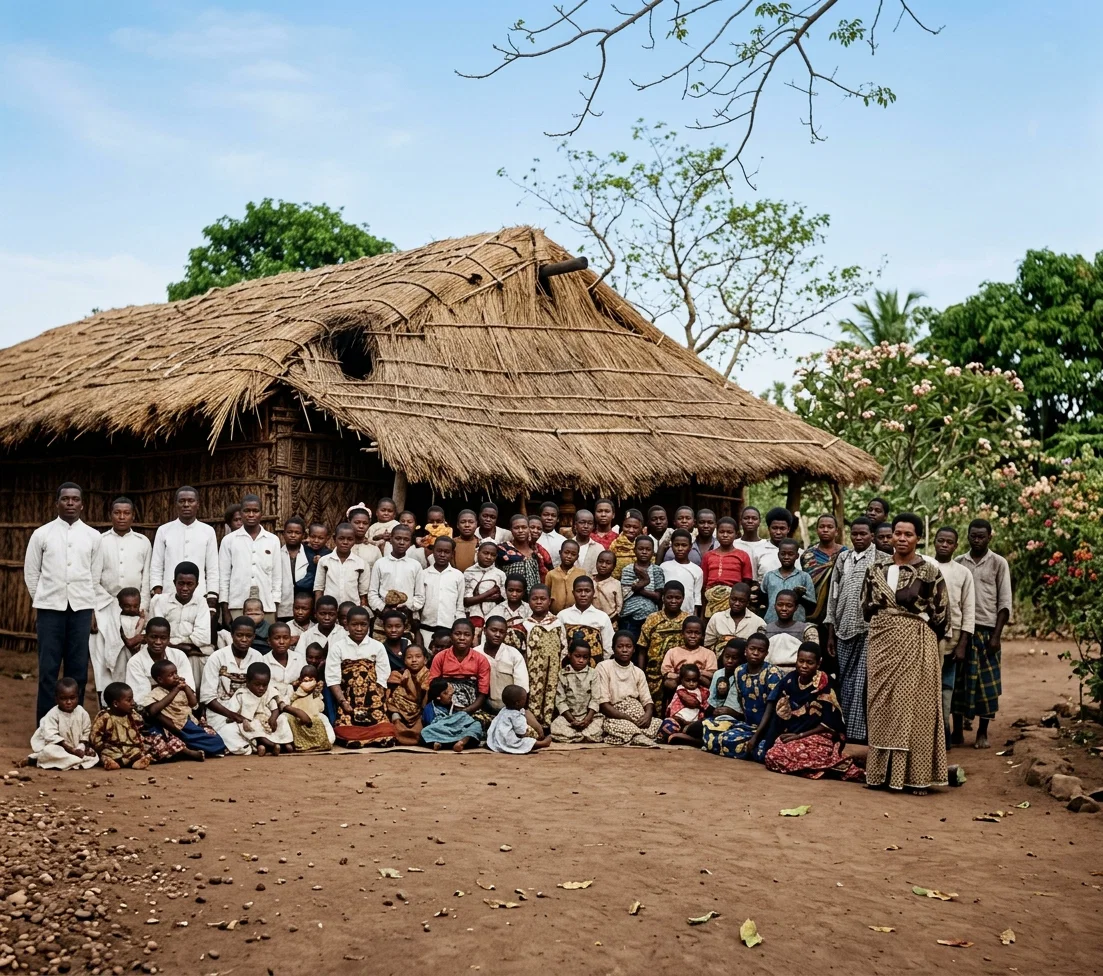
When our mission in Nyassaland was first opened, it was called Plainfield Mission. That was in the year 1902. It is situated at Cholo, British Central Africa.
THE SCHOOL AT THE MALAMULO MISSION
This mission had been conducted by the Seventh-day Baptists for three or four years, and was named after their headquarters at Plainfield, N. J.
On reaching this field, I learned from the natives that among them this mission is widely known as the Sabbath Mission, in distinction from the missions where Sunday is observed. It occurred to me that some name indicating a prominent feature of our faith would be better than its present name. One well understood by the natives would also be desirable.
Taking the New Testament in the Nyanja,—the universal tongue of British Central Africa,—I looked for words on the coming of Christ, the Sabbath, the commandments, etc. The single word which seemed best to meet the requirements is Malamulo. It means the commandments. This word is found in Rev. 14:12: “Pano pali chiriro cha oyera mtima, cha iwo akusunga malamulo a Mulungu, ndi chikhulupiriro cha Yesu.”
The phrase malamulo a Mulungu means the commandments of God. The same word “malamulo” is used both for the verb and for the noun of command, also for the word “law” in all its forms. Thus it is one of the most common words in the Bible. It is found in the native New Testament more than two hundred and thirty times. The Old Testament, in which it is so much used, is now being translated into the native tongues of British Central Africa. The same word is used for civil laws and commands. We earnestly asked God to give us a name for our mission which would be favorably received by the people. We believe he has given us the right name.
We find some things to encourage us as we learn more of this land and the people. Brethren and sisters, you are supporting this mission with your money. We are thankful for such support. We are about to open a training-school for native teachers. Our Cholo school consists mostly of small children with their fathers and mothers. We must continue this school, and open new ones like it. But our urgent need just now is teachers trained in the truths of the message. We are having calls for teachers frequently. We must have a new station for training them. Our present station reaches but one tribe, and that an inferior tribe. Our main station and school for teachers must be in the heart of the country, so it will reach the other tribes which are the superior ones. We need much wisdom for opening this new school. Will you please pray for these definite things?—
That the Nyassa people may inquire after this message;
That wisdom be given us in opening the new school;
That native young men who will make good teachers be given us;
That God will help us to learn the language quickly;
That our health may be preserved for the work.
Cholo, British Central Africa.
C. H. PARKER
By C. H. PARKER
Fiji
C. H. PARKER
It is some time since I have written, but that is not because my interest in reporting has lessened. The only trouble is to find the time. There is so much to do, and there are so few to help do it!
Our Fiji Mission council was held June 12-18. There were thirty-five delegates and one hundred and forty-two other persons present. It was a precious season. There was a full attendance at each meeting.
Special interest was manifested in the early morning meeting, and in the Bible study at 9:30 A. M. At these services the spirit of prophecy and the rise and progress of this denomination were studied. Every heart responded to a full faith in the organization and the Testimonies. These studies were conducted by Elder J. E. Fulton, and were clearly and forcibly presented.
We took our native brethren upon all our committees, and they were a real help to us. When the reports of the committees were read before the council, the utmost confidence was manifested in them. After general discussion by all, they were passed without a dissenting vote. Every measure was calmly studied before being passed. The prevailing spirit in our sessions was so different from that which is manifested in the14councils of the other denominations at work here, that it was the comment of all. Not a ripple passed over the calm waters of our meeting.
It was voted to inaugurate a campaign similar to that on “Christ’s Object Lessons,” for selling our book, “Tukutuku no Veigauna”—a translation of part of “Great Controversy.” I never saw more enthusiasm manifested. This same spirit was seen when we discussed the problem of carrying the truth to all the other islands of this group. The brethren were willing to give their native teachers to the work beyond, and take care of themselves. There was no question that God was directing the deliberations of our council, and that his Holy Spirit was brooding over it.
Elder O. A. Olsen, president of our Australasian Union Conference, planned to attend, but was prevented from coming by unavoidable circumstances. The labors of the vice-president, Elder J. E. Fulton, were very much appreciated. Brother and Sister Thorpe, of the Tongan Mission, were present, besides our own laboring force. We now have ten native workers here.
This good council closed with a consecration service, and a number gave themselves anew to the service of the Master. The brethren left for their different island homes with songs of praise upon their lips. One could almost imagine that that scripture in the thirty-fifth of Isaiah, last verse, was being experienced: “And the ransomed of Jehovah shall return, and come with singing unto Zion; and everlasting joy shall be upon their heads: they shall obtain gladness and joy, and sorrow and sighing shall flee away.”
Everything looks encouraging for a prosperous year in the work for this people. Our only fear is that the many calls for labor can not be supplied, and the hearts that are now warm and prepared for the truth will grow cold and indifferent. Pray for us and the work here.
Buresala, Levuka.
GEO. TEASDALE
By GEO. TEASDALE
Java
GEO. TEASDALE
This is a fine country, the best I have ever been in. So far we have found the climate all that we could desire, a little warm at times, but never so hot as it is in Cooranbong, N. S. W., in the summertime. The weather is never cold; indeed it varies but little the year round. When rain is falling in the mountains, or when there is a little more moisture in the atmosphere than ordinarily, then the thermometer will fall a few degrees. It generally stands between eighty and ninety, with a fall of a degree or two during the night. This is reported to be the wettest country in the world, and I would not be surprised if it were; at least, a country that had more rain would scarcely be able to comprehend the fact that the waters which were under the firmament were divided from the waters which were above the firmament. The rain, however, is not so objectionable as it is in cold countries, and we do not seem to notice it. Indeed, the comparative coolness is attributable to it, so we are glad of it.
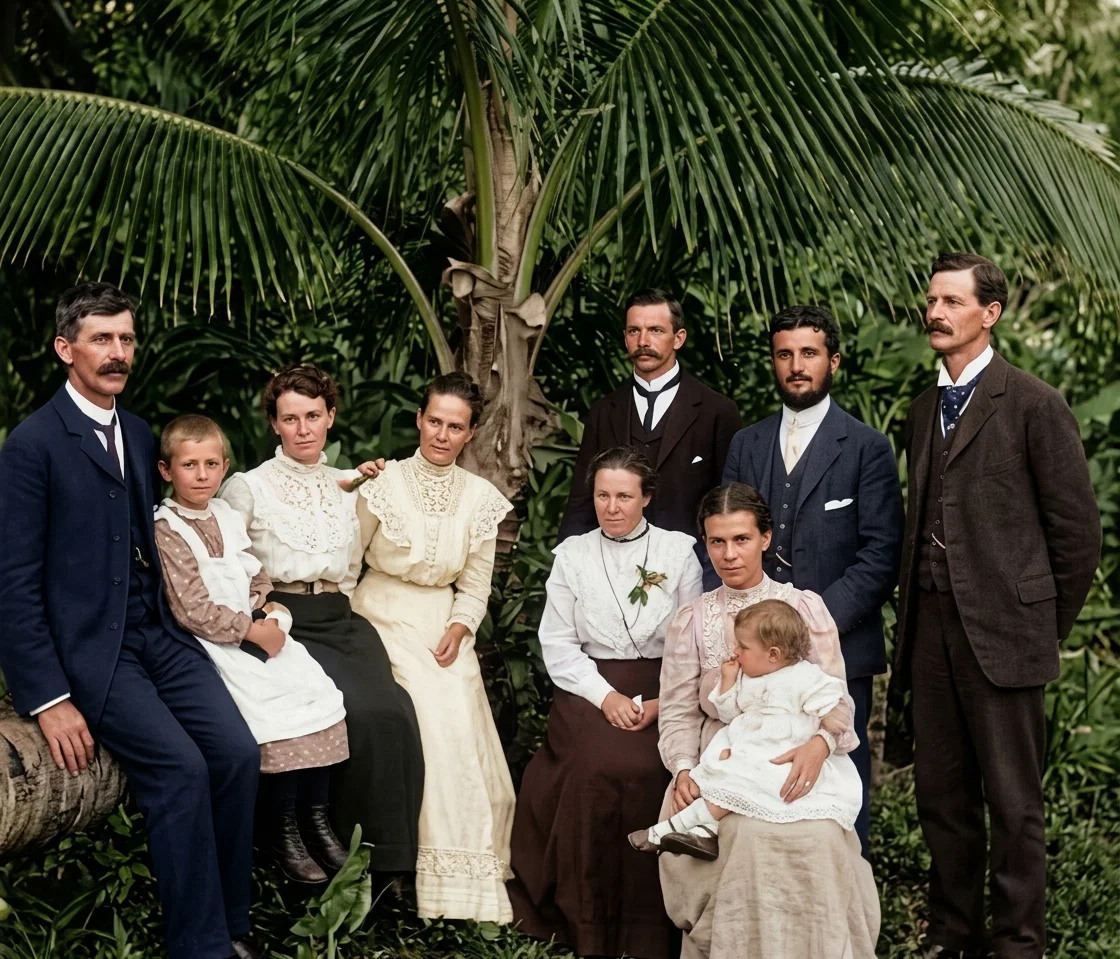
WORKERS IN ATTENDANCE AT THE FIJI MISSION COUNCIL
The country districts of Java are beautiful, and the whole island is exceedingly fertile. Although only half the size of New Zealand, it supports a population of thirty millions, and exports a large amount of produce besides. Fruits are abundant, and such fruits as people in cool climes never dream about. Some of these we have not yet learned to like, and there are some which we are sure we shall never care for. One advantage this country has over almost all other tropical countries is a fairly good supply of vegetables, which are grown in the mountains of the interior. They do not have the flavor of vegetables grown in colder countries, yet they are very acceptable, and help to vary the monotony of our menu. Living is rather costly, especially in the cities.
The large cities are not very nice places in which to live, and I should be glad if we could make arrangements to live in the country. So far, however, our work is in the town, and it is impossible for me to move out of it, because, unless we go about fifty miles away, the place is so thickly populated and so low-lying, and consequently damp and unsanitary, that it is better to live in the city. The houses are built very near one another.
There are swarms of natives in Java. Even in the country they are everywhere; and the highroads are full of them wherever we look out of the train. In the town they are dirty, and not nearly so respectful as they are in the country districts. Their habits are unmentionable. When traveling in the country in the train, one can tell by the odor when nearing a campong (village) or a market-place. The natives are good-natured, and content to work for little, except when they are working for a person who is a stranger to the country; then their wants are never satisfied. There are a great many Chinese here, most of whom are natives, and are highly civilized. They are the nicest class of people here, and it is among them we expect to begin our work.
The Dutch government holds the natives in strict subjection, and is very careful about the admission of strangers. Life and property are more secure than they are in many of the civilized countries of Europe, and there is practically no poverty, as we understand it in other countries. The natives generally are very poor, and may not possess enough clothing to cover them, or have the semblance of a house to live in, yet they never suffer from want, as millions do in other places. Twopence [four cents] will keep a native for a day; and if he has a mind to be economical, it will suffice him. But as long as he possesses money, he is not economical.
Foreign missionaries have to obtain a special permit from the government before they are allowed to operate. It is now about four months since we sent in our request, and we have not received our desired permission yet. Twice I have had to appear before the dignitaries here to answer questions, and then my answers have had to be sent to the capital. So we do not know yet whether or not we shall be allowed to remain here. The Methodists from Singapore are operating a mission in Batavia, and have contemplated starting here. Two denominations are not allowed to work in the same district, so if we obtain permission here, it will shut them out. Dutchmen can go to work without all this trouble, and they have many advantages which foreigners do not enjoy, especially Englishmen and Americans. It is surprising how well Adventism is known here, and what a strong prejudice there is against it in the minds of many. However, this is not so pronounced as in other countries, and I feel sure that the Lord has a number in Java who will accept the truth.
The prospects for the work here are very good, much better than we had expected. When we came, but one woman was keeping the Sabbath. Now her husband is with her, and they are getting along very nicely. They are English Eurasians, and came from Singapore, where they learned the truth. The Eurasians seem to possess the puerilities of both the Europeans and the Asiatics, and few of the strong qualities of either. There are thousands of them in this part of the world. Those of Dutch descent seem to possess sturdier qualities than15do others. We are hoping that many of them will accept the truth in this country, and form a strong nucleus for a church in the Dutch possessions in the East. Already one aged man and his wife are keeping the Sabbath through reading, and we know of quite a number of others who are interested. Our stock of literature is limited, and we can convey intelligence to them in no other way as yet. In order that a person may work to advantage with them, it will be necessary for him to be able to speak the Dutch language. Most of them do not care to speak to a European in the Malay, as an undue familiarity with that language is too suggestive of one half of their parentage. But this is not the case with all. A man, a Catholic who edits the Malay paper here, comes to the house twice a week, to help us with the Malay. We love him, and hope that some time he may be one of us. He is a very sensible man, and kind-hearted. He has discontinued the use of tea, etc., and is trying to stop the use of tobacco.
You would be surprised to know how many languages nearly every one can speak in this country. The Eurasian editor speaks English well, also Italian, and has a working knowledge of French, besides Malay, Javanese, and Dutch. A young Chinaman who comes to our house for lessons speaks five languages besides English. He is now taking lessons from me, and I am also giving him lessons from the Bible. We hope that he will accept Christianity as the result. We are putting our best efforts on the Malay, and in the course of a few months expect to be able to speak quite a little in that language. We ought to have a Dutch worker here to labor for the Dutch-speaking community now, while the prejudice is comparatively small, and while there is a desire on the part of many to hear. It is the best opening I have ever seen, and my constant regret is that I can not fill it. I would begin to learn Dutch immediately, but I find one language is quite as much as I can manage at once. If we could have a young couple, or a man from Holland, here with us to labor, I am sure we should soon have a good company.
In a few weeks we expect to start a school for the Chinese, to teach them English. They are anxious to learn, and are willing to pay a good price for it. We will make this the basis for missionary operations, as soon as we know the Malay—the language they speak.
Sourabaya, Java.
The Southern California Camp-Meeting
By H. W. Cottrell
One of the most remarkable camp-meetings I ever attended, in some particulars, was the one held at Los Angeles, which closed September 2, having continued three weeks. The camp-meeting was preceded by an institute, which also continued three weeks.
The camp was situated on a ten-acre plat of land just outside the city limits. Two lines of electric cars ran directly to the camp, which made it very convenient for the traveling public. The camp was beautifully laid out with broad avenues and streets, and the usual directory was found convenient for locating the twelve hundred people who were residents in the cotton city composed of three hundred one family homes. There were also five large tents for public service, and one for a dining hall.
The principal auditorium was sixty by one hundred forty feet, seated to its utmost capacity, and on Sabbaths, and usually in the evening, it was filled to overflowing.
The attendance from the city during the evenings and on Sundays was fair for such occasions. A deep impression was made upon the minds and hearts of the people through the preaching of the word, and I trust that fruit of the effort put forth may be seen in the kingdom of God.
The evening and Sunday services were given up almost entirely to the consideration of the special features of the great message that we are commissioned to bear to all people in this generation.
While the spirit of the Master was present in every service, the Sabbath services were especially marked by the Spirit's presence in the conversion of souls, reclaiming backsliders, and sending deep conviction to the hearts of believers that the time had fully come when each should be entirely surrendered to the Lord, and wholly consecrated to him for immediate and active service. Forty were buried with their Lord in baptism.
There were special services held each day with the German and Spanish-speaking people; also with the young people, intermediate, primary, and kindergarten divisions. There were about forty German persons present, and the services for them were in charge of Elder A. Schlotthauer. The Spanish services were under the general direction of J. F. Blunt and Mrs. Augusta S. De Angeles. The Spanish attendance averaged from fifteen to twenty-five.
The young people's work was directed by Profs. H. G. Lucas, E. S. Ballenger, and J. L. Kay. There was an average of one hundred fifty in this division. There were one hundred seventy-five in the intermediate department, and they were in general charge of Mrs. Dr. Leadsworth. There were eighty in the primary division, and they were in charge of Sisters Ruth Kane and Letta Hibben. There were one hundred little people in the kindergarten in the care of Mrs. Geo. Miller.
All the instructors did their best, under God, in the work assigned them, and the Lord greatly blessed their efforts.
A course of study was conducted the last week of the meeting on the subject of Bible organization, in which the people manifested marked interest, and were greatly profited. Certainly no line of thought presented created a greater awakening among our people than the one on order among the people of God.
Dr. Lillis Wood-Starr, assisted by other physicians and nurses, gave instruction daily on health and temperance.
Besides the ministers of the local conference, there were present, all or a portion of the time, Elders I. H. Evans, W. T. Knox, M. C. Wilcox, W. C. White, H. G. Thurston, A. Schlotthauer, and F. R. Rogers, and Brethren H. H. Hall and J. R. Ferren, and the writer. Brother H. G. Lucas was set apart by ordination to the sacred work of the gospel ministry.
Elder G. W. Reaser was re-elected president of the conference; H. H. Winslow was elected secretary and treasurer.
The remainder of the executive committee is about the same as last year. Pledges and donations were secured to be applied as follows: Fernando Academy, $2,500; $150,000 fund, $700; Sabbath-school collection, $700. Through the public sale of the Bible Training School, $230 was provided for the Southern Missionary Society, to be forwarded through the regular channel. The conference voted $1,500 of its surplus tithe to the foreign mission treasury, $500 of which is to be applied to the work for the colored people in the South, conducted by the Southern Missionary Society, under the direction of the Southern Union Conference, and $2,000 more was also voted conditionally to the mission work.