JUST across the Hudson River from Upper New York City there is a new kind of park. It is called the Palisades Interstate Park. It has thirty thousand acres of land. It has cost about $8,000,000, and though unfinished and comparatively little known, it gave more than 1,500,000 people a good time in the open last year. It is one of the most democratic and truly American institutions in all the United States. There is not a commercial concession in it, yet it attracts and provides accommodations for every one, from the underfed East Side boy to the automobile tourist accustomed to the best that money can buy.
Athletic fields are equipped for every outdoor sport. Every one, no matter where he lives, who wishes to live the life of the open, is welcome at this park and all on equal terms. And so well is it conducted, so well behaved are the folks who go to it, that last year only one person was arrested.
MARGARET JENKINS.
Urban Gardens Boost the Nation's Food Supply
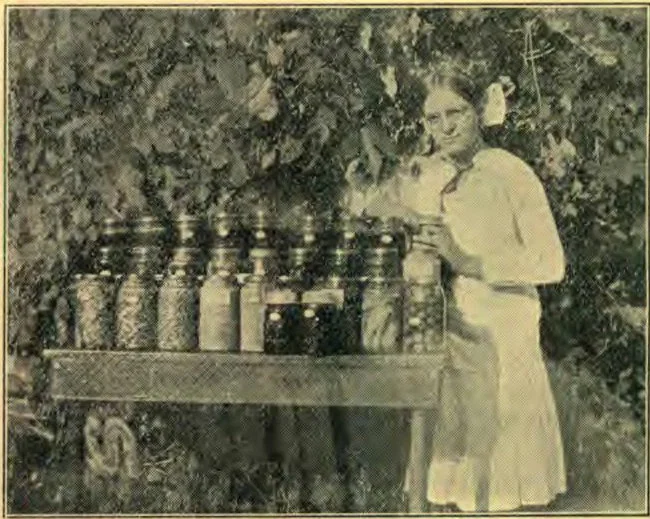
GENEVA STRONG, CULDESAC, IDAHO, AGED TWELVE
Geneva is the second member of the "Instructor" Canning Club to win a premium.
One million one hundred fifty thousand acres of city and town land were under cultivation the past season for the first time. Urban and suburban America became a vast garden as the result of the impulse given to the nation by the National Emergency Food Garden Commission. The nation-wide survey located nearly three million such gardens. It is said that by the planting of gardens the nation’s food supply has been increased to the extent of more than $350,000,000.
The motion-picture industry is now fifth in importance in the United States. The number of exhibitors is variously estimated as from 15,000 to 22,000, and the daily attendance is somewhere between 12,000,000 and 20,000,000.
Which Day Did Jesus and the Apostles Keep?
By Carlyle B. Haynes
The Sabbath of the New Testament
CARLYLE B. HAYNES
There was an unusually large number present at the tent on the baseball lot on Monday night. It was plain that the discussion of the Sabbath question had created an unusual interest. Brother Harris had promised that on this evening he would read and study every passage in the New Testament that mentioned the first day of the week in any connection, and this brought out many who felt sure the evidence for the observance of Sunday would be found in the New Testament.
In the audience Donald Hunter saw a number of Sunday school teachers, and he noticed one especially whom he had heard saying to another man that there was abundant proof in the New Testament for Sunday keeping. He had pointed out, too, that the minister seemed to be devoting most of his attention to the Old Testament, and that if he would read the New Testament he would find that Jesus always met with his disciples on the first day of the week, and did this so many times that it became a custom of the early Christians to meet on that day.
Tonight Brother Harris read nothing from the Old Testament, but confined himself exclusively to the New Testament. He said:
“While it is clear to all and freely admitted by all that the Old Testament teaches the observance of the seventh day as the Sabbath, it is often claimed that the New Testament introduces another day, the first day, as the Christian Sabbath. We must now examine the evidence which is produced for this claim.
“The best way to arrive at the truth or falsity of this claim will be to study every passage in the New Testament that speaks of the first day of the week. In this way we shall bring together the entire teaching of the Bible on this subject, and we shall certainly learn whether the first day has taken the place of the seventh day.
“The first time the first day is mentioned in the New Testament is in Matt. 28:1. This verse is the introduction to the account of the resurrection of Christ, and contains the historical record that he rose on ‘the first day of the week.’ The verse was not written to give any information about a change of the Sabbath, but to give the facts concerning the resurrection. While the first day is mentioned here, it is given no sacred name or title. It is not called ‘the new Christian Sabbath,’ or ‘the new Sabbath,’ or ‘the Lord’s day.’ It is called merely ‘the first day of the week,’ and is plainly considered by Matthew as one of the working days of the week, the first of them. There is clearly no evidence here for Sunday observance.
“The second time reference is made to the first day is in Mark 16:1, 2. It will be seen that this passage is the same historical record of the resurrection by another writer, who agrees with Matthew that Christ was raised on the first day of the week. Mark does not give this day any sacred title or name; he does not say it is now to be observed as the Christian Sabbath in honor of the resurrection of Christ; he is entirely silent with regard to any sacredness belonging to this day; he mentions it in his gospel simply because he cannot write the account of the resurrection without speaking of it.
“Instead of proving that the first day is the Sabbath, this verse makes it clear that it is not. Mark speaks of two days, ‘the Sabbath,’ and ‘the first day of the week.’ One day is given a sacred title; the other has no sacred title. One day is a holy, sacred day; the other is merely one of the ordinary week days, the first. And let it be noticed that when ‘the first day of the week’ comes, the Sabbath is then past. If one prefers New Testament teaching to Old Testament teaching concerning the Sabbath question (though they both teach the same thing), here it is. The New Testament clearly teaches that the day just before the first day is the Sabbath, and that when the first day comes the Sabbath is past.
“The third time this day is mentioned is in Mark 16:9, and here again the first day is spoken of as an ordinary week day, without any special honor.
“The fourth time the first day is mentioned is in Luke 23:52-56; 24:1. Here we have the account of the resurrection of Christ by another writer, Luke. Again the day of the resurrection is given no sacred title. It is spoken of as one of the week days, ‘the first day of the week.’ Not the slightest hint is given that it is to be considered as different from the other week days. In this passage the day of the crucifixion is called ‘the preparation.’ This was Friday. The next day, the seventh, is called ‘the Sabbath day according to the commandment.’ And the day following the seventh day is merely ‘the first day of the week.’
“From this passage it is clear which day is the Sabbath of the New Testament; it is that day which is between the sixth day and the first day of the week, the seventh day, known as Saturday, ‘the Sabbath day according to the commandment.’
“The fifth time the day is mentioned is in John 20:1. Here again, by another writer, is the same historical record of the resurrection. But there is no Sunday sacredness here. This verse does not call the first day by any sacred name or title any more than the previous verses we have studied. It is merely ‘the first day of the week.’ That is all.
“This day is mentioned the sixth time in John 20:19. And here, at last, we have the record of a meeting of the disciples on the first day. This verse has been made the basis of the claim that the disciples had met together in order to inaugurate the first day as the new Christian Sabbath in honor of Christ’s resurrection on that day. But this claim cannot be true. In the first9place the disciples did not believe at this time that Christ had been raised from the dead. This is the same meeting spoken of in Mark 16:10-13 and Luke 24:36-40. Hence it cannot be true that they were establishing a new Sabbath in honor of an event which they did not believe had taken place. Nor was this a religious meeting. They ‘were assembled for fear of the Jews,’ not for worship. They were afraid the Jews would find them, and treat them as they had treated Jesus, so they had all gone home (Acts 1:13), and locked the doors. No evidence here for Sunday keeping.
“The seventh time the day is mentioned is in Acts 20:6-8. Here is a religious meeting on the first day, but it was on the dark part of the first day, for ‘there were many lights in the upper chamber,’ and Paul preached to them ‘until midnight.’ Now, the only dark part of the first day of the week is that part we now call Saturday night. The days of the week of the Bible were not reckoned as we now reckon days. Bible days began at sunset and ended at sunset, while our days begin at midnight and close at midnight. Hence this meeting was on Saturday night, not on Sunday. It was held at this time because the next day Paul was to leave these people, and this was a farewell meeting. No evidence for Sunday sacredness here.
“The eighth time the day is mentioned is in 1 Cor. 16:1-3. From this passage the claim is made that the early churches were accustomed to meet on Sunday and take a collection. But the passage says no such thing. This is not instruction to hold a weekly meeting, but for ‘every one’ to ‘lay by him in store.’ Their gift was to be placed in a public offering, but to be laid by ‘in store’ at home, and would then be gathered by Paul when he came. It was a special fund for the relief of the needy saints at Jerusalem, not a regular weekly collection. It was made up on the first day of the week, not because that was the Sabbath, but because it was the first working day. After the brethren had kept the Sabbath, and returned to their work on the first day, the first thing they were to do was to cast up their accounts to see how God had prospered them the previous week, and as he had prospered them, they were to lay aside their portion ‘in store’ until Paul came, and he would either take it or send it up to Jerusalem. There is no evidence at all in this passage for Sunday sacredness.
“These are the only passages that mention the first day in the New Testament. It is spoken of but these eight times. And these passages contain no command to keep the first day; there is no record of its ever having been appointed as the Sabbath; there is no record of its being made holy; there is no record of any sacredness being attached to it; there is no promise of blessing for its observance; the apostles did not keep it; Christ did not keep it; the early Christians did not keep it; in fact, there is nothing in all the Bible that gives the slightest hint of a Sunday institution. Sunday keeping is a practice without Bible authority, and should therefore at once be discarded by all Bible Christians.
“And now it will be interesting to notice that the disciples were accustomed to preach constantly on the Sabbath, instead of the first day. Read Acts 13:14-16; 13:42-44; 16:11-13; 17:1-3; 18:1-11. That Jesus himself was accustomed to observe the Sabbath is plain from Luke 4:16, 31.
“Thus it will be seen that there is much evidence in the New Testament for the observance of the seventh day, the true Sabbath, and absolutely no evidence for the observance of the first day. The introduction of Sunday observance into the Christian church is of later origin than the times of the apostles, and authority for it cannot be found in the Bible.
“Therefore I again appeal to you Christians that you discard this anti-Scriptural practice of Sunday keeping, and follow Jesus, follow the apostles, and follow the Bible in keeping holy the seventh day of the week, the true Sabbath of God.”
As Donald passed out of the tent he heard old Deacon Sewell, of the Methodist Church, say to his wife, “Mother, how strange it is that we have lived so long and have not before this learned these things. The minister has made things so clear that I am convinced we have been wrong in keeping Sunday.”
There seemed to be many others who held a similar opinion to the deacon’s. Mr. Hunter, Donald’s father, carefully looked up the scriptures that had been used, and as he closed the Bible his face was set in determined lines.
As for Donald, he was already convinced. There never could be any other Sabbath than the seventh day for him. But he was glad that his store of knowledge was increasing every night. He wanted greatly to learn all the truth, so that some day he would be prepared to tell it to others as clearly and convincingly as did Elder Harris.
My Neighbor
By Maude Francis Crump
I've a little neighbor
Over the way;
He is just as brown
As he is gay;
And he sings so merrily
All the day
That I love to hear
His rollicking lay.
He lives on a limb
High up in a tree,
Where he's safe from puss
And her kittens three.
He leads a life
So happy and free
That I almost wish
That a bird I could be.
And today when I read,
In the best Book of all,
How God always knows
When the sparrows fall,
I knew he must hear
Me when I call,
Though I'm only ten
And not very tall.
So if he cares for me
I will gladly sing,
And to every task
Will lightly spring,
That, like my neighbor,
I too may bring
Blessings of cheer
From our loving King.
MAUDE FRANCIS CRUMP.
Church Moves Evening Service to Afternoon for Winter
In an effort to save coal and electricity the time of evening services of the First Presbyterian Church in Greenfield, Indiana, has been changed for the winter. The usual hours for evening service is half past seven o’clock. Hereafter the Sunday evening sermon will be delivered at four o’clock in the afternoon.
Sunflower seed is a delicacy much relished by Russian soldiers. At railway stations where bodies of troops are waiting, the platforms are always littered with the shells of sunflower seed. On troop trains the men can be seen cracking the seed between their teeth and chewing the kernels.
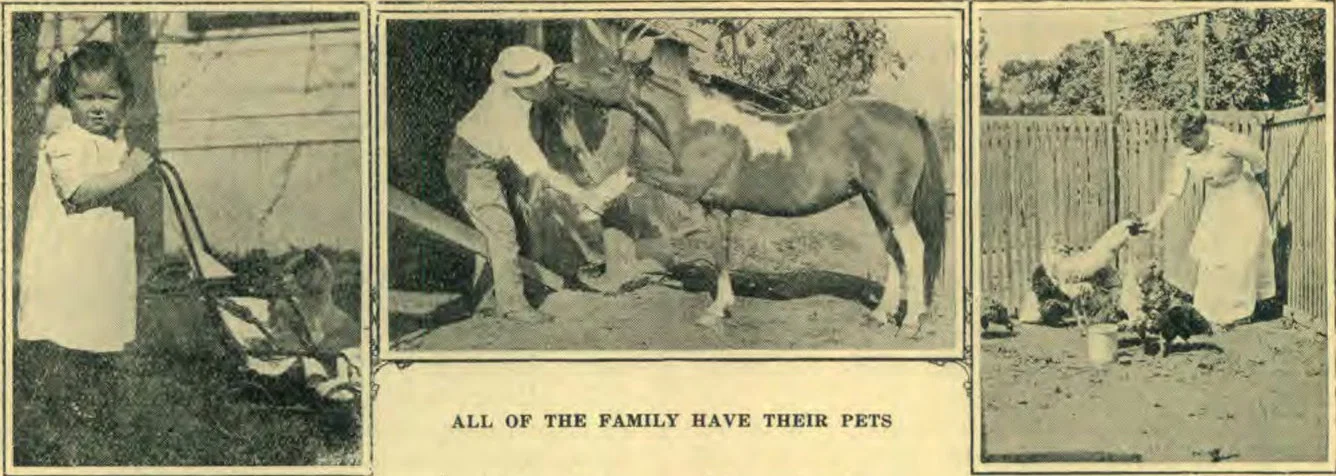
ALL OF THE FAMILY HAVE THEIR PETS
“In Just a Minute”
By Loula B. Freeman
LOULA B. FREEMAN
Carl, a bright, freckle-faced boy of ten, swung listlessly back and forth on the pasture gate, as he basked in the sunshine of an early July morning. There was a three-cornered tear in his blue overalls, and his bare, chubby toes wriggled over the edge of the lower board of the gate. His light-brown hair stood in shocks over his forehead, and his big blue eyes wandered searchingly over the pasture. Soon a rabbit hopped from one cabbage to another in the neighboring patch. Carl had been reading “The Bed-time Stories.”
“Hello, Peter Rabbit! You’d better get out of that cabbage patch. I’m Farmer Brown’s boy, and I’ll get you!” he cried as he jumped from the gate and ran along the path to the garden.
Just then mother’s familiar voice called from the kitchen door, “Carl, where have you been? Come, and mind the baby.”
There was a note of irritation in the voice. Already the kitchen was close and heated, though it was only eight-thirty, and mother had a big day’s work of canning to do. Baby was cross, and wanted some “be’ies.” He was continually getting into the ripe fruit.
“In just a minute, mother,” answered Carl carelessly, as he neared the cabbage patch.
The rabbit, startled, hopped along the rows and hid beneath some big green leaves.
“Oh, don’t think you’ll hide so easy, Peter. I’m coming,” said Carl.
The rabbit jumped out from beneath the cabbages, and went lipperty-lipperty-lip down a long row, under the wire fence, and into the tall grass of the pasture. Carl pursued him until he darted past a clump of currant bushes. The ripe currants, like so many rubies, caught Carl’s eye. His mouth watered as he tasted some, gathering more meanwhile. Soon he had eaten several handfuls and had wandered on into the pasture, spying better bushes, until an hour had passed.
“Guess Baby John’d like some of these,” he thought.
A quarter of an hour later Carl arrived at the dining-room porch, where the baby was contentedly playing with the cat, and an improvised rag doll, which his eighteen-year-old sister, Maggie, had given him.
“Carl, you’re about an hour behind time, as usual,” said Maggie. “Now run down to the mail box, please, and hurry back, for there must be some letters.” Maggie resumed her task of washing berries.
Carl started off down the driveway toward the road. Just then Uncle Walter called to him and said, “After you’ve given the mail to Maggie, Carl, come here. I’ve something for you to do.”
Uncle Walter was watering Old Ben, the pet horse, at the big trough, and Carl sighed, “O dear, seems as if they try to keep a fellow busy!” But he answered, “In just a minute, Uncle Walter.”
When he reached the mail box, the mail wagon, late this morning as it happened, was just approaching. Carl’s attention was attracted by a group of covered wagons about half a mile down the road. Smoke was ascending from a camp fire in the shade by the roadside, and five or six men and women were moving about. Unharnessed horses outnumbered the wagons.
“Gypsies,” thought Carl. “Mr. Postman, will you please give me a ride?”
“Jump in,” said the carrier, “if you’ll take this mail and give it to your folks when you come back.”
Carl took the three letters and the newspaper and held them carelessly in his hand, saying, “Guess those must be gypsies up the road, aren’t they? Did you ever visit any gypsies, Mr. Postman?”
“No, and perhaps it wouldn’t be well for you to do so either, sonny,” replied the latter. “Sometimes you know gypsies run away with small boys like you.”
When they had come within a short distance of the interesting scene, the postman turned his horse, as was his custom, onto the crossroad, leading in the direction parallel with the length of Mr. Davis’s farm. So Carl, fearing the gypsies just a little, continued to ride with the postman until they came to the grove along the edge of the roadside near the barnyard.
“Perhaps I’d better get off now; it’s most dinner time, and I’m hungry. Thank you for the ride. I’ll go with you again some day.”
As Carl waded through the tall grass by the side of the road, he picked some daisies for mother, and accidentally dropped two of the letters, one addressed to “Miss Margaret Davis,” and the other in typewriting to “Mr. George Davis.”
Carl reached the kitchen door just as dinner was being taken up. “Was there any mail, Carl?” asked Maggie.
“Yes’m, three letters and a paper, I think. Why, there’s only one here!”
Just then Carl’s father spoke. “There must have been one for me, Carl, an important business letter.”
“Why, I think one did have your name on it, father. What could have happened to those two?”
“Where did you pick those daisies, son? Very likely you dropped the letters when you picked them. You run back and hunt for the letters; and mind, no dinner until you find them.”
With a sigh, Carl retraced his steps to the side of the road, where, after a little searching, the lost letters11turned up in the tall grass. He ran back to the house.
“Here they are, father!”
Carl’s father and Maggie accepted the letters with satisfaction. Carl washed for dinner and took his place at the table.
“Where’s Uncle Walter?” he asked.
Mother looked up with a tired expression on her face. She remembered the number of times Carl had been behindhand that morning.
“He went out to the Big Red River for a fishing trip,” she said.
“Oh, I wish I could have gone,” said Carl with disappointment.
“You could have,” said mother, “if you had come back in time; Uncle Walter said he would have taken you.”
Carl remembered how he had said as usual, “In just a minute,” and resolved hereafter to “do it now,” and not “in just a minute.”
Mysteries Solved
IN the days of Ralph Waldo Emerson, matches were not sold loose in boxes, but were made up in “cards,” as they were called, of a dozen or so, connected by a common wooden base, from which they were broken off as necessity required.
Emerson used to place a fresh card of matches on a table by his bedside every night, together with a candle and some writing materials, in order that he might jot down at once any valuable thought that came into his mind during the night watches.
One night he wakened with a particularly brilliant idea, and bethought himself at once of his canny preparations for such emergencies. Reaching out he grasped his card of matches, broke off the outer one, and struck it sharply on the under side of the table. It failed to ignite. Swiftly he struck the next and the next, but with the same result.
Even so great a philosopher began to grow a little annoyed. Sitting up in bed, with grim determination he broke off one match after another until the card was gone. Not one gave the faintest spark.
By that time the idea was gone, too, and so his only recourse was to lay himself down again to ponder over a new problem, to wit: “Why wouldn’t those matches light?”
Whatever his solution was, however, it probably had to be revised the next morning, when he was wakened by a startled outcry from his wife.
“Oh, what can have happened to my best tortoise-shell comb?” she said. “I left it on the table at the head of the bed last night, and this morning it’s in fragments!”—Selected.
A Music Story
By Agnes Colthurst
The Berbers of Algeria, Africa, like music very much, but their ear is not trained to melody. Their singing is weird and monotonous. They love to hold one note a long time and then keep returning to it. Their instrument is a sort of flageolet. An amusing story is told of a young Moorish woman who works by the day for different families here in Mostaganem, Algeria.
One day this young woman—people here call these women “Moresques”—went to work at a lady’s house. This lady’s little girl takes music lessons. On coming home from school the child sat down as usual at the harmonium to practice. As the Moresque was unacquainted with this instrument, she was frightened and told the little girl there was a jackal hidden inside, and that each time she pressed her foot down she squeezed the jackal’s tail and it began to howl. That was the sound of the harmonium to her. The little girl laughed and persuaded the woman to try playing on it. The Moresque put her fingers on the keyboard, but the instrument did not make any sound as it did when the little girl played. Without letting the woman see what she was doing, the child then pumped the pedals, so that the keys the Moresque was pressing on made a noise. She was very much frightened, and jumping up ran to another room, declaring that the jackal would come out.
The little girl’s brother who had witnessed the scene said he would go and bring in the jackal to show her. The Moorish woman began to cry, and seizing the little girl’s mother by her dress, implored her to keep the jackal out of the room. They then explained to her the difference between the piano, an instrument she had heard before, and the harmonium, which was new to her. They also explained the use of the pedals. So she lost her fear. AGNES COLTHURST.
God Untangles the Snarled Threads of Our Lives
“Jesus cares for each one as though there were not another individual on the face of the earth. . . . Let God untangle the snarled-up threads for you. He is wise enough to manage the complications of our lives. He has skill and tact. We cannot always see his plans; we must wait patiently their unfolding, and not mar and destroy them. He will reveal them to us in his own good time.”—“Testimonies for the Church.”
Blotting Out Transgressions for God's Own Sake
“I, EVEN I, am he that blotteth out thy transgressions for mine own sake, and will not remember thy sins.”
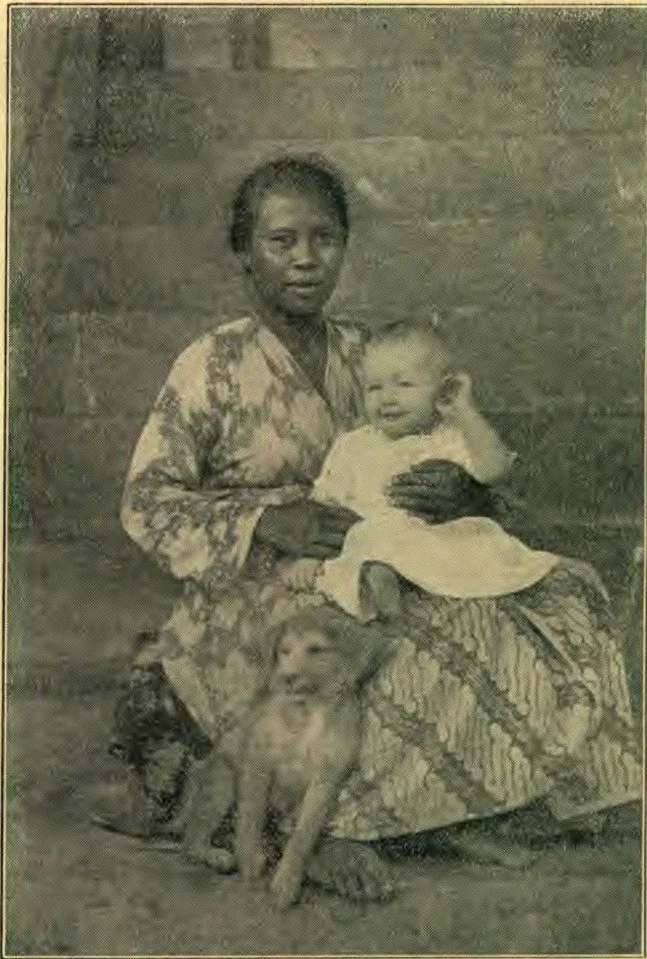
GLADYS ELLEN BARTO, BABOE, AND TOWSER, MEDAN, SUMATRA
Another Blessing for the Righteous
(Texts for December 23-29)
WHEN asked what persuaded him to become a Christian, Stanley replied: “The beautiful life of David Livingstone.” In that confession, Stanley pointed out one of the sweetest privileges of Christians,—the privilege of representing God so adequately that others will be drawn to him. God not only comforts, directs, and keeps the righteous, but he makes them his representatives on earth, and he uses their lives as magnets for drawing others to himself.
Only “the pure in heart . . . shall see God;” and only those who see him can make him known to others. But “if we confess our sins, he is faithful and just to forgive us our sins, and to cleanse us from all unrighteousness,” and what God cleanses will be pure, and sweet, and clean. So if we let him, he will keep our hearts cleansed from the stain of sin, and we too shall see God, and share with the righteous the great privilege of making him known to others.
Only a few, comparatively speaking, can be called to represent “Uncle Sam” officially in other lands; but with God it is different. He can use all as his representatives; “whosoever will” is called to fill this office. And the Spirit of prophecy says that “he hath appointed the youth to be his helping hand.” This means that you have a special call to be God’s representative in your community, among your friends.
Our ambassadors do not go abroad to promote their personal interests—at least that is not what they are called to do. They are servants of “Uncle Sam;” it is to his business, not their own, that they are to give first attention. We do not pity the men who are called to give up some of their own plans to go to represent our fair land beyond the seas; they do not pity themselves. There may be hard things to endure, and it takes constant effort to be all that is demanded of an ambassador, but they esteem it an honor to represent the Stars and Stripes in other countries. And so it is.
But if these men are genuine Christians,—Christians after God’s heart,—they have another still greater honor conferred upon them, for they are then God’s representatives to those with whom they serve. No higher honor, no greater opportunity, no more exalted privilege can come to a young man or a young woman than to be God’s representative. This office in life transcends all others. To represent him truly in all the walks of life is the privilege of young people today; and they should make this their first business. God calls them to live lives that will demonstrate to others his saving and keeping power; in unselfish ministry they are to help others to understand God’s yearning love for all; they are to teach those about them to read the Creator’s message on the pages of his great nature book; they are called to point out from the Bible the path that leads to our heavenly home; and day by day they are to pour into other hearts the peace and comfort God has poured into their own. Yes, it is their business to interpret God to others.
God does not ask his faithful children here to live on credit. There are some things they must do without; there are some things they must do which they would rather leave undone. But he knows best. He loves best. He always compensates. “Generosity greatens; virtue exalts; charity transfigures.” Yes, “he does the very best for those who leave their choice with him.” And some day God will break “diplomatic relations” with this old world and call his faithful representatives to that home of endless bliss. Then why should we pity those who give up their selfish pursuits to be God’s ambassadors? Selfishness always overreaches itself, and brings the heaviest curses upon its own head; but unselfishness is ever scattering blessings and ever reaping greater ones.
“Lord Rosebery tells how the captured Napoleon, on board ‘Bellerophon,’ stood from seven in the morning till noon watching the French coast line through a telescope, until its last vestige faded, and then, with a ghastly face, he turned and tottered to his cabin. It was his last view of France. Behind that vanished coast line lay his empire and his glory.” Contrast with this the end of Paul’s career. That lonely, deserted prisoner went to his death triumphant; he had won the greatest victory mortals can claim; his heart was at peace with God and without malice toward man; his life was about to close, and he cast one sweeping glance over his career. He has not left us even one hint of regret to think he had chosen to be God’s representative among men. There had been hard things to meet, but it was “a good fight;” it had been well worth while. And with an assurance worth more than all the treasures of earth, he laid down his life to await the Lord’s return and his eternal reward. Surely he who chooses God chooses wisely. For him—and for him only—the present is full of blessing, and the future bright with hope.
The Real Meaning of the Morning Watch
By Ella Iden
“MISS ROBINSON, I am trying to fill out my individual report blank, and there is one item on it that I am not quite sure about. It is the question, ‘Are you an observer of the Morning Watch?’ Of course I have heard about the Morning Watch for a long time, and have tried in a way to follow it; but I don’t really understand it, and I don’t know whether I can truthfully say I am observing it or not.”
“Well, Virginia,” said Miss Robinson, with an encouraging smile, “sit down here with me, and just pretend you have never even heard of the Morning Watch. Start in at the beginning, and ask every question you can think of regarding it. When we get through, my dear, I believe you’ll understand it fully. All ready, let the questions come!”
This was exactly what Virginia wished, and she began without the least urging:
“What is the Morning Watch?”
“By the Morning Watch is meant a time in the morning, set aside for communion with God.”
“What does it mean to observe the Morning Watch?”
“The observer of the Morning Watch makes it the rule of his life to spend the first moments of the day in communion with God, through prayer and through his Word.”
“Who may observe the Morning Watch?”
“All should be encouraged to do so; real spiritual life demands quiet communion with God daily.”
“How much time must one spend in devotion each day to be considered a Morning Watch observer?”
“Enough time genuinely to realize the presence of God and to hear him speaking to us out of his Word. At least fifteen minutes a day, or better still, half an hour is desirable; but it is well to remember that it is13not so much the amount of time spent as it is the reality of the communion. Five minutes of real devotion is better than an hour of perfunctory study.”
“At what hour of the day should the Morning Watch be observed?”
“The first moments of the day, if possible immediately upon rising. A few moments then are worth more than any other time of the day. The mind is clear, the cares of the day have not yet come to annoy us.”
“How should the Morning Watch period be spent?”
“That is an individual matter. Part of it will be spent with God’s Word, part in prayer, and some portion should also be spent in waiting quietly before the Lord in meditation, and in listening to the still, small voice.”
“Are there any rules which will help us to keep the Morning Watch?”
“Yes, there is one very important one: ‘Allow no exceptions.’ Begin to keep the Morning Watch tomorrow morning. The first morning will be easy. The next morning it will be more difficult. On the third morning perhaps the alarm will fail to go off, or the fire will be out and require your attention. Then comes the real test of the mettle that is in you. But if you have a ‘bit of red iron in the will,’ as Gordon expresses it, you will remember your rule, and ‘allow no exceptions.’ A single exception helps to break the habit you are endeavoring to form.”
“Have we any literature to help us in the observance of the Morning Watch?”
“Yes, indeed. The Morning Watch Calendar is just what you need to use in connection with your Bible study. ‘Alone with God,’ Miss Erickson’s new book, and ‘Steps to Christ’ are also excellent.”
“Must I memorize those verses every day to be called an observer of the Morning Watch?”
“It is the ideal way, though one can be a Morning Watch observer who has never even seen one of our little Morning Watch Calendars. But all who have once used it feel that it is invaluable. I will give you one of the new 1918 Calendars. It is one of the best we have had. Every one should have a copy and begin using it the first thing on the first morning of January.”
“I certainly want one. I thank you for your clear explanation of just what the Morning Watch is, and what it means to be an observer of it. It was always sort of shadowy and indefinite in my mind before, but now I understand it fully. I shall not wait until the new year, but begin tomorrow morning really to observe it.”