HALLEY'S great comet has doubled the cape of the sun, and has begun its long journey through the sky. For over thirty-eight years it will rush through trackless space at a rate of speed past our comprehension. It will stop at no way stations. After this long journey it will swing about in its celestial pathway toward our sun again. Its return will consume another thirty-eight years, provided it shall return at all. Should it have attained sufficient momentum in its present visit to carry it beyond the confines of our solar system, it may be seized upon by the attractive power of another sun, and may never return to us again. It is very probable that many comets have left our system forever, and that many comets from other systems have come to us. The journey which this comet is to make is a perilous one. It is attended with many dangers. Planets are scattered through the sky. They are sending out their attractive forces across the comet's path. They are dangerous highwaymen. They may draw the comet into themselves, or may convert it into a satellite to revolve around some primary.
Comets are common visitors to our solar system. Over eight hundred have been recorded. Only a part of this number come to our sun. Many do not come inside the orbits of our outer planets. The inter-solar spaces are the comets' playgrounds. The great Kepler once said that comets are more numerous in the heavens than are fishes in the ocean. They are harmless wanderers in the skies. Photography and spectroscopy are now employed with profitable results in the study of these peripatetic wanderers of the sky. But, after all, this study is principally confined to the comets that visit our sun.
Until about 1680 little scientific effort had been made to determine the laws governing the movements of comets. In 1682, when the comet recently in our sky made its appearance, Halley, a co-laborer with Sir Isaac Newton, undertook to compute the orbits of about two dozen comets. The appearance of this one in 1682 determined him to direct his attention to it. He first identified it with the one of 1531 and 1607. After much labor in a field then new, he determined its path among the constellations, and computed its period, and the date of its return, late in 1758, or early in 1759. He had no hope of being alive at this date, but made his computation for the benefit of men yet unborn. In honor to him his name has been given to the comet. It was a complex problem to solve. The path of the comet would be in the midst of planets whose disturbing influences would assail the traveler. It was a new field. No one had attempted its solution. Yet so accurately did he master the problem, that he was only a few days from its actual appearance, seventy-seven years in the future. The comet passed its perihelion on March 25, 1759. Considering the fact that Uranus and Neptune had not then been discovered, the result was wonderful indeed.
The discovery by Newton of the law, which has been formulated into the theorem, that all matter attracts in proportion to its amount and in inverse ratio to the square of its distance, enabled him to estimate the influences correctly. He determined when the comet would appear, if it met with no delay; and having ascertained that Saturn would delay it 100 days, and Jupiter 518 days, making its period 618 days longer than he had calculated, he was enabled to fix its date of coming. No scientific prediction ever excited so much curiosity and wonder. The comet came, and traversed the course among the stars mapped out by him, and reached its perihelion on March 13, 1759, only a few days from his indicated time.
This daring prophecy opened a new field in astronomy. The history of this act invests Halley's comet with an especial interest. Astronomers now calculate the movements of comets, though to the public the process has lost much of its exciting interest. From such labors and results men get a broader and clearer view of the universe. They learn that everywhere is a perfect balance;—that “all are but parts of a stupendous whole;” and that a law, once discovered, applies to all manifestations of matter, regardless of time or space. The Infinite Mind that planned the universe placed all of its parts in perfect balance. Harmony prevails everywhere; and when once we see a part, we can calculate all other parts, and can catch glimpses of the harmonious system in its entirety.—Samuel Phelps Leland, A. M., Ph. D., LL. D., in Christian Herald.
A Child's Faith
A LITTLE boy of eight years, who was converted and joined the church about a year ago, accompanied his mother on a visit to a Western city. A few days after they reached their destination, the mother became suddenly ill, and was taken to a hospital. Here she continued to grow worse until the physician lost all hope of her recovery. He told her if she had any message to send to her family, or any business to settle, she should attend to it at once. This word went to the home of the child's uncle.
When the uncle, who was an unconverted man, told the boy that his mother must die, he said: “No, mama will not die. I will write a card to our pastor and his wife, who will pray for her to get well; I will pray, too, and when two or three pray, the Lord will hear them, and mama will get well.”
This wonderful faith of the child so moved the heart of the uncle that he was converted. He went to the hospital, and told his sister-in-law that he was a saved man, and that he would give anything in the world for such faith as her little boy had. The mother recovered, and came back to her home in less than four weeks from the time she had left it.
The uncle now enjoys the blessing of a Christian life, and the mother is well and at home with her family. Beautiful was the simple faith and trust of this little boy! — Selected.
To Nervous Women
AVOID haste and hurry; these are the things that confuse the brain and make clear judgment impossible. The besetting temptation of the nervous woman is to hurry from one duty to another in breathless haste, attempting many tasks, yet achieving none of them with dignity or freedom. When such a temptation arises, call a halt. Remain quiet for a few minutes; summon back your self-possession, and refuse to do, in one hour, work that should be spread over two.
Habituate yourself to the control of the emotions. Nothing makes such havoc of the nervous system, nothing disorganizes the inner life, like anger, fear, worry. These forces must be quelled if the soul is to maintain its supremacy, and peace of the nerves is to be enjoyed; and this is done, not, indeed, by a fiat of the will, but by substituting for these destructive emotions such constructive ones as love, aspiration after some ideal, and faith in God. -- Dr. S. S. McComb, in Harper's Bazar.
For Cleaning Windows
FOR cleaning windows and mirrors, there are several proprietary articles on the market, but a little soda or kerosene and a little thin starch spread over the glass and allowed to dry, will give excellent results when rubbed off, and polished with newspaper or cloth that leaves no lint. In very cold weather a little alcohol on a cloth is effectual.— Harper's Bazar.
Sherbro, West Africa
By D. C. Babcock
D. C. BABCOCK
FORMERLY Sherbro was separate and distinct from the colony of Sierra Leone, but a few years ago they were united and brought under one government. Bonthe, the chief town of Sherbro, is about one hundred miles from Freetown, and up the Sherbro River from the coast fifty miles. The country is low for many miles around Bonthe, and with sandy soil the dry season becomes exceedingly hot. For more than two years we have been planning for a tent effort at this place, but the work there has been thwarted.
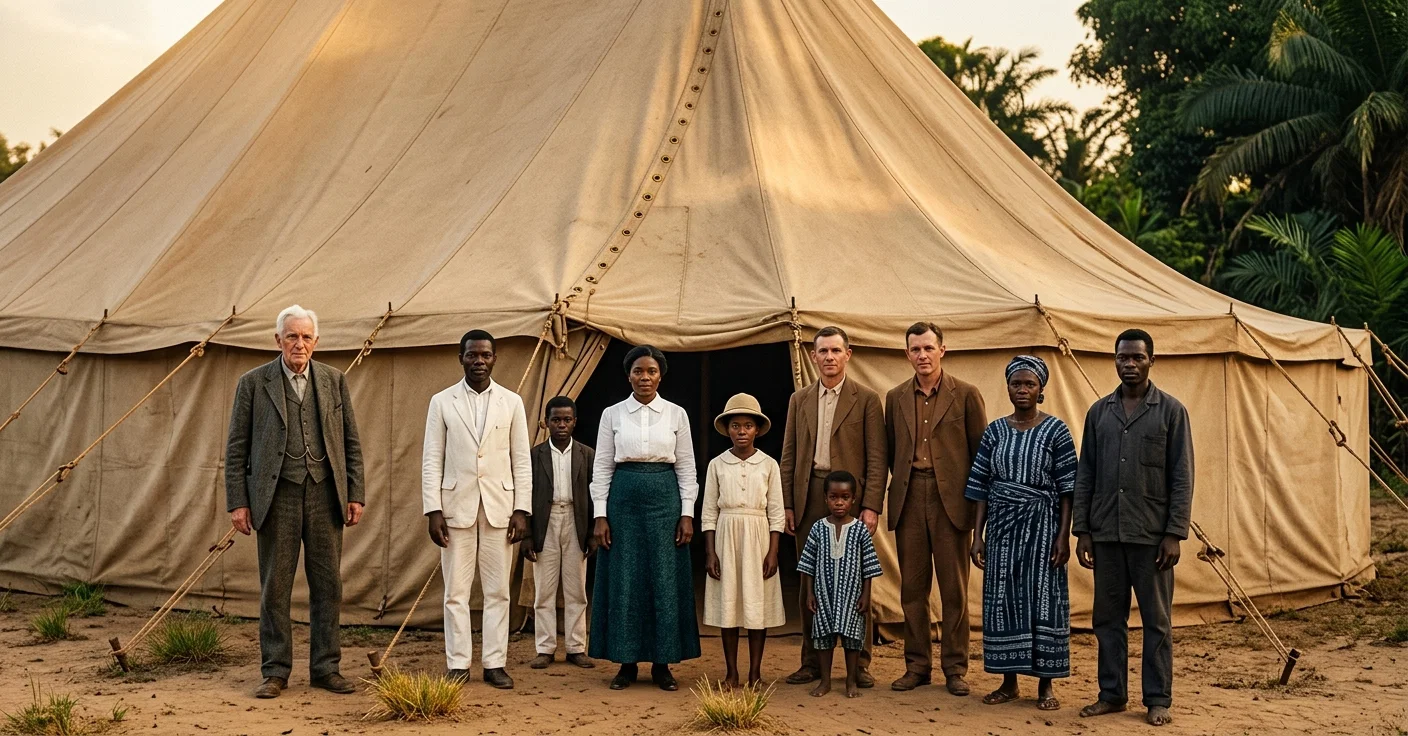
Brother W. W. Randell [in the picture standing at the extreme left], our faithful canvasser, whose hair is white with years, went to Sherbro in September, 1909, and has sold many of our books and papers. He has also distributed several thousand pages of our small tracts. Thus the field was prepared for us.
On February 17, Brethren Harding and Buah, Sister Bidwell, Mrs. Babcock, and the writer, left Freetown for Bonthe, to begin work in our forty-by-sixty-foot tent.
Our steamer lifted anchor at midnight, February 17, and early next morning we learned that the ship was out of her proper course. The steamer was moving slowly, when suddenly we felt a severe shock, and the vessel came to a standstill, perched upon a rock about ten miles out at sea. At ten o'clock we shifted from the rock to a sand-bank, and there remained for two days, which seemed very dreary to us.
We were thankful to our Heavenly Father the following Monday morning, on reaching Bonthe, to set our feet once more on land. We were soon located, and began at once to pitch and seat our tent.
Friday evening, March 25, our meetings opened with a crowded tent, and many were unable even to get near enough to hear. Everything was ripe for the message. In the very first meeting, while I was outlining the subjects to be taken up, a gentleman arose and asked for the Sabbath question. We were forced rapidly from point to point in the message, and in a little over three weeks the principal points of the truth had been given to the people. The message was largely presented from questions handed in.
Very little opposition was offered except by the Catholics. The Lord blessed the effort. We formed two visiting companies, and each day visited from house to house, and distributed tracts and papers. It will take some time to learn just how many will be faithful to the message. More than fifty expressed their confidence in the truth at one of our meetings. We are confident that a good company will be raised up at Bonthe.
This is an excellent point from which to enter the hinterland, five navigable rivers emptying into the Sherbro River at Bonthe. These rivers extend far into the interior, and all the territory is thickly populated by the Mendi and Sherbro tribes.
Urgent invitations were given us to open stations up these rivers. At the close of one of our meetings, an old, white-haired man came up to me, and said, “My heart is touched with this message. Won’t you come to my village and tell us these things?” A woman came down four days’ journey, and visited us twice at our home. She urged us to start our work up the river where she lives. On another river a sister seventy-four years old from the Freetown church has been canvassing. She returned last week, and told of a good interest there. From all these rivers there are urgent calls for this message. Where are the men to answer them? They must be workers who can speak the Mendi.
My heart aches when I look at our boys in school, and think how long it will be before they will be ready to fill these places. May the Lord raise up mature men, who will be able to take up the work now. We must have men and means from some source.
One young man has accepted the truth at Bonthe, and I hope he may soon be able to answer one of these calls. The expense will not be large to open a station in the interior, if we use native help, which we must do. It means hard work, and strong faith in God, to enter such three fields. Heathenism is on every hand, and with it cannibalism. We ask again, Shall Africa wait? We appeal to our brethren and sisters to send us help. Do not let the millions in West Africa wait longer.
TENT COMPANY AT SHERBRO, WEST AFRICA
We are in great need of medical aid. Our workers need rest and rational treatment. The Lord has marvelously preserved the health of our people, but at times some tremble on the brink. We earnestly appeal to our people for medical help before it is too late. While you enjoy your pleasant homes, with sanitariums all around you, we ask for only small treatment-rooms for all of West Africa.
Freetown
On our return to Freetown, we were glad to find the work moving along nicely. The Lord continues his blessing to this company. Last Sabbath the church was well filled, and several new faces were noticed in the congregation. Brother R. P. Dauphin is holding special meetings for the Yimni tribe each Sabbath afternoon. Good results are already realized, and some are preparing for baptism. Brother W. H. Lewis and family have suffered some with fever, but they are up again.9
Waterloo
Prof. T. M. French sends us good word from the work there. The school is moving on successfully, and new students are added weekly. Several are awaiting baptism. We hope to complete the church and school building early in April, and that will add much to our work at Waterloo, and also reduce expenses. A minister has accepted the truth there.
Gold Coast
Good word comes to us from the work on the Gold Coast. Brother C. E. F. Thompson writes that others have accepted the message at Axim. While they have many difficulties to encounter, their courage is good. Brother A. C. Ackah sends encouraging reports from the Apollonian coast. Two more villages are erecting school buildings, and they ask us to come and help them. In one of these villages, the chief has accepted the Sabbath. We are all of good courage in the Lord.
Freetown.
A Tiller of the Soil
By Christian Burke
THIS is the place where thou didst bid me stand,
And work and wait;
I thought it was a plot of fertile land
To tend and cultivate:
Flower and fruit, I said, are surely here
In rich earth stored,
And I will make of it a garden fair
For thee, my Lord!
Lo! it is set where only bleak skies frown,
With rank weeds sown,
And over it the vagrant thistledown
Like dust is blown;
Long have I labored, but the barren soil
No crop will yield:
This have I won for all my ceaseless toil—
A bare, plowed field!
“Nay, even here, where thou didst strive and weep,
Some sunny morn
Others shall come with joyous hearts, and reap
The full-eared corn:
Yet is their harvest to thy labor due;
On Me ’twas spent—
Are not the furrows driven straight and true?
Be thou content!”
— Christian Burke.
Solusi Mission
By R. C. Porter
R. C. PORTER
ONE would scarcely think he was in the heart of heathenism in Africa, should he awaken at the Solusi Mission without having had the experience of traveling across country fourteen hundred miles from Cape Town to reach the place. The appearance at the mission is quite like an American farmer’s home.
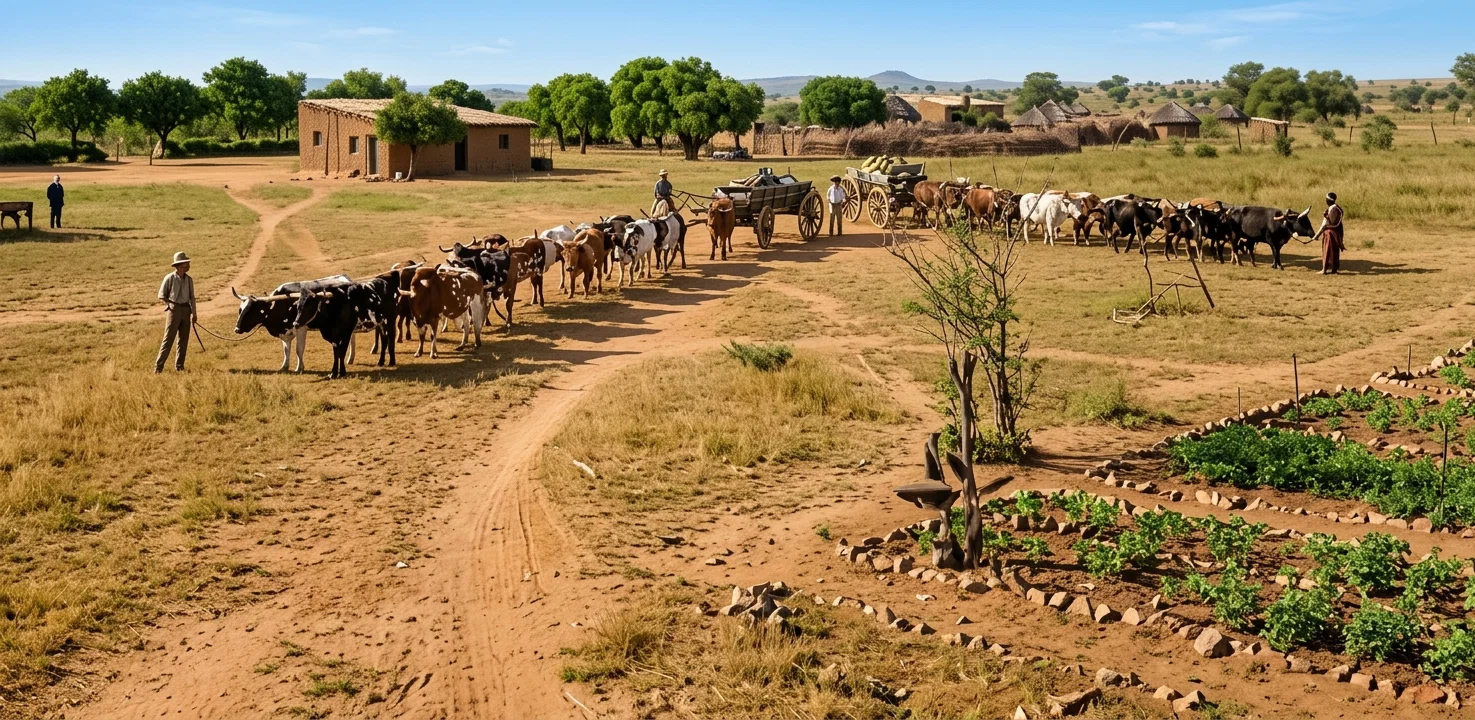
They are just now harvesting their crops. They have two hundred acres of good mealies (corn). I measured three ears, picked as I passed through the field, and they averaged nearly nine inches around and a foot in length. They have but thirty acres of this variety. The other fields are of a smaller-eared variety, but very productive. At one time it looked as if the whole crop would wither and die for want of rain. After earnest prayers had been offered by the mission family, the rain came in time to save the entire crop. They also have about forty-five acres of Kafir peas, with peanuts, potatoes, sweet potatoes, beans, and other garden produce. On the farm are 145 head of good cattle, four mules, a driving horse, one mule-wagon, two ox-wagons, two carts, one double and three single cultivators, one iron harrow, one breaking plow, two disk plows, one two-horse corn-planter, one mowing-machine, a steel hay-rake, a milk-separator, and a corn-sheller. With this equipment the mission is prepared to do good work in the line of agriculture.
When Mrs. Porter and I visited this mission one year ago, there were thirty-two students at the main station school, and an average attendance of twenty-five at each of the four out-schools. They now have ninety-two at the main station, and seven out-schools, with about the same average attendance. They expect to open another out-school soon. The students are mostly a mature class, their ages ranging from twelve to twenty-five, with the average age above sixteen.
When we began mission work in Africa with small children, who must be grown as well as educated and trained for the work, it looked like a slow way to enlighten Africa with the message. But from that first class have developed our stanch and reliable teachers, who have given character to the work; and they have gained the confidence of the natives, so that now our schools stand in the foreground of native mission schools, both as industrial training-schools and as places to obtain a thorough education.
As the result of the work of this mission we now have a church of eighty-eight members, including the three white teachers. Their tithe last year was £76 9s.; annual offerings, £10 3s. 6d.; Sabbath-school offerings, £8 13s. 9d. This makes a total of $372.37 tithe and $91.80 offerings.
STARTING OUT FOR MARKET FROM SOLUSI MISSION
Twenty teachers at Solusi and nine at other places have been trained at this mission. Thirty-six others who have been students and are members of the Solusi church are engaged in other work. Twenty who live in their kraals are keeping the Sabbath, though they have not united with the church. Another class is preparing for baptism.
One of the older boys now at the school came from Chinde, a distance of over nine hundred miles, and another came a distance of over eight hundred miles. They had not heard of the school before starting; but on reaching Bulawayo they learned of it, and refused good wages in order to attend. They think that the Lord led them to Bulawayo, that they might learn of the school, and become acquainted with the message.
To see the marked change that has taken place in this family of students so recently come from heathenism, and to hear them engage with such fervor in songs of praise to God and in intelligent testimonies and prayers, can not but touch one’s heart. I could not refrain from weeping at the thought of what God has done and is doing for the darkened heathen of Africa.
Thomas Ntaba and wife, with his mother, have recently gone from Solusi to assist Elder F. B. Armitage and wife in opening a new mission among the Zulus. Grandma Ntaba has always been called “the mother of the Solusi Mission.” She is a mother in Israel, and Thomas is one of our best teachers. They will be greatly missed at Solusi, but all were willing to part with them in the interests of the Zulu work.
Elder M. C. Sturdevant and wife expect soon to move to a place near Umtali on the Beira Railroad, where they have selected a new station. They have asked for Mark, one of our best teachers at Solusi, and six other boys to accompany them. The Solusi Mission workers have granted their request, and offered them a donation amounting to about $500 to aid in starting the new station. It is a pleasure to see this spirit prevailing in our mission fields.
It may seem to some that it is unwise to make so much preparation for farming on a mission station; but when one can see that with the preparation made at this station, they are enabled to support twenty native teachers and nearly a hundred students from the proceeds of the farm, without calling for any funds except for the salary of the white teachers, it must appeal to all that it is wise to make thorough preparation to make the industrial work a success. They expect soon to be able to support the white teachers also. Brother and Sister Sturdevant and Brother Victor Wilson have labored hard and managed their work well. Brother Wilson will soon have a new book of hymns ready for the press in the Centibela language.
We have been greatly cheered by what we have seen of the prospering hand of God in the work at Solusi during the past year. Our prayers will ever be for its continued prosperity.
Solusi.
Selling the Truth in Buenos Aires
In Buenos Aires, Argentina, an Italian sister, unable to read or write, asked for a supply of La Verdad Presente, and started out selling them from house to house in the city. An Austrian lady on whom she called became very much interested in the paper, and asked for other reading-matter. Later, Brother and Sister O. Oppegard gave her Bible readings, and she accepted the truth, and is now matron of our missionary training-school in Pua, Chile.
Progress in Haiti
By W. J. Tanner
W. J. TANNER
The first quarter of the year has witnessed very material progress in our work in Haiti. During this time I have baptized twenty-four believers, all but three or four of whom were Roman Catholics. Our baptism of sixteen at Grande Riviere on New-year's day excited no little comment on the part of the other missionaries, and some of the oldest Protestants here have told me that they never before heard of such a large number being baptized at one time in Haiti. Nor is this all; for since this baptism at Grande Riviere, between sixteen and twenty more have accepted the message and joined a second baptismal class. These are all from the Catholic Church.
At Port-au-Prince our native worker, Mr. Nord Isaac, is holding up the banner of truth against great difficulties. About two years ago over a third of the city was destroyed by fire, and at the present time it is almost impossible to rent a suitable place for meetings. At first the young brother was permitted to hold meetings in one of the Protestant churches; but as soon as he reached the Sabbath question, he found that his preaching was no longer desired in the church. Our worker was, however, able to make arrangements to carry on his work in an empty storeroom, which he rented for two months. During these meetings the daughter of the bishop of the Episcopal Church in Haiti began the observance of the Sabbath.
A brief account of how this lady learned of the truth will be interesting. Ten or twelve years ago, while she and her father were visiting friends in Brooklyn, N. Y., they were invited to attend some Bible readings held by the late George A. King. As a result the daughter was convinced that the seventh day is the Sabbath, and began to observe it, yet, however, without leaving the Episcopal Church, of which she has always been an active member. But it is difficult for one to remain in a nominally Protestant church, and at the same time observe all the law of God. Either the Sabbath or the church will be given up, and in this case it was the former. Nevertheless, the conviction that she had heard the truth relative to the Sabbath question never left her, and this and other circumstances worked together to cause her to be well prepared to hear and accept all the message when our worker opened meetings at Port-au-Prince.
As this lady is a person of some talent, the only daughter among eight or nine brothers, and has always been an effectual worker in her father's church, her acceptance of our faith has caused no little comment in the different Protestant missions. Her aged father, the bishop, while not approving of the change, has manifested a most charitable and generous attitude toward her and toward us.
I have just now returned from a trip to Port-au-Prince, where I not only baptized this sister, but also three other persons, all of whom are from a good class of people. Others will follow in a later baptism.
This progress of the work at the Haitian capital is very encouraging; for besides being the political center of the republic, it is also the largest city in the island, and it is but appropriate that our work should gain a foothold there. We are greatly handicapped, however, for want of a suitable meeting-place. At present our meetings are conducted in a small room behind a cake shop. It seems impossible to rent anything that would be suitable to our needs, and even for very inferior rooms the rents are exorbitantly high. The only way out of this difficulty is to build. I do not know how we are going to do this; but as it is evidently the necessary and right thing to do, I doubt not that means will be forthcoming for this purpose.
Cape Haitien.
Japan
By H. F. Benson
H. F. BENSON
A short time ago Elder H. Kuniya and seven canvassers from the school came to Hiroshima to begin a three months' effort here. The canvassers immediately began a systematic canvass of the city. At first there was some doubt as to the possibility of selling the papers; some thought that but few people would be reached in this way, and advised lending the papers for two weeks, and then replacing the old paper with the next issue. The first day's work demonstrated clearly that the papers could be sold, and, more than that, that a large number could be sold. Brother Y. Seino sold 215 of the Owari No Fukuin, our Japanese paper, besides a number of tracts, in one day, working about six and one-half hours. The general average for the whole company has been about ten to twelve papers an hour. Taking into account the purchasing power of the Japanese, this would be about equal to the same number of ten-cent magazines if sold in the States. The first day Brother Sato secured a subscription for the paper, and since that time a number of yearly subscriptions have been taken.
The Lord has greatly blessed in the work, especially in enabling us to secure a house for meetings in the very heart of the city. This house is on a side street, the first door from the corner of the principal thoroughfare, and will comfortably accommodate fifty or sixty persons, besides the rooms upstairs, in which part of the workers live. It has taken some time to alter and furnish this building. The floor of two rooms was taken out, and a cement floor laid. This makes it possible for the Japanese to enter without leaving their wooden shoes at the door.
We are having so many encouraging experiences that it is difficult to pick out the most interesting. One or two, however, will indicate the way in which the Spirit of God is working on the minds of the people. From the very first, many have asked where we held meetings, and expressed an intention of attending as soon as we opened our meeting-hall. The first subscriber secured by our canvassers has, after being visited several times, expressed a desire to keep the Sabbath.
One day Elder Kuniya stopped at a barber shop, and while awaiting his turn, picked up a bunch of tracts and papers carefully bound together, and placed on the table for the use of the customers. They proved to be literature which the barber had bought of one of our canvassers. This man told Elder Kuniya that he wanted to know more of our belief. Later he placed a sign in his shop that stated that the shop would be closed on every Saturday, and last Sabbath he attended Sabbath-school and the preaching service. A young man who had purchased a paper from one of the canvassers said that he was going to give up the use of tobacco. He had read in this paper a short article on tobacco and its evil effects. One worker secured a trophy the other day. He saw a man filling his pipe, and thinking it a good opportunity, began to tell him about the poisonous nature of the weed. The man, after listening a short time, handed the worker his filled pipe and pouch, at the same time stating that he intended to give up tobacco forever.
During the first part of May there will be two large festivals in Hiroshima, and we are planning to get out a large special edition of our paper, to sell to those who attend. This will enable us to get the paper in the hands of people from all parts of Japan. Thousands from the small islands and from the other provinces on this island are expected. The canvassers have promised to sell one thousand copies apiece; this will make eight thousand in all.
There is no question but God is preparing the way for his work in Hiroshima. This city is regarded as one of the most difficult places in Japan for Christian work, but our canvassers have done better here than in any other place in Japan. The western part of the city has hardly been touched by other denominations in their twenty-five years of work here, on account of the seemingly insurmountable opposition of the Buddhists. Our young people sold more literature there than in any other part of the city. On Temple Street, a street with nothing but temples on both sides for several blocks, they sold from one to three papers in nearly every temple. We have covered the whole city once, and have begun on the second round. It is too early to make a comparison, but in one district more papers were sold on the second round than on the first.
We do not feel elated over the success that has attended the work in Hiroshima. We know that every soul gained must be the fruit of earnest, prayerful effort.
Hiroshima.
Editorial
By Editor
Choosing the Name.— As the cause of the third angel’s message spread forth, and believers and churches multiplied, and associated effort began more and more to be required for the conduct of the work, it was increasingly apparent that a uniform denominational name was needed by which this specific body of believers could be intelligently referred to or described. Some had opposed the choosing of a name, but there was practical unanimity reached in the conference held at Battle Creek in 1860.
THE REVIEW of October 23 reports the action taken. After much discussion, Brother Stephen Belden remarked that going without a name was “like publishing books without titles, or sending out a paper without a heading.” Then Elder James White spoke a word for those who had at first felt opposed to having a denominational name:—
He had been in the same position once. In times past, when we were comparatively few, he did not see the necessity of any such step. But now large bodies of intelligent brethren are being raised up, and without some regulation of this kind will be thrown into confusion. He then gave a review of the past, mentioning the opposition which had been manifested by some all the way along, first against publishing a paper, then against issuing pamphlets, then against having an office, then against the sale of publications, then against church order, then against having a power press. It had been hard to bring the minds of some of the brethren to the necessity of these things; but they had all been essential to the prosperity of the cause.
It was then voted that a name should be chosen. The report continues:—
Having voted to adopt a name, the discussion now turned on what that name should be. The name Church of God was proposed, and zealously advocated by some. It was objected that that name was already in use by some denominations, and on this account, was indefinite, besides having to the world an appearance of presumption. Brother White remarked that the name taken should be one which would be the least objectionable to the world at large. The name Seventh-day Adventists was proposed as a simple name, and one expressive of our faith and position.
After some further discussion, it was,— Resolved, That we call ourselves Seventh-day Adventists,— and the name was recommended to the churches, as expressive of the faith and mission of the body of believers. And all the subsequent history has furnished ample evidence that the brethren made a wise decision.