The Youth’s Instructor, Vol. 34, No. 2.

JONAH AND THE WHALE

The Youth’s Instructor

Jan 13, 1886

S. D. A. Publishing Association · Battle Creek, Mich. · Jan 13, 1886

JONAH AND THE WHALE.
Papa, my school-teacher says that a whale doesn’t have a throat any larger than my arm. How could the whale swallow Jonah?” so said a little boy to his father, a few weeks since, as the family had come together for worship, and a chapter from the book of Jonah was about to be read.
“But, my boy,” said his father, in attempting to explain the difficulty in the child’s mind, “the book of Jonah does not say that it was a whale which swallowed the prophet. It simply says, ‘Now the Lord had prepared a great fish to swallow up Jonah.’ And in the three other texts where it is referred to in the same book, it simply calls it ‘the fish.’”
“But, father,” said an older sister, taking sides with the little boy, “the New Testament does say that it was a whale which swallowed Jonah. ‘For as Jonah was three days and three nights in the whale’s belly, so shall the Son of man be three days and three nights in the heart of the earth.’”
“My daughter,” said her father, more fully realizing the difficulty of the situation, “the words that you have quoted from the twelfth chapter of Saint Matthew, are not, in the absolute sense, the words of our blessed Saviour. The Redeemer, when he was in this world, did not use the English language. Indeed, the English language was not then even in existence. Christ’s words are in the ancient Greek language, and we now have them in the Greek New Testaments. But before we can understand them, they have to be changed into our language. This change of words from one language to another is called a translation. Our English New Testament is simply a translation of the words of Christ and those who wrote the New Testament in the Greek language. But translators are not inspired to do their work. They translate as nearly according to the original as they are able; but sometimes it is difficult to fully translate the exact meaning of one language into another.”
“But why does the New Testament say it was a whale, if it was not surely one?” chimed in both the children.
“The Saviour,” their father continued, “did not say a whale. The word which he used in Matt. 12: 40, was Ketos. Now this Greek word Ketos does not necessarily mean a whale. But the translators of the New Testament have by their language restricted this word Ketos to a whale, or to the whale species.”
“To help you to understand the matter more clearly, I will state a few facts: All languages have their lexicons, or dictionaries, which define, or give the meaning, of the words. Thus we have Greek dictionaries. These dictionaries are prepared by scholars, who know the meaning of all the words in at least two languages, often many more. One author of a Greek dictionary, Mr. Robinson, defines Ketos in this way: ‘A huge fish, sea monster. See Matt. 12: 40.’ Another, a classical lexicon, by Messrs. Liddell and Scott, defines Ketos, the word Jesus used in Matt. 12: 40, thus: ‘Any sea monster, a huge fish.’ And Mr. Parkhurst, another author of a lexicon, in writing about this matter says, ‘There is the highest probability that the fish in question was not of the whale, but of the shark species.’”
“Will you tell us, then, something about the shark?”
“I can give you a few facts in regard to the shark; but if you want full information, you must go to the encyclopædia, or to some book on zoology. ‘The Sea and its Wonders’ will be a most interesting book for you to read.”
“But I can say, in a general way, that the fiercest, the most to be dreaded, and the most hateful of all the monsters of the deep is the shark. There are many species of them, as the white shark, the blue shark, and other kinds. The white shark is sometimes nearly forty feet long. He can swallow a man whole with ease. They follow in the wake of vessels to pick up what is thrown overboard. And woe betide the man who falls into the sea; for he is almost sure to be caught in the jaws of these voracious monsters. The Mediterranean Sea is particularly full of sharks; but they are found in every part of the great ocean, and often come into harbors when the ships are at anchor. The shark has six rows of teeth nearly two inches in length, and shaped like saw teeth. They are sharp as the sharpest knife. The shark’s mouth is on the under side of the neck, like some kinds of sturgeon, so that when it seizes its prey, it has to turn over on its back.”
“But, strange as it may seem, some seamen are so bold that they are not afraid to jump into the deep ocean, with a knife in hand, and attack these ugly sea monsters.”
“I may also add,” continued he, in explanation of the animal that swallowed Jonah, “that many New Testaments do not say that it was a whale. The Revised Version; which all can consult, reads sea monster in the margin. A late Swedish translation reads, ‘den stora fiskens,’ the large fish. One German New Testament says, ‘Seeungeheuer,’ that is, sea monster. And a French Testament has it, ‘grand poisson,’ a great fish. So you see that good scholars and translators do not think that the word Jesus used necessarily means a whale.”
“But could not the Lord have made a whale with a throat large enough to swallow Jonah?”
“Oh, yes. Indeed, it says in Jonah 1:17, ‘Now the Lord had prepared a great fish.’ But from the fact that whales have very small throats, and do not get into the Mediterranean Sea except by storms or accident, it is best to understand the language to mean some huge sea monster.”
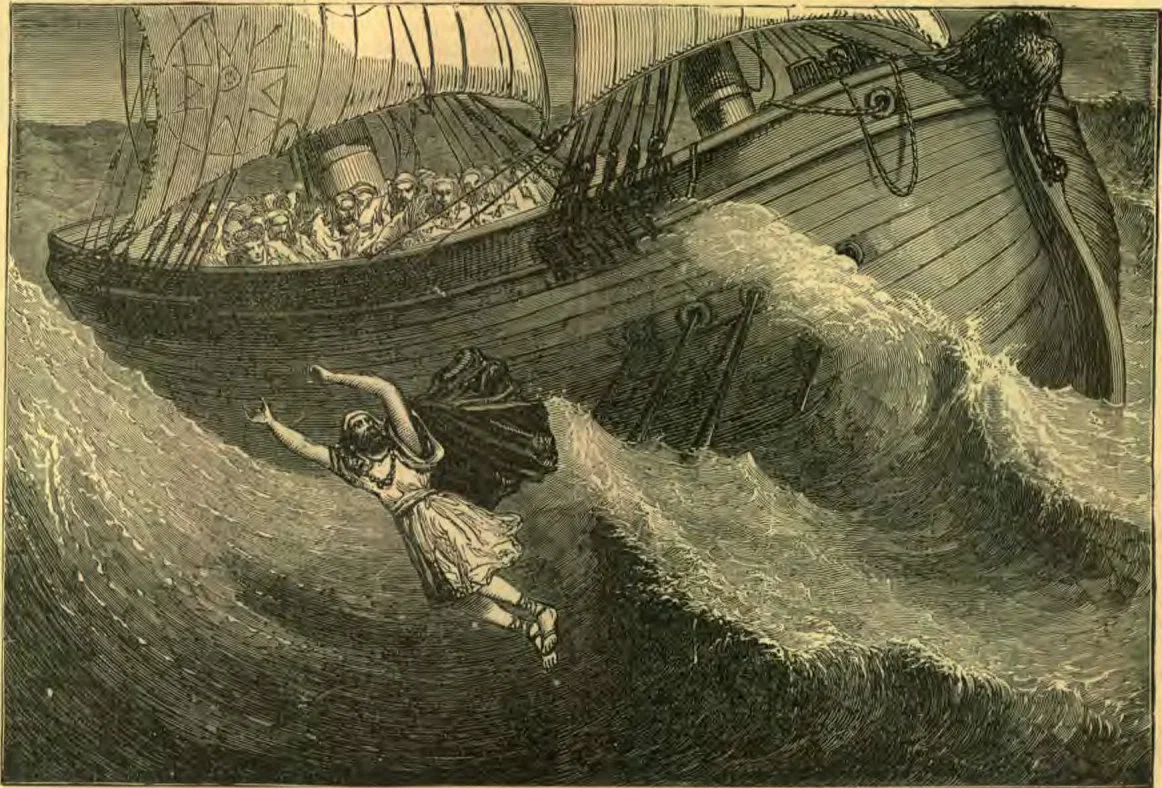
In the illustration we have a thrilling view of the wayward prophet, as the heathen sailors were committing him to the bosom of the great deep. A full history of Jonah is given in the book which bears his name. It will be interesting to all the readers of the INSTRUCTOR household. This prophet is once mentioned in another part of the Old Testament. See 3 Kings 14:25. Jonah lived and had his most singular experience some eight hundred years before the birth of Christ. G. W. A.

PHIL'S OFFERING.

EVERYBODY in town liked him, and was proud of him. “A smart young fellow, the world will hear from him yet,” said one and another, nodding approvingly as they met him.
“There's only just one thing to hinder,” said Joe Graham, his chum and best friend. “Phil is a little too smart for his own good, according to my way of thinking; and if he doesn't look out pretty sharp, he will find a shoal or two ahead of him in the end.”
But Phil only laughed when Joe intimated anything of the kind to him; he felt so sure of himself and his capabilities. Why, there wasn't a boy in the academy that could make such brilliant recitations as he, and he never spent half the time preparing them that the rest did! To be sure, upon close examination some of the boys whom Phil secretly looked down upon as “pokey,” had really come out ahead of him because they had gone to the root of the matter, and thoroughly mastered the subject, while he had only skimmed on the surface of it. Joe's warnings had come to him at such times, and he had been troubled with faint misgivings lest, after all, there was some truth in them. But as such thoughts were uncomfortable, he always shook them off as quickly as possible, resolving, however, to be more thorough himself in the future.
But there was always so much to attend to, and after all, one did not get caught very often; and before Phil knew it, he had forgotten all about his resolve.
When he was sixteen, he gave himself to Christ. He was thoroughly sincere in the consecration, and made many an earnest resolve to be faithful in working for the Master. But he forgot that he could glorify God just as truly in doing his every-day work and duties faithfully as in attending church services; so it came to pass that while his place was never vacant in church, and he never failed to take part in the young people's meeting, his lessons were but poorly prepared, and sometimes were positive failures.
Joe Graham watched him in silent disapproval. “Phil's either making a mistake, or else there isn't anything to it. I don't believe in a religion that approves of wasting talents like his,” he said to himself. “Going to meeting and making prayers are all well enough, but somehow I'd have more faith in it if it made Phil get his lessons thoroughly and do his work faithfully. Bah! His father sent him to mend a fence the other day, and he actually didn't half do it, he was in such a hurry to get off to meeting. He said it would do well enough, but a mosquito could have knocked it over. As for school, he is just wasting his time there; it's a shame, I say.”
In the meantime Phil was longing to have Joe with him in this, as they had been for years in everything else. It was so hard not to be able to appeal to him for sympathy and counsel; and many an earnest prayer went up from his heart for his friend. He tried time and again to plead with Joe, but somehow, do his best, he could never get a chance to say a word on the subject.
He felt a little hurt over it; and one night, as they were going home together, he resolved that he would speak anyway. Perhaps Joe guessed his purpose, for he talked nonsensical things. Phil could not help laughing, but he would not be bluffed in that manner.
“I say, Joe,” he said, interrupting him finally, “just save your nonsense awhile. I want a little talk with you. I—want you with me, Joe. Won't you give yourself to Christ? Can't we try to serve him together?”
Joe walked on a few steps in silence.
“You say you have given yourself to Christ, do you?” he said presently.
“Yes,” answered Phil. “Won't you do the same?”
“I always supposed that when we gave away anything, we took special pains with it. I remember when you made that bracket for Miss Gardner you fussed over it more than a little to have it perfectly true. I don't exactly understand you now, Phil.”
“And I am sure that I do not understand you,” responded Phil rather stiffly. He was quite sure that Joe was finding fault with him, though he did not really see how, and he had a chronic dislike to being found fault with in anything.
“Why, you say that you have given yourself to Christ. Now, if you were going to make a gift to the—president, for instance—you wouldn't give anything but the very best that you could get—you would be ashamed to, you know; but it strikes me that you are making a poor article of your gift to the Lord. I am not very well versed in the Bible; but if I remember aright, it was a command that only that which was perfect should be offered in sacrifice. It seems to me if I gave myself to him, I would try to make my offering as nearly perfect as possible; for, as I look at it, it would honor and praise him more if I were all that I possibly could be in every direction. I don't mean to hurt your feelings, Phil, but it seems almost insulting for one to complacently offer the Lord what one would never think of offering an earthly friend. Good-night,” and Joe bounded in at his own door, giving Phil no chance to say anything either way.
He felt very uncomfortable; it had seemed to him that the gift of himself was a great deal. Could it be possible that Joe was right? He remembered how much pains he had taken with the bracket for Miss Gardner; he would never have offered her anything that was not done the very best that he could do it; and yet he was taking no particular pains with the self he had given to God. He knew very well that he was not making half what he might of himself. It came over him, as never before, how little he was really making of himself.
It was a new idea to him, and not a very comfortable one, for he liked to feel that he, and whatever he did, was about right; but before he went to bed that night, he knelt down and humbly prayed for help to make his offering as perfect in all ways as possible.
Joe nodded approvingly several times to himself during the next two or three days as he watched Phil closely; and when one night Phil came to him, he met him with outstretched hands.
“Oh, Joe, I am so glad that you spoke to me so; and, God helping me, I will make the most of myself after this, though the best is poor enough; but somehow I had never looked at it so before.”
“All right, old fellow,” responded Joe. “I knew that you would if you only thought of it, and—I guess—we'll try together after this.”—Zion's Herald.

THE NEW YEAR.

SPEAK softly! The old friend is passing away, Who led us thus far up the steep, winding slope, And cheered us through many a cloudy, dim day, By pointing us on to the beacon of hope.
Tread gently, speak softly! The old friend departs, He speedeth away to the home of the years; And what though the record he leaves on our hearts Be bright with our laughter, or dark with our tears? We can make of each sorrow or joy of the past A step that will help us to heaven at last.
—H. M. Burnside.

THE POWER OF A LIVING BIBLE.

A YOUNG man joined one of our churches. He was an intelligent, educated young man, and the son of pious parents; but through some strange influence he got away from the teachings of his parents, and lost his faith in the Bible and in religion. He became an infidel, and would not allow any one to speak to him on the subject. He gave up going to church. He would not read the printed Bible, and so God sent him a living Bible, which he could not help reading. In his father's house a young lady resided, who was a relative of the family. Her fretful temper made all around her uncomfortable. She was sent to a boarding-school, and was absent some time. While there, she became a true and earnest Christian. On her return, she was so changed that all who knew her wondered and rejoiced. She was patient and cheerful, kind, unselfish, and charitable. The lips that used to be always uttering cross and bitter words now spoke nothing but sweet, gentle, loving words. Her presence brought sunshine instead of clouds. Her infidel cousin George was greatly surprised at this. He watched her closely for some time, till he was thoroughly satisfied that it was a real change that had taken place in his young cousin. Then he asked her what had caused this great change. She told him it was the grace of God which had made her a Christian, and had changed her heart. He said to himself, “I don't believe that God has anything to do with it, though she thinks he had. But it is a wonderful change that has taken place in her, and I should like to be as good as she is. I will be so.” Then he formed a set of good resolutions. He tried to control his tongue and his temper, and kept a strict watch over himself. He was all the time doing and saying what he did not wish to do and say. And as he failed time after time, he would turn and study his good cousin's example. He would read this living Bible; and he said to himself, “How does it happen that she, who has not so much knowledge or as much strength of character as I have, can do what I can't do? She must have some help that I don't know of. It must be, as she says, the help of God. I will seek that help.” He went into his chamber and prayed to that God whose very existence he had denied. He prayed earnestly. God heard him and helped him, and he became a Christian.—The Young Men's Christian Magazine.

JANUARY

O THE beginnings of things! Bright little springs in the mountains, from which great rivers down flow; The first pale pink of the roses; the first white fall of the snow; Babies, the beautiful darlings, dimpled and winsome and dear; The glow of the sky in the morning—and the first new days of the year!
I love the beginnings of things! For then you feel stronger and braver; more ready to climb and to try; The old day of blunders is over, the time for mistakes is gone by, And somehow or other the future is fuller of light and of cheer, When a little maid peeps at the world through the first new days of the year.
—Wide-Awake.

Father's Promise

ONE morning, when stopping with a friend in the country, he raised the curtain as we arose from family prayers, and we looked out of the window. The rain was falling slowly, and the heavy clouds gave promise of a gloomy day. As we were looking out at the storm, a carriage filled with people came down the lane, which passed the house, and led back to a cottage in the interior of the farm.
Said my companion, “Here come John and Mary, with their children. A fine time they will have going to town for a holiday in this rain! But they have promised the children they could go, and go they must. Then he added,—and his own children heard him,—“We never make our children any promises. When a holiday comes, if the weather is fine, we take them; but if not, they can stay at home without being disappointed.”
I said nothing. I was looking at the faces of those in the carriage. Happiness was certainly there. How I admired the strength and activity of the oldest boy, as he leaped from the carriage in his rubber coat, and held wide open the great gate for his father to drive through. Many long, weary days had he toiled at the appointed farm tasks, cheered by the promise that a day of rest and recreation should follow; and now, as he looked into his father's face, and realized that his promise was being fulfilled in spite of the rain, it was easy to read what was in his heart. The faces of his two little brothers and baby sister, and even of his aged grandmother, seemed to tell the same story, as they passed out of my sight.
Then I looked at the children within. They had been watching the carriage too, but their faces were turned from mine now to hide the tears that were gathering. They had counted on a holiday too,—if the sun shone,—but father had made them no promise, and his words to me gave them the assurance that they were to remain at home, and “not be disappointed.”
There was sunshine in the carriage, gloom without; but tenfold was the gloom within the house,—a gloom which rested like a pall on the withered hopes of childhood, and stunted the growth of that filial love which God had planted there.
I saw the same carriage come home late in the afternoon. Again the gate swung wide, and again I saw the faces of those within. What mattered that the rain still fell! that they had been obliged to eat their basket lunch in church or hall, instead of in the park! that they had failed to see the gorgeous parade of knights and firemen which the storm prevented! Father had kept his promise; the rest was forgotten. Sunshine and joy lit every face, and love filled every heart.
Then I thanked my heavenly Father that he had lightened our toil with sure and steadfast promises. He has not left us to struggle on in doubt and despondency, but has promised us a rest if we are faithful.
And no rain will stop that procession, nor silence the music of the band; for this time our Father “measures the waters in the hollow of his hand,” and “the winds and the sea obey his voice.” Let us, therefore, “cast not away our confidence, which hath great recompense of reward.” For if we have patience, “after we have done the will of God, we shall receive the promise.”
F. S. HAFFORD.

Doing the Work God Has Adapted Us For

To try to do other work than that to which God has adapted us, is simply to break and ruin some of God's tools, and leave our work undone.

WORTH SAVING.

Mat Hemsworth was as stout a sailor as ever reefed a sail. A good fellow he was, too—honest, trusty, and upon the whole, rather religious; at least, he revered the Bible, and listened when the chaplain read or prayed. Whether this had any effect on his heart or life was another matter.
One day a lady, whose heart was filled with love to the Saviour, came on board Mat’s ship, and began to speak to him of Jesus. He listened as to an oft-told tale.
“I know it all, ma’am,” he said. “I believe every word of the Bible.”
“You believe the Lord Jesus died on the cross?”
“I do,” replied Mat.
“Then have you ever thanked him?”
Mat looked startled. “I can’t say as I have, ma’am.”
“Well, Mat, suppose I fell overboard, and you jumped in and pulled me out; what would you say if I never even thanked you?”
“Indeed, ma’am, I’d say you were not worth saving,” was the candid reply.
“And I’d say you were about right,” said the lady pleasantly.
Dear children, God’s word tells us that the Lord “shall see of the travail of his soul, and shall be satisfied.” Do you think he can be satisfied if, after giving his life to save us, he sees us forgetting and neglecting him? Turn to him for forgiveness, thanking him from your very hearts for what he has done for souls; and make it your object every day to live to please him who thought you worth saving.—Selected.

MIND YOUR BUSINESS.

NINE-TENTHS of all that goes wrong in this world is because some one doesn't mind his business. When a terrible accident occurs, the first cry is that the means of prevention were not sufficient. Everybody declares we must have a new patent fire-escape, an automatic engine switch, or a high-proof, non-combustible sort of lamp oil. But a little investigation will usually show that all the contrivances were on hand, and in good order; the real trouble was that somebody didn't mind his business; he didn't obey orders; he thought he knew a better way than the way he was told; he said, “Just this once I'll take the risk,” and in doing so, he made other people take the risk too; and the risk was too great.
At Toronto, Canada, not long ago, a conductor, against orders, ran his train on a certain siding, which resulted in the death of thirty or forty people. The engineer of a mill at Rochester, N. Y., thought the engine would stand a higher pressure than the safety valve indicated, so he tied a few bricks to the valve to hold it down; result: four workmen killed, a number wounded, and mill blown to pieces. The City of Columbus, an iron vessel fitted out with all the means of preservation and escape in use on shipboard, was wrecked on the best known portion of the Atlantic coast, on a moonlight night, at the cost of one hundred lives, because the officer in command took it into his head to save a few ship lengths in distance by hugging the shore, in direct disobedience to the captain's parting orders. The best ventilated mine in Colorado was turned into a death trap for half a hundred miners, because one of the number entered with a lighted lamp the gallery he had been warned against. Nobody survives to explain the explosion of the dynamite cartridge factory in Pennsylvania, but as that type of disaster is almost always due to heedlessness, it is probable that this instance is not an exception to the rule.
What is most wanted in this world is people that will mind their business; all the devices, inventions, and contrivances you can shake a stick at, won't insure safety; the real need is automatic obedience, patent honesty, non-combustible brains, high-proof character. Men that can furnish these are in demand. Be sure, whatever your disadvantages, however humble your present position, your services will not long go a' begging if you have that one faculty of minding your business.—Treasure-Trove.

BE HONEST.

Sit down and think about it, boys. Do you really want to be honest men? Men who can be trusted anywhere? And with any amount of money? Then you must begin by being honest now. Never allow yourself to take or retain a single penny that is not rightfully your own. Take nothing without permission, or without giving something in return. Pick no berries that are not on your own side of the fence. Go into no orchard where you do not belong. Plunder no melon patches nor gardens, nor cheat your little playmates in any trade.
God loves honest boys, and he loves honest men. He says that the man or boy, who is “faithful in a little will be faithful in much;” and we know that none but the faithful ones will find a place in the kingdom. You stifle the voice of conscience when you allow yourselves to take what does not belong to you. You sear, or burn it as with a hot iron, so that it cannot feel; and if you keep on being dishonest, you will, after awhile, not care at all, and will become, it may be, robbers and murderers, and lose all the bright things God has promised to the good. Be honest, boys! And don't forget that the one who is honest will always get along the best in this world, and in the world to come.

A THE TEACHER'S COVENANT.

Whoever takes any place of trust or responsibility, by that act agrees to fulfill the obligations involved. Such is the unwritten covenant of the Sabbath-school teacher. First, it is a covenant with God to faithfully represent him to the pupil; to show him in his true character, as a living, present, loving, impartial, holy God. It is an agreement to teach the teaching that he gives us in the word of God, putting away guesswork and speculation, and giving to the hungry and thirsty soul the divine manna and the living water of revealed truth.
Second, it is a covenant with the people, to be faithful to the spiritual needs of all. Sick men must not be trifled with. Faithfulness may cause pain, but it is better to heal by suffering, than to destroy by soothing. It is an agreement to teach in a Christ-like manner, simply, aspiring to be understood rather than to be admired, earnestly impressing the pupil with the reality of the truth, lovingly touching the heart with divine tenderness.
Third, it is a covenant with one's self, to seek by daily walking with God, by prayer, meditation, and service, to know God, that we may correctly and convincingly represent him. To seek by honest study to know the word of God, that we may be able to teach it. To study the individual needs of the pupils, that, like a wise physician, we may be able to prescribe for them intelligently. To seek and cherish the spirit of Jesus, that we may be enabled to teach in a Christ-like manner.
If the obligations of this covenant seem too heavy to be borne, remember that he has promised to every faithful worker: “My grace shall be sufficient for thee.” For the sake of the children, the world, and the kingdom of our dear Lord, let us be faithful to God, faithful to our pupils, and faithful to ourselves.—Selected.

A FLOATING CITY.

ONE of the most wonderful cities in the world is Bankok. It is the capital of Siam, and is situated on—or rather in—the great river Meinam. On account of several great cholera epidemics that had visited the city, one king ordered the people to build on the river in order to secure greater cleanliness and better ventilation. Afterward, the royal family and persons of distinction were permitted to build on the banks of the river. The following account of it will help you to form a picture of this unique metropolis:—
“The capital of Siam! Did you ever witness such a sight in your life? On either side of the wide, majestic stream, moored in regular streets and alleys, and extending as far as the eye can reach, are upward of seventy thousand neat little wooden houses, each house floating on a compact raft of bamboos; and the whole intermediate space of the river presents to our astonished gaze one dense mass of ships, junks, and boats, of every conceivable shape, color, and size. As we glide along among these, we occasionally encounter a stray floating house, broken loose from its moorings, and hurrying down the stream with the tide, amidst the uproar and shouts of the inhabitants and all the spectators. We also observe that all the front row of houses are neatly painted shops, in which various tempting commodities are exposed for sale; behind these again, at equal distances, rise the lofty and elegant porcelain towers of the various watts and temples. On our right hand side, far away as we can see, are three stately pillars, erected to the memory of three former kings, celebrated for some acts of valor and justice; and a little beyond these, looming like a line-of-battle ship among a lot of cockle-shells, rises the straggling and not very elegant palace of the king, where his Siamese Majesty resides. Right ahead, where the city terminates, and the river, making a curve, flows behind the palace, is a neat-looking fort, surmounted with a grove of mango-trees, over which peep the roofs of one or two houses, and a tall flag-staff, from which floats the royal pendant and jack of Siam—a flag of red groundwork, with a white elephant worked in the center. That is the fort and palace of the prince Chou Fau, king of Siam, and one of the most extraordinary and intellectual men in the East. Of him, however, we shall see and hear more, after we have taken our baggage on shore, and had a little rest. Now, be careful how you step out of the boat into the balcony of the floating house, for it will recede to the force of your effort to mount; and if not aware of this, you lose your balance, and fall into the river. Now we are safely transhipped, for we cannot as yet say landed; but we now form an item, though a very small one, of the vast population of the city of Bankok.”
“We take a brief survey of our present apartments, and find everything, though inconveniently small, cleanly and in other respects comfortable. First we have a little balcony which overhangs the river, and is about twenty yards long by one and a half broad. Then we have an excellent sitting-room, which serves us for parlor, dining-room, and all; then we have a little side room for books and writing; and behind these, extending the length of the other two, a bedroom. Of course we must bring or make our own furniture; for, though those houses inhabited by the Chinese are pretty well off on this score, the Siamese have seldom anything besides their bedding materials, a few pots and pans to cook with, a few jars of stores, and a fishing-net or two. Every house has a canoe attached to it, and no nation detests walking so much as do the Siamese; at the same time they are all expert swimmers, and both men and women begin to acquire this very necessary art at an early age. Without it, a man runs momentary risk of being drowned, as, when a canoe upsets, none of the passers-by ever think it necessary to lend any aid, supposing them fully adequate to the task of saving their own lives. Canoes are hourly upset, owing to the vast concourse of vessels and boats plying to and fro. On account of this negligence or carelessness in rendering assistance, a Mr. Benham, an American missionary, lost his life some twelve years ago, having upset his own canoe when it was just getting dusk; and though surrounded by hundreds of boats, not one deemed it necessary to stop and pick the poor man up.”—Selected.

IMPORTANT BIBLE SUBJECTS.

LESSON 4.—THE CLEANSING OF THE SANCTUARY.

[NOTE TO THE STUDENT.—Do not consider the lesson learned until you can give at least the substance of every text, with the correct reference for each. The references in black letters indicate those texts that should be committed to memory. A little diligent application each day will enable you to learn them, although this need not be considered a test of scholarship.]
1. Describe the daily round of service in the sanctuary. Ex. 29:38, 41.
2. What other services were performed from time to time? Lev., chapters 4 and 23.
3. When did the yearly service take place? Lev. 23:27.
4. What was that day called? Verse 28.
5. What was the object of this day of atonement? Lev. 16:30.
6. With what was the atonement made? Lev. 17:11.
7. What besides the people was cleansed? Lev. 16:33.
8. How were the people required to observe this day? Lev. 23:27–31. (See .)
9. What offering was selected with which to make the atonement? Lev. 16:7, 8.
10. What is the penalty for breaking the law of God? Eze. 18:20.
11. Which goat was slain? Lev. 16:9.
12. Why did the goat have to suffer this penalty?—Since the sins of the people rested upon him, he had to receive the penalty of God's broken law.
13. What did the priest do with the blood of the Lord's goat? Verse 15.
14. What does the blood represent? Lev. 17:11.
15. Why was the blood of these sin-offerings sprinkled upon the mercy-seat?—To show that the law deposited beneath it demanded the life of those who had broken that law.
16. What was the mercy-seat?
17. What was beneath it? Lev. 16:13.
18. What solemn work did the priest perform when he returned from the most holy place into the first apartment called in this chapter the “tabernacle of the congregation”? Lev. 16:18, 19.
19. How was this work accomplished?
20. For what did the priest first make an atonement on this tenth day of the seventh month? Lev. 16:11–14.
21. What was the next step in the important services of the day? Verses 15, 16.
22. What work of cleansing was performed in the first apartment? Verses 18, 19.
23. After the high priest had thus made an end of reconciling, or purifying, both holy places and the altar of incense, what ceremony did he perform at the door of the tabernacle? Verses 20, 21.
24. What name was given to this goat that was kept alive? Verse 10, (also margin of verse 8).
25. What was finally done with this goat? Verses 21, 22.
26. What was thus in a figure fully accomplished?—The cleansing of the sanctuary by removing the sins of the people from it.
27. Did this service actually take away sin? Heb. 10:3, 4.

NOTE.

Every teacher in the Sabbath-school has a duty to the school as a whole, as well as a duty to his particular scholars. The school does not belong to him, but he does belong to the school. In the opening and closing exercises, in the teachers' weekly meeting for lesson-study, in the united planning and doing of the school for its scholars, each teacher has a place and a part. If he fails there, he is not faithful to his duties as a teacher in that school. It is not enough to be faithful to one's class; one must be faithful to one's fellow-teachers, to one's superintendent, and to one's school, in order to be a really good Sabbath-school teacher.

DUTY

God doth not need Either man's work or His own gifts: who best Bear His mild yoke, they serve Him best; His state Is kingly. Thousands at His bidding speed, And post o'er land and ocean without rest; They also serve who only stand and wait. —John Milton.

A CAT'S LONG RIDE.

PROBABLY the longest and swiftest ride ever taken by a cat that survived the journey, was one on the fly-wheel of an engine in the Star Printing Establishment a few months since. The Montreal Star thus tells the story:—
“The engineer, soon after starting the steam engine Tuesday morning, noticed a white patch on the inner surface of the drive wheel, which he thought was a piece of paper caught by one of the spokes in its flight and whirled round and round by the wheel. The white patch was noticed by several of the hands during the morning, who accounted for it in the same way; but no attention was given to the matter until the engine was stopped shortly after noon. As the wheel stopped, the engineer was surprised to see the white spot fall to the ground, and then get up and crawl away. He then, for the first time, became aware that the white spot whirling in the fly-wheel was a cat which had been clinging to one of the spokes of the wheel, and had only relaxed its hold when the wheel had come to a standstill. The cat seemed dazed for awhile, and was taken into the street for fresh air. Here it remained perfectly still for considerable time; but on an attempt being made to cover it with paper, it ran off in a zig-zag course, but apparently as fully alive as ever. The lower portion of the fly-wheel revolves in a trough, the sides of which fit close to the broad tire of the wheel; and it is supposed that the cat, which was a strange one, being frightened at the entry of the engineer, jumped into the trough to get out of the way, and when the wheel was started, found itself whirling around on the inside of the tire. The wheel is ten feet in diameter, and as it revolved from 7 A. M. to 12 P. M., and at a rate of sixty revolutions per minute, by a simple calculation it will be found that the cat traveled a distance of about 110 miles, or about 18,000 revolutions of the wheel.”

A QUEER JAIL.

PRISON convicts so frequently escape, or attempt to do so, from their places of confinement, that how to make prison-houses the most secure sometimes taxes the ingenuity of a genius. One curious plan is displayed in a new Omaha jail, and is thus described in a local paper:—
“The cells are arranged in the form of a great iron cylinder, which revolves about so that only one cell is at the opening at any one time. This cylinder is three stories high, there being ten cells on each floor. Its weight is forty-five tons, and this ponderous weight is hung from above, instead of turning on a track below. The strangest part of the arrangement is that the great cylinder can be turned by a simple crank with very little force, a man with his left hand moving it readily. When it is complete, it is the intention to have a little water motor in the basement; and then, by simply moving a lever, the cylinder will be set to rotating. It is suggested that when there are prisoners who, it is feared, may be trying to cut out, the cylinder can, by a motor, be easily kept moving slowly all night, so that the prisoners do not remain long enough in one place to do any mischief, or even to crawl out if they had made a partial break. It seems that prisoners have little chance for escape from the new jail. A cage of iron bars completely surrounds the cylinder in which the cells are. The entrance on each floor is guarded by two doors. The officer standing outside does not have to unlock even the first door, but can swing the cylinder around until the cell appears in which is the desired prisoner; and then, by a simple movement, the inner door is opened, and the prisoner can step out of his cell. Then the officer can open the other door, and let the man out; but the other prisoners are way beyond any possible reach of the officer, and it is impossible for them to make any break on him while he is taking a man out or putting one in. He can handle any number of men in the same way, and they cannot reach him until he chooses to let them.”
Continue reading: DOMESTIC LIFE IN INDIA