The Youth’s Instructor, Vol. 34, No. 2.

JONAH AND THE WHALE
Earlier text: JONAH AND THE WHALE

DOMESTIC LIFE IN INDIA.

It too frequently happens that a single servant occasions more trouble than he really does good; but when a family is dependent upon a number, and unfaithful ones at that, its domestic peace must be greatly marred. But the annoyance of several American servants perhaps would be slight in contrast with what one experiences who is dependent upon outside help in far away India. At least, it would seem thus from what Mrs. Leonowens has written of domestic life in that country. In her “Life and Travels in India,” she says:—
“To begin with, there were too many servants for so quiet and unpretending a household; but I soon found it would be still more difficult to do with fewer; ‘dusto’ (custom) was flung into my face morning, noon, and night. I implored my husband to send half of them away; but if he sent one off, either the whole gang disappeared like a flash, or else the work of the banished servant was scrupulously avoided by every one in the establishment. There was, in short, a servant for every distinct thing to be done in the house. There was a khansamah, or native butler, a high caste Hindoo, who was supposed to keep all the servants in order, but who invariably incited a revolution in the camp if I wished anything to be done my way and not his. Then there was a cook, a ‘kling’ (a name for a certain race, natives of Madras), who got drunk whenever we happened to have friends to dinner; there was a cook’s mate, who was inclined to be musical just as we were going to sleep; there was a ‘buttee-wallah,’ or lamp-lighter, a stripling, some near relation of the butler’s, whose friends and relatives were always dying, and who asked permission three times in the course of a few months to be allowed to go and bury his mother. When I very gently, because of his flowing tears and doleful expression of face, reminded him that he had already buried or burned her twice, he burst into a passionate sob and said, ‘Oh! that one was my aunt’s mother, and the last one my father’s mother, but this is my own, own mother.’ Of course I had to let him go off for two or three days, and the butler too, who was also a mourner. Then there was, besides these, an ‘ayah,’ or lady’s maid; a ‘dhoby,’ or washerman, who came to the house once a week for the clothes, and stayed away sometimes for three weeks, owing to that chronic epidemic, death in the family; a ‘bheestie’ who filled the tubs in the bath room with water, and did nothing else; a ‘jarrowallah,’ who only came each morning and swept the house and grounds, and then disappeared until the next time; a coachman, a groom, a ‘pundit,’ or professor of Oriental languages; and lastly, a tailor, whose name was Tom.”

Self-Winding Clock Keeps Perfect Time for Years

A CLOCK which has required neither winding nor regulating for five years was placed by the Belgian government in a railroad station four years ago, and has kept perfect time ever since.

Prince Bismarck's Preference for Quill Pens

PRINCE BISMARCK never uses any pens, save those made of goose-quills, and dries his writing with blue sand. Steel pens and blotting-paper he deems inventions of the enemy.

HOW THEY KEPT THEIR FEET.

EFFIE was busily learning the Bible verse which grandma had given her; for at Grandma Wilson's the children were always expected to repeat a verse of Scripture every morning. Grandma herself had done so ever since she was a little girl, and Effie and Winnie thought it no hardship, but rather pleasant, to do things “as grandma did.”
It was a bright, cold Sabbath morning outside, but not a bit of cold stole into the pleasant dining-room where Effie sat. The coal-fire sparkled, and sent up funny little jets of flame, which Effie and Winnie thought must be something like very tiny volcanoes. Effie felt happy and satisfied as she looked up now and then from her Bible, around the pretty room, and especially on her garnet cloth dress, which she had on for the very first time this Sabbath morning.
“What are you doing?” asked Winnie, when she came in.
“Learning my verse. It's such a long one; just listen: ‘If thou turn away thy foot from the Sabbath, from doing thy pleasure on my holy day; and call the Sabbath a delight, the holy of the Lord, honorable.’ And that isn't the whole verse, either, but grandma said I need only learn this much.”
“I wonder what verse grandma will give me,” said Winnie, smoothing down her garnet dress.
Grandma soon settled that; for when she came into the dining-room, she said, “And now I must find a Sabbath verse for Winnie, too: ‘Keep thy foot when thou goest to the house of God, and be more ready to hear, than to give the sacrifice of fools.’”
“Oh!” laughed Winnie. “Our verses have both got ‘feet’ in them. Does it mean, sure enough, feet like ours, grandma?”
“It certainly does,” said Mrs. Wilson.
“But, grandma,” said Effie, thoughtfully, “how can our feet keep the Sabbath holy, except by taking us to church?”
“Now, that is what I want you to think about, and find out,” said grandma, smiling. “The Bible says a great deal about our feet. It says we must ponder, or think over carefully, the paths of our feet. It tells us of the foot that hasteth to deceit, of the foot of pride, of the foot which may offend, or cause us to sin. If each one of my little girls watches, and keeps her foot in the right way, and turns it away from whatever is contrary to the fourth commandment, to-day, perhaps you will see how the little feet can keep the Sabbath holy.”
Soon both little sisters were snugly buttoned up in their warm coats, and off for Sabbath-school.
“There's Betty Hill,” exclaimed Winnie. “She is trying to catch up with us. And such a sight! She's been wearing that plaid suit for ever so long, and her hat is her summer one trimmed over. Let's walk right on, and pretend not to see her.”
“But, Winnie,” said Effie, looking troubled, “we have seen her; and if we walk on, won't our feet deceive? And you know grandma said something about the foot of pride, too. You know Betty's folks are poor, and she can't have such pretty clothes as we can.”
“Why, Effie, I had forgotten about the feet almost! I suppose we would better wait for her.”
Betty looked pleased as she came up to the girls.
“I wasn't going to Sabbath-school,” she said; “but, as you've stopped for me, I think I'll go along too.”
Miss Baker was glad to have another scholar, and at the close of the school thanked Winnie and Effie for bringing Bettie with them. The little sisters smiled at each other, and Effie whispered,—
“Winnie, aren't you glad we ‘turned away’ our feet?”
But as they went into church, and Effie was rather noisily tripping up the steps, it was Winnie's turn to whisper,—
“Don't you think, Effie, it would be keeping our feet to go more quietly into church?”
Then Effie blushed, and walked very softly up the aisle.
“It's Sabbath,—we can't go,” said Winnie, resolutely, though Effie looked rather wistful, when a schoolmate came in the afternoon to know if they would go out walking.
“I wish grandma wasn't quite so strict,” said Effie, with just a little bit of a sigh, as she closed the front door.
“Why, Effie,” exclaimed Winnie, “it isn't grandma; it's your Bible verse that says ‘not doing thy pleasure on my holy day.’ And you know just walking for our own pleasure wouldn't be turning away our feet from doing our own will at all.”
“I s'pose you're right, Winnie; but I never did think before about our feet helping us to be good.”
“You can't go into badness unless you let your feet carry you,” laughed Winnie.
“Has it been a happy Sabbath?” asked grandma, when each brown head was on the pillow, and she came to tuck in the bed-clothes round the little girls.
“Yes, grandma,” said Effie.
“And we did try to keep our feet,” said Winnie.—S. S. Times.

THE ICE-KING'S REIGN.

The sun had gone down with promises sweet, When, keen from the north, the wind Came blustering along on its coursers fleet, And left frozen tracks behind.
Maude stood at the window: the moon shimmered down On whirling leaves, stiff and dead, All piteously driven; she turned with a frown, And soft to herself she said:—
“The old tyrant Winter leaves nothing to prize, Leaves nothing that's bright or fair; He has stolen the blue from the bending skies, The warmth from the earth and air.
“The summer's dear blossoms are withered and dead; My garden is brown and bare; The chirper of birds in the nest overhead Is hushed, for no birdlings are there.
“The woodlands no longer are shady and sweet, Dry leafage encumbers the ground; The pathways, once verdant and soft to my feet, In fetters of ice are bound.
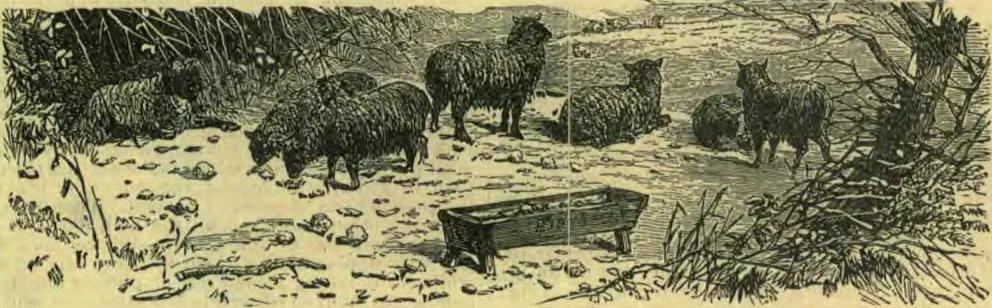
“The pride of the barn-yard sits humped with the cold, One frozen foot under his wing; And the sheep huddle closely, for warmth, in their fold; The ice tyrant reigns as king.”
She turns from this picture of ruin and death, And seeks the broad casement again; And, lo! from the dews of her wasted breath Great forests have grown on the pane.
Such beautiful trees! such ferns! and such flowers! Such rivers and mountains bold! Such charming cascades! she gazes for hours, And worships the ice-king cold.
—Our Little Ones.

Behind the Snow Loaf: God Above the Sunlight

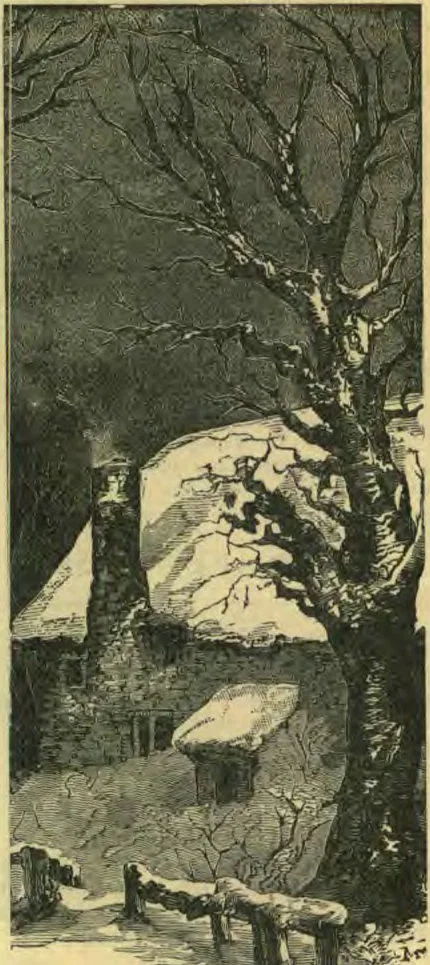
BEHIND the snow loaf is the mill-wheel; behind the mill the wheat field; on the wheat field falls the sunlight; above the sun is God.—J. S. Russell.

Letter Budget

THIS full Letter Budget shows what some of the little people have been doing; and we have a well-filled letter box besides. We are glad so many love the INSTRUCTOR, and are trying to be made wiser and better by reading it. Now for the letters.
WILLIE CASE, of Winnebago Co., Wisconsin, writes: “I am nine years old. We take the INSTRUCTOR, and like it very much. I have two sisters; one is seventeen, and the other is six years old. I had one brother and one sister that died. We have a Sabbath-school of nine members. I study Book No. 1. We all keep the Sabbath, and hope to meet the INSTRUCTOR family in heaven.”
HERE is a letter from LUCY A. REED, of Adair Co., Iowa, who says: “I am a little girl twelve years old. I go to Sabbath-school almost every Sabbath, and get my lessons in Book No. 3. I have one brother and one sister. We live three miles from meeting. Our school begins in a week from to-day. My grandpa lives with us. He keeps the Sabbath too. He is eighty years old, and he is not very well. I am trying to be good, so that I may meet you all when the Lord comes.”
FLORA MARSHALL, of Jefferson Co., Ind., writes: “I am a little girl eleven years old. I have two brothers and one sister younger than myself. We have been keeping the Sabbath for nearly three months. I go to Sabbath-school every Sabbath, and get my lessons in Book No. 1. We have three classes. There are seven scholars in the small class, eight in my class, and ten in the large class. I send my regards to the INSTRUCTOR family.”
JESSIE B. CASSIDY and MILLIE SLATER send letters from Buffalo Co., Nebraska. They go to the same Sabbath-school, and get their lessons in Book No. 3. There are thirty-six members in the school. Jessie was thirteen, and Millie sixteen, this fall. They are trying each day to live as Jesus lived, so that when he comes again, they may go to dwell with him in his kingdom. They send love to all the INSTRUCTOR family.
WILLIE A. BAKER, of McCook Co., D. T., says: “I am twelve years old. I have not seen any letter from here for some time, so I thought I would write. I have a father, mother, five brothers, and two sisters. I go to Sabbath-school, and study in Book No. 5. We live only a little way from the church. I also go to day school. Our school house is about half a mile from our house; and we have a good teacher. We live on the banks of a creek, and there is a stone quarry near us. There are stones here quite as large as a house floor, and we have lots of fun running around on them. This is a pretty place in the spring, when everything is green. I am trying to be a good boy, so that I can have a home in the new earth.”
NANCY GOBIN writes from Clinton Co., N. Y. She says: “I am a little girl eight years old. My mamma and I live with my grandma. My papa is dead, and so are my two little brothers, Frankie and Willered. Little Willered died last fall. I am trying to be a good girl so that I can meet them in heaven. I have two uncles who keep the Sabbath. They take the INSTRUCTOR, Review, and Signs. I love to read the INSTRUCTOR very much. I hope all the INSTRUCTOR family will pray for me. This is my first letter to the Budget.”
ADA BATTEN, of Lee Co., Iowa, says: “I have never seen a letter from this place, so I thought I would write one. I have been keeping the Sabbath with my mother, brother, and sister for over a year. I have two brothers who do not keep the Sabbath. We do not have an organized church, but we have a Sabbath-school with about twenty members. I mean to keep the Sabbath as long as I live. Pray that I may have a home with you in the new earth.”
CHARLIE ALGREN, writing from Blue Earth Co., Minn., says: “I am twelve years old. I study my lessons in Book No. 5. We have a good teacher to teach our class. We have a large church in Mankato; and after camp-meeting, we held a tent meeting there. Eld. Gregory held meetings for about two weeks in a school-house two miles from our place. We went there nearly every evening, and he visited us once. I have read the Bible all through once, and have got as far as the fourth chapter of Nehemiah the second time. I am trying to be a good boy so that I can stand in the battle of the great day of the Lord. I have taken the INSTRUCTOR ever since I could read it, and I think it a very nice paper. I read it all through every week; and after that, I give them to my schoolmates. They like it, too, but they don't want to subscribe for it. Pray that I may meet the INSTRUCTOR family in the new earth.”

You have reached the end of this edition.

The Youth’s Instructor · Jan 13, 1886