The temperature of the body in health is 98.6°, and it remains practically at this point the year round, regardless of the ordinary external influences, or even of atmospheric conditions. There is, however, a slight variation. The temperature is usually from .5° to 1° lower in the morning than in the evening. A thermometer placed in the mouth registers in health about the temperature given, or a little lower if it be placed in the armpit. The internal temperature, that is, the temperature in the heart, liver, and other internal organs, registers, of course, very much higher than this, being from 103° to 107°. As before stated, the temperature is subject to but very slight variation from external influences. This is true of the so-called warm-blooded animals. The bodily temperature of cold-blooded animals, such as the fish, the frog, etc., changes according to the environment. For instance, the temperature of the fish is only one or two degrees higher than that of the water in which it swims, the temperature of the fish rising and falling as the temperature of the water changes.
It is possible to cause a rise of temperature by vigorous muscular exercise. Severe muscular exercise may make a difference of several degrees. The temperature, however, soon returns to the normal point when free perspiration occurs. Such a rise of temperature is considered physiological.
The temperature is maintained at the normal point through the influence of the nervous system. When there are conditions surrounding the body which would cause a fall in the temperature, the body, through the mechanism of the nervous system, sets in operation processes which tend to conserve the heat of the body by lessening the elimination, and also by increasing the production of heat. Thus, during cold weather, the perspiratory activity is diminished, the skin is more tense and firm, there is less blood circulating in the skin, and the energy within the heat-producing cells of the body is increased.
On the other hand, when conditions are present which would naturally tend to increase the body temperature, such as warm air, excessive clothing, or during exercise, the body is prepared to combat this tendency to temperature rise by increasing the perspiration, the evaporation of which cools the body. There is increased blood circulation through the skin, and the blood coming from the internal parts of the body at a high temperature is cooled as it passes through the skin. The heart also is made to beat more rapidly, which in turn increases the amount of blood in the skin. Thus we see that so long as an equilibrium is maintained between the production of heat and the elimination of heat, or, in other words, so long as the balancing centers are undisturbed, the normal temperature can be maintained.
In disease processes, this equilibrium is disturbed, and fever results. Fever is one of the most constant symptoms of disease processes, especially of acute diseases. Fever, however, must not be looked upon as an unmixed evil. It is protective in its purpose. It is, first of all, one of the means nature takes to put the patient to bed. A man may in the morning feel strong and able to accomplish the usual amount of work, but by evening, if a marked fever develops, he finds himself weak and prostrated, and unable to do otherwise than go to bed. Were it not so, many persons would continue to perform the usual amount of work, using up their store of vital energy, which it is so important to conserve in order to sustain the body13through the trying ordeal of, perhaps, several weeks of sickness.
Another purpose of fever is that the increased intensity of the vital fires may more rapidly consume the products of disease processes taking place in the body. There would otherwise be an accumulation of wastes in the tissues, which would quickly overwhelm the body and destroy life. It is only when the vital fires burn too fiercely that it becomes necessary to moderate them.
Section men working on railroads frequently set fire to the weeds and rubbish which accumulate on the company's property, and the fire makes a clean sweep as it burns; and so long as it is confined to proper limits, it serves a most useful purpose. If, perchance, some sparks fall into a farmer's wheat field or his granary, the fire has gone beyond its proper limit, and damage results. It is necessary to quench the flame. So it is with the vital fires. As long as they keep within bounds, consuming only the wastes of the body, they fulfill a useful purpose; but when burning so fiercely as to cause the bodily temperature to rise to a critical point, endangering the vital processes, it is necessary that their vigor be diminished.
Increased bodily temperature is due either to an increase in the amount of heat produced within the body or to a failure on the part of the body to eliminate heat with sufficient rapidity, or to both. It is important to remember this fact, as it governs, to a considerable extent, the methods which may be properly applied for combating the fever.
To illustrate this point, we might cite the case of a patient attacked with a malarial paroxysm. There is deficient elimination of heat through the skin, which is evident from the pallor of the skin and the marked sensations of chill. While the patient is experiencing these unpleasant sensations, if the internal temperature is taken, fever will be found present. To plunge such a patient in a cold bath to reduce the temperature would be most absurd.
There are other disease conditions besides malaria in which fever is due to deficient heat elimination, as indicated by goose flesh and pallor of the skin, chill, and shivering, and in which vigorous cold baths must be avoided in combating the high temperature. In other cases in which fever is present, due to an excessive production of heat, where the face is flushed, the surface of the body is warm, and there is no tendency to chill, vigorous cold baths may be administered. When the patient is perspiring freely, nature is doing all that is possible to reduce the temperature, and it will certainly fall without further assistance.
It is necessary to understand the principles involved in fever processes, as here outlined, before it is possible to deal intelligently with cases of this sort. Suggestions as to the simplest and best methods of combating high temperature will be presented in our lesson in the next issue.
A Loving Word
By Lilian Gray
ONLY a loving word!
Which cost us nothing to say;
And yet in the web of a tangled life
It shines like a sunny ray.
Only a loving word!
But it made a weak heart strong,
And helped a tempted soul to choose
The right instead of the wrong.
Only a loving word!
But it brightened a gloomy day,
Or, spoken to some one weary and sick,
It charmed his pain away.
Only a loving word!
But it made the angels smile,
And what it is worth perhaps we'll know
After a little while.
— Lilian Gray.
A SISTER
By A Sister
From an Appreciative Reader
DEAR SISTERS: I do not know that I could say one helpful word to any of the readers of this page, but I wish to thank others for the good received through their articles from time to time. I believe that we isolated ones appreciate the letters of this department more than do those who have the companionship of others of like faith, and the articles I find here are very helpful in regard to the little ones, very comforting also in many ways. May we soon meet in one happy family in our Father's home, where there will be no isolated ones, no sorrow on account of sin, but an eternity of joy with him who hath redeemed us. May a blessing be bestowed to fit the especial need of each of his followers.
A SISTER
Loomis, N. Y.
The Highest Duties Lie on Lowest Ground
By Monsell
THE highest duties oft are found
Lying on the lowest ground,
In hidden and unnoticed ways,
In household works, on common days.
Whate’er is done for God alone,
Thy God acceptable will own.
—Monsell.
Giving and Receiving
By Plass
If deeds of love you would achieve,
This one great truth you must believe:
By giving you can best receive.
With prophet poor your cruse divide;
The little left is multiplied,
And want is kept far from your side.
Give water with a liberal hand;
And though a famine curse the land,
You never once athirst shall stand.
Scatter the seed across the field;
Expect that when the scythe you wield,
Abundant increase it will yield.
Give all you have in faith that more
Will be supplied from God’s own store;
Blessings will fall beside the door.
The naked clothe, the hungry feed;
What would supply a brother’s need
Lay not aside in selfish greed.
God sees the gift before him laid,
The liberal soul shall fat be made,
The deed of love full well repaid.
— Plass.
G. W. REASER
By G. W. Reaser
Natal
G. W. REASER
A list of the attractive features of Natal would include her sugar-cane industry, her tea, banana, pine-apple, arrowroot, and citrus-fruit plantations; her artificial forests of black wattle (the feathery acacia of California), her wild fruitless banana plants, giant ferns, and massive ant-hills. All of these indicate a semitropical land.
All the industries mentioned, except the wattle growing, are confined to the coast district. The labor connected therewith is performed almost wholly by indentured coolies, or the laboring classes of India, of whom there are more than sixty thousand in Natal. The term “indentured,” as used here, signifies that these natives of India are brought here under contract by the government of Natal, and hired to individuals by the government, for a period of five years; the employers to pay them at the rate of two dollars and a half a week, for the first year, the wages to be increased at the rate of twenty-five cents a week for the second and each succeeding year of the term, so that the last year of the five, the cooly will get three dollars and a half a week. In addition to this the employer must furnish a certain amount of food, and a shelter for his servants. If the man who is thus indentured has a wife, a separate contract is made with her, in case she desires to work for wages. This is said to be much better than the working classes can do in India.
The habits, as regards wearing apparel and house furnishing of these Asiatics, are very simple and inexpensive. As a rule they are hatless and shoeless. The women seem to manufacture but one garment, which is a short sack, reaching down to the waist. Then for the remainder of their covering they take a few yards of thin cloth, light in color, and cleverly winding it about their forms, tuck one end in and fasten it securely; and aside from the great display of jewelry which they all wear, they are attired in the height of Indian fashion. They bedeck their persons with gold, silver, and brass jewelry, in almost every conceivable place where it can be worn. The ears are punctured for massive pendants, the nose is perforated on either side for brass rosettes, numerous rings adorn the fingers and toes, a necklace is added “to give grace and symmetry” to the upper portion of the form, while numerous bands of silver or brass, embracing wrists and ankles, complete the attire and ornamentation of the ordinary cooly woman. These devotees of style seem to think, with many of their fairer sisters in civilized lands, that the Creator has made them greatly out of taste, and hence take much pains to make themselves anew.
The coolies who have completed the terms of their indentures, constitute a numerous class of small merchants and vegetable and fruit peddlers. As yet the vast majority of the Indians are in darkest heathenism, but a few have been Christianized. Nearly all of them speak three languages,—their native tongue, the Zulu, and the English. Great numbers of them come to the shores of Natal on shipboard, but are refused the privilege of landing, as the country would soon be overrun with them if they were allowed to come freely.
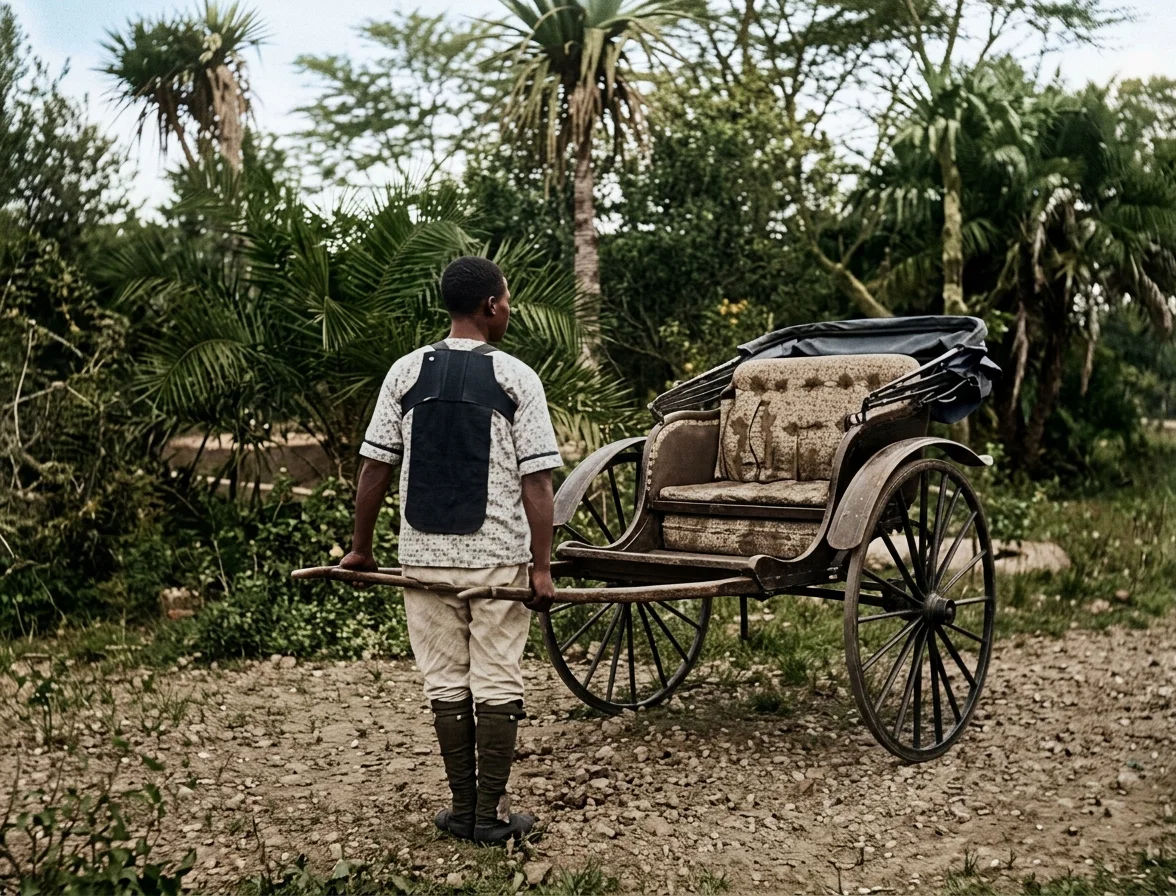
A JINRIKISHA BOY
The home of an Indian family is a place of the utmost squalor, with an admixture of filth. It sometimes boasts of two small rooms,—one, combining kitchen, dining room, sitting room, and general work room; the other is the family bedroom. There are no bedsteads, no chairs, and no stove. The floors are of packed earth, and the fowls and pigs are at liberty to share the kitchen, at least during the daytime, with the family. The building is of the14thatch, or of the cheapest material at hand. When a family of these poor people arrive from India, their effects are all carried from the steamer to the city, by the members of the family, and all together would scarcely fill a trunk of the smallest size.
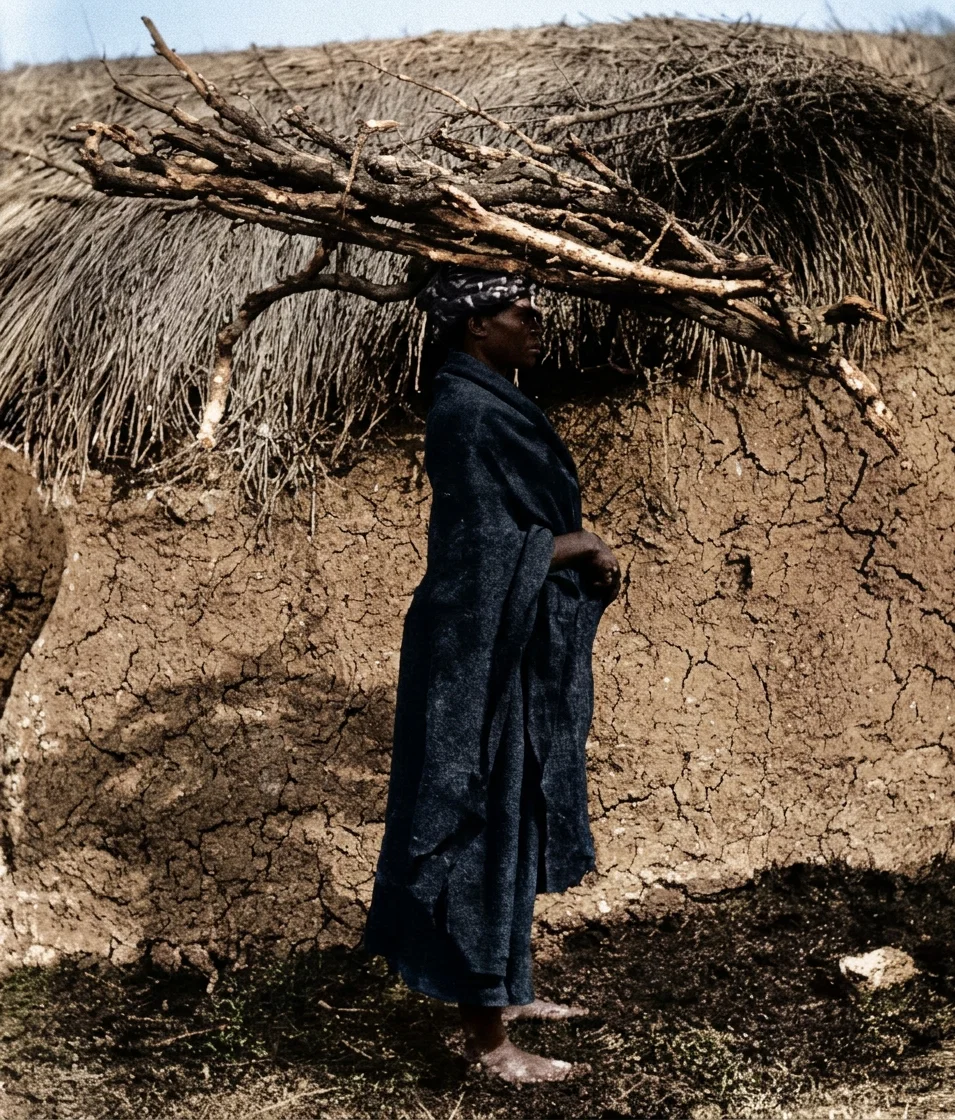
A NATIVE BURDEN BEARER
In Natal the Zulus, who number six hundred thousand, are the most numerous class of inhabitants. They perform the farm labor in the “up-country” districts, are the “jinrikisha boys” of the cities, the servants in almost every household; but the great masses of them are settled on large tracts of land called “native locations,” assigned to them by the government. It seems strange that one fourteenth of the population of Natal should constitute the ruling power, and hold the reins of government entirely in their hands, notwithstanding the fact that not long ago the natives had the supremacy, and were monarchs of all they surveyed. But as a matter of fact, the natives have no voice whatever in governmental affairs, nor even the right of franchise. The whites, about fifty thousand strong, are the governing body, but of course only a few of these hold offices. At present there is some dissatisfaction among the natives because they are not accorded the so-called privilege of the franchise, or vote.
One of the greatest evils among the natives of Natal, is their system of polygamy. One man may have as many wives as he can purchase, the price for each being ten head of cattle to the father of the bride, and one to the mother. They call this purchase price “lobolo.” If a young couple desire to unite in marriage, and the would-be bridegroom cannot pay “lobolo,” occasionally there is an elopement. This is not the end of the matter, however, for the father of the bride has the right, according to Zulu custom, which constitutes their law, to claim all the offspring as his property. Thus by this system the father of every family regards his wives and children as personal property, to work for and support him, and add to his worldly possessions in “cattle and goods.” Perhaps the worst feature of it all is that some husbands will deliberately bargain away some of their wives for a period of time to other men, on one condition only, and that is that the first husband, as the owner of the woman, shall have all children that may be born to her, as his chattels. The Europeans in Natal are agitating the plan of having the matter taken in hand by the government, and thus compel the natives to abandon polygamy. Many think that such a course would cause a general uprising, and a more disastrous war than has ever been waged by the powerful Zulus.
While the coolies wear brass and silver in profusion, the Zulus adorn their persons with a superabundance of beads and dozens of brass rings. The latter are worn about the wrists and ankles and just below the knee. In the country, the wearing of clothing, on the part of the unchristianized natives, is regarded as a matter of small importance. The more scant the wearing apparel, the better they seem to be pleased, provided the adornment of beads is not omitted. When the Zulu women reach a certain age, they wear what was formerly called in America a “chignon.” These projections are from four inches to a foot in length. The differences in length indicate one of three things,—either that the maiden has reached the age when a proposition of marriage would be proper, and presumably agreeable, or that she is betrothed, or that these two periods having passed, she is married. May it not be possible that the autocrats of fashion in Paris, perplexed to find something new for their devotees in the matter of dressing the hair, obtained the “happy idea” from looking over a collection of photos of the styles in “darkest Africa,” and hence gave the chignon to the world of fashion?
The native men puncture their ears, and then expand the opening until a lady’s thimble, in some cases, would drop through the hole. In this orifice they carry a spoon-shaped bone, used by them instead of a kerchief. The laws of the whites forbid the natives the privilege of making their favorite intoxicant—Kaffir beer. But it is not an unusual thing for a sober and industrious native to be seen drawing a drunken white man through the streets, in his jinrikisha.
At present we do not know of a single Zulu who has accepted the third angel’s message. We hope, however, that a work may soon be begun among them, which will result in bringing to many of them a saving knowledge of the truth. They are among the most intelligent natives of Africa. Many of them have really nice features. We are taking steps to have some of our smaller publications translated into the Zulu tongue, which is doubtless the language of two million people. “Steps to Christ” will be the first book that we shall place before them in their mother tongue.
The government employs a number of native policemen to look after the deportment of their own people. These are armed, not with firearms, but with their ancient weapon of war, the assagai; and they do not hesitate to use it on their own race, if occasion requires. Wherever one travels in South Africa, at the present time, he is confronted by soldiers. Only very limited journeys can be taken without a military permit; nor can one leave the country without showing this document. In a journey of a few miles, during the past week, the writer saw soldiers and officers in great numbers, a large hospital camp, a populous Boer refugee camp, also a train load of Boer prisoners, strongly guarded. One of the cars of this train was loaded with cannon, en route to the front. A few days ago a steamer, carrying one thousand four hundred and six Boer prisoners, sailed from Durban for Bermuda.
While thousands of Boers are held in the refugee camps, we hope to be able to supply them with present truth, in their own language. We trust that the Lord will bless this effort to the salvation of many.
An excellent way to give the truth to the natives would be for some consecrated, energetic young farmers to settle in the Transvaal at the close of the war, and arrange for a large number of native families to live on their farms. In this way they could not only be taught in schools, but they could receive a practical illustration of the truth, in the lives of those by whom they were employed.
The Secret of Support in Prayer
“He that knows how to pray has the secret of support in trouble, and of relief from anxiety; the power of soothing every care, and filling the soul with entire trust and confidence.”
Early Missionaries in the Cook Islands
By A. H. Piper
A. H. PIPER
THIS group in the South Pacific Ocean contains six principal islands,—Raratonga, Mangaia, Aitutaki, Atiu, Mauki, and Mitiero,—besides three others, which are small and of little importance. The total area is about one hundred and fifty square miles. The population is seven or eight thousand. Our work has been established a little over seven years in the principal island, Raratonga, and is known to our people as the Raratongan Mission.
From Raratonga it is one hundred and sixteen miles to the nearest island, Mangaia; and one hundred and fifty miles to the most distant, Mauki. The language spoken is the same, with the exception of a few words. In all the islands the natives use the Raratongan Bible. Until ten or fifteen years ago, each tribe was governed by its own chief, but the different chiefs had not the same power. In Aitutaki and Mangaia it was only nominal, but in Raratonga the chief’s power was absolute. He owned all the tribal lands, and, in fact, everything. If one of his tribesmen went to another island to work for a season, on his return he had to share his earnings with his chief. This power on the part of the Raratongan chiefs has made it hard for those natives who have desired to keep the Sabbath of Jehovah. On this point we will have more to say later. At the time mentioned above, the chiefs federated, and made the chief of the principal tribe in Raratonga the nominal head of the federation. However, each chief retained his status as far as his own tribe was concerned. In 1900 the whole group was annexed to England, and the chiefs are gradually losing power.
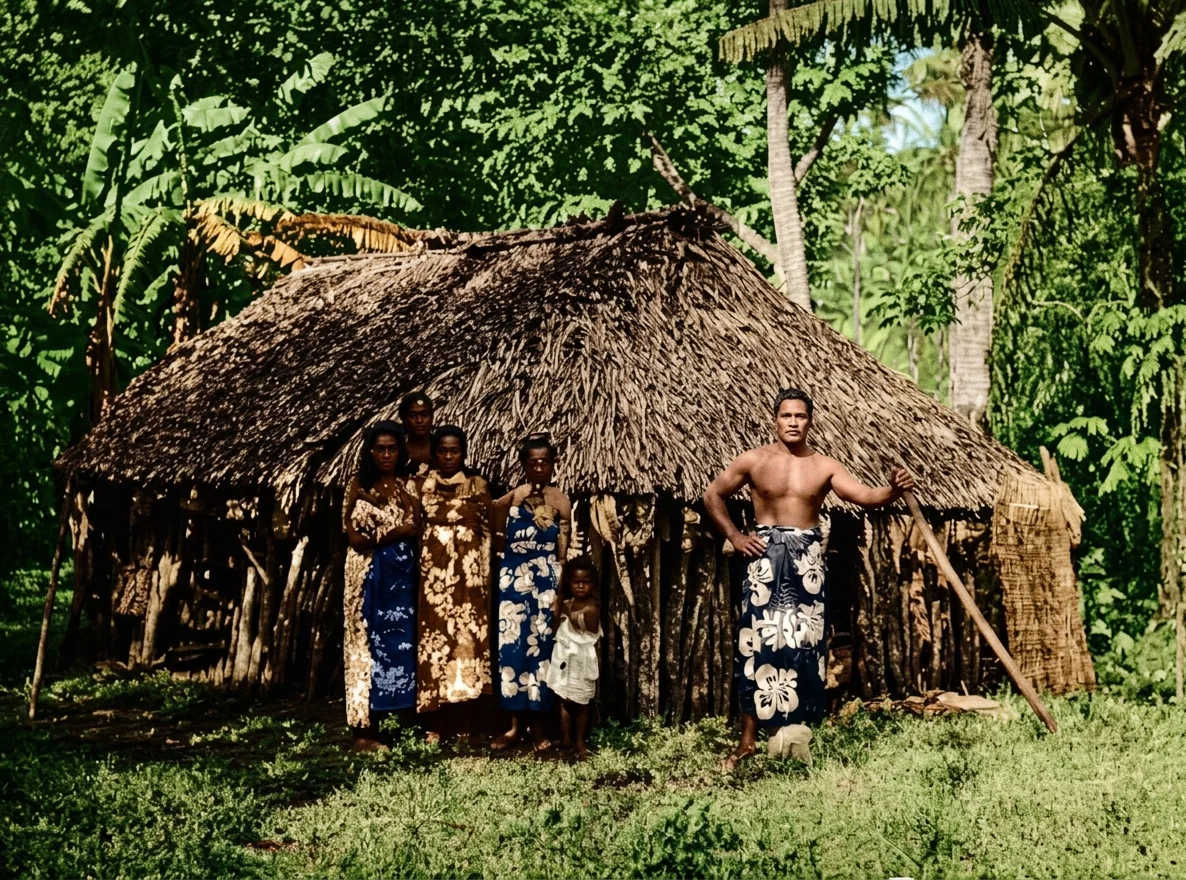
NATIVE FAMILY AND HOUSE, RARATONGA
When first discovered by Europeans, the natives were cannibals, addicted to terrible vices, and living in the depths of degradation. Tribal wars were frequent and sanguinary, and the weak lived in constant terror of the strong. Raratonga is only twenty-two miles in circumference, and on this island there were three tribes more or less hostile to one another. After a fight the conquered could at best put only a few miles between themselves and their conquerors. To be caught meant to be killed and eaten. With this condition the first missionaries had to contend.
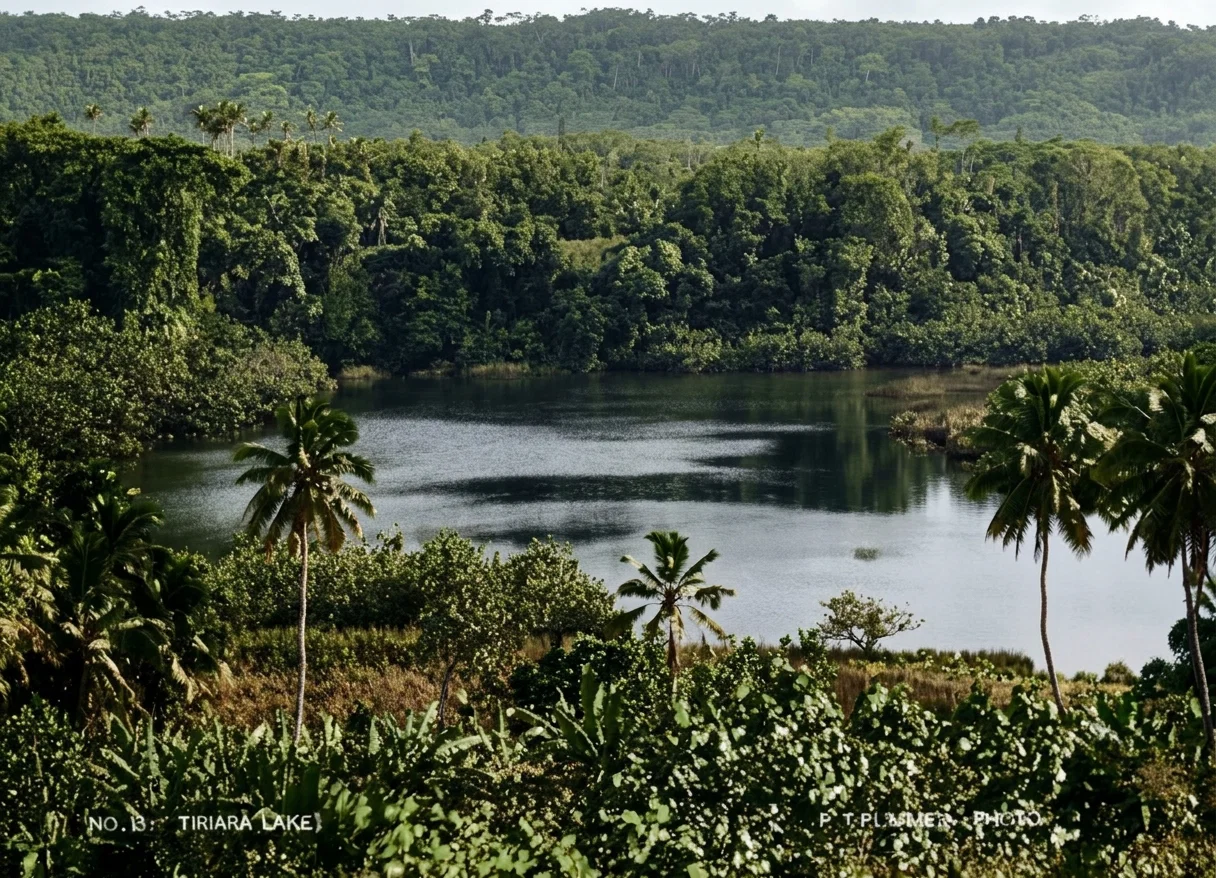
TIRIARA LAKE, MANGAIA ISLAND
Missionary enterprise was first begun in these islands about seventy-five years ago, under the leadership of John Williams. Aitutaki was the first to receive the gospel. At his own request, Papeiha, a native teacher from the Society Islands, and a comrade were landed on this island to preach the gospel. Their reception was not favorable, for they were both seized and carried to a “marai,” a place where victims were offered to the gods, and there given to the gods. However, right on this spot, they besought the people to forsake their idols and turn to the living God. Their lives were spared, and after a year’s hazardous toil the heathen began to accept their teaching. The evangelization of Mangaia was next attempted, but owing to the ferocity of its inhabitants, it was abandoned for some time. After this, John Williams sailed to Raratonga, landed several Tahitian teachers and their wives, and “lay begun off and on” for the night. Next morning the teachers came off to the ship with bruised limbs and torn clothes, and reported that they had experienced a terrible night. In consequence, it was resolved to abandon Raratonga for a time. But as they were about to sail away, Papeiha announced his intention of remaining on the island. He said, “Jehovah is my shield, I am in his hand,” and jumping into the sea with only a portion of the Scriptures in the Tahitian language bound upon his head, he swam ashore. God wonderfully blessed this dark-skinned disciple; for in two and a half years the idols throughout the island were overthrown. He lived many years after this, and was a faithful follower of the Master, and teacher to the Raratongans. European missionaries soon entered into the openings made by the native teachers throughout the Cook Islands.
As in many other heathen lands, the first missionaries found it no small task to reduce the language to written form. After this was done, the Bible was translated. The first book printed was 1 Peter. The first complete edition of the New Testament in Raratongan was printed in England, and reached the island in 1839. The complete Bible was ready in 1852. Since that time it has been revised.
Since the agents of the London Missionary Society were established in these islands, they have trained not a few of the Cook Islanders as teachers to carry the gospel to the inhabitants of other islands in the Pacific that knew not God, and several have in this way laid down their lives for the Master. Good work has been done by this means, and to-day many Raratongans are laboring with the heathen Papuans of New Guinea, where James Chalmers and others were recently massacred.16
The natives of the present day are, on the whole, good-natured, affectionate, and kind. They are not fond of work, and rarely stick to anything that they from time to time take up. In domestic life, the men do most of the cooking. This is done by putting heated stones into a hole in the ground, placing the food upon them, and covering it up with leaves. Many of the men make their own clothes, although considerable clothing is bought from traders. The women usually wash the clothes. This is done by soaking them in cold water, and after soaking, placing them upon a flat stone and pounding them with a stick. Much of the food used grows of itself, and consists of several species of bananas, oranges, mangoes, pineapples, breadfruit, cocoanuts, and yams, taro, and kumera, which require some attention while they are growing.
In times of festivity, at deaths, births, and marriages, it is the custom to have a feast, and on these occasions many pigs are slaughtered, cooked, and eaten. At the opening of a church recently (not a Seventh-day Adventist church) several hundred pigs were consumed by those attending the opening. Drinking is common, and is encouraged by unscrupulous traders, who sell spirits to the natives.
As to their condition spiritually when they first accepted the gospel and turned from their idols, we have nothing to say. At the present time they are sunk deep in the mire of sin. The majority attend church, but it is only a “form of godliness” without the life. Even many of the officers in the churches are not to be trusted. Many have the idea that when they are seen stealing, the act is a wrong one; but should they steal and not be detected, it is all right. Prayer is common among them, and they generally have morning and evening worship. They were taught by the early missionaries to pray, and rightly so, but it has degenerated into a mere habit with them. They pray before entering upon their games, they pray before beginning their dances, which, when held, have a soul-destroying effect upon performers and on-lookers alike. Nevertheless, we do not suppose that they are one whit more wicked than their more enlightened neighbors in civilized lands. Here, sin is open and easily detected, and consequently well-known; there, much is done in secret, but it is just as heinous in the eyes of a pure God.
The local churches endeavor to stem the tide of evil, but are powerless. This is a characteristic condition in all lands in these last days. In the providence of God, there is an agency to arrest individuals in their course of sin, and that is the everlasting gospel as found in the three angels’ messages of Revelation 14.
A Glimpse of Our Chicago Institutions
By David Paulson
In the year of the World's Fair there was opened at 28 Thirty-third Place, near Cottage Grove Avenue, a Chicago Branch of the Battle Creek Sanitarium. This was made possible by the gift of forty thousand dollars from the Wessels Brothers of South Africa, on the condition that the earnings should be used for the development of charitable and philanthropic work in Chicago.
A short time after this, a free laundry, baths, and a medical missionary dispensary were opened on Custom House Place, near Van Buren Street. Thousands of the sick and needy among the destitute classes availed themselves of this opportunity. As the work developed, a workingmen's home soon became a necessity, where poor men could procure wholesome meals at actual cost, where a clean bed could be furnished for a few cents, where they could wash their clothing, and have it disinfected during the night. Multitudes of struggling men have gladly availed themselves of these privileges.
It soon became apparent that there was a wide field for definite evangelistic work, so a suitable hall was secured at 436 State Street; inspiring mottoes were hung upon the wall, the room was made as cheerful and attractive as possible, and this was the beginning of the now well-known Life Boat Mission. In this place the spiritual and physical gospel is proclaimed in a most effective manner every night in the year, and as a result hundreds of men have been transformed, so that instead of being moral wrecks, they are now leading useful, sober, and moral lives.
Since then a well-equipped hospital has been opened at the corner of Cottage Grove Avenue and Thirty-third Place, where all classes of medical and surgical cases are received at just the cost of caring for them. A successful missionary training school for nurses is maintained in connection with this institution and the Branch Sanitarium.
An excellent medical missionary dispensary has been established at 3558 Halsted Street, where sanitarium physicians and nurses are constantly giving medical attention to the large number who are unable to avail themselves of the advantages of either the hospital or the sanitarium. The free visiting nurses have their headquarters at this place. Every day they are busy searching out those who are in extreme suffering and want in this needy portion of the city. Their training enables them to make use of the natural remedies that are within reach of almost every home, no matter how poor and wretched it may be.
At 442 South Clark Street is located the Life Boat Rest for girls, where loving hearts and willing hands are winning back to the path of virtue and happiness those who have gone astray.
Recently the Branch Sanitarium has opened Hygienic Dining Rooms near the University of Chicago, so that all the students who desire to do so may have the benefit of a wholesome dietary.
The Life Boat is an illustrated monthly magazine, of twenty-four pages, devoted to the interests of health and charitable and philanthropic work. It was established in 1898 with a circulation of five hundred. It has now a circulation of nearly twenty thousand. Each number vividly portrays the scenes which are constantly brought before the mission worker in his efforts to help the various classes of humanity in our large cities. The subscription price is only twenty-five cents a year. Address The Life Boat, 28 Thirty-third Place.
The American Medical Missionary College was organized about seven years ago. It is the only medical college in America which has for its sole object the training of medical missionaries. It has a regular four years' course, furnishing all the privileges of medical education in the best medical schools, and in addition gives special prominence to physiological remedies and the development of the missionary spirit in the hearts and lives of its students.
At present the total number of students is a little more than a hundred. Most of the theoretical work and laboratory work covering the first two years is done in Battle Creek, while the major part of the last two years' work, when special attention is given to the clinical work and to hospital opportunities, is given in Chicago. DAVID PAULSON.