OUR first week in India was spent with Brother and Sister J. S. James in their large territory in the southern part of India. Through various reports to the Mission Board, the REVIEW, and the sessions of the General Conference, I had felt fairly well acquainted with this mission; but once more I learned how much clearer one's vision becomes, and how much more real and tangible everything seems, when one is on the ground itself. This visit had a number of surprises for me. I was aware that the South India Mission embraced the Madras Presidency and the island of Ceylon; but it was not until I traveled over the territory, getting hurried glimpses of the country, the cities, the villages, and the people in their varied conditions, that I obtained anything approaching a true conception of this mission. It is much larger than I had realized. Its western boundary is washed by the Arabian Sea for a distance of about five hundred miles; while the eastern shore stretches 1,200 miles along the Bay of Bengal—farther by two hundred miles than from New York City to Chicago. And in this territory there are over fifty million people—more than half the entire population of the United States.
It was in this mission field that Ziegenbalg, Plutschau, and Schwartz, the first Protestant missionaries to all India, carried forward their wonderful work. The two former located near the coast in the district of Trichinopoli in 1706. Schwartz located in the city of Trichinopoli in 1750. These men were missionaries of the apostle Paul's stamp. Great success attended their efforts, and today, after nearly two centuries of missionary endeavor in India, more than one half of all the Protestant Christians in this entire land are to be found in the Madras Presidency where these pioneers did their work.
The program that had been arranged for us included a visit to our Nazareth Mission station in the extreme southern part of the field. An all-night's ride from Trichinopoli brought us to Tinnevelli. Here we changed from the railway train to bullock carts, called bandies in this region. A bandy is a two-wheeled cart with a cover of some sort stretched over a framework to protect the passengers from the sun.
The box of the cart is about six feet long, four feet wide, and six inches deep. The cover is about three feet at its highest point above the bottom of the box. As there are no seats in the bandy, the most comfortable way to ride is lying full length in the cart box. Rugs were spread on some straw in the bandies, pillows were provided, the bullocks were attached, and we crawled in for a twenty-four-mile ride. There were six in our company, including Professor Salisbury and Brother and Sister James. There was also the formidable stack of luggage a company of that number usually carries in India. Four bandies were required for the journey. We started at nine in the morning, and reached our mission at six in the evening.
When two or three miles from the mission station, we were met by some of the teachers and students and a number of the members of the church. They had come with a native band, to welcome us and escort us to the station. After cordial greetings, the band led the way, being followed by teachers, students, brethren, and our caravan of bandies. The music and the unusual procession attracted large numbers of villagers, many of whom kept joining us until our number became quite imposing by the time we reached the station. From the veranda of the bungalow we gave a brief address expressing our appreciation of the enthusiastic reception given us. Then all separated to get ready for the evening service.
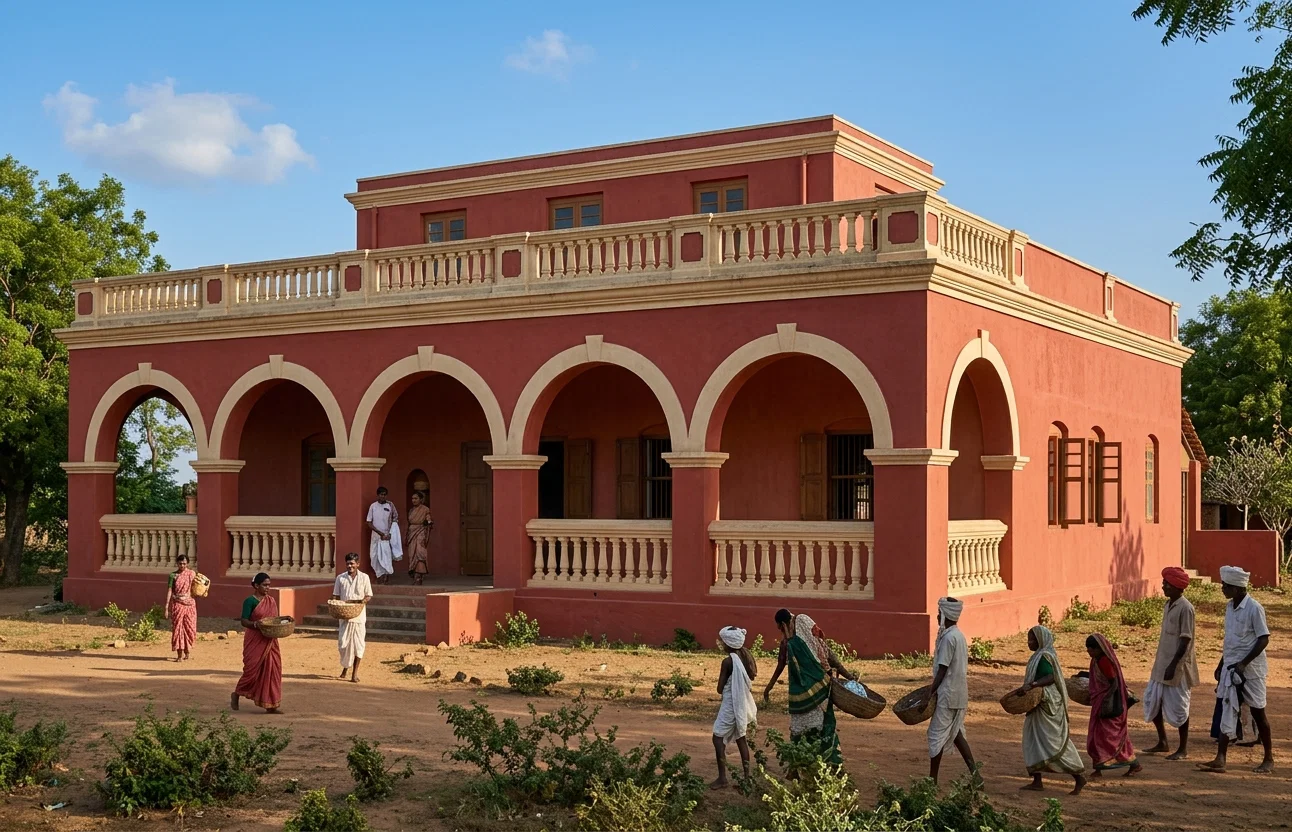
I was very much encouraged by what I found at this mission station. Brother James began work here seven years ago. The response made by the people to the message he presented led to the establishment of a permanent station. Three acres of land could be secured just outside the village. But before a final decision was made to locate on this site and erect buildings, a well was sunk on the place to ascertain whether an abundant supply of good water could be secured. The test gave the fullest satisfaction. Then the ground was secured, and the buildings were erected. The precaution taken by Brother James to be sure of having plenty of good water, should always be taken by missionaries before purchasing land and erecting buildings for mission stations.
SCHOOL AND CHURCH BUILDING, NAZARETH, SOUTH INDIA
We have three buildings at this station—the bungalow, the school, and the dormitory. The bungalow is a brick structure well planned and substantially built. It provides a good home for those in charge of the mission. It cost a little less than $2,000. The school building cost only $400, and the dormitory for boarding students but $83. Both the school and the dormitory are too small for the work now being carried on at this mission. At the time of our visit11there were 118 students attending the school—87 boys and 31 girls. The regular schoolrooms were full, and one class was being held on the veranda of the school building, another in the dormitory, a third on the veranda of the bungalow, and yet another in a shed. How all this can be managed in the rainy season is a problem.
The dormitory for the boarding students was also badly overcrowded. It is only thirty by thirty feet. In it were living the preceptor and his family, nine girls, and nineteen boys. The only room for the boys is eight by ten feet. Each boy is required to have a chest in which to keep his clothes, books, stationery, pen and ink, comb, etc. Nineteen of these chests in a room only eight feet wide and ten feet long left little space for the boys. When I inquired where the boys slept, I was told, “On the floor of the dining room.” The girls had no better provision. Sometime, and not too far away, money should be provided for a larger and better dormitory for these youth.
I was greatly pleased with the work being done at this station. For two or three years almost the entire work has been carried on by our Tamil brethren, no European being on the place. Brother E. D. Thomas is in charge, and is assisted by seven teachers, five of whom are our own baptized members. Brother Thomas and his assistants have all embraced the message since Brother James began work in Nazareth seven years ago.
MISSION BUNGALOW, NAZARETH, SOUTH INDIA
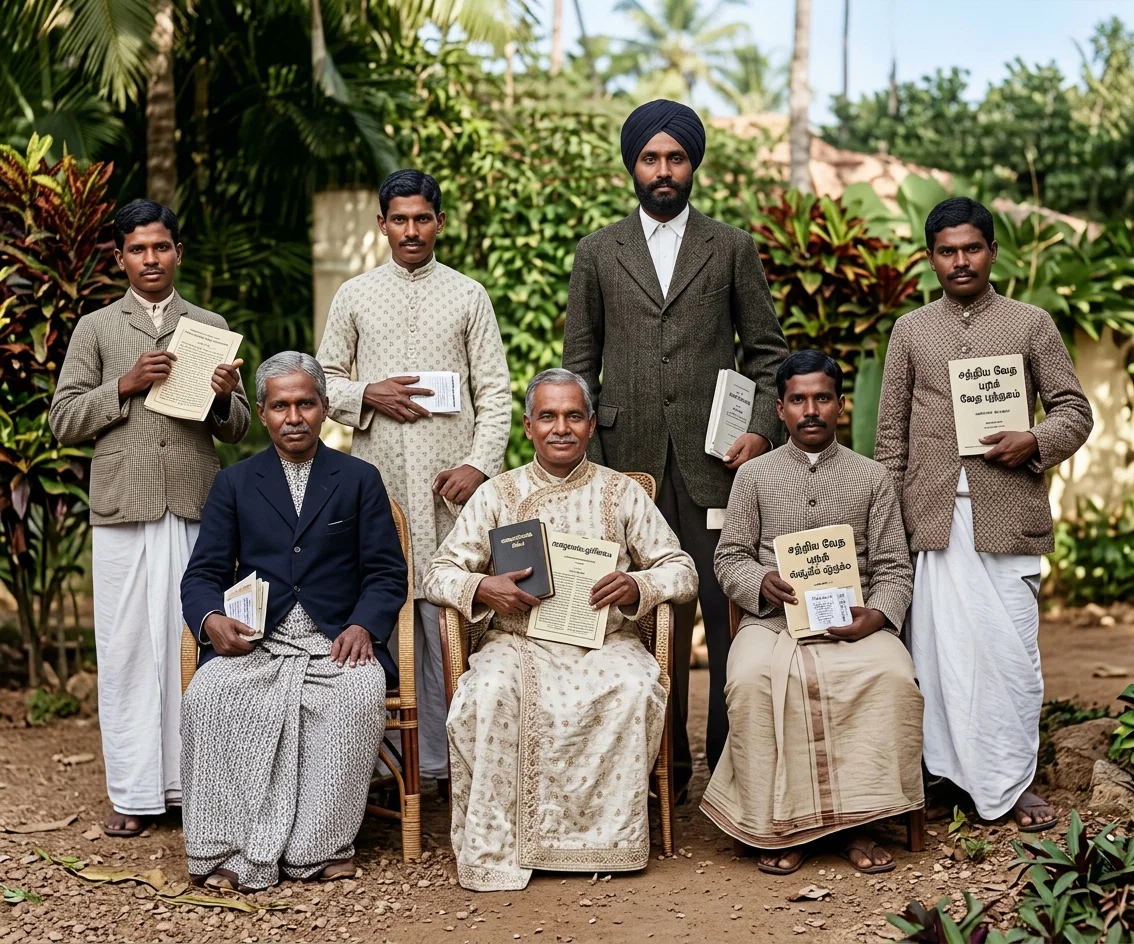
As nearly as I could judge, these teachers are doing excellent work. The students are Hindus, Roman Catholics, etc. Some have no religion. Yet with this medley we found a strong spiritual influence pervading the school. Thirteen of these students have given their hearts to the Lord, and united with the church. They are earnest, wide-awake young missionaries. Every month they are allowed to go out to the villages to sell papers and tracts. Sometimes they walk twenty miles doing this work. They are making a good impression in all that region, and men are bringing their boys from all directions to place them in the school. When I was there, two men came from villages miles away in opposite directions, to see about getting their boys in the school.
During the week of prayer some of these Christian boys gave a part of the rice allowed for their daily food, in order to make offerings to foreign missions. They denied themselves the food they really needed for their growth and work. None of these boys use tobacco in any form, and they have abandoned everything that savors of heathenism. The girls who have become Christians have shown the same zeal. They have done what is probably the hardest thing for a girl in India to do,—taken off all their jewelry, bracelets, rings, neck rings, anklets, toe rings, and all. The ears of some were so disfigured by the heavy rings hanging in them from infancy, that it was necessary to perform surgical operations to restore them to something approaching their natural condition. All this they have done for their Lord and Master. They are good girls, and will make good wives for the Christian boys who are preparing for service in the Lord's work.
OUR COLPORTEURS IN SOUTH INDIA
In an address presented to us by the members of the faculty of the Nazareth school on the occasion of our visit, they said:—
The object of this work is to lay a true foundation in the lives of the students for a future Christian building; to teach them the special truths for which we as a people have been called into existence; to encourage them to practice these truths and to spread them throughout the sphere of their influence; to develop a thorough Christian experience and beget in them a lasting desire to become earnest workers for the Lord in carrying this message to the millions of South India. Believing the Scriptures to be the foundation of all true education, and recognizing its importance in a school curriculum, much emphasis is placed on the teaching of the Bible. We have already seen some of the results of our efforts in this direction. Of our students, thirteen have been baptized. One boy has connected with the office work at Trichinopoli, another boy has taken up duties in the school while continuing his education, and others are being prepared to take up responsible work in connection with this cause at an early period. We also see a great change for the better in the lives of the Hindu children of our school.
The church membership at this station is close to seventy, with a Sabbath school of 135. They are faithful in the payment of tithes and offerings for the support of the work. The total amount paid in 1913 was $260, and in 1914, $400. This is not a large amount, but they are poor people, and it means much to them.
It was surely a great privilege to visit these dear fellow believers who are so happy and earnest in the truth. I could not but wish that we had hundreds of such stations scattered over India.
The work done at the Nazareth station represents the most we have done so far for the fifty millions of the South India Mission field. In August of last year work was begun in Pondicherry, a French settlement on the coast about one hundred miles below Madras. Brother and Sister V. E. Peugh and a Tamil brother located here to look after an interest that had been awakened. In November Brother James visited this place12and baptized seven believers — four men and three women. Others are being taught and prepared for baptism.
Brother and Sister Morrow, who came to India last year, have located in Bangalore. They are studying the Tamil language with a view to engaging in the vernacular work.
All the workers in the South India Mission, and in all India as well, were delighted to have Brother and Sister Lowry return. They will begin work in a new center. Brother Lowry has a good knowledge of the Tamil language. He loves the field, and it is believed his work will be blessed to the salvation of many.
At the recent biennial conference it was decided to establish the headquarters of the South India Mission in the city of Madras. This will enable Elder James to carry on evangelistic work among the European-speaking people.
The task in this mission field alone is stupendous. Besides the seventeen million persons speaking Tamil, there are twenty million who speak Telugu. Although no direct effort has yet been made by us for the Telugu people, a few have embraced the message and united with us. Great opportunities are now in sight among these people, and we must begin work for them without delay. Plans are laid to have a man and his wife located among the Telugus this year.
Then there is Ceylon, with its millions. Every worker in India feels that Ceylon should be entered now. It should be made a separate mission division under permanent leadership. It is hoped to have a brother and his wife located in Colombo in a few months.
Knowing the value of literature in this work, Brother and Sister James are struggling hard to produce and circulate papers and tracts in the five different languages spoken in their field. But their facilities and physical powers seem so limited for this great task. O, how greatly, how terribly, we need workers and means for this stupendous undertaking! If ever the church of God should pray the Lord to send forth laborers into the field, it is now. Will not those who read this report pray for this most fervently? The Lord will surely hear the united, fervent prayers of his people.
A. G. DANIELLS.
Words of Council to Those Laboring in Mission Fields
By T. E. BOWEN
T. E. BOWEN
In looking through some files recently, I ran across a few paragraphs addressed to laborers in foreign fields, published in a special Testimony, which seemed so full of helpful suggestions that I give them below. And these good words should, as well, be taken home to our own hearts as workers in the home fields:—
“When laborers are associated together who decidedly vary, both in natural disposition and character and in their manner of labor, each will need to keep a careful watch over his own strong traits of character, and to exercise the meekness of Christ, or he will be in danger of drawing apart from the others. Such a separation would retard the work and dishonor God. Brethren, you should make no move independently or in opposition to one another. Pray together; counsel together in humility, willing to be instructed. This will bring you where God will be your counselor. By indulging a stubborn, self-confident spirit, workers can easily place themselves where divine wisdom and power cannot aid them in their labors, where they cannot have help in counsel, in difficulties and trials.
“As laborers together with God, you should come close to one another. Precious lessons of love, confidence, respect for one another, must be given, both in and out of the desk. You must live that which you teach. Remember that the new converts look to you for an example.13
“Some for whom you labor will wish to have the work done in their own way, thinking that their way is best; but if you have the spirit, the meekness of Christ, if you show respect and love for one another, God will enable you to perfect the work in a manner that will please him. Work for your own souls until self is subdued, until Christ recognizes his image in you. The most impressive lesson that you can give to those whom you educate, will be that of a Christlike character.
“In foreign fields especially, the work cannot be accomplished, except by well-considered plans. While you should endeavor to labor in harmony with the instructions of those at the head of the work, many unforeseen circumstances will arise for which they could make no provision. There must be something ventured; some risks run, by those on the field of battle. There will be crises in which prompt action is necessary. The workers should not in every movement feel that they should wait to receive directions from headquarters, but after counseling together, with earnest prayer, they should do the best they can under the circumstances.
“The laborers should counsel together. No one is to strike out on his independent judgment, and work according to his own mind, regardless of the counsel of those connected with him. If we think ourselves sufficient to manage the work of God, and depend for success on our own wisdom to plan and execute, we may expect defeats and losses; for they will surely come. It has been shown me that the planning of the work must not be trusted to inexperienced men. Those who have not had full breadth of experience are not the ones to take large responsibilities, although they may think themselves qualified to do so. Their brethren may see defects where they see only perfection. . . . Our younger laborers must be content to work their way among the people slowly and surely, under the advice of those who have had more experience.”
As the trials of the end thicken about us, how necessary it is for us to press together, to counsel together, and then follow the plans matured as the result of the combined best judgment of all. God always blesses the workers and church members who thus love and respect one another by being willing to listen to and follow the counsel given. On the other hand, those who feel no need of advice, and follow their own wills rather than profit by the experience of those who have been longer in the field, will find sooner or later that it is best to take counsel with their brethren. Those who persist in their own ways God leaves to themselves, to follow their own devisings, the greatest calamity that can befall any one. And, too, believers who love the Lord and his truth, fathers and mothers of experience in the different fields where our laborers are called to go, are eminently qualified many times to give valuable counsel.
Let us press together, pray for heavenly guidance, and God will surely lead us into safe paths, even though troubles may be all about us.
He who is the “Way,” is also called “Wonderful Counselor, The mighty God, The everlasting Father, The Prince of Peace;” and the government is upon “his shoulder.” All we “are brethren.” Our unerring Guide, Christ’s representative, the Holy Spirit, will be with us to the end.
Barotseland Mission, South Africa
By S. M. KONIGMACHER
S. M. KONIGMACHER
THE Lord is blessing us, and in some respects we can see advancement in his work at this station. The language here is very similar to the one we knew in Nyasaland. A Catholic priest came over to the mission several times and helped us with the Chitonga language. With this and the help of my wife, I was able to preach in the language some weeks ago. Of course I cannot speak so fluently as I wish I might, but what I have acquired of the language is a great help, for we have no one here to translate or interpret.
Very soon after we arrived, the school was turned over to us. As the result of a few simple changes and much hard work, we can see some advancement. The boys have memorized the beatitudes, and are now committing to memory the commandments. A few who several months ago could not read are now reading in the Gospel of Matthew. They write well, and are doing sums in addition. We sincerely hope that the gospel thoughts presented every morning will sink into their hearts and result in some taking a firm stand for the truth. We are hoping that we can use some of these more advanced boys in opening up village schools in the Lusakas district, for as yet it has not been entered by any other mission. The people are anxiously waiting for a station, and we are very sorry that the funds are not sufficient to send a white teacher there.
It is quite difficult to acquire the language here, for the most of the schoolboys are Batema. The Gospels are published in Ila, and the district and two native teachers are Batonga. There are three Barotse boys and one Machekelongwe among the forty-four students.
There has been a great deal of sickness among the boys, and one of our boys died. We have been putting in our extra time screening the veranda to make the house mosquito proof, for the spring is a fruitful time for mosquitoes. I have finished the mission house. I made two doors, and put in a base of cement all around the house under the screen so the mosquitoes cannot get in beneath and the white ants cannot get up to eat the frame. The other house will be finished later.
The heavy rains have brought out the wild flowers, and some are very beautiful. There is one variety that looks as if it were dusted with gold. My little son likes to go out on the veldt and gather these flowers, and the boys bring in bunches of them, making the house look quite homelike.
One evening after the Sabbath, Mrs. Konigmacher took her little organ up and played for the boys. You ought to have seen their eyes sparkle. Then she and I sang together, and that pleased them so much that we sang the song over several times until they started to sing it with us. We then promised to translate it and teach it to them. The sentiment is a good one, “Keep Sweet”—this to be done under all circumstances, and through all kinds of trial and changes.
At present we are all well, and are not troubled by the war, only that there is an increase in price in the necessaries of life. Trouble may come later, but everything is very quiet up this way. We sincerely hope that the work will be finished soon, so that we can meet our loved ones, never to part again.
The Resurrection and Deliverance
“At that time thy people shall be delivered, every one that shall be found written in the book. And many of them that sleep in the dust of the earth shall awake, some to everlasting life, and some to shame and everlasting contempt. And they that are wise shall shine as the brightness of the firmament; and they that turn many to righteousness as the stars forever and ever.” Dan. 12: 1-3.
Among the Bible Colporteurs
“ONE day a passenger showed me his check book and said, ‘With this I can buy many things; now buy something with your book.’ I answered, ‘I should like to buy your soul.’ He laughed, called his friends together, and made fun of me. So I said to him, ‘What treasures do you expect your book to buy for you in the next life? All the checks it contains will not give you one drop of living water,’ and I read them the parable of the rich man and Lazarus. Then I gave him a Gospel and went away. An hour or two later, as I was about to leave the ship, he called me and said, ‘I have read in the book you gave me, and I want to keep it. And please give me a Bible also, for I see it says here, “Search the Scriptures.”’ Thus he purchased my book, and my book purchased him.”
“On a German ship, an English-speaking sailor came to me and said, ‘I am very, very glad that I bought that Bible from you on the last voyage. In Ceylon, I was brought up as a Christian but through being thrown with men who had no religion, I had lost mine. Since reading my Bible I have come to see things differently, and now I read it every evening.’”
“On a French ship a sailor began to scoff when he caught sight of a Testament. ‘I believe I can read your thoughts,’ said I. ‘You are perhaps laughing at unworthy priests and their ceremonies. But I want you to realize that the Lord Jesus Christ was a poor man, who went about doing good; and he was crucified by priests like those at whom you are laughing.’ The man remained14silent, but a little while later he came to me and bought a book. Others followed his example, so I had good sales on that ship.”
“On the deck of an Egyptian steamer I talked to some Bedouins who had been taking camels to Egypt for sale, and were now returning to Syria. I sold one Gospel, and went on to visit other passengers. When I returned, they were seated on the deck around a man who was reading aloud to them. I asked an old Bedouin, ‘Do you know of whom this is written?’ He stood up and said, ‘Bring for each one a copy of this book, for they are the words of the Messiah.’ Besides the Gospels, the old man also bought a Bible. Handing it to his son, he said, ‘You will read this aloud to me every day, for life indeed is short, but our wisdom is much shorter; therefore it is good to learn of such a paradise of knowledge.’ I sold among these Bedouins sixteen books.”
“On a Dutch steamer a Chinaman came and showed me the book of Isaiah, who asking if Jesus is really the Messiah there foretold. I showed him from the Gospel that he is. Then the man took out a silver coin and said, ‘Give me as many books as this coin is worth.’ I did so, and these he distributed among his friends. He even explained to them the prophecies, and their fulfillment in the New Testament. His friends followed his explanations with much interest. He said to them, ‘Jesus is not in wood or stone, but in the light which shines in our hearts and souls.’”
“I sold a Bible to a lady in the third-class cabin of an Orient liner. As she took it, she asked, ‘Do you know why I bought this? My sister and I are going to Australia. We are very poor, and did not intend buying anything on the journey but what was absolutely necessary. When you showed me the Bible, I felt at once that we had forgotten the most necessary thing in this life.’ Handing it to her sister, she added, ‘We have been feeling lonely; but now we shall have the Lord Jesus with us.’”
West Africa
By E. W. MYERS
E. W. MYERS
We have a good place here at Mamunta, or would have had we completed our buildings before the war broke out. My own house is nearly finished, but we need a house for our native schoolteacher, and a place for the school and dispensary. These are to be built of mud with grass roofs. Although we do not have all we might wish in the way of improvements, we are doing the best we can, and are beginning to see some results from our efforts. This gives us courage, and we hope that things will soon be settled so that we can have our other buildings. At present we are holding school in one of the chief’s barries.
Naturally, I am much interested in medical work. Every one here seems anxious to take medicine whether he is sick or not. A great many applicants have to be turned away. There are many needy ones for whom we could do much if they could be induced to follow our method of treatment long enough. One case might be of interest. The chief brought his sister to us with one side of her face badly swollen. On examination I found that there was an opening outside of her mouth and one inside. Both were discharging, and all her teeth on that side of her lower jaw were loose, with pus oozing out around them. I wanted to remove a few teeth and make the outside opening a little larger so that we could wash the pus out. They would not listen to this treatment, nor any part of it. They just wanted some medicine to rub on the outside, so we did the best we could for her with a bottle of antiseptic. In a few days I heard that something hard had appeared under her tongue. I supposed that it was one of her teeth which had fallen out, but it proved to be a piece of the jawbone.
In a short time we lost track of her entirely, only hearing occasionally that she was still alive. In about three months she came back to us ready to be treated. The first thing I did was to remove the piece of bone which was still protruding into her mouth. This almost made her angry, but her husband said it was all right. Then we began washing the sore every day with an antiseptic. At first the medicine ran freely from the outer opening into her mouth. In about two months the face was healed. The recovery of this woman has won the confidence of her family, who seem to appreciate our efforts.
The people here are all devil worshipers, with just a little Mohammedanism mixed in. We see many of their sacrifices and ceremonies. We have not been able to preach to the people regularly because we have not always had an interpreter; but when we are able to hold meetings, we have some interested listeners. One evening when I gave a chance for questions, one man asked, ‘What good thing must I do to please God?’ At another time, when I had been talking about the law of God, a man asked, ‘Does it please God for a man to have plenty of wives?’ I had said nothing about polygamy, for I thought it a little too soon to attack a custom so firmly held by the people. I thought surely the Holy Spirit must be working to raise this question in this man’s mind.
We are thankful that our Heavenly Father has seen fit to allow us peace and safety here in this time of trouble. We have felt the effects of the war very little. Of course prices of imported foods are a little higher; but the rice crop is good this year.
Our health is as good as could be expected. We begin to feel the effects of our stay here. The heat is rather hard on Mrs. Myers this year. We are just starting into our third dry season, which is the hottest part of the year.
Two Helpful Devices
By Mrs. C. C. Lewis
MRS. C. C. LEWIS
We are receiving many letters expressing interest in the Home Department. I wish our readers would tell us wherein the department is helping them, and wherein it is failing to meet their needs. We should be glad to hear from those who are being benefited, and also from those who are not receiving the help they desire. We should appreciate suggestive topics. If more of our mothers would do as one mother has done, we should be able to make the department more helpful. For the encouragement of others we will let this mother tell how she helped her little ten-year-old boy remember his duties without being told:—
“For more than a year we have used a simple device which has proved helpful to Frank in showing reverence for the house of God on the Sabbath day. To one end of a piece of white drawing paper six and one-half inches long by four and one-half inches wide, we drew a bunch of flowers and colored them. Neatly cut out flowers or traced ones may be used. Through the middle of the remaining portion we drew several lines with ink, three quarters of an inch apart. Above these we wrote ‘Frank’s marks for showing reverence in the house of God on the Sabbath day.’ We tacked this on the wall in the kitchen, and each Sabbath when he was worthy he received a mark. If he was irreverent, he did not receive a mark, and lost the one for the previous Sabbath as well. At the end of a month he received a small present if he deserved it, which was always a surprise. We soon discontinued this plan, as we do not believe in training him to do right for a reward, but from principle. He is very proud of his marks, and they have proved a real help to him in remembering how to conduct himself in church.
“We have another little ‘reminder’ which helps Frank in calling to mind his little ‘before breakfast responsibilities.’ For this we used a piece of drawing paper three inches wide and six and one-half inches long. Through the middle we drew, one inch apart, two light lines that could be erased. Through this space, tracing around a penny, we drew eight circles, and colored each differently. Over each circle we put a letter, indicating the different things which he was to remember in the order they were to be done. S stood for stove, and meant to light the gas jet under the oven. W was for wash, C for comb, B for brush teeth, T for teakettle, etc. We have the card tacked on the inside casing of the door between the kitchen and the dining room, and without being reminded by his father or me Frank is able to do his work ‘decently and in order.’ He delights to get downstairs first in the morning and have his part all done before I appear. Where there is more than one child in the home, there could be more circles, and these could be grouped and marked in different ways for each child. Even we older children forget sometimes, and just a hint or a glance at something will bring to mind the things we have to do, which, if they were neglected, might prove an unpleasant burden to ourselves and others. This little plan has been a great saving and help to both Frank and me.”
A Framed Postage Stamp
OVER my desk is a square of heavy paper with corners clipped in it to make a frame for a two-cent stamp. It is the only stamp on the place that never gets used, no matter how great my hurry, nor how urgent the cause. “Why do you keep it? you ask, and ask it curiously if you know me, for I am a regular devourer of stamps. It is a family joke that mother spends all her living on riotous postage stamps, and yet, this one stays. It came to me in a letter from my old minister—the minister of my childhood and girlhood days.
It was a long letter, and it nearly broke my heart to read it. All the homesick longing for a bit of news from those who had been in his care for many years, crept into the feeble writing. There were pages of questions about people who had been dead for so long a time that I had almost forgotten they had ever lived. We forget so soon in this rushing age! Only two of the people he asked about are living. One of them is too feeble to write to him; the other is still a strong man and a busy one, holding an office of importance in his home town. When I told him that our dear Brother W— had asked about him, his eyes filled with tears. Even busy people often have kind hearts, but are obliged to stifle the good impulses that would take time to carry out. “I’ll write to him15right away,” this busy man said, with a queer huskiness in his voice. He took the address and hurried on. Perhaps he wrote. At least, he meant to, for that one moment. I’m not worthy to criticize, if he didn’t, for I fail so miserably in doing the good things I mean to do. But I did answer this letter.
I forgot to say that, at the close of Brother W—’s letter, was this little appeal: “If you ever find the time, I shall be so glad to hear from you.” And there, below the words, clinging bravely by one corner, was the stamp. It was the stamp that broke me all up, if I may use slang. I cried when it lay in my hand, the pathetic little piece of pink paper. On it was a full front view of the father of his country. His calm eyes seemed to look up at me reproachfully, and I said: “Don’t look at me that way—I’ll answer the letter, but I won’t send you to carry it back. I’ll keep you as a reminder of neglected duties to old friends.”— Christian Standard.
Christian Battle Song
By WORTHIE HARRIS HOLDEN
WORTHIE HARRIS HOLDEN
Go forth with our army, O God,
To strengthen our bands for the fray;
Bestir us to heed thy commands
For triumph and conquest today.
Our foes are both valiant and strong,
Their number like sands of the sea;
But thou art the King of all kings.
And victory belongeth to thee.
Unknown are the hours with their needs,
Unseen is the enemy's plan,
Yet thou seest all, and wilt guard
Thy children from plottings of man;
And Satan, o'erpowered, must flee
And leave us unscarred to possess
The land of thy choice and delight,
Which thou with thy presence shalt
bless.
Portland, Oregon.
Home Life Department
By Mrs. C. C. Lewis; Miss Lora E. Clement
Conducted by Mrs. C. C. Lewis, Takoma Park, Washington, D. C.
Assisted by Miss Lora E. Clement
Through the columns of this department, hints will be given on all matters pertaining to the home life. Short articles and letters are solicited from home makers, telling of their everyday experiences,— their joys and sorrows, their failures and successes.