The Youth’s Instructor, Vol. L., No. 41

In the Streets of the City

The Youth’s Instructor

October 16, 1902

Review and Herald Publishing Company · Battle Creek, Michigan · October 16, 1902

In the Streets of the City

“AND the streets of the city shall be full of boys and girls playing in the streets thereof.”
Lest our hearts should be o’ercome by the strangeness of the sight Of the New Jerusalem when we reach the city bright, Where our comrades will be angels and shining seraphim, Where we’ll eat the fruit of life by the living river’s brim, Where the walls will be of jasper, and the streets will be of gold, And the music of the harpers be like mighty thunders rolled,— Then one dear, familiar sight our vision there will greet,— Our boys and our girls will be playing in the street.
Then there will be no more weeping, no sorrow, and no pain; There friends will meet each other nevermore to part again; No more to suffer hunger, or thirst, or heat, or cold; No more to pine in sickness, and never to grow old. There none shall grope in darkness; for there will be no night, But one eternal morning, the Lamb himself the light. Then just one touch was added for happiness complete,— Our boys and our girls will be playing in the street.
ELIZABETH ROSSER.

The Early Life of a Great Man

There is an impressive truth wrapped up in Longfellow’s words:—
“Lives of great men all remind us We can make our lives sublime, And, departing, leave behind us Footprints on the sands of time.”
Eternity alone will fully reveal how the lives of such men as Joseph, Daniel, and Paul, as well as some of the grand characters of modern times, have served to quicken the life-current in millions of other men’s lives.
There are few men who have left so marked an impression upon the destiny of a nation, as well as on individual minds, as Abraham Lincoln. It is profitable for us to learn in youth all we can concerning the foundation upon which such a giant life was built; for to just the extent that God shall use us to repeat such a useful life, to just that extent he will lead us through a similar pathway of preparation. Multitudes of young people aspire to be great, but rebel at the painful discipline which every man must cheerfully accept before God can intrust him with true greatness.
Not long ago I had the privilege of visiting the place where once stood the humble village grocery store in which Lincoln was a clerk. In the excavation that marks the ancient cellar are now growing several flourishing trees. Many years ago a patriotic wood-carver cut an excellent likeness of Lincoln’s face high up on the trunk of one of these, and the picture is yet reasonably well preserved.
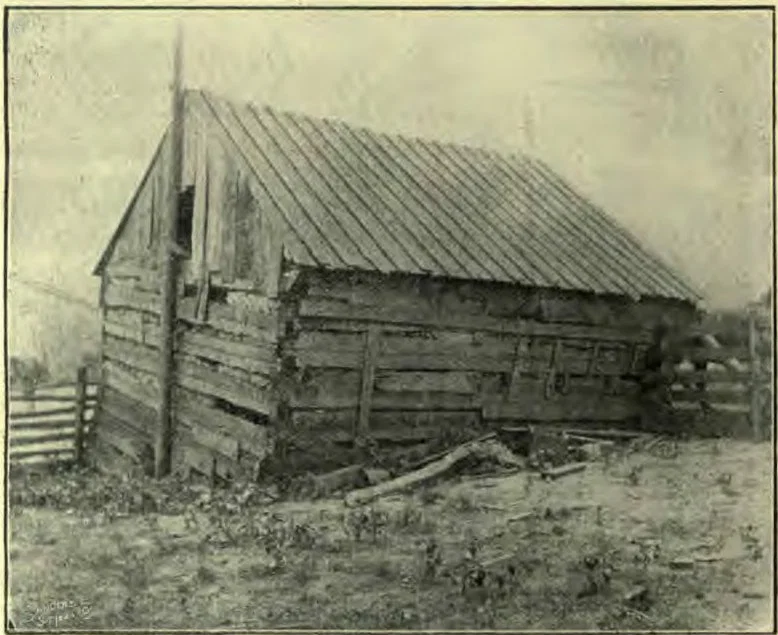
About half a mile away is a striking illustration of how little the American people treasure historic things; for here may be seen the old log cabin in which Abraham Lincoln lived when he studied law. It is situated in the center of a barn-yard, and is used for—a pig-sty! I took away with me as a relic a piece of the chinking, which was still clinging between the old, decaying logs. It was in this humble home, rather than within the walls of some stately university, that Lincoln absorbed those masterful truths by which he afterward shook an entire nation, and swept from American soil its darkest curse.
IN THE ANCIENT CELLAR
We commend to the earnest consideration of every boy these significant words from Lincoln’s stepmother: “Abe was a good boy, and I can say what scarcely one woman—a mother—can say in a thousand,—Abe never gave me a cross word or look, and never refused, in fact or appearance, to do anything I requested him. His mind and mine—what little I had—seemed to run together. He was here after he was elected president. He was a dutiful son to me always. I think he loved me truly. I had a son, John, who was raised with Abe. Both were good boys; but I must say, both now being dead, that Abe was the best boy I ever saw, or expect to see.” Remember that no boy can be laying the foundation for true greatness and at the same time treat his parents shabbily.
Are you sometimes almost disheartened at your apparently unfavorable surroundings, and the meager opportunities with which you are favored? Then read the following in reference to Lincoln, when he was twenty-one years old, and take fresh courage: “When he left his home, he went empty-handed. He was already some months over twenty-one years of age; but he had nothing in the world, not even a suit of respectable clothes. One of the first pieces of work he did was to split rails for enough homespun, dyed with white walnut bark, to make him a pair of trousers. He had no trade, no profession, no spot of land, no patron, no influence. Two things recommended him to his neighbors,—he was strong, and he was a good fellow.”
It was to Lincoln’s advantage, however, that he was not only a mental giant, but almost a physical Samson. It was said of him that he could lift as much as three ordinary men; and, “My! how he could chop!” says Dennis Hanks. “His ax would flash and bite into a sugar-tree or a sycamore, and down it would come. If you heard him fellin’ trees in a clearin’, you would say there were three men at work by the way the trees fell.”
“Standing six feet four, he could out-lift, out-work, and out-wrestle any man he met. Friends and employers were proud of his prowess, and boasted of it, never failing to pit him against any hero whose strength they heard vaunted.”
Those who have a strong tendency to scorn honest toil should make a careful note of this: “Such were the conditions of his life at this time that, in spite of his popularity, nothing was open to him but hard manual labor. To take the first job which he happened upon,—rail-splitting, plowing, lumbering, boating, store-keeping,—and make the most of it, thankful if thereby he earned his bed and board and yearly suit of jeans, was apparently all there was before Abraham Lincoln in 1830, when he started out for himself.” More than likely if he had been too indolent or too proud to soil his hands with what is often called “common labor,” Lincoln’s name and influence would have been neither known nor felt outside of the little village on the banks of the Sangamon River.
The following year he secured employment on a flat-boat, which was floated down the Mississippi to New Orleans. It was here, for the first time, that there was stamped upon this great soul the terrible significance of human slavery, and it “ran the iron” into him then and there. One morning as he passed a slave-auction, a girl was being sold. Her bidders made her trot up and down the room like a horse, to show how she moved, and in order, as the auctioneer said, that bidders might satisfy themselves whether the article offered was sound or not. This scene made such an impression upon Lincoln that he turned away with this remark to his companions, “Boys, let’s get away from this. If ever I get a chance to hit that thing [meaning slavery], I’ll hit it hard.” History records the fulfillment of that prophetic determination.
Lincoln was popularly known as “Honest Abe.” One or two incidents serve to show how completely honesty dominated his actions. “Having discovered on one occasion that he had taken six and a quarter cents too much from a customer, he walked three miles that evening, after his store was closed, to return the money. Again, he weighed out a half-pound of tea, as he supposed. It was night, and this was the last thing he did before closing up. On entering in the morning, he discovered a four-ounce weight on the scales. He saw his mistake, and, closing up shop, hurried off to deliver the remainder of the tea.”
During the summer, when the farmers were busy tending to their crops, the duties of the store where he was clerking did not occupy all his time; so he secured some old law books, and began to read them. But he did not content himself with a merely superficial reading. He himself says, of this time: “The more I read, the more intensely interested I became. Never in my whole life was my mind so thoroughly absorbed. I read until I devoured them.”
No ordinary obstacles could baffle this man of mighty determination. His office as postmaster yielded but a small salary, and his grocery sales were few; so he found it necessary to work part of the time in the mill below the hill, and at splitting rails; but even then he was barely earning a reasonable support. At this juncture he was tendered the office of surveyor. He knew absolutely nothing of the science of surveying, but he secured a treatise on the subject, and then studied while he worked. Day and night he studied, and in six weeks he had so thoroughly mastered the subject that he entered upon his duties as county surveyor.
THE CABIN WHERE LINCOLN STUDIED LAW.
The following quotations afford us a glimpse of that magnificent spirit of helpfulness which must pervade our lives if we are ever to accomplish anything for humanity that shall be of lasting value: “In the Rutledge tavern, where he afterward lived, the landlord told with appreciation how, when his house was full, Lincoln gave up his bed, went to the store, and slept on his counter, his pillow a web of calico. If a traveler ‘stuck in the mud,’ in New Salem’s one street, Lincoln was always the first to pull out the wheel. The widows praised him because he chopped their wood; the overworked, because he was always ready to give them a lift. It was the spontaneous, unobtrusive helpfulness of the man’s nature which endeared him to every one, and which inspired a general desire to do all possible in return. He possessed in an extraordinary degree the power of entering into the interests of others,—a power found only in a reflective unselfish nature, endowed with a humorous sense of human foibles, and with great tenderness of heart. Men and women amused Lincoln; but so long as they were sincere, he loved them and sympathized with them. He was human in the best sense of that fine word.”
Thousands of young people are frittering away golden moments, thereby allowing the possibilities of a lifetime to slip between their fingers. But Lincoln, though deprived of all ordinary opportunities for education, became, by diligent application, an extraordinary mental giant. “He never studied with anybody. He seems to have thrown himself into the work with an almost impatient ardor. As he tramped back and forth from Springfield, twenty miles away, to get his law books, he read sometimes forty pages or more on the way. Often he was seen wandering at random across the fields, repeating aloud the points in the last reading. The subject seemed never to be out of his mind. It was the great, absorbing interest of his life. The rule he gave twenty years later to a young man who wanted to know how to become a lawyer, was the one he practiced,—‘Get books, and read and study them carefully.’”
Multitudes of young people become so engrossed in studying books that they make the fatal error of failing to study human nature, and therefore they are utterly unable to adapt themselves to the various characters with which Providence brings them in contact. Lincoln was a master among men. Of him it was said: “His absorbing interest was the men he met. To get acquainted with them, measure them, compare himself with them, and discover wherein they were his superiors, and what he could do to make good his deficiency,—this was his chief occupation.”
One of the secrets of this great man’s success is told in the following words: “Lincoln had a mental trait which explains his rapid growth in mastering subjects,—seeing clearly was essential to him. He was unable to put a question aside until he understood it. It pursued him, irritated him, until solved. This characteristic became stronger with years. He was unwilling to pronounce judgment on any subject until he understood it, and he could not let it alone until he had reached a conclusion which satisfied.”
It was this determination fully to understand everything that he grappled with that gave him an almost prophetic view of the outcome of so many complicated issues, and helped him to stand for the right, even when he had to stand apparently alone.
Lincoln was one of the factors in God’s hands for the solving of some of the greatest problems in history. Do you expect to become a man or a woman of God’s opportunity? Are you daily learning some of these same lessons in God’s great preparatory school?
DAVID PAULSON, M. D.

Story of Our Matabeleland Mission

The First Letter from the Workers

“To the General Conference:
“DEAR BRETHREN: It takes time to get a letter answered now, because we are so far from the post-office. When we have forty miles to go, we can not go every week. It has been nearly two months since I was in Buluwayo. After the rainy season it may be different. During the rainy season here, the rivers, which are numerous, are quite high, and it is with difficulty that they can be crossed.
“At present Brother Sparrow, who is on the mission farm, has a large hut, eighteen feet in diameter, and also a very good tent. Brethren Lausman and Burton, two young men from Cape Town, have a hut about eight feet in diameter, and a house which is not finished, although it is thatched with grass, as all the huts are, and is quite comfortable in this pleasant weather. It has four good-sized rooms. These two brethren live together, their dwelling being about a mile from my two huts, which are ten feet in diameter. Brother Goepp has been building a second hut, but I do not know whether it is finished yet or not.
“It is forty miles from my dwelling to town, four miles to Brother Sparrow’s, and about a mile and a quarter to the hut where we meet for our Sabbath services. We built the hut for that purpose fifteen feet in diameter for the present, expecting to have a better building next year. It is just four weeks since Brother Wessels spent his last Sabbath with us, and we do not expect to see him again until next year. He told us of a new Sabbath-keeper in Buluwayo, with whom we became acquainted, and to whom we gave reading-matter, on the way from Vryburg. He seemed to be an earnest man, and we all rejoiced to know that he now keeps the Sabbath of the Lord with us. We have since visited him at his home. Others are also convinced of the truth through reading and talking.
“We have organized a Sabbath-school. The natives who attend take great interest in Brother Sparrow’s lessons concerning the true God, who created all things. They are principally the laborers on the farms, who are with us in our homes. We are endeavoring to teach them both by precept and example. Our meetings among ourselves are very interesting and profitable. There is help in them. On Wednesday evenings we can not all meet together, but nearly always two or three of us meet and have a little missionary meeting, and pray for the missions and missionaries at home and abroad. These seasons are good. I have attended all that have been held I think. We meet at one or another of our homes for this. I can assure you that we enjoy the missionary reports in our periodicals.
“The rainy season is beginning, although we have had only a few showers. When the ground is moistened, we can do a little more plowing and gardening; and I think we shall have a little garden growing soon. The natives are preparing their ground now.
“I would like to tell you about the god of this people, but can not take the time now. They love to talk about him and his home, which they say is a cave eighty miles to the southeast of our place.
“I will give you the prices here of a few common articles. Salt of the coarsest quality is 10 cents a pound. Eggs sell from 75 cents to $1.50 a dozen. Butter is about the same price a pound as eggs a dozen. Boer meal, similar to graham flour, is $22 for a sack of two hundred pounds. This is rather high, and better grades of flour bring prices accordingly. Sugar is 25 cents a pound. Condensed milk is 30 cents for a small can. Bread is 25 cents a small loaf or three loaves for 60 cents. A small load of crooked, dry sticks brought $11.25 on the market the last time I was there. Brother Sparrow took twenty poles for building purposes, and received $12.50 by auction. These poles were nearly straight, from twelve to twenty feet long, and from two to four inches thick. Clothing is high in proportion. Gold-mining seems to be the cause of the high prices.
“We can not do much with crops except during the rainy season, but we shall have enough to do in the line of building and making hedges of brush, to keep us busy during the dry season, together with taking the crops to market and trading.
“We hope that the time is nearing when others will be on their way from America to Matabeleland. E. J. HARVEY.”
Brethren E. J. Harvey and Adolph Geopp were two who had gone from America in the fall after the mission farm had been secured, planning to take up claims near it, and engage in self-supporting missionary work. At the time the foregoing letter was received, plans were being laid to secure workers for the mission, and these were soon on their way. Their experiences after reaching the farm make a most interesting chapter in the story of our mission.
ESTELLA HOUSER.

Fixing Happiness on Things That Pass Away

If a man has fixed his happiness on anything lower than the stars, less stable than the heavens, less sufficient than God, there comes a time, sooner or later, when it passes from him or he from it. Do not venture the rich freightage of your happiness in flimsy vessels. If you do, be sure that somewhere or other, before your life is ended, the poor, frail craft will strike on some black rock rising sheer from the depths, and will grind itself to chips there.—Alexander McLaren.

— Frank Walcott Hutt

Worryland

WORRYLAND’S a wilderness Where no tree nor flower will grow, Where no sunbeam’s sweet caress Cheers the desert place below.
Worryfolk are sure to frown, Be the weather what it may; Keep in sight of Sunny Town, And you can not lose the way.
Hill paths are the best, you’ll find, Sunshine falls on every hand; So, beware of paths that wind Down the vale to Worryland.

— Frank Walcott Hutt

Turn on the Searchlight

TURN on the Searchlight wherever there are dark corners, “full of the habitations of cruelty.” It is the only thing that can scatter the darkness, and strengthen and uplift the fallen sons of men. There is no book like the Bible; none other that can cleanse the vilest of human hearts, and fill them with love for God and Jesus and for all things pure and holy.
We need fear nothing evil when we have the Searchlight always in our hands. It will carry us safely past all dangers; show us all pitfalls, all obstructions, every lion by the way. It is a clear, shining lamp to our feet, a light to our path.
A Sunday-school missionary, Mr. G. S. Jones, was traveling “among the mountain slopes south of Warrior Knob, near where the two Carolinas meet under the same chestnut tree.” Eight miles farther, there was a settlement called “The Dark Corner.” Toward this “Dark Corner” Mr. Jones bent his steps.
There he found a young married couple, who had been taught in a Sunday-school that he had planted in another county, years before, and of course they welcomed him with gladness. Near by was a schoolhouse called “The Eagle’s Nest.” Thither the people were gathered. Beautiful songs were sung, prayer was offered, and then it was decided by the young people that they would have a Sunday-school, for not all at the “Corner” were in darkness and ignorance.
One of those who spoke said: “We’ll have to watch and be brave, if we expect to keep this ‘Nest’ from disturbance. We are surrounded, they say, by ‘blind tigers,’ blockade stills, and ‘summer rattlesnakes.’”
“Yes, that may be so,” responded another, whose face was radiant with the spirit of success, “but I’m not afraid of any such hidden dangers. We meet here to-day to put up a big Searchlight, and this shall remain no longer ‘The Dark Corner.’”
I like the spirit of his words! Let the lamp burn brightly from purely polished human-candlesticks, and the darkness will soon in some measure be dispelled. All that God wants us to do on earth will be done. His kingdom will come, and his will be done on earth as it is in heaven. S. ROXANA WINCE.

Georgiana, an Elder Sister

When the sweet woman of whose story I am thinking to-day was a girl, just sixteen, a great trouble came upon her. Few girls were ever more beautiful than she, with a rose-leaf complexion, eyes like blue violets, and hair of raven blackness,—a girl whom artists would have loved to paint, so exquisite and madonna-like was the type of her rare loveliness.
She was in school one day when the first intimation of lifelong suffering came to her, in a pain that shot through her head like a knife, and stayed there like a stone. Little by little, she knew herself under the power of a malady which was incurable. In four years, she was no longer the straight, slim, graceful maid, whose step was light and carriage queenly. She was a cripple, with a hump on her back; and the exquisite head was sunken beneath bowed shoulders.
Nobody ever knew why or how this great calamity came. Whether from a fall in babyhood, or some consequence left from childish illness, none could explain. The eldest in a family of rarely beautiful girls, she bore the misfortune, not merely with patience and resignation, but so brightly, so buoyantly, so serenely, that she was the magnet in the household for children, the comfort of her parents as they grew old, and the counselor of any who needed advice and sympathy.
There is a phrase I always think of in connection with Georgiana,—“called to be saints.” She was called of Christ to be a saint, but she never knew it. She was just saintly, which is holy, and, being holy, she carried every need to the Lord. She was the possessor of a sweet voice, and, in church and at home, it was pleasant to hear her sing hymns, ballads, and the Scotch songs which her father loved.
I was a very young girl when I met Georgiana, and one of her younger sisters was my intimate friend, so that I was much in her home. I suppose she was thirty then, though to my eyes she seemed older. When I had my first long dress, she took a great interest in it, and was my confidante in all the details of my first party. I remember how she insisted on simplicity. “You do not need much trimming; you have color and youth and happiness; let the dress be very plain, dear,” and, though he did not mean to do so, she was really laying down a very good fashion rule for every girl in her teens.
One after another in that household, the sisters and brothers left for other homes, or were taken away by death. Georgiana superintended the wedding preparations. Never was any one more efficient, more sensible, more capable, than she. Never any one said so little about suffering, yet she was not for a minute free from pain. She carried complete self-effacement to the point of sublimity. Her own affairs seemed always to be those of others. When death came across the threshold, she it was who cheered the pathway of the invalid, who all but stepped into the dark waters with the dying. “Going to heaven, darling!” she said, with such joyful courage, to the sister who was passing hence, that the fading eyes lit up with her invincible smile, and borrowed something from her matchless trust.
She lived to be the last of her group; father, mother, all passed away before one morning, when she was sixty, she fell asleep. And, because she was brave and patient and stout-hearted, and accepted God’s will without one murmur, I call hers one of the noblest lives I have ever known.
“Just at first,” said a friend to Georgiana, “did not this trial seem greater than you could bear?”
There was a flash in the dark-blue eyes! “Not only just at first,” she said, “but always, always. I never could have lived if Jesus hadn’t been bearing it with me, every hour of every day.”
There was her beautiful secret—the life hidden with Christ in God. In this world there are many such people carrying about with them bright faces over aching hearts, because in the midst of sorrow and suffering they have real help from the great Helper.—Margaret E. Sangster, in Well Spring.

The Path Through the Tuny Patch

WE need not go very far from home to learn lessons upon the way of truth. Jesus taught us that. From the things of the wayside and household he drew spiritual lessons. Right in our own yard and garden I have learned many such.
In our back yard the rock crops out upon the surface in some places, and the soil is not very deep anywhere. It is in just such spots that the “tuny” (which is Indian for prickly pear) loves to grow. It is a very prickly plant indeed, and one needs be extremely careful as to his walk when he is near it. A part of our back yard is overgrown with these plants. There is a path through the “sticker bushes,” as the children call them, leading to a cleared space on the hillside, where they sometimes go to gather wild flowers and to play. The path is not often used, and the tunies encroach upon it in places, holding out a prickly hand here and there. With great care one may pass through the path without harm; but if he is at all careless, he is sure to get all “stuck up,”—and the “stickers” make painful wounds. Leading out from the main path are little branching paths, that go nowhere in particular, and are made no one knows how. The temptation to step aside to gather some of the large, bright-yellow flowers that grow upon the tunies is great, but one is almost sure to pay for his trophy with many a painful jab of the wicked thorns.
So in the way of life the flowers of sin lie about us on every side, guarded by the thorns that warn us to beware. There is a pathway through, however, made by him who said, “I am the Way.” If we walk in this way, walk “even as he walked,” we are safe. The enemy lays his snares for us right and left. Here and there are paths that seem to lead right; but before we know it, we are in a place from which it is difficult to escape.
Sometimes our little girl, in her desire to gather the pretty blossoms, goes out among the bushes, and occasionally she gets shut in by them. Then I hear her call, “Papa! I am all stuck up,” and I hasten to her rescue. She holds out her hands, and I lift her up bodily, and carry her out of the patch.
So our Saviour hears us cry to him, and he comes to our rescue in danger or temptation. Let us put ourselves in his care, and he will carry us out of the “sticker bushes” of sin, and place our feet in a safe path. Let us remember, when the way is dark, and the stickers jab and hurt us, that his word is “a light unto our path.”
E. L. PAULDING.

MINNIE ROSILLA STEVENS

Friends

'Tis good to have a friend to fully trust, To love, admire, and lean upon in need; One in whose strength our weakness is submerged, Whose weaknesses to higher efforts lead,— A human friend, portraying in each deed That plan the Friend of friends for friends decreed.
And such a one, have you, dear, been to me; And such are you still being every day; E'en though we disagree at times, I feel You cheer like fountains by the dusty way, Which, smote by breezes, ruffle into spray, Then calm, and show the sky, with clouds astray.

MINNIE ROSILLA STEVENS

A Suggestion

I CAN NOT tell why there should come to me A thought of some one miles and years away, In swift insistence on the memory, Unless there be a need that I should pray.
He goes his way, I mine; we seldom meet To talk of plans or changes, day by day, Of pain or pleasure, triumph or defeat, Or special reasons why ’tis time to pray.
We are too busy even to spare thought For days together of some friends away; Perhaps God does it for us, and we ought To read his signal as a call to pray.
Perhaps, just then, my friend has fiercer fight, A more appalling weakness, a decay Of courage, darkness, some lost sense of right— And so, in case he needs my prayer, I pray.
Dear, do the same for me! If I intrude Unasked upon you, on some crowded day, Give me a moment’s prayer, as interlude; Be very sure I need it, therefore pray.
—Marianne Farningham.

Loyalty to Our Aim

Our young people can not too carefully guard against the danger of losing sight of the design in forming Young People’s Societies in our churches. There is a possibility of thwarting the real purpose of this movement by contenting ourselves with the mere fact that a company has been organized, and meetings are held regularly on the Sabbath.
The organization of these companies is but a means to an end. While thus used, they will prove helpful. Considered in any other way, they must prove a hindrance. The large possibilities capable of realization in their proper use as an efficient means to a definite end, will remain undeveloped while the members of the company look upon their organization as an end in itself.
This fact was appreciated by those who participated in the organization of the Young People’s movement, and the end to be attained was very clearly indicated in the words chosen to represent our aim,—“The Advent Message to all the world in this generation.” This surely means active, earnest, aggressive service. If we find ourselves only formally organized, but not definitely serving, we may be assured that our organization is but outward and worthless. The transformation of this lifeless form can be effected only by a living experience in active service on the part of each member. Let this be effected without delay, and the association of these strong, active young lives may prove a great blessing to the work. The value of united effort, directed to some specific end, will then be realized, and it will be seen that more is accomplished than by the scattered and purposeless effort of individuals governed by no common plan of action. Furthermore the association together proves a stimulus to activity, a source of mutual encouragement, and a reason for more zealous individual effort, thus greatly multiplying the extent and value of the service rendered.
Reader, what has been the experience of your society? If you are in danger of looking upon your organization as the chief end of your association together, determine within yourself that your attitude shall be forever against a course so destructive to the primary purpose of this movement. If you have thus far accomplished a good work, determine that the usefulness of your company shall be multiplied many fold.
It is said that on one occasion a lieutenant serving under General Napier approached his commander, and, saluting, said, “Sir, I have captured a standard.” General Napier looked upon the young officer whose bravery had won the proud trophy of victory, and with solemn severity he replied, “Sir, go and capture another.” The old general had received honorable wounds in his country’s service while still a young man. He had especially distinguished himself in the awful campaign before Lucknow. He doubtless saw the young lieutenant’s tendency to be satisfied with one victory. Hence, his stern command.
Have you, by the grace of God, captured a standard from the enemy? Our Commander bids you go forth to take another, and yet another, till “all dominions shall serve and obey him.”
H. E. OSBORNE.

A Kindly Light

A SCHOONER on its way from Boston to Nova Scotia was driven by a winter storm on the “Bantam” rocks on the Maine coast, and it went to pieces so quickly that the crew had barely time to launch their dory and push off.
Nothing ever seemed less likely than that they would escape. Blinded by the flying snow, the men had been unable to steer their ship, and now, at night, cast to the wind and waves in a frail boat, their lives hung upon the chance of a miracle. They rowed at random; for they could only guess which way to head for shelter. It was impossible to find by seeking any of the coves that would give them safety on that rugged coast.
When they were nearly exhausted, suddenly a strange eddy in the wind showed them a light through the smothering storm. They turned about and pulled toward it, and presently felt the terrible power of the waves begin to abate, and in a little while they knew where they were.
Between Cape Newagen at the lower end of Southport Island and a small neighboring island, there is a small but safe harbor. In one of the houses of the little fishermen’s village a woman awake late at night, caring for her invalid husband, had looked out into the storm, and seeing only unbroken darkness along the miles of coast, set her lamp in the window. She knew the perils of the ocean, and the simple act was her prayer of pity for drifting souls. It was that little lamp which, later in the night, guided the five shipwrecked sailors to the refuge of her home.
There are lives that are as truly a beacon and a blessing as that woman’s lamp. They make no heroic rescues, but their influence saves many from danger. It is what the sublime Teacher meant when he said, “Let your light so shine.” — Youth’s Companion.

In Exile

The noise of hurrying crowds all day Has driven up against my door; Yet have I wandered far away, Along a sunny, silent shore. O seaward-sloping meadows wide! O happy waters, far and blue! Where white sands wait the swinging tide, My homesick heart has gone to you.
All day my window-blinds have stirred To jarring hoofs and wheels below; Yet I am listening for a bird That sings beneath a tree I know,— A slender tree against the sky,— An orchard paling, brown with years, A blackbird’s whistle, clear and shy— Why do my eyes grow dim with tears?
The crowds go back and forth all day, The sun burns fierce along the street; But I have found a shady way, With cool, white clover at my feet. Far off beneath the branches low The foot-path wanders, still and fair; My feet are fast with toil,—but oh, To-day my heart is walking there!
—Mabel Earle.

Battles Between Truth and Falsehood

STUDY PREPARED FOR THE YOUNG PEOPLE'S MEETINGS
Lesson XXIV — Two Thousand Years of Battle
(October 19–25)
HOW TO STUDY THESE LESSONS.—(1) Read the lesson story; (2) try to recall or find scriptures in proof of each statement; (3) study the texts; (4) see how many missing links you can supply; (5) give the lesson to some one else. You will keep only what you give away.
In the seventh chapter of the book of Daniel is a wonderful outline of prophetic history. In a night vision the prophet was standing by the great sea. The waves were lashed into fury by a battle between the four winds. While watching the strife and commotion, a beast was seen coming up out of the billows. It appeared like a lion: but it had wings like an eagle. Soon a beast like a bear followed the lion, and a little later a leopard with four heads and four wings. Last of all was a fierce, wild beast. Unlike anything in nature, with iron teeth and nails of brass, it devoured and crushed everything before it.
This beast had ten horns; and while Daniel watched it, a little horn appeared among the ten. Soon it had pushed three of the ten out of the way to make a place for itself. Stranger yet, this horn soon developed keen, searching eyes; and a mouth that spoke pride and boasting.
While watching the dreadful beast and the strange horn, the attention of the prophet was attracted to another scene near by. Thrones were being arranged for a court. Then in great majesty, God the Father opened the judgment. A multitude of witnesses were present, bringing the life-records of those who were to be judged.
Hearing some very loud words from the little horn, Daniel turned to watch it again. Not long afterward he saw this great beast with the proud horn thrown into the consuming fire.
Looking back now to the place of judgment, Daniel sees Jesus being escorted before the Father. To him are given all of earth’s kingdoms, for an everlasting dominion.
Of course Daniel was anxious to know the meaning of all these things; and everything was clearly explained to him. The four beasts were four kingdoms. The dreadful fourth beast was the fourth kingdom that would be on the earth. The ten horns were ten divisions of that fourth kingdom. The little horn was a power that would arise among the ten, and fight against God and his people. During his proud career the judgment would sit, and his rule would be overthrown.
It will be sufficient for this lesson to get a clear idea of the vision, and the main outline of the explanation.
Let each practise telling the story. Study the chapter till you can see the vision.
Recall the story of the second chapter, and compare the two.
Here is a view of the long struggle between the “man of sin” and the “Son of man.”
Continue reading: A Complaint