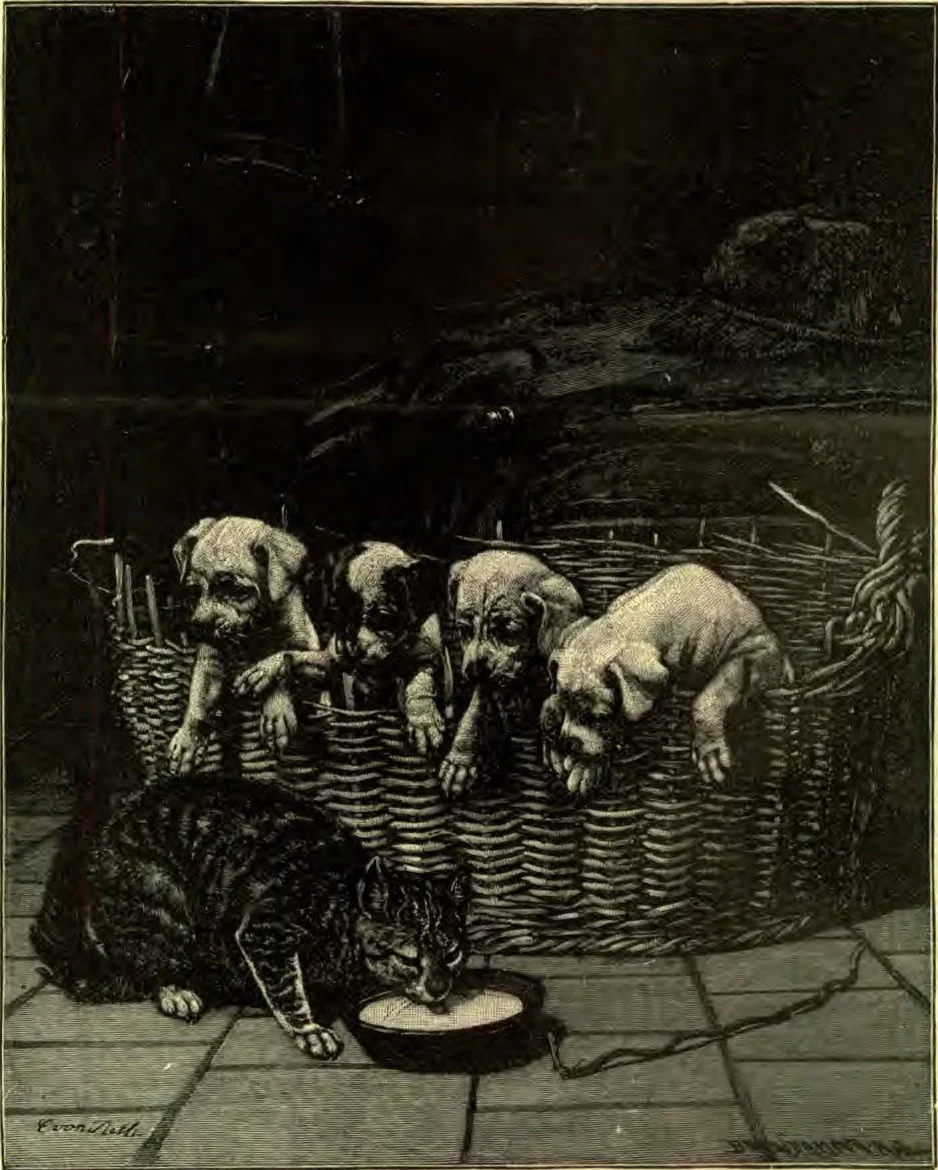
“WHEN Molly put our nice, sweet milk
Into our pan, so clean and shiny,
We were so glad we barked for joy,”
Said Tim and Trotter, Trip and Tiny.
“But when old Tabby Cat came by,
We climbed into our cradle basket;
And though we’re hungry for our milk,
Not one of us would dare to ask it.
“So here we sit and watch and wait,
And all of us feel very whiny,
Because the milk is nearly gone;”
Said Tim and Trotter, Trip and Tiny.
“If Tabby had a dish of milk,
We’d leave her be in peace to drink it;
’Cause she has thorns in all her feet,
And we’re not thieves. You needn’t think it.
“But if her eyes were not so fierce,
And if her paws were not so spiny,
We’d make her give our breakfast up,”
Said Tim and Trotter, Trip and Tiny.
“But just you wait till we are grown,
Then some cold morning
in December,
We’ll take her breakfast,
just to help
Old Tab her manners to
remember.”
ELIZABETH ROSSER.
Myrtle’s Courage
By Anna Cliff White
Meow! Me-ow! Me-o-w! Where in the world were those kittens? Myrtle, swinging under the old apple-trees in grandpa’s orchard, slipped off her seat in haste.
Meow! Me-o-w! Me-o-w! Dear, dear; it sounded as if there might be twenty kittens, all crying in as many different keys. Myrtle hunted all around, and finally discovered that the noise came from under an old shed. No amount of coaxing or calling could persuade the little creatures to come into sight. They’d stop crying for a moment, only to redouble their efforts the moment her voice died away.
How should she get them out? Surely they were in distress; for no happy kitten ever gave vent to such agonizing yowls as were greeting her ears at that moment.
There was a big hole under the foundation of the shed at one side, big enough for Myrtle to creep into. But it was from that very hole, three mornings ago, that Jim, the hired man, had seen a snake crawl; and if there was one thing in the world of which Myrtle was afraid, it was a snake. She never looked at even the picture of one if she could avoid it; and once when she came upon a cage of them at the Zoo, she was seized with such a gasping, shuddering horror that papa had to take her around to the other side, and interest her in the comical antics of a cage of monkeys, and it was some time before she could forget her fright.
But there were those kittens; what should she do? Jim and grandpa were away down in the back pasture lot, and would not be back until night. Grandma was enjoying her afternoon nap, and could not be disturbed; while Aunt Maria was deep in the mysteries of canning berries. Oh, if there were only some one! But there wasn’t, and Myrtle’s sympathetic little soul had become so excited by this time that she imagined all sorts of horrors regarding those kittens. Evidently, she was their only hope.
“SO HERE WE SIT AND WATCH AND WAIT”
She found a long stick, and proceeded to try to poke the kittens out, almost holding her breath for fear something more dreadful would appear; but she only succeeded in stirring up a more vigorous protest on the part of the distressed babies. There was clearly no help except to crawl in, and look after matters personally.
Myrtle sat down, and considered. At first she thought she would go off out of sight and hearing, and let the kittens manage their own affairs. But then she couldn’t do that; for wasn’t she a member of the newly organized Band of Mercy, and wasn’t it only yesterday that she held forth to grandma because there wasn’t a solitary thing around there to help. And here was her opportunity, the first one, too, right before her. If only that terrible snake had crawled out of any other hole in the neighborhood!
Half an hour later Aunt Maria, peacefully washing up her canning utensils, was startled by an apparition—muddy, disheveled, tearful—holding in her apron four of the wettest, dirtiest, thinnest kittens you ever saw.
“What in this world?” she began.
“Oh, do take them,” quavered Myrtle. “They were under the shed with the snakes, I mean where the snakes came from,—and oh, I couldn’t get them out! And there wasn’t anybody else. They were all in a puddle of water, and I guess they’re hungry. And I was afraid to crawl in—and—and—”
Poor Myrtle sat down on the floor, kittens and all, and gave vent to her overwrought feelings in a burst of tears. It took auntie some time to understand the situation; but by the time the kittens were fed and washed and dried, and cuddled down in a basket to sleep, and Myrtle had been likewise cleared of the marks of the fray, she had managed to make matters clearer.
Auntie, who knew the child’s great horror of snakes, took her little niece on her lap, and praised her warmly for her courage and kindness.
“What made you decide in the end, darling?” she asked as they talked it over.
“My morning verse, auntie. I thought of that, and then I kept saying it over and over, as I crawled in, ‘He shall give his angels charge over thee.’”
ANNA CLIFF WHITE.
Who Knew Best?
A True Story
“No,” said Miss Ray, decidedly, “I can not think of allowing you to burn off the playground until Mr. Johnson plows his field. It would not be safe.”
“We will watch it,” began Arthur.
But Miss Ray shook her head, and said: “Don’t tease; I have answered you.”
Now Arthur was altogether too old to pout; nevertheless, I am quite sure his lips did not wear their usual smile when he left the room.
“Not safe!” he muttered. “That is all she knows about it. She’s smart enough in books, but she hasn’t been in Dakota long enough to know that we always burn our dooryards in the spring. I’ve lived here all my life, and I know.”
All his life was barely twelve years; but then that was fully three times as long as Miss Ray had been in the State; so, of course, he must know three times as well as she what was best!
He walked moodily out to the back of the playground, and stood looking at the dead grass at his feet. The green was just beginning to appear.
“’Twould be nice in a week, if only this old brown stuff were out of the way,” he thought.326
“And we shouldn’t lose the ball in it either,” he said to himself.
He put his hand in his pocket. His fingers touched something, and he drew it out. It was a match. He held the match for a moment in his fingers, then, lighting it, shielded the flame carefully with his hand while he looked about him. There were no windows at the back of the schoolhouse, and the children who were outside were playing “Anthony-Over” too busily to notice him. Presently he dropped the match into the grass.
It was a quiet day, and the little flame did not spread rapidly at first. Arthur watched it creep along the grass, growing larger and larger as it went, and thought how easy it would be to put it out, and how little danger there really was on such a beautiful day. He promised himself that, when it had burned “a nice square place,” he would put it out. But it was burning so prettily when it reached the boundaries he had set that he thought, “A little farther won’t make any difference.”
Presently a stray breeze caught it, and, in an instant, Arthur saw that he must lose no time if he would control the fire. At this moment, also, the other children discovered it, and came rushing to see what he was doing. Arthur promptly set them all at work. His brother Charlie ran into the schoolhouse, and seized the water pail. It was empty, so away he ran to the well, fifty rods away.
The busy teacher had not noticed Charlie’s entrance, but the girls had, and they crowded to the window, from which the fire was now plainly visible.
“O Miss, Ray!” they cried.
Miss Ray gave one glance, then hurriedly seizing the broom, made her way to the scene of action.
“George, call Mr. Clark. Johnnie, run down to Mr. Johnson’s,” she directed, as she vigorously beat the fire away from the shed with her broom.
Help came quickly. The word “Fire!” is a word to be dreaded on the prairie. Mr. Clark sprang from his table, seized a new grain-sack from his wagon, and ran to the rescue. Other neighbors came on horseback, and in a few moments the danger was past.
Last of all, just as the final bit of flame died under the stroke of Mr. Clark’s damp and blackened grain-sack, neighbor Johnson appeared with a pail of water and an armful of sacks.
“Too late, Johnson,” said one of the men, adding, in an undertone, “if we had all been as slow as he, I wouldn’t give much for what would be left to-night of his buildings.”
Arthur heard the remark, and hoped the teacher would punish him.—Sunday School Times.
Inquire Within
By Martha Burr Banks
LITTLE Lady Apple-Core, in
her pretty cot,
Is sometimes glad of visitors,
and sometimes she is
not.
If she's ready for a caller, you
can tell without a
doubt
By the color of the servitors
who're waiting round
about.
If you're greeted by white
maidens, you are not
yet expected,
But if all you meet are black
ones, you will not be
neglected.
She will give you hearty welcome, and, as often I've
been told,
She'll offer you the very best
the little house may
hold.
— Martha Burr Banks.
First Lessons in Geography
By Floyd Bralliar
Lesson I
“THROUGH faith we understand that the worlds were framed by the word of God, so that things which are seen were not made of things which do appear.” Heb. 11:3.
In the study of geography we shall learn of the earth we live on; of its plants, animals, tribes of people; and of the wonderful way in which God has made it. As we look around us, and see so little change from day to day, we are likely to forget that the earth has not always been here; yet it is only about six thousand years old.
The earth, and all things on it, were made in only six days. God had decided to make a new world, and it was decided that Jesus was to do the work. On the first day he created the world. When he spoke the word, the world immediately came into existence where he had commanded it to be; for he “spake, and it was; he commanded, and it stood fast.”
As the earth came forth, the land and the water were mingled, and the whole was a liquid, shapeless mass. All was dark. But Jesus wished the world to be beautiful, so his Spirit came; and he spoke, and there was light. It is always light and beautiful where the Spirit of God is. He “set a circle [margin] upon the face of the deep,” and shaped the world into a globe. Then he divided the light from the darkness; the darkness he called Night, and the light he called Day. The light was on one side of the earth, and the darkness on the other; the earth was made to revolve so that all parts of it were turned to the light and to the darkness every twenty-four hours. This marked the length of the day.
If you stick a pencil through an apple, and hold it in a pail of water so the pencil lies on the surface of the water, and then roll the pencil, you can see how this is. The water may represent night, and the air day. The day and the night stand still, and clothe the earth as a garment, while it is turned to them just as you would roll the apple in the water. See Job 38:14. We call the line on which the earth turns its Axis: the ends of the axis are called the Poles. One points north, and is called the North Pole. The other points south, and is called the South Pole.
QUESTIONS.—How old is the earth? Where did it come from? What was it like at first? What shape did God make it? What did he make on the earth? What did he call the night? How does all the earth get to the light each day? What is the earth’s axis? What are the poles? Name them.
Lesson II
Before anything having life could be placed on the earth, air must be made. On the second day God made the air to surround the earth. The air is a wonderful thing; for in it God has placed that which is necessary to life. There is nothing more invigorating than pure, fresh air. We call the air a gas. It surrounds the whole earth to a depth of about fifty miles. It has the power to take up water, and hold it, as a sponge does. Yet when it was first made, it never took up enough to form dense clouds, but held sufficient to form a dew on the plants when it grew cold in the evening.
Set a dish of water in the warm air of the schoolroom, and see how long it takes the air to soak it up. Fill a pitcher with ice-water, and notice the dew form upon it. Where does the dew come from?
At the close of the second day, there was air, so things might have lived on the earth; but there was no dry land. On the third day God gathered the waters together, and caused the dry land to appear. He called the dry land Earth. It was not like our earth now, mixed with clay and rocks in many places. It was all very fertile, and everywhere the rocks were buried deep in the soil, to form the framework, or bones, of the earth. In many places the soil was mixed with gold and silver, while precious stones glittered on the surface, plentiful as pebbles. Iron and all the metals man could use for his comfort or pleasure were to be had on every hand.
The earth was not alike in all places. Here would be broad stretches of level land, called Plains; while in other places it would rise in beautiful mounds called Hills, or in larger ones called Mountains. Between the mountains were lowlands called Valleys. Everywhere the world was ready, waiting for something to be created to grow in it.
The waters were gathered together into bodies called Seas. These were very beautiful, as the crystal waves rippled in the breeze, or beat upon the golden sands of the shore. But most of the waters were shut up inside of the earth, so they could soak upward into the soil. Ps. 33:7.
QUESTIONS.—When was the air made? Why? What are the uses of the air? What causes dew? What is earth? What is a hill? A mountain? What is a valley? What are seas? Where was most of the water placed?
College View, Neb. FLOYD BRALLIAR.
Little Millionaires
By Ethelwyn Wetherald
TWENTY little millionaires
Playing in the sun,—
Millionaires in mother-love,
Millionaires in fun,
Millionaires in leisure hours,
Millionaires in joys,
Millionaires in hopes and plans,
Are these girls and boys.
Millionaires in health are they,
And in dancing blood;
Millionaires in shells and stones,
Sticks and moss and mud;
Millionaires in castles
In the air, and worth
Quite a million times as much
As castles on the earth.
Twenty little millionaires,
Playing in the sun;
O, how happy they must be,
Every single one!
Hardly any years have they,
Hardly any cares;
But in every lovely thing
Multimillionaires.
— Ethelwyn Wetherald.
Adopted Into God's Family: Heirs Only by Adoption
For a number of years, a young girl had made her home with a family of wealth and influence. She enjoyed all the privileges of a daughter of the house, and was usually looked upon as such. “Has Mr. B. adopted you?” she was frequently asked. “No,” she would reply; “I’ve never been quite willing to break off my family connections. Then, there isn’t any use in it. I’m as well off as I am. I am just the same as a daughter.” So she was for the time being; but when her benefactor died, she was a penniless orphan.
There are a good many people who tell us that they are just as good as the children of God, though they have never been formally adopted into his family. They forget that it is only the children who are the heirs of God and joint-heirs with Jesus Christ.—The Outlook.
Two Roads
In winter-time ’tis straight and hard,
The road to Knowledge Land;
By Study Lane and Schoolbook Place,
With pencil in your hand.
Your eyes must see, your ears must hear,
The things there are to learn;
And never to the right or left
Your little feet must turn.
But when the summer comes, oh, then
You’ll find that Greenfield Way
And Woodsy Path and Sunset Hill
Will lead you day by day
(If you will look and listen well,
And read on every hand
The open books Dame Nature leaves)
To that same Knowledge Land.
MEMORY VERSE: “Ye shall know them by their fruits.” Matt. 7:16.
Synopsis
The seventh chapter of Daniel deals with the four universal kingdoms which have in turn ruled the world. The lion is Babylon; the bear, Medo-Persia; the leopard, Grecia; and the fourth beast, for which no name can be found, is Rome. This beast had ten horns, representing ten kingdoms (verse 24); their power finally culminates in that of a little horn, whose dominion shall endure until the judgment, and the time come that the saints possess the kingdom. The little horn, therefore, must exist now; for the message that “the kingdom of God is at hand” is being preached all over the earth. The question is, How shall we know this power? What is its work?—To make war with the saints, wear them out, and speak great words against the Most High.
The work of the little horn identifies it with the first beast of Revelation 13. A careful study of the opening verses of this chapter will reveal a number of similarities between them.
Dan. 7:12 gives us to understand that the first three kingdoms “had their dominion taken away, but their lives were prolonged for a season and a time.” Just so from Rev. 13:2 we learn that the beast with ten horns was like a leopard, like a bear, and like a lion; that is, certain characteristics of the three kingdoms which these beasts represent were prolonged and developed in the work of the beast, whose power is from Satan (Rev. 12:9),—“even him whose coming is . . . with all power and signs and lying wonders.” 2 Thess. 2:9.
The very fact that this fourth beast is so fully described, and yet has no definite name, shows it to be a very deceiving power; and the danger is that people will not recognize it. In fact, all the world wonder after it, and worship it, saying, “Who is like unto it?” when in reality they are worshiping Satan.
Revelation 17 gives further light concerning the beast with ten horns. Here the power of the beast is represented by a woman “full of names of blasphemy,” “drunken with the blood of the saints, and with the blood of the martyrs of Jesus.” But this is the same work as that of the little horn, and therefore this woman and the little horn must be identical. Her name is “Mystery, Babylon the Great,” “that great city, which reigneth over the kings of the earth.”
So to-day the beast with ten horns is exercising its power over the kings of the earth under the name of Babylon. The principles of ancient Babylon are still alive, and are penetrating every nook and corner of not only the governments of the world, but every system of education and religion. The religions of to-day are not nearly so dangerous as the world’s systems of education, in which the doctrines of Rome and Babylon are not so clearly recognized. “Now as never before we need to understand the true system of education. If we fail to understand this, we shall never have a place in the kingdom of God.”—Special Testimony on Education.
Questions
With what does the seventh chapter of Daniel deal?
What is represented by the lion, bear, leopard, and fourth beast?
How is the great power of this fourth beast represented?
In what does its power finally culminate?
How long is the little horn to continue?
What shows that it must be reigning now?
How can we know it?
The work (or fruit) of the little horn identifies it with what other beast?
What other similarities do you find between these two beasts?
Although the first three beasts lost their dominion, yet what was prolonged for a season and a time?
In what beast, then, do we find the characteristics of the first three developed?
MEMORY VERSE: “With what measure ye mete, it shall be measured to you again.” Matt. 7: 2.
(The chapter given as the Lesson Scripture is the lesson to be studied. Read this every day, and think over it until you know just what it teaches. Then the following notes, which should be read several times, will help to a fuller understanding of the lesson. Lastly, go over the questions carefully, and be sure that you can answer each in the words of Scripture.)
The well by which Jacob first met his cousin Rachel was no doubt the one where Eliezer had waited for Rebecca. In those early times the young women helped the men in taking care of the flocks, as they do now in some countries. When God first made man, he put all the animals under him, and gave him the garden to take care of. For a long time after the fall, the best men seem still to have kept to those occupations that were God’s plan. Abel was a keeper of sheep. The wealth of Abram and Lot was in their vast flocks and herds. Isaac inherited his father’s wealth, and so his son Jacob was used to a shepherd’s life. This he showed by his readiness and ability to water Rachel’s flock.
Jacob had been sent by his father and mother to take a wife from the land that Abraham came out from, and where he had sent in search of a wife for Isaac. As in the case of Eliezer, so with Jacob: the first woman whom he met by the well was the one whom God had chosen. For he loved his cousin Rachel, and the seven years that he served her father for her seemed to him but a few days.
But Jacob had a terrible lesson to learn—that “with what measure ye mete, it shall be measured to you again.” Because Jacob had deceived his blind old father, God suffered him also to be deceived. When he had served the full time for Rachel, and expected that she would become his wife, another was given to him instead, and he did not find out the deception until Leah had been made his wife. This is why Jacob had two wives instead of keeping to God’s plan, for he afterward married Rachel, though he had to serve another seven years for her.
Jacob could not love Leah as he did Rachel. He had never chosen her for his wife, and she had only become so by deceit. But God, who, we have found, is ever ready to comfort those that mourn, even though it be through their own sins, comforted Leah by giving her a number of children.
But Rachel had no children, for many years after her marriage. At last, in answer to her earnest prayers, God gave Rachel a son whom she named Joseph. Another son was also given to her, but she died at the time of his birth. These two boys were more dear to Jacob than all his other children, because they were the sons of his beloved Rachel, and because they were given to him in his old age, as Isaac was to Abraham and Sarah.
Questions
1. Why was Jacob sent away from his home? Where did his father and mother tell him to go? Gen. 27:43 and 28:2.
2. Whom did he meet at the well outside the city? Gen. 29:9. Who else had waited at the same well, and whom did Jacob meet there?
3. What did Jacob do when he saw Rachel?
4. What did Rachel’s father do when he heard that Jacob was come?
5. What wages did Jacob ask for the work he did for Laban?
6. Was Rachel the only daughter? What was the name of her elder sister?
7. How long did the seven years of service seem to Jacob? What made them pass so quickly?
8. But what great disappointment did Jacob have? Why did God allow him to be so deceived?
9. What did God do for Leah because Jacob did not love her?
10. Did Rachel have any children? What were their names? How did Jacob feel toward the two sons of Rachel?
The Best Story
LITTLE Blue Eyes is weary—
Come here and be rocked to sleep;
Shall I sing to you, darling, or tell you
The story of little Bo-Peep?
Of the cows that got into the meadow,
Boy Blue fast asleep in the hay?
If I’m to be story-teller,
What shall I tell you, pray?
“Tell me” the blue eyes opened
Like pansies when they blow—
“Of the baby in the manger,
The little child Christ, you know;
I like to hear that story
The best of all you tell;”
And the little one nestled closer,
As the twilight shadows fell.
Then I told my darling over
The old, old tale again,
Of the Baby born in the manger,
And the Christ who died for men,
Of the great warm heart of Jesus,
And the children whom he blest,
Like the blue-eyed girl who listened,
As she lay upon my breast.
And I prayed, as my darling slumbered,
That this child with eyes so sweet
Might take in the Saviour’s lessons,
And sit at the Master’s feet.
Pray God she may never forget it,
But always love to hear
The old and most beautiful story,
That now to her is dear.
— Selected.
Bookkeeping at Home!
THE QUICKEST; THE BEST!
A FULL course in “Fireside Accounting and Business Training” by correspondence, $3.00.
One valuable feature, given in the examination set, is a Special Column Journal illustrating how the transactions common to any family may be accurately and easily recorded by the Double Entry method of bookkeeping.
Upon completion of the course, the student receives a Certificate.
Solicitors engaged on commission or salary.
“Your ‘Fireside Accounting and Business Training’ is the most complete thing I have yet seen.”—Prof. F. M. Wright, Principal Tilsonburg Business College, Tilsonburg, Ont.
For particulars address:—
FIRESIDE ACCOUNTING INSTITUTE,
Battle Creek, Mich.
SOLID THROUGH TRAINS OF
WIDE VESTIBULE COACHES and PULLMAN SLEEPING CARS BETWEEN
Battle Creek and Chicago, Buffalo, New York, Philadelphia, Toronto, Montreal, Boston
For time-tables, descriptive matter, and information, apply to any representative of the company.
Toronto, Montreal, Boston
A Wonderful Machine
By Edison Driver
Doctors do some wonderful and daring things nowadays, even cutting open people's skulls, and snipping out little pieces of diseased brain tissue. But perhaps the most wonderful of their recent work has been done on the heart; for of all the delicate machinery in the body, the heart easily takes the lead. It may beat steadily through eighty or ninety long years, without a falter or a flutter — it is so strong. But it is at the same time so delicate and sensitive and wonderful that merely to touch it with a knife, or a needle, or anything which does not belong around it, usually stills it forever in a few short minutes.
Not long ago a man who had been injured with a knife was taken to a hospital in St. Louis. It was found on examination that the knife had actually reached his heart, and cut a deep gash in the outer wall. Still he was not dead; and the surgeons, giving him ether to ease the pain, quickly cut out a piece of his breast bone, made an opening through to the heart, and while it rested between beats, took three stitches with a needle and thread to close up the gash. Then they sewed up the flesh, and left the man to get well. He talked with his friends after the operation, and the doctors thought he would certainly recover; but in two days he died.
Some heart operations have been successful, but they are few indeed; for the rude touch of man is generally sufficient to disorganize the delicate nerve structure, and stop the pump. The Hand that made it, and the hands which often try to mend it, are very, very different powers!
EDISON DRIVER.
Mary and Her Lamb
By Mrs. J. A. Corliss
WHO does not remember with what delight the story of Mary and her lamb was read in childhood, and how the oft-repeated verses clung to the memory, and left their lasting impress on the mind? That story, perhaps more than any other simple narrative, has fixed the principle of kindness in the heart of thousands of young children, and helped them to regard the dumb animals with tender sympathy and love.
But how many have learned that Mary and her lamb were really and truly a little girl and her pet, and not merely imaginary creations in the mind of the writer?
The following are the facts, as related by Mary’s niece to a lady whom she met while traveling on a return passage from Europe:—
Mary was born March 22, 1806, in Sterling, a pretty farming locality, in the county of Worcester, Massachusetts, and her name was Mary Elizabeth Sawyer. While Mary was yet a tiny girl, one morning her father brought to the house from among his flock of sheep a poor little lamb, almost dead. Her love and sympathy were at once aroused, and she asked her father to let her have the lamb, that she might nurse it back to life. He gave it to her, and she tended it with loving care. Soon it grew strong and well, and learned to love Mary, and to follow her wherever she went.
When the time came for Mary to enter the district school, the lamb could not understand why it might not be allowed to go with her there as well as elsewhere. One morning it walked into the schoolroom behind her, never thinking that it was “against the rule.” Mary was much perplexed, but tried to shield her pet by carefully stowing him away under her desk, and covering him up with her shawl. But when recitation time came, and Mary left her seat to go to her class, the lamb missed her, and ran out from its hiding-place, and that made the “children laugh and play.”
A young student named Rallston was visiting the school that day, and his poetic genius was set aglow by the amusing incident, and a few days afterward he rode up, as Mary was leaving school, and gave her the first two stanzas of the poem, which has been committed to memory by so many children. The supplementary lines were added by another some years later.
The lamb lived a number of years, and grew to be a large sheep, but at last came to a sad end by being gored to death by a cow. Mary’s mother saved the fleece, and spun it into yarn, and knit a pair of stockings for Mary from it. These she preserved with great care for many years in memory of her pet lamb.
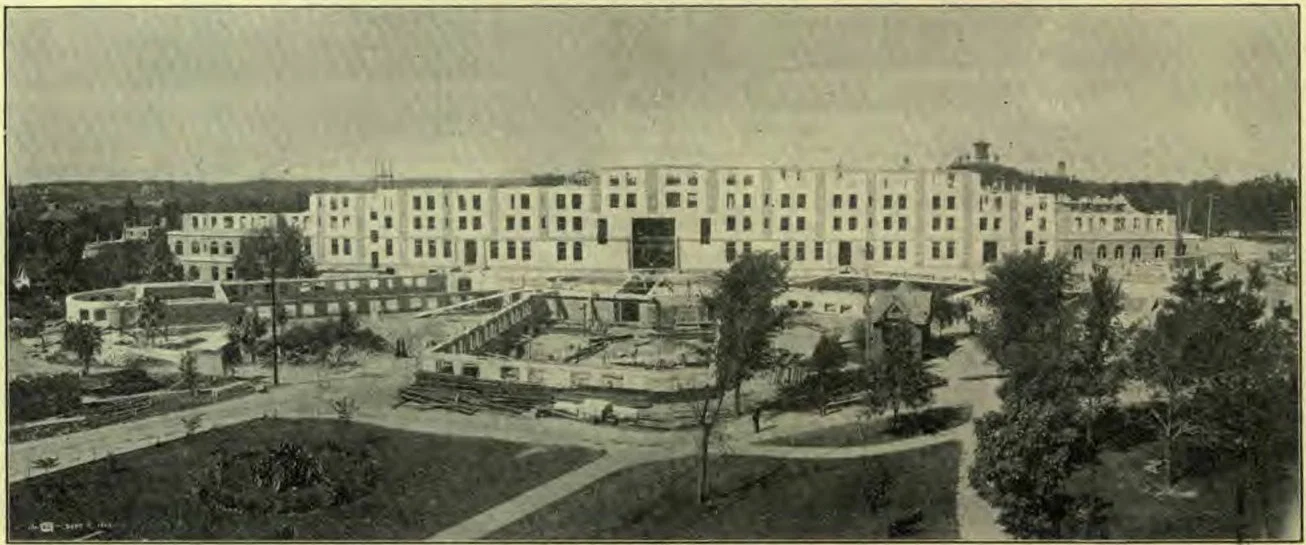
REAR VIEW OF THE NEW SANITARIUM BUILDING AS IT APPEARED ON SEPTEMBER 7
Mary became a young lady, and was married to a Mr. Tyler, and lived in a beautiful home in Somerville, near Boston. In the course of time a proposition was made to tear down and move away that venerable old historic structure, the Old South Church.
But the ladies of Boston were loath to see it go, and determined to try to save it, making a fair to raise money for that purpose. Now was the time for Mary to make good use of her stockings that were made from the wool of her lamb which was once as “white as snow,” but was now quite yellow with the lapse of time. She raveled them out, and cut the fluffy yarn into proper lengths, tying them on to cards on which she had written with her own hand, testifying to the genuineness of the relic. These were sold, and the proceeds made quite a contribution to the fund that preserved the old church which every American loves.
Mary lived to be a bright, lovely, and benevolent old lady, and died but a few years ago, at the ripe age of nearly eighty-four years.