LATELY while reading about the earthly sanctuary, my mind was struck as never before with the thought of its grandeur and glory. The beauty and splendor of that wonderful building is difficult to be imagined. Then I thought of the great privilege of the men who officiated within its gold-lined walls, redolent with the odor of costly perfumes, and holy on account of the wonderful presence of Jehovah. I thought of the purity of mind and body that was required of the one who was permitted to lift the vail that separated between the holy and most holy places and gazed with unveiled eyes upon the sacred ark, the seat of the presence and glory of God.
In spite of me my mind would draw a contrast between those holy men and many who in this age of the world claim to be the servants and ambassadors of the same holy God, and I could not help imagining (although it was really shocking to all sense of reverence or propriety) Aaron saying in the morning to his wife, "Elisheba, to-day I have many arduous, fatiguing duties to perform; many people are to offer sacrifices, and I very much desire that thou shouldest make for me a good strong cup of Oolong or Java, as I feel much in need of some stimulant to be able to do the work of the Lord." After partaking of an appetizing breakfast, I see him drawing still more stimulation from a fragrant Havana, after which he places within his mouth a good sized quid of fine cut, and thus armed and strengthened he goes within that sacred edifice to make atonement for the sins of the people. How long think you would He who struck Uzzah dead for simply putting his hand to that sacred vessel which contained God's holy law, allow such irreverence? In all the furnishings of that sacred building, we read of no cuspidores where the officiating servant of God might deposit his worn-out quid or superabundant saliva.
This picture is too absurd to allow us long to contemplate it, but if such things were not allowable then, can the same Being, who never changes, look with any more leniency upon them now? Can we exercise credulity enough to make us believe that he smiles upon such defiling habits in this age when he required such perfect purity in that? We find very many explicit directions in regard to bathing the clothes and the body before anyone might with safety come before God even to make an offering.
Then I thought of that other temple the care of which is given into the keeping of each one of us—the human body; for we are told in the word of God that our bodies are temples—temples of the Holy Ghost. What sacred building ever made by man can compare with these wonderful, living, moving temples built by Jehovah himself? In his word, too, he has told us how we should care for these temples to keep them pure and fit for the indwelling of his Holy Spirit, and he asks us this significant question, "Know ye not that ye are the temple of God, and that the Spirit of God dwelleth in you?" And then he makes this solemn declaration, "If any man defile the temple of God, him shall God destroy, for the temple of God is holy, which temple ye are." Viewed in this light it is a solemn charge that has been committed to each one of us, more solemn and sacred than that committed to Aaron. For this we shall have to render a strict account of our stewardship, and the time is at hand, even at the door.
He who sitteth in the heavens designs to plead with us feeble worms of earth that we should keep our temples pure. "I beseech"—beseech is the word, not command—"I beseech you therefore, brethren, by the mercies of God, that ye present your bodies a living sacrifice, holy, acceptable unto God, which is your reasonable service." Then it is a reasonable thing that we are to do, nothing foolish or unnecessary. Well, if we do this what shall we have therefore? What will it profit us if we inconvenience and deprive ourselves of the good (?) things of this life? Verily, "eye hath not seen, nor ear heard, neither hath it entered into the heart of man the things which God hath prepared for them that love him." And those things are in a land of perfect purity and into which shall never enter anything that will defile, and yet whosoever will may enter there.
Well may we shrink back when we contrast that pure and holy place with our sin-polluted selves—our bodies made vile by our evil habits of eating, drinking, dressing, and working, and exclaim, "Woe is me, for I am undone, for I am a man of unclean lips, and I dwell in the midst of a people of unclean lips."
The idea of ever so cleansing ourselves as to be fit to enter that holy dwelling place is too great for us to grasp. But we need not despair; for although God tells us to cleanse ourselves from all filthiness of the flesh and the spirit, perfecting holiness in the fear of God, yet he knew that we could never in our own strength do this; he therefore laid help upon One who is mighty and willing, and who is the very essence of purity itself. He has bought us, all laden with impurity as we are, and he will cleanse, and clothe us in garments of spotlessness, if we will only submit ourselves to him; we must show that we wish to be made pure by renouncing all filthy, polluting habits, and leaving off the soul-defiling jests and foolish idle words, forming pure habits, not fashioned after the habits of the people of the world, but having our conversation in heaven, from whence we look for our Lord, "who shall change our vile bodies and fashion them after his glorious body," and make "us meet to be partakers of the inheritance of the saints in light."
Oh for a home among that pure people and in that pure place! All who will may enter there.
Hebron, Wis.
WHAT NEXT?
By W. E. Cornell
BY W. E. CORNELL.
WE have had the identical straw on which the pope of Rome was compelled to lie while a prisoner in the Vatican some years ago, the veritable coat that Joseph wore on his memorable midnight journey down into Egypt to save the life of the infant Jesus, the seamless garment of the Saviour's over which lots were cast, sections of the cross on which he was crucified, and hundreds of other like relics, all of which have been exhibited to an ignorant and credulous people by the crafty priests that hold sway over them, and immense sums of money have been secured for the privilege of looking upon them. The latest is found in the telegraphic dispatches from New York of recent date, and is as follows:—
The Rev. Father Titreau, whose zeal in establishing the French Canadian church of St. Jean Baptiste, in this city, of which he is pastor, has made its altar a shrine sought by the afflicted, from near and far, who believe in the power of the saint to heal, is delighted to-day over the arrival of another well authenticated record. Mgr. Marquis, of Quebec, who has been to Rome and France, and who arrived to-day on the La Champagne, brought with him for St. Jean Baptiste the largest portion of the body of the saint which has yet been cut from the remains which are believed to repose in the basilica of Apt, in the province of Avignon.
Since Father Titreau obtained the tiny particle of the saint's body, which is in the altar of the church, he has been endeavoring to get a much larger piece. Mgr. Marquis and Father Titreau are great friends, and so it came about when the former came to Rome, the latter asked him to intercede with the archbishop of Avignon for a very considerable portion of the saint's body. The monsignor was successful in his mission, and there is great rejoicing at the church.
"I understand," said Father Titreau, "that the piece Mgr. Marquis has brought is eight or ten inches long. The piece we now have is a mere fragment, about two inches in length."
It seems almost marvelous how men can believe such a statement, but they do; it is just as marvelous to understand why Sunday-law advocates cannot see the logic of their course. The one follows blindly, but ignorantly, the leadings of the priestcraft, the other has willingly become drunk with the united Church and State idea. The end of each is alike fatal.
OUR DIVINE HELPER.
By Mrs. A. W. Heald
BY MRS. A. W. HEALD.
Of the many pitiful cases which came to our Saviour's notice during his short earthly ministry, few appeal more to our sympathies than that of the impotent man at Bethesda. For thirty-eight years this man had been helpless; yet ever as the season returned, he insisted on being conveyed to the famous pool, whose healing qualities were esteemed well-nigh miraculous, in the constant hope of relief. But again and again was he borne home, still cumbered with the heavy weight of infirmity.
On this eventful day, while great steps leading down to the water were thronged with "a great multitude of impotent folk, of blind, halt, withered, waiting for the moving of the water," Jesus drew near, and, knowing this man's pitiable condition and his weary years of suffering, he was moved with tenderest compassion, and said to him, "Wilt thou be made whole?" The answer reveals utter loneliness and despair: "Sir, I have no man, when the water is troubled, to put me into the pool; but while I am coming, another steppeth down before me."
This man knew not who had addressed him, but when the Great Physician bade him rise, faith was born in his heart, and immediately he was made whole, and, obedient to the divine command, he took up his humble couch and walked forth. After this Jesus found him in the temple, and revealed himself as the Messiah, saying, "Behold, thou art made whole; sin no more, lest a worse thing come unto thee."
Are there not in this incident practical lessons for us? We are in difficult places and have no helper. Our distress may be occasioned by disease. Possibly we are not guiltless in the matter, but are, even as this poor man, reaping the sad harvest of sin, for perhaps no sins are more widely prevalent than those against the body. With fearful665import the words of Inspiration are borne home to our hearts: "If any man defile the temple of God, him shall God destroy." "Ye are the temple of the living God." Yet, guilty though we are, and apparently left to bear the penalty of our own wrongdoing, the Great Physician is not unacquainted with our needs; he regards us with compassion, and speaks in tenderest love, "Wilt thou be made whole?" Through faith in the divine Son, we too may receive forgiveness full and free for past sins, healing for the body and strength of purpose, that, trusting in Christ our righteousness, henceforth we will "sin no more."
Windham, N. H.
MARY'S DISAPPOINTMENT.
By Sallie V. Du Bois
BY SALLIE V. DU BOIS.
"MARY, dear, I am so sorry for you," mamma said, "but your father is not willing that you should join the boating party to-day. He was in a moment ago to say that he thought the excursion would not be a safe one, and I was to bid you to remain at home."
"O mamma," said Mary, bursting into tears, "Lillie Lee and Annie Gray just called at the door, and they say that all the party intend going. Surely papa would not be so cruel."
"My dear, you know your father never willingly disappoints you, but delights to witness your happiness. But he has had great experience, and he is sure there is a storm not far off. He says that the boat would not be properly manned to meet a storm, and he is not willing that his daughter should incur such danger."
"But, mamma," Mary said, as she threw open the blinds, "see what a perfect morning it is. Why, I never saw fairer sunshine than this. Papa is mistaken, I am sure."
"And yet he must be obeyed, my dear daughter. I know something of the disappointment you are called upon to bear, but try to accept it like a Christian."
Mary watched from an upper window the boating party sail up the river, and turned away from the sight with tear-stained face. She took up a holiday book and tried to read, but threw it aside after making two or three vain attempts to become interested. She seated herself by the organ and prepared for a pleasant hour with her music, but after five minutes' idle dreaming, she shut the lid down with a bang that made mamma sigh.
"It is no use trying, mamma," she said; "I cannot interest myself in anything to-day. Papa was mistaken this time, after all my disappointment, for only see what a perfect day it is proving."
"I am not so sure of that, daughter. Take a look out of that western window."
Mary did look, and a startling sight greeted her eyes. In her vexation she had not noticed that the sky was overcast, but now she found the western horizon was one mass of misty clouds, with a play of forked lightning running through them.
"The storm promises to be very heavy, I think, dear; had you not better close the casement?"
While Mary was still in the act of closing the blinds, the terrific fall of water began, accompanied by gusts of wind.
"O mamma," she said, as she came over and threw herself on her knees by her mother's chair, "I wonder where they are!"
"They are under the care of the Heavenly Father, who holds the waters in the hollow of his hands."
As the storm increased, Mary hid her face in her mother's lap, and there they remained, holding silent communion with their God. Suddenly the door opened and Mary's father entered. He was a man of powerful frame, but it was shaken now with deep emotion.
"Oh, wife, daughter!" he said, "I have witnessed an awful sight. I was coming up the river ten minutes ago, when I saw the sailboat capsize, and heard the dying shrieks of the wretched excursionists. I was powerless to save them, and there was no one else in sight. My daughter, and you might have been among them!" Mary arose and encircled her father with her arms.
"All day," she said, "my heart has cherished bitter feelings because of my disappointment; but, oh, papa! I shall never forget the lesson taught me this day. There is one commandment which holds a new meaning for me now: 'Honor thy father and thy mother, that thy days may be long in the land which the Lord thy God giveth thee.'"—Harbinger.
THE ORANGE IN CALIFORNIA.
By D. B. Weir
THE orange was first planted in Southern California by the San Franciscan Fathers, soon after they established their first mission in the State, at San Diego, in 1769. Around Los Angeles the golden fruit was clustered, and a few outside orange groves proclaimed that the soil and climate in that section, as to the requirements of citrus and semitropical fruit trees, could not be surpassed. The climate and its delicious product, however, in time10asserted themselves, and it is to them that not only the beautiful city of Los Angeles, but the whole region of Southern California, owes its great prosperity.
When the secret of the soil's fertility—a secret which nature had so long kept guarded under the unattractive covering, of parched sage and grease bush—was discovered and understood, the scene was rapidly changed, and the rich soil, riotous in the exuberance of delight at escape from the bondage of aridity, burst out into productiveness on a scale that drove men wild with excitement. They had found out that with irrigation those dry, barren lands could be converted into gardens of Hesperides.—D. B. Weir, in August Californian.
"TOGETHER."
SAYS the apostle in Romans 8:28, "We know that all things work together for good to them that love God." But says a dear soul undergoing heavy trial, How is this bitter cup for my good? Why have I lost this dear friend? And many other such like queries. We reply that singly the trial may not be for your good. If all your life were to be spent in such trial, if there were no hereafter, you would indeed be miserable. But that affliction may work out for you an eternal weight of glory if you will but learn the lesson. Humble yourselves before God and he will exalt you in due time.
Believe God still. "He is too wise to err, too good to prove unkind." Your trial is needed in some way. You only see the now; God sees the end. You are thinking of the present and near future; God has in mind the ages of eternity to come. The rain, cold as it seems, is as necessary as the sun to the tiny plant; so dark trials are as necessary as pleasant, sunny blessings. And as the rain is blessing as well as the sunshine, so dark trials are blessings together with the sunny places of life; for "we would not learn to walk by faith could we always walk by sight." Leave the web of promise to the great Weaver; if it be his will, let him mingle the dark and light, the rough and smooth. He never makes mistakes; he will correct ours. When the web is finished, and we shall see it all, the dark places will be the most glorious; and while in this life we could not see that these trials alone were for our good, we shall then see that all things have worked together for our good, through the perfect wisdom of God. But let us not wait till then to know; faith says now, "We know."
WHAT THE RELIGION OF JESUS DOES.
It makes men pay their debts.
It makes women stop talking scandal.
It makes children obey their parents.
It makes men do good with their money.
It makes those who have been vicious control themselves.
It makes the drunkard stop buying beefsteak for the saloon keeper, and go to doing something for his own family.
It throws jailers out of employment, and raises the workman's wages.
It builds asylums and furnishes the money to run them.
It makes men unselfish and women more lovable.—Selected.
Every Man’s Task
"EVERY man's task is his life preserver. The conviction that his work is dear to God and cannot be spared, defends him."
THE TWO WORDS.
One day a harsh word, rashly said,
Upon an evil journey sped,
And like a sharp and cruel dart
It pierced a fond and loving heart;
It turned a friend into a foe,
And everywhere brought pain and woe.
A kind word followed it one day,
Flew swiftly on its blessed way;
It healed the wound, it soothed the pain,
And friends of old were friends again;
It made the hate and anger cease,
And everywhere brought joy and peace.
But yet the harsh word left a trace
The kind word could not quite efface;
And, though the heart its love regained,
It bore a scar that long remained;
Friends could forgive, but not forget,
Or lose the sense of keen regret.
Oh! if we would but learn to know
How swift and sure one word can go,
How would we weigh with utmost care
Each thought before it sought the air,
And only speak the words that move
Like white-winged messengers of love!
—Sel.
A YOUNG SWISS HERO.
A FEW years ago the traveler through Switzerland might have seen a charming little village, now, alas! no longer in existence. A fire broke out one day, and in a few hours the quaint little frame houses were entirely destroyed. The poor peasants ran around wringing their hands and weeping over their lost homes and the bones of the burned cattle.
One poor man was in greater trouble than his neighbors even. True, his home and cows were gone, but so, also, was his son, a bright boy of six or seven years. He wept and refused to hear any words of comfort. He spent the night wandering sorrowfully among the ruins, while his acquaintances had taken refuge in the neighboring villages.
Just as daylight came, however, he heard a well-known sound, and, looking up, he saw his favorite cow leading the herd, and coming directly after them was his bright-eyed little boy.
"Oh, my son! my son!" he cried, "are you really alive?"
"Why, yes, father. When I saw the fire, I ran to get our cows away to the pasture lands."
"You are a hero, my boy," the father exclaimed.
But the boy said: "Oh, no! A hero is one who does some wonderful deed. I led the cows away because they were in danger, and I knew it was the right thing to do."
"Ah!" cried the father, "he who does the right thing at the right time is a hero."—The Mid-Continent.
BOOK 1. The Life and Words of Christ.
The first of a Series of Three Books covering a Three Years' Course of GRADED SCRIPTURAL INSTRUCTION FOR CHILDREN.
"BIBLE OBJECT LESSONS," 160 Pages,
NO. 1, Contains . . . . . .
52 Lessons—one for each Sabbath in the Year.
30 Original Hymns and Songs, written for the Lessons.
36 Beautiful Full-page Illustrations, with Colored Plate.
52 Original Pen Drawings, showing how to use the Kindergarten Material when Teaching the Lessons.
SOLD BY SUBSCRIPTION
In the following styles of binding. Orders by mail will be filled postpaid at prices given below. Twenty-five cents less per copy if delivered by canvasser:—
ROYAL EDITION,9 x 11½ inches, with Colored Plate.
EXTRA CLOTH, panel sides, Green and Gold, printed on Enameled Paper, Gilt Edges, $3.75.
COMMON CLOTH, Aluminum and Brown, Calendered Paper, Lemon Edges, $2.75.
Plain Edition, 7½ x 10 inches, without Colored Plate, Plain Edges, Ink Titles, - - - $2.00.
BOARD COVERS, paper sides, $1.50.
DISCOUNTS TO SCHOOLS.—Six copies, 10 per cent; twelve copies, 15 per cent; eighteen copies, 20 per cent; twenty-four copies, 25 per cent from agents' retail prices.
When the Kindergarten Material (set of three boxes) is ordered with the book in either style of binding, purchaser will receive a beautiful premium "Portfolio of Blackboard Sketches on the Life of Christ," to aid mothers, teachers, and children in drawing.
Address, Pacific Press Publishing Co.,Oakland, Cal.,
Or, 43 Bond St., New York.Sole Agents for California, Oregon, Washington, Montana, Idaho, Utah, Nevada, Arizona, Massachusetts, Rhode Island, Connecticut, New York City, Long Island, New Jersey, and Delaware.
Orders from outside the above-named territory should be addressed to F. E. Belden, 5007 Calumet Avenue, Chicago, Ills.
Special Kindergarten Material
TO ACCOMPANY *
Bible Object Lessons & Songs for Little Ones,
Book 1.—The Life and Words of Christ.
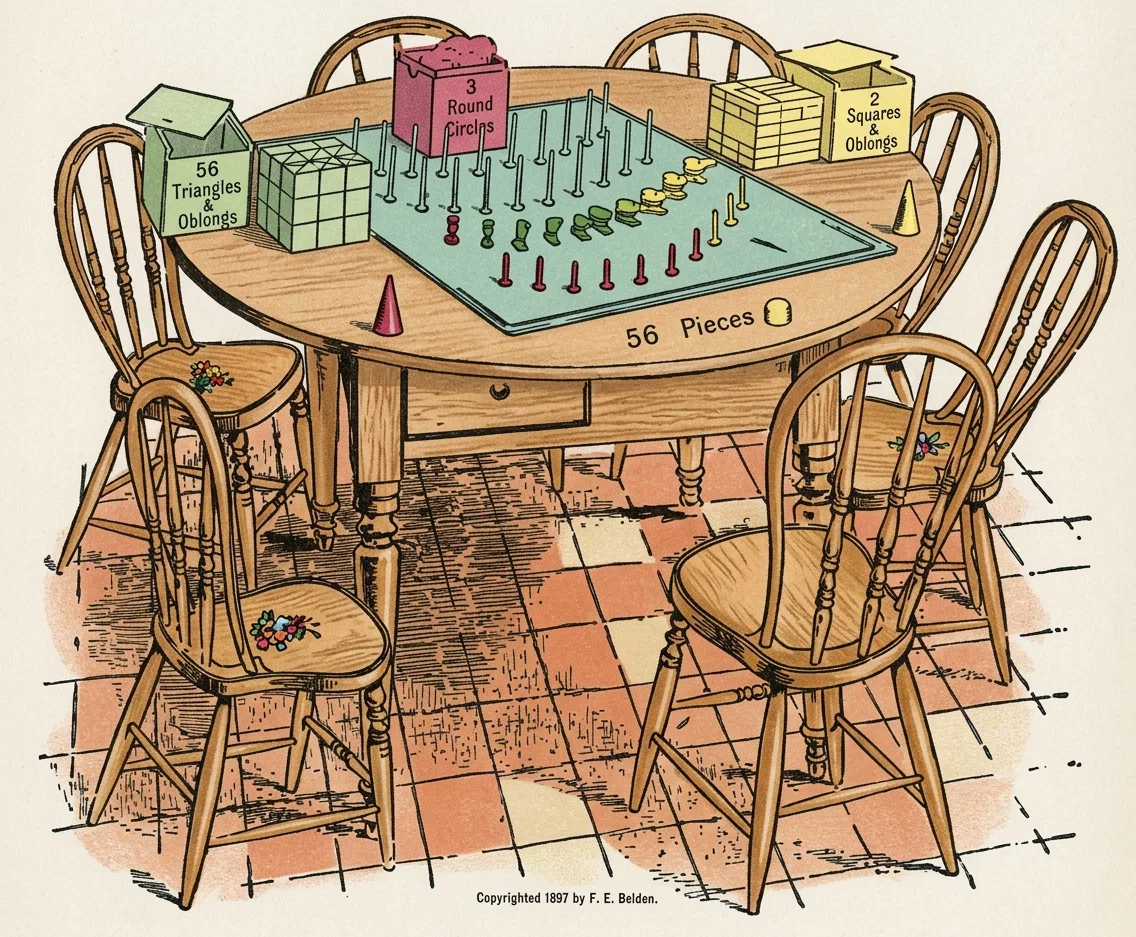
The material for this book consists of three boxes:—(1) Cubes and Triangles; (2) Squares and Oblongs; (3) Miscellaneous Supplies—two Cones and two Domes, ten 1-inch and twenty 7-inch Mounted Orange Sticks, to represent people, thirty-six 2-inch and twenty-four 1-inch Unmounted Green Sticks for Outline and Tree Building, ten Miniature Sheep, and Crumpled Green French Tissue Paper, to represent water. Boxes 1 and 2 are made of finished cherry, 3½ x 3 x 3 in., with locked corners and sliding top. The blocks are of hard maple. Box 3 is of pasteboard, with double sides.
Price of the Three Boxes, by mail, - - $1.75
Delivered by canvasser, - - - - - 1.50
In lots of 6 sets or more for Sabbath-Schools, 10 per cent discount. Freight or express, extra.
ROUND TABLES, 20 inches high, felt top, 30 inches in diameter (to seat from 5 to 8), lock drawer large enough to hold all the material needed for the entire series of books, $3.75
Drayage and freight or express, extra.
In lots of 6 or more for Sabbath-Schools, 10 per ct. discount.
SMALL CHAIRS, ornamental, strong, bent rim, RED, 12 inches high, for children, each, 60 cts.
BLUE, 14 inches high, for teachers, each, 60 cts.
Drayage and freight or express, extra.
In lots of twelve 12-inch and two 14-inch, for the Sabbath-School, 10 per ct. discount. Noiseless Rubber Tips for chairs, 12 cents per chair additional.
Address, Pacific Press Publishing Co.,Oakland, Cal.,
Or, 43 Bond St., New York.Sole Agents for California, Oregon, Washington, Montana, Idaho, Utah, Nevada, Arizona, Massachusetts, Rhode Island, Connecticut, New York City, Long Island, New Jersey, and Delaware.
Orders from outside the above-named territory should be addressed to F. E. Belden, 5007 Calumet Avenue, Chicago, Ills.
CHOLERA AND ALCOHOL.
By G. Lowther, M. D.
THAT no pains should be spared to prevent the spread of cholera everyone will admit. All the wisdom gathered from past study and experience should be utilized to stay its progress. It is well known that any form of filth is a hotbed for the breeding of infectious diseases. The places where intoxicating liquors are sold have proved to be generators and conductors of cholera. Not only so, but the users of alcohol are the most ready victims of the disease. This is accounted for by the fact that, by its use, the digestion is deranged, the blood vitiated, the nerves unstrung, and, further, that the presence of alcohol in the system renders it more susceptible to infection. But account for the facts as we may, here are the testimonies of physicians and others during the scourges of 1832 and 1866:
Dr. French, a medical health officer in Liverpool, says: "The outbreak of cholera in July, 1866, in that city, was in a house where a woman died of another disease. They kept the body for three days, during a drunken debauch, in a crowded room, filled with the fumes of tobacco and alcohol. This revel was called 'a wake.' One week from that time 48 persons had died from cholera within a radius of 150 yards from that place."
During the epidemic of 1832 Dr. Bronson said: "In Montreal 1,000 persons have died of cholera, only two of whom were teetotalers." A Montreal paper said: "Not a drunkard who has been attacked has recovered from the disease, and almost all the victims have been at least moderate drinkers."
In Albany, N. Y., the same year, cholera carried off 366 persons above 16 years of age, all but four of whom belonged to the drinking classes. Packer, Prentice & Co., large furriers in Albany, employed 400 persons, none of whom used ardent spirits, and there were only two cases of cholera among them. Mr. Delevan, a contractor, said: "I was engaged at the time in erecting a large block of buildings. The laborers were much alarmed and were on the point of abandoning the work. They were advised to stay and give up strong drink. They all remained, and all quit the use of strong drink except one, and he fell a victim to the disease." He says also: "I had a gang of diggers in a clay bank, to whom the same proposition was made; they all agreed to it, and not one died. On the opposite side of the same clay bank were other diggers who continued their regular rations of whiskey, and one-third of them died."
In New York City there were 204 cases in the park, only six of whom were temperate, and these recovered, while 122 of the others died. In many parts of the city the saloon keepers saw and acknowledged the terrible connection between their business and the spread of the disease, and, becoming alarmed for their own safety, shut up their saloons and fled, saying, "The way from the saloon to hell is too short." In Washington the board of health was so impressed with the terrible facts that they declared the grogshops nuisances, ordered them closed, and they remained closed for three months.
A prominent physician of Glasgow reported, "Only 19 per cent. of the temperate perished, while 91.2 of the intemperate died." One extensive liquor dealer of Glasgow said, "Cholera has carried off half of my customers."
In Warsaw 90 per cent. of those who died from cholera were wine drinkers.
At Tifels, Prussia, a town of 20,000 inhabitants, every drunkard died of cholera.
Drunkenness itself is a disease. It is a disease mainly germinated in the saloons. It is known to be the cause of many other diseases, some of which are transmitted to the offspring of the drunkard. Since this business costs the United States, in direct and indirect wastes, $140,000 every hour, and kills in the same time 185 men, and brings nothing good in return for this waste of men and money, and since it is a cesspool of contagion likely to scatter cholera throughout this nation, endangering the temperate as well as the intemperate, it would seem the dictate of wisdom to follow the example of the authorities at Washington in 1832, declaring the saloons nuisances, and close them.
The Supreme Court of the United States has said: "No Legislature can bargain away the public health or the public morals. The people themselves cannot do it, much less their servants. Government is organized with a view of their preservation, and cannot divest itself of the power to provide for them." President Harrison acted wisely in declaring a quarantine of twenty days for foreign vessels coming into our ports. Health authorities of the different cities and towns throughout the Union have power to remove anything that endangers public health. Let us by all means close the saloons for three months.
CONSUMPTION CONTAGIOUS.
DR. J. G. HOPKINS, of Thomasville, Ga., considers consumption contagious, and thinks that "consumptives should be forced to provide for the destruction of sputa. Whenever situated so as not to expectorate directly into a germicide or the fire, they should use some means of conveying the sputa to the germicide or the flames. If handkerchiefs or clothes are used, they should not be sent to the laundry, as human happiness and life are jeopardized through the probability of inoculation through abrasions upon the hands. These bacilli should never be allowed to dry up and impregnate the air, as is now done, through ignorance of possible result. Numerous experiments by leading medical authorities have proved beyond doubt that consumption is an inoculable disease, and so rapidly is the throng of converts growing that resorts now soliciting the patronage of the consumptive will at some day not far distant be quarantining against him."
HOW TO DRINK MILK.
"SOME complain," says a contemporary, "that they cannot drink milk without being distressed by it." The most common reason why milk is not well borne is due to the fact that people drink it too quickly. If a glass of it is swallowed hastily, it enters the stomach and then forms in one solid, curdled mass, difficult of digestion. If, on the other hand, the same quantity is sipped, and three minutes at least are occupied in drinking it, then on reaching the stomach it is so divided that when coagulated, as it must be by the gastric juice while digestion is going on, instead of being in one hard, condensed mass, upon the outside of which only the digestive fluids can act, it is more in the form of a sponge, and in and out of the entire bulk the gastric juice can play freely and perform its functions.—Selected.
THE ATONEMENT.
The author, in a book of 368 pages, takes up this great central doctrine of the gospel, and treats it in two parts. Part first,
An Atonement Consistent with Reason.
In this he shows that the doctrine of an atonement through the medium of a voluntary substitute is consistent with reason. Part second,
The Atonement as Revealed in the Bible.
In this is discussed the plan of redemption through Christ, by which every sinner who accepts Christ will be justified; sin will be turned back upon the head of its originator; the earth will be cleansed from the curse; God's righteous government will be restored over the entire universe; and all who will not become loyal subjects of that government will be destroyed.
The book presents a CRITICAL AND EXHAUSTIVE TREATMENT on this interesting subject, by a thorough Bible student, and wholly from a Bible standpoint, and cannot fail to be of great value to everyone who reads it.
Third edition, bound in cloth, embossed in black, with gold title on back and front cover.
Price, postpaid, $1.00.
Address, Pacific Press Publishing Co.,
43 BOND ST., New York City. Oakland, Cal.
BRAZIL.
By The Rev. J. J. Taylor
Serious Problems.
BY THE REV. J. J. TAYLOR.
(Missionary of the Southern Baptist Convention.)
No country, I suppose, can be found that offers more serious problems than does this “Southern Paradise,” as Brazil is sometimes called. Here the statesman, the politician, the social reformer, and the missionary are taxed to their utmost to solve the problems that present themselves on every hand. They call this a republic, “the latest star in the galaxy of republics;” nothing was ever much further from the truth. It would be but for two rather serious defects—it is neither by nor for the people. In the first place only about one man in a hundred takes any interest whatever in the elections, than which there can be no greater farce. Then the few who take part in politics are about equally divided between republicans and monarchists. In the third place, almost without exception, all who are interested are looked upon as office seekers—for the money there may be in the office. There is no public confidence either at home or abroad. “There is neither patriotism nor executive ability in the Brazilian,” said a man to me, who has had a long and useful life among them. Another said: “They pretend to copy and follow the Constitution of the United States; but they cut out all the parts that are disadvantageous to self-aggrandizement.”
Now let me add that one redeeming feature is that religious liberty is guaranteed here, yet, too, this is a great farce. No missionary has assurance that he will not receive a shower of stones from the howling mob that dogs his footsteps—that, too, with the knowledge and consent of the police.
We are walking over the partially hidden mouth of a smoldering volcano that is constantly giving forth signs of an eruption. Even now in several States a fratricidal war is in progress—in one of which mutual extermination seems to be the order of the day. In this revolutionary feature of Brazil the religious “seer” thinks there may be ground for hopefulness. Seeing that nothing stable remains, whether we look to the social, moral, and spiritual business or political feature, it is hoped that by the faithful presentation of the ever-abiding blessings of the gospel many may be won to lives worthy of the name.
The social reformer, too, has much to do. Insurmountable difficulties rise up at the very outset. Disregard, wholesale and complete, of the Bible as the authoritative voice of God declaring vengeance against all ungodliness, has led priest and people alike and together into the great pitfall of unchastity. If you preach purity, insist upon it, denounce unchastity, you are laughed at for your pains and denounced as a hypocrite, for “manly purity is impracticable, impossible, and not demanded.”
With all this cloud of darkness and death there is a silver lining. There are at least a few who do show the power of the gospel in the hearts and lives of those who by it do believe in God. Many places are sending Macedonian cries for helpers, many are hungering for the comforts of the gospel, many gladly hear the preaching of the gospel and express entire belief in the message presented.
—Independent.
CROWNING A BLACK KING.
A SECRET meeting is first held by the chiefs of the country, at which they unanimously select one person of the royal line to be made king. A public meeting of chiefs is next held, a few days or weeks after, when the party chosen is called to attend. On his arrival about half a dozen men, hidden for the purpose, rush out and take hold of him. Astonished at such proceedings, he naturally asks, "What have I done?" He is then told by the eldest chief that the Ebebege told them he is to be king. (Ebebege is a square frame of wood, and carried by four men, who profess to be directed where to go by this frame, which is supposed to be inspired by the spirit of the fathers.) Then the other chiefs answer, "Yes, yes, so it is; did not the Ebebege tell us so?" He is not allowed to return home, but is led to a house, and put in a room already prepared to receive him. His shirt is taken off, leaving only his handkerchief cloth around his loins; then he is told to sit on a stool and is chalked over from head to foot. This is the anointing. For three days he is to be alone in this room, chalked, his meals brought to him by servants.
On the fourth day a public meeting is held of the whole country people. The king elect, after washing, is dressed in a most expensive cloth and shirt. Loaded with corals around his neck, arms, and feet, he appears and sits on a large arm chair, and is exhibited to the people as their king, amid loud exclamations and praises. When silence is effected, a chief advances, and on getting near the king, gives him a crack on the head, saying, "The country is in your hand; mind it well." Another comes and gives him a box on the ears, saying, "Keep your ears open, do justice, and give right judgments." Another comes and gives him a thump on the forehead, saying, "Keep your head clear, and pity the poor;" and so on till twelve or fifteen chiefs, as the case may be, have duly impressed the king concerning his official duties, both by word and thumping.
After this priests appear with their sacrifices, and killing of goats and fowls, to propitiate the gods and the forefathers. These the present Christian king refused to have performed for him, and they were dispensed with. After the sacrificial performances, a day is chosen for the whole of the inhabitants to go out fishing for the king.—Church Missionary and Quarterly Token.