The Youth’s Instructor, Vol. 29, No. 6.

THE BUTTES

The Youth’s Instructor

Feb 9, 1881

S. D. A. Publishing Association · Battle Creek, Mich. · Feb 9, 1881

THE BUTTES.
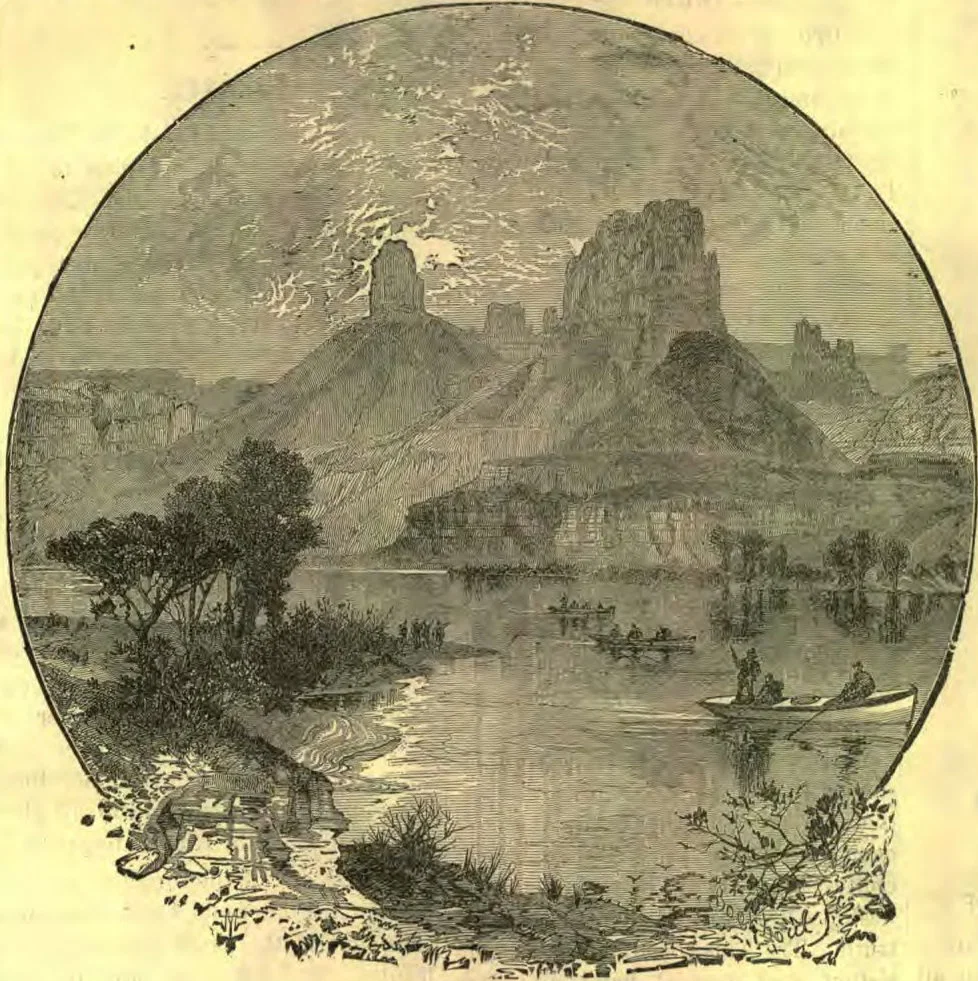
THIS picture represents a class of rocky elevations quite common in the mountainous States and Territories of the great West. Especially are they common in Wyoming, Montana, and Colorado. The name buttes is given to a single peak or abrupt elevation, too high to be called a hill, and not high enough to be called a mountain. Red butte, or black butte, indicates the color of rock of which it is composed.
In Sutter Co., California, are some quite noted buttes. Some of them are so high that they are said to be seen for more than a hundred miles. The most prominent one is called South Butte; it is about 1800 feet high, and is covered with massive rocks, brush, and trees. “From this height,” says one who has stood there, “the eye takes in the most romantic prospect,—the Feather River on the east, and the Sacramento on the south and west; the snow-capped Sierras on the east, and the coast range on the west.” Off these buttes is a body of water called a slough, varying from six to twenty feet in depth, and bordered along the banks with trees of different kinds.
Of the red buttes not far from Cheyenne, Wyoming, near which a railroad station by the same name has sprung up, Crofutt, in his “Tourist’s Guide,” says: “Red Buttes is situated on the plain, six miles from Harney. It derived its name from several ridges and peculiar formations of sandstone lying between the railroad and the Black Hills on the right.”
“Many of the sandstones rear their peaks from 500 to 1,000 feet above the plain, apparently worn and washed by the elements into wild fantastic shapes and grotesque figures. Rocks which, at a distance, might be taken for castles, rise side by side with the wall of an immense fort; churches rear their roofs, almost shading the lowly cottage by their side; columns, monuments, and pyramids are mixed up with themselves and one another, as though some malignant power had carried off some mighty city of the olden time, and, wearying of his booty, had thrown it down upon these plains without much regard to the order in which the buildings were placed.”
It is not strange that tourists visiting this wild and picturesque region are lost in contemplation of the giant works of the Great Architect, and are ready to exclaim, “O Lord, how manifold are thy works; in wisdom hast thou made them all.” J. E. W.

ANCIENT BRITAIN.

In our last, we spoke of the ancient look of some of the buildings of Liverpool. Be it remembered we are now treading upon part of the soil of ancient Rome,—that part which was reft from Rome by the Saxons and Angles in A. D. 476.
Julius Cæsar, B. C. 55, made a descent upon Britain, and revealed to the Roman world some knowledge of these islands, with their various resources. It was about a century after this, however, before the Emperor Claudius attempted its definite conquest. In A. D. 78-84, Julius Agricola carried the Roman frontier to the Friths of Forth and Clyde. He did not, however, plant his standards of silver Roman eagles in the highlands and islands of Scotland, but in the western Hebrides, in the great bay of Loch-na-keal, on the island of Iona,—still so called. The ancient name of this island was “The Island of the Druids.”
The Druids were worshipers of the sun. To this they soon added the worship of the serpent. The Druids were chosen from the oldest and wisest of the people. They were the priests of the people and advisers of kings. They added to their power over the people, by preparing medicines from plants, with which they healed various maladies and wounds. What these medicinal plants were, and how prepared, was kept a secret among themselves. One thing which they used was the ripe berries of the mistletoe. This is a plant which grows out of the branches of the oak-tree. They taught the people that God lived in these oak-trees. When the mistletoe berries were ripe, a great feast was made, to which all the people were called; and while they sang songs under the oaks, and prayed to the sun and serpents, the oldest Druid, with his long, venerable, white beard, and a white band around his head, himself dressed in white, would ascend the trees and gather the mistletoe berries with a golden sickle.
The serpent’s egg was the crest of the Druid, and actual living serpents lay entwined at the foot of their altars. These ancient Druid priests from Iona spread their idolatry over these islands, and there are many relics of these ancient Druids and their worship still to be seen in different parts of the kingdom. One of the most remarkable of these remains is found in Avebury, in Wiltshire, some sixty miles from Southampton. This relic consists of four hundred and sixty-one great stones which once composed the figure of a coiled serpent, extending for two and a half miles over the green hills, and serving as approaches to circles within a circle, supposed to be the place of their altar and worship. The head and tail of the serpent are still plainly to be seen.
J. N. LOUGHBOROUGH.

ONLY

ONLY a seed; but it chanced to fall In a little cleft of a city wall, And taking root, grew bravely up Till a tiny blossom crowned its top.
Only a flower; but it chanced that day That a burdened heart passed by the way; And the message that through the flower was sent, Brought the weary soul a sweet content.
For it spake of the lilies so gaily clad, And the vexed heart grew strangely glad At the thought of a tender care, over all, That noted even a sparrow’s fall.
Only a thought, but the work it wrought Can never by tongue or pen be taught; For it ran through a life, like a thread of gold, And the life bore fruit a hundred-fold.
Only a word; but ’t was spoken in love, With a whispered prayer to the Lord above: And the angels in Heaven rejoiced once more; For a new-born soul entered in by “the Door.”

Correction Regarding Population of Cork, Ireland

CORRECTION. In Eld. Loughborough's article entitled "Land Ho!" in No. 51, page 218, last volume, it should have read that the city of Cork, Ireland, "has a population of about 100,000 inhabitants." The figures given were a misprint.

Doing Plain Duty Quickly and Cheerfully

HAPPY is he who has learned this one thing,—to do the plain duty of the moment quickly and cheerfully, whatever it may be.

DOING GOOD FOR THE LOVE OF IT.

Mr. Harvey was riding slowly along the dusty road, looking in all directions for a stream, or even a house, where he might refresh his tired and thirsty horse with a good draught of water. While he was thinking and wondering, he turned an abrupt bend in the road, and saw before him a comfortable looking farmhouse; and at the same time a boy ten or twelve years old came out into the road with a small pail, and stood directly before him.
“What do you wish, my boy?” said Mr. Harvey, stopping his horse.
“Would your horse like a drink?” said the boy respectfully.
“Indeed he would, and I was wondering where I could obtain it.”
Mr. Harvey thought little of it, supposing of course that the boy earned a few pennies in this manner, and therefore he offered him a bit of silver, but was astonished to see him refuse it.
“I would like you to take it,” he said, looking earnestly at the child, and observing for the first time that he limped slightly.
“Indeed, sir, I don’t want it. It is little enough I can do for myself or any one; I am lame, and my back is bad, sir, but mother says that no matter how small a favor may seem, if it is all we are capable of, God loves it as much as he does any favor; and this is the most I can do for others. You see, sir, the distance from Painesville to this place is eight miles, and I happen to know that there is no stream crossing the road that distance, and the houses are all some distance from the road, and so, sir, almost every one passing here from that place is sure to have a thirsty horse.”
Mr. Harvey looked down into the gray eyes that were kindling and glowing with the thought of doing good to others, and a moisture gathered in his own, as a moment later he jogged off, pondering deeply upon the quaint little sermon that had been delivered so innocently and unexpectedly.—Sel.

Truth.

Truth gives character to youth more than all other qualities combined, and it is of greater worth than mountains of gold. “Better die for the truth, than live to uphold error.” To be thought truthful is not sufficient; act the truth, for truth alone will stand. If you obey the spirit of truth, it will lead you to perfect happiness. No one ever regretted being true and pure in early life. A true life wears the best. The pure and true are ever attracted to those who live unsullied lives—“like gathers to like.”
Truth is as necessary to the soul as health to the body. “Stand for truth, whate’er betide.” Truth is the basis of all manly character; it is the foundation of all goodness. A person may have faults; but confidence can be placed in him, if he is truthful; but when veracity is gone, all is lost, unless he is soon won back to truth. A fault concealed will be very troublesome; it will set one’s invention on the rack to add other faults thereto; even in point of prudence, an honest confession is always better, always the best. All Heaven is on the side of truth. Truth is beautiful, it is consistent, and near at hand, and does not need untruth to bring out its beauty. Some youths vow to be true, and raise many pleasant expectations which they never seem to think of again; they practice a thousand deceits, when straight forward truth is just the thing required. Too often they are “chips of the old block.”
Be true. Truth and simplicity are beautiful ornaments of culture and refinement; it is a mistaken idea of refinement, or a false culture that ignores either. Open your hearts to the sunlight of truth; brush out the “cobwebs of sin” by confession, and make room for that which is prized by the honest and pure. How beautiful is truth! Write it down on your memories, and let it stand as a title-page of your whole lives. A fig for all your endeavors, if truth is wanting! Seek the ornaments of truth, of purity; these will clothe you with unfading glory, and they will last in eternity.
“Buy the truth, and ‘sell it not.” Be bold for truth, fear God, and you have nothing else to fear. If you would make your mark in life for all that is noble and good, have an unbending regard for truth, and my word for it, you will succeed. Watch! gather to the stronghold of truth, and from it may you never depart.—Daniel Orcutt.

RUINED

A FEW months ago John S. Morton was sentenced in Philadelphia to ten years’ imprisonment in the Eastern Penitentiary. As he left the court-room, his friends—for the most part fashionable and wealthy men—surrounded the judge, clamorously demanding that he should be driven to jail in a carriage instead of the prison van.
This little incident and the story of the prisoner is worthy the attention of young men beginning commercial life.
One short year ago Morton was a leading citizen in Philadelphia; not a leader after the fashion of Tweed or Fisk, but a refined, cultured gentleman, the descendant of a signer of the Declaration of Independence, and a long line of judges and honorables, energetic in business, and in all philanthropic and Christian enterprises.
He was one of the foremost projectors of the Centennial Exposition, was president of the great permanent exhibition, and his name was brought prominently before the people as a candidate for governor of Pennsylvania.
He had everything that could give a man a solid, honorable footing in the world; but unfortunately he fell into the society of a clique of fashionable people, of the sort who would think the riding to prison in a van a worse disgrace than the crime that drove him there.
In his haste to gain money and to vie in splendor with these friends, Morton was led to dabble in stocks, then to gamble in them, and finally in order to make up his losses, to issue fraudulent stock in a railway company of which he was president, to the amount of two millions of dollars. The man had not the hardihood of a villain born in vice, for, on discovery, he pleaded guilty, and fainted in the court-room.
Boys who read such stories as these are apt to think of themselves as of an entirely different order of human beings from these gigantic swindlers; yet the shop-boy who sells a lot of damaged goods to an unwary customer, or the lad who cheats at a game of marbles, is each in his degree guilty as was Morton, and afoot on the same broad highway.
Deception and fraud permeate every part of our commercial system, and they generally meet a temporary success. The shopman who cheats in his master’s interest usually is promoted, just as Morton, with his ill-gotten gains, was able to live like a prince; but retribution is sure, even in this world. The tricky clerk is known and avoided as a tricky merchant, and John S. Morton, with his shaved head and convict’s dress,—will meet old age in a prison cell.—Companion.

The Ministry of Song.

Sing to the little children, And they will listen well; Sing grand and holy music, For they can feel its spell. Tell them the tale of Jesus, Then sing them what he said,— “Deeper and deeper still,” and watch How the little cheeks grow red, And the little breath comes quicker; They will ne’er forget the tale, Which the song has fastened surely, As with a golden nail.
I remember late one evening, How the music stopped; for, hark! Charlie’s nursery door was open, He was calling in the dark: “Oh, no, I am not frightened, And I do not want a light; But I cannot sleep for thinking Of the song you sang last night; Something about a ‘valley,’ And ‘make rough places plain,’ And ‘comfort ye;’ so beautiful! Oh, sing it me again!”
Sing at the cottage bedside; They have no music there, And the voice of praise is silent After the voice of prayer. Sing of the gentle Saviour, In the simplest hymns you know, And the pain-dimmed eye will brighten As the soothing verses flow; Better than loudest plaudits The murmured thanks of such, For the King will stop to crown them With the gracious “Inasmuch.”
Sing when the full-toned organ Resounds through aisle and nave, And the choral praise ascendeth In concord sweet and grave. Sing, where the village voices Fall harshly on your ear; And while more earnestly you join, Less discord will you hear. The noblest and the humblest Alike are “common praise,” And not for human ear alone, The psalm and hymn we raise.
Sing in the deepening twilight, When the shadow of eve is nigh, And her purple and golden pinions Fold o’er the western sky. Sing in the silver silence While the first moonbeams fall, So shall your power be greater Over the hearts of all.
Sing till you bear them with you Into a holy calm, And the sacred tones have scattered Manna, and myrrh, and balm.

A PRAYER ANSWERED.

DURING the Revolutionary war, one severe winter, the American army went into quarters at Valley Forge. They were in a very destitute condition, many of them not having shoes or blanket, and having to lie upon only straw, in miserable huts. Everything looked dark,—the government without money, officers scheming against one another and against Washington, and the army perishing for food and clothing. Washington saw it all, but could do nothing. But the historian tells us that, one day, as a Quaker was walking through the woods, he heard some one talking, and pushing aside the underbrush carefully, he saw Washington on his knees, his face toward heaven, and the tears streaming from his eyes, begging God to spare the army. The Quaker went home and told his wife that if God hears prayer, the Colonies would certainly succeed. They did succeed.
The Bible says that the fervent prayer of a righteous man availeth much. The Lord will remove all obstacles for those who ask in earnest. With God and the right, we shall always succeed; without him, we shall fail. How important, then, to make sure of his help!
J. R. CALKINS.

EDUCATION

THE best education that one can obtain is the education which experience gives. In passing through life, learn everything you can. It will all come into play. Do not be frightened away from any one pursuit. If you cannot have anything more of an education than a smattering, it is better than nothing. Even a slight knowledge of the arts, sciences, languages, opens up a whole world of thought. A little systematic endeavor—one hour, or even half-an-hour, a day, devoted to the acquisition of knowledge—and a man may become learned before he dies. Learn thoroughly what you learn, be it ever so little, and you may speak of it with confidence. A few clearly defined facts and ideas are worth a whole library of uncertain knowledge.—Sel.

BOYS WANTED.

BOYS of spirit, boys of will, Boys of muscle, brain, and power Fit to cope with anything— These are wanted every hour.
Not the weak and whining drones That all troubles magnify; Not the watchword of “I can’t,” But the noble one, “I’ll try.”
Do whate’er you have to do With a true and earnest zeal; Bend your sinews to the task; “Put your shoulder to the wheel.”
Though your duty may be hard, Look not on it as an ill; If it be an honest task, Do it with an honest will.

SCENES IN THE LIFE OF CHRIST.

LESSON 3.—THE HOLY LAND.

The land where Abraham, Isaac, and Jacob dwelt; where Saul, David, and Solomon reigned, where the prophets taught, and our Saviour was born, is called the Holy Land. This most interesting of all countries lies in the western part of Asia, bordering on the Mediterranean,—the Great Sea, as it is called in the Bible. It is about seven thousand miles directly east from the coast of Georgia, and in going from Michigan we would have to travel as much as eight thousand miles to reach it. We would have to cross the Atlantic Ocean, pass through the Strait of Gibraltar, and sail the whole length of the Mediterranean Sea. We would probably land at Joppa, or Jaffa, a small sea-port town about thirty-five miles northwest of Jerusalem. In going from Jaffa to Jerusalem, we first travel over a beautiful, fertile plain for several miles, and then take our way along a narrow pass, winding among rocky hills and mountains, till at last, coming upon an eminence, the sacred city lies full in view, embosomed among its surrounding hills.
We will not stop now to describe this wonderful city, neither will we try to make our way through its narrow, crooked streets; but as we are coming from the north, will turn to our right, and pass down into the Valley of Gi'hon, near the upper pool. Following down the valley, we come to the second, or lower, pool, cut partly in the solid rock, and made partly of brick. This pool is 40 feet deep, almost 600 feet long, and nearly half as wide. It used to contain water brought through an aqueduct from a fountain near Bethlehem; but it is now dry. Going on from this pool, we find the valley growing narrower and deeper, till, turning toward the left, we enter that part called the valley of Hinnom. This valley has a remarkable history, which we will some day tell. On its left side rises the hill of Zion, or Mount Zion, as it is sometimes called. There David built his grand palace; and near the brow of the mountain his tomb is still shown. On the right side of the valley the rocks rise to a great height, and their steep sides, more or less shaded by olive and pomegranate trees, are completely honeycombed with tombs. Indeed, the dead about Jerusalem are far more numerous than are the living who now inhabit the city.
Passing on eastward, we soon come to the brook Kedron, which flows down from the north through a deep valley on the east side of the city; but soon it turns to the east, and passing through frightful cuts in the rocks, at last makes its way into the Dead Sea. Near this place is a well, more than a hundred feet deep, and thought to be the En-Rogel where the sons of the priests waited in the time of Absalom's rebellion to bear news to David. Here, too, Adonijah made his feast, when he undertook to take the kingdom.
Since we want to go to Bethlehem, we must turn to the right and climb the hill. Before crossing the ridge, however, we will look back up the valley upon Mt. Moriah, where the beautiful temple once stood. Going on to the south, we travel for a mile or more along a fertile plain, which is shut in on all sides by rocky hill-tops and ridges. This was called the valley of Rephaim, which means the valley of giants. Here David had some terrible battles with the Philistines.
About four miles south of Jerusalem, we turn a little to the left from the main road to Hebron. Just here stands a small, square building, with white walls, and a rounded roof called a dome. In the center of the building is a pile of masonry covered with plaster. This is Rachel's tomb, where she has lain ever since Jacob buried her there. Read Gen. 35: 16–20; 48: 7. A little farther on, and in plain sight, is the rocky ridge on which Bethlehem stands, with its one long street, and its substantial white stone houses, shaded by beautiful trees.
In another lesson we will tell about Bethlehem, and some of the remarkable things that have happened there.

QUESTIONS.

  1. What country is called the Holy Land?
  2. In what part of the world is it found?
  3. It is directly east of what State? About how far?
  4. In going from Michigan, about how far would we have to travel in order to reach it?
  5. Give a brief description of the route.
  6. Where would we probably land?
  7. Where is Jaffa?
  8. Over what kind of country do we pass in the first part of the journey from Jaffa to Jerusalem?
  9. Describe the latter part of the route.
  10. What do we finally reach?
  11. What lies full in view from this eminence?
  12. From what direction do we approach the city?
  13. As we come near it, what course will we take?
  14. What do we pass, in going down the Valley of Gihon?
  15. Describe the lower pool.
  16. What change do we notice in the valley?
  17. What turn do we make?
  18. What name is given to the deepest and narrowest part of the valley?
  19. What very high hill rises on the west side of it?
  20. What once stood upon this hill?
  21. Describe the opposite side of the valley at this place.
  22. In going on eastward, to what stream do we soon come?
  23. Through what does this stream flow?
  24. What remarkable well is found near this place?
  25. Describe the farther course of the Kedron.
  26. What course must we pursue in order to go to Bethlehem?
  27. In looking back up the valley of the Kedron, what noted object may we see?
  28. For what things is Mt. Moriah remarkable? Gen. 22; 2 Sam. 24.
  29. Upon what do we come as we pass over the ridge to go to Bethlehem?
  30. What does Rephaim mean?
  31. For what is this place noted?
  32. What interesting object is found about four miles south of Jerusalem?
  33. Describe the place.
  34. Where do we find accounts of Rachel's death and burial?
  35. What rises in full view a little farther on?
  36. How does the place appear?

LESSONS ON NEW-TESTAMENT HISTORY.

LESSON 16.—REVIEW OF LESSONS 13-15.

1. What were the leading events connected with the birth and infancy of our Saviour?
2. Relate the only circumstance left on record concerning his youth.
3. Describe his baptism.
4. Describe his temptation.
5. What was his first miracle?
6. Relate the circumstances connected with his attendance at the passover.
7. How did he spend the next six or eight months after this passover?
8. Give a brief account of his journey toward Galilee, and of his interview with the woman of Samaria.
9. Relate the conversation between Christ and his disciples on their return from Sychar.
10. What important lesson may be learned from this conversation?
11. By what figure did our Lord set forth the willingness of the people to receive the truth?
12. What words of encouragement did he give to gospel laborers of every age?
13. What caused the people of Sychar to come out to hear the Saviour?
14. What effect did his preaching have upon them?
15. As the Lord went throughout Galilee, teaching in their synagogues, what did he say?
16. Explain the meaning of his words.
17. Give the circumstances connected with the healing of the nobleman's son.
18. What practical lessons may be learned from this account?
19. If our Lord could heal the sick by a word, when so many miles away, can he not do the same from Heaven?
20. How do we estimate the time of our Lord's preaching in Judea?
21. What did his disciples probably do while he retired for a time to Nazareth?
22. How did he reveal himself to the people of that place?
23. How did they receive his testimony in regard to himself?
24. How did he reply to their questions?
25. What roused their anger?
26. What did they attempt to do?
27. How did Jesus escape?
28. Where did he then go to dwell?
29. How had this event been foretold?

THE HOMES OF JESUS.

It is thought that the child Jesus could not have been more than a year old when Joseph and Mary returned with him to Nazareth. The little town, with its white stone houses, lay on a hill-side among the highlands of Galilee; and in one of these quiet homes Jesus lived until he was nearly thirty years old.
Looking from the top of the hill on which Nazareth was built, one obtains a very pleasant view. Here, without doubt, Jesus often stood, and gazed over the green plains and valleys, wooded hills, and the shining sea. A few miles north lay the village of Cana, which was afterward to be the scene of his first miracle; and not far from Cana was Sepphoris, which, during the childhood of Jesus, was rebuilt as the capital of Herod Antipas. Still north, as far as the eye could reach, rose the countless hills of Galilee.
On the east rose Mount Tabor, where the army of Sisera had been defeated by Barak and Deborah. Four or five miles south of Tabor, just across a narrow valley, stands Little Hermon. On the northern slope of these hills lay the village of Nain, where the young man was one day, at the word of Jesus, to rise up from his bier alive; and about two miles farther to the east was Endor, where Saul went to inquire of the witch concerning the fate of his kingdom. On the south-western slope of Little Hermon was Shunem, where Elisha raised the son of the woman who had made a home for him; and about three miles farther south, on a spur of Mount Gilboa, stood Jezreel, the city of Naboth, whom the wicked Jezebel had slain in order to obtain his vineyard. To the south-east lay Megiddo, on the southern edge of the great plain; and then came the range of Carmel, with the Kishon flowing at its base. Away to the west were the blue waters of the Mediterranean, shutting off farther view. All this and more might Jesus see from the hill of Nazareth.
But when the time came for him to commence his public ministry, he must needs go beyond the secluded town of his childhood; so “leaving Nazareth, he came and dwelt in Capernaum, which is upon the sea-coast.” The Jewish rabbis were wont to say that God had made seven seas in the land of Canaan, but had chosen only one for himself,—the sea of Galilee. And indeed this sea was chosen by our Lord for himself, and honored above all other seas of the earth, in a sense which the rabbis little dreamed. The men who dwelt there, and even the fields and valleys around it, were made sacred by their association with the Saviour. As will be seen, this place was in many ways peculiarly fitted to be the center of the great work upon which Jesus was now to enter.
On the western shore of the lake lay the plain of Gennesaret, so noted for its fertility. The description which Josephus gives of this little plain is interesting, as showing what Palestine once was. He says: “A region of the same name borders the lake Gennesar, admirable for its character and beauty. The soil itself, on account of its richness, refuses nourishment to no plant, and all varieties are accordingly cultivated here by the inhabitants, the happy temperature of the air suiting those of different kinds; for nut-bearing trees which flourish in the coldest climate, thrive here in endless profusion; then again, palms, which are nurtured by heat, and figs and olives, which belong to a temperate climate, grow by their side.”
It was in Capernaum that Jesus chose his home, beside the gleaming lake, embosomed deep on this its western shore, in soft, terraced hills, “laughing with fruitfulness.” Capernaum was the home of his three chief apostles, Philip, John, and James, also of Andrew. When Jesus first came to dwell in Capernaum, it would appear that he dwelt with his mother and brethren; but his stay at this time was short, for he presently went to Jerusalem to the passover, immediately after which he spent more than half a year in preaching throughout Judea. The result of this ministry seems not to have been very encouraging. The proud, self-sufficient Jews, vain of their rabbis and their schools of learning, were unwilling to accept the teachings of the humble Galilean, upon whom they looked with something of contempt; and we may well deem that Jesus would gladly return to his more honest, open-hearted countrymen of the north.
On his return it seems that the family of Jesus had gone back to Nazareth to live; for there he went to stay until the time should come for him to resume his work. During his public ministry he appears to have made his home at Capernaum more than at any other place; and from several passages we are led to think that he stopped at the house of Peter and Andrew.
In those days the whole landscape around the sea was full of life. Busy towns and villages crowded the shores, and the waters swarmed with boats employed in the fisheries, which gave their names to several of the towns. Capernaum itself was then a thriving, busy town, on the great highway from Damascus to the Mediterranean. The people were no doubt proud of their city, little dreaming of the ruin which would one day make even its site a question.
Herod Antipas, grown tired of his capital far off among the hills of Galilee, had at this time just completed a new city on the shores of the sea. The site of Tiberias, for such the new capital was called, was one of the most beautiful on the lake, on a southerly bend of the shore, and about half way down the lake from Capernaum. Herod had spared no pains or expense to make Tiberias a beautiful place; and there stood the city, with its splendid palace, grand public buildings, huge arsenal, and famous baths, glittering in the bright sunshine; while beyond still rose town after town. At the head of the lake, on the other side of the Jordan, lay Bethsaida Julias, the capital of Philip the tetrarch,—the husband of Salome,—this, too, fresh from the hand of the builder.
All these, and more, were familiar to the eyes of Jesus, as, in the course of his ministry, he passed to and fro from Capernaum, across the sea or along its pebbly shores. But all is now changed. Tiberias, then so magnificent, has shrunk into a small, decaying town; the white towns and villages once reflected in the clear waters have disappeared; the fleets of vessels that crowded the lake are now represented by one solitary fishing boat; the richly wooded hills are bare, and the beautiful plain is overgrown with thorns and thistles.
E. B.

BECAUSE MAMMA SAYS SO.

Grandpa Giles has laid down his newspaper, and is taking off his spectacles. The children all know what that means—they are to have a story.
When I was a little boy, I lived on a farm. We had horses and cows and chickens; but best of all, we had a long hill that sloped from the grove back of the house way down to the river. There we used to slide by the hour together, some of the boys from the village, and your Uncle Seth and Aunt Rosa, and your grandmother too. She was a little girl then, and wore a scarlet hood and short dresses. One day my mother said to me, “Johnny, you are not to go to slide to-day; will you remember?”
“Why not, mamma? It’s only cloudy, and the snow is as hard as can be.”
“You cannot go, Johnny, because mother says she does not wish you to. Isn’t that enough?”
“I think I might,” said I, whining and beginning to cry. “I don’t see why I can’t have a good time as well as the other boys. I don’t want to sit rolled up on the rug all day, just like the old cat.”
My mother looked very sober, but did not say any more. She left me and went into the back kitchen to churn. I could hear the splashing of the cream and the regular turning of the dasher. She had asked me to ravel out a piece of carpet for the rug she was making. The carpet lay by me, but I didn’t touch it. I sat with my arms on the window-sill, looking out at the snow. As I sat there, I heard voices and footsteps. They came nearer, and soon Henry Jones and Luke White came up. I beckoned them to the window.
“What! ain’t you going to slide to-day, Johnny?” said Henry.
“No,” I answered gruffly.
“Why not?” said Luke; “you sick?”
“I can’t go because mamma says I can’t,” I said.
“Didn’t she tell you why?” said Henry.
“No; she thinks it’s enough if she says so.”
“Ah—m!” said Luke. “I always make my mamma tell me the reason why. I’m big enough to know what I ought to do;” and Luke drew himself up and stood on his toes; but just then a snowball hit him on the back, and he came down flat, and we all laughed.
The boy who threw the snowball came up then to the window. “Why, Johnny,” he said, “why don’t you come out and have some fun? Are you playing prison? You ain’t sick, are you?”
“I did have a little sore throat last night, but I don’t feel it any now. My mamma says I can’t go, and so I can’t.”
“I tell you what,” says Luke, “you just slip out the front door and come down for an hour. She’ll never know. Making butter, ain’t she?”
I hesitated. Just then I happened to look toward the fire. The cat lay there purring. I remembered what I had said about lying around just like her, and I jumped up, took my cap and overcoat, opened the front door softly, and went out. My woolen scarf I entirely forgot in my hurry.
“That’s jolly,” said Luke; “I never do anything ’cause my mother says I must. If she don’t tell me why, catch me!”
My red “Antelope” never seemed heavier then when I drew it slyly around the back way that day, and the air never so cold. My mother’s face seemed to be looking at me from the clouds, the river and the trees. I thought I heard her calling me two or three times, but the boys said it was only the wind.
“Luke,” I said at last, “I am sure mamma is calling me; I’m going.”
I went back as I had come. I went into the sitting-room. It was still as I had left it. The old clock in the corner was ticking, the miniature ship rocking on the top, and the cat lying on the hearth. How I wished then I were the cat in truth. I went out into the back kitchen, but mamma was not there. Just then Hugh, the hired man, came in. “Sakes alive!” he said; “Johnny, what have you been about? Your mother was going to take you a sleigh-ride to Aunt Hannah’s. She was going to surprise you, she said, but she saw a boy who said he saw you going down the hill. So you see she left me to look you up. She won’t be back till after dinner.”
So I lost a sleigh-ride, and, by leaving off my scarf, took the scarlet fever. But I learned a lesson. After this, “because mamma said so,” was enough. And now I am old, I have learned a greater lesson: “Thus saith the Lord;” and when I don’t see the reason why he has said it, I still trust him.—Selected.
Continue reading: THE GOSPEL ALPHABET