Your ShelfYour Projects

Review and Herald, Vol. 76, No. 12.

A TRIP TO QUEENSLAND

Review and Herald

Mar 21, 1899

Seventh-day Adventist Publishing Association · Battle Creek, Mich. · Mar 21, 1899

A TRIP TO QUEENSLAND.

MRS. E. G. WHITE.
Our first camp-meeting in Queensland was held in Brisbane, Oct. 14-24, 1898. From the one hundred and seventy-five Sabbath-keepers in all parts of that great colony, over one hundred were at the meeting. Several had come from Townsville, which is one thousand miles to the north, and there were a dozen or more from Rockhampton, which is about half as far. There were a few who had attended one of our camp-meetings in the southern colonies; but to most of those present, this was their first opportunity to attend a general meeting of our people.
For some weeks before this meeting, my health was not good, and my work in writing was very urgent; therefore I was not willing to attend the meeting, and decided not to do so. But in the visions of the night I was addressing large audiences, where the people stretched forth their hands as if to say, We need light. Will you help us? I was shown several companies, varying in size, but all painfully in earnest, reaching out their hands and asking for help, and these words were distinctly spoken to me: “Say not ye, There are four months, and then cometh harvest? behold, I say unto you, Lift up your eyes, and look on the fields; for they are white already to harvest. And he that reapeth receiveth wages, and gathereth fruit unto life eternal: that both he that soweth, and he that reapeth may rejoice together.”
I dreaded the journey to Brisbane, and would fain have believed that this meant Maitland, Newcastle, and the smaller places within thirty miles from Cooranbong. But again the scene of people calling for help was presented before me, and a voice said, They are as sheep that have no shepherd. Then I said, I will go to the camp-meeting; for the Lord has been teaching me my duty.
We left home Wednesday evening at eight o’clock, and after one hour’s ride to Newcastle, changed to the express-train to Brisbane. Accompanied by Sister Mc Enterfer, I took a small room in the Pullman sleeping-car, while Sister Minnie Hawkins, one of my copyists, and several young ladies from the school, who were going to join Sister Haskell in Bible work in Brisbane, found places in the ordinary carriages.
Although much wearied, I felt very peaceful and quiet in the Lord; and I prayed most earnestly that the Lord would impress upon those attending the camp-meeting the fact that it would not be what they could do that would make the meeting a success, but that their part in its success would depend upon their entire surrender to God. If men desire to place themselves where they can be used of God, they must not criticize others, nor labor to make their defects apparent. This is Satan’s special temptation, whereby he strives to hinder the work of God. The Lord can not bless hearts that are not meek and lowly. It is not our work to seek to humble others. The word of God to us is, “Humble yourselves therefore under the mighty hand of God, that he may exalt you in due time.”
At the meeting before us, there will be many precious souls seeking for light, who know not the reasons for our faith. How important that our attitude shall not be that of condemnation toward those who have been walking in what light they have had. Although they are not walking in the way of God’s commandments, he has not forsaken them; for they have supposed that they were obedient, and have testified that they accept Christ as a personal Saviour.
As I awoke in the night, my soul was filled with a hungering and thirsting after righteousness; and in my dreams I was standing before many people, with great earnestness urging them to trust in God, to have increasing faith and confidence in Jesus; for in him all hope of eternal life is centered. He is the chiefest among ten thousand, and altogether lovely. In all our ways we should acknowledge him, and thank him for his manifold benefits. His angels, thousands upon thousands and ten thousand times ten thousand, are commissioned to minister to those who shall be heirs of salvation. They guard us against temporal evil, and press back the powers of darkness, to save us from destruction. If Satan had his way, and carried out his designs, destruction would be seen on every hand. Why is it that we do not value God’s watch-care? Why is it that we so seldom recount his mercies? Why is it that so little thanksgiving flows back to God? By our failure to express gratitude, we are dishonoring our Maker. Have we not reason to be thankful every moment? And should we not express our thankfulness, even when there are difficulties in our pathway?
When I awoke and looked out of the window, I saw two white clouds. Then I fell asleep again; and in my dreams these words were spoken to me: “Look at these clouds. It was just such clouds as these that enshrouded the heavenly host who proclaimed to the shepherds the birth of the world’s Redeemer.” I awoke and looked out of the car window again, and there were the two large white clouds, as white as snow. They were distinct, separate clouds, but one would approach and touch the other, and for a moment they would blend together; then they would separate, and remain as distinct as before. They did not disappear, but continued in sight throughout the forenoon. At twelve o’clock we changed cars, and I did not see the clouds any more.
During the day I was deeply impressed with the thought that angels of God, enshrouded in these clouds, were going before us; that we might rejoice in their guardianship, and also in the assurance that we should see of the salvation of God in the meetings to be held in Brisbane. And now that the meetings are over, and we have seen the wonderful interest manifested by the people, I am more than ever sure that heavenly angels were enshrouded in these clouds,—angels that were sent from the courts above to move upon the hearts of the people, and to restrain those distracting influences that sometimes find access to our camp-grounds, by which minds are diverted from the consideration of the vital truths which are daily presented. At this meeting, thousands have heard the gospel invitation, and have listened to truths that they never have heard before. During the whole meeting, there has not been any boisterous opposition, or loud contention from those whose hearts are opposed to the law of God. And throughout the city, we hear of no public opposition. This is an unusual experience; and we believe that the angels of God have been present to press back the powers of darkness, that unbelief should not have the supremacy. The Holy Spirit has also been at work with the efforts of God’s servants, that the sword of the Spirit might flash to the right and the left, cutting through the fleshly tables of the heart, piercing the recesses of the soul, and bringing conviction to the consciousness of men. If we will discard the rubbish of self, if we will purify our souls by obeying the truth, the workers will individually gain precious experiences.

GOD IN THE HEART.

THE man who finds not God in his own heart May search the universe, yet find him not; He only will his presence full impart In that most hidden and most sacred spot. The man who finds not God where, first of all, And most of all, he should be found,— In his own heart enshrined as all in all,— Will search for him in vain through earth's wide bound.
'Tis there God manifests himself most clear, In tender graciousness and love and power; There plants the hope that shuts out doubt and fear, And breathes new life and strength each passing hour. The world is full of clamor, noise, and strife, That drown the “still small voice” that ever pleads With men to keep the way of peace and life, And in the heart's recess alone succeeds.
The man who findeth God in his own heart Will ever after find him everywhere; Earth, sea, and air,—each atom in each part,— Reveal alike to him that God is there. He sees in each event of life his hand Who guides, directs, and overrules all things, And by this glorious vision brightly spanned, Faith soars to higher planes on buoyant wings.
—William G. Haeselbarth, in Christian Work.

Jesus Knows and Cares for Each Soul

“EVERY soul is as fully known to Jesus as if he were the only one for whom the Saviour died. The distress of every one touches his heart. The cry for aid reaches his ear. He came to draw all men unto himself. . . . He cares for each one.”

J. N. LOUGHBOROUGH

THE FORMER DAYS.—NO. 1.

J. N. LOUGHBOROUGH

“But call to remembrance the former days, in which, after ye were illuminated, ye endured a great fight of afflictions; partly, whilst ye were made a gazing-stock both by reproaches and afflictions; and partly, whilst ye became companions of them that were so used.” Heb. 10:32, 33.
No further back than 1858, the field of operation in our whole cause was so limited that one man (Brother Uriah Smith) kept the books of the Review Office. He was secretary and treasurer, keeping all accounts with subscribers, writing the addresses on papers mailed each week, and doing editorial work on the paper besides. His record-book for a whole year would not be of greater bulk than a man could place in his coat pocket. Times have changed. The third angel’s message has made its way to different nations and tongues, and is circling the world. So varied are the interests that have since developed in this world-wide harvest-field, that scores of men are now required to manage successfully the numerous undertakings that have been put in operation by this people in different parts of the world. The cause is still one, however, in all these fields, and is moving onward under one great Leader, even Jesus our Lord. As the human agents seek for wisdom from their divine Head, all goes on harmoniously.
Beginning with the year 1846, the pioneer days of this cause, Elder James White seemed to be, in the providence of God, thrust out to take a leading position in the work of publishing the truth, and urging laborers to enter the gospel field. For this reason some of the brethren rather injudiciously took the position that he was “a modern Moses, to lead this people through to the heavenly Canaan, as Moses was Israel’s leader through the wilderness.” Let it be understood, however, that Brother White never gave credence to such a claim for himself.
We may acquaint ourselves with his position on “Leadership,” from an article written by himself, and published in the pamphlet edition of “Testimony for the Church,” No. 25, 1875. As the article does not appear in the bound “Testimonies for the Church,” the following paragraphs quoted from it will show his real position, and what is evidently the gospel doctrine of “leadership.”
Taking as his text, “One is your Master, even Christ; and all ye are brethren” (Matt. 23:8), he says:—
At no time during his public ministry did Christ intimate that any one of his disciples should be designated as their leader. He does say, however, that “he that is greatest among you shall be your servant.” Matt. 23:11.
Paul enjoins obedience and submission in his epistle to the Hebrews. But he does not require this in particular for himself, or for any other one who may be regarded as the chosen leader of the church. He pleads in behalf of all the faithful ministers in these words: “Remember them which have the rule over you, who have spoken unto you the word of God: whose faith follow, considering the end [object or subject] of their conversation. Jesus Christ the same yesterday, and to-day, and forever.” Heb. 13:7, 8.
But here we wish it distinctly understood that officers were not ordained in the Christian church to order and command the church, and “to lord it over God’s heritage.” In the case of differences of opinion that arose in some of the churches relative to circumcision and the keeping of the law of Moses, recorded in the fifteenth chapter of Acts, the apostles and elders at Jerusalem acted as counselors, in a manner to give room for the Holy Ghost to act as judge. Christ came into that assembly by his Spirit, and found the apostles, elders, and all the brotherhood in a teachable frame of mind, and at once led them out of their difficulties. In this case, at an early date in the Christian church, the true doctrine of the leadership of Christ and the equality of the ministerial brotherhood stands the test, and the triumphant record is immortalized among the acts of inspired men.
Let the following statements be carefully considered:—
1. I have never professed to be a leader in any other sense than that which makes all of Christ’s ministers leaders.
2. At the very commencement of the work, when organization was impossible, it was necessary that some one should lead out until those appointed by an organized body could act officially. I doubt not but God called me to his work.
3. In my labors with Mrs. White, in correcting errors, exposing wrongs, and establishing order in the church, it was my duty to stand firm with her. And because I could not be induced to yield to the demand of error, but stood firmly for right, I was charged with being stubborn, and having a desire to rule.
4. I do affirm that I have ever been anxious to counsel with those associated with me in office, and in the ministry, and that the statements charging me with a desire to lead, or rule, have originated with those who have tried in vain to turn me from the course which I had the best evidence was right.

THE ABSENT ONES.

“HOW ARE YOU, Brother A? I do not see you at church any more, What is the trouble?”
“Well, to tell the truth, I do not care to go as long as such a man as X is there, and taking a prominent part.”
“But, my dear A, is X any worse than Judas, who was a thief, so degraded that he stole from his brethren and his Lord, and for money betrayed to death his best friend?”
Brother A looked down in silence while his friend continued: “If the eleven disciples had been as particular about their church associations as you are, they would all have missed that last great typical example of humility and service, given by Christ after the Passover supper. If, like you, they had refused to meet with the Lord at the appointed place, because Judas was to be there, John could not have reclined his faithful head close to the Master’s loving heart, and we should have lost his wonderful account of the prayer of our Lord for his people.”
O brother, sister! do not refuse to be at the Lord’s appointed places, because you think you have detected a Judas there. When you are near the Lord, Judas can not contaminate you; but woe to you when, like Peter, you follow Christ “afar off”! One of these days you may be called upon to shed bitter tears of repentance for having hastily and weakly denied your Lord.—Selected.

THE SPIRIT OF PROPHECY.

R. C. PORTER. (Hamilton, Mo.)
The Spirit of prophecy, says Peter, is the Spirit of Christ testifying beforehand of the sufferings of Christ, and the glory that should follow. The same Spirit also inspired the writing of the Gospels, testifying to the fulfilment of the predictions of the prophets who had testified beforehand concerning Christ. Acts 18:22.
We are greatly indebted to the Spirit of prophecy for a reliable history of ancient times. The most ancient historical records are those furnished by Moses, who was a prophet like unto Christ. Deut. 18:18. In fact, the work of the Spirit of prophecy is twofold in all the ages since God first spoke through it to rescue a fallen world,—first, to foretell and forewarn with reference to things to come; and secondly, to bear a faithful testimony with reference to the current events of history, concerning which predictions have been made.
How noticeable is the accuracy with which future events are predicted. Take, for example, the history of the rise and fall of kingdoms, foretold by Daniel in such minute detail! The scattering of the Jews, and the first advent of Christ, are in like manner very specifically portrayed beforehand. Did it not take some faith on the part of the prophets thus to delineate the history of the ages?
God thus placed himself on trial before the universe, that every intelligent creature may have evidence that he is God, and besides him there is none else. What an important place the Spirit of prophecy occupies in the plan of redemption! What darkness, confusion, and uncertainty must have existed without it! What a firm foundation it lays for faith, for every one who will consider it candidly! Is it any wonder that Paul could so confidently declare that “faith cometh by hearing, and hearing by the word of God,” and give it the chief place in the desire of believers, in the words, “Covet earnestly the best gifts,” and “desire spiritual gifts, but rather that ye may prophesy”?
These words, dictated by the Spirit of Christ, show plainly the position of honor in which the Lord has placed this gift. Is it unworthy of the honor that God says is its due? Why is it that this gift is so lightly esteemed in the world to-day? Why is it so often held up to ridicule?—The reason is simple. It is the same that caused John the Baptist to be imprisoned and beheaded, and Jeremiah to be cast into the mire in the prison. One part of the work of the Spirit of prophecy is to deal faithfully with every soul with whom it has to do, commending the right, and reproving the wrong in every case. It is no respecter of persons, and shows no favoritism. The king upon the throne is as faithfully told of his sins as is the poor peasant. How unlike the world is this! Humanity commends and flatters friends, regardless of their wickedness, and condemns foes unsparingly, regardless of their virtues. The Spirit of prophecy invites all into the secret council of the truest friendship,—that of love’s reproofs to save,—and knows no enmity. Its messages are the outreachings of infinite, yearning love, to rescue souls from danger and death.
Here is Satan’s battle-ground. When the message sent from God to man reproves, it is not joyous to the natural heart, but grievous. Satan seeks to blind the soul to the very instruction that will save, if received. How dangerous to linger when the Lord calls from any forbidden path! It may seem a right way, but its end is death. That is why he calls us from it. It may be a work of faith to accept the word he sends, but it is always safe. Peace, life, and eternal salvation are in it.
These are general principles, upon which all readily agree when applied to the past; but how about the present? In the time of Christ, the Jews could believe in the prophets of the past, and accept their testimony on general principles; but they could not see any light in the testimony of Christ, who was the author of the Spirit of prophecy, when it was brought specifically to them at that time by one living among them. This should be a warning to every one who deplores his mistakes. Christ accepted, and commended in the highest terms, the prophet of his own time. He said a greater prophet than John the Baptist had never lived.
Paul informs us plainly that the Spirit of prophecy will remain in the church until the perfect state is reached, and all have come to the unity of the faith. John says that the last church before the second coming of Christ will be honored by having it in their midst. Rev. 12:17; 19:10.
This being the case, people will be tested upon it now as in the past; and those who, with unfeigned faith, accept the testimony it bears, will be greatly benefited; while those who reject it will be in the greatest peril.

Since God's Transcendent Love Is More

SINCE God’s transcendent love is more, Far more, than man’s can be, And all his promises are sure, I’ll trust entirely.
Contentment, grandeur, nobleness, If we his burdens bear, The humblest life will surely bless, And age seem doubly fair.
— George Bancroft Griffith.

DO YOU THINK IT? OR DO YOU KNOW IT?

(Present Truth.)
How OFTEN we read, with reference to something pertaining to the Bible and religion, “Dr. —— thinks that this is,” etc.; and what the doctor thinks is by many considered as final, until he “thinks” again, or until somebody else “thinks” something else.
“Then you would have us ignore the opinions and ideas of other men, and each one simply follow his own thoughts?”—Not by any means; our own thoughts are no better than other people’s, and often not so good. I would have you follow, not what you or anybody else thinks, but what you know. When you absolutely know a certain thing, you accept it, not on anybody’s authority, but for its own sake. Then you are sure of where you stand.
“Ah, but what conceit for a man to assume that he knows the truth, in a case where more learned men confess their ignorance!”—Yes, indeed it is, if you assume that you know the truth. Don’t assume anything; and when you are not sure that you know, don’t be ashamed to say that you don’t know. But what is there strange in a person’s knowing what the Lord tells him, and being sure that he knows it? In such a case it is sin not to know. Jesus says, “If ye continue in my word, . . . ye shall know the truth.” The word of God is sure; and whoever believes it may be sure.

INSULATED

The King’s Messenger.
“WHEN the lecturer on electricity wants to show an example of a human body surcharged with his fire, he places a person on a stool with glass legs. The glass serves to insulate him from the earth, because it will not conduct the fire—the electric fluid. Were it not for this, however much might be poured into his frame, it would be carried away by the earth; but when thus insulated from it, he retains all that enters him. You see no fire, you hear no fire, but you are told it is pouring into him. Presently you are challenged to the proof—asked to come near and hold your hand close to his person; when you do so, a spark of fire shoots out toward you.” He is insulated, filled to overflowing, and the fire is retained until it passes away by contact with others.
This insulation is as necessary in our spiritual life to receive and retain the electrical power of the Holy Ghost, as it is in the natural to absorb and hold the power of electricity. We receive, but do not retain. He comes in, but he passes through and out, and we are left as before, perhaps worse. What is the matter?—Lack of insulation! The power is dissipated, the world has drawn off the current, and we are powerless.
Receive and retain. Keep insulated; enter into your closet, there is where the power is put on. Accept the gift, do not try to make, or earn, or deserve, but receive the gift of the Holy Ghost, and stir up the gift that is in you by being attached to the dynamo. He is the power; not you. He is powerful; not you. All power is given unto him, and you receive power by being attached to him. You are the wires, insulated. He is the power, attached. Keep in touch with him. Keep insulated.

WHITE LIGHT.

L. A. REED.
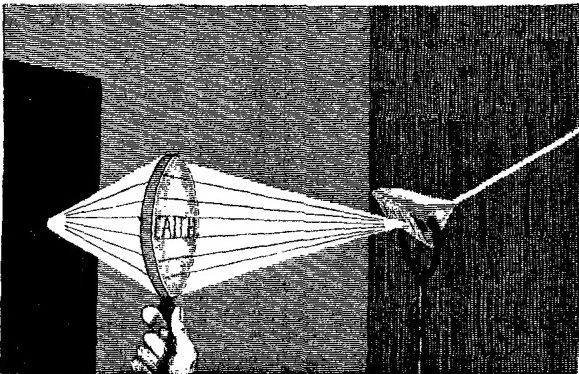
We have seen that when white light is passed through a prism, the ray is separated into its seven colors. Light seems simple, but the prism reveals that it is composite. Now we may pass these seven colors—red, orange, yellow, green, blue, indigo, and violet—through a convex lens. In doing so, we notice that the seven colors are again re-combined, and changed back into the original white light.
In passing through the glass prism, each color took a slightly different path, and appeared upon the screen isolated from the others. Next, passing through the convex lens, they are drawn together again, and reunited into the original pure, white sunlight.
You will also remember that the light of God, spiritual light, is likewise composite. Analyzed by the Word, we find that it is made up of the following different graces,—knowledge, temperance, patience, godliness, brotherly kindness, and charity. Now, as it requires a convex lens, or a reversed prism, to re-combine the prismatic colors into the original white light, so in the case of this spiritual light, it requires something like this convex lens to blend the light into the pure white character.
Of what avail is knowledge devoid of love? Paul says that knowledge puffs up, but love builds up. The difference in their effects upon us singly is the difference between the soap-bubble and the mighty and enduring oak.
We want not one, but all; we want them blended and interwoven in the character. How shall we blend them? How shall they be thus interwoven and reunited? What is this convex lens, this reversed prism, which gathers up the rainbow colors of spiritual light, and unites them in the life in the white light of the spotless soul?—I will tell you,—it is faith.
Faith is the convex lens; it is the prism that unites all these attributes into one harmonious whole; it makes them into the pure white character: for do you not remember that all these graces mentioned by the apostle are to be added to faith; they are to reach the soul through faith?
“When the apostle Peter exhorts all believers to add to their faith virtue, patience, godliness, brotherly kindness, and charity, he employs a word in the original Greek, χορηγέω, which signifies ‘to lead a chorus or band of musicians.’ The idea involved in the expression is that perfect harmony should exist between all these virtues, as between the notes of a piece of music, each enhancing the effect of the other. There is harmony in colors as well as in sounds, . . . and when the proper hues are associated together, the complementary ones contrasting and harmonizing with one another, the effect is exceedingly pleasing. As in the field of nature, so in the Christian character, all the graces should blend in such a way that the effect of the whole may be to the eye what sweet melody is to the ear.”—Hugh McMillan.
Faith, then, is the leader of this band of musicians. It causes them all to act together, producing the sweet melody of a soul in tune with God.

READING THE BIBLE.

In this age of hurry and bustle, Christians fail to study their Bibles. As faith comes by the Word (Rom. 10:17), many are becoming faithless, because they spend so little time reading that Word for themselves. There are far too many who read the Scriptures only when they want something for others. These are weak Christians, and are starving to death.
The following words may inspire some one with a new love for the Word of truth:—
“Do not read the Bible for others, for class or congregation, but for yourself. Bring all its rays to a focus on your own heart. While you are reading, often ask that some verse or verses may start out from the printed page as God’s message to you. Never close the book until you feel that you are carrying away your portion of meat from that Hand which satisfies the desire of every living thing. It is well sometimes to stop reading, and seriously ask, ‘What does the Holy Spirit mean me to learn by this? What bearing should it have upon my life? How can I work this into the fabric of my character?’”
“Let not the Bible be to you simply as a history, a treatise, or a poem; but as your Father’s letter to yourself, in which there are some things which you will not understand till you come into the circumstances which require them, but which is also full of present help.
“Above all, turn from the printed Word to prayer. If a cluster of heavenly fruit hangs within reach, gather it. If a promise lies upon the page as a blank check, accept it. If a prayer is recorded, appropriate it; and launch it as a feathered arrow from the bow of your desire. If an example of holiness gleams before you, ask God to do as much for you. If a truth is revealed in all its intrinsic splendor, entreat that its brilliancy may ever irradiate the hemisphere of your life like a star. Entwine the climbing creepers of holy desire about the lattice-work of Scripture; so shall you come to say, with the psalmist, ‘O how love I thy law! it is my meditation all the day!’ It is sometimes well to read over, on our knees, the one hundred and nineteenth psalm, so full of devout love for the Bible; and if any should chide us for spending so much time upon the Old Testament or the New, let us remind them of the words of Christ: ‘Man shall not live by bread alone, but by every word that proceedeth out of the mouth of God.’ The Old Testament must be worth our study, since it was our Saviour’s Bible, deeply pondered and often quoted. And the New Testament demands it, since it is so full of what he said and did, not only in his earthly life, but through the medium of his holy apostles and prophets.”

WHO WILL GO?

THROUGH the doors that open stand Who will go? Calls invite on every hand, Who will go? You whom Christ from sin has freed, Hear the Lord of glory plead For the lands that lie in need, Who will go?
Soul, does Jesus speak to you, Will you go? Has he work for you to do? Will you go? He has borne the cross before, He will keep the crown in store, Enter then the open door! Will you go?
— Selected.
Continue reading: HOW I SAW JESUS ON THREE OCCASIONS