The Youth’s Instructor, Vol. 37, No. 2.

WINTER IS HERE

The Youth’s Instructor

Jan 9, 1889

S. D. A. Publishing Association · Battle Creek, Mich. · Jan 9, 1889

WINTER IS HERE.

Old Winter is here in his grimness— Dark clouds, driving storms, and black nights; His days of distraction and dimness, Long troubles, and fleeting delights; His winds with their blistering boldness, His vapor, and water, and mire; His blains, and discomforts, and coldness— We seek for delight near the fire.
Old Winter is here in his glory Of icicles, frost-work, and snow; Although so bewrinkled and hoary, Yet is he with beauty aglow. I love to behold in the morning The deeds which by night he has done; Eaves, roof-tree, and windows adorning, They laugh in the light of the sun.
Old Winter is here with his magic— No wizard so wondrous as he; But, though in appearance so tragic, We smile his strange doings to see. The trees in the hedgerow and orchard Have lost all their natural shapes; For them the magician has tortured To elephants, camels, and apes!
Old Winter is here with the sorrow He ever has brought to the poor, Who think with a sigh of to-morrow, And fear the gaunt wolf at the door. To them he comes solemn and sullen, To us he brings little of dread; For are we not covered with woolen? And have we not plenty of bread?
Old Winter is here with the labors Which Christians owe to their kind— To lighten the loads of their neighbors, To comfort them, body and mind. Arouse ye, whoever are wealthy, Whoever have plenty of cheer, Whoever are happy and healthy; Arouse ye—Old Winter is here! —Rev. Samuel Wray.

THE "RICH FOOL."

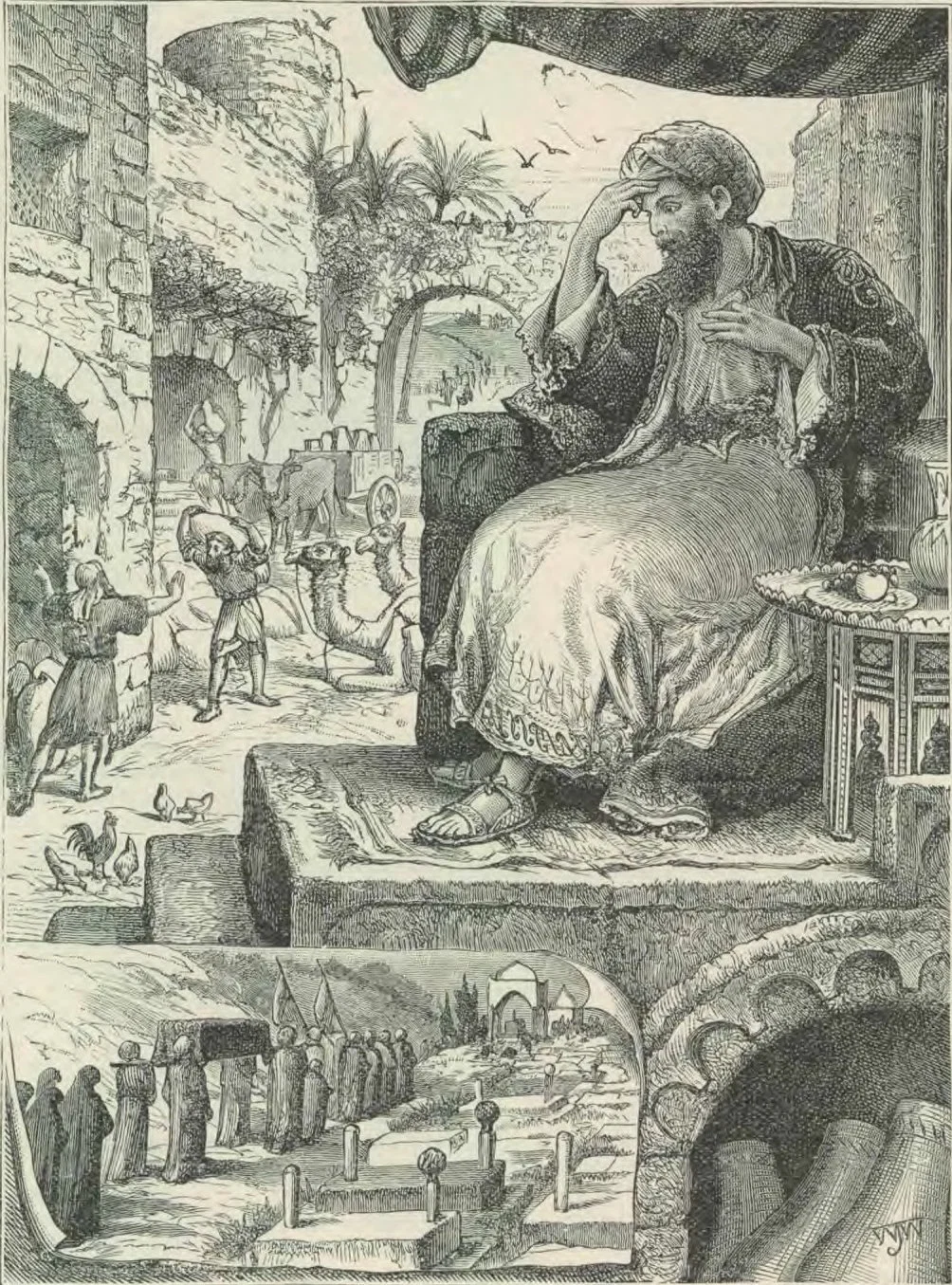
LONG, long time ago, yes, many hundred years ago, there lived, in a far away country, a very rich man. He could not have been so rich as King Solomon, because the Lord said to this king that he would "give him riches and wealth and honor, such as none of the kings have had that have been before him, neither shall there any after him have the like."
Nor do I suspect he was so rich as Croesus, king of Lydia, whom the Greeks said was the richest king then living. But the man of whom I am telling you had large possessions, and his fields were so well cultivated that they produced great crops of grain and fruits. In fact, his immense farm yielded so bountifully that he was really puzzled to know what to do with a year's produce.
After studying over the matter a good deal, he decided that he would tear his old barns all down and build new ones, large enough to hold his yearly crops, which, gathered from his extensive possessions, would be enough to last him many years. Then he would let his land rest, while he would take life easy.
Why couldn't he do so? With enough laid by to eat and to drink and to wear, and money to spend as he liked, why need he be perplexed any more for a long time?
He settled the matter, that he would not; that he would get things in good shape, throw off all care, and eat, drink, and be merry, as he pleased.
If you noticed the heading of this article, you saw that this story was about a "rich fool." Wouldn't you think he reasoned like a smart man? Let us see. Just as this man had his plans all matured and was anticipating many years of happiness, he died very suddenly one night. He had spent all his thoughts and his strength in accumulating riches, and had set his heart wholly upon them, making no provision for anything beyond. His riches all passed to others, who had no regard for him farther than to get possession of his money. Besides this, and most deplorable of all, he had run up a great debt in the bank of heaven; for he had not had God in all his thoughts. He had buried his talent of wealth, had wronged the widow and the orphan, had defrauded the laborer in his hire, and had robbed God of his tithes, etc., etc. Do you see any good reason for calling him fool?
By the term fool is not always meant a simple-minded person, one of weak intellect, an idiot; but it oftener means one who moves unwisely, acts rashly, contrary to good judgment. Some persons show well-balanced minds in some matters, while in other things they seem to be very lacking in good sense. Belonging to the latter class there are a great many foolish people in the world.
Do you know of any one's ever acting more unwisely than the man in the story? Don't you think fool is an appropriate name for him? But it was the Lord who named him thus, and you have in the above story the parable of the rich man, as found in Luke 12: 16-21.
Some others may not have so much wealth to take up their thoughts as did the man in the parable, and at the same time may be making just as foolish a mistake as he. Why wouldn't the name of fool be just as applicable to one who lets anything else take his thoughts and affections from God? Are you sure that you have nothing that separates you from him? nothing that is absorbing your thoughts and affections so that you justly deserve the same title as the rich man? Don't think lightly of those things that affect your eternal destiny. If fool must be applied to your name, let it be only that you are one for Christ's sake.
M. J. C.

WHAT WAS THE SECRET?

“Daisy, Daisy Gregory!”
It was a weak little voice that called her; but Daisy turned about, and walked back to the wee girl who owned it.
“What is it, Gracie?” she said; for Gracie’s eyes were red with crying.
“Would you please go back home with me, Daisy, and not mind? Some of the boys called me Humpy as I came along, and I’m afraid.”
“Oh, yes, indeed! Take right hold of my hand, and don’t be afraid. I’ll fix those boys.”
There was a dangerous light in the big black eyes as Daisy spoke; and the proud little head, set so gracefully upon the firm shoulders, was held a trifle more erect.
“Aren’t you ashamed of yourselves, Willie Dutton and Frank Turner, to call a poor little lame girl names? I should think God would hear you, and be very angry, and perhaps make you lame to punish you. I would, if I were he. And you needn’t put any more oranges in my desk, Willie, or bring me any more flowers, Frankie. Mamma tells me to have nothing to do with boys who are not gentlemen.”
Then, having said her say with flashing eyes, Daisy held the little hand tighter, and drew Gracie along past the boys,—who hung their heads, blushing rosy-red with shame,—and never let go her grasp until she had set the little one down at her mother’s door; then kissing her gently, and telling her not to mind, because Jesus knew all about it, and in heaven she wouldn’t be lame any more, she ran toward home.
“Daisy, will you please come in a minute?” called Susie Sherman, as Daisy passed her door. “I can’t get this sum right, and I’ve been trying so hard!”
“Yes, indeed! Let me help you, then. Mamma says we must always try, before we get help, to see what we can do.”
Daisy’s pencil flew fast along the slate, and there was the troublesome example which she had solved that morning for herself.
“Thank you so much!” said Susie. “You are always so good. You always seem to love to help, Daisy.”
“Well, it’s fun to make people happy. Don’t you think so? It pleases God, you know, too. Now I must run home, for mamma’ll be wondering where I am; and I never like to worry her, and she worries easy. Good-bye.”
“What can I do to help you, mamma dear?” she said, as she finished her dinner. Not a word of the new book she was longing to begin.
“Could you take care of baby while I have a little nap, dear? My head aches. I was up with him so much last night.”
“Yes, indeed! Come, darling; come to sister!”
The hot little hands were held out so gladly; and the teething baby’s head soon dropped upon her shoulder, as she walked back and forth to still his crying.
“Could you help me make a kite, sister Daisy?” said her brother Harry, just as she sat down on the broad window-seat to read two hours later; “I want one so much.”
Daisy’s face bore no trace of annoyance.
“Yes, Harry,” she answered. “Bring your things. I know how to make a splendid one; for I helped Jamie make his.”
“Can you read the paper to me a little while, daughter?” said the tired father, coming in, and throwing himself down on the lounge, quite exhausted: “Just the principal news.”
Daisy knew what this meant, but she cheerfully laid her book aside.
“I don’t know how I could live without my little daughter,” he said, as he drew her down to kiss the rosy cheek.
“That is all the pay I want, papa,” answered Daisy.
“It’s easy enough to be good where Daisy is,” said Harry, who was putting an extra bob to his kite. “I’m the envy of all the boys. They every one think she’s the handsomest and the nicest girl in school; and they’re right, too.”
Daisy’s face grew crimson. “You’ll all spoil me, I’m afraid,” she said. “But I’m so glad you love me! I’m sure I don’t know why, but I’m the happiest girl in the world.”—Well-Spring.

Glimpses of Switzerland: Walenstadt and Johannes Escher

GLIMPSES OF SWITZERLAND.—NO. 8.
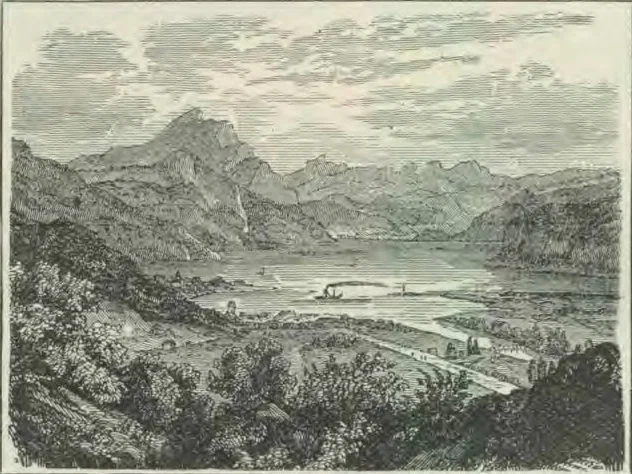
Before continuing farther with incidents of the trip mentioned in the preceding article, let us return to eastern Suisse, not to be astonished at, and admire its wonderful sights, of which there are many; but to consider an instance illustrative of the fact that with other excellent qualities of the Swiss, they have real philanthropy and enterprise. A few miles northwest of Ragatz, at the head of Lake Walen, is a town called Walenstadt. In the picture you see a part of this lake, with a chain of the low Alps in the canton of St. Gall in the background, while in the foreground there is a large canal for drainage, and a wide, smooth street leading to the village beyond. Strasse is the German for street, and stadt is town or city; thus you get the meaning of Walenstadtstrasse.
A hundred and twenty-one years ago, a little German boy named Johannes Conrad Escher was born at Zurich. His father, an eminent judge, chose for his son some place in government affairs, but his life work proved to be of a different nature. After finishing his preparatory course at the home school, and taking a course at Geneva, where he learned to speak the French fluently, he spent two years in untiring study at the celebrated university of Göttingen, in Hanover. Then he visited the principal manufactories of England, and took an important business trip to Italy. During this time, the French Revolution began to involve Switzerland in its turmoils, and for some time Escher figured largely in politics, as an editor of a popular paper entitled Le Républicain Suisse.
But his extensive studies and varied experience until this time were fitting him for a noble work of great value. Referring to this, I quote from Monsieur Ch. Didier:—
“A new career opened before him when there was a question of draining the swamps of the Linth. Stripped, little by little, by tempests and heavy rains, of their soil, the mountains bordering the river had for centuries poured their spoils into it. Wherever the river bed was shut in by walls of rock, the strong current carried all this débris before it; but where the valley opened, and the channel was not only wider, but near the level of the surface, this accumulation from the mountains had considerably raised the river bed, and each year frightful inundations occurred, . . . and the overflowing torrent had at last converted a large share of the most fertile part of the canton of Glaris into an unhealthful marsh. . . . Pestilential miasma carried death to the very summit of the mountains. . . . Intermittent and putrid fevers reigned periodically over a vast extent of territory. . . . The evil seemed without remedy; for the effort to be made was far beyond the resources of the people, a simple pastoral tribe, brave, energetic, but poor and few in number. This great evil required a great remedy; then a man was found who comprehended the situation, and who executed what he had conceived. That man was Escher.”
WALENSTADTSTRASSE.
WALENSTADTSTRASSE.
After many unsuccessful attempts, he appealed to the nation for assistance, and an association with Escher as president, was formed. A grand beginning was made, when suddenly he was abandoned by all of those who had promised to support him. But, firm in his grand project, he never gave it up, and finally moved to the scene of his labors. “He put himself at the head of the workmen, and devoted a part of his fortune, and sixteen years of his life, to this memorable enterprise. As thorough a geologist as he was skillful and persevering an engineer, he commenced by digging a new channel for the Linth; he conducted it to the lake of Walenstadt, giving it a descent of forty feet to each thirteen thousand, which sufficed to render all clogging of the stream thereafter impossible. . . . All these labors, which may be called gigantic, if they are compared with the resources of the country, and the obstacles to be met, were, with the blessing of God, the work of Escher. Those unhealthful marshes are to-day tillable. Health has taken the place of fevers, and life reigns where before death reigned. . . . When Escher reached the victorious end of his patriotic enterprise, the gratitude of the public, late though it was, knew no bounds. . . .”
“Loved and venerated of all Switzerland, Escher enjoyed his renown. But although he was still young, his health failed from day to day, in consequence of his great labors. It was noticed that his health remained unchanged during the progress of the enterprise, and only began to decline after the victory.
“He died at Zurich the 9th of March, 1823. There was then a general mourning, and his name is still held in veneration by the Swiss.”
A memorial building and school carrying out some of the plans and purposes of Escher, was established on a section of the very territory he had reclaimed, with a view to extend and perpetuate his principles and memory. This little story gives not only some of the characteristics of a leading man of his time, but also a glimpse of the enthusiastic appreciation of real merit on the part of the people and their substantial way of manifesting it. Another instance of this we see in the careful preservation of memorials of Zwingli in his native town, among them the house where he was born, over at Wildhaus, not far from the little lake in the picture.
Speaking of their appreciation of the noble, the beautiful, the grand, reminds me of a thought that has presented itself as I have tried to give some idea of the Alps and other Swiss scenery. It is, that it may appear to some that there is too much said about these, but if such could hear the native inhabitants talk of these features; if they could know of the constant and inspiring pleasure they give to even those accustomed to daily views of the wondrous, changeful beauties and endless varieties of magnificence of the Alps; if they could see how eagerly they seek to catch glimpses of them from all parts of the country; then I think all preceding references to them, and those which follow, would not seem extravagant nor too numerous.
Now to return to the trip in western Switzerland. I secured a circular ticket, good for sixty days, from Basle to Lausanne via Berne and Fribourg, to return via Neuchâtel and Bienne, which, by taking third class, cost a little over three dollars. This was for a distance of nearly four hundred miles, and over a route including many of the finest views in the country. It required some effort to secure a non-smoking compartment, but most of the way, it was done. Many of the Swiss cars are, like those of England, partitioned off crosswise into three compartments, each having two seats facing each other, and a door at each end of the passage between them. Thus these seats run across the car, and the car doors (six of them) are at the sides, not the ends. Each compartment comfortably seats ten persons. Other cars are nearly like ordinary coaches in America, and of late years they are using, more and more, imported Pullman sleepers. Incidentally, I will mention here that our people in Suisse habitually travel third-class, often to save expense.
At various points along the route, I had excellent views of the Alps. But from Berne I caught the most striking, the grandest sight of the high Alps, Jungfrau, Finsterahorn, etc., that I could ever hope to see. I shall never forget the impression upon my mind, when, on making a sudden curve, just before running into the station, my gaze unexpectedly took in, as a blaze of glory, their broad extent of shining whiteness, and jagged summits reaching high into the heavens, as they were lighted up by a bright afternoon sun; apparently they were just across a narrow valley, really they were about forty miles away. Even with knowing that the clear atmosphere of that beautiful day presented little obstruction to the sight, I cannot comprehend how they could seem so near when actually so far distant. Indescribably grand this rare Alpine view—for frequently tourists remain at this point many days hoping to catch something such an unveiling of their magnificence—stamped ineffaceably on memory's walls, one of the loveliest pictures which can ever be placed there! ADDIE S. BOWEN.

SPEAK KINDLY.

A POOR boy went to a house, asking if the mistress would please buy some matches.
Harry, who lived there, happened to see the boy, and to hear what he had said. Harry simply said, “Go away.”
The poor boy turned away with his matches, looking very downcast.
Soon after, Harry thought he should like to have a run with his hoop: so he went and fetched it, but then remembered that he had lost his stick. He must have a good stick for a good hoop. He would go and ask his papa for some money to buy one.
He found his father very busy reading. He made his request, but his father did not answer him.
Presently he asked again, when his father said, “Go away.”
Poor Harry now remembered that it was just the answer he had given to the poor boy with the matches, and felt how much better it would have been to have spoken kindly.
He still wanted a hoop-stick, and thought he would go to the woods close by and try to break off a branch that would do for a stick. He was not long in finding one, but in trying to break it, he found it was too strong for him. While he was still trying, some one stepped behind him, and said: “I think I can break it.” He seized hold of the bough and broke it off.
Harry was surprised to find it was the match-boy, and before he could thank him for his kindness, he had run away.
Harry now thought a great deal more of his rough answer, “Go away,” to the poor boy, and he and his father had a talk over the matter, and father and son owned they had been wrong, and hoped to speak kindly for the future.
Let us learn the same lesson. If we do not want to buy of the poor people we meet with, let us at least speak kindly to them; for many of them have sorrowful hearts, and we should not add to their sorrows by harsh words.—Little Friend.

WHERE?

WHERE is the honey-bee? Where has the swallow flown Only the chickadee Chirrup his song alone.
Where is the bobolink, Bubbling with merriment? What was the road, think, The gadding fire-fly went?
Whither flew the little wings, Grown in green forest aisles? Where are the pretty things That blossomed miles on miles? —Mary N. Prescott.

“GOD LOVETH A CHEERFUL GIVER.”

Little Peggy Peterkins said this text over and over to herself, and then aloud to grandma, who was knitting by the open fire. “Don’t make any difference if I put a penny into my mite-box, if I don’t exactly want to, does it?” she asked.
“I should think it did,” was grandma’s answer,—“all the difference in the world.”
“Why, grandma, if the cent goes into the box, it does,” and here Peggy gave a decided jerk to her head, just as if she was putting a cent into the box, and it went hard. “And then,” she added, “it goes to help little heathen children, if I would rather have candy, or something nice for dolly, doesn’t it?”
“Oh, yes, Peggy, it goes; but we don’t know how large the blessing is that goes with it; perhaps all the great blessings go with the willing, cheerful pennies; it always seemed to me so.”
But Peggy shook her head, and decided that God couldn’t care much, if she only put the penny into the box, notwithstanding her text said, “God loveth a cheerful giver.”
Just then little Nathan came into the room, with his hands and face pretty well covered with molasses, and a number of sticks of molasses candy on a tin plate. “Got a canny party in the titchen, I has; me an’ Rosa an’ Harky (the cook); me is to eat it all, too.” And he held fast hold of the plate, and stood in the corner away from his sister.
“Please give sister some,” Peggy said, in her most winning tones; “that’s a good boy.”
“No; Nathan’s canny,” said the little fellow, as well as he could with two sticks in his mouth; “me eat all canny.”
“Just one stick, just one to sister?” going nearer and nearer to the tin plate.
Nathan shook his head, and placed one sticky hand over his stock of candy. Some words followed that were not as kind as they ought to have been, and then Nathan picked out the very smallest stick, and gave it unwillingly to Peggy. She sat down by the fire and ate it; but somehow it did not taste so very good.
“Nathan gave you the candy, didn’t he?” said grandma.
“Yes,” said Peggy, “but—”
“Is it nice?”
“Yes, grandma, pretty nice—not so very.”
It was soon eaten, and then Peggy said her verse once more and shut up her little Testament, and got out Fanny Maria, a very smart dolly, and began to play “Come and see.”
In a few moments her little sister Daisy came in, bringing, on a piece of paper, two sticks of candy. “These are yours,” she said. “I made ’em; it’s all I made, and it’s all yours, Peggy.” The loving smile, and the way she held out her little treat, touched Peggy’s heart.
“You are just a darling,” she said, giving Daisy a kiss. “It’s ever so nice, eating the candy; there was no fun in eating Nathan’s, he was so stingy.”
“It is the same kind of candy, I suppose,” said grandma.
“Yes; Harky fixed it for us,” said Daisy.
“But I like Daisy’s best; it’s real good.”
“Do you know why?” asked grandma.
“Not exactly.”
“Both are made of molasses?”
“Of course, grandma.”
“There’s something in Daisy’s that is not in Nathan’s?”
“Oh, no! they were just alike.”
Grandma smiled, and shook her head, and said, “Yes there is,—guess what it is.”
They both guessed many things, all very wonderful when thought of in connection with candy, and at last gave it up.
“Daisy put a good deal of her heart into her candy; Nathan left all of his out. We all love a cheerful giver, don’t we, Peggy?” asked grandma, looking into the earnest face before her.
Then the little girl understood her text.
God loveth a cheerful giver, and if he sees your heart going with your missionary penny, he may pick out one of his large blessings to go with it.—M. K., in Little Helpers.

JOSIE'S STORY.

This is a true story. It is about me.
My name is Josie, and I am ten years old.
Mamma said that perhaps if I told you about my being naughty, and not minding, it might help me to remember next time.
Aunty Clark asked me to come and see Lolly and Ned, and to stay two days. Oh, wasn't I glad when mamma told me! I jumped up and down, and made a cheese. You whirl round fast, sit down quick, and your dress makes the cheese. Mine didn't, for I sat on the cat.
Aunty Clark has a great big house and a barn, and she makes better gingerbread men than anybody else.
There was one for Lolly, Ned, and me, just out of the oven, when papa and I got there.
Lolly and Ned had gone to school.
Aunty Clark said I could play out in the snow until they came home. She said I could slide down hill in front of the house, but that I mustn't go far away, or near the pond.
There isn't any place to slide at home. It is all houses, and they put ashes on the sidewalks; but at Aunty Clark's there is a long hill, and it is steep, too.
I slided for ever so long, and then I got tired.
The pond is at the bottom of the hill.
The ice looked hard, and I wanted to try it. Aunty Clark told me not to, but I was only looking.
Then I put one foot on, and then I slided about. I forgot some more, and went out into the middle of the pond. Ice can make a noise like Fourth of July. I know—for I heard it. It broke, and I went into the water.
Ice-water makes you ache. I screamed just as loud as I could, and I wished I had minded.
The water wasn't deep, but I couldn't get out; when I tried to, the ice kept breaking more all about me.
Uncle has a big dog, not a nice dog to play with, but one that knows a great deal. He came running over the ice. It didn't break with him. He caught my dress with his teeth, and pulled me up where the ice was strong. Then he barked and jumped all about me.
I went up the hill as fast as I could. I didn't want to go. I didn't want anybody to see me. My clothes began to freeze and make a funny noise when I ran. I wished I hadn't come.
When Aunty Clark saw me, she threw up both hands and said: “Where have you been? What will the child do next?”
She undressed me, and put me to bed wrapped up in a warm blanket.
I had to drink something hot, that was very bad.
Aunty Clark didn't say what a naughty girl I had been. She knew I knew it. She only looked sorry.
She praised Carlo, said he was a good doggie, and always did as he was told.
I thought a good deal in bed. That I should have to tell mamma, and that little girls could be worse than dogs.
I had to stay in bed all day.
I didn't know it, but Lolly was to have a party that afternoon. It was to be a surprise.
Aunty Clark had asked all the little girls. They all came, and I couldn't be there.
They played “Hide and Seek,” “Blindman's Buff,” “Going to Jerusalem,” and I couldn't be there.
I tried not to cry, but when I heard them playing “Hunt the Thimble,” and they hunted and hunted, and I knew I could have found it quick, I cried out loud; but Aunty Clark came and talked to me, and I am always going to mind after this.—Youth's Companion.

FULL, YET ROOM ENOUGH.

“Mamma,” said six-year-old Fred, “I can’t love God and you both, so I’ll choose you.”
“Why, my child! what do you mean by saying that you cannot love both?”
“Because that is what the Sabbath-school lesson teaches; it says that I must love God with all my heart, and there isn’t but one ‘all’ to it, so if I love him with all, there won’t be one bit left for you.”
Mamma laughed, and only asked Fred to come with her. Going to the cellar, she quietly asked him to help her fill a large pan with potatoes.
“There,” said he, piling on the last big fellow, “it’s full.”
“Full, yet there’s room,” answered mother, as she next took a bag of beans, and began to shake them into the big crevices between the potatoes. She poured and shook until a quart or more had disappeared, and the pan was speckled with white.
“Neither is it full yet,” she said; and taking up a shovelful of sand, she scattered that over the pan, and it, too, disappeared, and another after it.
“Not full yet,” she said again, as she took a cup and began pouring water on the pan; and she poured and poured, until several quarts were gone.
“Now, you see how a thing can be full, and yet hold more—of something else. So your heart may be full of the love of God, and plenty of room left for me, and papa, and sister, and play, and books.”—Examiner.

THE FAITHFUL DOG.

Tony belonged to a little Italian boy named Beppo, who was poor and spent his days in the streets selling flowers to the passers-by, and his nights in a cellar. Tony was his one friend and companion who never left him day or night, and with whom he shared both his bed and his breakfast.
One morning Beppo awoke feeling very ill, and of course lonesome and sad, so that the tears kept coming. It was plain that Tony knew all about it, and felt very sorry too, for he cuddled up to his master closer than ever, and lapped away the tears and wagged his great tail very hard, as much as to say, “Cheer up, my little master! I will take care of you. What can I do for you?”
Then Beppo could not help smiling and patting the good dog, and at last he got up and went to the florist, who lived close by, and bought his flowers as usual. He arranged them in a basket, and also put into the basket a tin cup to hold money. Then he tied the basket around Tony’s neck, and said,—
“See here, Tony! you are all I have to depend upon; go and sell the flowers, and don’t let anybody steal the money.”
Then he opened the door, and the dog knew what was expected of him, and went and took his stand at the usual place.
When the little boy’s customers came along, they understood too what was expected of them. They took what flowers they wanted, and put the pay for them into the cup. Once or twice rude boys tried to snatch a bud or a penny, but Tony’s growl warned them that it would not be safe.
At night Tony came back with his basket empty and his cup well filled, and you may be sure Beppo rewarded him with many hugs and kisses and a good supper.
What lessons can our little ones learn from this story of Tony?—Little Helpers.

Verses on Helpfulness, Humility, and Duty

HELP the weak, if you are strong; Love the old, if you are young; Own a fault, if you are wrong; If you're angry, hold your tongue. In each duty Lies a beauty If your eyes you do not shut, Just as surely And securely As a kernel in a nut.
Continue reading: OLD TESTAMENT HISTORY