FOR the first time in the history of the work in this Western field, all the union missionary agents in the Pacific Press territory met for counsel in connection with the bookmen’s convention of the Central and Northern unions held in College View, Neb., Jan. 8-15, 1912.
Two days the union agents were occupied in laying plans for the work during 1912, and in seeking God for wisdom and power to carry them out successfully. This was indeed a profitable meeting, and will mean much for the work in this field.
Besides the field missionary agents of the Northern and Central Union conferences, the following leaders in the publishing work were present: A. A. Cone, general agent of the Pacific Union Conference; W. R. Beatty, general agent of the North Pacific Union; F. E. Painter from the Northern Union; W. L. Manful from the Western Canadian Union, and the writer from the Central Union Conference.
Besides these, we had with us N. Z. Town from Washington, D. C.; H. H. Hall and G. C. Hoskin from Mountain View, Cal.; and James Cochran and S. J. Abegg from Kansas City, Mo.
The convention proper opened January 10, with most of the field agents of the Northern and Central unions present. The good spirit of the union men’s meeting was carried into the convention. A note of victory was sounded from the very first. It seemed hardly possible that any meeting could be better than the first one, but each succeeding one grew in interest.
The recommendations of the General Conference Publishing Department relative to uniting the magazine and subscription-book work under the management of the union and field agents, was not only voted unanimously, but with enthusiasm. This is a step in the right direction, and will mean great advancement in the circulation of our literature in this field.
The thought of faithful service was prominent throughout the convention. Each union and field agent pledged himself not only to spend ample time assisting the canvassers in field work, but to spend at least two successive weeks with prospectus in actual field work during 1912, reporting the result with the other canvassers.
The following important measure was passed by the convention:—
“That a regular colporteur’s credentials be granted to permanent canvassers who have demonstrated their faithfulness and consecration to the satisfaction of the conference committee; and to students who have declared their intention of making this their permanent work, and have spent at least two vacations canvassing.”
“That a colporteur’s license be issued to those who have had less experience, but give evidence of becoming successful laborers in this branch of the work.”
We believe this will be a source of great encouragement to our faithful, permanent workers.
The sale of subscription books in the Northern Union for 1911 amounted to $21,625.38, and in the Central to $35,036.43. But for 1912 we have set our stakes for sales far beyond these, and intend by God’s help to reach them.
We believe that our bookmen should have proper encouragement and assistance from the conference, and then be expected to get results. The ox that treads out the corn ought not to be muzzled, but we also believe he ought to tread out corn.
Above all, stress was laid upon the fact that the very best plans and methods in the world are useless without the Spirit of God to breathe life into them. We feel that an advance step must be taken this year. Only ordinary things have been done in the past, but the time has come when extraordinary things must be accomplished. We are in God’s hands for service.
C. G. BELLAH.
News and Miscellany
Notes and clippings from the daily and weekly press
— “It has been estimated that 1,500,000 men and women of the United States are disqualified for work by the use of intoxicants.”
— The dentists have learned that they can make teeth insensible for thirty minutes of dental work by injecting into the spongy bone beside the tooth a solution of novocain. This discovery will be a great boon to humanity.
— Out of 62,400 building-trades workmen regularly employed in Chicago, 41,600 are now idle. This great slump in building is the result of extreme cold weather since the first of the year. Plumbers are the only men not affected.
— Fifty-three of the crew of the British steamer “Wistow Hall” were drowned on the morning of Jan. 18, 1912, when the ship foundered on the Bullers of Buchan, off the coast of Aberdeenshire, Scotland. Only the captain and three of the crew reached shore.22
— The Norwegian cabinet will ask for an extraordinary credit of $4,125,000 for the development of Norway’s naval defense.
— The revolt in the republic of Santo Domingo is spreading rapidly. All the telegraph land wires have been cut by the rebels.
— It is estimated that 750,000 people gathered to welcome John Cardinal Farley when he landed in New York January 17, on his return to America as a newly created prince of the Catholic Church.
— Through the munificence of Andrew Carnegie and other philanthropists another magnificent marble building, rivaling in architectural beauty the Pan-American Union building, soon is to be erected in Washington, D. C., at a cost of $850,000, for the Brotherhood of North American Indians. This society is of recent origin, and has the financial and moral support of many men of means throughout the country.
— An aftermath of the late Moroccan affair between Germany and France, was the resignation recently of the entire French cabinet, including Premier Caillaux. This was brought about by the charge that members had been in secret negotiations with the German government. As a result of the upheaval, the resignations were accepted by President Fallières, and Raymond Poincare has been appointed premier. This new head of affairs has chosen a cabinet that seems to give general satisfaction.
— The impending coal strike in England brings the nation face to face with a great peril. More than a million miners have decided to walk out, throwing still other millions of workmen out of employment; and for want of fuel the industries everywhere will be forced to suspend operations by April 1, 1912. Viewing the situation from Manchester, it is declared that the country confronts the greatest industrial strike it has ever had to meet since the peasant uprising in 1381, more than five centuries ago.
— The great Peace Palace, donated in the main by Mr. Carnegie, is gradually rising with majestic form on its site at The Hague. It is expected that it will be in readiness for the Third Hague Conference in 1914 or 1915. Various nations are contributing from their leading products for the finish or the furnishing of rooms. Rare woods are being furnished by South America, and ivory and other means of ornamentation are being contributed by the East. It is expected that each nation will have a room, and that the various peace organizations will have headquarters there.
— The Chicago Tribune’s summary for 1911 shows there was a decrease in the United States in the number of suicides, legal executions, embezzlements, and homicides compared with the figures for the year before. There were 12,242 cases of suicide, against 12,608 in 1910. The proportion of suicides as between men and women remained about the same, being 8,130 men and 4,112 women. Physicians again head the list among professional men, they numbering 27, as compared with 51 in 1910, and clergymen come next, 11 having taken their own lives. Among business men 19 bankers and brokers have committed suicide during the past year.
— At last, after sixty years’ effort, New Mexico, on Saturday, Jan. 6, 1912, was admitted into the Union as a State.
— Arthur M. Beaupre, the American minister to Cuba, has been notified by the Cuban secretary of state of the full ratification by the veterans’ leaders, on Jan. 20, 1912, of an agreement with the Gomez administration, which assures the country of peace without the necessity of intervention by the United States.
— Conpetroline is a new generative power for air-ships. The inventor has succeeded in transforming gasoline into a paste, which is put up for use in the form of tablets. These can be dissolved and diluted by a certain liquid, the identity of which the inventor does not disclose. These tablets are non-explosive, and light.
— The completion of one of the greatest engineering feats of the present age was celebrated Jan. 22, 1912, when the first great “railroad over the sea,” the Key West extension of the Florida East Coast Railway, was formally opened. By using the Florida Keys as stepping-stones, this steel highway runs over miles of salt water, from a point a few miles south of Miami, Fla., to the island city of Key West.
“Christ, the Reformer.”
By S. B. H.
The following editorial from the Marion (Ohio) Daily Star, under the heading “Christ, the Reformer,” Seeks the Individual,” is worth reproducing:—
“It is to be regretted that Rev. Mr. King, of Trinity Baptist Church, could not have preached his morning sermon of last Sunday to all of Marion; nay, more, such a sermon should be thundered throughout the length and breadth of the land. It is a bit of the convincing gospel that the whole country needs.
“Rev. Mr. King had for his theme “Christ, the Reformer,” and the central, dominant thought was that reformation must reach the individual. The pulpit application, of course, is that the saving grace of Jesus Christ in the heart is the key to all reformation. A Christian world will not dispute, it can not; but whether or not one accepts Christianity, he must accept the logic of a better order with any people beginning in the individuals that make up that people.
“The world needs more of such convincing sermons. We need more converts to righteousness, and less futile efforts to legislate everybody into a righteous state. We need more convincing, and less attempt to coerce by law.
“It has always struck us that it was a confession of weakness that the great and good Christian religion never deserved, to confess an inability to reach men through its teaching, and seek to reform them by legislation. It has detracted from the influence of the church. But upon reflection, the weakness is not of the church; it is the ineffectiveness of the ministry. The American people are not drifting from the influence of the church, but the pulpit has too often failed to convince and carry the needed conviction. The great truth has never failed; the failure is in its utterance. Not enough preaching has stirred the individual conscience.
“The truth is that the uplifting, helpful, moralizing influence of Christian teaching has been too much neglected, while accomplishment has been sought in legislation. The force of moral law has been ignored in seeking cure-alls in statutory law enacted by men. There has been more concentration on civic correction than moral redemption; and as Rev. Mr. King so forcefully pointed out, the latter must come first, and must have its beginning in the individual heart.
“Sermons like this of Rev. Mr. King at Trinity Church are more than devotional pabulum to his congregation. They stir thought and conscience and a new consecration, and the effects reach beyond congregational and denominational lines. And more men and women, with righteousness in their hearts, will soon make Marion a fairer and better city, no matter what the statutes require, no matter who is elected president or what goes into the new constitution, no matter whether initiative and referendum and recall prevail.”
S. B. H.
The Publishing Work
Conducted by the Publishing Department of the General Conference
E. R. PALMER - - - - Secretary
N. Z. TOWN - - - Assistant Secretary
NOTICES AND APPOINTMENTS
By H. S. Shaw
Western Canadian Union Conference
The second biennial session of the Western Canadian Union Conference of the Seventh-day Adventists will be held in Didsbury, Alberta, Canada, Feb. 21 to March 3, 1912, for the election of officers and the transaction of all other business properly coming before the conference.
H. S. Shaw,
President.
The Magazine With the Message
By Editor
The March Issue Is a Soul-Winner
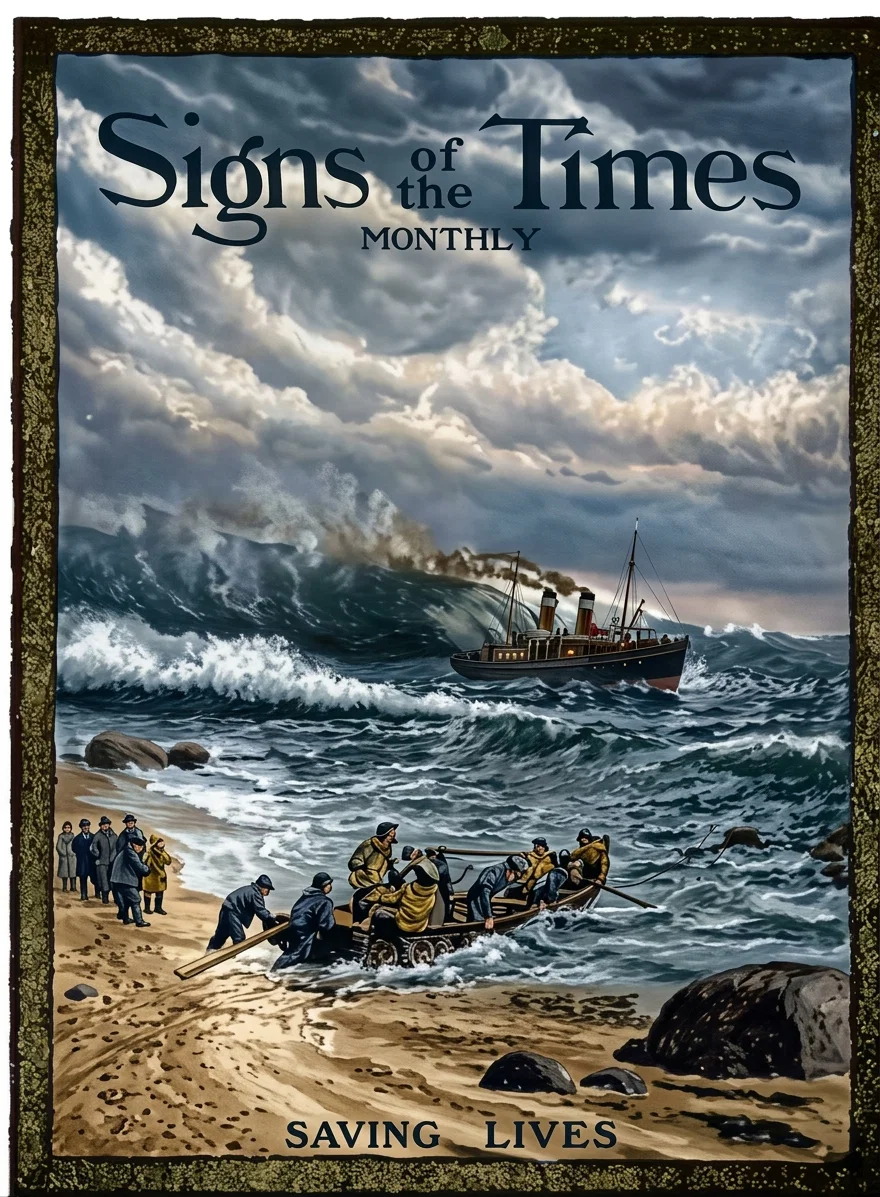
THE cover design typifies the perils that sometimes overtake the traveler in this world, and also depicts one of the great instrumentalities for the saving of lives.
SAVING LIVES
“Saving Lives,” an article on this subject by the veteran editor of the weekly Signs of the Times. Illustrated by the cover design and other graphic views. The conclusions of this article are perfectly logical and soul-winning. Worthy of your careful study.
“The Word Made Flesh,” by Mrs. E. G. White. By special request we republish this contribution upon the divinity of Christ, instead of the regular serial from her pen.
“Intensity of War Training,” by A. O. Tait. Some forceful facts, figures, and pictures present this subject in a most telling manner.
“Intensification.” Our well-known writer, Mr. Frank S. Weston, writes an illuminating article under the above title. He shows how intensity is taking hold of every movement in the earth; that while evil and evil workers become more intense, righteousness and adherents to righteousness also become more intense; that the picture of a reign of peace on earth previous to Christ’s coming is a fallacious doctrine is shown by this very fact; that the world will not change except in intensity; that the powers that have operated will continue to operate only with increased power. We hope the article will have a wide reading.
“The Threatening Future in This Country.” Another almost startling article on conditions that threaten the peace and progress of this nation.
“Glimpses of China,” by F. E. Stafford, continued in this issue. The present world-wide interest in China and Chinese affairs make these notes and illustrations of thrilling import.
“Sabbath Queries.” Under this heading, T. E. Bowen continues his articles, considering questions and answers on the all-important subject of the Sabbath.
“Current Topics.” Always of importance to those who watch present-day events in the light of prophecy.
Our regular “Bible Study,” and other contributions of equal value. Your neighbors and friends need this issue of the magazine with the message.
Yearly subscription, $1; single copy, 10 cents; 5 to 40 copies, each, 5 cents; 50 copies or more, each, 4 cents.
Please order through your church librarian or tract society.
Business Notices
This department is conducted especially for the accommodation of the Seventh-day Adventist readers of this paper.
Conditions
Any person unknown to the managers of this paper must send with his advertisement satisfactory written recommendation. The fact that one is a subscriber does not necessarily23make him “known” to the managers, nor constitute sufficient recommendation. Such recommendation should come from one of our ministers, or from the elder of a Seventh-day Adventist church. It is not enough to refer to some individual by name. Secure his recommendation in writing, and send it.
We open no accounts for advertising, and cash must accompany each order.
A charge of two dollars will be made for each insertion of forty words or less. Each additional word, initial, or group of figures in excess of forty, will cost three cents.
No discount for several insertions.
COOKING OIL direct from refinery; pure, healthful, delicious. Barrel (50 gallons), at 58 cents; 30 gallons, at 59 cents; 5-gallon can, $3.25; 10 gallons, $6.25; 8 1-gallon cans, $5.90. Cash with order. Lookout Cooking Oil Co., Chattanooga, Tenn.
TWO FARMS FOR SALE.—One thirty, one forty acres. Buildings on each; wood; pure, soft water; mild climate, choice fruit, well-distributed rainfall; near railroad, good markets. Will sell separately or together. Called to Cuba, reason for selling. Geo. M. Brown, R. F. D. 1, Greensboro, N. C.
BIBLE MOTTOS, 12 x 16, express prepaid. New Father and Mother lead. Special: 20, $1; 50, $2; 100, $3.75; 200, $7; 300 and 100 Post-cards, $10. We also sell one of the highest grade Cooking Oils made. 5 gallons, $4; 10 or 20 gallons, 70 cents a gallon; 50 gallons, 60 cents a gallon. Guaranteed. We do not deal in cheap oil. Hampton Art Company, Nevada, Iowa.
COMPETENT man bookkeeper and stenographer desires situation. Has filled, in most satisfactory way, position of conference secretary and treasurer and tract society secretary and treasurer. Resigned last position in the South on account of poor health, but has recuperated now so that he can do good work. Best of references can be given. For further particulars address L. W. Graham, 32 Union Square, New York City.
Publications Wanted
THE following-named persons desire late, clean copies of our publications, sent post-paid:—
E. E. Messinger, Box 140, Sanford, N. C., desires denominational literature for free distribution.
Late, clean copies of the Signs of the Times, Youth's Instructor, and Life and Health are desired by Mrs. Dora Terrell, Decatur, Ark.
English and Spanish publications, especially Our Little Friend, are desired by E. C. Boylan, Box 35, Espanola, N. Mex., for free distribution.
Dora F. King, Shreveport, La., R. F. D. 2, Box 38, would like copies of all our denominational papers, except the REVIEW, for missionary work.
Signs of the Times, Life and Health, Youth's Instructor, and Our Little Friend, for free distribution, will be appreciated by Mrs. W. O. LaBonte, R. F. D. 1, Mountain View, Mo.
Address Wanted
The Seventh-day Adventist Church of Boston, Mass., desires to learn of the whereabouts of Sister Allen Flint, who when last heard from had gone to California. Address Elder A. S. Sanderson, 254 Willow Ave., Somerville, Mass.
Obituaries
RUDY.—Effie Nancy Rudy was born at Springfield, Ill., in 1869, and died Dec. 26, 1911, at her home in Dinuba, Cal. For fifteen years she was an earnest member of the Seventh-day Adventist Church, and her life was one of faithful service to others. Her husband, one son, and one daughter sorrow, but with hope’s sweet assurance. Elder H. C. Basney and the writer conducted the funeral services, which were attended by a large number of friends. Text, Ps. 71:9, last part.
H. G. THURSTON.
EELLS.—Martha Kent Eells was born in St. Lawrence County, N. Y., Feb. 22, 1843, and died at Keene, N. Y., Dec. 29, 1911, aged 68 years, 10 months, and 7 days. In November, 1862, she was married to Seth Eells, and to this union were born seven daughters, five of whom are living. Sister Eells united with the Seventh-day Adventist Church in 1871, under the labors of Elder C. O. Taylor, and was a faithful, devoted Christian. Funeral services were conducted by the writer.
J. W. LAIR.
PRATT.—Christiana Pratt was born at Kissy, Sierra Leone, West Africa, Dec. 25, 1848, and died Dec. 2, 1911, aged 62 years, 11 months, and 7 days. She accepted the third angel’s message and was baptized early in 1908, uniting with the little church at Waterloo. She was a faithful Christian until death took her from our midst, and was loved and honored by all who knew her. One sister and many friends are left to mourn their loss. Funeral services were conducted by the writer, who spoke words of comfort from 1 Thess. 4:13.
W. H. LEWIS.
SMITH.—Anna Smith, daughter of George H. and Sarah Smith, was born in Hampton Township, Mich., March 27, 1887. She was baptized and joined the Bay City Seventh-day Adventist Church June 2, 1899, and fell asleep at the home of her sister in Flint, Mich., Jan. 2, 1912. There remains to mourn their loss a father, two sisters, and many friends. Words of comfort were spoken by the writer from 1 Sam. 20:3.
F. L. THUEMLER.
BELL.—Clara A. Bell, née Russel, was born Dec. 12, 1851, and died Dec. 31, 1911. She was one of the first to accept the third angel’s message under the labors of Elder W. M. Healey, and became one of the charter members of the Los Angeles, Cal., church. Sister Bell’s life was in many respects one worthy of imitation, for she was unselfish, thoughtful of the wants of others, and devoted to the cause she dearly loved. Her husband and two children are left to mourn. Elder Healey conducted the funeral services, assisted by Elder J. W. McCord and the writer.
J. W. ADAMS.
McCUTCHAN.—John Franklin McCutchan died in Petaluma, Cal., Dec. 25, 1911, aged 74 years, 8 months, and 25 days. He came to Petaluma about one year ago and joined the Seventh-day Adventist Church by letter. During this time we learned to love him dearly for his sterling character. His last church work, only a few days before he fell asleep, was to give all he had to the $300,000 Fund. For thirty years he was a believer in this message, and we have the hope that he will awake at the resurrection of those who keep the commandments of God and have the faith of Jesus. The writer spoke from Rev. 14:13.
A. G. WILBUR.
DAVIS.—Thomas H. Davis died at the River Plate Sanitarium in Argentina, South America, Nov. 26, 1911. He came to Chile nearly eighteen years ago as a self-supporting canvasser in behalf of the third angel’s message. There were many obstacles to meet in a country where the language and customs of the people were strange. Upon landing at Valparaiso he was obliged to go to work at once in order to secure money necessary for a night’s lodging. God richly blessed his labor of love and faith, and soon there were believers rejoicing in the truth. Thus Brother Davis was one of the pioneer missionaries to Chile. Ill health compelled his return to the States at the close of 1901; but after a short rest he returned to South America, this time pioneering the work in Ecuador. Here he laid his wife to rest. In 1906 he was called to take charge of the canvassing work on the west coast, and with his children he returned to Chile. After a canvassing agent was secured for Peru, he took charge of this work in Chile alone, in which capacity he served until his death. He married again in 1910, and his wife and three children survive. Brother Davis had not been strong for many years. There is no doubt but that this was largely due to the irregularities and inconveniences incident to the character of his labors in South America. For a year he had been able to do but little work, and for more than six months he had been confined to his home. Receiving no help from the physicians in Chile, he came to Argentina in September to seek relief at our sanitarium. At times there was hope of his recovery, but finally a severe hemorrhage ended his life. He fell asleep peacefully and without suffering, and we believe with a certain hope of a part in the first resurrection. This is the first Seventh-day Adventist missionary who has come from a foreign country to South America and died in the field of his choice. The funeral services were held in the River Plate school building, the writer speaking from Rev. 14:13. We can but believe that in the day of Christ’s coming many will come forth to bless our brother for his unselfish labor, which, under God, resulted in their salvation. Under the soft moonlight we laid him away in the little Protestant cemetery near Crespo, there to await the fruition of his hopes and his labors at the coming of the One he loved and served.
J. W. WESTPHAL.
MILLER.—Charles F. Miller was born in Roeskilde, Denmark, July 1, 1836, and died Dec. 19, 1911. Brother Miller was a firm believer in present truth, and we are confident that he sleeps in Jesus. He was one of the charter members of the Wilmington, Del., church.
F. A. HARTER.
SAUNDERS.—Ora O., son of John F. and Laura Saunders, was born in Hancock County, Illinois, June 4, 1889, and died in Colorado Springs, Colo., Jan. 7, 1912. Brother Saunders had been ailing for nearly a year. Last fall, accompanied by his father, he sought health in Colorado, but died nine days after an operation for appendicitis. His companion and one son, father, mother, and three brothers survive. The writer spoke to a large company of relatives and friends assembled in the Methodist church at Adrian, Ill., from 1 Thess. 4:13, 18.
JOHN E. HANSON.
WU.—Wiu Guan San, aged 45 years and 8 months, died at Chang-sha, Hunan, China, Oct. 2, 1911. Brother Wu was born in a little village about twenty miles from Chang-sha, was brought up a Confucianist, and according to the old curriculum received a good education. While in his teens he became addicted to the use of opium, and remained a slave to this habit for nearly thirty years. About three years ago some gospel tracts, and later a Bible, came into his hands. After reading these, he determined to become a Christian and keep all the commandments of God. Through prayer and medical aid from Dr. Laird, he overcame the opium habit. A year ago last October he was baptized by the writer, and united with the Chang-sha church. From that time he served the mission faithfully as language teacher, and later as Sabbath-school superintendent and local treasurer of the Chang-sha mission. His accounts were kept faithfully and accurately, and he performed this work until within three weeks of his death. Brother Wu had a strong desire to live, and during his illness he often longed that the writer, who was away at the time, might return and carry out the instruction in James. His faith in the power of God was great, but he was resigned to the Lord’s will, saying that he felt safe in his hands. He died of tuberculosis, and the funeral services were held in our mission chapel. Evangelist Hwang spoke words of comfort from the text, “I am the resurrection, and the life.” Our brother was then laid to rest to await the glad morn when Jesus will call forth his sleeping children. His wife survives him, and continues her work as teacher of our girls’ school.
R. F. COTTRELL.
Russian Tract Society Threatened
Elder J. T. Boettcher, writing from Riga, January 10, mentions an authentic report in the newspapers just at hand, which may mean a further hindrance of the message in Russia. Translated, it reads:—
“The senate had under consideration the protest which the minister of the interior rendered against the registration of some societies. Some time ago there were about six societies properly registered by the governors, against which the former minister of the interior, Mr. Stolypin, protested. Because these societies were religious organizations, they had to be registered by the minister of the interior. The senate agreed to this protest, and dissolved the resolutions of the governors. Among these societies is one registered by the governor of Lio-land, namely, the Russian Tract Society, a society for the distribution of religious literature.”
The Russian Tract Society is the name under which our tract society operates in that country. Brother Boettcher adds: “You can imagine how this made us feel when we first read it. We are now expecting the execution of this resolution almost any day.” He further writes: “About the same time we read the above report in the papers, we heard that Brother Wildgrube was sentenced to two months in the fortress. The newspapers have given quite full accounts of the trial. He was in the courtroom from ten o’clock in the morning until twelve o’clock at night. The Lord must use this as a means for spreading his truth.” Let us not forget in our prayers, the work and the workers in that land, that God may in his own way reach the honest in heart with his saving truth.
Annual Religious Liberty Day
By Editor
As announced in last week's REVIEW, the last Sabbath in February will be used as the annual Religious Liberty day, for setting before all our people the needs of this department of our cause. This program will take the place of the regular fourth Sabbath exercises for February. The program for Religious Liberty day will be found on pages 19-21 of this issue of the REVIEW. Will our local church officers make note of this?
ELDER S. B. HORTON, the assistant secretary of the Religious Liberty Association, has returned from the meeting of the Atlantic Union Conference, recently held in Brooklyn, N. Y., and reports an enthusiastic interest on the part of the delegates in the religious liberty work.
The Statement of the $300,000 Fund will be found in this issue on page 18.
Progress of the Work in Japan
W. L. FOSTER writes from Sasebo, Japan, that the workers and new Sabbath-keepers at that place are of good courage; that interest in the message is increasing; and that there seems to be on the part of the hearers a disposition to obey.
Rome and Religious Liberty
By invitation of the president of the Eastern Pennsylvania Conference, the circulation manager of the magazines published by this office, Brother A. J. S. Bourdeau, went to Philadelphia on Sunday of this week to speak at the First Seventh-day Adventist Church in that city, on “Rome and Religious Liberty.”
Pacific Press Reports Prosperous Year
Our people generally will be glad to learn that the year 1911 was the most prosperous year the Pacific Press Publishing Association has ever experienced. The home office and all three of its branches show substantial gains. The board of directors for the present year are: H. W. Cottrell, C. H. Jones, M. C. Wilcox, H. H. Hall, H. G. Childs, A. O. Tait, and B. M. Shull.
Degerings Appointed to West Caribbean Conference
BROTHER CHARLES DEGERING and his wife, of Walla Walla, Wash., sailed February 3 from New Orleans, La., for Colon, Canal Zone, where they go to take charge of the West Caribbean Conference office. The book work in Panama and Honduras has made rapid growth in the recent past, and because of the removal of the West Indian Union office to Jamaica, the Canal Zone office needed reenforcements. Colon is destined to become an important shipping center in connection with our English and Spanish work in Central America, and Brother and Sister Degering have responded to the call for help at this place.
A Nurse Wanted
THE Medical Department of the General Conference has an application for a lady nurse to look after the physical welfare of the public-school children of one of the cities in Tennessee. Favorable terms are offered, with an excellent field for missionary work. The one making the call is anxious to see the plan adopted by other school boards of the State, and is in official position to help bring it about. Immediate information is desired by the Medical Department, that will lead to securing a well-qualified nurse to fill this position.
Revolution Prevents Landing in Ecuador
WHILE the steamship “Chile” was lying off the coast at Guayaquil, Ecuador, January 15, Brother Spicer mailed a letter from which we learn that on account of the revolution just broken out there he was unable to land. Their ship on the way down the coast was ordered into Manta, where one thousand soldiers were taken on board. Yellow fever was also doing its deadly work at Guayaquil. Brother Spicer was thus compelled to take boat for Peru as quickly as possible, without meeting Elder J. W. Westphal in Ecuador, as planned. This will be a great disappointment to our brethren in Ecuador, as it was to the visiting brethren, but was unavoidable because of the uprising. A cable tells of Brother Spicer’s safe arrival at Lima, Peru.
Important Gathering in Shanghai
ELDER I. H. EVANS and his party arrived safe at Shanghai, China, Dec. 16, 1911. Elder E. M. Adams and his wife and Brother Floyd Ashbaugh, under appointment to the Philippine Islands, continued their journey the same day to that field. In his letter Brother Evans mentions the appointment of a meeting of the Asiatic Division Committee, to be held in Shanghai, January 25 to February 10. It was expected that C. L. Butterfield, of Korea, F. H. De Vinney, of Japan, L. V. Finster of the Philippine Islands, and G. F. Jones, of Singapore, would be present. At the same time there was to be a general meeting of the China mission workers, most of whom are already in Shanghai because of the revolution. This is an important gathering for the work in the East.