News Items on Suffrage, Aviation, and Reconstruction
Page 2
The Youth’s Instructor
Jun 24, 1919
Review and Herald Publishing Assn. · Takoma Park Station, Washington, D. C. · Jun 24, 1919
News Items on Suffrage, Aviation, and Reconstruction
National suffrage for women was again indorsed by the House of Representatives on May 21, and adopted by the Senate on June 4.
Mr. Henry Ford recently sent out word that he wished to employ one thousand maimed or crippled soldiers within twenty-four hours.
The Traymore Hotel of Atlantic City now offers its guests the diversion of an air flight in its own plane at the rate of one dollar a minute.
Five hundred fifty thousand buildings in the devastated districts of France are to be reconstructed, according to recent statistics issued by the French government.
The first transatlantic steamboat trip was made in May, 1819, just one hundred years ago. The centenary of this event marked the first transatlantic airship flight.
A resolution now before the Florida Legislature provides for a vote at the next election regarding the division of the State into two commonwealths, North Florida and South Florida.
Lieutenant Roget, the French aviator who in April made a nonstop flight of more than 680 miles, from Lyon to Rome, has started on a flight from Paris to Morocco, whence he plans to attempt a flight across the Atlantic to Brazil.
Of the three American naval seaplanes that left Newfoundland on May 16, only one reached the Azores without mishap. This was the NC-4, which continued the transatlantic trip, and, making a short stop at Lisbon, Portugal, reached Plymouth, England, May 31.
During the war, when conservation was in style, a number of sheep were pastured on the White House lawn in Washington. President Wilson recently issued orders that these should be sheared for the benefit of the Salvation Army Fund which was being raised. Commander Evangeline Booth sent a telegram of thanks to the White House officials.
Prof. David P. Todd, director of the Amherst College astronomical observatory, sailed for Montevideo, South America, early in May, that he might take observations of a solar eclipse May 29 from a naval seaplane at an altitude of 10,000 or 15,000 feet. Professor Todd predicted that his plan, which is an innovation in astronomy, would result in obtaining clearer photographs of an eclipse than had ever been made before.
A message written in blood on a grain of Syrian wheat, thanking American relief workers for aiding his people, has been received from the headman of a village of Lebanon by representatives of the American committee for Armenian and Syrian relief in Beirut. The message, so finely inscribed that it can be read only with a magnifying glass, declares that its author, Nasib Said, could not find “a better ink than the blood of my heart nor a paper more appropriate than a grain of wheat” to record “your great benevolence.”
Spring cleaning at the national Capitol is no small task. The building proper is 751 feet long, and 350 feet wide. It has 679 windows, miles of marble corridors, 550 doors with finger marks upon them, 140 fireplaces with their 140 sets of andirons. All of these must be washed or polished. Then there are 18,592 electric bulbs to be cleaned or replaced. There is also a large array of bathtubs, shower baths, and wash basins, 261 of the latter, demanding attention.
Dr. L. Stamm, of London, in a recent lecture on “Aviation and Life Insurance,” affirmed that aviators abstaining from the use of alcohol and tobacco have steadier nerves than those who use these narcotics. “I have no hesitation in declaring,” stated the lecturer, “that from the point of view of life insurance a lower rate of premium should be offered to the abstaining pilot.”
The two daring aviators, Messrs. Hawker and Grieve, who made a futile but heroic attempt to cross the Atlantic in a Sopwith plane, were compelled, through engine trouble, to alight upon the water after a flight of 1,100 miles. They were picked up by a Danish vessel ninety minutes after alighting, and transferred later to a British warship bound for the mainland.
Prohibition has saved Butte, Montana, from “hard times.” The mines are not working more than 60 per cent, because of overproduction of material and slackening of demand for export; but it is said that “the adoption of a dry policy has resulted in diverting money which formerly went to the saloon into legitimate channels which more than offsets slack business.”
Our book and periodical sales for the month of April, 1919, amounted to $296,657. This is a gain of 109 per cent over the corresponding month of 1918. The gain in the foreign fields as shown in this report amounts to 170 per cent. The grand total is larger than the sales of the denomination for the whole year in 1900.
Eighty-six per cent of all the business failures last year are classed by statisticians as due to the inefficiency of the individual. If you aspire to success, make yourself a skilled workman, make yourself personally efficient in the things that count for success.
Norway, the Land of the Midnight Sun
By Louis Halsvick
LOUIS HALSVICK
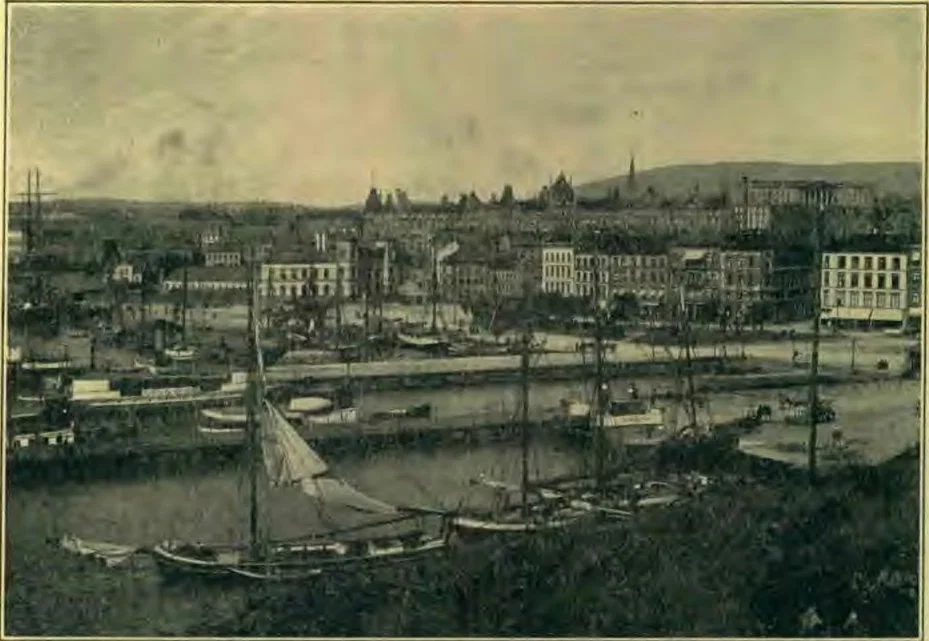
A VIEW OF CHRISTIANA, NORWAY
NORWAY in summer! No pen can describe the beauty and majesty of nature. The mountain peaks covered with eternal snow; the glaciers, formed at the time of the deluge, working their way down the mountain side toward the ocean; the beautiful fertile valleys spotted with red and white painted farmhouses; the green and flower-covered hillsides where the herd girls watch their sheep, goats, and cattle; the extensive forests where wild animals roam and the mirrorlike mountain lakes thousands of feet above sea level; the long and narrow fiords and the hundreds of islands scattered along the coast line, making a fence against the wild waves of the Atlantic,—all these add to the loveliness of the scene.
Mr. M. W. Stroup, an American traveler, says: “Persons who have gone to Switzerland once, go to Norway a score of times. Tourists who have circled the globe exclaim that other places are grand, but none excel this paradise of nature,—Europe’s Eden, where kings visit and royalty reigns.”
The Geography
Norway is not a large country. The area is estimated to be about 124,495 square miles. Most of the European countries are small in size. Norway, Italy, and England are about the same size. If we look at the map, we find that Norway is a part of the Scandinavian peninsula. Its eastern frontier is contiguous to that of Sweden and Russia. On the north, northwest, south, and southeast the boundary is the sea—the Arctic Ocean, the Norwegian Sea, the North Sea, and the Skagerak, respectively. Measured in a straight line from north to south, Norway is nearly 1,700 miles long. The extreme breadth is 270 miles, but in the north it is much less—about sixty miles on the average.
The Topography
The coast consists for the most part of bold, precipitous cliffs. It is remarkable for the vast number of islands by which it is lined, and the bays and fiords which, narrow, deep, and winding, cut into it in all directions, providing a series of excellent natural harbors of refuge.
Norway is a mountainous country. Particularly in the west and north the mountain masses assume the form of great plateaus or tablelands, and are called fjelds. In general, the valleys are short and abrupt; and the streams dash down impetuously through the rocky gorges, forming numerous cascades.
The Fauna
The great forests are still the haunts of the bear, lynx, and wolf. The elk is found in the eastern forests. The red deer is found in the west coast districts. On the high mountains roam the reindeer, glutton, lemming, and fox. Hares are very common in all parts of Norway, and the beaver is found in the Christiansand district.4The common seal is also frequently seen in the surrounding waters, and the walrus visits the northern coast. A large number of fisheries have been established along the coast where there is cod, herring, mackerel, and coalfish. Various species of whale visit the coast, and salmon, perch, pike, and eel are common in fresh-water streams. Game birds are fairly abundant in most districts. Willow grouse, woodcock, snipe, and geese are common. Sea birds are exceedingly numerous.
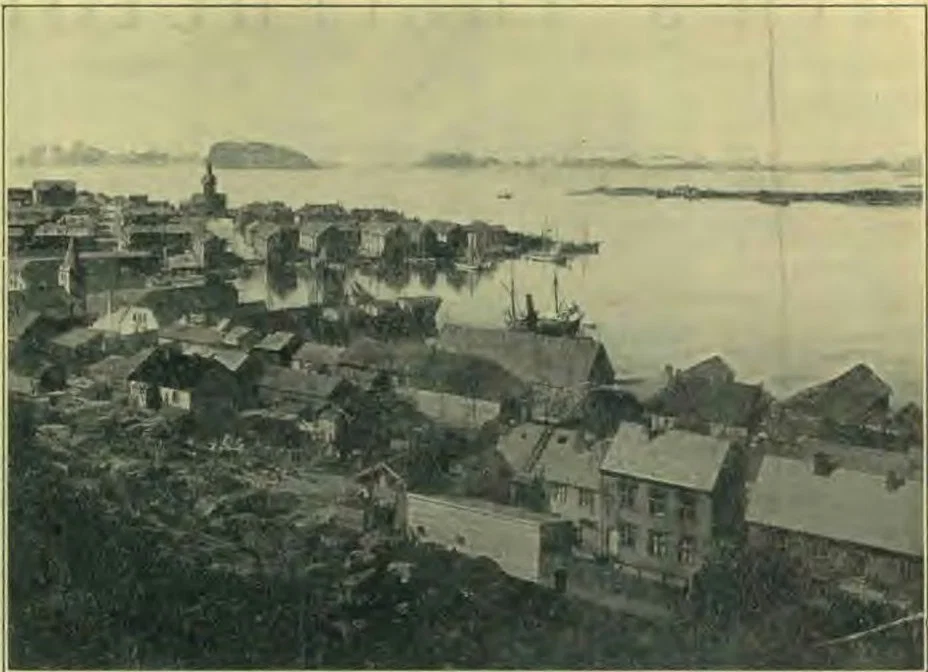
HAMMERFEST, NORWAY
Industries
The fisheries contribute mainly to the support of the inhabitants along the seaboard, as more than 100,000 people are employed in this work.
The farms are generally the property of those who cultivate them. Among the crops cultivated for food are barley, rye, wheat, and potatoes. Some hemp, flax, and tobacco are produced in the southern part. Fruit, too,—particularly the apple, pear, and cherry,—is raised in southern and central Norway. Cattle, horses, sheep, and goats are kept in large numbers.
Norway has a great mining industry. Among the minerals are silver, copper, pyrite, iron, and marble.
Lumbering is another great industry of this north country.
Before the war the mercantile navy of Norway was fifth in size as compared with other merchant marines, and her ships and sailors were found in every country.
Among the manufacturing industries we find the saw and planing mills and machine shops. There are large iron, carriage, and car works. The textile industries, such as spinning and weaving mills, jersey factories, and roperies employ thousands of workmen. Canneries and flour mills are scattered throughout the country. The potteries, china factories, and nail-rolling and wire mills have a large output. During the last few years there has been a great growth in manufacturing lines in Norway. Perhaps the greatest industry at the present time is the saltpeter factories.
Education
Free compulsory education obtains in Norway. Parents who neglect to send their children to school, either public or private, are fined. The subjects taught at the primary schools are reading, writing, religion, geography, natural science, history, arithmetic, singing grammar, drawing, and gymnastics. In the cities the young people flock to the high schools, and many speak English and German as well as their own language. The university, located at Christiana, is fully modern in every respect.
Renowned Men
Norway has produced many renowned men. In literature we have the names of Björnson and Ibsen. In music we have Edvard Grieg and Ole Bull. Every one has heard about Fridtjof Nansen and Roald Amundsen, who discovered the South Pole.
Religion
Norway remained a heathen country until about 1000 A. D. Then the people were forced to accept the Catholic religion, and Norway was a Catholic country for five hundred years. During the Reformation the country became Lutheran, and this is still the religion of the state church. It is a curious fact that the Scandinavian countries have been among the last to grant religious liberty, and full rights are not yet extended freely to all denominations. Public offices are open only to Lutherans. There are probably few countries in Europe where the ministers have so great an influence in the administration of affairs as in Norway. The Norwegians are a church-going people, but their adherence to churchgoing is mostly a ceremony. Most of the priests attend theaters and dances, and smoke and drink.
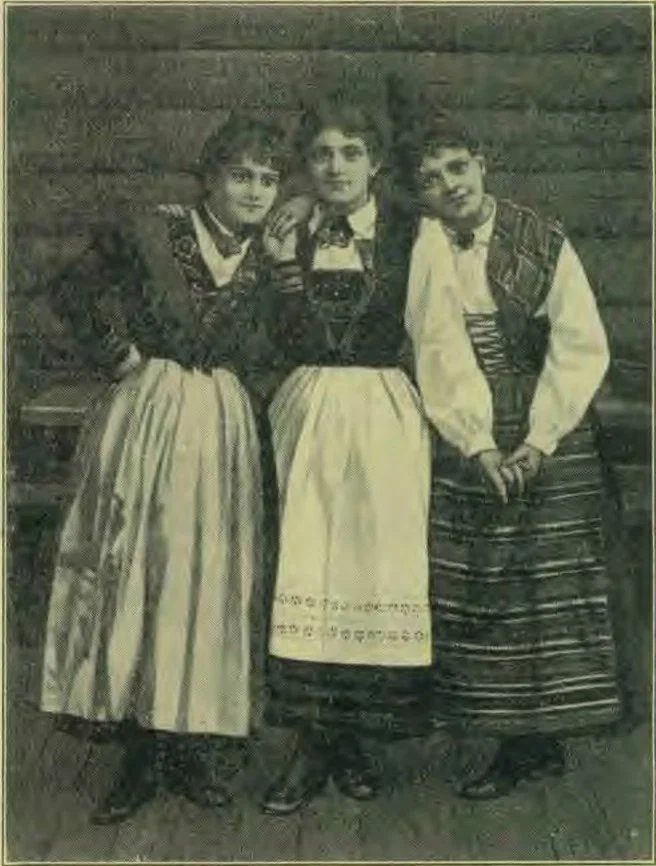
A TRIO OF NORWEGIAN GIRLS
Elder J. G. Matteson was the first Seventh-day Adventist missionary to Norway. At first he met5much opposition, but finally a good work was started in Christiana, and a church organized. We now have three local conferences in Norway, with a total membership of about one thousand. There are also four or five treatment-rooms and one printing house.
Alone with Jesus
By W. F. Strickland
W. F. STRICKLAND
Just to be alone with Jesus!
Just to follow where he leads,
Just to tell him all my heartaches,
Just to tell him all my needs!
There I long to hold communion,—
Sweet communion with my Lord;
There to meet in grand reunion,—
There to dwell in sweet accord.
O, to be alone with Jesus!
Just to hear him speak to me:
“Come, my son, and heed my calling
Evermore my child to be.”
Just to be alone with Jesus,
Free from sin and all its harms,
Just to rest in peace and comfort
In his everlasting arms!
There, within that secret chamber,
Sheltered safely from the foe,
I can tell him all my heartaches,
And he’ll hear me—this I know.
Then, dear Saviour, give me power
All my sins to cast on thee:
Keep me, guide me every hour,
Throughout all eternity.
Sounds of China
By H. O. Swartout
The strange sounds are one of the first things noticed by the new arrival in China. Every place has its peculiar sounds. A city is called a “hive of industry” because of its hum as much as because of its activity. The peculiar sounds of the countryside have given birth to the expression, “Farmyard chorus.” But those living in America or other Western lands have become so accustomed to the characteristic sounds of their localities that they pay little attention to them. It requires a change of environment, such as a trip to China, to arouse a person to the notice of sounds.
The Coolies’ Chant
On the day we landed in China, our trunks and boxes reached the mission compound in Shanghai just before dusk.
As they were being carried from the carts to our rooms, we first heard one of China’s characteristic sounds—the chant of the coolies while engaged in heavy work. Coolies’ chants are of great variety and very hard to describe, but some of the more common are something like the following: “Heigh-ho, ho-hah, heigh-ho, ho-hah;” or else, “Heigh-hah, high-hee, heigh-hah, high-hee,” repeated over and over with a peculiar tune and rhythm like nothing Westerners ever hear at home.
Though it was in Shanghai that we first heard the coolies’ chant, yet Shanghai is an international port with foreigners in control. So a great many noises have been suppressed as public nuisances and others have come in as a result of foreign industries. One must get outside that city if he wishes to hear many sounds that are distinctly Chinese. Doubtless every section of China has its own peculiar sounds. The writer’s residence in interior China consisted of only a few months at Nanking, hence the sounds spoken of in this chapter may be somewhat peculiar to that place.
Bugling at the Barracks
The first night of our stay in Nanking, and many nights after, we were awakened at about three o’clock in the morning by the bugling at the various barracks. There were thirty thousand troops in the city at the time. However short they may have been of guns and ammunition,—they never fired a shot in seven months,—they had their full equipment of bugles. The post of bugler seemed most enviable to the Chinese soldiers. Every time a regular bugler went out to give a call, a troop of aspirants followed him, borrowing his bugle to practise on by turns for the next hour or two. The combined effect of a few dozen such amateurs practising in various directions at the same time was hardly conducive to sleep. They must have expected appointment to the coveted post when they were proficient, for they would hardly keep up practice so long just for the fun of making a noise.
Squeaks of Wheelbarrow and Pig
Two common sounds in Nanking are hard to distinguish. One is the squeaking of the trains of wheelbarrows, and the other is the squealing of the droves of pigs on the way to market. The wheelbarrow wheels are never greased. One man said that the squeaking wheels are of real use,—they tell the employer whether his coolies are working or standing still; but this man couldn’t think of any use for the squealing of the pigs.
The Blind Beggar’s Hammer
Another common sound is a clear, sharp ting-ng-ng, ting-ng-ng, caused by the blow of a little hammer on a three- or four-inch disk of steel, hanging from the wrist of a blind man. When one hears this sound, he knows that a blind musician beggar is coming. His instrument is something like a banjo with a very small head and a very long neck. He will play and sing a long time for two or three coppers, but people usually give him the money without asking for the “music.”
The Vender’s Drum
There is a frequent rubadub, rubadub, just like a drum, which in truth it is. But the drum is a small one with a long wooden handle, which makes it look more like a covered saucepan than a drum. There is no drumstick, but a little beater hanging by a string from one edge of the drum strikes one side and then the other as the handle is given a rapid quarter turn to the right and then to the left. This sound announces the approach of a man carrying two little cupboards slung to the ends of a pole over his shoulder. The cupboards hold his stock in trade,—pins, needles, thimbles, thread, chopsticks, combs, and many other small household necessities. If one wishes to buy any of his goods, he may go out and call the vender into the yard or bargain with him on the street.
The Candy Peddler’s Announcement
A noise the children like to hear is the clump, clump, clump of a small club striking against a resonant wooden block. This block has had holes bored through it, one near each end, the wood between the holes being chiseled out, thus making a long slit. The noise made by striking this block is the sign of the candy peddler. His candy is about like a mixture of glucose taffy and flour, but the children are very fond of it.
The Tinker’s Clink Clink
Still another business sound is that of the tinker. He takes several strips of thin iron, about an inch and a half wide by eight inches long, punches a hole in the end of each strip, and strings them loosely on a wire. A bunch of these strips hangs from each end of his carrying pole. As he walks with a peculiar swaying gait, these iron strips swing about and strike against one another with a rhythmic clink, clink, clash, clash, that tells the housewives to bring out their old pans and kettles to be mended; or seems to say:
“Locks repaired, and keys made,
Or anything else in the tinker’s trade.”
Sometimes one hears what he might think to be his neighbor’s small son lustily beating a tin pan. This is the vender of tin buckets, dustpans, and various6other household articles which are made from the empty five-gallon oil tins which are so common everywhere in the East. The vender strikes his wares with a bamboo stick to let people know he is coming.
The Gambler’s Tin Can
When one hears a sound as if somebody were pouring a spoonful of shot into an empty tin can, he is made to think of the Chinese love for gambling. The sound comes from a handful of little bamboo slips being dropped into a tin can or a joint of bamboo. The man running the business has a few cakes or trinkets for prizes. For a copper a person may shake up the sticks and draw out a few. All the slips have numbers or characters written on them. The prize drawn is figured out from the combination of the numbers or characters. Though most of the prizes are practically worthless, still it is possible to draw a prize worth a dime by the expenditure of a copper, so the rattle of the sticks always draws trade.
Many of China’s most familiar sounds are connected with the worship of ancestors and idols. No description of Chinese sounds is complete without mentioning these; but we shall leave them for another chapter.
Miscellaneous Sounds
The medley of sounds on a Chinese street may contain all the peculiar sounds already mentioned,—and more. There is sure to be a babel of the vocal cries of numerous hawkers and small tradesmen. Mingled with these will be the growling and barking of dogs, the cackling of chickens, the quacking of ducks, and the shouting and crying of children. Often there is the screaming and reviling of angry men and women. The confusion is tiresome and meaningless—sometimes terrifying—to the newcomer; but the sounds are so characteristic that after a few months one can walk along the street with his eyes shut and tell what is happening. H. O. SWARTOUT.
Miscellaneous Items
By An Interested Reader
SOMETIMES it seems that real courtesy will soon have become an obsolete virtue. Young men, especially, appear to lack that graciousness and charm of manner toward the opposite sex which is a distinctive mark of good breeding. Perhaps this is not entirely a denominational shortcoming, but at any rate a large percentage of Seventh-day Adventist young people are among these offenders against the laws of good form, as relates to courtesies of today between men and women. A few concrete suggestions may be helpful to those who either consciously or unconsciously have become the victims of this unfortunate situation. “A word to the wise is sufficient.”
Which Speaks First?
Since custom gives to a woman the privilege of discontinuing the acquaintance of any man when she wishes, it is expected that she will be the first to bow when they meet on the street. While a lady does not speak to any man to whom she has not been introduced, except to acknowledge a courtesy, a gentleman must bow to any woman who recognizes him. And he always lifts his hat.
Escorting
A courteous man wishing to escort a woman anywhere always asks her permission to do so, and calls for her at an appointed time. He does not wait for her along the road, and never asks her to meet him at the door of the church or lecture hall unless they are very well acquainted and he is forced to do so by extenuating circumstances. He follows her up the aisle to a seat if an usher is on duty, but precedes her if there is no usher. He sits with her during the service or entertainment, and attends her to the door of her home or rooming house, leaving only when the door is open and she is ready to enter.
The independent spirit of our age has changed the old-time feeling that a respectable young woman will not go abroad after nightfall without a gentleman escort. Girls would be deprived of many an evening’s pleasure if they were required to adhere to this custom. The average young woman, of course, usually prefers to go out in the company of a congenial escort; but when she does venture to some gathering unattended, she does not appreciate having to run the gantlet of a row of young men as she starts for home, any one of whom is likely to join her without so much as lifting his hat, or asking, “May I?” If a gentleman wishes to escort a friend or an acquaintance home whom he did not accompany to the gathering, he should ask her quietly, as the company breaks up for farewells, if he may have this pleasure; meet her at the foot of the stairs as she comes from the dressing-room, and thus relieve her of the embarrassment of wondering whether she must go home alone or with some young man whose company she would certainly decline if given the opportunity.
And another thing: Men always take the initiative in this matter of escorting. This may seem a superfluous suggestion, but a young man was recently surprised to receive a call from a feminine acquaintance, and her purpose in coming was to ask him to take her to an evening entertainment. Much embarrassed, he declined the honor; but she was insistent, and finally he was obliged to choose the alternative of escorting her or staying at home himself. Some young men may be considered “slow,” but any one of them can screw his courage up to the point of asking for the company of a lady whose society he really desires.
No well-bred young man ever invites two ladies to accompany him on the same expedition, unless one be a relative. It is always embarrassing for some one, even though the escort may be grasping the opportunity for reflection and comparison.
The Matter of Tickets
When tickets are necessary for entrance to a gathering, it is always the man’s duty to provide them. The woman does not ordinarily take any responsibility in this matter, though recently an incident came to our attention of a young woman who, wishing to attend a certain musicale, purchased not only her own ticket, but also one for her escort. These same young people attended another entertainment together, but this time the young man provided his own ticket, and only his own. Do not consider this an isolated case. To our certain knowledge it has occurred in the experience of other supposedly well-bred young people.
On a Pleasure Trip
When a picnic or an afternoon excursion is planned, the providing of the lunch is usually left to the young woman; but it is perfectly proper and acceptable for the man to offer to contribute fruit, candy, or some similar part of the repast. He always provides for their transportation in any event, or he always should,—yet we have known this item to be neglected.7
Calls
It is not ordinarily considered good form for a young woman to invite a man to call. He should request this privilege for himself. However, it is proper for a young woman’s mother or an older member of the family to give such an invitation.
On the Street
A gentleman seeks never to detain a lady on the street. If he wishes to speak with her, he turns and accompanies her while stating his errand, first, of course, obtaining her permission to do so.
Letters
In the matter of the exchange of letters the man always takes the initiative. He asks the privilege of writing to the woman, and requests the favor of her reply. She never writes first except in case she is leaving town and is not able to give her future address. Then, too, it is the woman’s privilege to discontinue the correspondence when she wishes, and no gentleman will be insistent in his literary attentions.
Presents
The free exchange of gifts between young men and women is not appropriate. Occasional flowers, a box of candy, or a new book may be accepted from a gentleman, but the woman is under no obligation whatever to return these favors. They merely show that her friend is appreciative of her society.
Photographs
Young men and women should be extremely conservative in the exchange of photographs. It is not good taste to offer your likeness to any except intimate friends. Girls cannot be too careful about giving their pictures to men, even when they are requested. Some young men collect such photographs for what they style a “Goose Gallery.”
On the Street Car
A gentleman on a crowded street car always surrenders his seat when women are obliged to stand. Custom does not demand this, but true courtesy does. A lady will never accept this favor without a gracious word of thanks.
“Spooning”
And in conclusion—don’t “spoon” on the street. There are proper times and places for the expression of true sentiment, but a public exhibition is hard on your own reputation, and amusing as well as disgusting to the enforced audience.
AN INTERESTED READER.
What Is She?
She is the strangest of all mothers. She does not hatch her eggs, give birth to her young, or drop her eggs in the water, as do others of her kind.
She lays her eggs, about one hundred at a time, and with the help of the father they are spread over her back. A rough skin covers her back in which are exaggerated pores, or tiny holes. Into these the eggs sink.
For a length of time she hops about, going more and more slowly, but eating voraciously that in some way the young may get food.
One fine day the work is done, and the little ones crawl out of the holes, full formed.
She is a member of a very common family, and one may meet her cousins any day. She is a ———.
HAZEL L. HANSEN.
The Electric Woman
While this exercise may not meet the highest standard of English and ethics, it will help a person to familiarize himself with electrical terms, and is a simple brain exercise of some merit. The counsel for the sixth line is found in the word “transformer.” In like manner find an electrical term that will complete the sense of each of the following clauses:
When she talks too long —
If her way of thinking is not yours —
If she is willing to come halfway —
If she wants to go farther —
If she wants to go still farther —
If she wants to be an angel —
When she is sulky and will not speak —
If she gets too excited —
If she proves your fears are wrong —
If she wants chocolates —
If she sings false —
If she is in the country —
If she is a poor cook —
If she eats too much —
If she is wrong —
If she is cold to you —
If she gossips too much —
If she fumes and sputters —
If she becomes upset —
Prohibition Notes
PEOPLE who have been planning to brew and distil their own liquors after the National Prohibition laws become operative, will be disappointed to learn that according to J. H. Callan, acting commissioner of internal revenue, all who do this will be considered illicit distillers. Penalty for such a disregard of the law is forfeiture of all apparatus and a “fine of not less than $500 or more than $5,000, and imprisonment of not less than six months or more than three years.”
The selectmen of Whitinsville, Massachusetts, have voted not to grant liquor licenses, despite the fact that the citizens of the town apparently voted for license for the first time in its history.
The question of what national prohibition will do to the Keeley Institute has been answered by an official of the institution in the observation that a strict enforcement of the law will mean the closing of their business and disposal of the property. But they are not concerned about this. For years this philanthropic institution has been carrying on the work of the reconstruction of hopeless drunkards. Its officials are therefore glad to have prohibition come, though it means the closing of their institution.
The Missouri Legislature defines “intoxicating liquor as any distilled, malt, spirituous, vinous, fermented, or alcoholic liquids, whether proprietary, patented or not, which contain one half of one per cent of alcohol by volume and which are potable or capable of being used as a beverage.”
The Rhode Island Legislature has adopted a bill declaring beer containing not more than four per cent of alcohol a nonintoxicant. Poor Rhody does not yet see clearly.