SIR HENRY RAWLINSON, who found in the Behistun group of inscriptions the key to the ancient Babylonian and Assyrian languages, was not content to use his important discovery in translating the findings of others, but he himself took part in excavation work.
Critics of the Bible had long taken occasion to discredit the Bible record concerning Belshazzar, since there was no such name to be found in all “Chaldean or other ancient history,—nor indeed in all literature,—although there existed an apparently complete list of the Babylonian kings, leaving no gap for the insertion of any other. And, to make matters worse, this list gave the name of the king—Nabonidus—who was actually reigning at the very time when the Bible account claimed that Belshazzar was king.
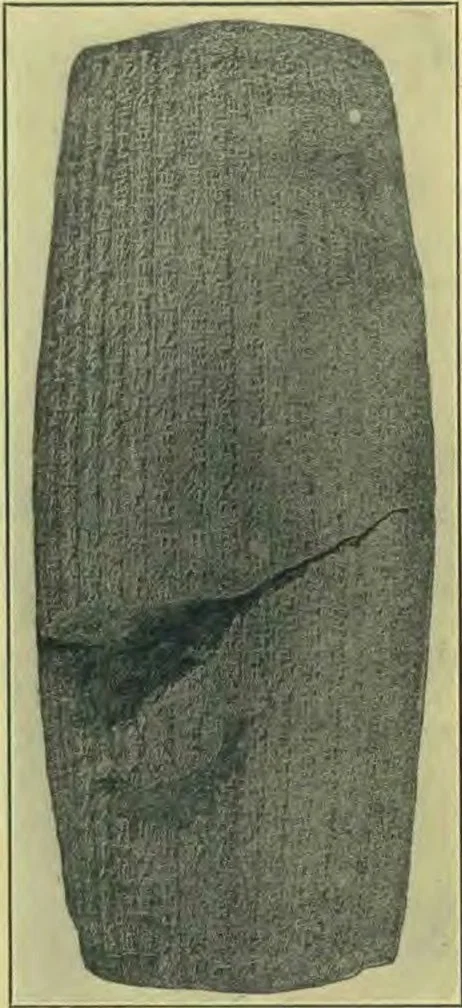
“But here again time and the spade did their work well. In 1854 Sir Henry Rawlinson discovered in ‘Ur of the Chaldees’ some terra-cotta cylinders containing an inscription by the above-named Nabonidus, in which he makes mention of ‘Belshazzar, my eldest son.’ This proved two things: (1) That there was a man named Belshazzar, and (2) that, being the son of Nabonidus, he lived in Babylon at the very time Daniel said he did. But there still remained this difficulty—how could he be king of the Chaldeans, while every ancient record showed that his father, Nabonidus, was the last reigning monarch?”
“A little more time and a little more spade, and the seeming contradiction was all cleared up, confirming to the letter this lonely Scripture record.”
Cyrus's Own Account of the Taking of Babylon
“In 1876 Sir Henry Rawlinson made one of the most remarkable discoveries ever known up to that time. His workmen were excavating on an ancient part of Babylon when they came upon some jars filled with more than two thousand cuneiform tablets; i. e., tablets bearing inscriptions in the wedge-shaped characters of ancient Babylonia and Persia. One of these was found to contain an official account, by no less a personage than Cyrus, king of Persia, of the invasion of Babylon, in which, after stating that Nabonidus first fled and then was taken prisoner, he adds that on a certain ‘night . . . the king died.’ Now, seeing that Nabonidus, who was taken prisoner, lived for a considerable time after the fall of Babylon, this ‘king’ could have been none other than Belshazzar, of whom the old discredited Bible recorded long ago that ‘in that night was Belshazzar the king of the Chaldeans slain.’ Dan. 5:30.
“It is now evident that Belshazzar was acting as regent during his father’s absence—indeed, he is actually referred to as king in another ancient inscription of a legal document, which is dated in the third year of King Belshazzar, only the name is spelled in a slightly different way.
“Moreover, the fact which has thus come to light, that Nabonidus and Belshazzar his son were both reigning at the same time, explains, as nothing else could, Belshazzar’s offer to make Daniel the third ruler in the kingdom (Verse 16), Nabonidus being the first, and Belshazzar, the regent, the second; otherwise Daniel would doubtless have been made second ruler, as Pharaoh made Joseph.
“This is another case in which two apparently contradictory accounts were both equally correct. The Chaldean historian was correct in saying that Nabonidus was king, while the old Bible was equally accurate in saying that Belshazzar was king.”
It is interesting to note in this connection that the Lord, in speaking of Nebuchadnezzar in Jeremiah 27:7, says: “All nations shall serve him, and his son, and his son’s son, until the very time of his land come: and then many nations and great kings shall serve themselves of him.”
A clay cylinder written by Cyrus giving an account of the taking of Babylon, and one by Nabonidus, the reigning and vanquished king, have been found. These two agree with the Bible record in the statement that Cyrus took the city easily.
Palestine Excavations
Explorers in Palestine have found at Samaria what is believed to be the remains of the royal palace of Omri (1 Kings 16:24), father of Ahab, king of Israel. Above this were the ruins of a larger palace, the walls of which were faced with white marble. This is believed to have been Ahab’s ivory palace. The ancient cities of Lachish, Bethshemesh, Megiddo, Taanach, and Jericho have been excavated. At Megiddo the excavators brought to light seven different strata, each revealing a different period of the city’s history. Dr. George Barton says:
“In the lowest stratum of the mound Dr. Shumacher found traces of a settlement the houses of which were constructed of mud bricks. Over the ruins of these a second series of houses had been built of stone. In the same stratum some tombs were found containing skeletons, some pottery of early forms, a bronze knife, and some scarabs set in gold. The walls of the city were in part built of brick. The settlement represented by this stratum antedated 2000 B. C.
“In the next stratum a large structure, probably a palace, was found, which had been occupied through the periods represented by the stratum in which its foundations were laid and the stratum next above it. The building was of stone and was large. In one part of it was a ‘pillar’ apparently used for worship. Various types of pottery, knives of flint and bronze, many stone household utensils, an Astarte figure, and some scarabs of the period of the twelfth Egyptian dynasty were found. This stratum, then, belonged to the period 2000-1800 B. C.
“Next above this stratum was one in which types of painted pottery similar to that of the Philistines came to light. In the fifth stratum from the bottom a palace of the Hebrew9period was discovered. In this palace a seal was found bearing a lion and the inscription ‘belonging to Shema, the servant of Jeroboam.’ It is impossible to tell whether the Jeroboam who was Shema’s master was Jeroboam I or Jeroboam II. In this same stratum a temple was found containing three ‘pillars.’ “In another part of the mound in a sixth stratum, which seemed to be late Hebrew, three ‘pillars’ were found in an open space near the south gate, a stone religious emblem, and a decorated incense burner. Elsewhere this sixth stratum yielded a blacksmith’s shop. In a seventh stratum, just under the soil, remains of the Greek period were found, among which was an Athenian coin. This was the last occupation of the tell, and was pre-Christian. At the beginning of the Roman period the town was moved from the high land of the mound down nearer the water supply. On the slope of the hill a native-rock altar was found which had been used in prehistoric times.”
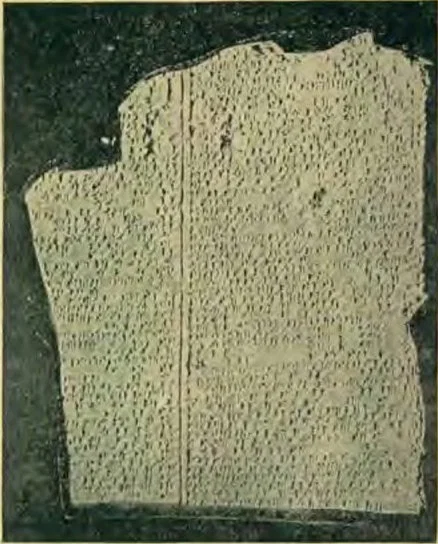
A Deluge Tablet, found in library of Assurbanipal, King of Syria
At what is supposed to be the site of Capernaum the explorers found the remains of a once beautiful synagogue which was probably built in the fourth century after Christ. Beneath it is the floor of an older building, which some have thought to be the synagogue built by the centurion whose servant Jesus healed, and which Jesus so often visited.
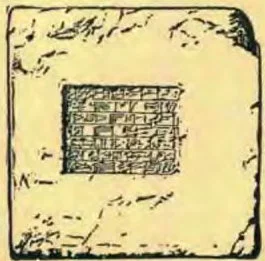
Brick Stamped with Nebuchadnezzar's Name
Revelations Made by the Nineveh Tablets
Dr. Edgar J. Banks in his little book, “The Bible and the Spade,” makes some interesting observations on the points given to us by these ancient tablets. He says:
“That the Babylonians possessed the story of the garden of Eden, similar to the Biblical story, is certain; a few fragments from the Nineveh library, so small and mutilated that they are almost illegible, are supposed to be a part of a tablet recording it. However, during the excavations at Nineveh, there appeared an impression of an ancient seal distinctly referring to the story. In the center of the little picture is a date tree; to the right of the tree is a man; to the left a woman, and behind the woman is a serpent standing erect on its tail. It is possible that in some Babylonian ruin a tablet containing the complete story may be found.”
“In the year 1872, after the tablets from the Nineveh library had been taken to the British Museum, George Smith, who in his day was the greatest of Assyrian scholars, took up the fragment of a broken tablet and read these words:
“‘I released a dove; it flew about, but finding no resting place, returned.’
“They were familiar words, and so significant that their appearance on the little fragment of clay overcame Mr. Smith; he recognized all that the words meant, and fell senseless to the floor. He had discovered a Babylonian story of the flood!
“The discovery was heralded throughout the world, and at once a London paper, the Daily Telegraph, provided funds to send Mr. Smith to Nineveh in search of the missing fragments of the tablet. In the chamber of the palace of Assurbanipal, where the library was stored, Mr. Smith found the fragment he most desired. Since then other excavators have discovered other copies of the same story, and at last the narrative has become fairly complete.”
The Babylonian account is not intended as a historical account of the flood; but it is evident that the Assyrian poet knew the story of the flood; and in his great epic merely appropriated incidents of the flood for his imaginative story. But even this is an interesting comment on the verity of the event.
Dr. Banks says further:
“Among the tablets from the royal library at Nineveh, was a Babylonian calendar of clay, covering a month of twenty-eight days; it was a copy of a more ancient tablet, or perhaps one of a series of tablets covering the entire year. According to the calendar, on each day of the month some religious duty was required of the king or of the people. The seventh day was a day of prohibitions, bringing to mind the Puritanic Sabbath of early New England. A translation of the calendar for the seventh day is as follows:
“‘The seventh day is a sacred day; the king of the nations may not eat meat roasted by the fire, or food prepared by the fire. The clothes of his body he may not change, nor may he wear fine clothing or ride in his chariot. He may not hold court, nor may he call in a physician. At night the king should offer his sacrifices that his prayer may be acceptable.’
“Such were the Sabbath laws of Babylonia even before the time of Abraham. The calendar, it is true, was for the king’s use, yet the same or similar laws must have applied to the people.
“One peculiarity of the calendar is that it calls the seventh day limmu, a word which in itself does not mean sacred, but evil. If we should translate the first line of the calendar literally, we should read, ‘The seventh day is an evil day,’ a day when it is evil to feast, or drive, or transact business.”
The Ancient City of Gezer
Gezer was an ancient city of Palestine thirty or forty miles northwest of Jerusalem. It was a city of great military importance, and “was a wedding gift to King Solomon from the Pharaoh of Egypt.” The explorations of the archeologist here are the most extensive and thorough of any in Palestine. Merneptah, the Pharaoh of the Exodus, says of Gezer in the same tablet in which he speaks of Israel, “Gezer is taken.” Two of the Tel-el-Amarna letters were written from Gezer; and in harmony with the line in Merneptah’s tablet, there has been found at Gezer an ivory breast ornament with the figure of Merneptah upon it, which may be indicative of his invasion.
Why the High Places Were Destroyed
It was at Gezer that a row of tall stones from five to ten feet high were unearthed. These, it is thought, formed the remains of an ancient Canaanitish high place. “It seems that among the standing stones human sacrifices were offered, for in a cistern near by were the skeletons of fifteen men and of one little girl who had been sawn in two, or sacrificed to appease the wrath of the local god.
“Near the standing stones and beneath the floor of the temple were jars containing the skeletons of newly born infants, and built into the walls of many of the houses were the bodies of other infants. It seems to10have been a Canaanitish custom when a house was built, to sacrifice a child and bury its body in the walls to bring good luck to the rest of the family. As gruesome as the custom was, it still survives under various forms throughout the East, for animals are still sacrificed on similar occasions.
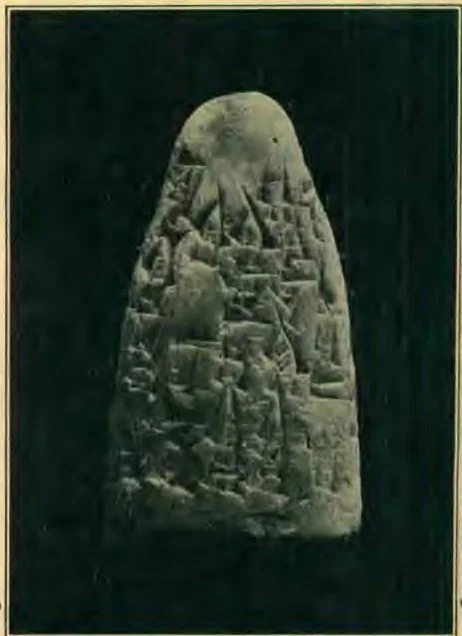
This tablet is from Warka, the Biblical Erech of Genesis 19:10. Date, about 2500 B. C.
“Thus we are beginning to learn the religious practices in which human sacrifice formed a prominent part, and to understand why the Hebrew prophets of every age so severely demanded that the high places be utterly destroyed.”
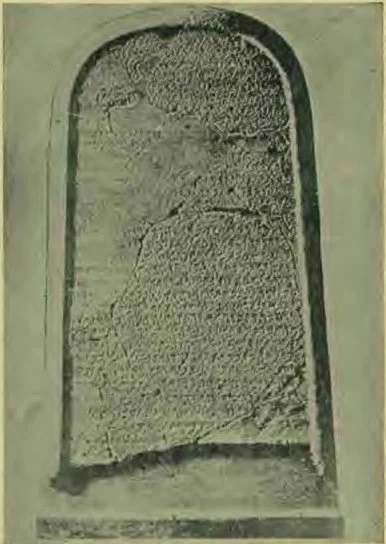
The Moabite stone — inscribed by Mesha, of Moab (2 Kings 3:4, 5). It makes reference to Omri and Ahab, of Israel.
Part of Solomon’s Temple, old wells, and many other interesting things have been found through Palestine explorers.
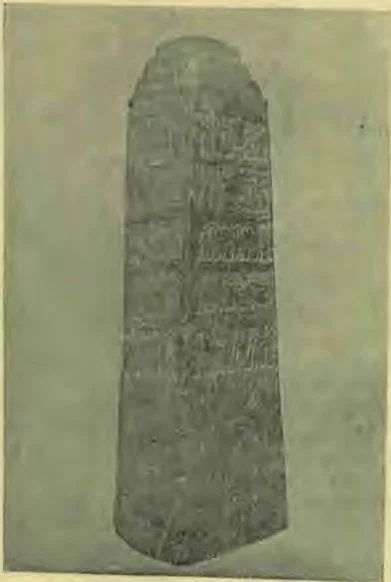
The Black Obelisk containing the name of Jehu, King of Israel
Almost every year suffices to add some interesting or remarkable bit of knowledge to the great library that has already been unearthed by the excavators and translated by the archeological linguists. May the humble spade continue its research work, until the mouth of every Bible critic is stopped. P. D. C.
The Young People's Society
By Emma Kennedy
Its Influence on the Individual Workers
WHEN I was a little girl, I lived in a country where there was a great deal of snow, and one of the principal amusements of school children was to line up on the edge of a five-acre meadow when covered with a fresh fall of snow, and see who could make the straightest line of tracks across that field. It was interesting to look back and see the difference in the paths. By their very crookedness one could pick out the paths of those who had watched their feet as they walked, while those who had kept their eyes fixed on some object at the farther side of the field, left a pathway behind them as straight as if it had been marked out.
I have been thinking that in our journey across the meadow of life the young people's society furnishes the objective points for the young Christian, its very aim causes him to look out and away from self, and gives him something to strive for; while those who go through life looking at and thinking of self will leave as crooked paths behind them as those school children did who walked across the meadow watching their feet. The young people's society, through its many departments, furnishes opportunities for the development of all our talents, and talents used are talents multiplied.
A successful life is not the result of chance or destiny, but rather the result of faith and painstaking effort. Every effort made for God and with an eye single to his glory, will react in blessings to ourselves. You know in the parable it was the man with the small gift who wrapped his talent in a napkin and left it unimproved; and did you ever think that in all the history of the church the great majority of its members are those to whom God has given but one talent, and the very weakness of the church lies in the fact that so many of us do as did the man in the parable? Because we cannot do some great thing we take that as an excuse to do nothing, forgetting that the right use of the many small gifts would be a more potent factor for good than the combined use of the few great ones; forgetting, too, that even that will be taken away from us if left unimproved, just as the physical arm would become useless if bound down and not used, and He who has apportioned the talents is equally honored by the improvement of each trust whether it be great or small. God expects returns according to that a man hath and not according to that he hath not.
Right here comes in the value of the young people's society, for every young Christian coming into the society and living up to his vow, will find little opportunity to bury his talent, but will easily and naturally drop into the place for which he is fitted; for not more surely is the place prepared for us in the new earth than is the special place designated on earth where we are to work for God, for we have been redeemed for service. Ministry is the object of life, and it is by the right use of our talents that we build our characters. A true character is the only treasure we can take with us from this world into the world to come.
We cannot attain to a character higher than our conception of a perfect character. A king once gave to his gardener and to a noted artist of his realm each ninety cents' worth of paint and canvas with the request that each paint for him a picture. The gardener, having no picture in his mind, of course could not produce one on canvas, and his effort went into the rubbish heap and was burned. The artist, with the same amount of material, produced a picture that today hangs in the Vatican at Rome. The last czar of Russia offered Pope Leo $400,000 for the picture and was refused. Ninety cents represented the value of the material in the picture; $399,999.10 the value of the picture in the artist's mind, which was reproduced on the canvas and which has enriched the world. Life is the ninety cents which the King of kings has given to each of us, but we cannot make more out of it than we see in it. If it means to us only a few years of pleasure and gain, we shall make of it a daub fit only for the fire; but by faithful performance of each duty as it comes to us, we may have such a mission as will enable us to make of it a picture that will illumine two worlds with its brightness, and that will shine as the stars forever and ever.
MRS. EMMA KENNEDY.
Being Everlastingly Careful Is Man's Nearest Approach
“BEING everlastingly careful is man’s nearest approach to infallibility.”
Kharaba
By Clarence D. Ussher
In the fall of 1899 I was transferred from my first large mission station in Harpoot to Van. On the twelve days’ horseback journey through a mountainous region I was accompanied by the usual government guard, or zaptiah. The village guestrooms in the interior of Turkey provide little more than shelter for the traveler, so I carried with me bedding, folding cot, camp chairs, lantern, and provisions.
One day we were fifteen hours in the saddle. There was a cold October rain, and when the sun set it became so dark that I could not see my hand six inches from my face. The only way in which I could follow my guide (a zaptiah) was by laying my hand on his horse’s flank as he rode along in the darkness.
Suddenly I felt the zaptiah’s horse drop away, and, fearing something serious had happened, halted Nedjib. However, I heard the rattling of stones as the other horse walked on, so followed, down a gully, through a small stream, and up the other side, and I heard the zaptiah dismount and grope along a wall till he found a door, on which he pounded vigorously. Soon there was a voice from within calling in Armenian, “Who is it?”
“Open!” answered my zaptiah in Turkish. Three times this dialogue was repeated; the third time the zaptiah shouted, “It is a consulos [foreigner]. Open the door and let him in.”
“Go to my neighbor; he has a better house; my house is not fit.”
“Open!!”
“My house is not fit; go to my neighbor; he has a better house.”
“Open!!!” yelled the zaptiah. Afraid to disobey longer, the man opened the door about two inches, placing his foot firmly behind it; and against the light from within we could see the profile of a villager peering into the darkness. I addressed him in Armenian: “Open the door, brother, and let us in. It is cold and wet and dark; let us in that we may spend the night.”
Surprised at hearing his own language spoken, he threw the door wide open, and stood gazing while I dismounted, approached him, and again asked for admission.
“Oh, sir,” he said, “my house is not fit. Go to my neighbor; he has a better house.”
“That does not matter. You let us in and we will make the house ‘fit,’” I replied.
With Oriental courtesy he then stepped out of the doorway, and waving his hand toward the interior, said, “Enter; the house is yours.”
We passed into a large room, the roof of which was supported by posts; in the far right-hand corner it had fallen in—the unrepaired damage of massacre times. The rain was drizzling through, making a puddle on the earthen floor; close by, a lot of poles were laid against the wall, thus forming a chicken coop; here, too, were a wooden harrow, and a plow of the kind used in the time of Vergil—little more than the forked branch of a tree. To the left was a large fireplace, and an immense copper pot, in which was stewing something that emitted a very offensive odor. A small jirak, or native lamp, made of a piece of clay which had been flattened and the edges turned up and then burned in the fire, was on the shelf over the fireplace. A dip wick hanging over its rim emitted a smoke that made us cough. Everything was black with smut. In the far corner to the left were some large grain pots the height of a man, and a pile of dried manure used for fuel.
“You see, sir; I said my house was not fit,” said my host.
“Never mind, we will make it fit,” I again replied, and calling my muleteers, I had them remove the farm implements and carry the foul-smelling pot to another part of the house. They swept the dusty earthen floor and spread my bright-colored Turkish rug at the right side of the fireplace; my folding cot bed and camp stools were set up on this; the provision box was put on the other side of the hearth, the top of it forming a table; last of all I got out my American lantern with its crystal-clear chimney, lighted it, and put it in place of the jirak, and lo, what a transformation!
These villagers were far from civilization, and had probably never before seen a lamp with a chimney. They gazed open-mouthed, then ran to the back of the house to call the women to come and see the wonderful light and the beautiful things the foreigner had brought. The women, in turn, ran out to call the neighbors, and soon there were lined up against the wall about a dozen men, picturesque in their white felt caps and colored turbans, black and gold jackets, gaudy silk shirts, and wide, straight trousers.
I invited my host to eat with me. In shocked surprise he replied: “Oh, sir! that would never do! In my house you must eat of my food; but, sir, I have nothing—nothing but a little bread and some madzoon.” (Madzoon is fermented milk.)
“Never mind,” said I; “bring your bread and madzoon, and I will eat of your food and you shall eat of mine.”
So we sat around my provision box, the zaptiah, my host, and I; and I questioned the young man about himself and his village. His name was Garabed, and the name of the village was Kharaba.
He was about twenty-seven years of age, the head of a family of twenty, his elder kinsmen having been killed in the massacre. The village church had been destroyed and its priest slain. Once a year at Easter a monk from a distant monastery would come to the village and celebrate mass. There was no school.
“Are you a friend of the Lord Jesus?” I asked him.
His jaw dropped and a stupid, far-away look came over his face as he grunted interrogatively. I repeated the question with the same result, then changed the form of it, and asked, “Is the Lord Jesus a friend of yours?”
Quick as a flash he answered, “No, sir, he could not be.”
“Why not?”
“My heart is too black. Jesus could not be a friend of mine.”
“Why is your heart too black?”
Without hesitation, but with a look of sadness and shame, he lowered his voice and replied:
“I swear and lie and steal. Jesus could not be a friend of mine.”
I urged that he was just the kind of sinner to whom Jesus wanted to be a friend; but again came the stupid, far-away look, and he did not seem to understand. Discouraged, at last I proposed that we should have family prayers before retiring. He evidently did not know what I meant, but nodded acquiescence. Anxious to have some native do the reading, I asked for a Bible, but was told there was none in the village,12and no one who could read it. I then got out my own Armenian Bible from my saddlebag and prayed to be guided as to what to read. The book opened to Revelation 3:20, and I read, “Behold, I stand at the door, and knock: if any man hear my voice, and open the door, I will come in to him, and sup with him, and he with me.”
Instantly I saw the parable. I reminded the young man how I had come to his door and knocked, and he had said to me, “Go to my neighbor; my house is not fit,” just as he was saying to Jesus, “My heart is too black.” I reminded him that I had said, “Just let me in and I will make it fit.” I had not asked him to clean up: as soon as he had said, “Enter; the house is yours,” I had had my men remove his poor belongings, sweep the floor, and bring in the handsome rug and the chairs and the wonderful light which he called the neighbors to see. “Just say the same to Jesus, ‘Come in! My heart and life are yours,’ and he will clear away all the lying and stealing and blasphemy, and make the heart a fit place for himself. He will bring in beautiful things and a wonderful light which will attract others.”
As I explained it thus, a light broke over the man’s face.
We prayed together, and then I retired, my host standing about to serve me in any way he could. As I was about to get into bed, he asked timidly, “Sir, wouldn’t you let me read that book?”
“What! Can you read?”
“When I was a boy I wanted very much to learn, so I ran away to the monastery, and the monks taught me a little. I think I could read it.”
So I marked some passages, turned down the corners of the pages, and left the book with him. I awoke at midnight to find him sitting on the carpet with the Bible on the little camp stool and the lantern hanging from the mantel shelf. He was following each word with his finger and spelling out every syllable. I slept, and awaked at two o’clock, and he was still poring over the book, just then spelling out John 3:16: “God so loved the world, that he gave his only begotten Son, that whosoever believeth in him should not perish, but have everlasting life.” I slept again, and when I rose at four o’clock he was still reading, and there was a light on his face which was not the light of the lantern.
When I left that morning I offered him money for the accommodation of the night, but he would not accept it. As I was putting the Bible in my saddlebag, he asked me if I would give it to him. Since it was the only one I had with me, and I might need it somewhere else on the road, I promised to send him another copy. This I secured the next day in Mush from a colporteur of the American Bible Society.
Garabed died three years later of cholera, but he left his mark on the life of the village. I found there, when I passed through in August, 1914, a school and a church, the fruit of that night’s experience, and a neat, two-story house was standing where the dingy, ruined hovel had been.—Clarence D. Ussher, in “Before Governors and Kings.”