The Youth’s Instructor, Vol. 34, No. 39.

FLIGHT OF THE SWALLOWS

The Youth’s Instructor

Sep 29, 1886

S. D. A. Publishing Association · Battle Creek, Mich. · Sep 29, 1886

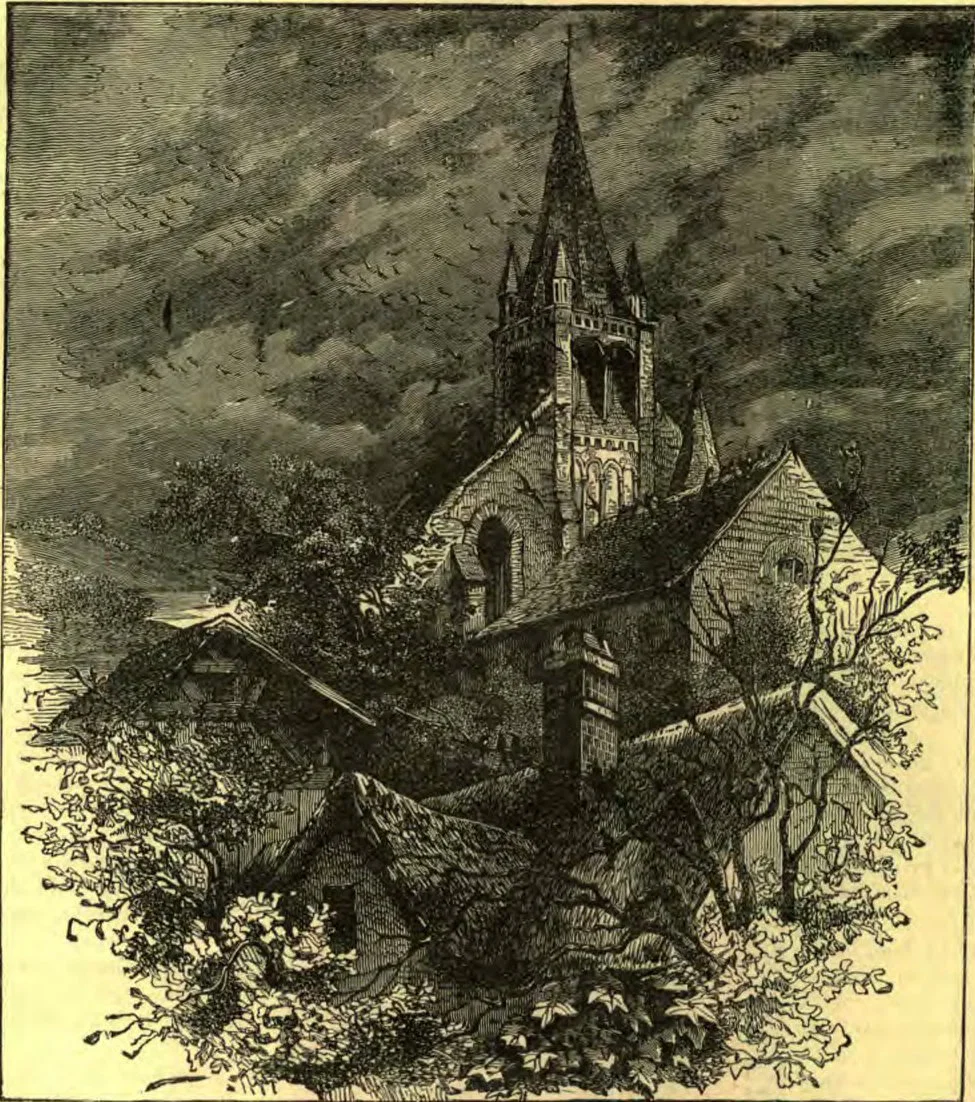
FLIGHT OF THE SWALLOWS.

Gay birds of summer! you we hail, While coming from beyond the sea, When flowers adorn the dewy vale, And blossoms hang upon the tree.
Ye love the spots where ye were reared, Where first ye stretched abroad your wings; These places seem to you endeared, Amid your many journeyings.
And there your little nests ye build, And nurse with care your tender brood; And skimming o'er the lake and field, Procure for them their daily food.
Oft have I marked your rapid flight, Ye happy birds! on sunny days, When earth was beautiful and bright, And warblers poured their sweetest lays.
And I have wished that I could fly With you afar, when winter lowers, To bask beneath a cloudless sky, Or roam among the myrtle bowers.
And I have wished to find a nest, Where, undisturbed by care or strife, In calm seclusion I might rest, And pass the sunny hours of life:— Where I might dwell, till o'er my head Age stretched its deepening clouds of gloom, And then my wings I'd heavenward spread, To seek a land of bliss and bloom.
Gay birds! ye visit us when bright The summer sun in glory shines; But from our fields ye take your flight When autumn day by day declines.
And so, like you, we often find That those, in fortune's golden day, Who seemed companions, loving, kind, When storms arise will haste away.
—Anon.

CLEAN HANDS.

THE Laroom children were gathered around their mother in the dining-room. The sun shone brightly across the carpet. Jip, the canary, whistled merrily in his cage, and Nig, the tiny terrier, was in his gayest mood; but neither the sun’s shining, Jip’s singing, nor Nig’s frisking could drive the shadows from the sober faces gathered in the room. First, after the mother, was Noll, a stout boy of sixteen; then Lucy, with sweet, fair face; then jolly, dark-eyed Rob; and lastly, little Grace, sitting in mamma’s lap, wiping the tears from her cheeks, while they brimmed in her own blue eyes.
“There’s only one thing to be done, mamma,” said Noll, “you have a little property; and if every thing else of papa’s belongs to his creditors, I don’t, and I’ll take care of the family.”
“I’ll help,” said Rob.
Mrs. Laroom looked at her boys, and really the sunshine, or something, did brighten up the room wonderfully.
“Of course, every thing will be sold, and we shall be obliged to move from here,” continued Noll, “so I’ll start right away and see what can be done.”
“Look in the Herald first,” said Mrs. Laroom, handing the paper to Noll.
“Why,” said he, glancing eagerly down a column, “Mr. Rand wants an under book-keeper. I think I could do that well. Father used to say I was as quick and accurate as Peterson, and every one said he was a good book-keeper.”
Noll went out hopefully to find Mr. Rand. The gentleman was acquainted with the Laroom family, and knowing of the death of Mr. Laroom and of his business entanglements, would gladly have given the place to Noll, but it was already promised to one of Noll’s classmates.
“Have you any thing else that I could do?” inquired Noll, at last.
“Nothing that a boy brought up as you have been would do,” said Mr. Rand.
“Tell me what it is and see,” said Noll.
“Well,” said the gentleman, “the engineer would like some one to ‘fire,’ clean machinery, move coal, and so on; but it’s a dirty job.”
“Will you keep the place for me a few days till I try for something better?” said the boy. “I’ve no great fancy for coal-dust and gudgeons, but I’ve a family to take care of, and must do as I can.”
“The place shall be ready for you any time during the week,” said Mr. Rand; “but I hope you will find something better.”
For a week Noll carefully watched the papers, and went from place to place without losing courage, but at the end of the time had not succeeded in finding any thing better than the work in the engine-room; accordingly, he entered on his duties there. Dirty and monotonous, indeed, the work proved to one unaccustomed to such surroundings, or to labor; but the hardest of all was when, dingy and grimy, he came from his work and met his old classmates, the assistant book-keeper, well dressed, neat and jaunty, and was passed with a cool stare or a mocking jest at his discolored hands.
“Please read that again, mother,” said Noll one morning at prayers; and the mother read slowly from the Bible, “The righteous, also, shall hold on his way, and he that hath clean hands shall be stronger and stronger.”
Noll kept thinking of the verse all day, and it greatly helped and cheered him. “Strange that mother should read that this morning,” he said to himself, “when I was so discouraged, thinking that I never could be any body in all this dust and blackness, and my hands can be just as white and clean before God as a baby’s if I choose to have them so. That’s worth trying for.”
“The most faithful, trusty boy I ever knew,” was the report Mr. Rand had of Noll when, at the end of seven months, he sent for the engineer and inquired of him concerning the boy.
“Ah,” said Mr. Rand, “send him up to the office as soon as he is at liberty.”
“So, Noll, wondering a little at the summons, came up from the engine-room with his face darkened by coal-dust and a smutty hand holding his cap, and stood quietly waiting at the side of his employer’s desk.”
Mr. Rand turned, and looking Noll over sharply, said, “My boy, I have a good report of you, and as the place for which you first applied is now vacant, you can have it; that is, if you have not become so attached to coal-dust and gudgeons as to prefer them to the office.”
“O, no, sir, thank you,” said Noll. “I shall like the other place so much if you think I can fill it to satisfy you. I do not like the coal-dust, and never should.”
“Yet you did the work well,” said Mr. Rand, and ‘he that is faithful in least,’ you know, is apt to be faithful in much, so I’ve no great fears of you; and, Noll, there’s another text I’ve been thinking of as you stood there (a merry little gleam shone in his eyes as he spoke); “you’ll do well to remember that ‘he that hath clean hands shall be stronger and stronger.’”
Noll flushed a little as he thought to himself, “I wonder if Mr. Rand has been reading my thoughts all the time I have been in his employ, and knows how hard I have been trying, however soiled my hands might appear to every one else, to keep them clean before God.”
Mr. Rand had not been reading the boy’s thoughts, but he had seen his faithfulness and honesty in doing disagreeable work, and the sight of those young hands darkened by the dust and drudgery of the engine-room, yet clean from deceitfulness and shirking, had brought the verse to his mind.—S. S. Classmate.

THE VEGETABLE KINGDOM OF AUSTRALIA.

While Australia grows a great variety of plants, few of them are strictly native; and although peaches, plums, pears, apricots, cherries, apples, etc., grow luxuriantly here, this is only their adopted land. Some of the productions of the country, however, are natives of no other part of the globe. Only on the northern and north-eastern coasts does the native vegetation resemble that of other countries. There the numerous palms and other plants are similar to those grown in most tropical countries.
Before coming to this country, we had heard much of a native cherry which was said to grow its stone on the outside. We made many inquiries of native Australians about the matter, but for a long time were able to gain little or no satisfaction. At last, being in the vicinity where the reputed curiosity was to be found, we learned that its shape resembled the yew berry, but that in taste it was much inferior; also that it has a hard seed which, curiously enough, grows on the stem near the fruit. This seed has been fancifully styled the stone. Some may eat the fruit, but it is insipid and unpalatable, and is hardly known outside of the localities where it grows.
There is a tree found in this country which, at first sight, one might suppose to be laden with tempting fruit; but on approaching near enough to pluck the pear-shaped production, his curiosity changes to disappointment; for upon examination, what he supposed was fruit proves to be a hard, woody substance in which is incased the seed vessels of the tree. Another curious thing is the fact that this seed protector is attached to the stem by its broader end, and so, a little way off, looks for all the world, just like a pear attached to the tree by the wrong end.
And thus, at the antipodes, things seem to go by contrasts. An English observer has said of this place: “It is a strange country of anomalies, where it is summer at the same time it is winter in Europe, and vice versa; where the barometer rises before bad weather, and falls before good; where the north is the hot wind, and the south is the cold; where the swans are black, and the eagles are white; where the mole lays eggs, and has a duck’s bill; where there is a bird with a broom in its mouth instead of a tongue.” Just how far these words are true concerning this land, we are not able to state, not having had opportunity for personal observation on all these points. One thing is certain: that in many ways, Nature here seems to almost outdo herself in her strange productions. We will speak more at length on this point in future articles.
Very few edible fruits or plants now found here are native to the Australian soil. There may be found in great abundance, however, in barren scrubs and brushes, a dwarf honeysuckle, which yields, at certain seasons, a large quantity of sweet resembling honey. This is found among the thread-like portions of its flower cone. Besides this and the misnamed native cherry, we do not now call to mind other native productions that are edible for man.
The native grasses are plentiful, spreading over boundless districts of the interior. Among these the oat grass seems to be the most prominent. The native blacks take the seeds of this grass, bruise them between stones, making them into cakes and baking them for their own eating. Kangaroo grass is also found in large quantities in low places, and is considered an excellent variety of feed. But the grasses of this country do not cover the ground uniformly as the American kinds do there. Here they grow in tufts, with spaces of bare surface between, which gives the country a sterile appearance.
Beautiful, gay-colored flowers abound here in the woods. Small shrubs with yellow and golden blossoms, climbers with rich crimson and other colors, and the more humble plants make the earth gay with brilliant dyes. The most magnificent plant of all, however, is the waratah, or native tulip, a tall, stately plant, straight as an arrow, with a stem from three to six feet in height, and grows on the hillsides. Its leaves closely resemble the oak, though considerably larger, and are of the richest green. The flower grows at the very top of the stem, and is of a very bright crimson. Another production worthy of mention is a gigantic lily, or spear-flower. The stalk of this beautiful plant rises from the center of an immense group of long, broad, curving leaves, to the height of fifteen or twenty feet, and is covered with a huge cluster of gorgeous crimson lilies. But one thing, in a great measure, robs the native flowers of Australia of much of their attractiveness—nearly all of them are without odor.
Many of the trees are valuable. The cedar, in color, resembles the American butternut, though perhaps a shade darker, and in texture somewhat softer. When polished, it has a pretty appearance. The Norfolk Island pine grows to a great height, some having measured two hundred and seventy feet. The Moreton Bay pine is remarkable for the slenderness of its trunk in proportion to its height. A tree of this kind with a diameter of only two feet will stretch to the height of from one hundred and fifty to one hundred and seventy feet. Another tree, called the bunyabunya, looks like a huge umbrella at the top of an exceedingly long stick. It frequently stands one hundred and fifty feet high, and has a diameter of five or six feet in some cases, without tapering, perceptibly, for sixty feet from the ground.
Then there are the several varieties of the eucalyptus trees known as red and white gums, also the stringy-bark. From the latter, the bark is removed in large flakes, and the particles being exceedingly interwoven with each other, makes it valuable for building the huts of those living in new districts. The bark is cut into the proper lengths and nailed upon the roof and sides of a building in the same manner as sawn boards. When in the interior, lately, we saw several houses made in this way. The red and white gums are used some for making furniture, but only to a limited degree. They compose the principal firewood of the country, though boxwood is considered far superior to either of them.
Acacia trees are also numerous, together with tree ferns and enormous nettles. The trees of an Australian forest are not generally so close together as those of an American forest. They have fewer branches also, and therefore the forests have less density of shade than our home forests. Here there are no sombre shadows,—no glades of profound gloom. The forest walks are comparatively light and airy, and the grass grows beautifully. Most of the trees are evergreen, or as a certain writer expressed it, “never-green.” The latter term, strictly speaking, seems to be the proper one; for some of the leaves are of a dull reddish color, others brownish, as in American autumn. These forbidding colors, continuing without change, rob the forests here of that grandeur displayed in northern countries where the trees cast their leaves in the fall, and are in the spring clothed in pretty, bright green. J. O. Corliss. Melbourne, Australia.

SELF-RELIANCE

Better lore did never science Teach to man than self-reliance; 'Tis the law of Him who made you— Aid yourself, and God will aid you.—Anon.

GRATITUDE TO PARENTS.

A VENERABLE clergyman of Virginia said lately: “Men of my profession see much of the tragic side of life. Beside the death-bed the secret passions, the hidden evil as well as good in human nature, are very often dragged to the light. I have seen men die in battle, children in their mother's and young wives in their husband's arms, but no death ever seemed so pathetic to me as that of an old woman, a member of my church.
“I knew her first as a young girl, beautiful, gay, full of spirit and vigor. She married, and had four children; her husband died and left her penniless. She taught school, she painted, she sewed; she gave herself scarcely time to eat or sleep. Every thought was for her children, to educate them, to give them the same chance which their father would have done.
“She succeeded, sending the boys to college and the girls to school. When they came home, pretty, refined girls and strong young men, abreast with all the new ideas and tastes of their time, she was a worn-out, common-place old woman. They had their own pursuits and companions. She lingered among them for two or three years, and then died of some sudden failure of the brain. The shock woke them to a consciousness of the truth. They hung over her as she lay unconscious, in an agony of grief. The oldest son, as he held her in his arms, cried:
“‘You have been a good mother to us.’”
“Her face colored again, her eyes kindled into a smile, and she whispered, ‘You never said so before, John.’ Then the light died, and she was gone!”
How many men and women sacrifice their own hopes and ambitions, their life itself, to their children, who receive it as a matter of course, and begrudge a caress, a word of gratitude, in payment for all that has been given them.
Boys, when you come back from college, don't consider that your only relation to your father is to “get as much money as the governor will stand.” Look at his gray hair, his uncertain step, his dim eyes, and remember in whose service he has grown old. You can never pay the debt you owe, but at least acknowledge it before it is too late.—The Angelus.

HOW HOES ARE MADE.

EVERYBODY knows what hoes are. Little boys and girls think it a great treat to have one. However, I notice that many of them, when they are a little older, seem to lose their admiration for it, especially when the hoe needs to be used all day in the garden or among the potatoes.
We do not know when they were first used, but we do know that the most ancient hoes were very rough, awkward things. They were made of wood tied on to a stick. When they came to be made of iron, they were very heavy and awkward; but now they are so improved as to be sharp, light, and easy to handle.
As we have a hoe-factory in Otsego, I went over this morning to see how a hoe is made. We might suppose that such an instrument could be made easily; but I found that it required much machinery, many hands, and several operations to make a hoe. Of course they are made of steel. This is bought in cast-steel bars, which are a little over half an inch thick, three and one-half inches wide, and about sixteen feet long.
We will now notice the different steps taken to make a hoe. First a steel bar is put into a power-press, where there is a great pair of shears. These powerful shears cut this steel bar into pieces five and one-fourth inches long, and do it as easily as a knife would cut cheese. One man can cut a thousand pieces a day. These pieces are then heated, and cut into two pieces, each one something like the letter T. This piece is then taken to a powerful machine called a trip-hammer, which is run by steam, and keeps striking with very heavy strokes on an anvil. The iron is heated, and by constant hammering the shaft, or shank of the hoe, that which connects the blade with the handle, is drawn out into the proper shape. One man will make eight hundred of these in a day. The socket, or that into which the handle is inserted, is next made from Norway iron, which is cut up into small pieces, and made into a round tube, like a tunnel. The shaft of the hoe is now placed into this socket, which is also hot, and then put under another heavy trip-hammer, where with three blows they are welded together. It is now carried to another trip-hammer, and pounded, to bring out what is called the boss, or the thick part of the hoe next to the handle. Six hundred is a day's work here. It is now carried to another machine called the plating roller, where it is subjected to a powerful pressure, which rolls the blade of the hoe down to the proper thickness. From this it is carried to another machine, where, with a die, it is cut into just the shape of a hoe. The edges are sheared off as you would cut a garment with shears. Up to this time, the iron has not looked so much like a hoe as like a rough, ill-shaped paddle; but now it is trimmed, it looks like a little spade. It is next taken to the fire, and heated and tempered, so as to make it hard,—hard enough to cut a nail. Then it is heated again, and the temper is taken out of the upper, or back part of the hoe, so that it will be tough, and not break readily. From here it is taken to a stone, where it is ground smooth. This takes off all the scales and rough places. Next it is taken to a machine which polishes it on the under side. Once more it is taken to another place, and the shank—that which goes into the handle, and connects the handle with the blade of the hoe—is now bent. Up to this time it has been straight, like the handle of a spade; now it looks like a hoe. Once more it is taken to another place, and polished all over nicely. It is carried now to still another place, where the handle is put in, and a nail is driven to hold the handle into the shaft. The shaft and socket of the hoe are now varnished, and coated with bronze, which looks very much like gold. Next the label of the firm is pasted upon the handle, and the hoes are tied up with burlaps, or coffee sacking, and twine. Now they are ready to be shipped anywhere.
So you see, children, it takes sixteen different operations to make one hoe, and it requires a large amount of powerful machinery to do it. This firm makes six kinds of hoes. The hoes of to-day are not more than half as heavy as they were twenty years ago. They are sent from this factory mostly to the West, but some to the South. They sell for three dollars per dozen, or twenty-five cents apiece. That seems cheap enough, considering the work it takes to make one. This firm employs, in the winter, twenty-five men, who can make six hundred hoes per day. Now, when you take up your hoe, think how it was made. Probably, from twelve to sixteen men have worked on that hoe to make it. And let me add that a good workman will always keep his hoe bright and clean. Do not leave it in the garden or on the grass to rust and spoil. Keep it bright and neat, and then you will love to use it. D. M. CANRIGHT.

THE GROWTH OF PUFF-BALLS.

There is a large natural order of plants, including mushrooms, toadstools, and the microscopic plants which form mold, mildew, etc., which is known as fungus. The Latin plural of the word is fungi. No doubt you have most all amused yourselves with the group known as puff-balls. Some things about their growth are of so much interest that we quote a few paragraphs upon the subject from the September St. Nicholas. They read as follows:—
“Every boy who lives in the country must have seen the giant puff-ball (Lycoperdon bovista) that grows in pastures, looking like a great white egg, sometimes nearly two feet high, set up on its small end. It is not easy to see where these curious growths come from, for they sometimes appear as large as one's fist, or larger, in the morning, in places where there was nothing of the sort the night before. Then they often grow for several days, and finally turn brown and break up into a dusty mass that at last blows away like smoke, leaving nothing but a dried, torn remnant behind.
“When one of these large puff-balls is seen, scrape the dirt away carefully about it, and the secret of its appearance will be discovered; for a mass of fine white threads spread away from it in every direction. This spawn takes the place of the roots of a tree, absorbing food from the decaying leaf mold, or whatever there may be of the same nature in the ground. All of its food is obtained in this way; so that the delicate spawn-threads may spend a long time in feeding and storing up food before they give any evidence of their existence. But at last a puff-ball begins to grow; at first, very small, then larger, but never very large, until a rain may give it the opportunity to break through the sod, and then, swelling up rather than growing, it suddenly makes its appearance.
“After a time a change occurs, when it seems as if the plant was rapidly going to decay; but this is not the case,—it is simply ripening. For a puff-ball is nothing more nor less than the fruit of the underground mycelium, or spawn; and the dusty mass that it dries into is composed of myriads of spores, which take the place of the seeds of flowering plants. How many puff-balls there would be if every one of these microscopic spores developed! In a puff-ball sixteen inches in diameter, if they occupy only one-third of the space, there are no less than 300,000,000,000,000,000 spores,—an inconceivable number. I do not know why it is, but these spores do not germinate readily, and very few of them produce other plants. Perhaps it is quite as well, as, if they all grew, there would be room for no other kind of vegetation.”

PARABLES OF CHRIST.

LESSON 3.—THE STRAY SHEEP, AND OTHER PARABLES.

1. By what parable did our Lord represent the growth of grace in the heart? Matt. 13: 31.
2. How does he describe the growth of the plant here called mustard?
3. What may be said of this plant as grown in the East?—It attains in Palestine a height of ten feet, and the linnets and finches settle on it in great flocks for the sake of its seeds.
4. What other parable seems to be given to illustrate the same thing as that of the mustard? Matt. 13: 33.
5. How does our Lord illustrate the development of Christian character in a parable recorded in St. Mark? Mark 4: 26-29.
6. What is here given again as the first step in the work? Verse 26.
7. What is said of our inability to trace spiritual growth? Verse 27.
8. How are its successive stages illustrated? Verse 28.
9. What follows as soon as the fruit reaches perfect maturity? Verse 29.
10. What warning does Jesus give against despising the little ones of his kingdom? Matt. 18: 10.
11. What does Christ say of his mission upon earth? Verse 11.
12. By what parable does he illustrate his love and care for those who stray from the path of duty? Verses 12-14.
13. In giving this parable, what question does he ask concerning the course of a shepherd toward a sheep that has gone astray? Verse 12.
14. What are a shepherd’s feelings when he has recovered a lost sheep? Verse 13.
15. What conclusion is then drawn? Verse 14.
16. In harmony with the principle of love and forbearance taught in this parable, what course should one Christian take toward another that has injured him? Verse 15.
17. What course must be pursued when the offender will not be thus conciliated? Verse 16.
18. What must be done if this means fails? Verse 17.
19. What question did Peter ask? Verse 21.
20. How did Jesus answer the question? Verse 22.
21. By what further parable did Jesus illustrate the spirit of love and forbearance which prevails in the kingdom of heaven? Verse 23.
22. Who was brought to the king as he was reckoning with his servants? Verse 24.
23. What command did the king give with regard to him? Verse 25.
24. How did the servant humble himself before his master? Verse 26.
25. How was the king affected by the poor man’s condition? Verse 27.
26. What kindness did the king show him? Same verse.
27. Describe the course pursued by this servant toward one of his fellow-servants who owed him only a hundred pence. Verses 28-30.
28. How did the other servants feel when they saw such cruelty practiced by one who had been so kindly treated by the king? Verse 31.
29. What did they do? Same verse.
30. When the king had called the wicked servant to him, what did he say to him? Verses 32, 33.
31. What just retribution was inflicted upon this wicked servant? Verse 34.
32. How did Jesus apply this parable? Verse 35.

Freshness in Teaching Familiar Truths

That which is very trite to a teacher may be very fresh and novel to his scholar. The teacher may have said the same thing over and over again a score of times or more; but the scholar may never have heard it said until now. If, however, a teacher says a thing mechanically, perfunctorily, as if it were too familiar a truth to be worth saying or worth hearing, his scholar is not likely to be impressed by it, even though it be, in fact, quite new to him. But if, on the other hand, the teacher says it with all life and living interest as a truth worth telling and worth hearing, it is likely to come home to his scholar as a new truth, and to become a part of that scholar’s mental furnishing. A teacher, therefore, should make each repetition of an old truth a new one by looking at it—as indeed it may be—as really a new truth to the scholar to whom he is saying it.

COMMON THINGS.

HOWEVER high be placed ambition's goal, Man's daily life must most refresh the soul. The precious things that make existence sweet, Spontaneous spring-like grass beneath our feet! The small events of each succeeding day, ’Tis these that make the greensward of our way. The plants of fortune bloom but here and there, Life’s humbler green outreacheth everywhere; And happy he to whom contentment brings The sense of beauty seen in common things. —George H. Coomer.

THE TEMPLE OF SERPENTS.

If you will look on the west or Upper Guinea coast of Africa, you will discover the kingdom of Dahomey, in which is a little town called Werda, celebrated for its temple of serpents. A strange temple, indeed, is it not? The subjects of this kingdom claim to believe in a supreme being, but they think he is so occupied with important matters that he does not give any thought to the affairs of this world, and so they offer their worship to lesser gods, which they “connect with some material object.” The principal gods they rank in distinct classes, the most important of which is the snake god, which has 1,000 wives. Next in order are the tree gods, the sea gods, the thunder gods, etc. It being to the snake god that they offer the highest reverence, will account for their having a temple dedicated to serpents. An exchange gives this description of it:—
“The temple of serpents is a long building in which the priests keep upward of a thousand serpents of all sizes, which they feed with the birds and frogs brought to them as offerings by the natives. These serpents, many of them of enormous size, may be seen hanging from the beams across the ceiling, with their heads hanging downward, and in all sorts of strange contortions. The priests make the small serpents go through various evolutions by lightly touching them with a rod, but they do not venture to touch the largest ones, some of which are big enough to infold a bullock in their coils. It often happens that some of these serpents make their way out of the temple into the town, and the priests have the greatest difficulty in coaxing them back. To kill a serpent intentionally is a crime punished with death; and if a European were to kill one, the authority of the king himself would scarcely suffice to save his life. Any one killing a serpent unintentionally must inform the priest of what has occurred, and go through the course of purification which takes place once a year.”
Can we read the above without placing a higher value upon the blessings of Christian civilization?

ANNIVERSARY OF A BELL.

The busy city of Breslau, in Prussia, found time recently to celebrate the five hundredth birthday of a church bell. A tragic story of the casting of this bell has kept it famous throughout Germany for a longer period than has elapsed since the discovery of America.
The founder of the bell, on the seventeenth of July, 1386, when the molten metal was just ready to run into the mold, left the foundry for a few moments in charge of a boy, warning him not to meddle with the apparatus. The boy disobeyed the injunction, and set the metal running. Terrified, he called the founder, who, on seeing the mischief, supposing the bell ruined, struck the boy to the earth, and killed him.
When the metal cooled, and the bell was tried, it was found to be of admirable tone and finish—the founder’s masterpiece. Stricken with remorse, he gave himself up to the magistrate, and was condemned to expiate his crime by death. He walked to the place of execution to the tolling of his own bell, calling upon all the people to pray for “the poor sinner.” The bell has ever since borne the name of the Poor Sinner’s Bell.
At that early period, Breslau was a country village of little note. It has now grown to be the seat of the linen manufacture of silesia, and next to Berlin, the largest city of Prussia. The anniversary of the founding of the Poor Sinner’s Bell was not forgotten, however. The bell was rung morning and evening, and the pastor of the church preached a sermon in honor of the occasion, in which he told once more the well-remembered tale.—Companion.

SOME OLD TRADITIONS.

Some old Greek traditions tell how Kadmus, a mighty leader and a very wise man in all the arts and sciences, came over from Asia and taught the Boeotians letters. In Phoenician the word Kadmus means the east-man, while the word Europe, which gradually was applied to a vast extent of land, a continent, at first belonged only to the land just across from the island of Euboea, on the other side of the narrow strait called Euripus, and means in Phoenician the west-land. So when you read of Kadmus coming to Europe, it is the east-man coming to the west-land. Over and over again in history we find names, to which all sorts of fanciful derivations have been given and beautiful legends and myths have been attached, turning out to be the simplest kind of words. Thus, Ireland also means the west-land, and it comes from the Celtic word iar and our word land, iar meaning the west. Iar, before being used to denote the west, meant the back, and that fact lets us into an important secret concerning the religion of the Celts who first came over the Irish Sea to the Emerald island. It tells us that those early men named the points of the compass according to the other directions when the observer faced toward the east. So the east was named from front, or forward, the west from back, or behind, the north from left hand, and the south from right hand. That means that the early Celts worshiped the dawn and the sunrise. And so faithfully have the old traditions remained in men's minds in that big western island of the British Empire, that, to this day, the emblem on the coat of arms of Ireland is a sunburst, or rising sun.
Another curious thing is that it is more than probable that the Irish preference of the color green, for their flags and their sashes, arose from a mistake among those who had lost a thorough knowledge of the old Irish language. The sun, in Irish, is called by a word pronounced like our word “green;” and it is likely that the Irish fondness for that color arose from the word's exact likeness in sound to their word for the sun. In the same way, when we talk about greenhouses, we think they are called so because the plants are kept green in them during the winter. Yet it is far more probable that “green” here is the Irish word meaning, not the color, but the sun; because greenhouses are built so as to catch the sun's rays and store them up while it is hidden by clouds, as happens more than half the time in showery Ireland.—St. Nicholas.

CURIOSITIES OF SCIENCE AND NATURE.

A BURNING taper uncovered for a single instant, during which it does not lose one-thousandth part of a grain, would fill with light a sphere four miles in diameter, so as to be visible in every part of it. The thread of the silkworm is so small that many of them are twisted together to form our finest sewing-thread. But that of the spider is finer still, for two drachms of it by weight would reach four hundred miles. In water in which vegetables have been infused, the microscope discovers animalcula of which many thousands together do not equal a grain of sand; and yet nature, with a singular prodigality, has supplied many of these with organs as complete as those of the whale or of the elephant, and their bodies consist of the same substance, ultimate atoms, as that of man himself. In a single pound of such matter there are more living creatures than of human beings on the face of the globe.

COTTON RAISING IN THE SOUTH.

WONDER if our little readers would like to know where all their cotton clothing comes from? Cotton you no doubt know, grows on a plant, from two to five feet tall, the cotton being only a long, hair-like growth that covers the seed of the plant like wool.
It is planted in rows, and the plants stand a foot apart in the rows. The ground is well prepared before planting, which is done in February. Down in Georgia it is planted about the first of April. It takes a great deal of care to keep it clean and growing nicely.
In June it begins to blossom, and then the cotton fields present a beautiful sight. When the blossom first opens, it is a pale straw color, turning by noon to pure white, and by the next morning to a bright pink. The flower is shaped a good deal like a morning glory. It then falls off, and the boll, or seed pod, that holds the cotton begins to grow. When it is about the size of a large walnut, it ripens and bursts open, and out comes the cotton as white and beautiful as any fuller on earth could make it. You can hardly imagine how pretty a field of cotton looks at the gathering season, with these bolls of snowy wool everywhere dotting the glossy, dark green leaves.
The cotton begins to appear in August, and then is the beginning of the harvest. There are blossoms and full-blown cotton bolls all on the same stalk. Now imagine you see hundreds of acres in one plantation, laid out in nice rows clear of weeds, all gay with white and pink blossoms and little snowy balls.
How do they gather it? Before the war this was a hard task for many of the slaves, but now it is their jubilee. The sun is so hot the white people cannot pick cotton very well; so the colored people have it about all to themselves. They are paid so much for every hundred pounds now, and that is why they like it.
Men, women, and children go into the fields, as you see them in the picture on this page. They all have a sack hung at their side, with a strap going over the shoulder. In this they put their cotton as fast as it is gathered. A real fast picker can gather three hundred pounds in a day, but two hundred pounds is a large day's work.
From the field it is taken to the cotton gin, a machine made to separate the little hard, round seeds from the cotton. After this is done, the cotton is pressed into large bundles, or bales, weighing about five hundred pounds each. Now it is ready to be sold to the factories, where it is woven into the different kinds of cotton cloth we buy at the stores.
How good God is to give us such a useful plant, and to give us wisdom to make use of it!
G. G. Rupert.
Continue reading: BALLOONS AND AIR-SHIPS