Review and Herald Publishing Company · Battle Creek, Mich. · Oct 19, 1899
"TO-MORROW" AND "OH, WAIT"
By Hope Onslow
That loving word for which a heart is breaking; Must needs be spoken now; That kind caress for which a soul is waking with throbbing brow should fall in tenderness; that deed to ease a desperate strait of woe or need should now be done, or it will come too late. What voice invites delay, crying, "Oh, wait," to hinder thee from ministry to sorrow,—crying, "Oh, wait," and yet again, "To-morrow"?
That fair resolve should have a swift fulfilling, or it will waste. Lo! sin that comes so bright to make thee willing, comes on in haste; for evil has no urgent voice to say, "Wait," and "to-morrow;" nay, it says, "To-day." Why yield to evil, then, and good belate, harkening to siren singing, "Wait, oh, wait," like bankrupt men who from some lender borrow, and promise pay or penalty to-morrow?
That prayer in silence in a sweet communion, strengthening within, shall knit thy soul in so divine a union thou shalt not sin. Then wilt thou dally, hesitating, slow, till the fair angels, disappointed, go; while thou shalt heed a voice of bitter fate,—"To-morrow, pray, but for to-day, oh, wait"? O sophistry of hell, that works but sorrow! He does no good who waits a coming morrow.
The word of God, unopened, lieth there beside thy hand. There waits a thought within to ease thy care, and make thee stand; some word for weary, laden soul, maybe, waiteth to pour its gold of love through thee. Aside wilt turn, and leave the gold for dross, heeding the whisper, "Wait," and know but loss? Oh, how the memory of neglect will harrow the soul who finds at last there is no morrow!
O devilish chains — "to-morrow" and "oh, wait"! They bind by stealth, knitting in habit bands as strong as fate to wheels of death. Some day the heavens will be as parted scroll, and thou shalt see, perchance, a ruined soul, lost from an uninherited estate, cheated by words "to-morrow" and "oh, wait." God grant it be not mine nor thine, this sorrow, to reap the harvest of a lost to-morrow.
Nay, let these words arouse to better things! Repent; return; redeem the time as one who taketh wings; and pray and yearn; lavish thy love; pray as thou hast not prayed; fill up the measure empty and delayed; and claim thy heritage and thy estate, spurning the voice "to-morrow" and "oh, wait:" So shall the future hold for thee no sorrow, sowing to-day what thou shalt reap to-morrow.
HOPE ONSLOW.
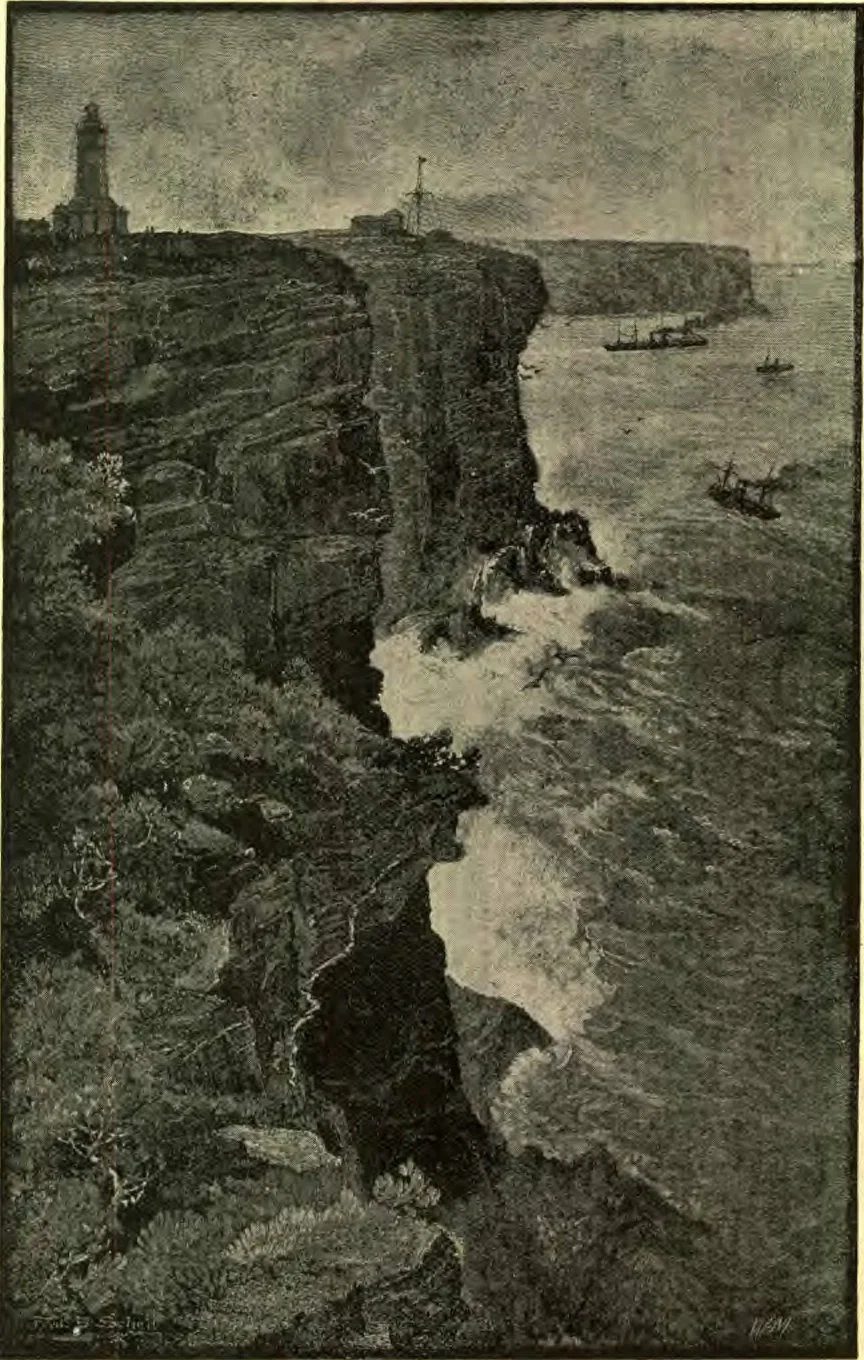
SYDNEY HEADS.
HER MAJESTY'S COLONIES
By G. B. Starr
(Continued.)
Twelve days later, after a brief stop at Auckland, New Zealand, we anchor in Sydney harbor. It is our conviction that no harbor in the world equals Sydney harbor; and we have heard of none that vies with it except that of Rio de Janeiro, though travelers who have seen both usually give preference to the former. Every bay we pass appears more beautiful than the last; palatial residences, fine cottages, and terraced gardens, with ornamental trees, ferns, and flowers, greet the eye at every turn. Ships from all nations lie at anchor in some one of the commodious inlets and bays; and we are told that all the vessels of the world could here be safely anchored from wind and storm. As mile after mile of safe harborage is passed, with miles of beautiful bays extending far inland on every side, we begin to believe that this is true.
Sydney, the capital of New South Wales, has a population of nearly four hundred thousand souls. The population of the entire colony is about twelve million persons. Being the oldest of the colonial capitals, Sydney is more nearly patterned after London than are any of the others. With a few pleasing exceptions, most of its streets are narrow and crooked. New suburbs are being laid out on a broader and better scale. The old-fashioned, noisy steam tramline, like a great train of cars, mars some of the best thoroughfares. Wherever new lines are put in, however, electric and cable trams are used, and the comparison between these and the old steam lines is the more striking. Numberless omnibuses add to the bustle and stir of the city, as they rush up and down its streets, laden, inside and out, with those who prefer this method of travel to and from business, labor, or pleasure.
The suburbs are also reached by a fine system of train service, closely resembling that of Chicago. This city having adopted the Pullman day-coach, with its revolving seat, the American traveler finds himself much more at home than in the “compartment” carriages on the through lines, or on the suburban trains of other colonies. Shut in a small compartment containing two seats, with no communication with the guard, no bell-rope, no electric button, the traveler involuntarily wonders what he should do if an accident were to happen. The first-class carriages are very comfortable, upholstered in blue, black, and brown leather, with spring back and seats. The compartments usually have lavatory and other accommodations. The second class compartments on some of the through lines are also comfortable, though furnished more plainly. Some of the second-class compartments on country lines, however, are abominable,—510“shelves in a wood-box,” one of our traveling companions called them.
But to return to Sydney: the visitor is struck by the many massive buildings that meet his eye in every part of the city,—buildings beautiful in structure and architecture, and striking in their massive solidity. “Substantial” is a mark of an Englishman's work. Everything is built to stand. Among the public buildings the post-office is prominent. The town hall, St. Andrew's Cathedral, with the new Market farther up George Street, form a group of buildings of surpassing beauty. The organ of the town hall has the reputation of being the largest, as well as one of the finest, in the world. The government supports the organist, whose productions furnish a constant source of enjoyment to the music-loving resident and visitor.
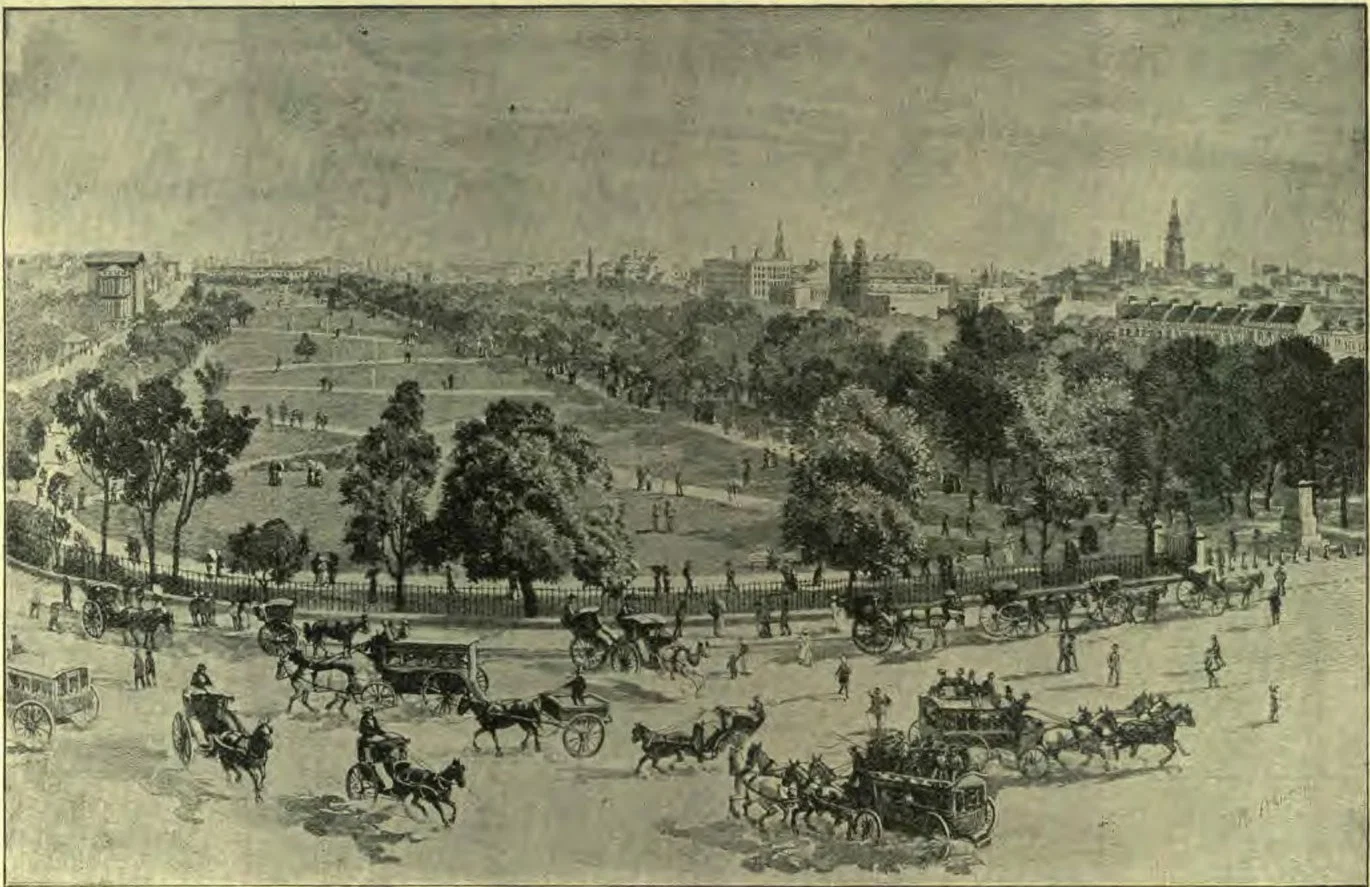
Another feature of Sydney—a beautiful feature—is its large number of well-kept, extensive gardens in all parts of the city, even in its very center. Here rich and poor alike can find a pleasant spot to spend an hour in the heat of the day; and the stranger, the homeless, a bed upon the grass for the night. The nights are so mild, the year round, that the parks are never entirely deserted.
HYDE PARK, SYDNEY.
There are a large number of pleasure-resorts near the city. Bondi, Coogee, and Manly beaches are among the most popular.
Apparently the great god of the colonies is Sport. Sacrifices of time and money, of comfort and pleasure, are freely offered by the thousands who stand, hour after hour, in the heat of the day, to watch a few men playing cricket, racing horses, or trying their skill on the bicycle.
At the time of this writing, the great matched game of cricket between England and the colonies is being played; and as many as forty-five thousand persons are in attendance daily, watching with breathless attention some twelve or fifteen men at play. Gentlemen, physicians, dentists, merchants, governors, premiers, statesmen, rich and poor, leave their occupations, and travel from all parts of the colonies, at great expense, to view “Colonial,” “Intercolonial,” and “English and Colonial” test matches. It is the general verdict of the American visitor that there are altogether too many “holidays” in the colonies. Holidays, holidays, almost innumerable, interfere with one's calculations; and if not on the alert, the newcomer will come up to a holiday, or a half-holiday, with absolutely necessary purchases unmade.
The productions of New South Wales are the fruits and grains of cooler climes, with apples, apricots, peaches, pears, plums, oranges, lemons, passion-fruit, etc., but no distinctly tropical fruits. Sheep are raised in large numbers, and the shipment of their wool and frozen carcasses to other lands is a great industry. A good horse can be bought for from forty to fifty dollars, and many are sold for from ten to twelve dollars. In Queensland I have seen unbroken horses and ponies driven into the sale-yards, and sold for from $3.75 to five dollars a dozen head. G. B. STARR.
TEXAS WILD FLOWERS
By D. A. H.
Spring in Texas is, of all seasons, most charming. Nature is at her best; and from March until June a succession of beautiful wild flowers delights the eye. The prickly pear, a common species of cactus, with a rose-like, canary-colored blossom, is seen on the prairies, in the woods, and by the roadside. I can never resist the temptation to pick it, though my fingers suffer from contact with the sharp prickles. It is a wonderfully hardy plant, invulnerable in heat and cold, it would seem; for it bears its large red edible berries in winter, and the drought of late summer does not affect it. I once brought a plant, which I had torn from its parent root, into the house in November, placing it directly behind the family heating-stove, where it remained for a week or two, retaining all its greenness and freshness.
A delicate flower, which I think very beautiful, is a species of the passion-flower growing in profusion on vacant lots, and blooming from early spring until late summer. A trailing vine with small crimson head, the size of our white clover, very delicate and fragrant, delighted us last year for several months. It belongs to the Mimosa family, and is called the “wild sensitive-plant.”
The brightest, showiest flower of all is the Texas plume, a species of cypress, bearing its scarlet blossom on tall spikes, and growing in such masses as to make the landscape glow with its brilliance. It is a late bloomer, at its best in June and July. D. A. H.
UNDER THE STONES
It is surprising what wonderful things are going on under the stones scattered along the roadway and in the meadows. Turn up the stones, and see what is hidden beneath them. A naturalist who goes about with his eyes open tells us some of the interesting and curious things he has found in this way:—
“It has always been a favorite pastime with me, this overturning of stones; and I know not how many thousands of them, big and little, and even rocks, too, have disclosed their dark secrets to me. Under one I find a mouse’s nest; under another, a snake or toad; the next may disclose the nest of the solitary bee, or brown wasp, or mud-dauber, or rare spider; and here I find a pretty orange-spotted salamander, or wood-frog, or a rare cocoon, to say nothing of all the host of squirming things—beetles, bugs, caterpillars, centipedes, armadillo-bugs, and ants—which are among the certain dwellers beneath almost any stone in the field.
“One day I lifted a large flat rock, and turned it over, when I was immediately saluted with a distinct explosion, accompanied with a tiny cloud of smoke among the border grasses. I quickly parted the grass, and saw a small blue beetle partly concealed beneath a dry leaf. I sought to pick him up, when I was treated to a repetition of the explosive report and another cloud of smoke.
“Here was a curious freak indeed,—a regular sharpshooter, blue uniform and all. I captured my insect, and placed him in a collecting-box. Shortly afterward, upon lifting the lid, the prisoner gave me another volley. But no provocation could induce him further to waste his powder. His ammunition was exhausted.
“After a night’s rest in captivity, however, the spirit of the insect was revived, and I got another round of three shots out of him, the puff of white, smoke-like vapor staining the tin interior of the box, and leaving an acid, pungent odor. The name of this insect is the bombardier beetle.”
OCTOBER
By Mrs. L. D. Avery-Stuttle
Brown October, dim and sober,
Thou’st a glory all thine own,
When the splendor, warm and tender,
Of the sun’s bright rays have shone
On thy forests, bright with rainbows,
On thy meadows, brown and sear;
Dim October, gay, yet sober,
Thou’rt the fairest of the year.
Regal flowers from thy bowers
Thou dost wear upon thy head;
Star-eyed daisies from the mazes
Of the meadow’s lavish bed;
Goldenrod, like yellow sunshine,
Crowns thy nut-brown locks with gold.
Half thy tender, glorious splendor
Dreaming poet ne’er hath told.
Leaves are falling, crows are calling,
Pumpkins ripening in the sun,
Squirrels chattering, nuts are pattering
’Mong the bright leaves, one by one;
Little children, laughing, dancing,
Through the meadows far and near,—
Dim October, gay, yet sober,
Thou’rt the fairest of the year.
Mrs. L. D. Avery-Stuttle.
Political Arithmetic of the Philippine Campaign
Political Arithmetic.—If it takes 40,000 men seven months and $100,000,000 to take possession of 300 square miles of the Island of Luzon, how many men, how many months, and how much money will it require to take and hold the whole island, consisting of 51,200 square miles, for all time? And after that calculation has been made, there is an opportunity to figure as to the whole area of the Philippine Islands, of about 115,000 square miles. The figures of such a problem may well make the American taxpayer gasp.—Manchester Union.
Chinese Girls
By Uncle Pilquist
Very few girls in China can read. No one thinks it necessary for girls to read books, or to be educated in any way. Boys are cared for, and brought to school while quite young. The father calls his boys, and says, “Get ready, hunt up your books, and come along; I am going with you to school.” So the boys, with fear and gladness, gather their small study-books, and start for school. Here they study the life of the great philosopher, Confucius, and are put through a course with the pan-tsi,—a board two feet long and three inches broad, which the teacher frequently uses on the backs of his pupils when they do not remember their lessons.
The poor little girls’ education is of quite a different character. When all the boys are in the village school, and father is sowing or reaping in the field, or perhaps at town to get some opium and other things that he thinks are necessary in the home, the mother and her small girls are doing different kinds of housework. When all things are quiet and settled, the mother’s mind turns to the education of her daughters. She calls one of the girls to come to her, and then says: “Now it is time for you to get ready to be married; it is time for you to be a woman.” The poor little girl knows well what this means. She has seen her older sisters made ready for marriage, and well she remembers their cries and tears. Now her turn has come. She weeps bitterly, and begs her mother to wait until to-morrow. “No,” says the mother, “it will not do to wait any longer. I have been slack in my duty too long already. And who do you think will marry you if you go sailing about on big boats (feet) like those foreign barbarians?”
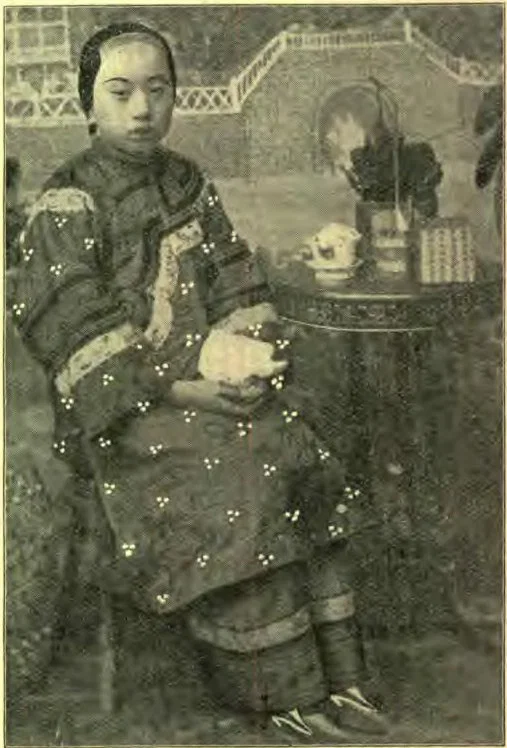
HIGH-CLASS GIRL IN SHANGHAI, CHINA.
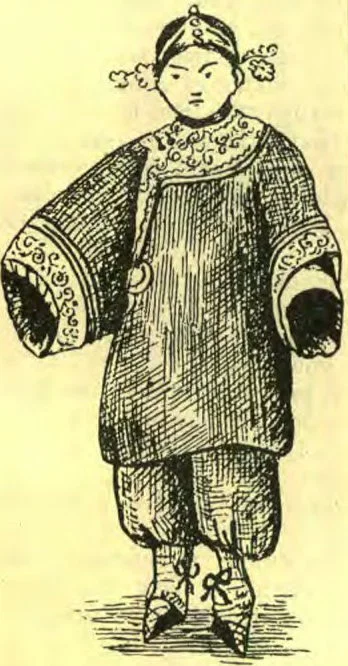
So the mother begins her work. First she soaks in very hot water the little girl’s feet; then the toes are turned in under the sole of the foot, only the big toe being left unbroken. In order to keep the toes under the foot, a long, strong bandage is wound tightly around each crippled foot and leg. It hurts terribly to be tortured in that way, but there is no help for it; it must be done. The poor little girl pleads for mercy, but the door of mercy is shut; no mercy is to be had. The proprieties of life must at any and all cost be performed. Sometimes if the girl will not stop crying, the mother beats her severely. Again she ties her hands and feet together, and hoists her up under the ceiling several times; or makes long needles of iron red-hot, and thrusts them into fleshy parts of the poor little maid’s body. The suffering child dares not cry, but lies down on the floor in great agony, sobbing and whispering, from her very heart, “Ma ko-lien, ko-lien O!” which means, “Mother, be merciful, be merciful unto me!” But the prayer of a suffering daughter is not to be heard by the mother.
The tortured child is not able to walk for several months, but is seen crawling on her hands and knees, as she must do the duty of a girl in the house now, the same as before her feet were bound. I have seen girls in that condition many times. It is pitiful to hear their heavy sobbing, and to see the silent tears streaming down their pale faces. They dare not cry aloud; for if they do, their mother will beat them. It is of no use to complain. One girl said to her mother: “Why bind my feet? I can not play with my hsiang-ti [younger brother] any more, and it hurts my feet to have them so tightly bound.” The mother then said: “Do not complain; this is the duty of life. Suffering will make you beautiful. The smaller your feet are, the bigger lump of silver can I get for you. Moreover, this is the right way of life, and the true road whereon you can obtain womanhood.”
The bandages are renewed every fortnight, and every time they are drawn tighter and tighter, until the foot has reached the desired shape. I have seen twelve-year-old girls with feet not more than three inches long. On these small, broken feet they hobble slowly along; after walking a few yards, they must sit down, and squeeze first one little bound foot and then the other, because they ache so dreadfully. Often have I seen little girls of five or six years of age walking with a stick in their hands to help them keep their balance. Your suffering sisters in China can not walk and run as you can. The foot-education is not easy to obtain.
You may ask why they have such a bad custom in China as to bind the girls’ feet. It is because the Chinese have wandered far, far away from the love of Jesus. I suppose you understand, perhaps better than I do, that the farther one goes from the true God, the more bad customs are seen in the life. Even here in America I have seen customs not to be recommended for a friend of Jesus. But now I am made happy by the thought that all the dear readers of the INSTRUCTOR are willing to put away everything of which Jesus does not approve. You must bear in mind that the mothers of China do not know Jesus as you do; and it is because of this that they are so cruel to their children, especially to the girls. No doubt if they had the good papers and books that you have, they would become enlightened, and see that foot-binding is a bad custom, and so put it away; and perhaps all other bad things would be put away. Will you not pray, with me, for China?
In closing, I will give you a few stanzas from a book called “Nü-erh-king,” or “Classics for Girls.” They are translated by a friend in Peking, and run as follows:—
“FROM SEVEN TO TWENTY
“When the wheel of life’s at seven,
You should study woman’s ways;
Leave your bed when day is breaking,
Early thus begin the days;
Comb your tresses smooth and shiny,
Keep yourself both clean and neat,
Bind your lilies tight and tidy,
Never go upon the street.
“When the wheel’s at eight or over,
While you gradually do grow,
Both your old and younger brothers
You should intimately know;
And while peacefully partaking
Of the tea and rice and wine,
About eating much or little
Never quarrel while you dine.
“When the wheel at ten is turning,
You should never idle be;
To the making of their clothing
And the mending you should see; Your position should be daily
Sitting at your mother’s feet;
Not, except upon an errand,
Should you go upon the street:
“When the wheel has turned eleven,
You have grown to womanhood,
And all culinary matters
Should be clearly understood;
If for fancy work from cooking
You can save some precious hours;
You should spend them in embroidering
Ornamental leaves and flowers.
A GIRL IN THE INTERIOR OF CHINA.
“When the wheel has turned to thirteen,
Your propriety should prize;
When your presence people enter,
You politely should arise;
Toward your aunts, your father’s sisters,
And his younger brothers’ wives,
You should not neglect your manners
From the nearness of your lives.
“When the wheel has turned to fifteen,
Or when twenty years have passed,
As a girl with home and kindred
These will surely be your last;
While expert in all employments
That compose a woman’s life,
You should study, as a daughter,
All the duties of a wife.”
Another time I will tell you more about our Chinese brothers and sisters.
UNCLE PILQUIST.
CHINESE ETIQUETTE
F. L. H. Pott, a missionary in China, and the principal of St. John’s College in Shanghai, when last in the United States, gave an account of the conversation and action that sometimes take place when a new pupil is brought to him. He said:—
“The fathers of the boys attending the college are usually politicians, merchants, or scholars. Of course I have to adapt myself to the etiquette of the Chinese; and so when a father arrives with his boy, I escort them to my Chinese reception-room, where the father and I each shake our own hands most heartily, and bow profoundly. I then say to him: ‘What is your honorable name?’”
“He replies, ‘My mean, insignificant name is Wong.’”
“Then I say, ‘Please be seated,’ and point to a seat in the back of the room, at the left of the table—the seat of the greatest honor. He immediately takes the right-hand seat, nearest the door—the post of least honor. I urge him to go up higher. He declares that he is unworthy. I then catch hold of him to force him to go higher, and he takes hold of me to prevent it. We have quite a vigorous struggle, lasting some time. Finally he accepts a compromise, and takes a seat halfway up the side of the room. I sit down in the seat next lower.512
“Before beginning our conversation, I send for tea and the water-pipe; and when they arrive, I say, ‘Please use tea.’”
“When he has taken some tea and a puff from the pipe, we talk. He asks innumerable polite questions about myself. A Chinese gentleman never comes to business for a quarter or half an hour. Time never troubles an Oriental. He begins by asking, ‘What is your honorable name?’”
“I of course reply that my mean, insignificant name is Pott. The next question from him is, ‘What is your honorable kingdom?’ And I am obliged, much as I dislike it, to say, ‘The small, petty district from which I come is the United States of America.’”
“‘How many little stems have you sprouted?’ he says. That is the way he asks how old I am.”
“‘I have vainly spent thirty years,’ I reply. Asking after my father, he says, ‘Is the honorable and great man of the household living?’”
“It is shocking, I know, but I have to answer, ‘The old man is well.’”
“Then comes, ‘How many precious little ones have you?’”
“I reply, gravely, ‘I have two little dogs’ (the little dogs are my children). The last question is, ‘How many children have you in this illustrious institution?’”
“My answer is, ‘I have a hundred little brothers.’”
“Then he comes to business, and says, ‘Venerable master, I have brought my little dog here, and worshipfully entrust him to your charge.’”
“The little fellow, who has been standing in a corner of the room, comes forward, kneels before me, puts his hands on the ground, and knocks his head on the floor. I raise him up, and send him off to school; and arrangements are made about his dormitory, course of study, etc.”
“The gentleman rises to take his leave. ‘I have tormented you exceedingly to-day,’ he remarks.
“‘Oh, no,’ I answer, ‘I have dishonored you.’”
“As he goes toward the door, he keeps saying, ‘I am gone, I am gone;’ and I reply, ‘Go slowly, go slowly.’”
“As I follow him to the gate in the garden, he says, ‘Please refrain your golden footsteps.’”
“When we arrive at the gate, we again shake our own hands, bow reverently to each other, and he is gone.”
“Chinese politeness is sometimes carried to an extreme that seems amusing to us. I have seen five or six men enter a door at which they had chanced to meet, and all urge one another to go in first. And this ceremonious politeness is not confined to the upper classes; if two wheelbarrow-men meet in a narrow path, and one has to go to one side to let the other pass, the one who kept the road will say, ‘I have sinned against you;’ and the other will reply, ‘Don’t mention it.’”
COMPENSATION
The truest words we ever speak
Are words of cheer.
Life has its shade, its valleys deep;
But round our feet the shadows creep
To prove the sunlight near.
Between the hills those valleys sleep,—
The sun-crowned hills!—
And down their sides will those who seek
With hopeful spirit, brave, though meek,
Find gently-flowing rills.
— Selected.
GUAM
The reports of naval officers who have lately visited Guam say that the island, which is the southernmost of the Ladrone group, has a fair table-land running along the west shore-line, back of which is a range of mountains of moderate height. The soil is fertile, and in some sections very rich. The native products of the island are not varied; but the fruits and vegetables of other lands, when introduced, thrive well. The population is estimated by Lieutenant Cottman as about seven thousand, though no reliable statistics have been obtained. Nearly all the inhabitants are of mixed blood. Foreigners are very few, among them four Spanish priests, besides former employees of the Spanish government. The people are indolent and contented, being able to obtain necessary food with little labor. They are lax in their morals, and greatly addicted, both men and women, to the use of la tuba, or coconut whisky. They are all nominally Roman Catholics, but the men pay little attention to their church. Leprosy exists to a considerable extent. One officer declares that “the priests are the moral lepers of the place, and are a great drawback and detriment.” All the reports unite in affirming that the climate, though tropical, is excellent, and that the island might be made a delightful place of residence. —Missionary Review.
“WE HAVE SEEN HIS STAR”
By Ellen G. White
III
WHILE the magi were studying the heavens, a luminous star, entirely new to them, made its appearance. As they stood gazing at it, they were impressed that it was the herald of some great event. They decided to investigate the matter, hoping that they would be rewarded by a knowledge of the promised Messiah. The Lord encouraged them to go forward; and as the pillar of cloud moved before the children of Israel through the wilderness, so the star guided the wise men as they journeyed toward Jerusalem. When they drew near Jerusalem, it no longer went before them, but was enshrouded in darkness. Entering Jerusalem, the magi made the eager inquiry, “Where is he that is born King of the Jews? for we have seen his star in the east, and are come to worship him.” They knew that the Messiah had been born. The star that had guided them thus far was an outward evidence, and the Spirit of God was kindling ardent hopes in their hearts. They expected to see and worship the King.
The people of Jerusalem looked upon the magi with astonishment; for no one had seen anything peculiar in the heavens, no one had heard anything about the birth of the King. The very people over whom this King was to rule had not been favored with any special token; for they had no knowledge that anything unusual had taken place. The minds of the wise men were filled with astonishment. Could it be that in the city of Jerusalem, the people knew nothing of the birth of him who was to rule over Israel? Had they themselves read the prophecy incorrectly? The magi had thought to find all Jerusalem filled with anxious expectancy. As they related their experience, they were surprised at the jealousy shown by the scribes and Pharisees. Surely the Lord, whom they had been seeking, had suddenly come to his temple!
The tidings of the Messiah’s birth reached the ears of Herod. He was startled. His jealousy was roused. Had One been born who had a better right than he to rule? Was he to be superseded? Why had he not heard of this wonderful event? Looking into the past, he reviewed the terrible conflicts through which he passed in order to gain the throne, and the murders he committed to secure his position. He has disposed of every rival in his way, and he determines that he will not rest until this new king, if there be one, is searched out and slain.
Herod was troubled by the tidings brought by the wise men, “and all Jerusalem with him.” It was in harmony with Herod’s jealous nature to be troubled over news of this character; but why should the leading men that among the Jews be so perplexed and terrified? Had they studied and explained the Scriptures in vain? Why were they not intelligent in regard to this great event foretold by prophecy, which meant so much to them? They had traced down the chronology, and knew that this was the time when the Messiah should appear. Why, then, were they so alarmed? They had read the words: “Prepare ye the way of the Lord, make straight in the desert a highway for our God. . . . O Zion, that bringest good tidings, get thee up into the high mountain; O Jerusalem, that bringest good tidings, lift up thy voice with strength; lift it up, be not afraid; say unto the cities of Judah, Behold your God! Behold, the Lord God will come with strong hand, and his arm shall rule for him: behold, his reward is with him, and his work before him. He shall feed his flock like a shepherd: he shall gather the lambs with his arm, and carry them in his bosom.” Why, then, were the priests and rulers, those in high position, so alarmed at the news of his coming?
The Jewish rulers were in ignorance of the coming of the Just One, because they had not been making ready for him. They had been separating from God by wicked works. The positions in the service of the priesthood were filled by men wholly unfitted for the work,—men who had not hesitated to stoop to falsehood and even murder to gain the coveted honor. They were not ready for Christ’s coming. They had not heard the angel’s message, “Behold, I bring you good tidings of great joy.” They had not heard the song of the heavenly host, because they were estranged from God. Spiritual things are spiritually discerned. The Lord could not enlighten them; for so great was the darkness surrounding them that they would not have made a right use of the light.
The priests and rulers began to ask themselves what these things meant. The shepherds had borne witness regarding the visit of the angels; now men from the far East bore the tidings, “We have seen his star in the east, and are come to worship him.” Men of another nation and faith were the first to herald the advent of the Messiah. If the report of the wise men were true, they, the rulers, stood in an unenviable position before their own people; for they had been passed by, while strangers were enlightened.
Herod was surprised that the Jewish rabbis—men looking upon themselves as favored above all other people—should apparently be in darkness, while those they termed heathen had received a sign from heaven that the King had been born. He was filled with perplexity. Why had the wise men made the long journey to Jerusalem with the inquiry, “Where is he that is born King of the Jews?” Had a king been born? Making an effort to appear gratified by the news, though his heart burned with jealousy at the mention of a rival, Herod gathered the chief priests and scribes together, and demanded of them where Christ should be born. “In Bethlehem of Judea,” they answered, “for thus it is written by the prophet: And thou Bethlehem, in the land of Juda, art not the least among the princes of Juda; for out of thee shall come a Governor that shall rule my people Israel.”
Calling the wise men to him, Herod “inquired of them diligently what time the star appeared. And he sent them to Bethlehem, and said, Go and search diligently for the young child; and when ye have found him, bring me word again, that I may come and worship him also. When they had heard the king, they departed, and, lo, the star, which they saw in the east, went before them, till it came and stood over where the young child was. When they saw the star, they rejoiced with exceeding great joy. And when they were come into the house, they saw the young child with Mary his mother, and fell down, and worshiped him: and when they had opened their treasures, they presented unto him gifts; gold, and frankincense, and myrrh. And being warned of God in a dream that they should not return to Herod, they departed into their own country another way.”