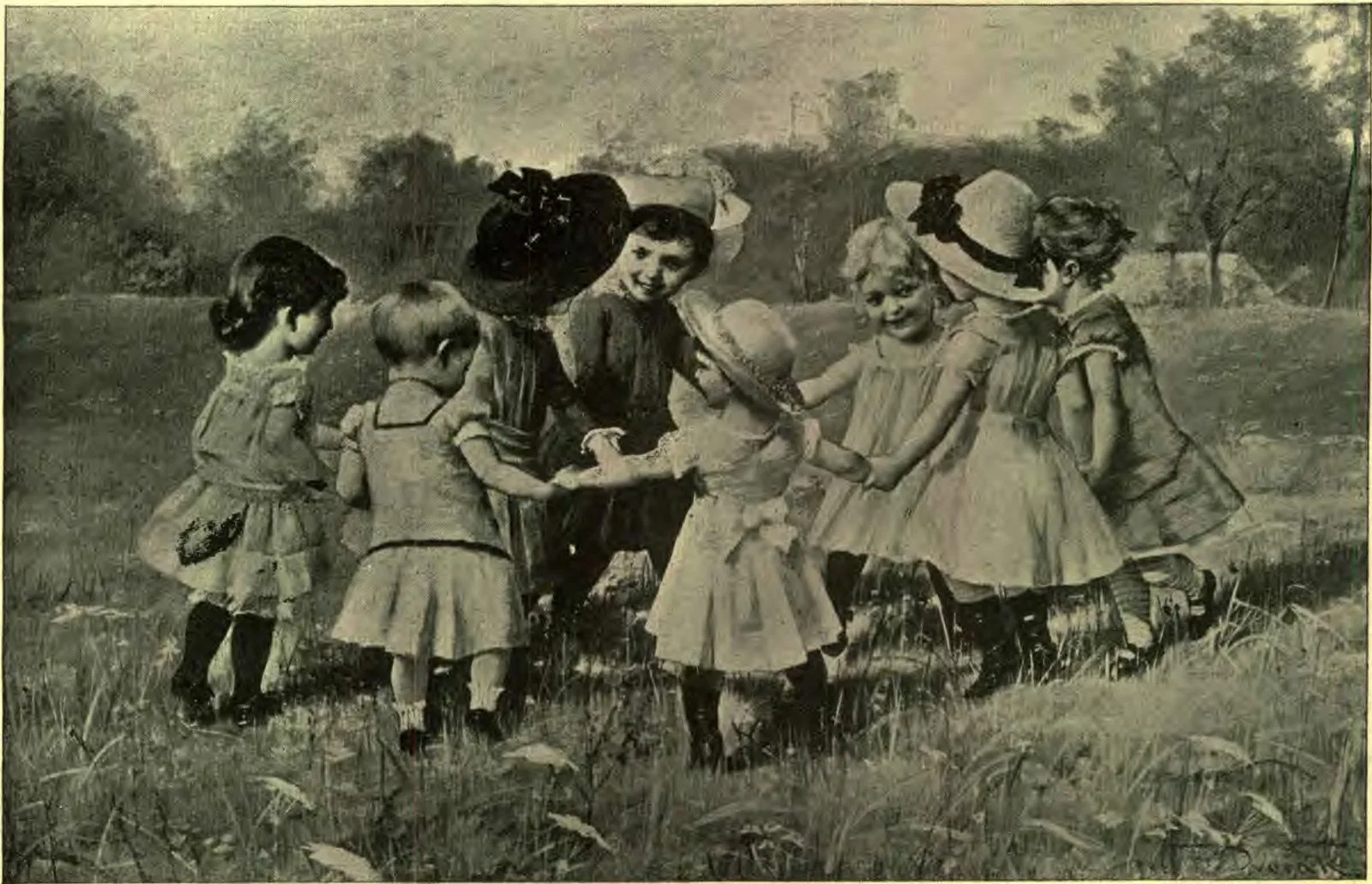
“Ring around roses” in the early spring;
Fields full of daisies, birds on the wing,
Lips full of laughter, eyes bright with fun,—
“Ring around roses” in the May sun.
“Ring around roses” in the summer day;
Hark to the reapers! Smell the new hay
Nests full of birdies swing in the breeze;
“Ring around roses” under the trees.
“Ring around roses;” leaves begin to fall;
Apricots and peaches ripen on the wall.
Birds flying southward, seek a new home;
“Ring around roses” ere snow shall come.
“Ring around roses;” winter’s frosty breeze
Never can wither roses like these;
Hearts full of sunshine, lips full of song,—
“Ring around roses” all the year long.
ELIZABETH ROSSER.
A DOLL STORY
A FEW years ago some men were digging in the ground near the old city of Rome, in Italy, and what do you think they found?—A marble coffin, which had lain there sixteen hundred years. A young girl had been buried in it, and with her a beautiful doll, carved from oak. On the thumb of its right hand were two gold key-rings, which showed that it was a doll housewife. In those long-ago days it was the custom to offer dolls to the gods that the people worshiped, just before those who owned them were married; so the presence of this doll and other articles in the coffin showed that the young girl had died just before her wedding-day.
It is known, also, that little Roman children had tiny chariots to play with, whose doll drivers leaned out over high dashboards to lash horses about four inches high. One writer thinks the little Egyptians in the days of Moses had dolls; but however that may be, we can easily believe that these were among the earliest toys made.
In more modern times, dolls have sometimes been made for other purposes than to play with. French ladies of the fourteenth century, having no fashion-plates, made little images, dressed them in the newest “style,” and sent them from one great lady to another, that each might know how to make her gowns. But little girls fell in love with them; and to please them, dolls to play with began to be manufactured in Europe.
These were made of wood, and most of them came from the Netherlands. They were called “Flemish babies,” and an old couplet says:—
“The children of Holland take pleasure in making
What the children of England take pleasure in breaking.”
“HEARTS FULL OF SUNSHINE, LIPS FULL OF SONG.”
But it was in England that the wooden “Flemish babies,” with their queer little jointed bodies, found the name that is still dear to us. At that time the name Dorothy, which means “God’s gift,” was very popular, and often it was made “Dolly” as a pet name for little girls. So, naturally, it was applied to the children’s pets, and “dolly” it remains to this day, although in time it became what we call a general, or “generic,” name.
Germany has been for many years the country to produce most dolls, a hundred million being sent to other countries every year. Entire villages are given up to their manufacture. In such a town there are doll headmakers, doll legmakers, doll wigmakers, etc. Men, women, and children earn their living by making one small part of a doll.
In London the making of dolls’ eyes is a flourishing business, hundreds of thousands being exported every year. England also makes wax dolls, which were very popular when they first appeared.
The most beautiful dolls are made in France, and from that country come those that wink, “go to sleep,” sing, walk, and talk. But they are admired rather than loved, because you could hardly expect to hug a doll with a “singing machine” inside of her.
In New York there is a tiny store where nothing is sold but dolls’ clothes. In that city there is also a famous “doll doctor,” who can mend broken heads, arms, and legs, and even put on new noses; and she is kept busy all the time.—S. S. Advocate.
BEFORE AND AFTER; OR “IN HIS NAME”
By Helen A. Steinhauer
Three little girls laid their heads together; and as they were ministering children, the result was a sweet and fragrant offering to an old lady in their neighborhood.
She was wrinkled, and faded, and worn; a woman with stooped shoulders, and a heart that held an ache of which no one ever heard.
But it also held in its depths that peace which the world can neither give nor take away (it oftentimes tried to, but never succeeded). Probably this was the secret of her quick sympathy and ready smile, and the hidden source of the strain of sacred song that so constantly welled up from her restful soul. Perhaps it also was why little children loved her so well, and the poor dumb brutes all instinctively owned her as their friend.
But on the night of the “happening” that I am about to relate—it was such a beautiful “happening,” one of the own, blessed sendings of the dear Father above!—on this particular evening the lonely feeling in her heart oppressed her. For comfort she had gone, first, to her knees, and then across the street to a tiny friend of hers, whose dewy-lipped, open-mouthed kisses, and dainty baby-touches, were wont to take the soreness out when the old, bad ache asserted itself too strongly.
The sun had set in golden splendor, and the western sky still glowed in glorious memory of the parting; but the day that it so royally ended had been long, and hot, and weary; and even now black clouds were gathering in the south, and as she listened, she distinctly heard the low mutterings of an approaching storm.
But, all unconscious of coming ill, baby cooed, and crowed, and dimpled: so, stooping514to kiss her once more, she hurriedly left, involuntarily saying, as she did so,—“I do not like to be alone in a storm at night.”
But the words had scarcely escaped her lips, ere the lines of an old Moravian hymn chased them from mind and heart; and as she turned her steps homeward, she softly sang, under her breath,—
“Quite alone, and yet not lonely,
I'll commune with God my Friend.
“O how blessed are the moments
When the Lord himself draws near;
When I feel his gracious presence,
And he listens to my prayer!”
Thus singing, she reached her humble home, and on glancing downward at the steps, there lay a box of beautiful flowers,—roses, pinks, sweet-scented clover, gracefully mingled with green leaves and ornamental grasses,—a belated “May basket,” sending its subtle fragrance out on the heavy air.
With an exclamation of pleased surprise, she carried it into the house, and lighted a lamp for a closer look, hoping to discover the name of the thoughtful giver.
Yes! there lay, half hidden among the flowers, a folded slip, with just these words:—
“From the King’s Daughters;”
and between the folds was tucked a card of admission to the Missionary Panorama, to which she had so longed to go!
I wish the three, whose was the kind thought, could have seen her then, as, almost unconsciously, she dropped upon her knees in her quiet dwelling. This was what God and the angels heard:—
“The earth is thine, O Lord! with not merely the silver and the gold and the cattle upon a thousand hills, but also its wealth of fragrant flowers, and its treasure of loving hearts. Bless these ‘King’s daughters,’ Father! bless them according to the greatness of their needs, whatever those needs may be, and the plenitude of thy greater love and mercy. If not even a cup of cold water given in the name of a disciple shall fail of reward, how much less shall this, given in the name of thy dear Son. Make them in very deed thine own, my Father, and grant that they may be blessed as well as blessing in their sweet ministrations to the sick, the lonely, and the poor.
“I ask it ‘in His name.’ Amen.”
Rising, she mechanically parted the window-curtains, and looked out and up; and lo! the angry clouds had rolled away, and the solemn, steadfast stars shone peacefully down, like the sweet, sweet thoughts of God to his children.
HELEN A. STEINHAUER.
ALL GONE!
All gone! All gone!
Where did the good supper go?
All gone! All gone!
Gone to help Babykin grow.
Here in his face all so rosy and sweet,
Here in his arms and his hands and his feet,
Here from the top of his head to his toes,
This is where Babykin’s good supper goes.
— Kindergarten Review.
Chapter XVIII
By S. M. I. Henry
From Sinai to Olivet
Chapter XVIII
“O my Heavenly Father!” cried Shirley, lifting her face, and clasping her hands, “what can I do? Help me!” and at first she was mystified as well as startled by a scripture that seemed to be spoken to her: “All thy children shall be taught of the Lord; and great shall be the peace of thy children;” then with a little laugh she said: “Oh, I see; I must be in the place of a mother to my father, in one way. I must pray and believe and wait patiently for him to see, as a mother would do, if he had one. I sort of feel motherly toward him, too; I do believe, and I will wait and be patient.”
Benjamin Goss went on to the barn, entered, closed the door, threw himself down on the hay, and began to dispute with the Holy Spirit: rather, he continued the dispute that had been going on for years.
His thoughts turned especially to the Sabbath. He knew very well that that holy day would hereafter be kept in his home as it had never been. He could see in Shirley much that brought his dead mother to memory, and he had loved her tenderly. He could not find it in his heart deliberately to plan to throw stumbling-blocks in the way of his child’s feet if, as he fully believed, she had begun a new life. He believed enough to be sure that the consequences to him would be serious if he did not help instead of hinder her.
He had suffered during the days that she had been absent. He had appreciated the dangers to which she had been exposed. When she was not at the train, his heart sank like lead; and at sight of her fresh, sweet face, so full of a new light, he had been greatly relieved. He knew that through these things a new and more imperative call had come from God to his soul. What should he do?—obey and be saved? or refuse and be lost?
He rolled this bitter morsel about, trying to get rid of it; but he could not. He considered it from every point of view, and in every position in which a man of fifty years was likely to throw himself. He came out, and walked up and down the long lane to the pasture. He took to the road, from which he could see the light in the sitting-room, and the dim outline of his daughter’s head and face through the sheer scrim curtain as she sat just where the light fell upon her. His heart suddenly swelled with gratitude that she was there,—that she had returned with no blight of mildew upon her, but instead with the glory of a new life covering her as with a garment. He thought of the future of the saints of God, the new earth, the restored home of the saved, families reunited, and then of the sacrifice that he must make if that far-away joy should ever515be his; and suddenly the faithful monitor asked him the pointed question, “What shall it profit a man if he shall gain the whole world, and lose his own soul? Or what shall a man give in exchange for his soul?” He mentally conceded at once that when it came to that, his contention with God must cease; he must acknowledge himself without profit or gain, or anything to exchange.
It would be impossible to follow him as, with restless feet and a more restless heart, he walked on through the small hours, recalled the past, and calculated the future. It would be impossible to describe how he felt as the suggestion came that the last call of mercy was being made to all the world, and perhaps to him just now. He did not know when it happened; but just about the time that the darkness, which is deepest just before the dawn, began to lift, he awakened to the awful fact that he stood alone in all the universe with that God who, as a father, had been waiting through many a year for an answer to his call.
There arose before him that scene in the kitchen, when he waited for his daughter to answer to his unreasonable questioning, and all that had happened since. Sorrow and actual shame had resulted in the eye of the public because she ran away from an unreasonable, unfatherly father; therefore what must result if the child of the perfect One, unfailing in love and gentleness, would not answer, would not obey, would not consent to be made happy and secure?
Just then out over the darkness there trailed a long, vivid, zigzag chain of lightning, followed by a low, trembling roll of thunder; and, as if answering to it, a bird’s first morning note trilled out from just over his head; and in each of these manifestations his quick thoughtfulness recognized the presence of his Father. The lightning thrilled him; the thunder came as an admonition; and the pleading sweetness of the bird’s note broke into his heart, and made it melt, and flow out in floods of tears.
“Whither shall I go from thy presence?” he cried out, aloud. Then, startled by his own voice as well as the words, he became silent; but his heart went on: “I can not contend with thee forever. Thou art too great for me. Thy presence in my child has lifted her into a place so high that I can not reach to it. But if I surrender now, I must yield all. I must say, Do with me and mine as thou wilt; and I can not. Oh, have mercy! but I dare not. Thou mightest take all from me,—my farm, my wife, my child, my reputation, my influence,—such things have happened,—if I could only surrender, be a Christian, and belong to any but the despised people of God—that mean little remnant into which I was born. But I know they have the truth; and if I surrendered, I must take it all,—all or nothing,—and I can not now. O Lord! have mercy on me. Do not crowd me too hard just now. I will try to be a better man at home. I will give Shirley a chance. I will not interfere with the Sabbath in the housekeeping; I will make it as easy as possible for her to be a true Christian; but I can not let go utterly just yet, for it would upset all my plans; and other people who do not believe as we do would become needlessly involved. Really, I don’t think I should be doing the fair thing by Jordan and his gang; for he never could see any sense in stopping work on the Sabbath, and he will not work on Sunday. Anybody can see that it is impossible for me to take this step until we can somehow raise up a company of Sabbath-keepers who will make good farm-hands. And that can never be; for just as soon as a good farm-hand gets hold of the truth, he turns into a missionary of some sort, just as Will has, and is good for nothing when it comes to steady work.
“And that isn’t the worst of it. I should have to make restitution to Seth’s mother. She left it to me to sell that fifty acres for her when she was left a widow, and had to have the money for the mortgage to save her home. Of course she said she would be satisfied if she got forty dollars an acre for it, and she always has been satisfied; but if she and Seth knew that I got forty-two dollars, and so put one hundred dollars into my own pocket from that sale, what would they think? Of course it would have been all right, as the world goes, for me to have a commission for selling the land; but I professed to do it out of neighborly kindness and sympathy. That was fifteen years ago. I should have to pay interest on that money, and I simply can not do it now. Oh, I am a bad man! I am in danger of being lost entirely; I know it—but—”
After this manner that wretched soul contended with God all that long night and the beautiful daybreak. He stood with his hot head bared, and watched as the pale dawn began to flush and glow, and as all the air about him became vocal with song, and as a low bank of cloud on the southwestern horizon gave utterance to vivid lightning-flashes and deep, admonitory thunderings, feeling that he was stripped and naked before the eye of God. At last the thought came, “What if this is my last call,—the very last striving of the Holy Spirit with my soul? If I knew it was, what would I do?” He stood still, as if rooted to the ground; sighed, “O God, be merciful to me a selfish sinner!” and, turning about, walked back to the house, and began his morning chores.
Then it was that Satan entered into Benjamin Goss, and through him ruled with a rod of iron; yes, with scorpion stings. Compared to that which Shirley had had to endure all that spring and summer, everything that had been arbitrary and harsh in his former manner, was gentleness itself.
Her mother continued feeble. It would have been impossible for her to recover tone and strength in the atmosphere with which her husband filled the home; and not a day passed that he did not lay upon Shirley, in some new and more painful form, the responsibility for all her mother’s ailments.
He refused to provide help for the work, which grew more heavy as the season advanced; he gave her no money, even for household expenses; nor did he allow the ordinary exchange of garden, poultry, and dairy produce for groceries, as he had always done for the “women folks” until now.
He made the keeping of the Sabbath almost an impossibility. In fact, its outward observance was often seriously interfered with by the manner in which he planned his work so as to throw as much extra as possible upon the housekeeping on that day. He even went so far as persistently to “forget” the errands with which he would naturally be charged, as well as the things which were needed for the house; and as for clothing, but for the stock of old things hung away in her closet, which she, assisted by Aunt Nell, made presentable, Shirley would have fared poorly.
Her father seemed determined to drive her from home. Everybody saw it, and wondered that she stayed. In fact, she had been a constant wonder to her old friends ever since her return from her escapade; for no one could help seeing that she had strangely changed. In the first place, she astonished Aunt Nell and her mother the very day after her return by bringing out the detested green cotton goods that had apparently been the immediate cause of so much trouble, and going to work to make it into a dress. Her father came in while she was cutting off the skirt, and she glanced brightly up at him. He concealed the feeling which rushed in upon him by saying, in a cutting tone, “You’ll look like a parrot, if you do sing like a mocking-bird, when you get that on.”
“Well, dad,” she answered, “that will be all right, so that I’m only what I seem—and I’m sorry I ever grumbled at things. I remember what Aunt Nell said to me that day when I went over there so angry,—that there were worse things than having a father who insists on buying one plenty of clothes that one doesn’t choose, and doing everything for one, as mine does for me, and I think she was right.”
He could not stand that. He hastened out of the house; and from that time the sight of that dress was torture to him. When he knew that Shirley was going to sing at the concert, he gave everybody to understand that he should not go, although he had not missed a May concert in all the years that they had been held in the village. He kept his word, so far as being absent from his usual conspicuous place was concerned; but those who had discovered the family jar, and yet knew his peculiar pride in his daughter, laughingly told how he had stood under the window, and “listened as if his life depended on it” while she sang.
One pathetic episode that happened about this time almost broke him down. When Shirley was a little child, her father was her play-fellow; and as she was just beginning to write, they had had a “post-office” in a hollow tree not far from the house. A wind-storm broke the tree down one night; and he sawed the splintered trunk off squarely, and built a tiny house, with a door slitted for letters, and a regular post-office sign; and through this medium they had carried on a correspondence with fluctuating regularity until Shirley grew to be a great girl. A little card which read, “Office open,” or a light made by a tiny lamp, had been an understood signal between them.
During the period of her growing discontent, the office had become dilapidated from neglect; but it still stood in its place—a weather-beaten monument of happier days.
Time: A. D. 31. Place: Jerusalem. Persons: Chief priests, scribes, elders, Jesus, disciples.
QUESTIONS
1. When Jesus had completed the lesson drawn from the withered fig-tree, to what place did he return? Matt. 21:23. As usual, what did he do while there? Luke 20:1. By whom was his work interrupted? Id.
2. What questions did they ask? V. 2. What proposition did Jesus make to them? Matt. 21:24. What was the thing he asked? Luke 20:4. Why did they fear to answer him? Vs. 5, 6. Because of their refusal to reply, what did Jesus say? Vs. 7, 8; note 1.
3. What parable did Jesus now relate? Matt. 21:28–30. What question did he then ask them? Give their answer. V. 31. What solemn application of the truth of the parable was then made by Jesus? Id. What reason did he give for thus applying it? V. 32; note 2.
4. By what further parable did Jesus seek to show these Jewish leaders their true condition? Mark 12:1. At the time of fruit, what did the owner of the vineyard do? For what purpose? Matt. 21:34. How were his servants treated? Vs. 35, 36.
5. Through whom did the Lord of the vineyard now seek to accomplish his purpose? For what reason? V. 37. How did those in charge of the vineyard reason concerning the son? V. 38. What did they therefore do? V. 39; note 3.
6. Having stated the parable, what did Jesus now ask? V. 40. Not knowing that Jesus spoke of them, with what words did the priests and rulers condemn themselves? V. 41.
7. To what prophecy concerning himself did Jesus then refer them? V. 42. By their rejection of him what would result to them? V. 43. With what words did Jesus end the parable? V. 44; note 4.
8. What did the rulers at last come to see? V. 45. What did they wish to do? Why did they not do it? V. 46.
NOTES
1. How quickly and easily Jesus defeated the purposes of his enemies! The trap which had been laid for him was used to catch them. And what Jesus did in this instance may be done by every child of God. The Lord has promised to give a mouth and wisdom which all our adversaries will not be able to gainsay nor resist. Luke 21:15. Now is the time to search the Scriptures, even as Jesus did, for that wisdom which will give victory in the time of trial.
2. It is clear that by the first son, Jesus referred to the publicans, whose life of sin had continually seemed to say to the Lord, “I will not go into the vineyard.” But under the preaching of both John and Jesus, they had repented of sin, turned to God, and had thus done what they once said they would not. It is also evident that the second son symbolized the Jews; for they, while professing to know God and seeming to be willing to obey, were stoutly refusing to do anything he asked of them. The publicans, by giving up sin, were entering the vineyard,—the fold of Christ, and the field of gospel work. The Jews, by clinging to sin, were shutting themselves out.
3. In the parable the householder represented God, the vineyard the Jewish nation, and the hedge the divine law, which was their protection. The tower was a symbol of the temple. . . . As the husbandmen were to return to the lord a due proportion of the fruits of the vineyard, so God’s people were to honor him by a life corresponding to their sacred privileges. But as the husbandmen had killed the servants whom the master had sent to them for fruit, so the Jews had put to death the prophets whom God sent to call them to repentance. . . . In the beloved son whom the lord of the vineyard finally sent to his disobedient servants, and whom they seized and slew, the priests and rulers saw a distinct picture of Jesus and his impending fate.—“The Desire of Ages,” pages 596, 597.
4. To fall upon the stone, upon Christ, and be broken, is to accept Jesus as a Saviour, and find “a broken and a contrite heart.” Ps. 51:17. That stone will fall upon us if we reject Christ, and we shall suffer the second death. At that time the Rock will fall with crushing weight to destroy all who have no hope.
THE LITTLE BREADMAKER
Take two quarts one pint of flour,
Fine and white as can be found;
Pour it heaping on the sifter,
Resting on the breadpan round.
Of sugar add one tablespoonful,
And the same amount of salt;
Mix and rub them on the sifter
Till all’s through, then call a halt.
Save one cupful of the mixture
Till to knead it you begin;
In one quart of blood-warm water
Melt a yeast-cake smoothly in;
Pour the water on the flour,
Mixing both into a dough;
Knead the dough for fifteen minutes
(Some say twenty); don’t be slow.
When the dough’s no longer sticky,
Cover it, and say good night;
Place it where ’t will not be chilly
If you wish to find it light.
In the morning you divide it,
Make three loaves, and knead again;
Let them rise a little longer,
To the pan’s edge. Place them then
In the oven. Bake one hour.
By that time they should be done.
Draw them forth, and cool them slowly,—
There! breadmaking’s only fun.
—St. Nicholas.
To Reach BATTLE CREEK
FROM
CHICAGO, BUFFALO, DETROIT, OR TOLEDO,
Purchase Tickets
Reading over the MICHIGAN CENTRAL
“The Niagara Falls Route.”
A First-class Line for First-class Travel between Chicago and New York and Boston. Elegantly equipped through trains pass Battle Creek in each direction daily.
R. N. R. WHEELER, O. W. RUGGLES,
Ticket Agent, Battle Creek. Gen’l P. and T. Agt., Chicago, Ill.
TAKE THE Canadian Pacific Railway
for . . . CHATHAM, OTTAWA, MONTREAL, LONDON, GALT, QUEBEC, WOODSTOCK, TORONTO, BOSTON, PORTLAND, and
All points in New England, the Maritime Provinces, Great Britain, and the Continent.
Illustrated literature, time-tables, and full particulars, upon application to—
J. FRANCIS LEE, GEN. AGENT,
Passenger Dep't. 228 SOUTH CLARK ST., CHICAGO
Branch Offices: 76 Ottawa St., Grand Rapids, Mich. Room D, Chamber of Commerce, Cincinnati, Ohio. 315 Chestnut St., St. Louis, Mo.
Cincinnati Northern Railroad Co.
TIME TABLE NO. 3.
IN EFFECT SEPT. 24, 1899.
Trains Pass Battle Creek, as follows:
WEST-BOUND.
No. 21, Mail and Express ............ 6.58 P. M.
No. 23, Accommodation ............ 2.07 P. M.
No. 27, Local Freight ............ 8.25 A. M.
EAST-BOUND.
No. 22, Mail and Express ............ 8.25 A. M.
No. 24, Accommodation ............ 1.45 P. M.
No. 28, Local Freight ............ 5.30 P. M.
Direct connections are made at Toledo with all roads diverging. Close connections for Detroit and Cincinnati.
J. L. READE, Ticket Agt., Battle Creek.
E. R. SMITH, City Pass. Agt., 6 West Main St.
Grand Trunk Railway System
Time Card in Effect February 5, 1899.
C. & G. T. DIVISION.
WEST-BOUND FROM BATTLE CREEK.
LEAVE.
No. 11, Mail and Express, to Chicago 12.00 M.
No. 1, Chicago Express, to Chicago 9.00 A. M.
No. 3, Lehigh Valley Express, to Chicago 3.40 P. M.
No. 5, Pacific Express, to Chicago, with sleeper 12.55 A. M.
No. 75, Mixed, to South Bend 7.30 A. M.
Nos. 11 and 75, daily, except Sunday. Nos. 1, 3, and 5, daily.
EAST-BOUND FROM BATTLE CREEK.
LEAVE.
No. 10, Mail and Express, to Pt. Huron, East, and Detroit 3.45 P. M.
No. 4, Lehigh Express, to Pt. Huron and East 8.27 P. M.
No. 6, Atlantic Express, to Pt. Huron, East, and Detroit 9.25 A. M.
No. 8, Lehigh Exp. to Saginaw, Bay City, Pt. Huron, and East 6.50 A. M.
No. 74, Mixed, to Durand (Starts at Nichols) 7.35 A. M.
Nos. 10 and 74, daily, except Sunday. Nos. 4, 6, and 8, daily.
E. H. HUGHES,
A. G. P. & T. Agt., Chicago, Ill.
A. S. PARKER,
Ticket Agent, Battle Creek.
FOR EVERY DAY OF THE WEEK
SUNDAY:
“Our place is kept ready for us to fill it.”
MONDAY:
“No matter how dark the weather,
No matter how rain might fall,
I’d be like a bit of sunshine,
To brighten and cheer you all.”
TUESDAY:
Employ the gift thou hast,
What’e’er it be, with true and earnest care;
And this endeavor shall not be the last:
Each good performed another shall prepare.
— Mrs. Guernsey.
WEDNESDAY:
Let knowledge grow from more to more,
But more of reverence in us dwell,
That mind and soul according well,
May make one music as before,
But vaster.
— Tennyson.
THURSDAY:
Press on! if once or twice thy feet
Slip back and stumble, harder try.
— Park Benjamin.
FRIDAY:
God make thee beautiful within,
And let thine eyes the good behold
In everything, save sin.
— Whittier.
SABBATH:
“Whoso offereth praise glorifieth me: and to him that ordereth his conversation aright will I show the salvation of God.” Ps. 50:23.