The Youth’s Instructor, Vol. 30, No. 42.

THE COLOSSEUM

The Youth’s Instructor

Oct 18, 1882

S. D. A. Publishing Association · Battle Creek, Mich. · Oct 18, 1882

THE COLOSSEUM.
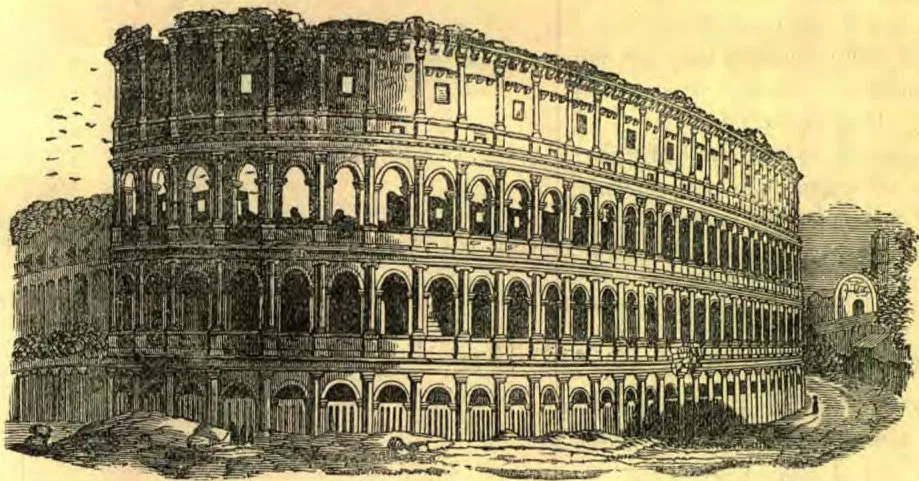
THE inhabitants of Rome, during the height of that city's power, found great pleasure in witnessing bloodshed. In their struggles for office and fame, ambitious statesmen took advantage of this weakness in the people, and sought to gain their favor and support by providing them with amusements of this demoralizing character. Slaves and prisoners taken in war were trained in the art of killing one another. These trained combatants, called gladiators, were compelled to fight with one another, and with wild beasts, in the presence of vast crowds. Wild beasts were left unfed for several days, and then let loose upon each other for the amusement of the beholders. So attractive were these cruel sports made, that it became impossible to accommodate the immense crowds that assembled to witness them. This state of things gave rise to the building of amphitheatres, or vast buildings in which the people were seated all around an open center, called the arena. In this arena the gladiators and wild beasts fought.
Nearly one hundred of these amphitheatres are known to have existed in the southern part of Europe. The largest and most magnificent of these structures was the one at Rome. It was begun by the Emperor Vespasian, and completed by his son, Titus, A. D. 80. The ruins of this stupendous pile as they now appear from the outside, are presented in the picture. The colossal proportions of this structure led to its being distinguished from all other amphitheatres by the name, Col-os-sé-um. Though for centuries it served as a quarry from which material was obtained for palaces and churches, it still stands—
“A noble wreck in ruinous perfection, While Cæsar’s chambers and Augustan halls Grovel on earth in indistinct decay.”
It is pronounced by all to be “the grandest ruin in the world.” Some idea of its size may be gathered from the following figures:—
The building was oval in form, its greatest length being 612 feet, and its greatest width 515 feet. The arena was of the same form as the outside of the building, and was at least 250 feet long by 150 in width. The height of the building was 160 feet, while the whole structure covered an area of nearly six acres. The arena was surrounded by a wall 15 feet high, which was made of polished marble so that the wild beasts could not by any possibility climb it, and was surmounted by a bronzed railing or network. On a level with the top of this wall was the first platform, which extended entirely around the arena, and was occupied by the noblest of Rome’s citizens, including the emperor and senators. From the top of the wall that formed the back of this platform rose a second platform, and above and back of the second, rose a third, and likewise a fourth which reached back to the outer wall of the building. Thus the view presented on the inside was that of an immense basin, with thousands of people clinging to its sides. Within this spacious inclosure were seats for 87,000 people, while 15,000 more could be provided with standing room. At each end of the arena was a large door for the entrance of men and beasts. The latter were kept in dens under the platforms, and were sometimes driven out upon the arena from small doors in the side of the wall surrounding the arena.
Lack of space forbids a description of the splendor and magnificence with which the interior was adorned. Marble statuary, gilded pillars and arches, ivory trimmings, and silken awnings made the place as attractive as it was possible for art and wealth to do. And yet we turn with disgust from the thought that all this outlay of human skill and labor was to furnish a hundred thousand of the citizens of Rome a view of their fellow-men being hewn, and hacked, and torn, until the whole arena was strewn with their dead bodies, and its soil literally drenched with their blood. During the persecutions of the early Christians, many noble martyrs lost their lives in the arena of the Colosseum, while the Roman populace taunted and jeered them in their dying agonies. But in A. D. 500 the emperor Theodoric put a final stop to all kinds of bloodshed in the Colosseum, and from that time to the present day the place has been deserted and left to decay. Trees have taken root in the crevices of its stones, and vines, bearing rare and beautiful flowers, twine over its walls and arches. Yet so massive were its walls, so admirably fitted were its arches and galleries, and so stupendous was the whole mighty structure, that it has withstood the pillages of both man and time, and still remains a monument to man’s intellect, and a reminder of the good he is able to accomplish when his powers are sanctified to the glory of his Creator.
C. H. G.

VINA'S WILD FLOWERS.

"Millie, will you go for a walk in the woods this afternoon, if I will come over after you? It is so warm and pleasant, and I wish to gather some flowers once more before they are gone."
"They are all gone now, I guess."
"Oh, no! Some of the latest, you know, last until after the hard frosts."
"Well, I will go, if you wish."
So that afternoon Millie Earl and Vina Somers spent in the woods, gathering flowers and mosses, lichens and autumn leaves, and, withal, laughing and chatting like the merry, joyous-hearted girls they were.
At early dusk, they started for home, with their baskets heavily laden.
The next day, Millie called at Vina's home. Seeing only a few sprays of flowers in a vase on the mantel, she exclaimed:—
"Why, Vina, where are the rest of your flowers? You had more than that, when I left you last night. What did you do with them?"
"Well," said Vina, "I called at Auntie Wild's for a glass of water; and as I was drinking, the old lady said: 'Why, what pretty posies! They make me think of the days when I was young, and used to ramble in the woods. My rheumatiz will not let me go so far now, though I like the posies as well as ever.' So I divided with her. She seemed so pleased as she got an old pitcher, and put them in it, placing it on her stand, just back of her Bible, so she could see them all the time.
"Then, I met some children, and they looked at my basket with such longing eyes that I gave each one a spray of flowers and a cluster of scarlet berries.
"And, lastly, as I was passing Widow Morton's, I saw her little crippled Lena sitting out on the stoop, so I stopped to speak to her. She said it seemed so warm and pleasant that she wanted to get out, for it would soon be cold winter weather, and then she would have to stay indoors all the while. She admired my flowers, and said she wished she could go and get some too; but she was afraid she never could again. So I gave her nearly all I had left. And now you know why I came home almost empty-handed," she said laughingly.
"Well, I've ever so much the nicest bouquet," said Millie. "Uncle Henry thought it was beautiful; and Prof. Spencer called to see papa last night, and he noticed and admired my flowers too. I told them I thought your bouquet would be the handsomest, as you had more than I. But you were foolish enough to give yours all away."
"Not quite all. I kept enough to keep the day and the grand old woods in remembrance. And I made hearts happy all along the way."
"But only for a moment or two," said Millie.
"Well, that was something," answered Vina. "Life is made up of moments, you know."
And Millie went home with a new idea springing-up in her mind and heart.—Well-Spring.

GOD’S CARE.

Not a brooklet floweth Onward to the sea, Not a sunbeam gloweth On its bosom free, Not a seed unfoldeth To the glorious air, But our Father holdeth It within his care.
Not a flower fadeth, Not a star grows dim, Not a cloud o’ershadoweth, But ’tis marked by him. Dream not that thy gladness God doth fail to see; Think not in thy sadness He forgetteth thee.
Not a tie is broken, Not a hope laid low, Not a farewell spoken, But our God doth know; Every hair is numbered, Every tear is weighed In the changeless balance Wisest love has made.
Power eternal resteth In his changeless hand; Love immortal hasteth Swift at his command. Faith can firmly trust him In the darkest hour, For the key she holdeth To his love and power.

“I GOT A-GOING, AND COULD NOT STOP.”

I heard of a boy who was standing on the top of a hill, and his father was standing half-way down, and the father called to his boy, “Come.”
He ran down, but did not stop where his father was, but went to the bottom of the hill.
His father said, “Why did you not come to me when I called you?”
He said, “O father, I got a-going, and I could not stop.”
Young reader, take care lest you have to say, “I got a-going, and I could not stop.”
I will tell you what once happened. There was a young man only twenty years of age, and he was lying in jail. He had killed a man, and he was going to be hung. He had been a Sabbath-school boy, and his teacher went to see him in prison. He had to go through a long, dark passage, and presently he came into the miserable cell.
It was a beautiful day; everything was lovely outside; the birds were singing; the sun was shining, and everything was green and beautiful. And this young man—only twenty years of age—was lying in this dreadful cell, his limbs chained together, going to be hung! And the gentleman spoke to him kindly, and said,—
“Oh, I am so sorry to see you here.”
The young man burst into tears, and said: “Ah! sir, if I had minded what my father and mother said to me—if I had attended to what you told me at school—I should not now be here! I got into bad company. I followed one young lad and another. I got something to drink. One bad thing led to another bad thing, and one day, being half drunk, I killed a man, and now, sir, I am going to die.”
Ah! “he got a-going, and could not stop!” Take care about the bottom of the hill. Do not “get a-going.” You may not be able to stop till you get to the very bottom.”—Rev. J. Vaughan.

TRYING, AND TRYING HARD.

Very few of us can become great, but we can all do little things well. As girls, you can set the tables straight, make sweet, light bread, and have your dresses fit nicely. As boys, you can drive a nail straight, and dovetail boxes together neatly; and as both boys and girls, you can study thoroughly, have good manners and a noble character, because you will begin by being patient, persevering, thorough. Give all your strength to whatever you are doing, so that it will be soon done and well done.
There is no need of waiting till you are as old as some other people before you begin to try. Don't you all know some little child who does the family work, and, what is harder still, takes care of her younger brothers and sisters because their mother is dead?
If you want to do something you almost always can do it. I know a young man who wanted to go through college, and how much do you think it cost him to live while there? About forty cents a week. He generally ate nothing but oatmeal, and drank only water; once a week he indulged in bread and milk. That was trying hard for an education.
I have seen boys and girls studying their lesson, and then they tell me they have tried. I'll tell you how they did it. Perhaps you have not seen anything of the kind. They worked hard over the first half of the page, then they remembered that their shoe-string was untied, and they tied it; then five more lines of the page, and suddenly their pencil needed sharpening; as soon as they used it, the fine point, half an inch long, which had taken five minutes to make, broke; of course it must be sharpened again. Next they went out to see what time it was; were amazed at finding it so late; stopped to say so to their mother; studied hard again for fifteen minutes, when something in their pocket was uncomfortable; so knife, pencil, strings, chalk, crumbs, and one mitten had to be taken out. Where was the other mitten? Better hunt for it at once. That took five minutes more, for it was in their coat pocket, all wet, and had to be stretched and put by the fire to dry. At last they really do study until the lesson is nearly learned; then nine o'clock comes and they are told to go to bed.
They say good-night, and add, “Now don't you think I have really tried? I only stopped when I had to.”
The next morning at school they guess at the right answer to the question they had not studied the previous night; but when examination day comes, a few months later, they fail, for there are so many places they had not had time to study up, yet they are sure they tried. So they come home cross, throw themselves down upon the lounge, and call out:—
“What is the use of studying? One can't study all the time and have no fun. I am sure I tried all I could.”
And so they live on in their self-conceited way of trying, and when grown up, find they cannot earn their living in the best places, but can only do the rough work in some trade—all from want of trying hard.—
Little Unity.

WHO HOLDETH UP THE SKY?

From the grass a Daisy looked, And with a glance quite shy, “Oh dear Miss Rose,” she asked, “Do you hold up the sky?”
“Dear Daisy,” said the Rose, “I cannot reach so high; And very far above me Is the blue and lovely sky;”
“But if you wish to know, To find out I will try; For maybe ’tis the Fir-tree That’s holding up the sky.”
Then the Rose to the Fir-tree Upraised her radiant eye, And said with a blush, “Good sir, Do you hold up the sky?”
The Fir-tree shook his head And answered with a sigh, “Oh no, indeed, sweet Rose, It surely is not I.”
And then he asked the Elm, Who stood to him quite nigh: The Elm her branches waved, And said, “It is not I.”
“But a Mountain very tall In the distance I espy; And on his shoulders rests, I think, the wondrous sky.”
And the Elm-tree sent the Wind, And the Wind did swiftly hie; And said, “Your highness, sir, Do you hold up the sky?”
Returned the Mountain, “Who would Into these secrets pry? I’ve stood here many an age, But I never touched the sky.”
“Sweet Daisy,” sighed the Rose, “I fear before we die We never shall find out Who holdeth up the sky.”
But as she spoke, a bird So far above did fly, They thought he surely touched That very same blue sky.
When flew the little bird To the Fir-tree by and by, They asked, “Oh, tell us, please, Who holdeth up the sky?”
Perched on the swinging bough, Then sang the happy bird, While Elm and Fir and Mountain And Rose and Daisy heard:
“’Tis He who made the Daisy, And He who made the Rose; ’Tis He who made the Fir-tree, The Elm, and all that grows;
“’Tis He who made the Mountain, And made the bird to fly— The good and heavenly Father, Who holdeth up the sky.” —Wide Awake.

IN THE DARK.

MANY illustrations of faith have been given, but none seem to us better than that given not long ago in a prayer-meeting.
A father said that his little girl, who was much afraid of the dark, slept at night in a crib beside his bed. Often had he been wakened during the night by a little voice, saying,—
“Papa, it’s dark! It’s dark, papa! Take Nellie’s hand.”
And when, in answer, he had taken hold of the lifted hand, she sank quietly to sleep, all her fears being taken away.
The remembrance of the pleading voice had often helped him to remember in the midst of troubles and distress that he, too, had a Father to whom he could lift his hand and say, “Father, it is dark! Take my hand.” And is He not “nigh unto all them that call upon him?”—Sel.

LESSON 91.—THE QUESTIONINGS OF THE SADDUCEES AND OF THE LAWYER.

On the same day that Jesus put the Pharisees to silence there came to him a company of Sadducees, who say there is to be no resurrection. They thought they could show that the doctrine of the resurrection of the dead was untrue, and began by saying, “Master, Moses said, If a man die, having no children, his brother shall marry his wife, and raise up seed unto his brother. Now there were with us seven brethren; and the first, when he had married a wife, deceased, and having no issue, left his wife unto his brother; likewise the second also, and the third, unto the seventh. And last of all, the woman died also. Therefore, in the resurrection, whose wife shall she be of the seven? for they all had her.” But Jesus said, “Ye do err, not knowing the scriptures, nor the power of God.” “But they that shall be accounted worthy to obtain that world, and the resurrection from the dead, neither marry nor are given in marriage, neither can they die any more; for they are equal unto the angels, and are the children of God, being the children of the resurrection.” “And as touching the dead, that they rise, have ye not read in the book of Moses, at the bush, how God spake unto him, saying, I am the God of Abraham, and the God of Isaac, and the God of Jacob? He is not the God of the dead, but of the living. Ye therefore do greatly err.”
When the multitude heard these words, they were astonished at the wisdom of Jesus, and certain of the scribes also acknowledged the excellence of his words, saying, “Master, thou hast well said.” When the Pharisees heard that Jesus had put the Sadducees to silence, they held a council, and chose one of their number, a lawyer of great merit and sound judgment, and put him forward as their spokesman. All their former craftiness had failed, and they now trusted their cause to a really honest man; yet one who had not hitherto believed on Jesus. Approaching Jesus, the lawyer said, “Master, which is the great commandment in the law?” Jesus at once replied, “Thou shalt love the Lord thy God with all thy heart, and with all thy soul, and with all thy mind. This is the first and great commandment. And the second is like unto it, Thou shalt love thy neighbor as thyself. On these two commandments hang all the law and the prophets.”
Then the lawyer spoke, saying, “Well, Master, thou hast said the truth; for there is one God, and there is none other but he; and to love him with all the heart, and with all the understanding, and with all the soul, and with all the strength, and to love his neighbor as himself, is more than all whole burnt offerings and sacrifices.” When Jesus saw that the man answered discreetly, he said unto him, “Thou art not far from the kingdom of God.”
After this no one dared to ask him any more questions.

QUESTIONS.

  1. Who next came to question Jesus on the same day that he put the Pharisees to silence?
  2. What was the peculiar doctrine of the Sadducees?
  3. What did they think they could prove?
  4. What did they begin by saying? Matt. 22:24.
  5. What case did they suppose? Verses 25–27.
  6. What question did they then ask? Verse 28.
  7. How did Jesus say they erred?
  8. What did he say of the marrying of those who will be accounted worthy to obtain eternal life? Luke 20:35.
  9. What did he say about their immortality?
  10. To whom did he say they will be equal?
  11. Whose children will they be?
  12. What circumstance did Jesus bring up to show that there will be a resurrection of the dead?
  13. What did the Lord say to Moses from the burning bush?
  14. What remark did Jesus make upon this?
  15. What does this imply?—That Abraham, Isaac, and Jacob are alive to God, since he will bring them from the grave, and give them eternal life.
  16. How were the multitude affected by these words?
  17. How did some of the scribes acknowledge the excellence of our Saviour’s words? Luke 20:39.
  18. What did the Pharisees do when they heard that Jesus had put the Sadducees to silence? Matt. 22:34.
  19. Whom did they choose to speak for them?
  20. What seems to have been the character of this man?
  21. What question did he propose to our Lord?
  22. What did Jesus say about the first commandment in importance?
  23. Which of the ten commandments are included in this?
  24. What did he say about the second great commandment?
  25. Which of the ten commandments are included in this one?
  26. What is meant by saying that on these two great commandments hang all the law and the prophets?—That the precepts of the law, and the instructions of the prophets were all meant to teach these great principles of love to God and man.
  27. What did the lawyer say when he had heard this answer? Mark 12:32, 33.
  28. What did Jesus then say to him?

NEW-TESTAMENT HISTORY.

LESSON 105.—JESUS INSULTED BY HEROD AND THE SOLDIER.

“WHEN Pilate heard of Galilee, he asked whether the man were a Galilean. And as soon as he knew that he belonged unto Herod’s jurisdiction, he sent him to Herod, who himself also was at Jerusalem at that time.
“And when Herod saw Jesus, he was exceeding glad; for he was desirous to see him of a long season, because he had heard many things of him; and he hoped to have seen some miracle done by him. Then he questioned with him in many words; but he answered him nothing. And the chief priests and scribes stood and vehemently accused him. And Herod with his men of war set him at nought, and mocked him, and arrayed him in gorgeous robe, and sent him again to Pilate.
“And the same day Pilate and Herod were made friends together; for before they were at enmity between themselves.
“And Pilate, when he had called together the chief priests and the rulers and the people, said unto them, Ye have brought this man unto me, as one that perverteth the people; and, behold, I, having examined him before you, have found no fault in this man touching those things whereof ye accuse him; no, nor yet Herod; for I sent you to him; and, lo, nothing worthy of death is done unto him. I will, therefore, chastise him, and release him.”
Now it was the custom for the Governor to release one prisoner at every Passover, whomsoever the people might choose. At this time there was in prison a noted outlaw called Barabbas, who was guilty of robbery, sedition, and murder; and Pilate being anxious to deliver Jesus, asked the people whether he should not set him free rather than Barabbas. Pilate could easily see that it was only because of their envy that the chief priests had accused Jesus, and he hoped by this appeal to the people to get a decision in favor of his release. But the chief priests instigated the people to choose Barabbas, the lawless murderer, rather than Jesus, the Saviour of men. Pilate was greatly perplexed, for he knew that the accusations of the Jews were false, and besides this, his wife sent to him, saying, “Have thou nothing to do with that just man, for I have suffered many things this day in a dream, because of him.”
When the people insisted on the release of Barabbas, Pilate said to them, “What shall I do then with Jesus, which is called Christ?” And they cried out saying, “Crucify him, crucify him!” Then Pilate said again, “Why, what evil hath he done? I have found no cause of death in him. I will therefore chastise him and let him go.” But they were the more persistent and turbulent, crying out with loud voices, “Crucify him, crucify him!”
“When Pilate saw that he could prevail nothing, but that rather a tumult was made, he took water, and washed his hands before the multitude, saying, I am innocent of the blood of this just person; see ye to it. Then answered all the people, and said, His blood be on us, and on our children.
“Then released he Barabbas unto them: and when he had scourged Jesus, he delivered him to be crucified.” “And the soldiers led him away into the hall, called Prætorium; and they call together the whole band. And they clothed him with purple, and platted a crown of thorns, and put it about his head, and began to salute him, Hail, King of the Jews! And they smote him on the head with a reed, and did spit upon him, and bowing their knees, worshipped him.”

QUESTIONS.

1. What did Pilate do as soon as he was told that Jesus was from Galilee? Luke 23:6, 7.
2. Why was Herod glad to have Jesus sent to him?
3. What satisfaction did Herod obtain from Jesus?
4. What course did the chief priests pursue?
5. How was our Lord treated by Herod and his men of war?
6. What reconciliation took place at this time?
7. When Pilate had called the chief priests and rulers and the people together, how did he address them? Verses 13–16.
8. What was it customary for the Governor to do at every Passover?
9. What noted outlaw was a prisoner at this time?
10. Of what was he guilty?
11. What did Pilate ask the people?
12. Why did he do so?
13. What could Pilate easily recognize as the cause of the bitter spirit the chief priests manifested toward Jesus?
14. What did he hope to secure by appealing to the people?
15. In whose favor did they finally decide?
16. How did Pilate regard the accusations of the Jews?
17. What circumstance added to his perplexity?
18. What did Pilate say to the people when they insisted on the release of Barabbas?
19. What response was called out by this question?
20. How did Pilate still further remonstrate with them?
21. What did he propose to do?
22. What was the effect of such an appeal?
23. What did Pilate now perceive?
24. By what ceremony did he show that he wished to be free from the crime of taking the life of Jesus?
25. What did he say as he washed his hands before the multitude?
26. How did the people reply?
27. What action did Pilate then take?
28. To what place was Jesus then led?
29. What did the soldiers there do to him?
30. How did they then mock and insult him?

HOW TO LEAD.

JUST in proportion as one rises to the vastness of the work which has his heart, does he rise above anxiety as to the credit he shall gain for his personal part in that work. Losing himself in the cause he lives for, he loses thought for himself as the one who more than others is living for that cause. And just in proportion as one gains in this unselfish devotion to a great cause, does one gain power over others in behalf of that cause. The world is more ready to be led, than it is to admit that it is being led; and he who is willing that others shall carry off the credit of his labors, will find many to go in his direction because of the credit which they can take for so doing. Thus it is, that he who will lose his life for the truth shall find it. It is in a beautiful exemplification of this spirit, that the poet Whittier says in his latest poem:—
“If any words of mine Through right of life divine, Remain, what matters it Whose hand the message writ?”
Or, as a saintly one of old expressed it: “I have planted; Apollos watered; but God gave the increase. So then neither is he that planteth anything, neither he that watereth, but God that giveth the increase.”

MARGIE'S LESSON.

LITTLE Margie, with her mother, was on a visit to her grandmother, who lived in a fine roomy old house in the town of Fernley.
There was a beautiful porch in front of the house, with very large white pillars reaching up to the roof of the house; and the floor was made of square stones, part white and part blue, while broad stone steps led down to the walk. But it was a rather dangerous porch for little folks, because, although it was almost a full story from the ground, it had no railing around it. This did not matter much, most of the time, as there were no little children living in the house, but everybody was uneasy about it when little Margie was there; and this was the reason why. That little girl had a very bad habit of never obeying right at once when she was spoken to. If her mother would call, “Stop, Margie,” she would always go a few steps farther before she obeyed. If she said, “Don’t do that, daughter,” when she was in any mischief, the little girl would almost always go on for a while instead of stopping as soon as her mother spoke. Many a bump and tumble she had gotten in consequence of it, but as yet nothing had cured her of this evil habit.
Her little cousin Lucy was there on a visit at the same time; but she, although younger, obeyed her mother perfectly, and gave no uneasiness to anybody.
When the two little girls were running on the porch together, as they were very fond of doing, just before they got to the end, Lucy’s mother would say quietly, “Stop now, Lucy,” and Lucy would stop right still that very minute, while Margie’s mother would cry, “Stop, Margie! stop! stop!” and then run after her and grasp her dress perhaps just in time to save her from running off at the end.
One evening, however, they started for a race, when Margie’s mother was talking with some one at the farthest part of the porch, and with her back to them. She turned in time to see them almost at the edge, but being too far off to hope to reach them, she screamed frantically, “Stop, Margie, you’ll fall! you’ll fall!” but, as usual, Margie would go a few steps farther. So off she went, just where the porch was highest, and fell in a little heap on the ground.
The mother did not wait for her bitter cry of pain, but, hastening round by the steps, lifted and carried her carefully into the house, one little arm hanging helplessly, pitifully, with splinters of the bone sticking through the tender flesh, for it was broken.
Oh! how dreadfully it hurt, even when nobody touched it; but when the doctor came and pulled it ever so hard, as he was obliged to do to get the poor little bone straight, it took mother and Aunt Margie both to hold her.
All this time, and for several days, the suffering was too great to let her remember how it all happened; but the thinking time came at last, when she had to sit in the big chair all day long with her arm in a sling, and nothing to do but remember how many times she had delayed and hesitated instead of obeying her mother promptly, and how that very thing had been the cause of all this trouble.
One day she called her mother, and putting her unbroken arm around her neck, she whispered, while her little lips quivered, “Mother, I know why I broke my arm, and I am so sorry I was such a naughty girl; I am going to try, when I get well, to mind you the very minute you speak to me; and mother, won’t you punish me whenever I don’t!—if I don’t mind the very first minute, mother?” And she held her tightly with that one good arm until she got the promise.
The next time they all visited grandmother’s, no one could say that Margie did not obey her mother as promptly as Lucy.—S. S. Times.

THE SILK-MERCHANT AND CAMEL-DRIVER.

A CHRISTIAN merchant, having intrusted a Turkish camel-driver with a certain number of bales of silk, to be carried from Alleppo to Constantinople, set out on the journey with him. But in the midst of the route, he fell ill and could not follow the caravan, which, by reason of this accident, arrived long before him. The camel-driver, not seeing his employer come at the expiration of a few weeks, imagined that he was dead, sold the silk, and changed his profession. At length the Christian merchant arrived, found him out, after much time spent in inquiry, and demanded his merchandise. The knave pretended he did not know him, and denied that he was ever a camel-driver. The Cadi, before whom this affair was brought, said to the Christian,—
“What’s your demand?”
“I demand twenty bales of silk which I intrusted to the care of this man here.”
“What do you answer to this?” said the Cadi to the camel-driver.
“I know not what he means by his bales of silk and his camels. I never saw the man before in my life,” replied the camel-driver.
Then, the Cadi, turning to the Christian, asked him what proof he could bring in confirmation of what he alleged.
The merchant could allege no other than that his illness had prevented his keeping company with the camel-driver.
The Cadi called them both brutes, and desired them to withdraw from his presence. He then turned his back upon them, and, as they went out together, he thrust his head out of a window, and cried out pretty loud,—
“Camel-driver, a word with you.”
The Turk immediately turned his head around, without thinking that he had lately abjured the trade and profession. Then the Cadi, obliging him to return, ordered him to be bastinadoed, and made him confess his knavery. He sentenced him also to make amends to the Christian for his silk, and to pay a considerable fine for the false oath he had taken.—Selected.

PARROTS

Parrots are found in tropical climates. They breed in hollow trees, and live on fruits and seeds. They are remarkable for the brilliancy of their colors and their faculty of making indistinct articulations of words in imitation of the human voice. The hooked bill is used in climbing. These birds are found in many parts of the country as pets. They become very interesting on account of their efforts at imitating sounds that they hear. Sometimes they will whistle in imitation of other birds, and in imitation of men and boys calling dogs. A man in a town had one that would whistle until he would gather a lot of dogs near his cage, then in imitation of a man he would cry out, “Get out, get out,” and send the dogs away in a great hurry. They will learn to pray or to swear. A lady once had one that had learned to swear by hearing somebody about the house swear. This lady knew of a man who had one that prayed. She concluded to take hers over to see whether it would not learn to pray by hearing the other one, but, sad to relate, the swearing one succeeded in teaching the other to swear instead of being converted to praying himself.
Badness is a dangerous thing to be about. There is so much of it in the world that it sometimes overcomes the good. If parrots can be led to bad habits by getting into bad company, there is danger of boys and girls becoming bad if they associate with others who are wicked.—S. S. Gem.
Continue reading: GOOD MORNING