An artist, fond of sunshine,
Who wide-spread fame had won,
Would oft begin his painting
By putting in the sun.
Then all the varying landscape
Of mountain, sea, and vale,
Received a bright reflection,
And told a sunny tale.
We love a cheerful painting,
And can not we begin
Each busy day that dawneth
To put some sunshine in?
Then every hour that follows,
In some harmonious way,
May mirror back the gladness
Which hailed the opening day.
The artist paints no longer,
His earthly days are done;
But still it lives—his lesson
Of putting in the sun.
—Eva Young.
“They Shall Not Hurt Nor Destroy”
By John M. Hopkins
JOHN M. HOPKINS
Every one who has ever lived in the Northwest, in Minnesota or the Dakotas, is familiar with the sound, the spring harbinger,—Bum, bum, boo!—the crowing of the prairie rooster, heard about as well as the first of any from the feathered creatures. And when the farmer hears this welcome sound at four or five o’clock in the morning, he says, “The time has come to sow and plant.”
After the long, cold winter we are always made glad by this crowing, and also by the sweet songs of the happy birds returned from their Southern winter homes. Taught of God, they retrace their journey through the trackless space of heaven, coming back each spring to the nesting places of former years.
But the prairie chicken remains all the year. In the last of April or during May she makes her nest in some cozy spot in the wild prairie grass, lays from ten to thirteen eggs as large as a medium-sized walnut, and there she sits and hatches her young. And when the little chicks are able to run about, it is almost impossible to find them, so closely will they nestle here and there in the grass.
Forty years ago there were one hundred prairie chickens in Minnesota to one now. They have been hunted and shot until the legislature enacted an ordinance prohibiting all persons from shooting them before the first of September each year.
To-day is the opening of the chicken season in Minnesota, and “Bang! bang! bang!” was the cruel sound that grated upon my ear about daybreak this morning, and I knew the beautiful innocent creatures were being killed to gratify the depraved appetite of men. Indeed, sportsmen eagerly look forward to this time of year, when load after load of men with dogs and guns may be seen driving over the fields where the grain has recently been harvested, in search of the prairie chicken. The trained “chicken dogs” run here and there, and scare the chickens, so the hunters can shoot them as they fly; and the man who “bags,” the largest number is the “lucky fellow.”
To me it is a very painful sight to see the poor things, which, a moment before, could fly in the pure atmosphere of heaven, harmless as doves, now hanging at the hunter’s side with a broken, bleeding wing, or maybe a broken neck. How any one can take delight in such cruel work I can not see. With the abundance of healthful foods that God has given us, it seems altogether unnecessary to slaughter our fellow creatures (all were created by the Lord), to deprive them of life, which is sweet to all animate beings. The beautiful fish in our lakes and rivers, our domestic animals—why should we be so cruel, so hard-hearted, as to take their lives?
Every day I thank God that this business will not always continue. The time is not far distant, when, according to the Word of the Lord, “they shall not hurt nor destroy in all my holy mountain.” Isa. 11:9. Study the first ten verses of this chapter, and I believe that as we draw nearer to that glad day, as we become more and more like him, growing daily into his loving, gentle nature, this flesh-hunger, this life-taking disposition, will leave us. We shall love our fellow beings, the beautiful flowers, and the patient, faithful creatures about us.
Let us pray for a baptism of the Holy Spirit. Let us cultivate the pure, the kind, the gentle. Let us cultivate a love for the pure and holy.
An Important Matter
Is it a fact that the peace of the home, and even that of states and nations, is affected for weal or woe by the diet of the people? An exchange believes this to be true, and says:—
“Bad cookery, bad food combinations, late suppers, indulgence in alcoholic drinks,—one or all of these may be, and frequently has been, the underlying cause of serious troubles in the home, the business, or the state life.
“A fermented state of the digestive organs produces a like fermented and irritated condition of brain and nerve; and while under the influence of this auto-intoxication, this self-manufactured poison, the individual may give vent to language that will separate chief friends, and result in life-long estrangements.
“ ‘Divorced, because of hasty words uttered while suffering from indigestion,’ might truthfully be reported as the chief cause of more than one divorce.
“ ‘Plunged into war because of a bilious attack upon the part of a leading diplomat,’ might truthfully be recorded also as the cause of war and bloodshed.
“ “Happy is that nation whose princes, noblemen, and diplomats, recognize this principle, and who ‘eat in due season for strength, and not for drunkenness.’”
True Health Reform Diet
TRUE health reform diet means the best and most nourishing diet.
Flesh Diet
Some people imagine they see starvation staring them in the face when they read or hear any suggestion of a “meat-famine.” A probable scarcity of flesh-meat in the market, or an intimation of high prices from any cause, is deemed a public calamity. But if all would invest the money usually spent for flesh food in any of the better articles of diet, they would be better off health-wise as well as in purse. That meat is a prime necessity in the line of food is a mistaken idea, as is shown in the lives of many individuals, and of large classes of people.
An instance, reported in a current press item, is that of a Frenchman who is one hundred and five years of age. Every day, no matter what the state of the weather, he is out on the streets of Carmes selling small brooms, which he makes himself. His name is Ignace Botta, and he is hale and hearty, with snow-white hair. He is in full possession of his mental faculties, yet his life has been full of hardships. His daily nourishment consists of a loaf of dry bread, and sometimes a glass of sweet wine. He never has tasted meat.
On this question of flesh diet, there are some leading points that are worthy of special consideration: 1. God knows what is best for the sustenance of the human body and mind. 2. When he created man and beast, no flesh food was prescribed for any living creature. The eating of flesh by man or beast was a result of the fall, and a consequent degeneration of instinct and perversion of appetite. 3. When God would supply his people with food in the wilderness, he gave them manna from heaven, although it was just as easy for him to give them quails, which he did not do until they cried for flesh, not being willing to accept the wisdom of God in the matter. See Num. 11:4, 13, 17-23, 31-33. 4. When Daniel and his companions chose to eat only vegetarian food while attending school, they were graduated with higher honors than any of their fellow students. 5. When God would select a food for the unlimited perpetuation of life, he choose the fruit of a tree—the tree of life—and not flesh food. 6. As there was no flesh eating before the fall, there will not be any such thing when the dominion shall have been restored, as it will be in Christ. See Micah 4:8; Rev. 21:1-3; 22:1, 2, 14. 7. Whatever of actual necessity there may be now for flesh eating at times or in remote places, under restricted circumstances, is the result of dependence upon it, and use of it, and the lack of preparation for the use of other diet. The necessity, real or imaginary, is altogether an artificial necessity—the outgrowth of long departure from the natural food provided by the Creator.—Signs of the Times.
Korea Awaits the Message
By F. W. Field
F. W. FIELD
THE following Macedonian cry from Korea has deeply stirred our hearts. Recent reports in the REVIEW have told how two Korean brethren accepted the truth in Kobe; and how one of them, Song-fun-cho by name, while on his way home, met a fellow-countryman, Rin-ki-pan, and presented the truth to him. As a result, Rin-ki-pan readily accepted the message, and returned to his home in Chin-am-po. He at once began to disseminate the truth among his acquaintances, and the result is stated in the following letter just received by Brother Kuniya at Kobe:—
“Ko-sho-go, a servant of Jesus Christ, to his dear Brother Hide Kuniya, greeting. Grace and mercy from our Heavenly Father be with you. Amen. Two years ago I was converted to Christianity, but the light received was somewhat dim. Lately a brother in the truth, Rin-ki-pan, taught us about baptism and other ordinances observed in your church. We were surprised and greatly enlightened, and greatly praise the Lord. We now believe, and desire to be baptized,—sixteen men, fourteen women, and six youth. Has not our Heavenly Father chosen these to teach this truth? We praise his name. We wish with Brother Rin-ki-pan to join your church; but recently this brother has been under some trial. We are praying earnestly. Dear brother, when you read this, hasten to take a boat and come to us, associate with us who believe these truths, and establish a church, and thus save perishing souls. In your letter you wrote that you can not understand our language; but if God be with you, why need you fear? See Acts 2:4; Eph. 6:19. If you can come, then send us a telegram, and our desire will be fulfilled. Also if you can not come, telegraph to us; but we shall look for you. May our Heavenly Father send you to us.”
The writer enclosed a list of the names of the thirty-six persons mentioned in the letter. The list includes husbands and wives, mothers and sons. We infer that they were all professing Christians before, and so were prepared to receive more light; but we know nothing of their church connections.
I hardly need add that our committee in charge of the work in Japan decided without hesitation that this call should be answered; so the desired telegram was sent, and Brother Kuniya will sail for Chin-am-po as soon as he can arrange to go.
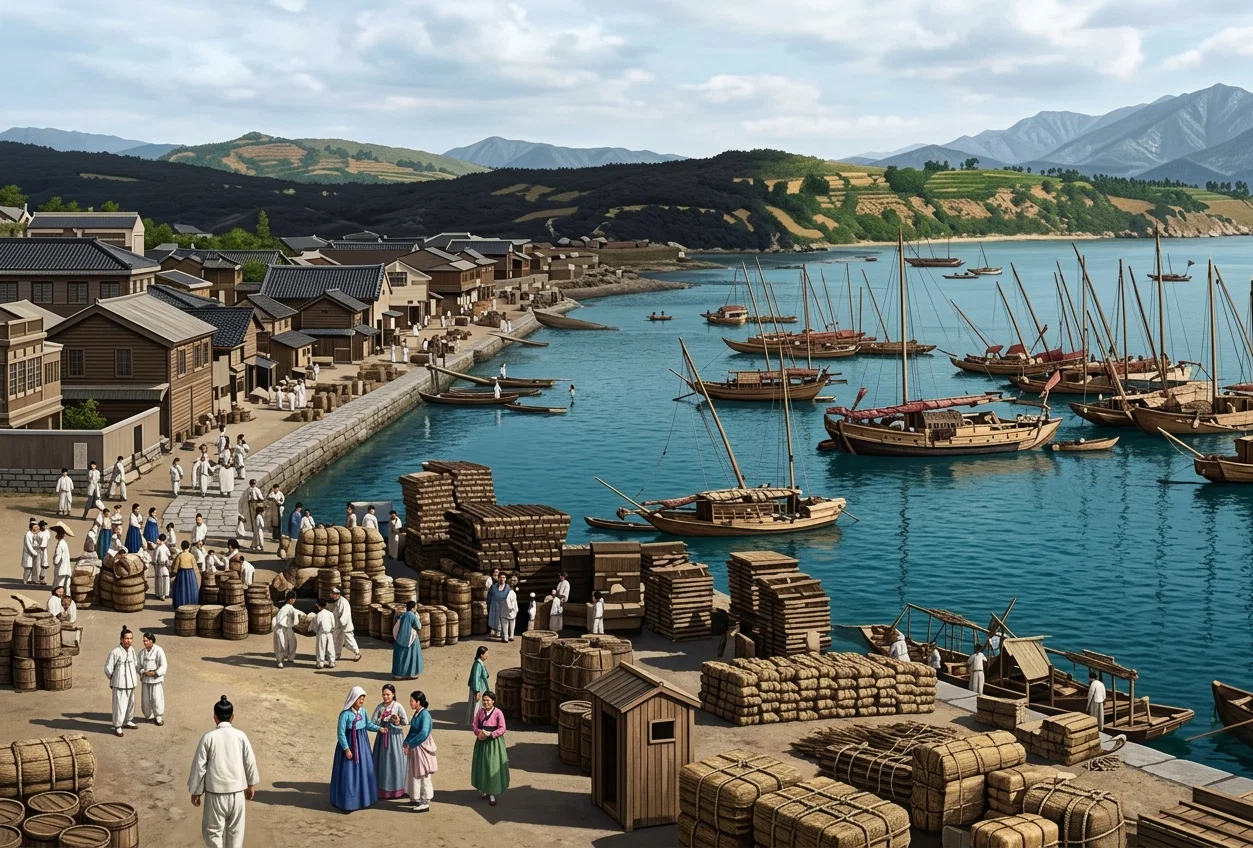
Chin-am-po is a port open to foreign trade, situated on the west coast, between one hundred and two hundred miles north of Chemulpho, the port of Seoul, the capital. It contains somewhere from fifteen to twenty thousand inhabitants. Farther up the Todang River is Pyong-yang, a large and important city. At both these places foreign missionaries are located; and Christianity has gained quite a foothold in this region. All those Koreans who have recently accepted present truth are from this part of the country; so this certainly seems a providential opening for our work.
Japan and Korea are closely connected in various ways. Why should not the Japanese Mission annex Korea to its field of operations? But to do this we need means and workers; and we now make a definite call in behalf of this needy, open, ripened field. Are not the clusters of the vintage almost falling into our hands? We know our people will be as stirred by these things as we have been. We could locate workers at once, who could begin the study of the language, and have a watch-care over these new believers. As yet we have no one who could act as interpreter between us and the Koreans; but a number of our Japanese brethren understand English fairly well, and one of these could act as such between our English-speaking workers and the Japanese merchants found in every open Korean port. This would enable our workers to get along in a business way till they could acquire some knowledge of the language.
We do not urge any hasty action in this matter; but what less can we do than to pass along the word. The Mission Board may not be able to respond to this call at once. But some of our conferences are giving a goodly part of their tithe and workers to other fields. We present this opening to the consideration of such. And any whose hearts are so moved might contribute to a fund for opening the work in the once Hermit Nation. Meanwhile we shall do all we can to enlighten these earnest inquirers, and we ask an interest in the prayers of our people, that Korea may soon be added to the many nations, tongues, and peoples among whom the standard of present truth has been firmly planted.
Tokyo, Japan.
CHEMULPHO, KOREA
Our East African Mission
By L. R. Conradi
L. R. CONRADI
Among the colonies of the German empire, German East Africa is the largest, and contains the greatest number of inhabitants. Its area is about one tenth that of the United States, or twice the size of Germany proper, while its population numbers six and a quarter millions. Thus it is somewhat more sparsely inhabited than the States. The most thickly populated districts are naturally along the seacoast in the east, and along Lakes Nyassa, Tanganyika, and Victoria Nyanza in the west, where the largest tribes live. Along the seacoast the tribes, except the Suaheli, are much smaller. Thus far, the greater number of the European plantations are in the Usambara Mountain region, just west of Tanga, in the northeast corner of the colony. The only railroad of which the country can boast is about fifty-three miles long, and passes just south of that range, along the Pangani River. About twenty miles northwest from the Usambara Mountains is the Pare range. A broad prairie in the midst of which runs the Mkomasi River, lies between the two ranges of mountains. The railroad is now being extended thirty miles further, to Momba. From this place it is about ten miles to14Masinde, a deserted government fort, and after a journey of thirty-five miles farther through the desert, we reach Kihuiro, the main settlement at the foot of the Pare Mountains. Nine villages, containing about two thousand inhabitants, lay grouped around here. The land along the river is very fruitful, but as there are many mosquitoes in this region, one meets with more or less fever. The place is a little more than five hundred meters above the level of the sea. From here we ascend for about three hours, to our station, which had been known as Momba, named after the creek passing through there, but the government allowed us to change the name to Friedenstal—the Valley of Peace.
Up to last winter there was no mission station in the South Pare range, which is about fifty miles long. At that time we settled there, and a little later the Leipsic Lutheran Mission, which has several stations in the Kilimanjaro district and in the North Pare Mountains, opened a station about eighteen miles north of ours.
While the country around Kihuiro is quite fruitful, and produces maize, rice, and bananas, farther north the foothills rise, where nothing but desert, covered with briars and a sort of cactus, is to be found. But as we ascend about three thousand five hundred feet above the sea, there appear very fruitful and well-watered valleys, and native huts are scattered throughout the mountains.
During my stay, I visited nearly all of the South Pare country, but did not find a single village there. These natives live thus scattered and hidden in the timber and in the valleys because they fear the Massai—a very strong tribe, numbering several hundred thousand, and living in the vast prairies south of these mountains, even extending across into British East Africa. These Massai are something like our American Indians in their manners. They do not till the land. They simply raise cattle. It took the German government a long time, and required a great deal of effort, to stop the inroads of this people into the surrounding hill country.
The Wapare tribe probably numbers, at best, about twenty thousand, and while their language belongs to the Bantu family, yet it differs so much from others that one must study the language for itself. The leading language in the colony, the language used by the government, and spoken by the coast people, and understood by the carriers, etc., is the Suaheli. This is somewhat related to the Arabic. The Bible and considerable other literature already exists in it. In Kihuiro, which lies in the caravan route, many people speak that tongue. In the mountains, only a few understand the Suaheli; for the mountaineers, as a rule, seldom leave their homes. While I was at the Leipsic Mission, I was able to secure from a man who had been studying the language for several years, a copy of the Lord's prayer in the Wapare, and as our people will be interested in reading something in this dialect, I quote that prayer. [See page 15.]
NATIVES DRESSING HAIR
When the missionary finds himself among an uncivilized and uncultured people, whose language is unwritten, and who have no literature, it is one of his hardest tasks to learn the native tongue, and commit its crude sounds to writing. The only way in which the work can be accomplished is for one to go among the people, asking them the name of this and that in their dialect, and then writing down the sounds as nearly as possible, and reading the words to them, to ascertain if they are written correctly. I myself thus acquired the knowledge of a large number of things and words. I gradually learned to put the words into sentences. One of the best ways to accomplish the desired object, is to associate with you a number of bright young men, who will work with you and for you. However, one other difficulty has to be met—the natives themselves often do not know whether the word they have just used belongs to their own or to another tongue. It requires quite a while to learn the characteristics of a heathen language. Again, it is hard to get the grammatical construction. The native can not very well tell you about the grammatical laws of his language. You yourself must learn what are the nouns, and what are the adverbs, and what are the pronouns; and how a sentence must be put together correctly. The native can not explain it to you any more than a little child could tell you why he speaks as he does. One must carefully observe the forms of expression they use, and construct his own grammar and dictionary.
The primitive condition of the native mind is shown by the average understanding they have of arithmetic. When the people first came to work for us, we paid them ten pesas a day; that is about three cents. For five days, they would receive fifty pesas. They did not count, saying five times ten, but they counted out ten (that is as far as they could count) for each day, and there were five days, so they had five piles of money, each containing ten pieces. That is the way we had to pay them.
When our brethren first came among the people in the country surrounding our mission, the innocent natives hid everything they had; for they feared we had come to take away all their cattle and grain and fruit. When our brethren tried to buy milk, the natives made believe that they had no cows—they kept the cattle hidden. When the women saw our brethren coming, they would flee; but as the people gradually learned that we had come only to do them good, they became more and more confident, until to-day they freely bring us their produce, such as maize, bananas, and milk, and are glad to work for us.
USAMBARA MOUNTAINS
In fact, the people of the Pare Mountains look upon us as their protectors.
As to the dwellings of the people, their huts are round; they are built of light timber, and covered with banana leaves, and have no chimneys. They often share their dwellings with the cattle and odors, and the darkness render such abodes anything but comfortable for the chickens. The smoke, the unwholesome white man.15
The great “staff of life” is maize, but the tribe for whom our mission has been established is not so very thrifty. They care to have only enough to live on. Of course this may change when they have a better market for their produce; thus far they really have had no great incentive to cause them to exert themselves in agricultural or other pursuits; for there was no easy manner in which they could find a market for their products. Bananas grow very luxuriantly, and where they are cultivated, an abundance of the finest and richest fruit is grown. They sold us seven medium-sized bananas for a third of a cent. They crush the maize in wooden vessels, with heavy wooden poles. They usually wet it a little, and as it is generally quite damp, it is not always the best tasting. They are very fond of meat. While they use the sheep for food, they are rather careful about eating their oxen. One great reason for this is that the oxen are a sort of medium of exchange, or money, as they are used in bartering for wives. Two oxen will often purchase a woman, but sometimes a wife is held at ten or twenty head of oxen. The women do the work, while the men smoke and take things easy. Nearly every one cultivates sufficient tobacco for his own use, and even young children have their snuff-boxes.
Their methods of cultivating the land are very crude. The one tool I found was a sort of native hoe, with a small ax-like instrument on one side; the handle to this small instrument is only about a foot in length. With this they cultivate the ground, and cut down and chop up their trees. I saw no sort of plow. As a tribe, the people are not very strong, and they are rather loath to take hold of European tools, like a spade or an ax, as they say that the tools of Europeans are too heavy.
When it comes to the question of roads, they are only narrow paths. If a tree falls down across the road, or if there is a stone in the path, a native will not think of taking that away, but will go around the obstacle, thus forming a new way, so the “road” is anything but straight.
As to arms, they have only bows, but they use poisoned arrows. In all the district I found but one blacksmith shop, and this had no roof, and was hidden back in the timber. The women manufacture their own earthenware and baskets.
Lord's Prayer in Wapare
Vava yetu nho hena wanga Izina
Father our who art above Name
lako li andzelve vufumwa wako vuze
thine be praised Kingdom thine come
Kintu kola we kikunda kivoswe
thing which thou lovest will be done
ma sa ngeni sa tsavu swaho hena
in the lands as it done is
wanga utwinke iyo tsala tsetu tsa mai
above Give us to-day bread our of the day
na we utusigie matesanyo etu sa
also thou forgive us transgression our as
na uswi twavasiga vala vetutesanya
also we those forgive who sin against us usitningye he kutegwa mira utukije
Lead us not into temptation but save us
he vuvivi vufumwa na uzinya na
from the evil Kingdom and power and
onbaha ni wako misi yose na yose
greatness is thine days all and all
Amen.
Amen.
(To be concluded)
Mission Notes
THERE are to-day eleven thousand widows under fifteen years of age in Calcutta alone.
THERE are now 6,838 preaching stations in Africa, and the number of foreign missionaries laboring on the continent is 3,051.
A CONGREGATION in Texas has planted six acres of cotton. The people come together and cultivate the cotton, thus making the work an occasion of social enjoyment, as well as genuine service rendered in the Master's cause. The proceeds from the sale of this cotton are to be used in home and foreign mission work. This example is worthy of emulation.—Exchange.
WE are assured, from a reliable source for missionary news, that over one fortieth of China's four hundred million people are slaves. Every well-to-do family in this vast empire keeps girl slaves, and a man's position is measured by the number which he keeps. These slaves are sold between the ages of three and fifteen years, and usually change hands at about eight years. The average price paid is between ten and twenty dollars apiece. Much depends upon the personal appearance of the girls for sale, as they are used for household service. It is much cheaper to buy slaves in this country than to hire help.—Selected.
HENRY WILLIAMS
By Henry Williams
Hayti
This black republic of the Western hemisphere celebrated its centennial Jan. 1, 1904, at Gonaives, the town where the declaration of independence from bondage under French rule was ratified. This anniversary was commemorated at a critical period, when the nation had just passed through the tragedy of a civil war.
It was a time of rejoicing and feasting, and booming of cannons. Congratulatory speeches were delivered amid the flow of champagne, and toasts were drunk to long life of the Black Republic. But while there was festivity and happiness among the victorious party at the central point of merriment, many were shot for conspiracy. Thus there was wailing and crying, with mourning and pain of heart, mingled with hilarity and the display of the coat of arms of the nation, accompanied with music and dancing, which continued for many days. To prevent a revolt at this gala season, additional vigilant guards had to be posted to maintain peace and order in the enjoyment of this peculiar festival.
During the last hundred years nineteen rulers have been at the head of Haytian affairs, under the names of emperor, king, and president. At the present time there are in exile in different countries many of Hayti's sons who ought to have been at home to share in this grand holiday, if the national motto, “Liberty, Equality, Fraternity,” were practised. The prisons are even now crowded with political prisoners whose lives are in the balance.
Blessed as this people have been with perfect freedom, and in the sole possession of a land so rich in natural resources, one would naturally expect continuous progress. Strange to say, the oldest inhabitant to-day declares the country to be worse off than at first. The government to-day is caught in a net of financial difficulty. From this it can not extricate itself, and hence it takes five Haytian dollars to equal one gold dollar. Everything is very expensive. There is hardly any importation just now.
It is said that the apartment assigned to Haytian industry in the St. Louis Exposition is scarcely, if at all, utilized, notwithstanding the fact that there is much talent, educational ability, and mechanical skill here. The heroic chief, Nord, is eighty-two years of age, yet he is firm and courageous, with honest intentions for his country's well-being.
In May, Brother C. N. Moulton, of Jamaica, remained with us six days, while on his way to Porto Rico to join Elder B. E. Connerly. His presence with us was really refreshing, like parents and son reuniting after long separation. He gave a few Bible readings, which were timely and instructive to us, and to all who were present. We regretted much his departure. A natural question arises, When will Hayti get her share of laborers?
HENRY WILLIAMS
The Need for Foreign Missions
REV. A. J. BROWN (Presbyterian) leaves not a single shred of that worn-out excuse, when he affirms: “The argument that our own land is not yet evangelized would have kept Paul and Barnabas in Antioch, would have prevented Augustine from carrying the gospel to England, would have prevented the founding of churches in our own country, and would to-day cripple every home-missionary church in the United States, since there is no other part of the United States more godless than the cities of New York, Boston, and Philadelphia. I do not mean to undervalue the importance of our work at home, but seven thousand Presbyterian ministers for our own constituency of less than five million in the United States, and two hundred and sixty-two ordained men for our foreign constituency of one hundred and fifty million, is not an equitable division.”—Missionary Review.
Norfolk Island
By S. T. Belden
As there has been no report from Norfolk Island for a long time, perhaps the readers of the REVIEW would like to know how the work is going here. I should be glad to tell you of many additions to the church; but instead of this, we do not number as many as when organized,—three having moved away, and two fallen asleep in Jesus. Since then we have had two additions. At present there are only thirteen members.
There are ten other adults who keep the Sabbath and consider themselves of us, who, having been sprinkled in infancy, can not as yet be made to see it their duty to be baptized. They attend meetings, and most of them pay tithes.
Our Sabbath-school numbers thirty-seven. We are in much need of a church-school. There are children enough to warrant our starting one. These now attend the public school, where they learn more evil than anything else.
We have just been having our week of prayer, which has been an occasion of profit and blessing. The offerings amounted to $12.25. This may seem small, but it is very hard to get money here; all are poor.
There is not much outside interest, though there are some who will read our books and papers, and I have taken quite a number of orders for Australasian Good Health. The bitter prejudice that existed against Seventh-day Adventists at one time has died out, and all are friendly. Many say they believe the coming of the Lord is near, and have confessed that the seventh day is the Sabbath, but they do not see the importance of keeping it. We are hoping and praying that the Lord may yet lead them to see the necessity of obedience. Mrs. S. T. BELDEN.
W. H. WAKEHAM
By W. H. Wakeham
Egypt
CAIRO.—The work of God in the land of Ham is making progress. During the hot season our activities are considerably restricted. But since our smallpox experience we have been trying to hold the fort, at least. We see evidences that the seeds of truth are growing.
A little over two months ago, after prayer and counsel, it was decided to locate our Armenian worker, Brother G. K. Ouzounian, in Alexandria for a time. For a long time I had desired to do something more definite for that city, where our good brother, Dr. Ribton, fell, a martyr to mob violence, while trying to hold up the light of the third angel's message. But the way was not opened till the present season.
The little company of Sabbath-keepers there are much encouraged and strengthened by this move, and during my visit last week I had the pleasure of baptizing Brother Ouzounian's father, who has been keeping the Sabbath for over a year, but who had not fully united with us. He is now in full fellowship, and rejoicing in the faith.
Brother Ouzounian is very centrally located, and has an increasing interest. He has fitted up one room in his house for public meetings, and is also giving medical treatment to the sick who come to him for help, thus endeavoring to fully carry out the gospel commission, 'Preach the gospel, and heal the sick.' As to the language, he is well qualified to work in that cosmopolitan city, having a good working knowledge of Armenian, Turkish, and French, also a fair knowledge of English, and sufficient Arabic to do business with the natives. We expect to see the work established and enlarged there this year.
We hope to make another effort in Upper Egypt when the hot weather moderates. We hear from many villages of an interest created by the reading of our tracts, which have been sent out all over the country. Yet we are not without evidence that the devil is hard at work. The apparent absolute surrender of soul and body to the powers of evil that one sees everywhere is most startlingly suggestive of the time when the Spirit of God will be withdrawn from the earth. But truth is stronger than error, and will finally prevail.
The season is proving to be a very hot one. Yesterday was the hottest of the season. I have not heard the official record, but in the coolest place in our house the mercury stood at one hundred and four degrees Fahrenheit. In the sun it rises to about one hundred and thirty degrees. But we are standing it very well, considering all things.
W. H. WAKEHAM
F. W. FIELD
By F. W. Field
Japan
It is nearly two months since my last report from Japan; but the work is progressing steadily. During June one candidate was baptized in Tokyo, and seven in Kōbe. These include the two Korean brethren mentioned in Dr. Lockwood's report.
We have heard from one of these brethren since he left Japan. On his way home he met a fellow countryman, a Christian, and at once presented present truth to his new acquaintance. As a result this man also gladly received the truth as far as he was shown it. They wish to return as soon as possible to study and learn further. Surely, we have turned our attention to Korea none too soon. We hope and pray that laborers may enter this field erelong.
We are glad to report that thus far all our young men have been excused from military service. Those examined are divided into three classes. Those of good physique and good health are placed in the first class, and are required to serve in the army for three years. Those wholly unfit for military service are placed in the third class. The second class is composed of those who do not quite come up to the standard required for the first class. They, too, are excused from service unless there is a deficiency in the first class, when the required number is made up from the second class. The three young brethren examined this summer were all assigned to the second class. One passed a satisfactory examination on every point, and was just about to be assigned to the first class, when the examining officer noticed that his little fingers were uncommonly short and weak. For this reason only he was placed in the second class, and so is free to engage in service as a soldier of the Lord. I need hardly say that earnest prayers were offered in behalf of these young brethren; but now our prayers are turned to praise. We make no protest or appeal to the authorities in such cases, but depend entirely upon the Lord to deliver our brethren; and he surely has heard our prayers.
Another of our young men has recently taken up the canvassing work, and will unite with Brother Noma in labor near Wakamatsu. So now we have six who are devoting their time to the sale of our literature.
Recently one of the students in my Bible class has been studying the Sabbath question very earnestly. He is a professed Christian, a graduate of the higher normal school, and so understands English quite well. Last evening I spent some time with him studying the sealing work of Revelation 7, and the third angel's message of Revelation 14. He freely expressed his intention to observe the Sabbath hereafter. He goes home to-day for the summer vacation, and will take a supply of reading-matter which I furnished him for distribution among his friends and neighbors. We are praying for him, that he may come fully into the truth, and become17a useful laborer; for he has good ability. We renew our request for a continued interest in the prayers of our brethren.