The Youth’s Instructor, Vol. 34, No. 5.

TIGER HUNTING

The Youth’s Instructor

Feb 3, 1886

S. D. A. Publishing Association · Battle Creek, Mich. · Feb 3, 1886

TIGER HUNTING.
Cold winters, deep snows, and biting winds, often make us long for a milder climate. Our grains, our fruits, our vegetables, and even our grasses, have to be planted, cared for, harvested, and stored away for use during the cold season. We have but one harvest in a year, and we have to gather enough then to last until the next is ripe. All this requires much toil and care.
In most of the hot countries of the earth the case is far different. In the islands and peninsulas of the Indian Ocean one can go out at any time of the year, and help himself to the richest of fruits growing wild in the jungles. Indeed there is no autumn or winter in those countries, but one perpetual spring and summer. The trees and other plants are always in blossom, and yet always loaded with ripe fruit. New leaves are continually bursting from the bud, and the breeze is ever laden with sweet odors. No food has to be laid by for winter, no warm clothing has to be made, and the houses are very light, being needed only as a shelter from sun and rain. The days and nights are of equal length the year round.
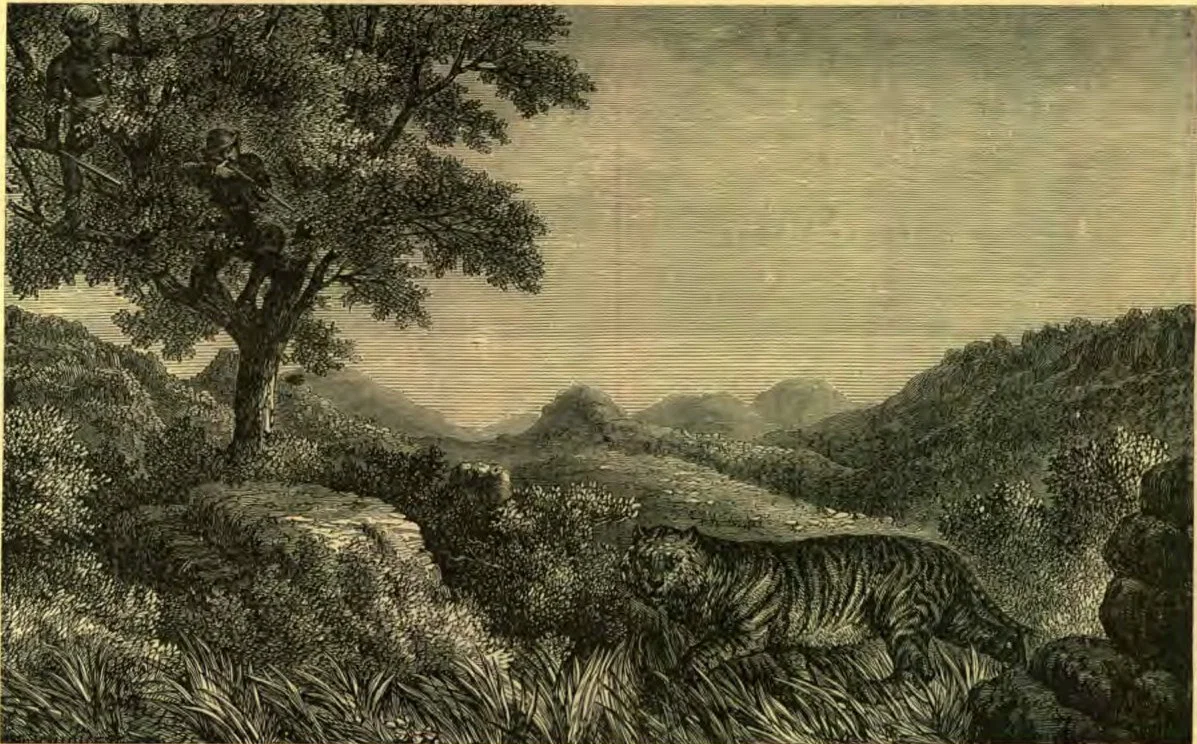
Such a country as this would seem to be an Eden; but since sin came into the world, there is no perfection here. These delightful tropical regions literally swarm with poisonous insects and troublesome vermin. Lizards, scorpions, huge spiders, and venomous snakes are almost everywhere, even in the houses. Fierce wild beasts infest the jungles, and make it unsafe to venture out alone, especially after nightfall. The dwellings have to be set up in the air on tall posts, and look as though they were on stilts. On the small island of Singapore, which lies close to the southern point of the Malay peninsula, it is estimated that the tigers kill more than three hundred people every year. They cannot be hunted off; for they keep swimming over from the main-land, which is in some places not more than a quarter of a mile distant. English hunters, with natives to help them, often go in pursuit of these dangerous creatures. A brief account of one of these hunts will give you some idea of the power of these fierce animals.
It was sometime in the summer of 1882 that this hunt took place. There seemed to be signs that a tiger of unusual strength and boldness had made his lair in the jungle not far from the town. Several persons had mysteriously disappeared. The last victim was a woman who had been missed from the outskirts of the city.
Six native men, called beaters, were secured to hunt up and follow the trail of the beast. They soon found a place where there had been a struggle, in which the little clothing worn by the woman had been torn from her. The weight of his burden had caused the tiger’s fore paws to sink so deeply into the sand that there was no difficulty in tracking him. Now and then a lock of the woman’s hair showed where her head had been thrust against a thorny bush in passing. Once the tiger had laid her down, and here the finger marks she made in the soil showed that she was still alive.
So the hunters and their men went on for two miles or more. The jungle grew thicker, and the track more winding; but the trail was very distinct. Finally they thought they must be very near the tiger’s den. The strongest and most experienced beater was now sent on a little ahead of the rest of the company. He had nothing but a large knife to defend himself with. As silently as possible they pushed on into the jungle, the beater keeping a short distance in advance. In spite of all their caution, however, the wary animal scented them, and came boldly forward. They had not expected this, and were taken by surprise. Suddenly the tiger sprang from the thicket. A crashing sound was heard, and a terrific scream pierced the deep recesses of the jungle. The brave leader was dashed down in a moment; but scarcely had he touched the ground when the report of a gun was heard, and before the fierce beast could bury his teeth in the flesh of his victim, a bullet, sent by the sure aim of one of the hunters, had pierced his brain. Slowly the powerful creature rolled off, straightened out, quivered a moment, and was dead. The daring native, though stunned and terribly bruised, was not killed. Presently he struggled to his feet, and pointing to his knife, showed that, in spite of being taken by surprise, he had buried it to the hilt in the chest of the tiger.
A few rods farther on in the jungle the hunters came to a small open spot surrounded by a very thick growth of bushes and vines. It was fully three miles from the nearest settlement; but many a poor victim had been brought all that distance by the gaunt monster, and devoured at his leisure in this almost impenetrable retreat. Nothing but the skeleton was left of the poor woman last captured by his royal highness. Piles of human bones lay scattered around. His majesty had dined chiefly on women, as was proved by the abundance of bangles, nose and ear ornaments, etc., that were picked up. Imagine how these gewgaws must have looked in such a place. What a lesson on vain show, and the foolish decorations so often employed!
G. H. BELL.

LITTLE TIM'S LUCK.

Tim worked in the rubber mills. He was twelve years old; but, although small for his age, he was quick-motioned and wiry. He entered the mill as errand boy. All day long, from attic to engine-room he hurried about, carrying orders, doing odd jobs, sweeping, and lending a hand everywhere.
When he had been there about two weeks, he was allowed to take charge of a little seven-by-nine room that was called the “barrel-room.” In it were two wooden cylinders, slowly revolving, filled with pumice stone, sand, and rubber goods. It was a happy moment for Tim when this charge was given him. As a companion and assistant, he had a boy whose name was Fred. He was a short, thick-set fellow, who wouldn’t go to school, and whose chief ambition was to “have a good time.”
As day after day the two boys worked in the barrel-room, they became well acquainted, and in a manner liked each other. With the acquaintanceship came various invitations on Fred’s part to the “good times” about the village.
“Say, Tim,” he said one evening, “come up to the Square to-night, and play ‘I spy the red lion.’”
“Can’t do it,” was the regretful reply; “got to work.”
“What work are you going to do evenings?” said Fred, in great surprise.
“Oh, well,” answered Tim, “I am going to be busy; not here, but at home.”
With a look of disgust, Fred dropped the subject, and persuaded some other boy to go with him.
The next day something very similar occurred. The hands were accustomed to kick foot-ball during the noon hour. Two of the boys came in for Tim, and found him eating his dinner, and studying a magazine illustration.
“Come out and kick.”
“Can’t,” said Tim; “got to work this noon. I’ll come some other time.”
What it was that Tim was at work on, none of the other boys knew. They liked Tim first-rate; he was so bright, and quick, and smart. Tim was a hard worker; even the lazy ones acknowledged that. What he did was done with his whole heart. Fred could work when he wished, but he was rarely taken that way. “I ain’t goin’ to kill myself,” he was accustomed to say.
In his heart, Fred rather despised Tim. He felt that in a manner he injured him by working so hard. Lazy folks are apt to dislike hard workers. The curiosity that possessed Fred to know what it was that Tim was at work upon was perhaps his strongest feeling. Many a noon he slipped up into the mill attic, where Tim was ensconced behind a pile of broken chairs, but he never discovered what it was he was at work on. Many an evening had he gone round by Tim’s house and inquired for him, and tried to discover the reason that he could not come out to play; but without any success. Tim kept his own counsel, and pegged away without satisfying their curiosity.
For two years, Tim and Fred worked side by side, getting barely pay enough to keep soul and body together; struggling for ten long hours each week-day with the refractory barrels, getting sifted through and through with the pumice stone and sand, having finger nails torn, and shins barked by the obstinate cylinders that never would stop in the right spot,—for two years they worked, and then they left together. Then Tim’s secret came out. He had been straining every nerve in learning to sketch. Every odd moment, morning, noon, and night, while waiting for the “heats” in the factory, he had been digging away at his sketching. Pencil in hand, he had made a business of his ambition; and now, when only fourteen years old, came the beginning of his reward. His drawings, over which he had labored for hours and hours, were sent to a Western school, approved by the teachers, and brought him a request to enter the school. How gladly he accepted, it is not worth while to state.
Fred also left; his odd moments had been taken up with “fun.” While Tim was working, he was smoking; while Tim was studying his art with all his mind and strength, Fred was walking around a billiard table. His chance was in rather a different line from Tim’s; he was promoted to drive a fish cart.
“I wish I had your luck,” he said to Tim as they parted; “but nothing ever strikes me.”
All this happened ten years ago; Tim is to-day a prosperous young man, well-to-do in life, and every year working up. But Fred still drives a fish cart, spends his evenings in the stables, ambitiously puffing a black pipe, and wishing, as ever, that he had “some of Tim’s luck.”—Little Christian.

EVERY ONE OF YOU.

YOU are not lost in the crowd, The Father's love is for each: Not one is so far away But his hands of blessing reach; For the heart of God is so large, And his mercy so very free, That no one has need to ask— “Is this kindness indeed for me?”
So, whenever the skies are fair, And the day is bright and long, And the gardens are gay with flowers, And the woodland glad with song, Let not thy heart be sad, Nor thine own voice silent be, For the beauty and joy of the time Is for all the world, and for thee.
When thine eyes on the holy page Of the Father's word shall see The wonderful promises there, Be sure they are all for thee. The guiding, providing hand, The safety, the peace divine, The pardon and deathless love, O child of God, are thine.
The Father forgetteth none, Though many his children be; Not one can be overlooked, Be sure that his smile is for thee. The poorest is dear to him, He hears when the little ones call, And at last, when the home is reached, You shall find there is room for all.
But to every one of you, The cross has been also given, Some care, some pain, to endure, Some work to be done for heaven. O rise to the Lord's demands, His blessings are ever free; But for service, and love, and trust, The Father has need of thee.
—London Christian World.

THE RELIGION OF ANCIENT DENMARK.

The mythology of the ancient Goths of Northern Europe was in harmony with their peculiar character and mode of living. Valor was the greatest virtue, and cowardice the greatest sin. Their happiness in the future world consisted in warlike enjoyments, connected with sensual pleasures. I will give a short sketch of their belief, which was about the same in Denmark, Sweden, and Norway.
In the beginning there were only substances without form, but the heat operated on these, until the giant Ymer came forth. (This account is not at all inferior to Darwin’s modern theory.) Then Odin killed Ymer and all his sons except one, who became father of the evil gods or spirits. From the body of Ymer, Odin created the organized earth. From an ash-tree he made the first pair, Askur and Embla, and he placed them in Midgaard. The gods dwelt in Asgaard.
Odin was the highest god, the father of men and the governor of the universe. Baldur, his son, was the wisest among the gods. Thor was the war-god, who warred against Yatterne, the evil spirits, and killed them with his hammer, Mjölnir. They associated him with the thunder and the lightning. Freja, Njord, and Frey were goddesses who presided over agricultural and peaceable affairs.
Those who fought bravely and died on the battle-field were received into the dwellings of the gods, and lived in the beautiful palace, Valhalla, which was decorated with shining shields and glittering swords. Every morning they went out to fight, and threw each other down, but in the evening they rose up again and returned to Valhalla, where they enjoyed a grand feast. The principal dish was pork from a certain immortal hog, Sarimner, which could be killed and eaten every day; while the fair girls of Odin brought the warriors nectar to drink.
It is no wonder that the Scandinavians are so extremely fond of pork, since their ancestors considered it the highest bliss in the spirit-world to be permitted to eat this unwholesome food.
Those who were cowards, and died on their beds, were thrust down to Helheim (or Niffelheim) to the homely Hell, where they continue their life as silent, trembling shadows, without joy and honorable deeds. Who may not in this see the origin of many modern ideas of spirit-life?
But this reign of the gods was not to last always. A terrible war between the gods and the evil spirits would cause the destruction of the world. Then a new earth would come forth from the sea, and the almighty God was to come down and judge men in righteousness. Then all the righteous and honest were to be taken to Gimle—a palace of shining gold, to live in eternal joy with the Almighty. But the wicked—perjurers, deceivers, and murderers, were to be cast down to Nastrand, where they should wade through venomous streams in a castle made of serpents.
Thus even in the old heathen mythology there were some glimmerings of light; and the first Christian missionaries took advantage of this, and tried to convince the Gentiles, that they were preaching no other god than that almighty God who should judge men in righteousness.
The gods were first worshiped in groves outdoors, and afterward in wooden temples. They had altars, and brought sacrifices to appease the gods. The victims were horses, oxen, hogs, poultry, and sometimes men who were taken from among the slaves or prisoners of war. The head of the family generally performed the service, but in the temples, priests and sometimes priestesses served. After the sacrifices they had a feast, and ate the meat of the slain animals. Their principal feast was Christmas, or Yule.
In writing they used sixteen characters called runes. These were marked on thin boards or engraved in stone. The few who could write or read these letters, were regarded with great superstition. Inscribed upon the swords or nails, letters were looked upon as a protection against sickness and danger.
The Scandinavian women were honored. They were commended for their good understanding, chastity, and skill. The healing art was principally left with the women. The men seldom had more than one wife. The honorable position of the woman is a good feature among these ancient barbarians; in this respect they differed greatly from the Orientals.
J. G. MATTESON.
Copenhagen, Denmark.

BEAUTY OF CHRIST'S CHARACTER.

In all the annals of this world's history, there is no picture so beautiful, so grand, so sublime, as that which inspiration has drawn from the life and character of our Saviour. The learned have given eloquent pen-pictures of earth's heroes and martyrs; and though the world at large might not be able to detect defects, yet perhaps their more intimate acquaintances would discover faults in the inner life.
But not so with the character of our Saviour. From the cradle in the manger to his ascension from Olivet, we see nothing but perfection. Upon the tablets of his heart was written the holy law of his Father. Ps. 40:7, 8. Never, when placed under the most trying circumstances, when seemingly forsaken by heaven, and when the powers of earth and hell were combined against him, did he in the slightest manner depart from those holy precepts. When, after fasting for forty days, he was famishing with hunger, he stoutly withstood the enemy, always replying, “It is written.” What loyalty to his Father's law!
Often when pressed by the coarse multitude, or when reviled and insulted by the hypocritical Pharisee, do we hear him speaking only words of wisdom and truth. Never once did he turn from him the poor, the down-trodden, the outcast who came to him in humility and faith. From his lips dropped only words of love and blessing. The poor beggar and the multitude, the leper, the blind, and impotent, as well as the nobles of earth, were made the happy recipients of his heavenly favors. His voice was music and life to the deaf; his touch was health and happiness to the sick and suffering.
But brightest of all do those heavenly traits of character seem to shine in the garden, in the Judgment-hall, and on Calvary. Hear that agonizing prayer in the garden, “O my Father, if it be possible, let this cup pass from me; nevertheless, not as I will, but as thou wilt.” What devotion to the cause he had espoused! what submission! what undying love and loyalty!
Following him thence to the Judgment-hall, we see him thrice denied, falsely accused, scourged, smitten, spit upon, attired with a purple robe and a crown of thorns. On Calvary we behold him fainting beneath the heavy cross. Those dear hands which had ever ministered blessings, those feet so often worn and wearied on long missions of love and mercy, must now be torn and rent with the cruel nails. His side wherein beat his great heart of sympathy and love must now be pierced with the cruel spear. Denied even a drink of cold water to cool his burning lips, mocked, suffering, bleeding, dying, the world's Redeemer hangs between earth and heaven, the grandest, the most awfully sublime spectacle of loyalty and love, meekness and long-suffering, submission and fortitude, that ever men or angels looked upon.
His pain was most severe, both of mind and body; and yet we hear him making provision for the future welfare of his mother. What devotion and affection! What an example! Forgetful of self, we hear him speaking words of love and forgiveness to the penitent thief. Himself the world's Creator and Redeemer, we hear him pray, “Father, forgive them, they know not what they do.” Oh, what love, what pity, what forgiveness! The darkness of night settles over the scene, and yet amid it all there shine those traits of character, those “fruits of the Spirit,” more brightly than ever. How marked the contrast between the powers of darkness and the holy Son of God! Possessing all power in heaven and in earth, “who, being in the form of God, thought it not robbery to be equal with God,” he “made himself of no reputation, and took upon him the form of a servant, and was made in the likeness of men: and being found in fashion as a man, he humbled himself, and became obedient unto death, even the death of the cross.” In all the world's history there is not a picture so beautiful, so sublime.
Well has one said, “We should dwell much upon the excellences of Christ's character, and should cultivate the same graces in our own.” Said St. Paul, “But we all, with open face beholding as in a glass the glory of the Lord, are changed into the same image from glory to glory, even as by the Spirit of the Lord.”
J. M. HOPKINS.

THE PASS-WORD.

DURING the late civil war, a noble band of Christians, called the Christian Commission, among whom was Mr. Stuart of Philadelphia, accompanied the army wherever it went, and amid the sick, wounded, and dying, did much work for Jesus.
Late one night, Mr. Stuart had to pass the lines of the army; and before starting, he asked the colonel of the regiment for the pass-word. “Chicago” was given him, and away he rode, feeling all safe.
At the line a sentry challenged him with the usual, “Who goes there—friend or foe?”
“A friend,” said Mr. Stuart.
The sentry presented his rifle, and demanded the pass-word. On its being given, he said, “It is my duty to shoot you, Mr. Stuart, but I know you. Ride back to headquarters and get the right one, for it would be death for me to give it to you.”
Mr. Stuart turned his horse’s head, galloped back to the colonel’s tent, and rushing in, said: “Colonel, you gave me the pass-word, ‘Chicago,’ and it is wrong.”
“How could I be such a fool!” said the colonel; “that is the one for yesterday; to-day it is ‘Massachusetts.’ I am deeply sorry for the mistake, Mr. Stuart.”
Again he approached the line, and again the challenge met him,—
“Who goes there—friend or foe?”
“A friend,” said Mr. Stuart.
“Have you the pass-word?”
“Massachusetts,” was the reply.
At once the rifle was lowered, and the word was given to pass.
As Mr. Stuart rode up to the sentry, he said, “Well, my lad, you have asked me for the pass-word twice. Once I gave it wrong; it might have been fatal to me. Let me ask you, do you know the pass-word for heaven, which will be asked for only once?”
The sentry replied, “I thank God I do, sir. I learned it from your own lips, Mr. Stuart, in a New York Sabbath-school. ‘The blood of Jesus Christ cleanseth from all sin.’ That is the pass-word.”—Everybody’s Paper.

A LITTLE EVERY DAY.

A few of us students had obtained permission to take our meals every day with a private family in the town. We waited for every meal from five to ten minutes,—a fragment of time which we usually expended in chatting, joking, and skylarking. A large scientific work, in royal octavo, lay on the table—probably the only book treasure of the house. Several of us expressed a desire to read it, but regretted a lack of time and opportunity. One of our number, however,—a silent, studious fellow—quietly took up the volume, nibbled at the title-page, glanced over the table of contents, and attacked the preface. In a moment more he was called to the table, and after eating, was out with the rest of us. At the next meal he resumed his reading where he left off; and so on, from time to time, until the continuity and steady purpose of his occupation attracted attention, and exposed him to many a volley of chaffing from his companions. He only smiled, and went on with his reading, while we went on with our usual chit-chat, until at last we forgot to notice him at all. The winter passed away; the spring approached; and the last dinner-bell of the term had just left its final clatter in the air, when the young tortoise plodder in the big octavo closed its covers together with an emphatic slap, and an announcement of “the end.” All the rest of us had wished to master the book, but hadn't had the time; he, by reading a little three times a day, had transferred its entire contents to his head.—Christian Union.

THE TWO ROADS.

A TRAVELER, going to a distant place, Came where two roads branched off on different ways; One, straight and smooth, held forth so fair a view It seemed to him that way he should pursue; And, since the other opened steep and rough, No word he asked—these hints were quite enough.
So, choosing that which seemed so good and fair, All obstacles and balks soon centered there; Briars and brambles, and a steep ascent, Failure, and loss of time, and discontent. What made things worse, the one bereft of grace Soon grew more fair, and reached the longed-for place.

MORAL.

Whether on duty or desire you go, Put not your trust merely in outside show; He but incurs the vexing fall of pride Who lets appearances his course decide. —Joel Benton.

MAKING MONEY.

The word “bullion” means uncoined gold and silver in the mass. Large quantities of gold and silver, after being coined, are frequently termed bullion. The following paragraphs from a recent exchange contain facts of interest in addition to what has already been published regarding the precious metals, both coined and uncoined:—
“Bullion is received at the mint in the form of bricks of all sizes and very peculiar shape, when it comes from Spanish American countries. The regular shaped bricks often weigh as heavy as 150 pounds. The Mexicans melt their silver and rub it into the most crude shaped molds in the world, in quantities so large and heavy that a burro [donkey] could not carry one casting. If the valuable metal was carried in quantities convenient for handling, raiders for miles around would be after it and demand the whole or a large portion of the silver as salvage for protection against other raiders. The Mexican silver received at the mint is taken to the machine shop and cut up before it is in shape to be put into any of the largest crucibles. The regular shaped bricks are taken first to the assay office, where the corners are clipped and the brick bored into. An assay is made of the clippings and borings. The result is made known to the person making the deposit, in about twelve hours. He gets his money, and the government gets his bullion. After the assay the bullion passes to the refinery if it should require the operations there performed.”
“When the silver has been obtained in a state as near as possible to absolute purity, it is taken to the press room, and by hydraulic pressure compressed into solid circular masses of from twelve to fifteen inches in diameter and five inches thick, resembling very much the shape of cheese. The silver is then placed in an oven in iron pans. A fire is raised, and the iron and oven are brought to a cherry red color for the purpose only of driving off moisture in the chloride of silver. The least portion of moisture in the crucibles would break them, and the silver would be lost in the ashes. The cakes next go to the melter and are run into bricks. If it goes on the market as bullion, its weight in ounces and its value is stamped upon each brick. If it is to be turned into coin, it is again melted and an alloy of one-tenth copper is put in both for silver and gold, and the whole is then run into ingots.”
“These are heated and rolled to the proper thickness and width, and the strips are then annealed and whitened. The blanks are next punched and cleansed of the grease from the rollers, and are then sent to the adjusters. Each piece is weighed, and if found too heavy a little is filed off the edge; if under weight, it is remelted. From the adjusters the blanks pass to the stamping room. The milling, as it is generally termed, is then put on, by pressure-squeezing the silver out into the little grooves of the mold.
“After it is upset, to raise the ring on the surface, the blank passes under the die. The impression is made on both sides from one blow.”
“A rule of the coiner’s department prohibits an employee leaving the department during the day until after the accounts are adjusted. From the coiner the money passes to the counter, who with the aid of a counting board, which holds an exact number of pieces, is able to count thousands where a person ordinarily would count only units. The counting board carries just 1,000 silver dollars. One of the most interesting objects to be seen in mint is a large balance scale, so nicely adjusted that one may take a hair from the head, split it and place it on one side of the scale pans, and the beam will be noticeably deflected.”

IMPORTANT BIBLE SUBJECTS.

LESSON 7.—THE CLEANSING OF THE HEAVENLY SANCTUARY.

[NOTE TO THE STUDENT.—Do not consider the lesson learned until you can give at least the substance of every text, with the correct reference for each. The references in black letters indicate those texts that should be committed to memory. A little diligent application each day will enable you to learn them, although this need not be considered a test of scholarship.]
1. What were the closing acts of the earthly priest in the yearly round of service?
2. Of what did this cleansing consist?
3. What were the people required to do on the day of atonement?
4. Was an offering made on that day besides the atonement offering? Num. 29:7-11.
5. Will the “true tabernacle,” or heavenly sanctuary, be cleansed? Heb. 9:23.
6. From what was the earthly sanctuary cleansed? Lev. 16:30, 33.
7. How did the earthly sanctuary stand related to the heavenly? Heb. 9:9.
8. Then from what will the heavenly sanctuary be cleansed? Heb. 9:26.
9. How did the sins of Israel get into the sanctuary? Lev. 4:13-18; 10:17, 18.
10. How do our sins get into the heavenly sanctuary? —Christ, our great sin-offering, takes them upon himself, and bears them into the sanctuary.
11. In what manner do they find a lodgment there? Jer. 2:22.
12. Are sins recorded in heaven? Rev. 20:12.
13. How, in figure, did ancient Israel receive forgiveness of their sins? Num. 15:24-26.
14. How do we receive forgiveness of our sins? Col. 1:14.
15. Anciently, when sins were forgiven, were they removed from the sanctuary?
16. When was this done? Lev. 16:29, 30, 34.
17. What was this removing of sins?—Cleansing the sanctuary. Lev. 16:30, 33.
18. How does our Saviour show that our sins are not blotted out when they are forgiven? Matt. 18:23-35.
19. Since the heavenly sanctuary is to be cleansed from sin, what must be done with the sins recorded there? Acts 3:19.
20. The removal of sins from the earthly sanctuary by the high priest, corresponded to what act of our High Priest in the heavenly sanctuary? Ibid.
21. To what, then, is the blotting out of sins equivalent? Heb. 9:23.
22. When will the cleansing of the heavenly sanctuary begin? Dan. 8:14.

NEW DATE CHART.

Our Sabbath-school Association has recently purchased from Eld. G. D. Ballou the plates and copyright of the charts illustrating the dates which will soon be considered in the series of lessons now in progress. This chart is printed on cloth 40x52 inches; and should be in every school in the land. Send in your orders at once, or it will be too late. Price, by mail, postage paid, $1.25. Address, Sabbath-School Worker, Battle Creek, Mich.

The Order of the Grain of Mustard Seed

WHEN Count Zinzendorf was still a boy, he and a few of his mates formed a little religious society which they called “The Order of the Grain of Mustard Seed,” as indicating their hope and purpose of growth. Every Sabbath-school teacher ought to belong to the class of growers in knowledge and grace, in character and attainments. Dr. Bushnell indicated “the talent for growth” as an important element in the preacher’s power. He said there were two sorts of men in the world: one sort who grow, and the other sort who grew; the one sort he likened to trees, the other to flagstaffs. A good teacher ought to be something better than a flagstaff; he should be a tree, and a mustard tree at that.

Guarding Children Against Moral Disease Germs

EVERY person who lives in a city lives continually in an atmosphere which is charged with the germs of disease. The same is true, in a less degree, of those who stay in the open country,—true even of those who pace the deck of the ship in mid-ocean. And yet many live on in good health, defying the attacks of these disease germs simply because the disease germs can find no weak or unprotected spot in which to begin their deadly work. There is a hint in this for those who are training children who by and by will have to go out into a moral atmosphere as disease-laden as the air of a great city. See that they go out with no weak or unprotected spot in their soul natures. There is a conquering power in robust bodily health which throws off, unharmed, the germs of disease; there is a similar conquering power in soul health,—and it is a power worth having.

What Has He Done? The Searching Question

“WHAT has he done?” is the divine question which searches men, and pierces through false reputation.

HIS CARE.

AMONG so many, can He care? Can special love be everywhere? A myriad homes, a myriad ways, And God's eye over every place?
I asked. My soul bethought of this: In just that very place of His Where He hath put and keepeth you, God hath no other thing to do! —A. D. T. Whitney.

GOLD IN THE OCEAN.

THE following concerning gold is an extract from an address delivered by the Rev. R. A. Cross, of Denver, Colorado. We have no fears that our young readers will be tempted by it to try to extract gold from the briny deep. A better way to obtain gold is to secure a claim to the imperishable gold in the new earth.
“Scientists tell us that the water of the ocean contains gold at the rate of one grain, or about four cents’ worth, to every ton. At this rate a thousand cubic feet of ocean water contains about one dollar’s worth of gold. If the ocean has an average depth of one mile (though it is probably greater), it contains enough gold to furnish $15,000,000 to every man, woman, and child in all the world, or more than $100,000,000 dollars to every family of seven. At this rate, if figures do not lie, a cubic mile of ocean water contains about $140,000,000 worth of gold.”
“What a pity we cannot get it!” do you say? Yes, it does seem a pity that you and I cannot get our shares. But it would spoil all the fun if all the other people got their shares too. Gold would no longer be a precious metal, and we would have to keep right on working for a living.
“The ocean is a rich gold mine, and let me say confidentially that there are plenty of unstaked claims on it and in it. Two practical difficulties, however, hinder the working of those claims. One is the difficulty of getting the gold out of the water, and the other is the difficulty of storing the water already worked while you are treating the rest. No doubt Yankee genius will solve even these problems when the time comes that the ocean gold is needed.”

THE VALUE OF AN EYELASH.

It is the experience of accountants that a very slight cause sometimes brings great perplexity to one's mind. An accidental mark on the paper, making a figure appear something else than it is, has occasioned hours of toil; but perhaps no error ever resulted from a simpler circumstance than the one described in the following paragraph:—
“A Washington financier, who is well acquainted with Colonel Lew Washington, the teller of Lewis Johnson & Co.'s bank, said that it was at the close of business hours, and Colonel Washington was poring and perspiring over a long column of figures on the balance sheet. The sum total of the column should have read $6,090. Instead of that amount, however, it showed a total of $6,990, or $900 more than he could account for. The vexatious mistake caused the Colonel to scratch his head vigorously and wonder where the excess was in the column of agonizing figures. While going carefully over the column for the twentieth time, he discovered the error, and it was one that would hardly occur once in a thousand years. One of the Colonel's eyelashes had fallen on the balance sheet and adhered to the first 9 in the line of figures $1,000, making a perfect figure 9 of the nought, and increasing the whole amount to $6,990 instead of $6,090. In going down the column the twentieth time, he brushed the eyelash away with his forefinger. Hereafter, Colonel Washington says, he will go over his balance sheets with a scraper before he begins to add the columns.”

ODD VISITING CARDS.

The cactus serves a queer purpose in far away South Africa, judging from a description given by a writer in St. Nicholas. He says:—
“But, after all, the oddest use of the cactus prevails in Cape Town, South Africa, where its leaves are made to serve the purpose of visiting-cards. Fancy carrying about in your coat pocket a lot of thick leaves covered with spines as sharp as needles! But wait a moment. The leaves of the particular kind of cactus so used are not very prickly; and, moreover, they are not carried about, but are left growing on the plant, which stands at the foot of the front steps.
“When a lady calls she has only to draw out one of those ever-ready hat pins, with which ladies are always provided, and with the sharp point scratch her name on the glossy, green surface of a leaf. A gentleman generally uses the point of his penknife. The lines turn silvery white and remain on the leaf, clear and distinct, for years and years. On New Year’s Day these vegetable cards are especially convenient, and ladies who wish to keep the calls of that day apart from those of other days appropriate a branch of the cactus to that purpose. One gentleman in Cape Town has a cactus plant which is nearly fifteen feet high. Its great, thick leaves are almost all in use as visiting-cards, so that he has a complete and lasting record of his visitors. It cannot be said that this practice adds to the beauty of the plant; but then it is oddity, and not beauty, that is desired in such cases. There is one cactus, not so plentiful as that just described, which is of a very accommodating character. It not only has smooth leaves, but the spines it has are so large and stiff that they can be used as pens for writing on the leaves.”
Continue reading: REMARKABLE RIVERS