AMONG the world’s natural curiosities are several rivers, each of which has some positively unique characteristic. In Algeria, for instance, there is a small stream which the chemistry of nature has turned into true ink. It is formed by the union of two rivulets, one of which is very strongly impregnated with iron, while the other, meandering through a peat marsh, imbibes gallic acid. Letters have been written with this compound of iron and gallic acid which unite to form the little river. In Columbia there is a river which, by admixture with sulphuric acid, becomes so sour that it is appropriately named Rio de Vinagre, or Vinegar River. Many varieties of fish abound in the large Orange River of South Africa, until the river passes through a rocky region containing copper ores, below which the water is said to be poisonous and to kill the fish that venture into it.
“China’s Sorrow” is the name that has been given to the great Hoang-Ho, which rises in the mountains of Thibet, and follows a wonderfully circuitous channel for 3,500 miles to the sea. The waywardness of this mighty volume of water makes the river a constant source of anxiety and danger, instead of wealth, to 170,000,000 of people inhabiting the central plain of China. It is known to have nine times suddenly changed its course. It has moved its mouth over four degrees of latitude each time, emptying its vast floods in different directions, and digging a new channel for itself where scores of villages had stood. It has greatly changed the physical character of a wide area, turning fertile regions into a sandy waste, or making shallow lakes of them, in which nothing grows, and over which nothing can sail. Whether it is within the power of western science to save this great plain from disastrous overflows and changes of the river-bed is a question that has been considerably discussed in England of late years.
A very curious river is the Webbe Shebeyli of East Africa, a deep and rapid stream, abounding in fish and crocodiles. Though it flows for hundreds of miles through fertile lands, the immense volume of water never reaches the sea. A little north of the equator the river loses itself in a desert region a few miles from the Indian Ocean.—Anon.
CHESTNUTS WITHOUT BURRS.
The boys and girls who so often wish the chestnut did not grow in a prickly case may be pleased to know there is a chestnut tree which bears the nut without burrs. A specimen was sent to the St. Nicholas, last November, from Freehold, N. Y., and the editor made the following comments upon it:—
“The dark brown nuts that are so sweet to the taste are usually kept secure in the prickly husk until Jack Frost sends them down and bursts into their prison cell; but in the specimen sent us they are huddled together in bunches of three or four, and covered only with soft furze; no burr or husk ever envelops them. The nuts grow to a good size, ripen, and renew themselves each year, and are as good to eat as if they had been encased all summer in the warm prickly jacket that their brothers always wear. It is the only tree of the kind known in that region.”
First United States Census of 1790
The first census of the United States was taken in 1790, and showed a population of 3,929,827 persons, excluding Indians. There were nearly 700,000 slaves included in it. This was the first systematic census ever taken by any government in the world, and has been continued ever since, at intervals of ten years.
JACK'S LESSON.
By W. E. L.
The short afternoon sun was fast sinking behind the hill-tops. Nearly all the merry coasters had gone home by the time Jack and Jill reached the top, drawing their sled up after them. Jill's cheeks were red with the unusual exercise, and the wind had caught the soft brown curls from under her closely drawn cap, tumbling them about in wild disorder.
“Come on,” cried Jack, getting the sled ready for another ride, “I'm going down the steepest side.”
“Oh, don't,” replied Jill, clapping her hands, which were aching with the cold; “I'm half frozen. Let's go home.”
“You'd better not go down there, youngster,” said one of the large boys, coming around where Jack was; “little boats should keep near shore.”
“I guess I can steer down straight,” retorted Jack. “Do hurry up,” he said impatiently to Jill, as she stood shivering and hesitating, afraid to go down the steep descent. “I'm glad I'm not a girl; they're such 'fraid cats, anyway!” he added scornfully.
“I'm not a 'fraid cat,” said Jill, flashing an angry look at him, “and I dare go anywhere a boy does!” And without more ado, she took her place on the front of the coaster, and away they went, faster and faster, till they almost lost their breath.
But alas for Jack and Jill! Near the foot of the hill the road turned suddenly to avoid a stone pile, and here the ground was bare in several places. When they reached this spot, the sled swerved, plunged, and threw Jill against the rough stones. Jack soon sprang to his feet. There lay Jill, oh! so still, with the red roses faded from her cheeks, which were now almost as white as the snow itself.
“Jill! Jill!” cried Jack, going down on his knees beside her, “are you dead or hurt? do wake up and tell me!” But only a faint moan came in reply from Jill's pale lips.
“Hello! over there!” frantically called Jack, running toward two coasters just leaving the hill. “Hold on! I say; come and help me!”
The two turned and came where Jill lay. “Mercy to us! if it isn't Jill Brown,” they exclaimed in one breath; “and she's hurt her on those stones.” Very tenderly and carefully they laid her on their long coaster, taking off part of their wrappings to make her more comfortable; and then the sorrowful little party went slowly toward Mrs. Brown's snug cottage.
How long the road seemed to Jill! Every jolt of the sled sent a pain all through her as sharp as a knife; but she bravely bit her lips and kept back the moans, although the tears would come. The sun had set by the time they reached the gate, and the stars began to twinkle, one by one, in the deep blue of the sky. Through the window, Jill could see the red hearth-fire burning, and her mother lighting the evening lamp. And then she knew no more until she found herself in her own warm bed, with her mother and the doctor bending over her.
“I think she will get over it in time, madam,” she heard the doctor say; “but it will take a long while. She must not be allowed to use her back in any way for weeks. Perfect quiet will be needed for a short time. I will call again in the morning.” And then she heard him latch the gate, and drive off, the jingling of his sleigh bells rapidly growing fainter and fainter, at last dying out in the distance.
How long the doctor's “few weeks” seemed to Jill, and to Jack, too, who had never been near the hill since that last eventful slide. Very repentant, he lingered around Jill's bed, bringing all his treasures for her to look at, and generously giving her the one he thought more of than all the others put together,—a scrap-book half full of all sorts of postage stamps. It cost Jack a hard struggle to give this up; for he had the largest collection of any boy in town.
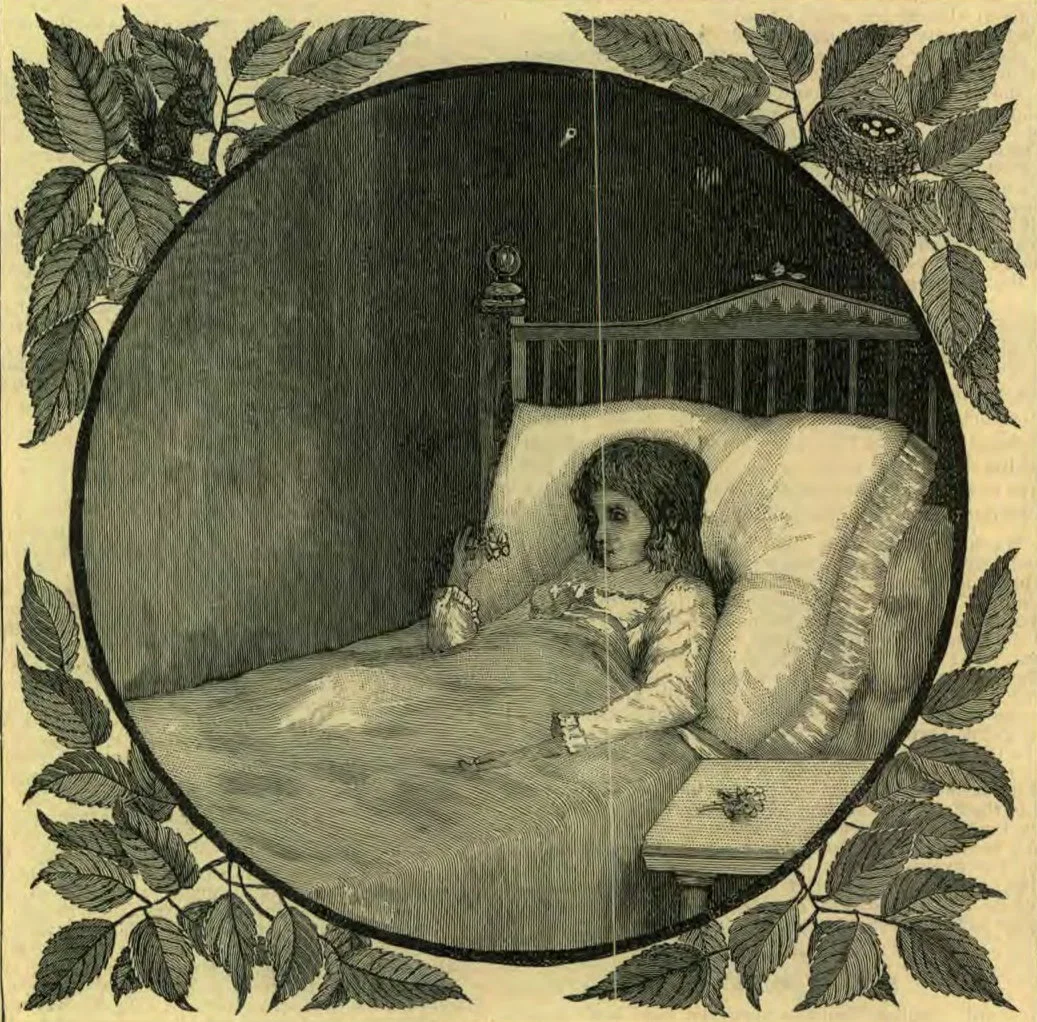
The lagging weeks brought March and April before Jill had left her bed. She could be bolstered up now, a part of the time; and one warm morning the window was thrown open so that she could hear the robins chirping in the tree-tops, and the swallows twittering under the eaves, all busy and happy at their house building. Jack was out, too, scouring the woods and fields for the early spring flowers that Jill loved so well,—the yellow buttercups, and pink May flowers, the pure white wind-flowers, and the blood-root blossoms, whose sweet fragrance and dainty freshness seemed to put new life into Jill. And there were odd green leaves, mosses, and lichens, and little fuzzy ferns, just uncurling to the light, and Jacks-in-the-Pulpit—how many hours they two had spent in imagining the strange things that Jack-in-the-Pulpit said to his flower-bearers.
By May, Jill could go outdoors if she walked slowly, and then she gained right along. You would hardly have known the careful, thoughtful boy who walked beside her for the old, hasty Jack of other days. He had learned a sad, bitter lesson in the long weeks when he thought Jill would never walk any more. And his mother had hung a motto in his room, where he would see it every morning when he first opened his eyes. It was,—
“Vessels large may venture more,
But little boats should keep near shore.”
W. E. L.
IF WE TRY.
WE can learn a useful lesson
From a single drop of dew,
For it sparkles to remind us
How to make our whole life true.
We should never waste our moments;
They are passing quickly by;
To improve them is a duty—
We can do it, if we try.
Let us drop a gentle warning
By the way-side, as we go,
And perhaps the germ of kindness
In a careless heart may grow;
Let our seed be sown at morning,
For the night is drawing nigh;
There's a harvest for the faithful—
We may share it, if we try.
As the bee is never idle,
And the brook is never still,
In the pleasant field of labor
There's a place we all may fill;
We should never waste our moments;
They are passing quickly by;
To improve them is a duty—
We can do it, if we try.
—Pilgrim Press.
Letter Budget.
NORMAN N. GREEN, of Alleghany Co., N. Y., writes: “I am a little boy eight years old. I like the INSTRUCTOR ever so much, and like to read the letters too, so I wanted to have a letter in the paper. I can’t write much, so mamma writes this letter for me. I hope I shall be able to write for myself by next spring. We have to go seven miles to attend meeting and Sabbath-school. When the roads are very bad, we cannot go. I get lessons in Book No. 2. I never went into a day school in my life; but mamma helps me learn at home. I help care for the stock, and help papa make maple sugar in the spring. I like to eat warm sugar, I tell you, I do. I am trying to get up a club for the INSTRUCTOR, so I should like your special instructions to agents. Mamma will help me about canvassing for it. I have no little children to play with, but I play with our dog. His name is Tiger. I harness him, and he draws my sled up the hill, and I ride down; then he gets onto the sled, and I draw him; so we have good times playing together. I want to be a good boy, and meet the whole INSTRUCTOR family in the new earth.”
Before you see this letter in print, we hope you will have received instructions for canvassing, which we have sent you. We wish you good success in adding names to the INSTRUCTOR list. We like your plan of giving faithful Tiger a ride. “The merciful man is kind to his beast,” you know.
FREDDIE PALMER writes from Marion Co., Ill. He says: “I thought I would have my mamma write a little letter for me. I have two little brothers, one three years old, and the other eighteen months. I am seven years of age. I keep the Sabbath with my mamma. We have no Sabbath-school here. There are but two other families here who keep the Lord’s Sabbath. We are having very cold weather now, and my brother Emry and I throw crumbs out on the side stoop, and the little snow-birds come and get them. I was in Jackson, Mich., last summer, to visit my grandpa and grandma Palmer. Grandpa let me drive his horse. I had a nice time. I attended the camp-meeting there. I want to be a good boy, so I can meet all the INSTRUCTOR family when the Lord comes. I have a missionary jug, and I am going to save my pennies in it for the missionary work. I remain yours in the INSTRUCTOR family.”
How thankful the birds are for the crumbs! For a number of years we have practiced feeding a little flock of them twice a day. But the birds are no shirkers; for just as soon as the snow melts a little, away they all go, to look out for themselves. May we not hear again from your missionary jug?
Here we have a letter from Eld. Burrill’s little daughter, ELLEN I. BURRILL, whom we once knew in Battle Creek. She writes: “My brother Cortez and I attend the South Lancaster Academy. Prof. Ramsey has graded the school, and put me in the fourth grade, and Cortez in the first. The teacher in vocal music has put me in the higher class. We have a good Sabbath-school. I am reviewing Book No. 5. My father was home Christmas; he had been away three months. He is laboring in Maine. We attended the Maine camp-meeting. Cortez wanted to be baptized at that time; but as he could not, he waited until he went to New York. We had a Christmas tree at our church, and had $250 for offerings to the Central European and Scandinavian missions. Cortez and I gave a dollar each. We earned it all ourselves. He is seven, and I am ten years old. I shall be glad if ever I can go back to Michigan. My older sister Carrie lives there.”
It affords us real pleasure to hear once more from these dear children, and to know that they are trying to walk in the path of wisdom and virtue. May heaven’s choice blessing rest upon them, and all the dear INSTRUCTOR family.
HARRY ROACH writes from Keokuk Co., Iowa. He says: “I am a little boy eleven years old. I go to Sabbath-school every Sabbath, and study in Book No. 4. I like my teacher very much. We repeat verses in the Bible, and at the end of the quarter we repeat all that we had through the quarter, and we get a prize. We take the INSTRUCTOR. There are only three in our family who keep the Sabbath. I am trying to be a good boy.”
Is the prize for perfect lessons, Harry? We think you would try hard for a perfect lesson though no prize was offered. How is it?