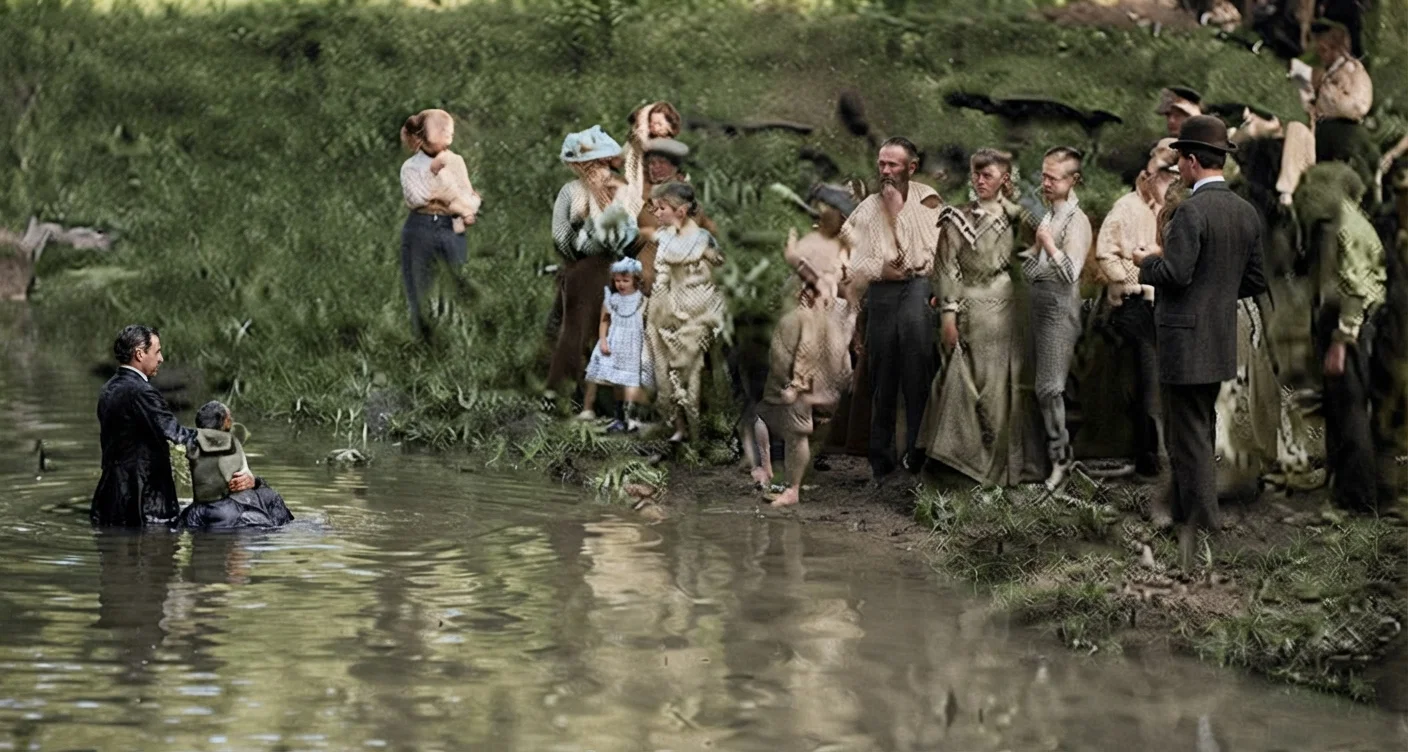
The Ceremony of Baptism in the Transaction—Our Baptism One of the Greatest Events in Our Lives
By H. G. THURSTON
OUR Saviour said that repentance and remission of sins should be preached in His name among all nations (Luke 24:47), and that the Christians of all nations should be baptized (Matt. 28:19, margin), and that the believing, baptized souls should be saved (Mark 16:15, 16).
“We are buried with Him by baptism into death: that like as Christ was raised up from the dead by the glory of the Father, even so we also should walk in newness of life.” Rom. 6:4.
FORMAL ANNOUNCEMENT OF CHANGE
Baptism is a formal announcement that the individual has changed life partners, having renounced "the old man" of sin, "which is corrupt according to the deceitful lusts" (Eph. 4:22), and "put on the new man" (verse 24), thus accepting the Lord Jesus, that He may ever dwell in the heart by faith. Eph. 3:17.
This great change in human life and experience is proclaimed by baptism. Since baptism is a gospel ordinance, and since all men are sinners by nature, and if they ever receive the immortality promised to the righteous, it comes only through the gospel, does it not follow that all men need the work signified by baptism?
MARRIED TO SIN
Every man is born in sin, and by his very nature and birth is married to sin, is subject to sin; for sin controls his life. If ever he is released from sin, it must be by death. Sin is likened to a husband from whom we must be separated if we are to become servants of righteousness and bring forth fruit to God. Rom. 7:1-4.
This death experience is nothing short of supernatural, miraculous. When married to sin, men serve sin. They are much alive in hatred, envy, lying, deceit, Sabbath breaking, theft, and murder, and delight their husband of sin by pleasing themselves in practicing the various desires of the natural heart, until they become convinced that they are indeed serving a hard master, whose wages are most undesirable (Rom. 6:23), and that the only possible way of escape is through death to sin. It could be seen that this death would mean suffering; but seeing others who appeared much happier with their new Husband (Isa. 54:5), who did not offer the weak and beggarly elements of earth as a reward, but a life of joy and peace and true holiness here, and the end everlasting life, choice was made of this new Companion for time and eternity. The agonies of death over, condemnation was gone, and they were exceedingly happy in their new state.
PUBLIC ANNOUNCEMENT OF DEATH
Baptism is a visible public testimony that we have actually experienced the agonies of this death. Without just that experience, baptism is meaningless, and but mockery; for if, while we are married to sin, and without this death to separate us from sin, we go through the ceremony of marriage to another, even Christ, our condemnation is written in the strongest language. Rom. 7:3; James 4:4.
This passing from sin to righteousness involves death, even to mortification; but by it we escape the wrath of God. Col. 3:5, 6. This is an experience each must have for himself, and not another.
THE DIVORCED HUSBAND STAYS AROUND
Although we die to our first husband, sin, apparently he does not die, but ever tries to recover his old place in the life as its ruler. The apostle Paul refers to his own Christian life, and to his continual warfare against sin, and writes, "I die daily" (1 Cor. 15:31); and also, "I keep under my body" (1 Cor. 9:27). This shows something of the continual warfare that must be kept up throughout this life, lest the old man again ascend the throne of our affections, and we become castaways at the end of the race. But faithfulness in this warfare maintains an intimate and happy relation in Christ, and insures in Him a continual abiding.5With such a prospect of being continually assailed by the devil through our old nature, we anxiously inquire, "Will this awful conflict be an uncertain one?" In regard to this we are not left to speculate. When a soul makes Jesus his choice, and unites his life to Christ, this new Companion, to whom is given all power (Matt. 28:18), and who has overcome sin and the devil in actual and deadly conflict (Rev. 3:21), promises His assistance to certain victory, assuring us that if we remain loyal to Him for a little while here, He will then forever secure us from any further trouble with this former husband, who seeks our ruin. We shall also forever bear His own "new name" (Rev. 3:12), and enter with Him into His great inheritance, of which He makes us heirs. All who accept Him, He accepts as joint heirs. Rom. 8:17.
The ordinance of baptism is an outward sign that this heirship is established, first by God's revealing the way of life to the sinner, and then by the sinner's acceptance of that way.
Baptism is one of the most solemn of all institutions of divine origin, bringing vividly to view the life of toil and love of our Master, and then that incomparable, incomprehensible death upon Calvary, and also His glorious resurrection from the tomb to a life of infinite glory and power.
A MOST IMPORTANT EVENT
The day of baptism is one of the most notable of man's whole life, ranking with one's birth, conversion, marriage, and death. And truly the significance of all the great events in spiritual life clusters around the memory of the day of baptism; for the sinner must die to the world in order to accept God's loving offer to be a Husband — accept His promise to love, provide for, protect, and defend — and in this manner become divorced from the former husband, sin.
As a means of making this death publicly known, God has provided a fitting burial ceremony; and the candidate for heaven arises from the grave of water to walk in newness of life, to render loving, pleasant service to the new Husband. By a diligent study of His wishes as expressed in His word, we ever seek to honor Him, to do His pleasure. We do not live as before, to please ourselves; for as in marriage resulting from true love, the wife ever seeks to please her husband, so in that union with Christ, the closest known to man, when the Saviour enters into the heart, and abides there, the converted soul is not seeking to please another, nor even himself, but the whole life's study and continual aim is to please Jesus.
For such an experience may every child of grace most earnestly labor, that his baptismal occasion may ever prove a precious and sacred memory!
Both Work and Play Were Planned
By Tyler E. Bowen
The Garden Beds Alone Were Neglected—The Boys Yielded to the Tempter—Is the World at Large Yielding in Like Manner?
By TYLER E. BOWEN
MR. HENDERSON was leaving home for the day; but before going, he laid out for his two sons that which he desired them to do while he was gone. He carefully measured their tasks, estimating the length of time required for accomplishing their work. He also provided for some time for play after their work was over.
THE WORK TO BE DONE
The usual morning chores at the barn and about the house were to be attended to, then a patch of beans back of the barn was to be hoed. This would take until about 10:30. A tree of cherries over by the horse barn was to be picked; and easily, the father knew, the boys could have this done by dinner time. Then the three beds in the garden, which badly needed weeding and hoeing, were to come in for attention, to take until two o'clock. With three or four minor duties laid out for them on the program between two and three o'clock — the old family horse to be brought from the little pasture near, and hitched up for mother and Sadie to make an afternoon call at Aunt Mandy's — this, with one or two other things to do about the horse barn, and their work would be over.
SOME TIME FOR PLAY
From three to six, the boys were to have the time for play — either a visit to Cousin Frank's, about a mile away, or a fishing excursion up through the woods for trout, as they might choose, both of which father knew the boys had been anticipating for several days.
Before leaving, the father carefully went over the day's program again, explaining to the boys how each piece of work was to be done, in his usual kind, painstaking manner, and Fred and Jamie both assured him they fully understood it all.
A CIRCUS AT MIDDLEBORO
Everything went well until just before dinner. As they were finishing the cherry tree, Bill Jones, a near neighbor's boy, happened over, and from the rail fence where he had just climbed up and sat watching the boys, called out:
"Say, Fred, aren't you about through with that cherry picking business? I've got somethin' to tell ye."
"O, is that you, Bill? Didn't know you were about. Why, yes, we're nearly done. What's up now?" Fred replied.
"I'll tell ye when ye come down."
When Fred, who was three years older than Jamie, came down, Bill beckoned for him to come over by the fence. Then, in a low, confidential tone, he excitedly went on:
"I've just heard from Tom Wilson that a circus is booked for Middleboro, and because of a storm yesterday they couldn't show at Grand Junction, so they will get to Middleboro this afternoon about half past two, and will unload and have an evening circus. Let's go down. It'll be big fun to see 'em unload."
"Yes, but—" and Fred began thinking over his program.
"Why, what ye puzzling over?" Bill inquired, in his dry, half teasing tone of voice.
"O, I was thinking of what father laid out for us to do to-day. We get through at three o'clock, and then have the day to ourselves."
"O, that's easy; leave out something, and" "tell him you forgot, and get off at two. You can make it all right then."
But Fred still looked puzzled. "I am afraid that won't work. Father knows we know, and he will be looking things over when he comes home. He seems to see into things without any one's telling him."
"Well, you're a fool," Bill sneered, "if you miss that sight of unloading. That's all I have to say." Then he put off for home.
After dinner, the boys slipped out to the horse barn, and Fred let the secret out to Jamie. They did some very earnest, low talking.
"We might leave out those garden beds, and get the horse now," Fred said.
"Yes; but father will see those beds as he comes up the road to-night and turns in; and you know, Fred, just what he will say. I think we better let the unloading go. We have no permission to go to Middleboro, anyhow."
"But I want to see them unload those big wagons, and put up those tents. If father knew about it, maybe he wouldn't care. We can weed the beds when we get back. Maybe we'll get back before father comes, anyway. Come on! Let's go."
So they hustled around, and hitched up old Sallie, and left her tied in the horse barn, and were off at about two o'clock.
It was an exciting afternoon for the boys. Wagon after wagon came down the long planks at the switch. The fine horses were hitched to them, and away they went for the show grounds. By and by, the boys joined the crowd, and were soon watching the men driving stakes and stretching the canvas; and presently up went the cotton
house, into which the wagons were hauled, or rather pushed by a great elephant that got his big head behind them, and so easily walked along with his load, which took six or eight horses to draw. Before the boys were aware of it, the sun was about down; and somehow — they couldn't quite explain how — all at once it came over them that they were not where they ought to be. Jamie looked it, and Fred's face told the same story, as they happened to look into each other's face. Neither spoke, but they started for home.
"I wish we had not come," Jamie panted out after they had been running for a while without saying anything.
"It wasn't such a sight, after all, was it?" Fred got out between breaths. "Somehow all I can see now is those beds in the garden, and father's face."
Many like expressions passed back and forth as they kept on hurrying toward home.
They slipped up through the orchard, and came into the horse barn door just as father was closing the stable door after putting out his team, and was starting for the house.
"Well, boys, just getting back from fishing, eh?" But somehow his tone and face said something else.
The boys looked at each other, each waiting for the other to say something.
"Yes, we're just getting back—but—" Fred got thus far, and somehow the rest stuck in his mouth; so father finished it for him by saying, "But not from fishing, I see."
Then slowly he went on: "I notice the bean patch is hoed in good shape, and the cherry tree has had a good job done in it; but something must have dropped in about here, for I see those beds yonder," pointing out toward the garden, "are just as they were this morning. You remember how we went over the program, Fred, and your work was to end by dressing out those beds."
Yes, Fred remembered; and two very sober boys slowly walked along toward the house, as it was clearly evident father was sorrowfully meditating what punishment must be meted out to his two disobedient boys, who themselves knew they merited what was coming, whatever father should decide that to be.
Let us here leave the boys a moment, and think of how, in like manner, nearly a whole world is doing precisely the same thing.
ANOTHER PROGRAM IS CHANGED
The heavenly Father has outlined certain requirements. He has been very explicit in making each point in our program very plain, so that all shall understand. Two, three — yea, seven, eight, and nine points in it are carefully carried out and obeyed, let us say; but one — just one — is fixed up a little — changed, if you please — to suit the children. A tempter has come along, and has suggested that it certainly will not make any difference with the Father if we change the program in just this little particular. After we have been so careful in all the specifications thus far, surely for just one to be done a little unlike the program, would result in no harm.
The subtle reasoner goes on: "It cannot be that in so slight a matter as the choice of a day, the Father would care. Sunday is as good a day as the day before it; and we can534use that for His Sabbath just as well as to be so particular, and go to all the trouble and inconvenience of resting upon the specific day He so long ago indicated in the Book; specially now that everybody, nearly, has discarded that old day.
Friend, this is as thousands upon thousands reason to-day. But it is the reasoning of a wily foe. Trouble will result for every one who listens to the artful tempter, as surely as it did for Fred and Jamie.
WE MUST BE LOYAL
It does make a difference. The leaving of the garden beds unweeded was a clear case of disobeying a loving father's directions. While the duties performed were all right, so far as they went, these could not atone for the one disobedient act. Neither will the loving heavenly Father accept a spurious sabbath for loyalty to Him, when He has made clear to His children His will upon this particular point, in the Book He has given us.
The fence may be ever so high and strong; but if one length is down — only one — the crop is at the mercy of invading stock. One weak link in the chain is enough to hurl a man to his death, if it breaks while he is being hauled up over the precipice.
One broken commandment in God's law is sufficient to make a person guilty before God of all.
Jesus kept them all. And so can we, in the strength and grace provided us through Him.
Let us not be deceived by the subtle voice of the tempter, for soon we shall have to meet our God face to face; and as the boys had learned, the Father knows all about what we have been doing, and what we have been hiding away back in our hearts where we may think no one sees.
Ah, how much better it will be, in that day, to have lived out the Father's reasonable program all the way through! How much better to hear His words, "Well done, thou good and faithful servant [yea, son or daughter]: . . . enter thou into the joy of thy Lord." For "blessed are they that do His commandments, that they may have right to the tree of life, and may enter in through the gates into the city."
Specific Prophecy of the Overthrow of the Jews as a Nation—The Time of Christ's First Advent Clearly Predicted
What Daniel the Prophet Saw
By JEAN VUILLEUMIER
Last week Mr. Vuilleumier concluded his studies of the papacy as presented in the eighth and ninth chapters of Daniel's prophetic book. The article this week continues the studies in Daniel by considering that portion of the ninth chapter which foretells the overthrow of the Jews as an independent nation and the first advent of the Messiah. Next week his article will pertain to that part of the prophecy which deals with the termination of the period of two thousand three hundred prophetic days. When did these days terminate, and what great event marks their close? EDITOR.
"In the first year of Darius the son of Ahasuerus, of the seed of the Medes, who was made king over the realm of the Chaldeans, in the first year of his reign." Dan. 9: 1, 2.
A few short and eventful months had passed since the fall of Babylon into the hands of the Medes and Persians in 538 B. C. Cyrus, the general in chief and conqueror, had loyally stepped aside, and left the scepter of this new realm to his uncle and father-in-law, Darius the Mede, son of Ahasuerus (Dan. 5: 31), called by Xenophon Cyaxares II, son of Astyages.
"I, Daniel, understood by the books the number of the years whereof the word of Jehovah came to Jeremiah the prophet, for the accomplishing of the desolations of Jerusalem, even seventy years." Dan. 9: 2.
"THE GRAND OLD MAN" OF PERSIA
Daniel was then about eighty-six years of age. He was in more senses than one "the grand old man" of the empire, and had immediately received high recognition from the conquerors. But these earthly honors he considered only as means to the furtherance of God's work. His constant study of the divine parchments, and his solicitude for his exile people, enabled him to recognize in Cyrus the providential man named in the prophecy of Isaiah, one hundred and seventy-four years earlier — the one before whom God would "break in pieces the doors of brass," and who should say of Jerusalem, "She shall be inhabited," and to the temple, "Thy foundation shall be laid." Isa. 44: 26-28; 45: 1-3.
DANIEL STUDIED JEREMIAH
From Daniel's study of the prophecies of Jeremiah also, he knew that the captivity of his people in Babylon was to terminate in about two years. He could not doubt that he had a responsibility in making Cyrus acquainted with his God-given mission in this important event. This was no small request to bring before a pagan ruler, the heir to the Babylonian throne. Again, Daniel felt that his people needed to be awakened to their duty to return to Judea when the way opened, and therefore to humble themselves before God for the sins that had caused their exile. Hence the anxiety and the earnest prayer of the aged prophet: "And I set my face unto the Lord God, to seek by prayer and supplications, with fasting and sackcloth and ashes." Dan. 9: 3.
The prayer that follows is the most heartfelt and touching confession found anywhere. Then comes his supplication to God to let His anger be "turned away from Thy city Jerusalem, Thy holy mountain."
CONCERNED FOR THE DESOLATED SANCTUARY
"Now therefore, O our God, hearken unto the prayer of Thy servant, and to his supplications, and cause Thy face to shine upon Thy sanctuary that is desolate." Dan. 9: 17.
The desolation of God's sanctuary, that marvel of architecture built by Solomon, was a special cause for reproach against the Jewish nation. But more than that, the sanctuary was the center of the worship rendered to the true God; and while it lay in ruins, the work of God in the earth seemed to have come to a standstill. Daniel felt this all the more keenly from the fact that a few months before, in his last vision, an angel had spoken to him these mysterious words: "Unto two thousand and three hundred evenings and mornings; then shall the sanctuary be cleansed." Dan. 8: 14.
What was this sanctuary? What were those two thousand three hundred days? Why had not this portion of his vision been explained, like the other portions, especially since the angel added, "And the vision of the evenings and mornings which hath been told is true"? Dan. 8: 26. All this increased the fervor of the prophet's petition, and he exclaimed in his utter helplessness:
"O Lord, hear; O Lord, forgive; O Lord, hearken and do; defer not, for Thine own sake, O my God, because Thy city and Thy people are called by Thy name." Dan. 9: 19.
THE ANGEL CAME TO HIM
The old Hebrew prophet and statesman was still lost in his devotions, when the very angel Gabriel who had been appointed to explain to him his last vision, drew near to him, and spoke on this wise:7
"O Daniel, I am now come forth to give thee wisdom and understanding. At the beginning of thy supplications the commandment went forth, and I am come to tell thee; for thou art greatly beloved: therefore consider the matter, and understand the vision." Dan. 9: 22, 23.
How swift the answer, and how great the relief! Daniel has now lost all anxiety as to his interview with Cyrus, and the restoration of the temple, and the understanding of the mysterious vision. The angel resumed his explanations exactly where he had left them a few months earlier, and proceeded to explain prophetic periods.
DEFINITE TIME FOR THE JEWS
"Seventy weeks are decreed upon thy people and upon thy holy city, to finish transgression, and to make an end of sins, and to make reconciliation for iniquity, and to bring in everlasting righteousness, and to seal up vision and prophecy, and to anoint the Most Holy." Dan. 9: 24.
The Hebrew word translated "decreed" is chatak, and as is agreed, should be rendered "cut off." The seventy weeks are cut off from some longer period. Which one? — Undoubtedly from the period of two thousand and three hundred days mentioned at the end of the former vision. From this long symbolic period of literal years, seventy weeks, or four hundred ninety days (seventy times seven equals four hundred ninety), representing literal years, are measured off upon the Jewish people, and upon the holy city of Jerusalem.
What a solemn declaration! A little less than five hundred years was to be the whole period allotted to the favored Jewish nation. And when the times of the Jews expired, then "the times of the gentiles" were to begin. God's object in setting apart a people from all other nations was to be fulfilled in these remaining five hundred years by allowing the "transgression" of that people to reach its climax in the rejection of the Messiah, by bringing in the glorious victory over sin, and at the same time making "reconciliation for iniquity," and bringing in "everlasting righteousness."
DEFINITE TIME MEETS THE PREDICTION
This was all to be achieved by the holy life and the atoning death of the Son of God. And as this was to occur at the exact time predicted, this wonderful fulfillment would "seal up" or fully demonstrate the divine veracity of this prophecy, and in fact of all prophecy. Even more: while, at the end of this period, the sanctuary of the old covenant was to disappear, a new sanctuary, or holy place, was to be "anointed" and inaugurated by the Son of God, thus to become the center of God's worship through "the times of the gentiles," or times of the new covenant.
"Know therefore and discern, that from the going forth of the commandment to restore and to build Jerusalem unto the Anointed One, the Prince, shall be seven weeks, and threescore and two weeks: it shall be built again, with street and moat, even in troublous times." Dan. 9: 25.
The starting point of the whole prophetic period is here given. Both the two thousand and three hundred years, and the four hundred ninety years cut off from them, are to begin with a decree for the rebuilding and restoration of Jerusalem. And from that point, sixty-nine weeks of years, or four hundred eighty-three years (sixty-nine times seven equals four hundred eighty-three), will bring us to the Messiah Himself. (The English "Anointed" is the translation of the Hebrew word "Messiah.")
When was the famous decree given? The decree of Cyrus given two years after this vision (536 B. C.), only provided for the rebuilding of the temple at Jerusalem; while the decree given to Esdras by King Artaxerxes (1 Esdras 7) fully answers to the terms of the prophecy, requiring the "restoration and the building" of the holy city. This decree was issued in the seventh year of Artaxerxes Longimanus, which fell on the year 457 B. C. This point of Biblical chronology, to which has been given exhaustive research, is absolutely beyond dispute.
DID THE PROPHECY STAND THE TEST?
All we have to do, therefore, is to find out whether the specifications of the prophecy took place at the dates marked out. The first division of the period is the seven weeks allotted for building the "streets and moats" "in troublous times." Seven weeks correspond to forty-nine prophetic days or literal years (seven times seven equals forty-nine). It took exactly forty-nine years, says Prideaux, in his learned "History of the Jews," "to complete the reestablishment of the Jewish church and state in Jerusalem and in Judea." This brings us to 408 B. C.
CAME AT THE PREDICTED TIME
The next division, "threescore and two weeks," or four hundred thirty-four literal years (sixty-two times seven equals four hundred thirty-four), counted from 408 B. C., brings us to the fall of 27 A. D. In that year, the Messiah was to be revealed. And so He was. On that year, Jesus, being then thirty years of age, was baptized, and "anointed" "with the Holy Spirit and with power." Immediately after that, He went into the synagogue at Nazareth, and read these words, which He applied to Himself: "The Spirit of the Lord is upon Me, because He anointed Me." And He added: "To-day hath this scripture been fulfilled in your ears." Acts 10: 38; Luke 3: 21, 22; 4: 18-21. It must be remembered that the Christian era was fixed, by mistake, four years later than the proper date. This explains why Jesus reached the age of thirty as early as the fall of 27 A. D.
"And after the threescore and two weeks shall the Anointed One be cut off, and shall have nothing. . . . And He shall make a firm covenant with many for one week: and in the midst of the week He shall cause the sacrifice and the oblation to cease." Dan. 9: 26, 27.
The last week of the seventy is divided into two equal parts: in the middle of the week (three and one half times two equals seven) the Anointed One (Hebrew, the "Messiah") was to be "cut off," and "cause the sacrifice and the oblation to cease" by the offering up of Himself on the cross. This is precisely what took place three and a half years after the baptism of Jesus, in the spring of A. D. 31, when Jesus was crucified. "The Lamb of God, that taketh away the sin of the world," had appeared. There was henceforth no more need of offerings to typify His coming. The services of the temple were henceforth useless, and the building itself had outgrown its significance and usefulness.
Hence we read that as Jesus was yielding up His spirit, "behold, the veil of the temple was rent in two from the top to the bottom; and the earth did quake; and the rocks were rent; and the tombs were opened; and many bodies of the saints that had fallen asleep were raised." Matt. 27: 51, 52.
PRIEST IS TERRIFIED
Church historians state that at that very moment, as the priest was at the point of killing the paschal lamb, he was so terrified by these occurrences, that the knife fell from his hand, and the lamb escaped and disappeared.
Christ was to "make a firm covenant with many for one week," by His personal work of teaching and healing during the first half of the week, and through the ministry of the apostles during the second half of the week, of seven years. At the end of that period, which closed forever the times of the Jews, soon after the martyrdom of Stephen, the apostle Paul was converted, to become the great apostle of the gentiles.
FOREWARNED OF HER DOOM
"The people of the prince that shall come shall destroy the city and the sanctuary; and the end thereof shall be with a flood, and even unto the end shall be war; desolations are determined. . . . And upon the wing of abominations shall come one that maketh desolate; and even unto the full end, and that determined, shall wrath be poured out upon the desolate." Dan. 9: 26, 27.
But this was not all. Terrible judgments were to fall on the people of the Jews for having rejected their Saviour, and for refusing to be converted under the earnest appeals of the apostles. In the year 70, the Romans laid siege before Jerusalem. It was at the time of the Passover, when thousands of Jews from abroad were in the city. Famine, pestilence, and murderous divisions among themselves, killed more Jews than did the Roman sword. The predictions written by Moses in the twenty-eighth of Deuteronomy, of the most horrible things, were literally fulfilled. Mothers devoured their own offspring. Eleven hundred thousand people perished inside the city. Ninety-seven thousand were sold as slaves. Many others were kept as victims to amuse the people by fighting wild beasts in Rome. The temple was burned, in spite of all the efforts536
Definite Time Allotted to the Jews
(Continued from page 7)
of the Roman general to preserve it; and the golden candlestick and the table of shewbread, made in the wilderness of Sinai, fifteen hundred years before, were taken to Rome, where they adorned the triumph of Titus.
From that time, the hand of God has been against all attempts to restore either the Jewish people or the temple. Since early in the seventh century, the Mohammedans have had the Holy Land in their possession, first under Arabian rule, then under Turkish. In the fourth century, as told by Eusebius, ("Ecclesiastical History," book 3, chapter 20), the emperor Julian commanded the Jews to rebuild their temple, offering them funds from the state's treasury. The work began. In the meantime, Julian went to make war in Persia. Cyril, bishop of Jerusalem, publicly quoted to the builders the words of Jesus in Matthew 24, verses 2 and 15, saying that they would have their complete fulfillment. On the night following, a mighty earthquake shook and scattered the stones of the old foundations, shaking also the neighboring buildings.
Thus wonderfully was the prophecy fulfilled upon the Jews. No less accurate will be the fulfillment of the predictions applying at the latter end of "the times of the gentiles."
Love, the Beginning of Righteousness
By W. H. S.
As lust is the beginning of sin, so love is the beginning of righteousness. “By their fruits ye shall know them.” W. H. S.
Restraining Prayer Is Retaining Care
"RESTRAINING prayer is retaining care."
THE ATTITUDE OF JESUS TO THE LAW
By J. E. F.
CONCERNING His attitude to the law of Jehovah, Christ's word is explicit: "Think not that I am come to destroy the law, or the prophets: I am not come to destroy, but to fulfill." In this plain statement, Jesus tells us what He did not come to do,—"destroy the law"; and John tells us what He did come to destroy,—"For this purpose the Son of God was manifested, that He might destroy the works of the devil." 1 John 3: 8.
Certainly no one will be ready to assert that the law of God is a work of the devil; and as that law is not a work of the devil, Jesus did not come to destroy it; and as He did not come to destroy the law, the law is not to be destroyed. It is to be "fulfilled." "But," says the objector, grasping, as a drowning man, at a straw, " 'fulfill' is equivalent to 'abolish.'"
ARE THEY ABOLISHED BY FULFILLMENT?
To the Scriptures we would appeal on the use of the word "fulfill":
It would be impossible to read into any one of these texts, in the place of the word "fulfill," any thought which has to do with making void, doing away, abolishing, weakening, destroying, or anything else that the no-law theory requires.
IS THE GOSPEL ALSO ABOLISHED?
When Jesus had read from Isa. 61: 1, 2 that wonderful promise for the poor, the broken-hearted, and the captive, every eye was fastened upon Him while He said, "This day is this scripture fulfilled in your ears." If "fulfill" means "abolish" when Jesus speaks of the law, then "fulfill" means "abolish" when He speaks of the gospel. We would have therefore neither law nor gospel.
"In His life the law appears,
Drawn out in living characters."
J. E. F.
IT GIVES US REST
JESUS CHRIST "hath abolished death, and hath brought life and immortality to light through the gospel." The light of immortality shines in the gospel with all the brilliancy of the independent orb. There is no borrowed luster there. And this light shines nowhere else. To look for it any place else is useless, for it is not there. Jesus Christ has brought life and immortality to light. And the light of immortality is in the gospel. Tell it to all the world, and tell every one that to look for life anywhere outside of Christ is useless. But tell every seeker after life that Jesus, the light of immortality, is indeed the life of men. And He offers immortal life free to all. And, best, above everything, tell them that we know this life when we get it, and are therefore at rest.