THE Roman Catholic Church in England has been rejoicing in a threefold triumph, the sixtieth anniversary of the restoration of Roman bishoprics in this country, the consecration of Westminster Cathedral, and the bill brought in by Mr. Asquith for altering the Royal Declaration so as to remove the expressions that are offensive to Roman Catholics. Her orators make use of this opportunity to glorify the principles of religious liberty which have permitted her to regain so much in this country, and which will, she hopes, enable her to regain far more. Dr. Barry, at the dedication of the cathedral, spoke as follows:
"Men can not be made Christian by acts of Parliament, or driven at the point of the bayonet to worship God in the persecutor's temple. He that created conscience in us created it free, sovereign over the whole man, never to be coerced or coercible. There was a time when the civil powers tuned pulpits and dictated articles of belief. That tyranny is overpast. It did all it could, and failed. Surely Catholics, in winning liberty of conscience for themselves, have learned and taught the lesson that a church can be founded only on God's grace and man's free-will. The beauty of holiness, which our new Zion incarnates, is persuasive beyond all words, and how much more potent than the grim rhetoric of racks and thumbscrews, fires and scaffolds, which may tear the flesh but can not convince the heart."
Yet while the representatives of Rome thus extol religious liberty where they hope to profit by it, they hold very different language in countries where they are supreme. And only a few days ago the "Catholic Times" was boasting that "Rome never changes." No. Rome strongly objects to pulpits being tuned by civil powers, but she thinks it perfectly proper that the church should tune those civil powers and make of them an instrument for enforcing her dogmas upon the people. Her views of religious liberty depend upon whether she is in the majority or the minority.
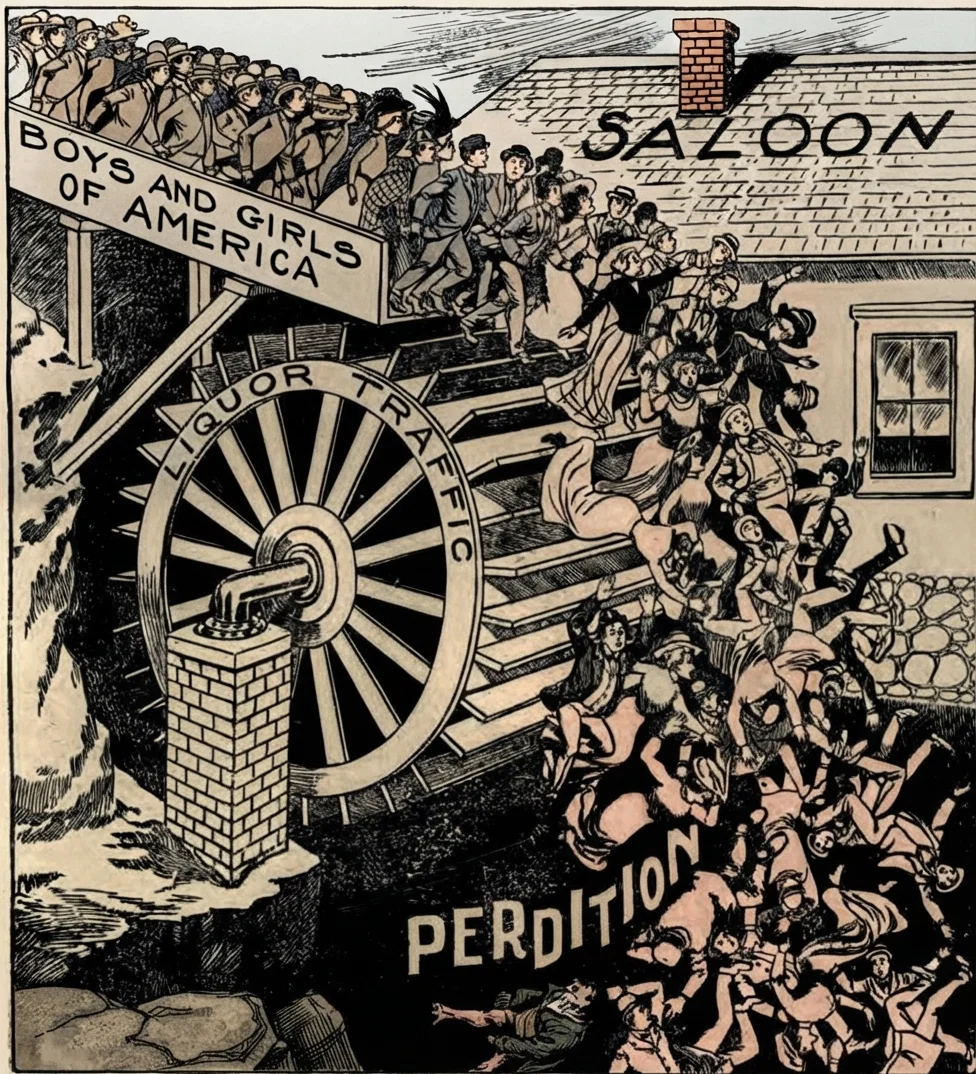
THE STREAM THAT GRINDS THE GIN MILL'S GRIST.
—★★—
The British Coronation Oath
By Editor
THE king's oath of England is still troubling both king and people. There is strong protest on the part of many in England against any change in the Protestant oath. A bill before Parliament provides for a change, and in the place of the language used as stated last week in the SIGNS it is proposed to substitute the simple declaration:
"I — do solemnly and sincerely, in the presence of God, profess, testify, and declare that I am a faithful member of the Protestant Reformed Church as by law established in England, and I will, according to the true intent of the enactments which are intended to secure the Protestant succession to the throne of my realm, uphold and maintain the said enactments to the best of my power according to law."
This is objected to by the Scotch because they have a Scotch church and they do not believe in prohibiting one who is a member of the church by law established in Scotland. The High Church, or Anglicans, who perform mass and invoke the Virgin Mary, who are practically Catholics, object fiercely to the introduction of the word "Protestant;" and the Non-Conformists, of whom there are one hundred fifteen in the House of Commons, oppose the new declaration as a new test act, excluding forever all Non-Conformists from royal succession, so Mr. Stead tells us, and there is a "pretty kettle of fish" over it.
It would seem that the word "Protestant" should be sufficient, if they must have any religious declaration in the oath at all. Why say, "By law established in England"? What would be infinitely better would be entire disestablishment of any church, and to exclude from the king's oath and the oath of members of Parliament all religion. Let the declaration be that there shall be no religious legislation in England whatsoever; no church of England established by law, whether Catholic or Protestant; but that all stand equal before the law. This would be consistent, harmonious, absolutely just. But this seems to be altogether too good to hope for. We certainly see no call for the present form of the oath. We do not believe in the Catholic religion in any way, but we do not see any particular virtue in insulting those who do believe in it. We believe that Protestants themselves would gain by the change.
Religious and Educational News
One hundred and ninety-two Americans are present at the fifth International Congress of Free Religions which convenes at Berlin during the first part of August.11
In speaking of the pressure of the ecclesiastical element upon the recent policies of the Spanish Government, Prime Minister Canalejas declared that in so doing “the religious element is invading a domain with which it has no concern.” He speaks truly.
English statesmen think there is much splendor in the proposition of the New York American that all members of all parliaments in the world should meet in New York in 1913, yet also think it would fail to accomplish anything substantial.
A Eucharistic Congress will meet in Montreal, September 6 to 11, the first to be held in America. It is estimated that 200,000 will be in attendance, including European princes, archbishops, and bishops, and American prelates.
A seminary for the training of missionaries for the Moslem world has been established at Potsdam, Germany. Of all missionaries, those working in Mohammedan fields have the hardest task. They need special training.
The National Educational Association will meet in San Francisco at its next session, as will also the International Sunday-school Association. Together these conventions will bring about 65,000 people to the city.
Great Britain's budget estimates for the coming year are for revenues, £199,791,000; expenses, £198,930,000. Put in round numbers in dollars these sums would be $998,955,000 and $994,650,000.
It has been found that fifty tons of flaky armor are in the plates of the North Dakota and the Utah. A conference of experts recently sat at Washington to fix the responsibility and cost of replacing.
The wireless “S. O. S.” call brought help to the burning coast liner Momus. The vessel had 185 persons aboard, and there would have been great loss of life had not another vessel come to the rescue.
July 21 Estrada's forces inflicted a defeat upon the government army in Comolpa, Nicaragua. The former captured great quantities of arms and 300 mules. The loss of life will amount to 500.
One good woman, who lost her mother, her son, and her baby child but a few days apart, said she was trying to wear the clouds inside out, so that the people about her might see the silver lining.
The gaekwar of Baroda, India, has asked an American, Dr. W. A. Borden, to take charge of the libraries of Baroda, and of the translation of Western classics into Hindustani.
Improvements involving the sum of $400,000,000 are being made on the Russian Trans-Siberian Railroad. The reconstructions will be completed in 1915.
A New York train was held up by five bandits July 23. Four have escaped the police. About $500 was taken before the robbers were frightened away.
The census enumerators in Passaic, N. J., found 350 persons living in one house in that city. Forty-five men are said to occupy three rooms.
The United States consumed over a billion pounds of coffee in 1909. And what good did it do?
During the past year there were 52,407 matriculated students in German universities.
Missionaries affirm that even the largest bookstores in Mexico do not sell Bibles.
The allowance of George V of England has been increased by $65,000.
Russian and Japanese Treaty.—The treaty between Russia and Japan which was thought to be such a menace to the United States and perhaps other powers, is not so considered when the full text has come to hand. Article 1 treats of commerce between the two nations and cooperation in railway transportation. Article 2 engages to maintain12and respect the status quo of Manchuria between Japan and Russia or between either of these two powers and China. Article 3 provides that in case any event arises of a nature to menace the status quo above mentioned, the two high contracting parties shall in each case enter into communication with each other in order to arrive at an understanding as to measures which may be deemed necessary to maintain existing conditions. It is looked upon now as a reaffirmation of the peaceful relations existing between the two powers. Ambassador O'Brien at Tokyo declares that the Japanese Government remains of one accord with the United States, and that there is no secret treaty behind the one just made public between Japan and Russia. Great Britain and Germany, it is said, stand in the same friendly relation.
Decorative Divider
—★★—
Bryan’s Local Option Defeat
The primary election, July 23, in Nebraska, makes absolutely certain the defeat of Bryan's proposal of local option in that state, according to newspaper reports. Good measures have been again and again defeated in the world's history, and this is not the first time that Mr. Bryan has been defeated while pleading for principle.
Jonah and Biblical Inspiration
In a sermon before the Michigan Lutheran Synod at the Emmanuel Church, Detroit, Rev. H. Speckhardt, speaking of Jonah and the sea-monster, said: "Those who reject this miracle must reject all the miracles. . . . Lutherans must accept the book of Jonah as a Bible truth, verbally inspired by the Holy Spirit." True.
—★—
Record Bank Theft in Louisville
The Fidelity Company of Louisville, Ky., lost $1,340,000 by theft through its assistant secretary, August Ropke. The amount equals the surplus fund of the bank, and is the largest bank theft in history. Ropke began his peculations about nine years ago.
Decorative Separator
—★—
Religious Communicants in American Cities
Memphis stands at the head of American cities in the proportion of Protestant communicants—84.4 per cent; Toledo and Washington next with a proportion of respectively 70 and 66.9 per cent. The following cities stand ahead in proportion of Catholic communicants: Fall River, with 86.5 per cent; San Francisco, 81.1 per cent; and New Orleans, 79.7 per cent.
Decorative Separator
—★—
The Religio-Medical Masquerade
"The Religio-Medical Masquerade." Cloth. Price $1.00 net; $1.08 by mail. A complete exposure of Christian Science by Frederick W. Peabody, LL.D., of the Boston bar. The Hancock Press, Boston, Mass.
Among the blows which Christian Science has been receiving of late, none have been struck with any stronger spirit behind them than those by Judge Peabody in this book which lies before us. He declares that he has placed more study upon it and its inner workings, with better opportunities to learn its inner workings through his legal connection with it, than any other individual in the United States, and he writes the book because he believes that he ought to write it.
Mr. Peabody has been engaged in several lawsuits in which Christian Science has been involved. He was one of the attorneys for Mrs. Eddy's son, George W. Glover, in the prosecution in the courts of New Hampshire for the appointment of a receiver of Mrs. Eddy's estate. The chapter headings are: The Sacrifice of Children, The Detached Heart, Pretended Equality with Jesus, The Faked "Revelation," The Fiction of God's Authorship, A Sham "Religion," A Bogus Healing System, Immeasurable Greed, The Eddy Autocracy, The "String" on the Gifts, The Eddy Ban on Marriage, Christian Science Witchcraft. Tremendous denunciations are the very titles themselves.
Yet Judge Peabody declares in his introduction: "I challenge Mrs. Eddy and the whole Christian Science combination to dare to prosecute me for libel, and I affirm and shall continue to affirm that their omission so to do is an acknowledgment of the truth of every statement I make. She knows I am telling nothing but the truth, and that the whole truth to be brought out upon a judicial investigation would be more damning than the truth as I have presented it. The whole truth can not be told outside of a judicial tribunal." As to whether these charges are proved truth we must refer the reader to the book.
Yet Speaketh He
By Gertrude Capen Whitney
“Yet Speaketh He.” By Gertrude Capen Whitney. Price 80 cents. Sherman, French and Company, Boston.
A sweet little story, well told, in which a consumptive boy is inspired by a noble deed of a young man who gave his life to save the boy’s little sister. Passing the life on in work for others, in repairing the broken, in bringing healing to the sick, in helping the helpless, in making deserts bloom, in binding up the bruised, became the boy’s life-work. In blessing others he was blessed, and in his life the noble deed of the young man bore fruit.
Food and Cookery
"Food and Cookery," its relation to health, lessons in practical work. Compiled by H. S. Anderson. College Press Print, Loma Linda, Cal.
The object of the little book is to set forth the values of various kinds of foods, their constituent elements, the best food values, how this food should be cooked, proper combinations, etc., etc. A large number of recipes are given, showing how to prepare the best foods in the best way. It is a neatly printed and helpful pamphlet to every housewife, in fact every one who eats. Can be obtained by addressing the publisher.
Religious Progress in America
By Editor
"Religious Progress in America; Progress and Achievements of 100 Years," by Samuel Nathan Church, is an address delivered before the Centennial Convention of the Christian Church at Carnegie Music Hall, Pittsburg, Pa., Oct. 16, 1909. It really shows the progress which has been made by the Christian denomination since Thomas Campbell, Alexander Campbell, and others who founded the church. Mr. Church takes rather broader views than do some of that denomination in stating that there is practically no vital or substantial thing in which that denomination differs from the Methodist, the Congregational, the Baptist, the Presbyterian, the Episcopalian. He emphatically says, "There is not one vital or substantial difference." He takes this as evidence that a practical Christian union has already arrived. He believes that there is far greater progress before us; and yet it seems to us that he has missed the very secret of true unity, and that is absolute loyalty to the Word of God.
Medical Men in the Time of Christ
"Medical Men in the Time of Christ." By Robert N. Willson, M.D. Neatly bound in cloth, with half-tone illustrations. Price $1.00. Sunday School Times Co., Philadelphia, Pa.
Dr. Willson points out that sometime in the past sin entered among the race of men, and disease entered the stage astride of sin; that reestablishment of health by medicaments has therefore succeeded never, and never will be successful in the hands of him who depends solely upon human agencies for the world's cure. Dr. Willson first gives a review of medical history. He then considers the lay condition surrounding medical men before and in the time of Christ; the Æsculapian temples of health, from Æsculapius, a partly mythical and partly historical character whose name is well known in the annals of medicine. Luke the physician is given a chapter, and the closing division of the book is "The Master Physician." It is worth while to find a physician who so clearly and emphatically believes in Christ Jesus the Healer. He declares: "No human influence nor training has before or since developed the naturalness, the directness, nor the simplicity of His method. In none is embodied the principle of His healing power. From Jehovah the Healer, Counselor, and Father of the fugitive band from Egypt came the all-wisdom and power that affected each cure." It is certainly a little book full of information and helpfulness; tho one may not always agree with the doctor.
I Choose
By Editor
"I Choose." By Gertrude Capen Whitney. Neatly bound, with illuminated cover and back. Price $1.00. Sherman, French & Company, Boston, Mass.
The aim of the little book is to show that environment and surroundings are different. Let our surroundings be what they will, we make our environment by our own choice. A sketch is given of a family and the blessings of rejuvenation under better education. It has some excellent, helpful suggestions in the making of better homes. It presents these pictures in the extreme, and it leaves out, it seems to us, one of the most necessary of all things in the building of character — simple faith in Christ Jesus.
"The Excursions of a Book-Lover."
By Frederic Rowland Marvin. Cloth, 331 pages. Price $1.50. Sherman, French & Company, Boston, Mass.
A collection of essays on literary themes, filled with numerous bookish reminiscences. Among other things, Dr. Marvin calls bad books a national evil—if two thirds of American journals were destroyed, we would have "purer morals and stronger minds." Many stories involve religious works, and often theology is interwoven, some good, some bad. It is unfortunate that none of the "excursions" reach into the Bible,—the most fascinating of all books.
The Crime of the Kongo
"The Crime of the Kongo." By A. Conan Doyle. Cloth. Price not given. Doubleday, Page & Company, New York.
There has been very much said on the Kongo and its crimes. Roman Catholics have charged that the awful stories of King Leopold's work among the natives have been engendered by Protestant prejudice and opposition; others have declared that it was a baseless scandal fostered by rival rubber firms, of whom some are Americans. Still others have contended that in the Kongo has been wrought by King Leopold and his followers the greatest crime in human annals; and Sir Arthur Conan Doyle is of the latter opinion.
He calls forth the witnesses of this crime, and points out the fact that they are of all nations, that there is no possibility of error concerning facts. There are honorable British consuls who testify as to the detail of fact and date; there are French officers who do the same; missionaries of many races; the "eloquent action of the Italian Government," which refused to allow Italian officers to be employed any longer in such hangman's work; the report of the Belgian commission; and the incorruptible evidence of the kodak. He declares that some at least who have apologized for the atrocities committed there have been paid for it in Kongo gold, and he as an Englishman is looking toward America to see if moral support can not be obtained here to remedy the awful difficulty. There are many who have only shadowy ideas of what the Kongo troubles mean. In this little work the author has set forth the entire question, How the Kongo Free State Came to Be Founded, Its Development, The Working and Fruits of the System, Voices from the Darkness, Various Reports, Catholic Testimony as to the Kongo, and The Evidence up to Date. The profits from the book will go entirely into a fund for further investigations and relief of conditions there.
Unidentified Fragment
—*
Shiloh: the Man of Sorrows
By Mrs. L. D. Avery-Stuttle
Chapter XXIII.—Mary Magdalene
EVER in Bethany, at the home of Lazarus and his sisters, there was great rejoicing. Already they had formed not only the acquaintance, but the deep friendship, of the Man of Nazareth.
Altho Bethany was a small hamlet, still it was so near Jerusalem as to be almost a suburb. And perhaps it was this fact, the happy family modestly declared to one another, no less than on account of the sincere friendship which had been formed between them, that had induced the Master to make Bethany, and particularly their humble but hospitable home, His frequent resting-place when in that vicinity.
This blessed intimacy had already continued for some time; and the only drop of grief which their cup contained since the peaceful death of their honored parents, had been the malignant and terrible insanity of their beautiful and dearly loved sister.
Since the morning when she had been carried by Simon, her betrothed, and the soldier Emil, and laid at the door of their cousin Adah, of Bethabara, her malady had continually intensified.
But now she has been made whole by the great Physician, and has returned to her home, a new light in her beautiful eyes, and an inexpressible gratitude and happiness in her heart, while Martha, unable to express the joy of her soul in spoken words, seizes her pen, and writes a letter to her cousin Adah, who has but lately removed from Bethabara to the city of Nain, and despatched it by our old friend Matthias.
This young man, Matthias, whom we last knew as one of the servants of Machbor of Jericho, had already left the employ of his master, that he might be free to follow the Nazarene,—since the imprisonment of the Baptist,—and minister to His needs. His was the unselfish love of a faithful friend, and his devotion that of a sincere and loyal heart. Others, even of those disciples more closely associated with the Master, might talk, as already they often did, of the glory of their Master's kingdom, which they supposed was soon to be set up at Jerusalem, and of the positions of honor which each would occupy. It was enough for Matthias to be near Him, to behold His face, to listen to His words, and to realize that the Messiah of Jacob had at last come to redeem Israel.
Just how this would be accomplished, he knew not, nor desired to know. His was the unquestioning faith of his grandfather Eliah, who perished at the hand of the soldiers of Herod. He only knew that the words of the prophets had their complete fulfilment in Jesus of Nazareth, and that the days were accomplished. It was the one wish of Matthias that his life, which had been so miraculously spared in infancy, might be devoted to Him in whom he believed.
The hand of Martha trembled with eagerness and joy as she penned the words which follow:
“Bethany, A.U.C. 781.
“To Adah, of Nain,
“Late of Bethabara:
“My Dear Cousin, Greeting.
“I write to inform my beloved relatives, Adah and Reuben, of the deep joy which has come into our lives, since that terrible morning when last we saw you,—the morning when our loved Magdalene was stricken,—a day which I must forever remember, tho I lived a thousand centuries. Of course, Adah, thou dost already guess my secret—that she is again well; yes, my cousin, she has been healed by the mighty Nazarene. Canst thou patiently follow me, while I make known the truth unto thee?
“First, let me relate a few of the more prominent events which have occurred since we saw thee, and of which it is quite likely thou mayest not be cognizant.
“Our brother Lazarus, of course, attended the late Passover at Jerusalem, and as he did not meet thy son, Cousin Reuben, we fear he may be in ill health. But, O my cousin, verily, all Judea and the regions beyond must very soon acknowledge that the Messiah has at last come. I suppose thou hast heard of the miracle at the wedding of Chuza, he who hath been appointed steward of Herod,—because Cana is not far from Nain.
“But truly I am of the opinion that the Master intendeth soon to set up His kingdom at Jerusalem; for at the Passover, He fearlessly entered the temple, and drove thence the greedy money-changers, and those that sold sheep, oxen, and doves; and Lazarus tells us that among those who fled from the temple, was Jazer the scribe, whom perhaps thou mayest remember. Then after the holy house was purified and purged of this bartering multitude, the Master healed very many sick people who had come to Him or had been brought thither by their friends—those who heard of the power and the wondrous pity of the great Healer.
“But I know that thou already weariest of my words,—only thou lovest to hear of the works of the divine Master. But now will I speak of that which thou dost desire to learn.
“Magdalene is at this moment seated with her beloved harp, a gift from our brother. It has always been her favorite pastime to play this instrument, and she is now singing one of the psalms of David. Verily my sister had always a sweet voice, but since her miraculous restoration, it seemeth sweeter than before.
“Thou dost remember in what deplorable condition she was on the morning when we left thy quiet and hospitable home at Bethabara. But immediately upon our arrival home, she became worse, until, of a truth, it seemed necessary for Lazarus to bind her. This was a source of deep grief unto me. At length we decided to take her to Jerusalem, and leave her in the care of Jocabel, the famous physician, whose dwelling is near the temple. This man declared her to be possessed of seven devils. O my Adah! It paineth me even now as I reflect upon the condition in which my beloved sister so long remained. Thus the weeks passed away, one by one; and surely thou knowest that each seemed like an eternity to my poor brother and me.
“Meanwhile, Lazarus had made the acquaintance of Him whom we so much desired to see, while we were yet at your old home in Bethabara. Now we do know and love Him, and call Him Master. We are glad to invite Him often to our home, and He seemeth pleased to accept our loving hospitality; and O what lessons of truth and wondrous beauty fall from His lips. Tho sometimes I can not find time to sit at His feet,—for indeed I am careful and troubled, as thou knowest, Adah, about the things of this life.
“But of a truth I wonder most of all that we were so hard of heart that we did not bring our afflicted one at once to His blessed feet. Had it not been for our strange blindness of heart, how much sooner our beloved invalid might have been among us.
“As I have told you, she was, until yesterday, in the care of the physician Jocabel; but early yesterday morning, even before the rising sun had appeared above the mountains, in some unaccountable manner Magdalene had escaped his watchful care, and the physician knew not whither she had fled. At once a messenger was sent in great haste from Jerusalem to make this known unto us, and to ask our brother Lazarus to join in the search for her; for we feared she might take her own life, for her paroxysms had become frightful.
“At last Lazarus found her, wallowing on the ground, just outside the walls of Jerusalem. At his approach she began foaming and screaming. He has since told me that it stabbed his heart like a knife to assist the men in binding her. The strong cords cut into her tender flesh until her arms were purple and bleeding. But so they bore her along by a back street, hoping to be able to enter the lodgings of the physician without being observed by many. But almost as soon as they had entered the gate of the city, they met a great concourse of people who were already following the Nazarene, and thronging His steps to be healed of their diseases.
“At once my brother and the men who were with him, passed before the Master, while our poor sister, as Lazarus tells me, fell again upon the ground, foaming and tearing madly at her bonds. Finally, as if the springs of life were quite spent, she fell at the very feet of the Master, who gazed upon her distorted face with sympathy and love. Her beautiful black hair hung in unkempt masses about her swollen and disfigured countenance, and she lay as one in a trance, insomuch that my brother supposed her dead.
“Then the Nazarene stooped and took one of the poor torn hands in His own, as He said: ‘O ye unclean spirits, I command you, depart out of her, and enter no more into her!’
“This He said in a voice of authority. Then in a tone of exceeding gentleness and love, He called her by her name: ‘Mary, Mary Magdalene!’
“Instantly there came over her a wonderful change. It was even as if she had awakened out of a deep sleep; and O my cousin, once again there came into the dark eyes a look of peace and happiness as in other days.
“‘Loose her, and let her go!’ commanded the Master. As soon as this was done, a cry of joy broke from her lips, as she sprang to embrace the feet of the Nazarene.
“Then, amid the silent awe of the multitude, there sounded a harsh voice: ‘He casteth out devils through Beelzebub, the prince of devils!’
“Lazarus turned to see whence came the voice; and behold, it was Jonathan, son of Annas, the high priest, as he spake unto Jazer, the scribe of the temple, who bowed his haughty head, and together they passed down the street of the city.
“This letter is long, my cousin; but verily thou wilt rejoice, even as do we also, that the mighty power of Shiloh is being made manifest.
“I must mention, before I close, that the haughty Simon, the former betrothed of my sister, has taken to wife Prisca, the daughter of Elkanah, a nobleman of Jerusalem. They abide in Bethany. This day, tho I almost feared to do so, I told my sister. But she only replied, smiling brightly:
“‘I am so content, my Martha, that verily I have no word of condemnation for Simon,—tho of a truth he hath done me a grievous wrong. But I,—behold, I have found Him whom my soul loveth,—even Him who shall redeem Israel; and my soul doth magnify the Lord.’
“So said my sister; and I also rejoice and am glad of this, because, as thou well knowest, neither Lazarus nor I have favored the man Simon, fearing that he was too hard of heart for our gentle and loving sister. Dost thou remember, Adah, his harsh words and his haughty manner when he looked upon her so coldly on that awful morning, as he said unto me, ‘Thy sister seemeth to be possessed with Beelzebub!’ I remarked, even then, that the young man Emil, the Roman soldier, regarded my poor sister with a look of greater compassion than did Simon, her betrothed.
“Matthias awaits this letter, that he may bear it unto you.
“Your happy and grateful cousin
“MARTHA.”
(To be continued)
To Thine Own Self Be True
To THINE own self be true,
And it must follow, as the night the day,
Thou canst not then be false to any man.
— Shakespeare.
Fruit Farm for Sale
LOCATED on the south slope of the Ozark Mountains, in the famous fruit belt of Missouri. The orchard of forty (40) acres is just old enough to begin to bear fruit. The peach orchard will yield 2,000 bushels this year. Circumstances of party owning make quick sale imperative, and at about half value. For particulars address James Cochran, 1109 E. 12th St., Kansas City, Mo.
IN THREE DAYS
SAN FRANCISCO
Overland Limited
TAKES YOU
To Chicago
ACROSS GREAT SALT LAKE
AND
HIGH SIERRA BY DAYLIGHT
Luxurious High-class Equipment
Electric Lighted Throughout
Pullman Drawing-room
Stateroom
Vestibuled Sleeping-cars
Careful and Attentive Dining
Service
Parlor Observation-car with
Library and Cafe
Ladies' Reading-room
Gentlemen's Smoking-room
Daily News Bulletins
Latest Papers and Magazines
Southern Pacific
LIBERTY
By Editor
THE OFFICIAL ORGAN OF
THE RELIGIOUS LIBERTY BUREAU
AN illustrated, 48-page, quarterly magazine, published as an exponent and advocate of true religious liberty; defending Christianity and the rights of conscience; upholding the Bible as the infallible word of God; recognizing the church and state as ordained of Heaven for specific and distinct purposes, but vigorously protesting against the alliance of the church with the state in the attempt to advance religion and to promote the state.
Price 25 cents per year. Liberal terms to agents.
Address, LIBERTY, Takoma Park, D. C.
Life and Health
A PRACTICAL health journal, published with a view of meeting hygienic needs in every home; teaching how to care for the health and how to preserve life; prescribing simple home treatments to assist nature in throwing off diseases rather than adding more poison by using drugs or unnatural stimulants as remedies: teaching how to avoid disease as far as possible, how to manage in the home when sickness does come, and how to combat the disease by simple remedies which nature provides.
Send for sample copy and special rates to agents. Price 10 cents per copy or $1.00 per year.
Address, LIFE & HEALTH, Takoma Park, D.C.
Bibles
Bibles.—Remember that we are headquarters for anything in the Bible line. We shall be pleased to send you our catalog of Bible selections on application. Pacific Press, Mountain View, Cal.