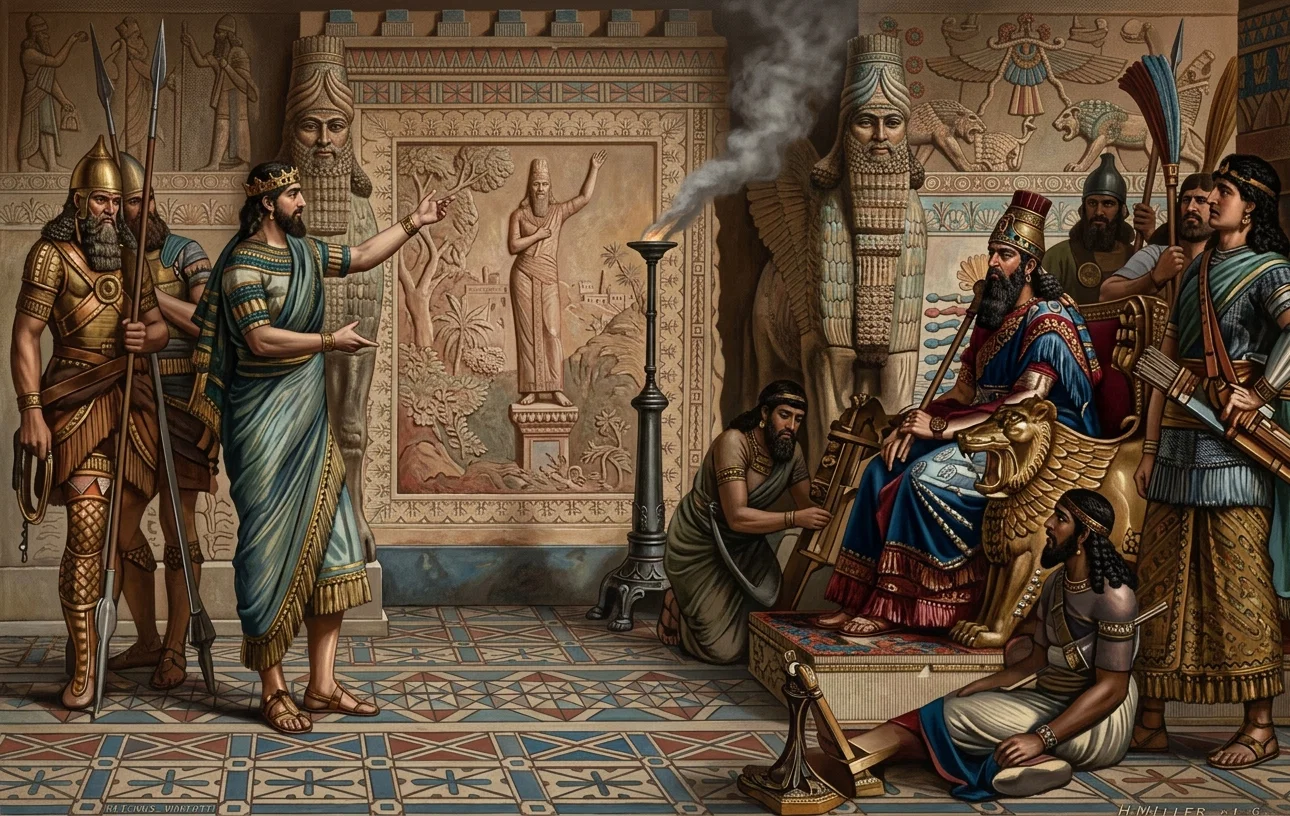
"And in the second year of the reign of Nebuchadnezzar, Nebuchadnezzar dreamed dreams, wherewith his spirit was troubled, and his sleep brake from him. Then the king commanded to call the magicians, and the astrologers, and the sorcerers, and the Chaldeans, for to show the king his dreams." "And the king said unto them, I have dreamed a dream, and my spirit was troubled to know the dream. . . . Therefore tell me the dream, and I shall know that ye can show me the interpretation thereof. The Chaldeans answered before the king, and said, There is not a man upon the earth that can show the king's matter." "It is a rare thing that the king requireth, and there is none other that can show it before the king, except the gods, whose dwelling is not with flesh."
Upon hearing this, the king was very angry, and commanded that all the wise men should be slain. But God revealed the dream to Daniel in a night vision. "Therefore Daniel went in unto Arioch, whom the king had ordained to destroy the wise men of Babylon; he went and said thus unto him: Destroy not the wise men of Babylon; bring me in before the king, and I will show unto the king the interpretation."
Daniel was taken in to the king, and said to him: "The secret which the king hath demanded can not the wise men, the astrologers, the magicians, the soothsayers, show to the king. But there is a God in heaven that revealeth secrets, and maketh known to the king Nebuchadnezzar what shall be in the latter days. Thy dream, and the visions of thy head upon thy bed, are these: . . . Thou, O king, sawest, and behold a great image. This great image, whose brightness was excellent, stood before thee; and the form thereof was terrible."
After describing the image which the king had seen, Daniel said, "This is the dream; and we will tell the interpretation thereof before the king. Thou, O king, art a king of kings; for the God of heaven hath given thee a kingdom, power, and strength, and glory. And wheresoever the children of men dwell, the beasts of the field and the fowls of the heaven hath he given into thine hand, and hath made thee ruler over them all. Thou art this head of gold. And after thee shall arise another kingdom inferior to thee, and another third kingdom of brass, which shall bear rule over all the earth. And the fourth kingdom shall be strong as iron. . . . And in the days of these kings shall the God of heaven set up a kingdom, which shall never be destroyed; and the kingdom shall not be left to other people, but it shall break in pieces and consume all these kingdoms, and it shall stand forever."
This dream was given to the king of Babylon, the events of the future, reaching down to the end5of time, were opened before him, that he might have light on this important subject. It was also given for the benefit of all future generations. The record was traced by the prophetic pen that the light might be shared by those kingdoms which should succeed the kingdom of Babylon.
Tho this wonderful dream caused a marked change to take place in the ideas and opinions of King Nebuchadnezzar, his soul was not cleansed from its pride, its worldly ambition, its desire for self-exaltation, by the converting power of God. The rise and fall of the kingdoms which were to succeed Babylon, were minutely described to him by the prophet; but instead of treasuring the conviction which had been made on his mind in regard to the fall of all earthly kingdoms, and the greatness and power of Jehovah's kingdom, the king, after the immediate impression wore away, thought only of his own greatness, and studied how he might make the dream turn to his own exaltation and honor.
He said much regarding the interpretation given by Daniel, but the words, "Thou art this head of gold," produced the greatest effect upon his mind. These impressed him so much that his wise men, who had not been able to tell the dream, proposed that he make such an image as the one seen in his dream, and that he set it up, that all might see the head of gold, which was a representation of his kingdom.
This pleased the king. His pride and vanity found full scope in the thought that he could thus represent his importance; and he resolved that instead of merely copying the image he had seen, he would make an image that should excel the original. It was his design that the whole image should represent the greatness of Babylon. Therefore that which had been said regarding the kingdoms that were to follow, should be blotted from his mind, and from the minds of those who had heard the dream, by the splendor of the image he was about to make. This image should not deteriorate in value from the head to the feet, as had the one he had been shown, but should be composed throughout of the most precious metal.
God had spoken plainly to Nebuchadnezzar in regard to his kingdom. "In the days of these kings," said Daniel, "shall the God of heaven set up a kingdom, which shall never be destroyed; and the kingdom shall not be left to other people, but it shall break in pieces and consume all these kingdoms, and it shall stand forever. . . . The dream is certain, and the interpretation thereof sure."
The king had acknowledged the power of God, saying, "Of a truth it is, that your God is a God of gods, and a Lord of kings, and a revealer of secrets;" but notwithstanding this acknowledgment, he now united with the men he had once sentenced to death, to dishonor God. He had purposed to destroy these men, because he had discerned their deceptions, and because he was convinced that their learning did not possess the power he had supposed; and they had been saved from a cruel death by the intercession of Daniel. Now he joins with them to frame a design for his image, and to make the light from heaven serve his pride, and forward his exaltation. The kingdom of Babylon was interpreted to be the kingdom that was to break in pieces all other kingdoms, and to stand forever; and they endeavored to make an image which would fitly represent Babylon as eternal, indestructible, and all-powerful,—a kingdom that would last forever.
"Nebuchadnezzar the king made an image of gold, whose height was threescore cubits, and the breadth thereof six cubits; he set it up in the plain of Dura, in the province of Babylon." As an idol, an object of worship, the image was placed in the most favorable position; and a proclamation was issued that all should worship it.
Thus the grand lesson given by God to the heathen, and to all people, was misconstrued and misplaced. That which was designed by God to teach lessons of truth, and to give the world clear, distinct rays of light, Nebuchadnezzar turned from its purpose, making it minister to his pride and vanity. The prophetic illustration was made to serve for the glorification of humanity. The symbol designed to unfold important events was turned into a symbol which would hinder the spread of that knowledge which God designed the kingdoms of the earth should receive. By the height and beauty of his image, by the material of which it was formed, the king sought to make error and false doctrine magnificent and attractive, more powerful, seemingly, than anything God had given.
Those who are willing to be taught, may learn a lesson from the conduct of the king of Babylon. As the enemy sought to make God-given light serve his own purposes, by leading the king to work for his own glory instead of working for the glory of God, so he works to-day to pervert truth in order to hinder God's purposes. All false religion has its origin in a corruption of the true. When unmixed with evil, truth is a mighty power to save; but if we allow the enemy to work through us, if by the light given us we seek to exalt self, even this truth may become a power for evil.
So it was in Christ's day. In their pride the Jewish leaders perverted the meaning of their religious services. Those who sat in Moses' seat could not bring their proud hearts to believe the prophecies, and they instilled into the minds of the people their false interpretation of Scripture. The truth was buried beneath their own doctrines, and maxims, and traditions. They taught the people that Christ was to appear as a great conqueror, to break the Roman yoke from the neck of the nation. They received that part of the prophecy which foretold one who was to shine before his ancients gloriously, who was to reign from sea to sea, and from the river to the ends of the earth; and they expected the Messiah to exalt Israel to universal dominion. When Christ did come,
with no outward show of a conqueror, they turned their faces from him, resisting his words, and working by every conceivable means to counteract his influence.
The enemy would lead us all to use, as did Nebuchadnezzar, the light and knowledge of God for our own exaltation. But self-exaltation can find no place in the work of God. "Thus saith the Lord, Let not the wise man glory in his wisdom, neither let the mighty man glory in his might, let not the rich man glory in his riches; but let him that glorieth glory in this, that he understandeth and knoweth me, that I am the Lord which exercise loving-kindness, judgment, and righteousness, in the earth; for in these things I delight, saith the Lord."
"SCIENCE AND RELIGION."
In speaking of "science and religion" the New York Observer remarks:—
It is odd that we hear so much respecting the conflict of science and religion rather than that of religion and science. The order of this phrasing is possibly not wholly without significance. It seems to imply that which is perhaps the fact, that science is the aggressor and more often proceeds to assault religion than does religion science. However that may be, there is at least an apparent variance, to put it mildly, between the scientific theories of the day and generally accepted Christian teaching. We say the science of the day, for science changes from week to week. "What are the latest conclusions of modern science?" one man asked another. "I do not know," was the reply; "I have not read the morning papers." What is good science to-day was perhaps but faint and reluctant prophecy yesterday, and may be held to be but nescience to-morrow. Science is in a state of flux serving thus to verify, it would seem, the universal theory of Heraclius.
This is true. And in a sense this is also true of religion. Not but what religion is all taught in God's Word, but the infinite depths and heights of that Word are yet unsounded; its breadths and lengths are yet unexplored. Like the conquering sun, the light from God's Word grows brighter. It ought to be as true of the church as of the Christian, "The path of the just is as the shining light, that shineth more6and more unto the perfect day." Prov. 4:18. Religion can not be bound by creeds. Man should not attempt to make a similitude of God's truth or the religion of Christ, any more than he should of the great Jehovah, the Author of the truth. How can you represent life in an image of wood or gold? How can you represent life in a cold, dead creed? The only sure way to obtain the true knowledge of God is in Jesus Christ, by faith—abiding in Christ.
IS TRINE IMMERSION NECESSARY FOR GOSPEL BAPTISM.
By O. Davis
As the commission to go into the world and preach the Gospel to every creature, baptizing them in the name of the Father and of the Son and of the Holy Ghost, did not originate the ordinance of baptism, but only authorized its administration in the name of those three, perhaps we may get a clearer understanding of its significance by studying its introduction into the Gospel dispensation by the Father, in preparing the way of his Son.
We will take our stand upon what the Word of God calls "the beginning of the Gospel of Jesus Christ, the Son of God; . . . behold, I send my messenger before thy face, which shall prepare thy way before thee. The voice of one crying in the wilderness, Prepare ye the way of the Lord, make his paths straight." Mark 1:1–3. John the Baptist being that messenger, how did he prepare Christ’s way? As this was the beginning of the Gospel in the fulness of its generating provisions and power, it must be on the Gospel plan. And as John was directed of the Father, the foundation must be right.
What was the mission of Jesus into this world?—In brief, it was to save us from our sins (Matt. 1:21), to so fulfil all righteousness as would enable him to justify us from the claims of God’s law in the court of heaven, as our high priest. As briefly expressed in Rom. 4:25: "Who was delivered for our offenses, and was raised again for our justification." His death and resurrection from the dead, were, then, the two great acts by which this would be accomplished. The rest of his work here was collateral to these.
We will now examine the work of him who was sent to prepare the way of Jesus, remembering that this was the beginning of the Gospel, and must therefore have been strictly on the Gospel plan. John came preaching the baptism of repentance for the remission of sins. Mark 1:4; Luke 3:3. Some came to John’s baptism who had not repented of their sins, and he would not baptize them. But replies to them, "Who hath warned you to flee from the wrath to come." As this was the way at that time to escape the wrath to come, there must be a full surrender of all sins, in order for them to be remitted and the sinner saved from the wrath to come.
Now, were the sins remitted by the baptism itself? or by it as a figure of the acts of Jesus, who was to remit sins in fact, and thus his way be prepared? Let us follow John to his baptism. He takes his candidate out into the water. He immerses him completely under the water, where, if he were held, he would die,—a complete figure of death. His death would be just as much assured as though his blood were all taken, as in the case of the animal offered for sin. Paul says: "Baptized into his death;" "buried with him by baptism into death;" "planted together in the likeness of his death,"—all recognizing baptism as a figure of the death of Jesus. Rom. 6:3, 4, 5. And this is also evident as a necessity, in order for sins to be remitted through it.
And a word here as to its being on the Gospel plan, since it is adapted to the world-wide field of the Gospel. In the previous remission of sin through a figurative offering; the life of a substitute bullock, goat, sheep, or a dove—must be taken, to show that the sinner’s life had been forfeited, and that there was no way for him to regain it except through the promised Redeemer, the Lamb of God, who is to give his life for the world. This offering was to be made at the door of the sanctuary at Jerusalem, so that the sin might be transferred to the earthly sanctuary.
Now the Gospel being as broad as the world, its plan must be equally broad. Its provisions for the remission of sins must be adapted to any part of its field. Wherever the sinner may be that repents of his sin, he can be baptized for its remission. And thus we see that John’s work was truly the beginning of the Gospel of Jesus Christ, and that he was, in reality, preparing the Lord’s way, the complete fulness of the Gospel plan.
We left our candidate under the water—under a realistic figure of what death, the penalty of the law, is, of which, by his confession of sin, he acknowledges himself to be worthy. How shall we get the right to raise him from this condition of death? Without referring to other scriptures, we find it in these words of John, who says, as he sees Jesus passing, "Behold the Lamb of God, that taketh away the sin of the world."
John knew he was preparing Christ’s way. He knew that this figure of death took hold of the death of this offering from heaven of the Lamb of God, for the remission of sins, and that therefore the penalty of death was cancelled in the promise, and he, the candidate, could be raised up a free man, an accepted child of God. As Jesus, who gave his life for our sins, was raised from the dead, so, by this death of Jesus, we are raised from our merited condition of death, by being released from the claims of that law that held us under death. And thus the baptism of John aptly prefigured Christ’s death and resurrection,—the acts which the Father sent him into the world to perform for man.
Notice also how Jesus, when he commences his ministry, walks in the prepared way, and is baptized by John, saying, "Thus it becometh us to fulfil all righteousness." And the Father now indorses the work by a special manifestation, and says, "This is my beloved Son, in whom I am well pleased." In this we see the perfect harmony of the Father and the Son. The Father gives the Son for man’s redemption, prepares his way by showing, in figure, the chief acts by which his work on earth is to be accomplished, and then the Son carries out in fact what has been shown in figure,—his death and resurrection. Baptism, thus far, shows the death and resurrection of the Saviour.
We now ask the question, Could the candidate for baptism be baptized by John’s baptism, and not recognize his relation to both the Father and the Son? The first essential thing is repentance of sin,—repentance toward God. We all have sinned, and come short of the glory of God. By going into a condition of death, under the water, we recognize the claims of God’s law upon us. And now there is no way for us to be released from the claims of that law, but by the death of Jesus, to satisfy those claims. Hence this figure of death must also lay hold of, and appropriate, that death to us, for the remission of our sins.
And thus it is absolutely essential to John’s baptism for the remission of sins, that both Father and Son be recognized. Then when both Father and Son are recognized in their relations to that baptism, what can you be baptized a second time for? It must be for something outside of what was at that time required.
We want to keep in mind that the time had not come for the Holy Spirit in its various gifts to be given in connection with baptism. That could not be given until the work of Jesus here on earth was completed, and he was thereby qualified to become our High Priest in the heavenly sanctuary. Immediately on the commencement of that work he receives from the Father the promise of the Holy Spirit, and it is poured upon the disciples on the day of Pentecost.
A few more thoughts touching John’s baptism. It went as far as man can go in the work of redemption. He could prepare Christ’s way. He could baptize the candidate, thus prefiguring these acts of Jesus which he would have to do for us, that man might be prepared to receive the Holy Spirit. That must come through the Father, and that brings us to the full Gospel commission of baptism: "Go ye therefore, and teach all nations, baptizing them in the name of the Father, and of the Son, and of the Holy Ghost." Matt 28:19. Mark adds (16:16–18), "He that believeth and is baptized shall be saved. . . . And these signs shall follow them that believe: . . . They shall speak with new tongues," etc. Luke adds (24:47), "Repentance and remission of sins should be preached in his name." In the Gospel commission of baptism, the Holy Spirit is added to what was recognized in the baptism of John,—the Father and the Son. This Holy Spirit was what Jesus promised to send when he went away (John 14:16, 26): "And I will pray the Father, and he shall give you another Comforter." "But the Comforter, which is the Holy Ghost, whom the Father will send in my name." Again (John 16:7), "If I go not away, the Comforter will not come unto you."
This Side the Cross.
We have now passed the cross. Jesus has carried out in fact what John’s baptism for the remission of sins showed in figure,—his death and resurrection. We find in the commission by Mark this statement: "He that believeth and is baptized shall be saved." We are, then, through belief and baptism, brought into covenant relations with God, a fully accepted child of his. The institution must, then, show the full grounds of our acceptance, and thereby become the figure through which we express our acceptance of these grounds.
Now notice the first introduction of baptism into the Gospel dispensation this side of the cross. As the Lord’s commission includes the Holy Spirit in its varied gifts in addition to what John’s baptism recognized, we find its introduction to be in connection with the gift of the Spirit. When the Holy Ghost was poured out on the day of Pentecost, and some were convicted of their sins, and asked what they should do, Peter replies (Acts 2:38), "Repent, and be baptized every one of you in the name of Jesus Christ for the remission of sins, and ye shall receive the gift of the Holy Ghost."
The Gospel work is now fully prepared, and as he that believeth and is baptized shall be saved, baptism must now have its full significance of redemption,—must be a complete memorial of it. John’s baptism looked forward to the cross. As introduced by Peter under the Lord’s command, it looks back to the cross, yet still including the remission of sins and looking forward to the resurrection. As our sins against God7were remitted by John's baptism, pointing us forward to the Saviour, as we have seen, so baptism, as introduced by Peter, remits our sins, by pointing us back to the acts ("this is the New Testament in my blood, which is shed for you for the remission of sins") of the same Saviour.
As we have found in John's baptism that it prepared the way of the Son of God, being on the Gospel plan, that it recognized both Father and Son, and could not be administered without that recognition, and that therefore there was no place for a second baptism, so here we find that the work is the same, only one points forward to the cross, and the other points back to the same, with the exception that this has the promise of the Holy Ghost.
Now where comes in the necessity of the second baptism, to entitle us to this additional blessing? We want this blessing; it is provided for us, and we need it to successfully carry on the work of God. It is the gift of the Spirit. It can strengthen us to overcome all sin, and perfect a character in the image of God, through Jesus Christ. What says the declaration of the apostle when speaking under the power of this same Spirit?—'Repent, and be baptized every one of you in the name of Jesus Christ for the remission of sins, and ye shall receive the gift of the Holy Ghost.' Now here is the statement made that if we comply with the conditions of baptism for the remission of sins, we shall receive the gift of the Holy Ghost. There is no question about it; we are not instructed to be baptized again, but to be baptized for the remission of sins.
This is where the apostle locates the efficiency. Have we really been baptized for the remission of sins? Have all our sins been confessed to God? Have they all been forsaken? And have we made a full surrender to God? Did we accept of Jesus Christ as the Lamb of God, who taketh away the sins of the world? Did we accept him as the one who died on the cross for the remission of our sins? Did we remember that the Father, when Jesus ratified the ordinance of baptism, by which the Father prepared his way, said, 'This is my beloved Son, in whom I am well pleased'? If we have been baptized under these conditions, the Father will accept the purchase of his Son's blood, and we shall receive the gift of the Holy Ghost. This is witnessed to in Col. 2:12, 'Buried with him in baptism.' We read in Rom. 6:4, 'Buried with him by baptism into death.' And as we are baptized for the remission of sins, we must be buried into death, 'planted in the likeness of his death.' Now, having accepted the death of Jesus for our sins, by God's appointed figure of his death, we will notice the rest of Col. 2:12: 'Wherein also ye are risen with him through the faith of the operation of God, who hath raised him from the dead.' As the claim of sin was canceled when we accepted Christ's death for sin in the figure, God accepts the purchase of his Son's blood, and raises us up, as he raised him from the dead, if we have faith in the operation of God. The thirteenth verse witnesses to this: 'And you, being dead in your sins and in the uncircumcision of your flesh [we were both dead by our own sins, and dead under the fallen nature of Adam], hath he quickened together with him [as he raised him from the dead by the power of the Spirit, so he will raise us], having forgiven you all trespasses.'
Now if we have faith in the operation of God, he will bring us up a new creature, having the indwelling power of the Holy Spirit. 'If ye then be risen with Christ, seek those things which are above.' 'For ye are dead, and your life is hid with Christ in God.' Col. 3:1, 3.
You have now, by your baptism, associated with faith, all that it can give you. Now if you are baptized again, it must be for something outside of the Gospel. And does it not show a lack of faith in God that he will not do just as he says he will? Does it not indicate that we feel wiser and wish an opportunity to help him a little by being baptized a second or third time, or giving it some other form, as our wisdom may suggest?
This is not intended to touch the question of rebaptism, in departing from first love.
O. DAVIS.
JEWISH CUSTOMS AND TRADITIONS.
By F. C. Gilbert
(By an Israelite.)
The Sanctuary and Its Services.—Continued.
The Golden Candlestick.
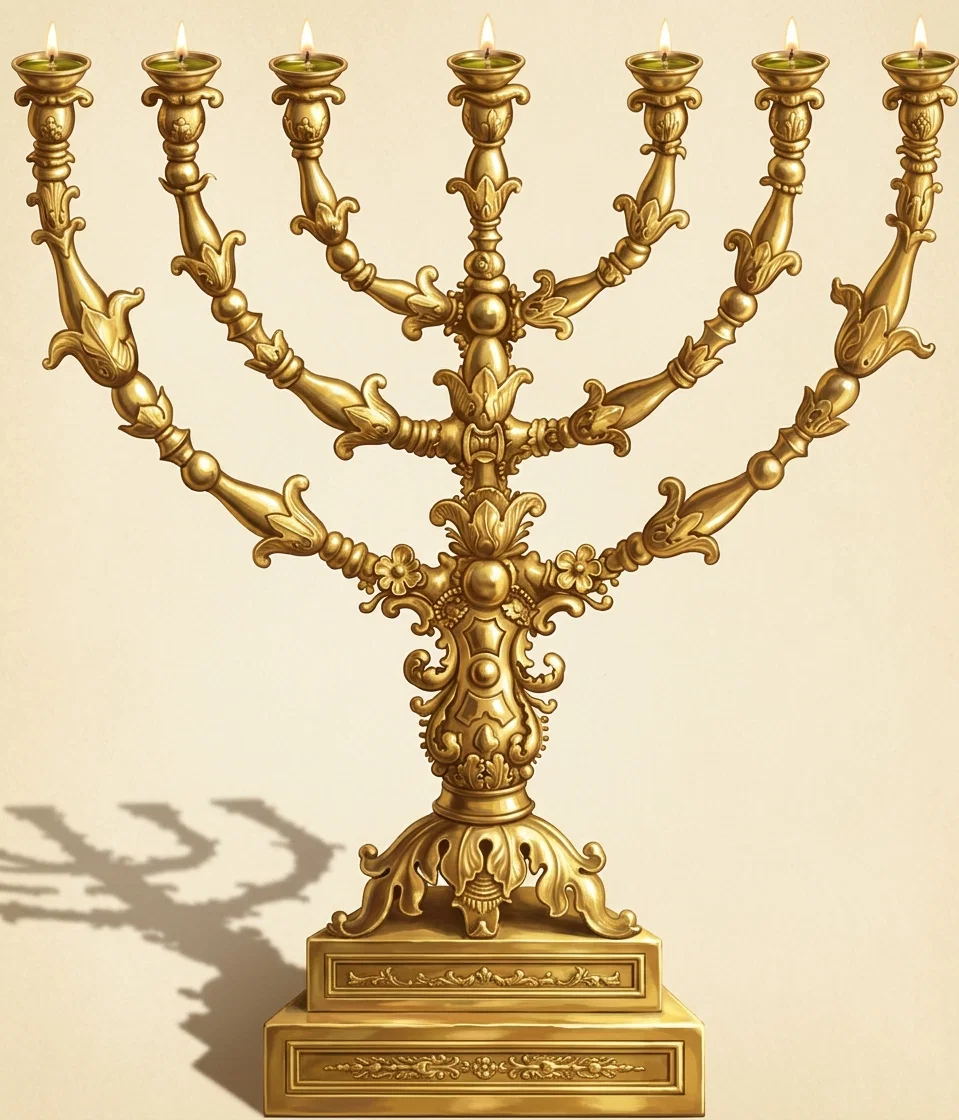
ALL artificial light was excluded from the sanctuary, neither were any provisions made whereby it might be admitted. When the priest entered there the first time, the place was totally dark. But God is light, and in him is no darkness at all; therefore he made some arrangement that light could be had in the sanctuary. The means for this were commanded of God, by having a golden candlestick made, which was to give perpetual light. It was made of pure gold, all of beaten work, with six branches coming out of it, three each side. This piece of furniture was artistically designed, and had most beautiful trimmings. The Lord also commanded the children of Israel to bring pure olive oil for the light, that the lamps might give a perpetual light. Every morning and evening when the priests offered the incense upon the golden altar, they were to trim the lamps. It might seem from Ex. 30:8, at first reading, the lamps went out during the day, and were started again each evening. But by comparing with chapter 27:20, 21, they were to burn always, and never to go out. The Hebrew word rendered in verse 20 'to burn always,' is 'a continuous, or perpetual light.' Once the lamps were lighted, they were never to go out. And it was the work of the priest each morning and evening to trim the lamps and fill them with oil. See Ex. 25:31-40; 27:20, 21; 30:7, 8; 40:4, 25; Lev. 24:1-4.
It is interesting to note how the candlestick was prepared to give light. It did not give light itself, but was simply a receptacle. The gold was first taken in the lump, and then passed through various processes of refining and beating, till it was made in exactly the shape that God intended it should be. Each part had to be exactly in harmony with the divine ideal, otherwise it was of no service.
Is it not by the refining processes that the Christian is made a light-bearer? Is it not by passing through the fiery furnace of affliction that our faith is tried as gold in the fire? And is it not necessary that all the dross be consumed and the right degree of beating and refining continue till every part is brought into perfect harmony with the divine will? It is only thus we are able to be light-bearers. God orders how the work shall be done; and if we submit ourselves to him, he will fashion us according to the pattern by which he makes all like himself.
It was only by this process that the Saviour was made perfect, and he is the light of the world. He was made perfect through suffering. And being made perfect, he became the High Priest for ever, for all who should obey him. Heb. 5:8, 9. All the light of the world was excluded from Jesus' life, that the light of God only might burn in his soul. And when God once started that fire to burn by the power of his love, it never was dimmed. God ever took care of it, and demonstrated to the world that he is the light which lighteth every man that cometh into the world. John 1:9. Thus God shaped and fashioned the dear Saviour, and made him to be the great receptacle which emitted the light of God to the world. 'He that hath seen me, hath seen the Father.'
Prior to his departure Jesus said, 'While I am in the world, I am the light of the world.' And since his departure from the world his disciples are the light of the world. 'Ye are the light of the world.' And as he is, so are we in this world. Thus God has made his followers to be light-bearers in this world. We are to be candlesticks beaten and refined of God, that the light of Jesus might be seen in the world. But if we expect to shine as God wishes, we should, we must, bear the test of refining; otherwise we shall not be the right kind of instruments. But, thanks be to God, Jesus knows how to sympathize with us while the work of beating is being carried on.
All outside means must be excluded, as the Lord allowed no other light but his own to shine in the sanctuary. 'For it is God which worketh in you both to will and to do of his good-pleasure.' And the material itself is much better than gold. For we are not redeemed with silver and gold which perisheth, but with the precious blood of Christ, as of a lamb without spot or wrinkle. And it is the trials and afflictions the Christian endures which makes him shine as a light in the dark world.
And the light in us must never go out either. It must be kept burning continually. There are some Christians that feel as tho they were shining one day, and the next day their light is out. But the true child of God seeks to have his light placed upon a candlestick, that it may give a bright light, and a continuous one. And it will never grow dim if we allow our great High Priest to trim the wick, and fill the lamp with the oil of grace. If we seek for his grace day by day, we shall give the right kind of light all the time. There are many bad edges which need trimming occasionally to keep the light burning brightly all the time; he will remove them if we ask him to supply us with needed help. It is much better for him to remove the trimmings than to remove the entire candlestick. And when he polishes and refines8and continually beautifies the lamp in which his own light shines, then many will be led to behold him who is the light of God and the light of the world.
He has told us what some of the means are to keep our lights burning brightly in our candlestick: 'Thy Word is a lamp unto my feet, and a light unto my path.' If we ever seek to imbibe that Word in our souls, then the darkness of tradition and superstition will never cause our lights to burn dimly or to become extinct.
Then let the good work go on in our every life; let him do all he thinks necessary that the light may shine brightly; that many may see our good works and glorify our Father which is in heaven.
'Light of the world, Thy beams impart,
To lead my feet through life's dark way;
O, shine on this benighted heart,
Nor let me from Thy guidance stray!
'Light of the world, shine on our souls;
Thy grace to us afford;
And while we meet to learn Thy truth,
Be Thou our teacher, Lord.'
F. C. GILBERT.
The Outlook
By W. N. G.
"I will stand upon my watch, and set me upon the tower, and will look forth to see what He will speak with me."
ANOTHER NATIONAL REFORM SCHEME.
A CALL has been issued for a National Good Citizens' Convention, to be held at Nashville, Tenn., May 18-20. The principal purpose is the organization of an International Good Citizens' League, the objects of which are thus set forth:—
"1. To unite for efficient and concerted action, and for mutual encouragement, all friends of good government, liberty, and prosperity."
"2. To purify politics, and for public office to 'provide out of the people able men, such as fear God, men of truth, hating unjust gain.'"
"3. To accept Christ and his law as the true basis of government and the supreme authority in national as in individual life."
"4. For alleviation of suffering, uplifting of humanity, and, as far as possible, abatement of poverty."
"5. For universal diffusion of knowledge and promulgation of truth."
"6. To promote the study of citizen-duty from the Bible standpoint, the glorious opportunities, privileges, and possibilities within reach of that nation whose government honors God's authority."
Like all the ostensible purposes of the various religio-political associations and combinations, these expressions sound well to persons not awake to the deceptive spirit that is abroad in the land endeavoring to establish such principles as must inevitably result in Church and State government. For the most part, the men and women who are engaged in these various enterprises are deceived as to their logical outcome, and are opposed to what they call Church and State union, namely, the adoption of any particular denomination as a national church. They do not see, or do not want to see, that the control of the government by all the churches combined involves the same principle, and must end in the support of, and consequently the enforcement of, certain religious tenets by the government. All these associations openly aim at one point, namely, the elevation of Christians to political office. Most professed Christians are at once attracted with the idea that this is a commendable object. They think it would be a grand thing to have the government in the9hands of Christian men, seemingly overlooking the fact that this was just what led to the corruption of both the Church and the State in times past. The great mistake arises from blindness to the fact that Christians do not want to control the government; only professed Christians, ambitious of political power, seek to control the government in the name of Christianity. No such effort was made in the days of Christ and his apostles. But the advocates of such a measure will stop at nothing to accomplish their purpose. With them "the end justifies the means."
But why are there so many of these associations, leagues, unions, etc., aiming at one point?—Evidently it is because one of them can not run long without its defects being manifest, and others hope to institute something that will not expose such vulnerable points. Again, jealousies arise; should one association succeed in bringing about the desired object, its leaders would have a prestige which others have an ambition to attain. Then there are sectional and denominational prejudices which have more or less influence in bringing about diverse, if not rival, institutions having the same end in view. The Christian Statesman, organ of the National Reform Association, says of the platform here quoted:—
"The third of the above-named objects, it will be noticed, is in substance identical with the fundamental aim of the National Reform Association. It may be said that the forces of this proposed convention and league might better unite with either the National Reform Association or the Christian Citizenship League. But if the friends of good government who gather at Nashville prefer to organize a league of their own for the noble purpose indicated above, we bid them Godspeed."
This third object is also "in substance identical with the fundamental aim" of the Woman’s Christian Temperance Union. And the second, third, and sixth objects are "in substance identical with the fundamental aim" of the Christian Citizenship League. Furthermore the kind of "Christian citizenship" which the Christian Citizenship League advocates is one of the prominent objects of the leaders and manipulators of the Young People’s Society of Christian Endeavor. So we see that the proposed International Good Citizens’ League is to be merely another factor in the "national reform" combination, having for its object the control of civil government by political religionists in the name of Christianity. This aim is wholly papal in principle. W. N. G.