A LOCAL camp-meeting is announced for Oxford, Neb., August 28 to September 2.
NINE adult converts are reported in connection with the work at Readstown, Wis.
SIX persons have accepted the truth as presented by Brother J. J. Hughes, at Ponca, Neb.
AT Trinidad, Colo., three young persons were recently baptized by Brother H. L. Hoover.
A COLPORTER wagon has been started on its mission in Idaho, under the management of Brother Fee.
MEETINGS held at Greeley, Colo., by Brother W. Zeigler, have resulted in twelve adherents to the faith.
THE fall term of Walla Walla College will open September 12. Prof. T. H. Starbuck reports a good prospect for a large attendance.
THE opening of the next term of Union College, at College View, Neb., has been set for September 19. Send to Prof. W. T. Bland for the College Year Book.
THREE more members were added to the church at Syracuse, N. Y., on the 4th inst., by baptism. Brother A. O. Burrill has been laboring in that city, and a good interest has been manifested for some time, with good results. Two additional elders, two deacons, and two deaconesses have been necessary in order to properly look after the increased interest of the growing church and its work.
AT the recent camp-meeting held at Hot Springs, South Dakota, twenty-three persons were baptized.
THE California Tract Society includes seventy-four local societies. They take in clubs 5,000 copies of the SIGNS OF THE TIMES weekly. The number of other periodicals taken regularly aggregates 7,000. This does not include the various tract libraries taken and circulated.
IN the Indicator of the 8th inst. Brother G. B. Thompson, president of New York Conference, notes the baptism of twelve candidates at Gorham, and the organization of a church of seventeen members. These results had been largely due to the labors of Brother and Sister Wightman.
AT Mission, B. C., a church of twelve members was recently organized by Brethren J. L. Wilson and George Squire. A half dozen others are keeping the Sabbath of the Lord who have not yet united with the church. The laborers here mentioned are now working in the suburbs of Vancouver.
WITH rare exception, our brethren have approved our plan to raise the subscription price of the SIGNS, because of the increased cost of production, and because it is deemed very cheap even at the advanced rate. At the last session of California Conference, the following resolution received hearty support:—
WHEREAS, Our pioneer missionary paper, the SIGNS OF THE TIMES, has been published at great loss to the office of publication, on account of the great increase in the price of paper, and the improvements that have been made; therefore,
Resolved, That we approve of the action of the publishers in increasing the regular subscription price from $1.00 to $1.50 per year, and also the proposed increase in club rates.
Even at the advanced rates there are few religious papers carrying so much reading matter and so little advertising, that are furnished at the price of the SIGNS.
ONE hundred young men and women can be admitted to the Chicago Medical Missionary Training School between now and the 1st of November. The opportunities that are afforded in this school for an all-around missionary training are unsurpassed. The hours from 8 to 10 each forenoon are selected for thoroughgoing class work. The remainder of the day is used in various ways to put into actual practice what has been learned. Thoroughly consecrated men and women can begin their missionary experience upon the day of their arrival. The expenses for board and room are $1.75 per week. Willing and aggressive workers can, in most instances, secure opportunities to earn their way. Such incidental expenses as will be necessary for books, clothing, etc., must be assumed by the student. Write for application blanks and further information, also mention the names of several leading workers in the cause to whom we can write for recommendations. Address all communications to Chicago Medical Missionary Training School, 1926 Wabash Avenue, Chicago, Ill.
PERIODICALS WANTED.
By Editor
CLEAN copies of our denominational papers and tracts are desired for distribution at a lake-side resort. Address, post-paid, Mrs. Lulu Wightman, Vine Valley, N. Y.
CLEAN late copies of the Signs and Sentinel, for missionary work. Address, post-paid, Mrs. S. C. Phillips, Huntsville, Ala.
MRS. J. W. NORWOOD wishes us to say to the friends who are sending papers to her that she has all she can use at present.
Wanted.—A man that can be trusted to represent a manufacturer locally. A permanent business to the right man. Reference required and given. Address, Robt. S. West, 65 Champlain Street, Cleveland, Ohio.
2,500 IN USE
By Joseph Lambert
Lambert's Nut Butter Mills
Are the original and only perfect nut grinders on the market, having stood the test of five years' general use. Ball Bearing, easily operated, make the finest kind of butter, warranted to give satisfaction.
Nut Butter is a valuable substitute for lard, cow's butter, and all animal fats, which are recognized to be injurious to the human system.
Guide for Nut Cookery, a most valuable book of 450 pages, given with each mill. We make roasters and blanchers too. Write to-day for special prices on all kinds of health foods, nuts, and machinery. Specialties: Spanish and Virginia varieties of shelled peanuts. All orders promptly filled. Send to-day.
JOSEPH LAMBERT
336 W. Main Street
Battle Creek, Mich.
Tobacco, Cigarettes, etc
By W. S. Sadler
DEMORALIZATION OF THE YOUNG MAN. No. 8.
[All rights reserved.]
Tobacco, Cigarettes, etc.
As the result of errors in diet, and from other causes of an exciting and demoralizing nature, the young man of to-day is early observed to take one of his first decisive steps in the downward course. The cigaret makes its appearance. It should be regarded as a signal of alarm, indicating that the lad is stepping down from the path of rectitude, purity, and happiness, and has entered upon the down grade of vice, pollution, and misery.
As the tender nerves are benumbed and paralyzed by tobacco poisoning, there is set up within his nature a continual clamoring for excitement and further stimulation. Tobacco-using is a vice which seldom makes its appearance in the life of a child unaccompanied by other vicious and debasing practises. Tobacco is an evil belonging to a family of other bad habits, and they are seldom separated in their destructive work of preying upon the young and innocent. We have known of children who have used tobacco for years before being detected by their parents. The devil has very wisely, from his point of view, placed upon the market a great variety of breath-smotherers and odor-destroyers, which are eagerly seized upon by the youth in their efforts to hide from parents and associates the odors of a telltale breath.
Drug Habits.
Sometimes because of vicious associates, sometimes through idle curiosity, sometimes to avoid the suffering of physical pain, the young man is led to resort to the use of opium, morphine, cocaine, and other drugs. These are often taken in the vain hope that the sensibilities of the mind will be so stupefied, and that sinful and unholy indulgences and amusements will be made to satisfy the heart. Thousands of youth are being sealed for destruction and marked for the tomb by the habitual use of drugs.
This one habit stands as the great barrier against rescue work among the fallen women of our large cities. Those who have had experience in this work, say without hesitation that more than fifty per cent. of these unfortunate creatures are addicted to the use of one or more of the above-mentioned drugs. Bright, intelligent, promising young men have had their prospects blighted and their hopes wrecked by the use of these drugs, which the enemy of the soul has invented to take the place of the sweet and refreshing ministry of the Spirit of God.
Social Inequality.
Altho largely unnoticed, among the greatest demoralizing influences with respect to the young man, are those social conditions and moral standards induced by what we usually term "social inequality." Society at large, and, sad to say, even woman herself in particular, has come to expect much less of man in meeting the standard of morality than is invariably exacted of the woman. Public opinion has been strangely molded, and society has taken a most singular and unreasonable attitude with reference to these vital questions. And while the young woman might do much to uplift the standards of Christianity and morality for the young man, too often she carelessly dismisses this subject with all its weighty bearings, with the remark, "O, he is a little wild, but after all a very nice young man!" Little does she realize that thus is she directly assisting in a seed-sowing whose harvest of sorrow and sadness she herself may afterwards be called upon to share. Too little does she realize that she must answer before the judgment bar of God for exerting this demoralizing influence, and for her failure to exalt the standard of purity and virtue.
To say the least, there is something strangely wrong with the social law of to-day, which receives the profligate young man with open arms, and re-enstates him in his former position in society and public confidence, at the same time placing its crushing weight of scorn and ostracism upon the erring girl, from whom it would appear nature had already exacted more than her share of remorse, humiliation, and sorrow. But even so it be, the records of an infinite God will some day disclose the errors of human judgment, and rectify the mistakes of modern society.
How the Saloon and the Brothel Work Together for the Young Man's Destruction.
In the first article it was intimated that little would be said concerning the saloon, the brothel, etc.; but we can not close the consideration of the various causes tending to the demoralization of the young man, without noticing these two gigantic evils and the manner in which they conspire together—augmenting the ability and opportunity of each—for the accomplishment of the greatest possible evil. The saloon, with its adjuncts of free lunch, music, "ladies' entrance," dance hall, and gambling room, and in our large cities, ofttimes an opium den in the basement and a brothel overhead, certainly represents a station in the course of demoralization of the young man that must be situated very near the fatal falls. It is a well-known fact that these two institutions,—the saloon and the brothel,—carry forward their nefarious work of health destruction and moral devastation hand in hand. For physiological and other reasons, the one evil augments the other. To fall under the influence of either of these two iniquitous institutions, is well nigh equivalent to taking the last step in the final departure from the pathway of purity and morality.
W. S. SADLER.
HOW STIMULANTS PRODUCE DISEASE OF THE LIVER.
By Eugene G. Wood, M.D.
THE question may arise in one's mind as to how stimulants and condiments produce disease of the liver. When I say stimulants and condiments, I mean alcohol, its allied products, foods highly seasoned with pepper, spices, etc. This problem is easy of solution if one be familiar with the human anatomy and physiology. The liver is the portal to the house in which we live. All food properties, after going through the different processes of digestion, must pass through this organ before supplying the different tissues of the body with nutrition. Consequently, one can see wherein irritating substances, when taken through the alimentary tract, directly affect the liver. It is one of the functions of the liver to store up these poisonous elements and eliminate them slowly, so as not to throw too heavy a strain on the other organs of the body.
How do these poisonous products affect the liver?—First, they overstimulate the liver cells, perverting their function; second, they stimulate the fixed tissue cells around the portal radicals (or the terminals of the veins carrying digested food from the alimentary tract to the liver), causing them to multiply in number, forming an excess of fibrous tissue within the substance of the liver. The liver then becomes enlarged; all its functions are interfered with, and the cells are destroyed by overstimulation and pressure produced by the fibrous tissue formation. After a time the cells undergo fatty degeneration and atrophy. When any tissue cell undergoes fatty degeneration, it is destroyed, and can not be regenerated. The organ then diminishes in size. This condition is known as venous cirrhosis of the liver. The most eminent authorities of to-day agree that alcohol is the most frequent cause of this disease.
With this condition going on within the liver, what is the effect produced upon the organism as a whole?—The patient is troubled with gastric disturbances; the internal viscera become congested; vomiting is not infrequent; hemorrhoids are a frequent complication; the body becomes poorly nourished; fatty infiltration and degeneration take place throughout the various organs; persistent headaches, nervous irritability due to auto-intoxication, and general dropsy finally ensue; the glycogenic function of the liver is interfered with; the general metabolism of the body is diminished; and the result is that the patient is being slowly but surely poisoned by his own waste nitrogenous products. This is due to the fact that the liver does not perform its metabolic function. The urea is diminished from 500 grains per day to 300 or less. The patient goes on and on, and finally succumbs to a disease, which is brought about, in the majority of cases, by the desire of the individual to satisfy an abnormal and perverted appetite.
What is to be done in this condition? The treatment comes within the province of the physician; but one thing I would say to the individual,—stop indulging in alcoholic beverages, condiments, etc. By thus doing you will remove the cause of the disease. Then13try to right the wrong that has been done. Abstain from the excessive ingestion of nitrogenous and carbohydrate food elements (flesh meats, fats, etc.). Partake of milk almost exclusively as a diet. Encourage thorough action of the skin, by baths, massage, etc. And, if no degenerative changes have taken place in the liver, it will usually assume its normal function in due time.
The great trouble to contend with is the fact that the early symptoms do not point toward disease of the liver, but rather to some disorder of the digestive organs. Before the disease is brought to the attention of a physician and diagnosed, destructive changes have usually taken place, thus rendering the disease practically incurable. The one way to prevent this disease is to abstain from the use of alcoholic liquors and stimulating condiments. He who is forewarned is forearmed.
EUGENE G. WOOD, M.D.
LOVE YE ONE ANOTHER.
By L. Kingsley
HAVE I loved my sister, brother,
With the love that Jesus gives?
Have I sought to help another
With the Christ that in me lives?
Have I sought to help the fallen,
Who are weak and feel oppressed?
Have I offered kindly greeting
As I should?—'Tis Christ's behest.
Have I sought to soothe the spirit
Of that aching Christian heart?
Have I shared the love God gives me
With the one that's in the dark?
Jesus, this is my petition:
Help me now, and evermore,
To impart Thy love and kindness
To the weak from heartfelt store.
Jesus, draw me close, yea, closer,
To Thy precious loving heart;
Make of me a loving helper
To the one that's in the dark.
—L. Kingsley, in N. Y. Indicator.
LOVE YOUR WORK.
By C. C. Pierce
THE world is big enough, boys, and there is enough in it which needs to be done, for you to find somewhere a work and a place in which you may be supremely happy. You may have to do some things—many things—which you don't like to do, but it will contribute so directly to the great purpose of your life that you will rejoice in it because of its bearing upon that one thing which you love best of all.
And then never forget this, a disagreeable duty bravely done, an unpleasant task resolutely mastered, leaves the imprint of victory. A battle fought out and actually won has rarely to be fought over again.
"I wish I could drop mathematics," said a sophomore to Dr. Dodge years ago at Colgate University. "I hate mathematics, and I don't see the good of it."
"Well, I want to tell you, young man," said the doctor, "if you don't master these things here you will have to do it elsewhere."
The disagreeable things of one stage in life mastered, no doubt strengthen us for the larger activities of what awaits us. Every day bravely lived, broadens the possibilities of enjoyment farther on, and, no doubt, many a soul has been turned aside from some great work in which it might have found supreme happiness, because it feared to master the difficult steps which must be taken before this happiness could be reached.
It is related of Laplace, the great mathematician, that when he had finished his immense work, "Mecanique Celeste," which has shed luster upon his name, he went over his work, purposely striking out long, difficult, and intricate processes, adding in place of them simply "therefore," or "thus it appears," leaving those to follow only who had sufficient love for the science to work out for themselves, step by step, the processes by which the true result was attained.
It is so with life. It is so with the Great Teacher. He leaves apparently gaps along the pathway to life's true results, which must be laboriously and patiently toiled across by those who love what lies beyond enough to pay the price of happiness and success.
The hard things are placed in life not to retard our progress, but to aid us; not to discourage us, but to bar out the unworthy; and any profession, any life, any attainment right of itself, affords the opportunity for the greatest happiness to those who are noble enough to master the steps which lead up to it.—C. C. Pierce, in Christian Work.
The DENSMORE
Again at the Fore
The order of the Pacific Press Publishing Co. for NINETEEN NEW DENSMORES is a powerful argument : : : : :
The ball-bearing D E N S M O R E is pre-eminent for light touch, high speed, good work and long wear : : : : : : : : : : : : : : : : : : : : : : : : : : : : : : : : : : : : : : : : : : : : : : : : : : : : : : : : : : : : : : : : : : : : : : : : : : : : : : : : : : : : : : : : : : : : : : :
United Typewriter and Supplies Co.316 Broadway, New York | San Francisco, Cal., 327 Montgomery St.Branches in Detroit, Grand Rapids and | Kansas City, Mo., 714 Delaware StreetPrincipal Cities
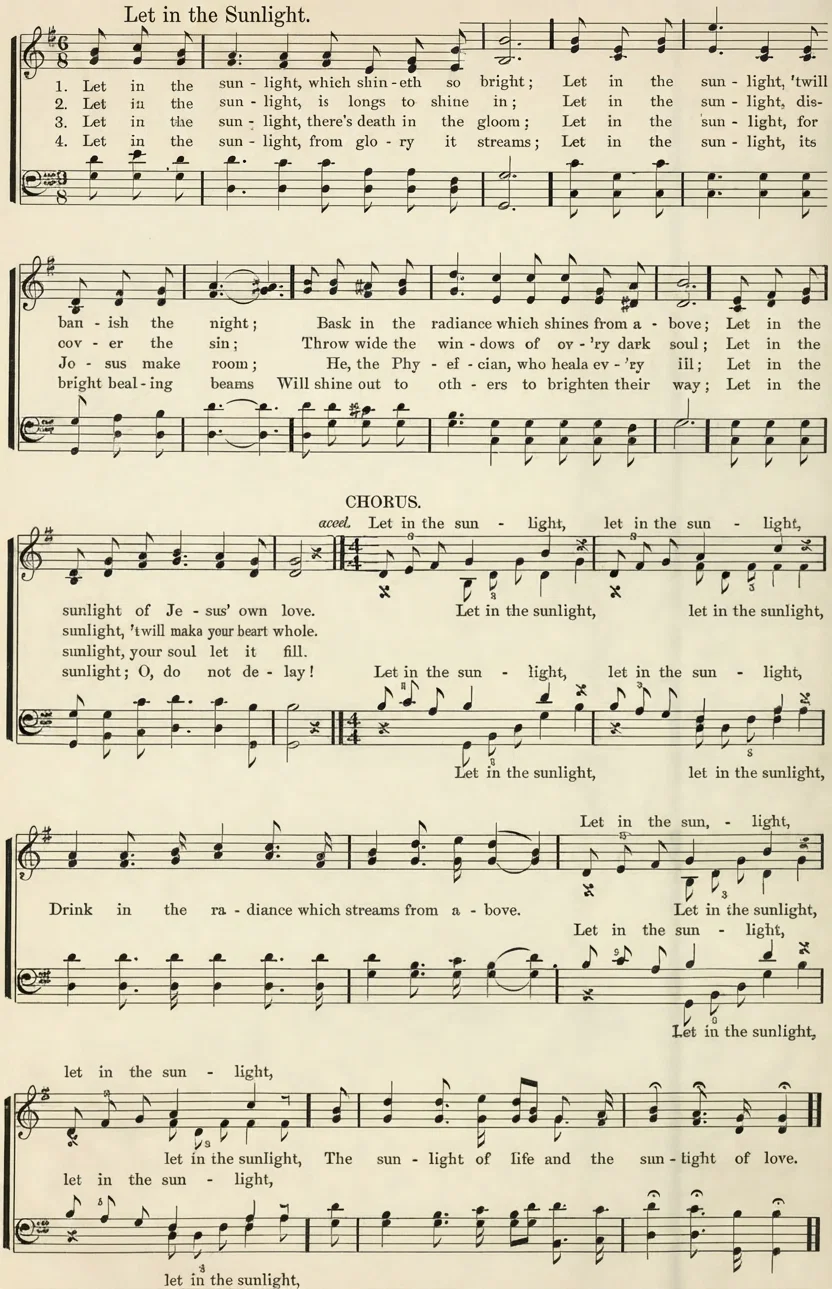
Let in the Sunlight.
By Milton Charles Wilcox
"The dayspring from on high hath visited us, to give light to them that sit in darkness and in the shadow of death, to guide our feet into the way of peace."—Luke 1: 78, 79. "But unto you that fear My name shall the Sun of Righteousness arise with healing in His wings."—Mal. 4: 3.
25 "And behold, a certain lawyer stood up and tempted Him, 26 saying, Master, what shall I do to inherit eternal life? And He said unto him, What is written in the law? how readest 27 thou? And he answering said, Thou shalt love the Lord thy God with all thy heart, and with all thy soul, and with all thy 28 strength, and with all thy mind; and thy neighbor as thyself. 29 And He said unto him, Thou hast answered right; this do, 30 and thou shalt live. But he, desiring to justify himself, said unto Jesus, And who is my neighbor? Jesus made answer 31 and said, A certain man was going down from Jerusalem to Jericho; and he fell among robbers, which both stripped him and beat him, and departed, leaving him half dead. And by 32 chance a certain priest was going down that way; and when he saw him, he passed by on the other side. And in like 33 manner a Levite also, when he came to the place, and saw him, passed by on the other side. But a certain Samaritan, as he journeyed, came where he was; and when he saw him, 34 he was moved with compassion, and came to him, and bound up his wounds, pouring on them oil and wine; and he set him on his own beast, and brought him to an inn, and took care of 35 him. And on the morrow he took out twopence, and gave them to the host, and said, Take care of him; and whatsoever thou spendest more, I, when I come back again, will repay 36 thee. Which of these three, thinkest thou, proved neighbor 37 unto him that fell among the robbers? And he said, He that showed mercy on him. And Jesus said unto him, Go, and do thou likewise."
Golden Text: "Love thy neighbor as thyself." Lev. 19:18.
SUGGESTIVE QUESTIONS.
(1) Who tried to confound the Saviour in His teachings? What vital question did he ask the Saviour? V. 25. Note 1. (2) How did the Saviour reply to the lawyer's question? V. 26. (3) What answer did the lawyer make? V. 27. (4) What did the Saviour say in reference to the lawyer's answer? What would the doing of this bring to the doer? V. 28. Note 2. (5) What other question did the lawyer ask? What was his reason for asking it? V. 29. Note 3. (6) Did Jesus give a direct answer to this question? What method did He take to answer the lawyer? What different individuals are brought into the narrative? V. 30-33. (7) What befell the man who was journeying to Jericho? What did the robbers do to him? In what condition did they leave him? V. 30. (8) Who came along that way soon after? Seeing the man in this condition, what did the priest do? V. 31. (9) Who else came that way? After looking on the man, what did he do? V. 32. (10) What other person happened to be journeying that way? How was he affected by what he beheld? V. 33. Note 4. (11) How did the Samaritan treat the wounded man? What did he do with him? How did he further show his compassion on the man? V. 34. (12) What provision did the Samaritan make for the wounded man's further needs? V. 35. (13) What question did the Saviour ask after finishing the narrative? V. 36. (14) What reply did the lawyer give? What practical application did Jesus make of the illustration? Show how this answered the lawyer's first question. V. 37. Note 5.
Who is represented by "a certain man"? Who are the "robbers"? What does the man's treatment represent? Who are represented by "a certain priest" and "a Levite"? Who by the good Samaritan? What is represented by dressing the wounds and caring for the man? What by the further provision made for the man? Note 6.
NOTES.
1. What shall I do?—The priests and rabbis had thought to entangle Christ by having the lawyer ask this question; but He required the answer from the one who asked the question. The Jews had been accusing Jesus of lightly regarding the law of God given from Sinai; but Christ turns the question of salvation, of eternal life, upon the keeping of God's commandments. And these things are written "for our learning."
2. This do, and thou shalt live.—"He presented the law as a divine unity, and in this lesson taught that it is not possible to keep one precept and break another; for the same principle runs through them all. Man's destiny will be determined by his obedience to the whole law. Supreme love to God and impartial love to man are the principles to be wrought out in the life."—Desire of Ages. The lawyer had pointed out the way, as shown in the scripture. It remained now for him to walk according to the light he had.153. Desiring to justify himself.—Jesus did not say that this lawyer was living up to the principles he had stated. He left that for the lawyer's own conscience to decide, and his conscience plainly told him that he was not. "The lawyer found himself a law-breaker. He was convicted under Christ's searching words. The righteousness of the law, which he claimed to understand, he had not practised. He had not manifested love toward his fellow-man. Repentance was demanded; but instead of repenting, he tried to justify himself. Rather than acknowledge the truth, he sought to show how difficult of fulfilment the commandment is. Thus he hoped both to parry conviction, and to vindicate himself in the eyes of the people." But there stood the Saviour's word, and stands to this day, "This do, and thou shalt live."
4. A certain Samaritan.—"The Samaritans were half heathen, a mixed race of Jews and Gentiles, accepting only the five books of Moses as their Bible, erroneous in some points of doctrine, and greatly despised by the priests and Levites. 'The Jews have no dealings with the Samaritans.' Note in this connection the noble spirit which Christ showed in this picture of a Samaritan, for it was but a short time before this that He had Himself been rejected by Samaritans in such an ungracious way that the disciples wished to invoke fire from heaven upon them. Moreover, it required great moral courage to thus exalt a Samaritan before Jews."—Peloubet. "This was no imaginary scene, but an actual occurrence, which was known to be exactly as represented. The priest and the Levite who had passed by on the other side were in the company that listened to Christ's words." The work that the priest and Levite ought to have done was the work which Christ described as His own when He said, "The Spirit of the Lord is upon Me, because He hath anointed Me to preach the Gospel to the poor; He hath sent Me to heal the broken-hearted, to preach deliverance to the captives, and recovering of sight to the blind, to set at liberty them that are bruised."
5. He that showed mercy.—"Thus the question, 'Who is my neighbor?' is forever answered. Our neighbor is every person who needs our help; every soul who is wounded and bruised by the adversary; every one who is the property of God."—Desire of Ages.
6. "In the story of the good Samaritan, Jesus gave a picture of Himself and His mission. Man had been deceived, bruised, robbed, and ruined by Satan, and left to perish; but the Saviour had compassion on our helpless condition. He left His glory to come to our rescue. He found us ready to die, and He undertook our case. He healed our wounds. He covered us with His robe of righteousness. He opened to us a refuge of safety, and made complete provision for us at His own charges. . . . Never should we pass by one suffering soul without seeking to impart to him of the comfort wherewith we are comforted of God."—Desire of Ages.
LESSON X.—SABBATH, SEPTEMBER 8, 1900.
SIN AND ITS REMEDY.
ROM. 5:12: "By one man sin entered into the world, and death by sin; and so death passed upon all men, for that all have sinned."
Rom. 3:9: "What then? are we better than they?—No, in no-wise; for we have before proved both Jews and Gentiles, that they are all under sin."
Rom. 3:23: "For all have sinned, and come short of the glory of God."
Rom. 3:19, 20: "Now we know that what things soever the law saith, it saith to them who are under [literally in, within the sphere of] the law; that every mouth may be stopped, and all the world may become guilty before God. Therefore by the deeds of the law there shall no flesh be justified [made righteous] in His sight; for by the law is the knowledge of sin."
Rom. 3:21, 22: "But now the righteousness of God without the law is manifested, being witnessed by the law and the prophets; even the righteousness of God which is by faith of Jesus Christ unto all and upon all them that believe; for there is no difference."
Rom. 3:24: "Justified [made righteous] freely by His grace through the redemption that is in Christ Jesus."
Rom. 6:1, 2: "Shall we continue in sin, that grace may abound? God forbid. How shall we, that are dead to sin, live any longer therein?"
Rom. 6:6, 7: "Our old man is crucified with Him, that the body of sin might be destroyed, that henceforth we should not serve sin. For he that is dead is freed from sin."
1 John 3:5, 6: "Ye know that He was manifested to take away our sins; and in Him is no sin. Whosoever abideth in Him sinneth not."
1 John 3:8: "He that committeth sin is of the devil; for the devil sinneth from the beginning. For this purpose the Son of God was manifested, that He might destroy the works of the devil."
Rom. 7:9-11: "I was alive without the law once; but when the commandment came, sin revived, and I died, And the commandment, which was ordained to life, I found to be unto death. For sin, taking occasion by the commandment, deceived me, and by it slew me."
Rom. 7:4: "Wherefore, my brethren, ye also are become dead to the law by the body of Christ; that ye should be married to another, even to Him who is raised from the dead, that we should bring forth fruit unto God."
NOTE.—Every one of the following questions may be answered in the exact words of some one of the foregoing texts. Study the text until you can find all the answers, and can see them plainly.
SUGGESTIVE QUESTIONS.
What came by sin?
Upon how many has death come? Why?
In what condition, then, are all men by nature?
What have all done?
In sinning, of what have we come short, and lost?
To whom does the law speak? What for?
What is the result of what the law speaks?
How extensive is the guilt? (Then to how many must the law speak? and who are within its range?)
What can no flesh gain by the deeds of the law? Why? What knowledge does the law give? To how many does the law give the knowledge of sin?
What is therefore manifested apart from the law?
Whose righteousness is it that is manifested?
Without what is it manifested? Yet by what is it witnessed? (With what, then, must the righteousness be in harmony?)
How, does this righteousness come? Unto and upon whom does it come? Do some receive the righteousness of God differently from others?
How are we made righteous? By what? Through what?
Shall we then continue in sin to give God an opportunity to manifest more grace? Why not?
What has been done to "our old man"? Why was the old man crucified? (Then what was the old man?)
Why is the body of sin destroyed? From what does our crucifixion with Christ free us?
Why was Christ manifested? What was not in Him? What is true of whosoever abideth in Him? (Show how it would be impossible for any one abiding in Christ to sin.)
Of whom is every one that commits sin?
Why was the Son of God manifested? (Then if He is manifested in any person, what must be true of that person?)
In what condition were we without the law? What did the commandment, the law, effect? To what was the law ordained? Yet what was it to us? What did sin do? By what did sin get the power to slay us? (Compare 1 Cor. 15:56.)
To what have we, if we are in Christ, become dead?
How do some become dead to the law?
Why do we become dead to the law?
Why do we need to be united to Christ?
NOTES.
1. ALTHO in this lesson there is no reference to the Epistle to the Galatians, it comes in naturally as a part of the study of that book. These texts are brought in here by themselves in order that the lesson on the actual text of Galatians may not be made too long by references to other scriptures. If these are carefully studied, so that they become fixed in the mind, any reference to them later on will not distract the mind of the student, but will only make his way clearer. It is true that every portion of Scripture is complete in itself for the purpose for which it was given; yet in studying any book of the Bible we get help from every other part with which we are acquainted, just as two lamps yield more light than one, altho each one is complete by itself.
2. THE texts quoted are simple statements of fact. All that is needed in order to understand them is to believe them. No attempt will be made to explain them, but we will simply direct attention closely to them, that each one may well observe what they tell.
3. THAT all are sinners is self-evident. Even tho a man has not been sharply and definitely convicted of sin by the Spirit of God, every one has this much of conviction, that he knows that he is not as good as he ought to be, or as he might be.
4. SINNERS of the Jews are no better than sinners of the Gentiles; that is to say, a professed Christian who knowingly commits sin is no better than an avowed unbeliever who does the same thing. The professor may indeed be much worse than the other, in doing the same act, since his knowledge and profession demand much more of him. To profess to be a Christian does not put one under the special protection of God, so that one may sin with impunity. God has no special favorites, whom He will shield from punishments for their sins, while others must suffer for the same things. God does not grant indulgences to Christians.
5. ROM. 3:19 is one of the two places in the Bible where the expression "under the law," as translated in our English version, does not mean condemned by the law. This is not an arbitrary difference from the same expression in other places, but arises solely from the fact that it is from an entirely different expression in the Greek. This text tells us that the law speaks to those who are in it, that is, within its range, and that as the result of what the law says to them, all the world are guilty before God. Then, indeed, they are under the law. Jesus said of the unbelieving Jews, "If I had not come and spoken unto them, they had not had sin; but now they have no cloak for their sin." John 15:22.
6. THEREFORE by the deeds of the law there shall no flesh be made righteous before God. Why not?—Because the law declares all the world to be guilty. By the law is the knowledge of sin; by Christ is the knowledge of righteousness.
7. BUT now a righteousness comes to us, apart from the law,—apart from our efforts to keep it. This righteousness, however, is not a different righteousness from that of the law, but the very same, as the law itself bears witness. It is the righteousness of God by the faith of Jesus Christ, in whose heart was God’s law in its fulness. It is a righteousness, not in word merely, but in action. It is not a righteousness which one strives to get from cold, lifeless stone, but the righteousness that is lived in the man by Christ, the living stone. It is all of God’s grace; for "where sin abounded, grace did much more abound." Rom. 5:20.
8. BECAUSE God is so gracious as freely to forgive our sin by imparting to us His righteousness in its stead, that is no reason why we should continue in sin. Exactly the contrary; for how is it possible to live in sin when we have God’s righteousness in and upon us through the abounding grace of God in Christ? Christ ministers righteousness, not sin.
9. WE become joined to Christ, sharers of His life, by being sharers of His death. It is in death that we are united to Christ. Therefore death can not separate us. Being dead with Him, we necessarily live with Him; and since He dies no more, the life which we live with Him is a life over which sin, and, therefore, death, has no power.
10. "OUR old man" is crucified with Him. That is, we are crucified as sinners. But "in Him is no sin," and therefore when we rise with Him it is to "walk in newness of life." No sin rises in Christ. "The body of sin is destroyed," swallowed up, in Him, and has no resurrection. If, after having been thus united to Him, we again commit sin, it is not He who does it, but it is of ourselves, because we have not held fast to Him in faith.
11. THE law convicts us of sin, and condemns us to death. But, instead of waiting to be driven to execution, we willingly and gladly suffer death with Christ, who gave Himself willingly, and who was "reckoned among the transgressors." It is in Christ that we receive the penalty of the law—death. So when we rise with Him, we are "dead to the law," so long as we "reckon" ourselves dead. So long as the "old man," which the law condemned to death, remains destroyed, and a "new man" lives in his stead, the law has nothing against us any more than it has against Christ. We are to remain dead to the law, but alive unto God.
BOOKS that Will Make Home Happier
Realizing that a large share of the unhappiness as well as the sickness of to-day is caused by wrong habits of living, the following books have been prepared so that those not having access to large and expensive volumes might yet have in cheap form and untechnical language that which would enable them to live healthfully, and as a result happily.