The railway equipment in Java is more like that of America than one sees anywhere else in the East. The toy engines and coaches that are used in Japan, China, and the Federated Malay States do not compare with those of Java.
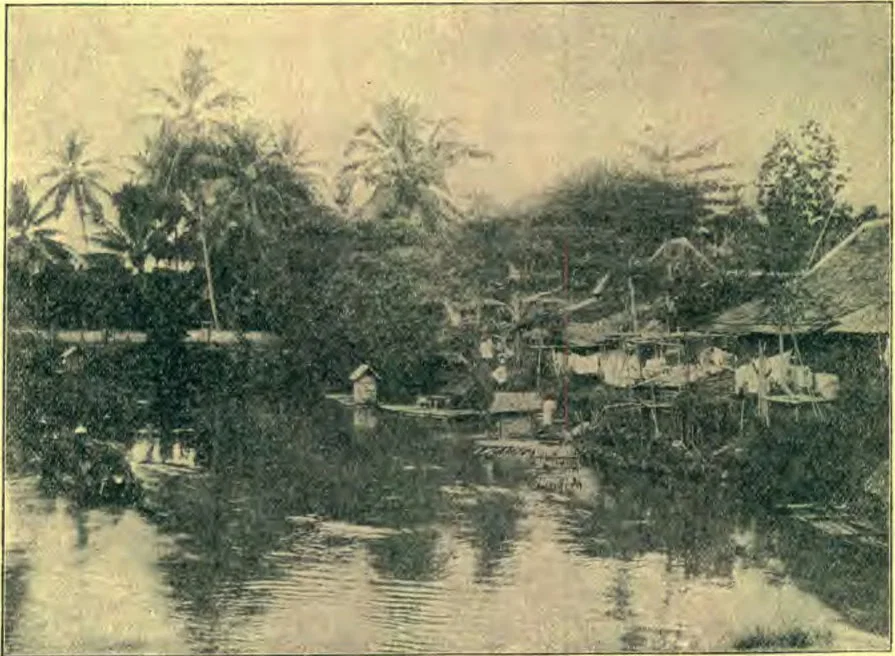
A SCENE IN JAVA
At the station in Weltevreden our things were transferred to a two-wheeled cart drawn by a small pony. There are no bullock carts in Batavia, as in Singapore, and one misses them. We boarded another two-wheeled cart called a sado. It is made especially for passenger traffic, and has springs and upholstered seats. Four persons, including the driver, can ride in one cart, two facing forward and two facing the rear. The little pony starts, the cart tilts back to an angle of about twenty degrees, and those in the rear brace themselves to keep from going out over the tailboard. There are no backs to the seats, so one is lucky to have someone behind to lean against.
These carriages charge twenty-four cents an hour and are cheaper to use than the jinrikishas in Singapore. The ponies do not weigh much more than three hundred pounds, but they go at a surprising rate. They are the only horse that can stand the heat. Australian horses are imported into Java, but they soon die.
These carriages are driven by Javanese or Malays.
The way of harnessing the ponies to the sados is unique. The shafts are not fastened tight to the sides of the pony, but are arranged by straps to have a good deal of play. As a result, when the cart is traveling, the ends of the shafts are generally well above the pony’s back, and one always fears that the little creature will be lifted clear off his feet.
There are also four-wheeled carriages to be had. They are more steady than the sados, but are as dilapidated. There are automobiles, of course, and an electric line and a steam tram. The steam tram is hauled by a locomotive that stores its steam at each end of the trip and carries no fire with it. The fare is about the same as in America.
On the way to our stopping place we passed a street sprinkler, and it was a novelty indeed. A man was walking slowly along the street with a pole across his shoulders, and a huge garden sprinkler at each end. When the sprinklers were empty, he would replenish them at wells along the roadside. Practically the only way to get water in Batavia is from wells. Most of them are surface wells only about twenty feet deep.
There are a few Artesian wells. This lack of good water must be a great drawback to health in such a large city.
We were glad to reach our destination, and after a good bath, taken Eastern style, we felt ready for anything. Bathing is done several times a day by everybody. The natives resort to the canals that flow through the city; the European to his bathroom. But there is no tub there. The Eastern way of bathing is to dip water from a huge jar or tank with a dipper, and pour it over the body in refreshing streams. One who has practiced this way for some time will aver that it is the best way in the world. After a hot, sweaty, dusty day, to step into the cool, damp room, and pour dipperful after dipperful of cool, fresh water over one’s tired, heated body, washing away fatigue and brain weariness as well as dust and perspiration, is a delight that is known and appreciated only by those of the tropics.
Weltevreden is well lighted by gas street lamps. All trains and tram cars throughout Java stop in the evening at about seven. One wonders why this is so. Cannot their native engine drivers be trusted at night, or is it feared that natives bent on mischief will place obstructions on the tracks to wreck trains? Everywhere there is profound mistrust of the native.
The rent of an ordinary dwelling house in Weltevreden is prohibitive. Forty dollars a month for a five-room house with a bathroom and servants’ quarters is an ordinary rental. Building materials, with everything else, is expensive in Java. Most of the Hollanders who come to the island receive large salaries, and they spend it all in living. Then, too, the government takes its share. There is an income tax, a tax on the rent paid, an automobile tax, and even a bicycle tax. The Netherlands government knows how to make its colonies pay.
The residence district of Weltevreden, in fact most of the city, is beautiful, far prettier than Singapore. The houses are kept apart, there is an abundance of trees and grass, and the streets are wide and well kept. All the houses are brick, the roofs are tiled, and the floors are covered with smooth floor tiles. There are very few two-story houses in Weltevreden.
There are several interesting sights in the old town of Batavia. The steam tram rattles along the streets, past canals and Chinese shops. Batavia reminds one of Singapore.8The houses are close together and there is no lawn and very few trees. But Batavia is a death trap, and no Europeans live there. They go there in the morning to their office work, but in the evening they all return to Weltevreden, where there is comparative freedom from sickness on account of the openness of the city.
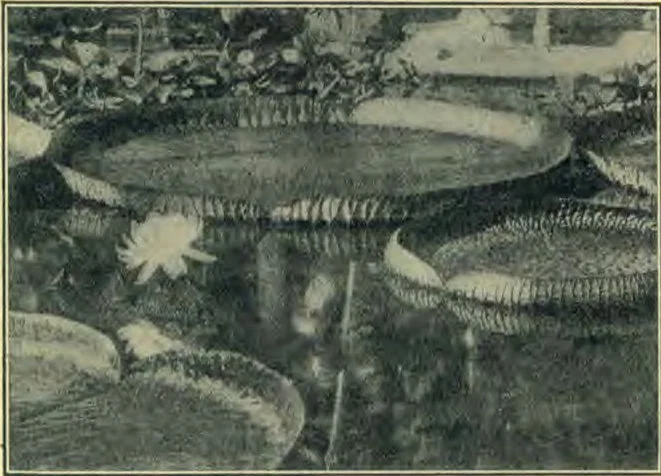
THE VICTORIA REGIA, OR GREAT WATER LILY
At the end of the steam tram line is a sacred cannon. It is not much to see, twelve feet of iron lying partly buried in the mud, but it is held in superstitious awe. There are numerous offerings made of paper with a piece of incense burning at one end, stuck in the mud about the breech of the cannon. It is claimed that this cannon was once used against the natives, killing great numbers. Therefore it has a “very bad spirit,” and if it is not worshiped it may kill many more. A woman who was selling paper offerings asked us to buy one and put it by the cannon; but we told her that we did not worship such things.
One of our friends had some business to attend to in Buitenzorg, and suggested that we accompany him in the automobile. His invitation was gladly accepted. Buitenzorg is a small city about forty miles from Batavia, up a short distance in the mountains. It is the residence place of the governor-general of the Netherlands Indies, and is also the location of the most interesting gardens in the world. These gardens are really part of the grounds of the palace of the governor-general.
The start was made in the early hours of the morning while the air was still cool. We flitted past the beautiful houses in Weltevreden, and were soon in Meester Cornelis, another residence section where many of the business men and officials live. The main roads of Java are well kept. The surface is smooth and hard, and fitted for fast automobiling, as our driver soon showed us. I thought that I had ridden behind cool, daring drivers before, but this native went beyond them all. Many a time at the speed of thirty miles an hour we whizzed past a native cart, just missing it. Otherwise the ride was delightful; the air was cool from a light fall of rain, and the sun shone brightly through the clouds that partly veiled the sky. On we went through coconut groves, past rice fields, in all stages from that ready to transplant to that brown on the stalk and ready to reap. Tapioca was growing in patches here and there also.
There were glimpses of villages, native workmen, the ever-present market, and fat, naked babies playing about. On, on we rushed, overtaking the diminutive two-wheeled carts drawn by the still smaller Sumatran ponies, and sometimes meeting another motor car that scudded past with a swish. Now the fields were open, and we saw crowds of people reaping rice, and men plowing with wooden plows drawn by ungainly water bullocks. Sometimes both sides of the road were arched with tamarind trees, and sometimes thickets of bamboo hid the fields from sight.
We passed several bodies of native soldiers, with Dutch officers. Some were on horses, some on bicycles, and still others were afoot. Some of the villagers near Batavia refused to pay their taxes and had rebelled. They were Mohammedans, as are nearly all the natives of Java, and they had put on the white robe, signifying that they would fight to the last. But the disturbance was easily quelled by the soldiers.
These soldiers are recruited from the other islands, as the Javanese cannot be trusted. A great many of the inhabitants of other islands are Protestant, and most of the natives working in more responsible positions in any enterprise are drawn from their ranks.
The road rises in a steady grade to Buitenzorg, an altitude of eight hundred feet. It follows a stream which at intervals has dams and gates, which force the water into ditches. These ditches are led into the surrounding fields for the purpose of irrigation. The dams are made of concrete and iron, and are undoubtedly supplied by the government. Where the ground is more uneven, terraces are built, and rice is raised on them. In places these terraces can be seen far up a mountain side.
Soon houses began to line the road, and our machine slackened its headlong pace and we knew that we were approaching Buitenzorg, the city “free from sorrow.” If sorrow is absent, rains are not, for according to the statements of the inhabitants, rain falls 325 days in the year.
The white walls of the governor’s mansion glistened through the trees under which were bands of deer, dozens of them, feeding peacefully like goats. The governor-general of the Netherlands Indies resides in Buitenzorg and goes to Batavia only when duty calls. The governor-general is chosen every five years, and a new one is chosen each time. His salary is £60,000, or $300,000 a year. The Netherlands Indies is divided into counties, over each of which is a resident. Upon these residents fall the burdens of the government.
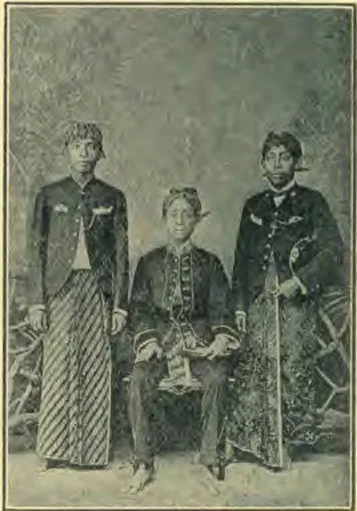
A GROUP OF JAVANESE
On reaching the main gate of the botanical garden, a park policeman offered his services in showing us about. We saw a great pond with the queen of water lilies, the Victoria regia, whose ponderous leaves cover nearly twenty square feet of surface; a garden of orchids, with 1,770 different kinds; palms, oaks, and evergreens were there in countless numbers and varieties, together with rubber, coffee, tea, cocoa, nutmeg, and cinchona trees. Quinine is made from the last-named tree.
The garden serves a practical use as well as a scientific one, for a great many experiments have been carried on there in acclimatizing various commercial trees and plants. Many trees and many plantations in Java9owe their start to the experiments conducted in that garden. Quinine is being raised and manufactured in Java, which is as it should be, for most of the quinine is used in the tropics to combat the dreaded malaria.
There is there a poisonous species of bamboo which has long thorns, a scratch from one of which is said to make a sore that will not heal for three months. We stayed at a respectful distance from this shrub.
THE LEAF INSECT
A hedge of this species growing about orchards in America might be useful. The garden is divided into plots, the trees are all numbered, and a stake by each bears its name in Latin to facilitate study by botanists. There are many greenhouses with species of smaller plants. There is also an aquarium where species of reeds and other water plants grow. There is little wonder that this garden is called the best in the world. There are one hundred and thirty-six native gardeners. Five doctors of botany supervise the work. Plants are being studied continually, new species are being brought in and planted in the garden. Students come from Europe just for the great privilege of study that the garden affords.
There is a small museum connected with the garden. We saw there a monstrous pair of horns, the spread of which was at least eleven feet. They looked more like a pair of elephant’s tusks than horns. There also we saw the live-leaf insects. They were feeding on bunches of green leaves, and were so nearly the same color and shape as the leaves that it was practically impossible to distinguish the leaf from the insect. We would pick out the quiet-looking object and make sure it was a leaf, and then it would walk away to feed elsewhere. Their wings were a living green, with veinings like leaves, and even holes in the wings, like leaves that had been partially devoured. We wondered if the insects sometimes did not mistake one another for leaves, and absent-mindedly lunch off each other’s wings!
A snake in a glass cage was shedding his skin. We watched him for some time as he rubbed against the dry branches in his den. He had removed half of his dead covering before we were obliged to leave.
A short trip about town showed us that in most respects this city was like Weltevreden. It is cooler on account of its altitude, and many people from the warmer towns spend several weeks here each year by way of recuperation. A mountain stream dashes through the town in a cañon one hundred feet deep. Its waters are muddy, as are all the streams we have seen. The reason must be that practically every stream in Java is used for irrigation, and the water that flows off from the fields finds its way back into the stream again.
(To be continued)
For the Finding-Out Club
1. WHAT caused President Monroe to issue the message to Congress known as “The Monroe Doctrine”?
2. When was the Battle of Waterloo fought, and the armies of what countries took part in it?
3. When was the White House built, of what material is it made, and why was it painted white?
4. For what reasons is mercury generally used in thermometers?
5. How long is a giraffe’s tongue (without stretching), and what is the giraffe’s favorite food?
6. From what country did the United States buy Alaska, and what was paid for it?
7. When was the Republican party organized?
8. How much was a Confederate dollar worth in gold in 1863?
9. On what conditions did Lafayette offer his services to the American Army?
10. In what country was silk first made, and why is raw silk produced only in certain countries?
11. What celebrated military commander was called “Light-Horse Harry”?
12. What early writers on geography, before Columbus, believed that the earth was round?
Members of the Finding-Out Club
T. D. Sanford5
Thelma Aletha Fretz
Milton K. Dymot
Hazel Brooks
Helen Salisbury
Mrs. W. T. Lewis
Harold E. Beasley
John Newton
George F. Webb5
Clora H. Curtis
Frances C. Rosenkrans
Faye F. Felter
Earle Stiles
Mrs. Grace C. White
W. C. Van Gorder
Mrs. E. M. Glass
Mrs. Blanch Spriggs
Mrs. Minnie Norman
Norman Lee Marsh
Lois A. Christian
Harold W. Clark
Inez Mortenson3
Edwin Montgomery
Irene Mac Donald
Louise Quick
Ruby E. Lea3
Almeda Laing
Bessie Mount6
Ity Ruth Thompson
Mrs. Grace Hoover3
Loretta Heacock
Mrs. L. A. Jacobs5
Ross A. Curtis
Mary H. Moore4
Mae C. Laing
Charles S. Channing3
Rose M. Brown
Lolita Leadsworth3
Harold N. Williams
Stella Teft Shryock
Cora Felker
Oscar Nystel
Grace M. Steves
Agnes Nystel
May Willhelm
Mary B. Long
Frank Steuenberg
E. Harold Shryock
Alfred Shryock3
Helen M. Gould
Milton Dillon, Jr.
Mrs. Robert Wallace
J. D. Mac Ginn
Lula Marchand
Eva B. Santee2
Mrs. H. C. Lyle
Reuben Coquillette
Mrs. Hattie Robinson2
Virgil Jackson
Eva B. Taylor
Evelyn Karr
Mrs. Anna Osborn
G. Nystel
Atholie Moseley
Laurence Mac Lafferty
Laura Sharp
R. R. Sweany
Mrs. Belle Schrank
W. M. Andress
Katherine Coleman
William S. Thomson
Pauline Sanford
Hattie M. Shoals
Lou Smith
Lillian Burrows-Parker
Myrtle E. Cooper
C. J. Dart
Orie A. Johnson
Lavina Burkhalter
Lillian Beatty
Engracia Hansen
Mary F. Beatty
Gussie Field-Colburn
Bernice Mac Lafferty2
Mrs. C. M. Babcock
Not Enjoyment, Nor Sorrow: Longfellow's Lines on Purpose
By Longfellow
Not enjoyment, and not sorrow,
Is our destined end or way;
But to act, that each tomorrow
Find us farther than today.
— Longfellow.
Ragweed Pollen as a Chief Cause of Hay Fever
THE pollen from ragweed, Ambrosia, is now regarded by medical experts as the chief cause of hay fever.
Birds: Their Symmetry, Grace, and Plumage
By James Montgomery
Birds, the free tenants of earth, air, and ocean,
Their forms all symmetry, their motions grace;
In plumage delicate and beautiful,
With wings that seem as they'd a soul within them,
They bear their owners with much sweet enchantment.
—James Montgomery.
Seven Reasons for Tithe Paying
By E. R. Palmer
1. The Bible says, “The tithe . . . is the Lord’s.”Lev. 27: 30.
I am unable to find in the Scriptures any evidence that the Lord has signed his claim over to us. I would not dare to trifle with a matter of that kind until I had as good evidence that the tithe belongs to me as I now have that it belongs to God.
We learn from the story of ‘Ananias and Sapphira how dangerous it is to appropriate to ourselves that which has been dedicated to God. The work of the gospel began soon after the fall of man. In the early history of God’s people, before the Levitical system was established, we find Abraham and Jacob paying tithe. The work of the gospel is not yet finished. Is it not, therefore, reasonable to believe that the tithing system will remain the basis of support until the gospel work is finished?
It was on this point that Satan fell. He failed to recognize that all things belong to God, to be dispensed by him according to his wisdom. Satan coveted that which belongs to God. When man was placed on probation in the Garden of Eden, he was tested on this same point. The Sabbath, one-seventh part of time, and the tithe, one tenth of his income, were sanctified and set apart as sacred to God. Those who fail to recognize the sacredness of these consecrated things, but appropriate them to their personal use, fail on the same point where Satan and Adam fell.
4. The tithing system was established under the Melchizedek priesthood, God’s heavenly priesthood, which includes all the work of ministry in behalf of the salvation of men, and to which the Levitical priesthood was only a temporary supplement. Heb. 7: 1, 2; Gen. 14: 18-20; 28: 20-22; Heb. 6: 20.
Abraham paid tithe to Melchizedek. Jacob paid tithe under the same Melchizedek system; and Christ was made a high priest forever after the order of Melchizedek. The Melchizedek priesthood being a permanent priesthood of both the old and the new dispensations, and the tithing system being established under that order, the temporary character of the Levitical system could have no more to do with the tithing question than it has to do with the Sabbath or with any other of the requirements of God.
5. The tithing system was approved by Christ and was set forth as a duty in his teachings.Matt. 23: 23.
I do not find among the teachings of Christ anything of a temporary character which might pass away at the cross. He taught the eternal principles of his Father’s law, and among them was the duty to pay tithes for the support of the gospel.
6. I am unable to draw a distinction between the two obligations of Sabbath keeping and tithe paying.
Sabbath breaking is a violation of the fourth commandment. It is an appropriation to common use of that sacred time which God has sanctified and set apart for his worship. Failure to pay our tithes is a violation of the eighth commandment. It is an appropriation to our own use of that which God has set apart for the support of the gospel.
7. All my life I have noticed that people begin paying tithe when they return to God by way of repentance, and that they stop paying tithe when they backslide from God.
When Jacob saw that vision of angels by night in Bethel, and when he repented and turned away from his sins, he promised the Lord he would henceforth pay his tithes. This gives me a clear intimation of my duty in this matter.
When a man turns away from his sins and his heart-wanderings, and God talks to him concerning his duty, among other things he confesses that he has robbed God, and he begins to pay his tithe; but when the world creeps into his heart, and expenses are high, he is tempted to use his tithe for common purposes, just as he is tempted to work on the Sabbath day when he finds it difficult to earn a living and keep the Sabbath. Let me ask you a plain question. Suppose you were unable to reason out logically the problem of tithe paying. Would you not hesitate to follow a course which men abandon when they turn to God? I invite you to think over this matter prayerfully, and listen to what God may speak to your heart concerning it.
E. R. PALMER.
My First Prayer
By Daniel A. Poling
I do not remember when I began to pray. I lisped an early prayer at my mother's knee, and the bedside petition was fixed in my life before the days of my earliest recollections. But I very vividly remember my first prayer.
I was a junior in college at the time, and as the result of a local oratorical contest had been selected to represent my institution in the State oratorical meet.
On Tuesday, three days before the night of the great event, which on this occasion was to take place in our own city, I became violently ill with chills and fever. The doctor diagnosed the case as grip, with a strong inclination toward pneumonia, the result of a very foolish bicycle ride too early in the season, which resulted in overexertion and overheating.
I shall never forget the look of disappointment that clouded my professor's face as he stood looking down upon me, the wreck of his oratorical hopes. My own chagrin and self-chiding were harder to bear than the physical hurt, for I knew how intense the disappointment of my college associates would be when they learned that through my carelessness the institution we loved would not be represented in the contest that she was to entertain.
Ah, how black a night that Tuesday night was! In the moments between delirious dreams I thought of Friday, and every dream was a nightmare in which angry students rolled great weights upon me.11
Early on Wednesday morning my small white dog crept into my arms, and shoved her moist nose under my chin. She was a real comforter. Impulsively I dropped my hand on her head. As I did so, I turned slightly, and my eyes rested upon an old-fashioned green wall motto, lettered in silver, that hung just above the wainscoting, directly across the room. I do not remember that I had ever noticed that motto before. The words of the text fastened upon my feverish brain: “There hath not failed one word of all His good promise.” And the suggestion flashed through my mind: “Try it out. Pray for another chance, a fighting chance.” Without a single mental reservation I floundered over on my face, and with the fever singing in my ears prayed.
Ah, if ever a young man prayed, I prayed that morning, just for a fighting chance to represent my college on Friday night. I did not pray for victory; for other men and colleges were to be considered, but I did pray for strength to command my wabbling limbs and for nerve to go through with my oration somehow. It was no formal supplication that I made, and there was no searching for choice phrases and pleasing sentences. The call that went out from my soul that morning was an unstripped appeal for help.
There on that cot in the old sitting-room at home, for the first time in my life, I “prayed through.” When assurance came, and it did come as clearly and unmistakably as the doctor came a few minutes later, I knew that I should deliver my oration. The physician laughed and humored me when I told him, and then reached down for my pulse. Other friends were sure that it was a mere whim of the delirium. But I knew. Mother believed, and the dear old professor understood.
Wednesday was a very trying day; Thursday was easier; but on Friday morning I was utterly miserable. For the first time since the message of the old green card had given me new hope I was despairing. But again my eyes turned to the motto, and the silver words fairly leaped across the room to me, “There hath not failed one word of all His good promise.” And I slid to the floor, and gripped that rock of truth as a drowning man lays hold upon the offered line of escape.
When the doctor came, he found my fever broken. He was very much surprised, and said that the sudden subsiding of the temperature accounted for my unusual weakness. I reminded him that it was Friday; and then he resolutely shook his head, and gave me an unconditional refusal. But I went through the day with the words, “There hath not failed one word of all His good promise,” strengthening me; and at five o'clock in the afternoon I sent for the doctor again. This time he heard my ultimatum, and I was fully attired when I delivered it.
Like the good fellow he was,—for he loved the old school too,—he set to work to help the Almighty get me in shape for my fifteen minutes on the platform. The drawing had placed me first; there were six speakers, and the man of science nursed nature along to have me as strong as I could possibly be on the minute, and if possible strong enough to go through that crucial quarter of an hour.
But the arm that I leaned upon that night was not the arm of the doctor, and it was not the arm of the dear old professor, much as he meant to me. And when I finally got to the platform, and for an instant the lights went out, and a wall of blackness was before my eyes, it was “There hath not failed one word of all His good promise” that turned the lights on again.
I went through the fifteen minutes, and walked off the stage and out of sight before I collapsed. God kept his word; I had offered up my first prayer; for the first time in my life I had prayed through, and ever after I was to have the assurance of the vital fact of intercession.
Many times since that day when I tossed in pain upon the couch in the sitting-room back at college I have turned my eyes to the old green wall motto, and it has never failed me. From that day to this I have not doubted my right to have an answer to every prayer. The desired answer has not always come. Many prayers have been answered in the negative, and some answers have been long delayed; but in times of spiritual stress, when doubts troubled and discouraging fears all but defeated faith, as well as in those more numerous even days when hope held an open way, the message of the old green card has triumphed.
—Daniel A. Poling, in Christian Endeavor World.
“Pneuma” — “Spirit” — “Life”
By Arthur L. Manous
WHEN the martyr Stephen was being stoned to death he called upon Jesus, saying:—
The Greek word, pneuma, here translated “spirit,” is rendered by the term “life” (R. V., “breath”) in Rev. 13: 15. Now, if we substitute this translation of pneuma for the word “spirit” by which it is rendered in Acts 7: 59, Stephen’s request would then read: “Lord Jesus, receive my life.” This thought reminds one of the expression: “And your life is hid with Christ in God.” Col. 3: 3. The Emphatic Diaglott New Testament, in its Interlinear Translation, translates Acts 7: 59 thus: “O Lord Jesus, do thou receive the breath of me.”
The psalmist also used a like expression on one occasion when he addressed the Lord, saying:—
The Hebrew word, ruach, here translated “spirit” is rendered by others as follows:—
“My breath to your hand I resign.”—Fenton’s Translation.
“Into thy hand I commend my breath.”—Cheyne’s Translation.
“Into thy hand I commit my life.”—Noyes’s Translation.
The scholarly Tholuck speaks of the psalmist in this text thus:—
“He is anxious for his life, but anxious in such a manner that he commits it to the best of advocates.”
In a note on this passage the translator and commentator, Mr. J. A. Alexander, says:—
“By ‘my spirit’ we may either understand my life or myself, but not my soul as distinguished from my body.”
Our Lord and Saviour Jesus Christ used very similar language when, expiring on the cross, he said:—
“Father, into thy hands I commend my spirit” (Luke 23: 46); or, as translated in the Emphatic Diaglott (margin): “Father, into thy hands I commit my breath or life.”
Speaking of the death of Jesus one writer says:—
“When he closed his eyes in death upon the cross, the soul of Christ did not go at once to heaven, as many believe, or how could his words be true, ‘I am not yet ascended to my Father’? The spirit of Jesus slept in the tomb with his body, and did not wing its way to heaven, there to maintain a separate existence, (Concluded on last page)12(Concluded from page eleven) and to look down upon the mourning disciples embalming the body from which it had taken flight. All that comprised the life and intelligence of Jesus remained with his body in the sepulcher; and when he came forth it was as a whole being; he did not have to summon his spirit from heaven. He had power to lay down his life and to take it up again.”—“The Spirit of Prophecy,” Vol. III, pp. 203, 204, edition of 1878.
The psalmist says: “Preserve my life.” Ps. 64: 1. Jonah prayed: “O Lord, take, I beseech thee, my life from me.” Jonah 4: 3. Christ said: “I lay down my life for the sheep.” John 10: 15. And he asked: “Wilt thou lay down thy life for my sake?” John 13: 38.
“Thus our life is something that we can commit to another for safe-keeping; it can be taken away from us; we can give it up, or lay it down.”—“Here and Hereafter,” p. 90.
With these facts before us it is plain that what the martyr Stephen wished the Lord Jesus to receive was his life, which is “hid with Christ in God,” and when Jesus who is our life, shall appear, then shall all the faithful appear with him in glory. See Col. 3: 3, 4.
ARTHUR L. MANOUS.
An October Riddle
By Grace Reese Adkins
THERE is a pretty picture
I'd love to have you see;
It's painted in the colors
Most beautiful to me—
A glint of golden yellow,
A dash of flaming red,
With green, and bronze, and gray,
and brown
And blue sky overhead.
There is a royal banquet
To which you ought to go;
The table is not set like ours,
With linen white as snow.
The chairs are soft as velvet,
The cups hold purest wine,
And all the time the orchestra
Makes music while you dine.
Now, would you see my picture,
And to the banquet go?
Just take a walk into the woods
Where oaks and maples grow;
Where acorns fall like raindrops,
And rocks the mosses hold,
And you will find that everything
Is true which I have told.