The Youth’s Instructor, Vol. 35, No. 16.

THE STONEHENGE

The Youth’s Instructor

Apr 20, 1887

S. D. A. Publishing Association · Battle Creek, Mich. · Apr 20, 1887

THE STONEHENGE.
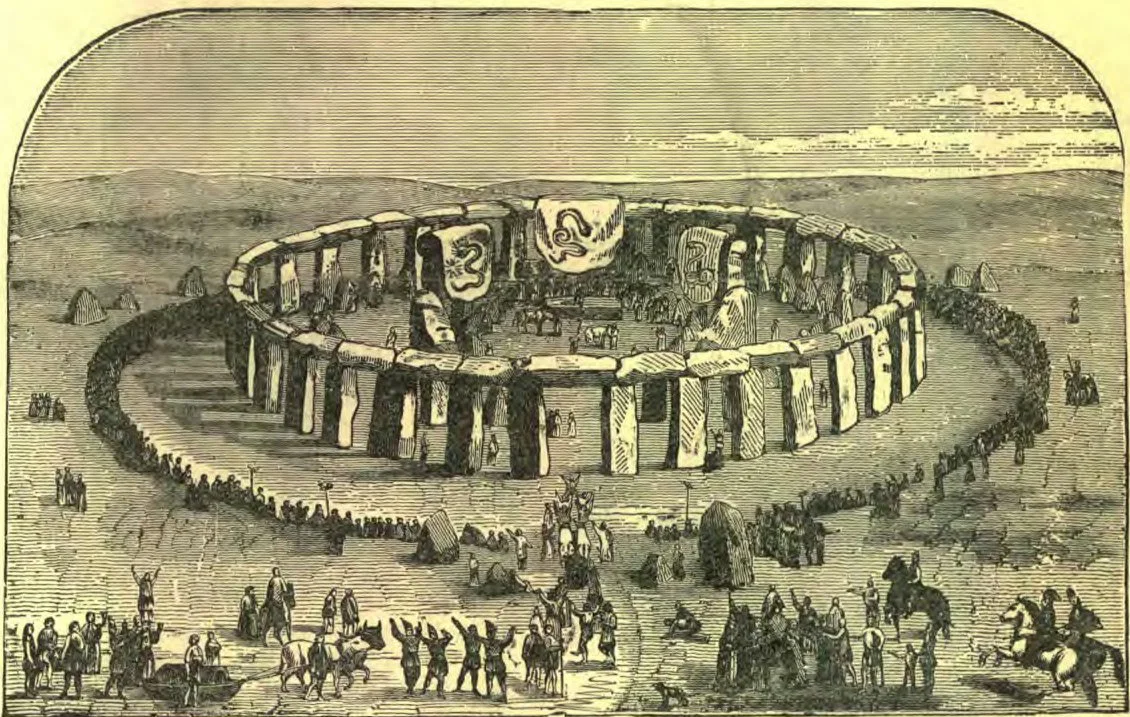
On Salisbury Plain, in Wiltshire, England, are to be found some interesting ruins. Scattered about over the plain are huge stones that appear from a distance like an irregular mass, but which, on closer inspection, we can see were once arranged in two ovals inside two circles. Mammoth great stones they are, of such weight that they could not possibly have been brought to this place and set up without the aid of some ingenious machine. The storms of many centuries have beaten upon them, yet some of their sharp angles, tenons, and mortises are well preserved. The ruins still go by their old Saxon name,—the Stonehenge, or “hanging-stones.”
As one views these immense stones brought together with a great outlay of mechanical skill and labor, he can but wonder what called forth the effort. Very probably they are the remains of an old temple of the Druids. The ancient Britons, who peopled these isles at the time they were visited by the ships of the Phœnicians many years before the birth of Christ, had a very strange and terrible religion, known as the religion of the Druids. Where they learned it, it is hard to find out, but it seems to have been brought from France. They worshiped the sun and moon and the serpent, and their rites were a strange mixture of the ceremonies performed to the gods and goddesses of other heathen people.
This religion was presided over by priests called the Druids, who kept many of their ceremonies a profound secret from the common people. Just what these ceremonies were we do not know, but it is certain that human sacrifices were often mingled with those of animals, and that on particular occasions both men and beasts were burned together alive in wicker cages! Suspected criminals were generally the ones offered in these sacrifices.
The priests held the oak in great veneration, and beneath its deep and sacred shades they instructed their pupils in their mysterious arts. As all the instruction was given orally, sometimes twenty years elapsed before a disciple finished his course. The Druids made and executed the laws, and were exempt from taxes; so it is not to be wondered at that the people readily believed that the more Druids there were, the better off the country would be, nor that their ranks were constantly replenished by the British youth.
The priests were better educated than the common people, and consequently exerted great influence. They prepared many remedies from plants, by which they healed the sick and wounded. And so miraculous seemed some of their cures, that they had no difficulty in making the people believe them to be enchanters and magicians. As the compounding of the medicines was a secret among the Druids, they did not run much risk of losing this reputation.
The mistletoe, a little plant with white berries, that grows on the oak, was considered very sacred by the Druids. When the little berries were fully ripe, the priests, dressed in white robes, ascended the oaks, and with solemn ceremonies cut off the mistletoe with a golden sickle.
But by and by people from other lands sailed in their little ships to the sea-girt isle, and settling among the Britons, taught them about the true God, and that to serve him as they ought they must love their neighbors as themselves, and do as they would be done by. The Druids lifted up hands of holy horror at this doctrine, and told the people that if they believed it, all manner of evil would befall them. They cursed the people heartily for listening to it. But when the people found out that they were none the worse for the curses of the Druids, and none the better for their blessings, they forsook their old religion, and from that time the ranks of the priesthood began to decline.
In our picture we see Stonehenge as it is supposed to have looked when the Druids worshiped there. At the present time there are not more than eight of the great stones left standing, but many fragments of others lie scattered about. Hillocks of earth here and there on the plain have been found to contain parts of altars, bones, and other remains that go to prove that here the Druids once offered sacrifice.
W. E. L.

ALECK'S RECRUIT.

Nobody in Dr. Alden’s congregation listened more attentively to the pastor’s sermon than Aleck Gardner, one warm summer morning. With wide brown eyes gazing into the beloved face, and ears that were unwilling to lose a word, the boy carried into his listening the same thoroughness which made him the best scholar in his class, the leader in all the games on the campus, and the dearest fellow in the world in the opinion of his mother and sisters.
Dr. Alden’s subject was Christian life, and his text, “How much owest thou unto my Lord?” Among other things, he said that the soldier in Christ’s army was always a volunteer, but that no true volunteer was ever contented to come into the ranks and stay within them alone. He would try to bring in recruits. He would never be afraid to show on which side he was, nor ashamed of his colors. Like Hedley Vicars, who, after his conversion, laid an open Bible on his table, so that his gay comrades should see for themselves that he had begun a new life, Christ’s soldier would be brave and steadfast, and would try to win others into the kingdom.
Aleck Gardner belonged to a very pleasant Sunday-school, and his class was composed of boys, like himself, from the best families of the ward. In all New York there was not a better neighborhood than the one in which the Gardners resided, and the church and school were both aristocratic.
Aleck went home, resolved to put the Docter’s sermon into practice. To do so, was to set about bringing in a recruit that very day. He ran over in memory the names of his friends and acquaintances, not one of whom but had gone to Sunday-school ever since he was three years old.
Aleck finally made up his mind that if he was to be of use, he must get his recruit on the avenue somewhere. “For highways and hedges, I must put alleys and street corners,” he said to himself.
Bible in hand, he set forth to Sunday-school, looking on both sides of the way for his recruit. Presently he saw him. But—would he, could he, present that lad, even if he should consent to go, to the select circle of young people in Dr. Alden’s church-school?
For one moment he hesitated. The next, with head erect, and outstretched hand, with a manner which was persuasive and polite, he approached the boy, who stood in a “don’t care” attitude, leaning against a lamp-post.
The recruit’s head was frowzy, and red locks stuck like wisps of straw through the torn places in his old hat. His feet were bare, his trousers were patched with ill-selected pieces, he had on an old faded shirt of striped calico, and no jacket.
“Won’t you come to our Sunday-school with me?” said Aleck. “I beg your pardon, but it’s rather slow work standing here in the sun with nothing to do, and our teacher is splendid.”
The boy of the sandy locks looked glum, and an angry blush stole through the thick-freckled skin.
“You’re making fun of me,” he said, glowering on Aleck, who was well-dressed from hat to shoe-ties.
“Not in the least,” was the prompt answer. “I am in dead earnest, and I never wanted anything more in my life than I want you now to go to our Sunday-school with me. Please come along!”
“Will you have me as I am? No dressing me up in your old clothes, nor giving me a new hat,—eh? What do you think of those boots?”
This lad had something of the spirit which animated tough old Samuel Johnson when a poor student at college. His shoes were wretched, and some kind person, in pity for their forlorn state, set another pair before his door,—which pair the future doctor of letters promptly threw out of the window. He would stand, please God, on his own feet, and in his own shoes.
Aleck had remembered a certain gray suit in his closet at home, not much the worse for wear, and had fancied how well his new acquaintance would look were he washed and brushed up generally; but with something of the divine tact which made the apostle Paul the missionary he was, all things to all men, he at once put the gray suit in the background.
“Come just as you are. It’s yourself I’m after, not what you have on. Come in as my friend.”
The smooth, slender hand was laid on the reluctant arm. Aleck did not know how strong a conflict was going on in the soul beside him, nor how slight a thing decided the other boy’s action; for just as Aleck spoke, there appeared on the corner a knot of boys of Tim Macgruder’s own class. They were ragged, dirty, and rejoiced in defiance of law and order; and they set up a shout of derision when they perceived the company in which their leader, as Tim Macgruder was, had somehow found himself.
What was their surprise when that leader turned, shook his fist at them menacingly, and then walked meekly beside Aleck Gardner, and entered the portals of St. Barnabas’s Church.
Tim Macgruder’s entrance there would have made a sensation, had the boys and girls been less well-bred, or Aleck Gardner less a favorite and a gentleman. As it was, no eye was allowed to rest on him with a stare, and the welcome of teachers and boys was cordial to Aleck’s new recruit.
Never will Tim forget the pleasure of that first hour in the Sunday-school,—the delight of the hearty singing, and the interest with which he listened to the lesson study.
One, two, three Sundays he was in his place, in the old clothes, though each week there was an improvement in cleanliness. On the fourth, he appeared in a plain but neat suit, with hair brushed, and shoes on his feet. Tim had found a good situation, was a member of society with an interest in keeping the laws, and was bringing home his wages every week to the poor old mother, whose prayers for him were now full of joyful thanksgiving.
Aleck’s recruit went on step by step,—won an education, entered college, finally studied for the ministry, and is to-day the successful, hard-working pastor of a prosperous church.
All this is true, although it does seem stranger than fiction. For, though Aleck’s name was not really Aleck, nor Tim’s name Tim, yet both Tim and Aleck were real boys, the sermon Aleck heard was really blessed to a hearer who became at once a doer of the word, and every incident in this story of Aleck’s recruit did really take place.—Margaret E. Sangster, in S. S. Times.

EASTER LILIES.

Oh, where are the tall white lilies That grew by the garden-wall? We wanted them for Easter, And there is not one at all!
Down in the bare, brown garden Their roots lie hidden deep, And the life is pulsing through them Although they seem to sleep;
And the gardener’s eye can see them —Those germs that hidden lie— Shine in the stately beauty That shall clothe them by and by.
Even so, in our hearts are growing The lilies the Lord loves best, The faith and the trust and the patience He planteth in the breast.
Not yet is their full sweet blossom, But He sees their coming prime, As they will smile to meet Him In earth’s glad Easter-time!
The love that striveth towards Him Through earthly gloom and chill, The humble, sweet obedience Through darkness following still—
These are the Easter lilies,— Precious and fair and sweet, We may bring to the risen Saviour And lay at his blessed feet. —Wide-Awake.

EASTER MORNING.

“Not a grave’s captive, but a garden’s guest.”
WRAPPED in the fragrance of a garden’s bloom, Night’s dewy tears fell ’neath the rayless gloom, Where slept the Lord, within the silent tomb.
O glorious day! that burst the bars of night, And shone resplendent with effulgence bright, With life and immortality and light. The Lord is risen indeed! Above him streams The golden light of morn, whose radiant beams Illume the shining lilies with their gleams.
Glorious the garden where Thy sacred head Reposed among the lilies, with the dead; Blessed be the grave through which thy feet have led.
Glad Easter morn, on which the Lord arose; As o’er our dying world thy beauty glows, Thy mystery of joy to us disclose.
O thou, who art the life, the truth, the way, Thou Son of righteousness! shine forth, we pray, And make our hearts to bloom on Easter day.
—Christian Weekly.

A PEEP AT AFRICA.

AFRICA, you know, is the second largest continent on the globe. But we would have a more definite notion of the size of this so-called "Dark Continent" if we were to compare it with our own land. If you were to draw a straight line from New Orleans directly through St. Louis till you strike the northern boundary of the United States, and should add all the land east of this line to the territory the Republic already owns, you would then have a country only one-third as large as Africa. This great division of the globe is about five thousand miles in length.
All around this great body of land the waves of the ocean rush and roar, for even the small neck of land that connected it with the rest of the world has been severed by the Suez canal, more than seventy feet wide and twenty-four in depth. This canal was completed in 1869.
The continent of Africa is the only one stretching entirely across the torrid zone. It has some remarkable lakes, mountains, and rivers. Lake Victoria, in the eastern central part, is supposed to be one of the largest fresh water lakes in the world, though its exact size is not known. Its waters flow into that historical river, the Nile, that bore on its bosom the infant Moses, by whose hand, its waters were in after years turned to blood in the days of Egypt's plagues. Directly east of Lake Victoria rise the two highest peaks on the continent,—Mt. Kilimanjaro and Mt. Kenia,—the former being 20,000 feet high, and the latter a little lower. Kenia is in the principal mountain range which extends along the eastern coast. The Atlas mountains, high and rugged, are in the northern part, and the Kong and Cameroons are near the western border.
Northern Africa embraces the Barbary States and Egypt. South of these States is the Great Desert, reaching for thousands of miles nearly across the continent, and covered mostly with shifting sand and gravel. The mode of travel across this desert is with camels. Sand storms in this region are often very destructive, and sometimes whole companies perish in them.
Central Africa includes the Soudan, the Congo Free State, Abyssinia, Guinea, and some smaller provinces. Crossed, as it is by the equator, it is remarkable for its fertility. Its mild and healthful climate is owing, no doubt, to its great height, having an average elevation of 5,000 feet above the sea level. This, however, relates to the country directly crossed by the equator. In the Soudan the heat is often excessive, reaching as high as 140 degrees Fahr. during the summer months, and excessive rains and droughts are common. South Africa is quite mountainous, yet it contains many fertile valleys and plains well adapted to agriculture and stock-raising.
Cape Colony, the most southern part, is nearly three and a half times as large as all the New England States. Its capital city, Cape Town, has a population of 33,000. In this colony there are large sheep farms, ranging in size from three thousand to fifteen thousand acres. Ostrich raising is also successfully carried on, and nearly five million dollars' worth of ostrich feathers are annually shipped from the colony. Diamond digging is another important industry of Cape Colony. $13,000,000 worth are shipped in a single year. This colony is controlled by Great Britain, and contains many thousands of English-speaking people. As we look over this great country, it is a sad thought that only a few of the millions in Africa are worshipers of the true God. In many parts the Mohammedan religion is the prevailing one. Then there are many tribes of savage barbarians whose children know nothing about pleasant homes, kind fathers and mothers; and as for a Sabbath-school, they never heard of one. When their fathers and mothers get old and feeble, they are often left out in the field or in the woods to die, perhaps to be devoured by wild beasts. A knowledge of Christ, and the saving truths of the word of God, alone can lift up and make better those who are sunken so low as are many of the millions of Africa.
D. A. ROBINSON.

Do It Today: The Duty of Prompt Action

If you have a plan, carry it out to-day; if you have been meaning to do a certain kind act, to write a gentle letter, to make a call that will carry comfort, do it to-day. How often the day drifts by while we go about our every-day duties in a half lethargy of benumbed will power. Up, then, to-day, and accomplish something! Down goes the temptation, and pampered pet sin,—conquered to-day, just as it was beginning to draw its sluggish coils about us. The windows of our higher nature fly open, and in pours the sweet, pure air, straight from the skies.

SOMEBODY IS UP.

You may be down to-day, but somebody is up, and why may not you be there also? You may be ignorant, at the foot of the stair-way, but somebody stands at its head, exalted through learning. Why may not you mount to be among the wise men? You are poor, but somebody is rich; and why may not you rise to be among those who, with large, open hand, scatter freely their wealth for God?
You are tempted, and may have fallen back to a discouraging position; but somebody has surmounted temptation after temptation, and their silent example beckons you to heights of right-doing where they stand. Be not contented to stay down when God says, “Up!” If you will only strive in his strength, putting your feet forward and your hands up, you will find yourself mounting a glorious stair-way.—S. S. Classmate.

FAITH

LESSON 3.—OPERATIONS OF FAITH.

1. How is faith obtained? Rom. 10:17; Gal. 5:22.
2. What did the woman who had been diseased twelve years say within herself when she saw the Saviour? Matt. 9:21.
3. What effect did this touch have upon her? Mark 5:29.
4. In what closer contact to the Saviour were others brought at the same time? Luke 8:45.
5. What was the difference between the press of the multitude and the touch of the woman? Verse 48.
6. Why was the attention of the Saviour arrested by the woman’s simply touching his garment? Mark 5:30.
7. How did the Saviour’s announcement affect the woman? Luke 8:47.
8. What do these circumstances show?—That outward demonstrations in prayer or otherwise are not necessary to the exercise of faith.
9. In what manner is it probable that many of the people received a knowledge of the Saviour before they saw him?—Through the preaching of the disciples whom Christ sent out. Matt. 10:2, 23; Luke 10:1.
10. What was the basis of their faith in his Messiahship?—He fulfilled the prophecies that had been made concerning the Messiah. Matt. 8:16, 17.
11. What first induced the centurion to send to Jesus in behalf of his servant? Luke 7:3, first clause.
12. Why did he not go himself? Verse 7.
13. How does he further show that he realized his unworthiness?—By sending a second deputation. Verse 6.
14. What unusual faith did the centurion manifest? Verses 7, 8.
15. What was the Saviour’s response? Verse 9.
16. What was the result of this faith on the centurion’s servant? Matt. 8:13.
17. What did this exhibition of faith bring to the mind of our Saviour? Matt. 8:11, 12.
18. What expressions in this narrative indicate that this faith brought to the Saviour’s mind the gathering in of the Gentiles?

NOTE.

“WONDERFUL, indeed, the faith embodied in the message which the centurion sent: I, a Roman officer, have a limited authority, but within its limits this authority is supreme. I can say unto one of my soldiers, Go, and he goeth; to another, Come, and he cometh; to my servant, Do this, and he doeth it. But thou, Jesus, art supreme over all. As my soldiers are under me, so under thee are all the powers and processes of nature. Thou canst say to this disease, Come, and it cometh; to that disease, Go, and it goeth; to thy servants Life and Death, Do this, and they do it. Say thou then but the word, and my servant shall be healed.”—Hanna.

Teaching Peculiar Traits of Bible Characters

WHEN teachers undertake to delineate a Bible character or to describe a Bible event, they should see to it that they note the characteristics which are really peculiar to the person or event indicated, and not those only which it shares in common with other characters. A Scottish doctor of divinity, now deceased, once had a startling lesson in this line. In an address to a class of boys, he informed them that he was about to tell them a story without names, and that he wanted to see if they knew the names by the time he had finished the story. Then he told the story of David and Goliath, emphasizing the insignificance of the lad who slew the giant, and the exceeding bigness of the giant who was slain. The story finished, “Now, my boys,” said the doctor, “I want all of you who know the name of the lad who slew the giant to hold up your hands.” Up went every hand in the class. “Ah! very good,” was the comment; “and what was the name?” “Jack, the Giant-killer,” was the response in full chorus. And the fault was the minister’s, not the boys’. He had not shown them a single characteristic of the story of David which distinguished it from that of their favorite nursery hero. The lesson is a good one for all teachers. Find out what is peculiar to the story you have to tell, peculiar to the person you have to describe,—and whatever else you omit, do not omit that. —S. S. Times.

TRAVELING PLANTS.

How many of the readers of the INSTRUCTOR have noticed how wisely Nature has provided for the rapid distribution of seeds over the soil? For instance, some there are like the maple, formed with wings to bear them onward; others, like the thistle, have a light, downy substance attached, enabling them to sail away as easily as a balloon. Some seeds have attachments with which they bury themselves in the ground; still others are provided with hooks, with which they cling to passing objects, to be carried along and finally deposited where they take root and thrive. Then there are explosive seed-pods, like the balsam, witch hazel, etc. The naturalist, C. F. Holder, noticing some of the most interesting of this class of seeds in a late article in the Youth's Companion, mentions some seeds that were purchased by a collector in South America. He says:—
The owner “placed them in his berth in his cabin to dry, when, without warning, the seed case exploded one evening with a report as loud as that of a pistol, and the large seeds flew about with force enough to break a mirror and almost to stun the people they struck.”
He also noticed the African tree pentaclethra, of which he says “a seed-pod two feet long was experimented upon, and when bound in iron wire, actually tore and rent itself in pieces in its efforts to become free.”
The peculiarities of other traveling plants, both in this and foreign countries, might be multiplied; but perhaps one more example will suffice to awaken an interest in your minds to search out some of these wonderful things for yourselves, as the summer approaches. The one to which we refer is the great tumble-weed plant of Colorado. In the same article by Mr. Holder, mentioned above, the writer thus describes it:—
“The tumble-weed plant is six feet or more across, and four or five feet high, and grows in the shape of a flattened sphere. It has very delicate and fragile roots that barely hold it in the dry soil. When it goes to seed, it dries, and becomes remarkably brittle. Then the tops bend in together and give the plant a still more spherical form. The roots die and wither, so that the first gust of wind severs their connection with the soil, and away they go, often collecting in vast numbers; so that, when piled together, resembling ledges of rock, as we have seen, they are ready to break up and roll away with the first gale.”
“The force with which these plants strike is astonishing. A horse or tent could easily be knocked over, and loss of life would probably attend their movements if they could not be avoided. These migrations are not without purpose, as during them the seeds, which are held loosely, are scattered over miles of country, insuring a future crop of the plants. Although the tumble-weed was not provided with locomotive organs, it was constituted so as to allow the greatest freedom of motion, and the seeds were all ready to drop out as it passed along.”
Mr. Holder mentions a conflict that a party of explorers had a few years ago with a number of these balls. It was like this:—
“While a party of explorers were pushing their way across the arid and desert tracts of Colorado, they were overtaken by a furious wind storm. The clouds accumulated with marvelous rapidity, and in a comparatively few moments an almost impenetrable darkness closed in upon them. Naturally, their first thought was shelter; but as far as the eye could reach, not a tree could be seen, and only far off in the distance appeared what might be a pile of rocks or boulders. Toward this their horses were quickly turned, and as they approached the supposed protection, to their astonishment it seemed to move, and soon resolve itself into a number of balls of large size, that under the advance gusts of the storm, began to gyrate about in a remarkable manner. Now a fiercer gust struck them, and, as if some mighty shell had exploded, the balls rolled away in every direction over the plain, accompanying their motion with a strange crackling sound. What had appeared to be shelter had now become an additional danger.”
“The rolling balls alarmed the horses. The party, turning about, was soon in a wild race before the storm, and before the crashing balls, that would now roll swiftly and evenly along, then striking some obstacle, bound into the air like living things, go whirling about, and come down hundreds of feet away, to bounce along in the same erratic manner. For several miles this race was kept up, only ceasing when the storm had spent its fury.”

A GREAT SEA ON FIRE.

The shores of the Caspian abound in naphtha springs extending for miles under the sea, the imprisoned gases of this volatile substance often escaping from fissures in its bed and bubbling up in large volumes to the surface. This circumstance has given rise to the practice of “setting the sea on fire,” which is thus described by a modern traveler:—
“Hiring a steam barge, we put out to sea, and after a lengthy search found at last a suitable spot. Our boat having moved round to windward, a sailor threw a bundle of burning flax into the sea, when floods of light dispelled the surrounding darkness. No fireworks, no illuminations, are to be compared to the sight that presented itself to our gaze. It was as though the sea trembled convulsively amid thousands of shooting, dancing tongues of flame of prodigious size. Now they emerged from the water, now they disappeared. At one time they soared aloft and melted away; at another a gust of wind divided them into bright streaks of flame, the foaming, bubbling billows making music to the scene.
“In compliance with the wishes of some of the spectators our barge was steered toward the flames and passed right through the midst of them, a somewhat dangerous experiment, as the barge was employed in the transport of naphtha, and was pretty well saturated with the fluid. However, we escaped without accident, and gazed for an hour on the unwonted spectacle of a sea on fire.”—Selected.

Curious Bee-Hives.

It is, no doubt well-known to most country boys that the bumble-bee makes his home in the nest of the field-mouse. Whether the bee drives out the builder and original occupant of the nest, or waits for him to vacate the premises, is not easy to decide. The fact that a nest which is built in the spring will often be found filled with bees and honey in July, proves that it has not been long without a tenant. Mr. Wells, in his account of his explorations in Brazil, mentions finding a great number of ant-hills, four to six or seven feet high, constructed of clay by a species of white ant, but then occupied by colonies of bees.
These bees had turned the ants out of their quarters and domiciled themselves in their place. Without exaggeration I believe many tons of honey could be collected from these mounds; from one hill alone we took out sufficient to satisfy the appetites of every one; even the mules had their share.
The honey is found in little compact balls of delicate black wax, about one and a half inches in diameter; each ball is separate and distinct from its neighbor, and the honey is most excellent in flavor.
The bees, of course, flew about us, but were perfectly harmless. They are small and black, not much bigger than a house-fly. The mystery is how they can conquer and drive off the white ants; perhaps many a battle was fought before they gave up possession. However, the bees were evidently masters of the situation. Only on two or three occasions was the same mound found occupied jointly by the bees and ants.—Exchange.

LUMINOUS INSECTS.

Sir Samuel W. Baker says there are a great variety of luminous insects in Ceylon. The following paragraphs are an extract from what he has written about them:—
“A night after a heavy shower of rain is a brilliant sight, when the whole atmosphere is teeming with moving lights bright as the stars themselves, waving around the tree-tops in fiery circles, now threading like distant lamps through the intricate branches and lighting up the dark recesses of the foliage, then rushing like a shower of sparks around the glittering boughs. Myriads of bright fire-flies in these wild dances meet their destiny, being entangled in opposing spider’s webs, where they hang like fiery lamps, their own light directing the path of the destroyer and assisting in their destruction.
“That which affords the greatest volume of light is a large white grub about two inches in length. It is a fat, sluggish animal, whose light is far more brilliant than could be supposed to emanate from such a form. The glow from this grub will render the smallest print so legible that a page may be read with ease. I once tried the experiment of killing the grub, but the light was not extinguished with life; and by opening the tail, I squeezed out a quantity of glutinous fluid, which was so highly phosphorescent that it brilliantly illumined the page of a book which I had been reading by its light for a trial.”

WHAT IS AN INCH OF RAIN?

The question, “What is an inch of rain?” is answered in the following paragraph:—
“An English acre consists of 6,272,640 square inches; and an inch deep of rain on an acre yields 6,272,640 cubic inches of water, which, at 277,274 cubic inches to the gallon, makes 22,622.5 gallons; and, as a gallon of distilled water weighs 10 pounds, the rainfall on an acre is 226,225 pounds, avoirdupois; as 2,240 pounds are a ton, an inch deep of rain weighs 100,993 tons, or nearly 101 tons per acre. For every 100th of an inch, a ton of water falls per acre.

Good Manners as Petty Sacrifices

Good manners are made up of petty sacrifices.

CONSIDER

There is religion in a flower; Its still, small voice is as the voice of conscience; Mountains and oceans, planets, suns and systems, Bear not the impress of Almighty power In characters more legible than those Which he hath written on the tiniest flower Whose light bell bends beneath the dew-drop’s weight. —Horace Smith.

Letter Budget.

THE INSTRUCTOR family has grown so large and is so prompt to write for the Budget that there is no prospect that the letter box will become empty in a long, long time, if ever it does. Well, we don't want it to become so. But as we have once said, you would lose all interest in the Budget should we print the same thing over and over every week, with no more difference than the writer's name or address, so we suspect many of these letters cannot be used. We will try to print the best, and a part of some, and once in awhile will give the names of the little people whose letters we cannot use, asking them to write again. By the time they write the second letter, probably they will hit the mark.
When any of you have something of interest to say, don't be afraid of making your letters too long. Write out your thoughts in as good shape as you can, and give us a chance to select the best of them should the letter be too long to be printed in full. We want you to learn to write interesting letters, so as to learn to do missionary writing; and we hope you will so use your time and opportunities as finally to be among those profitable servants who will have improved the talents the Master loans them.
There are so many letters in type, we will allow the remaining space for you. First,—
JANE TENNER sends a letter from Shiawassee Co., Mich. She writes: “I am eleven years old. My mother died one year ago last April. She was sick eight years. I never had much chance to go to school, because she needed me to wait on her. One year ago last June I came to live with Mr. Griggs's people. I like it here very much. Grandpa died last August, so there are now only grandma, grandpa's sister, auntie, and myself. We do all the chores, taking care of the horses and the cattle, and do the milking. It keeps us all very busy. I do not go to school, but study at home. We go eight miles to meeting every Sabbath. Last Sabbath we were afraid we would have to stay at home because the snow was so deep; but the weather was so mild we went, and had a good meeting. Last quarter we did not miss one Sabbath. I study in Lesson Book No. 6. I want to keep all the commandments, so I may be among the faithful ones when Jesus comes.”
LOIE and LOUIE SNYDER send a letter from Steele Co., Minn. They write: “We are twin sisters, thirteen years old. We are orphans, and have a step-mamma and a little half brother, who are out in Nebraska to spend the winter. It will be eight years the 16th of December since mamma died, and one year the 17th since papa died. We first saw the truth when Elds. Schram and Gregory had a tent here last summer, and we were baptized by Eld. Gregory the 30th of October. We each teach an infant's class in Sabbath-school. Our mamma does not keep the Sabbath. Please pray that she may. We send love to the INSTRUCTOR family, and hope to meet you all in heaven. We will try to be workers in the cause as soon as we finish school and our guardian will let us.”
On the last half of the same sheet as the above was a letter written by JENNIE VAN WAGENER. She says: “I am fifteen years old. It is nearly three years since my mother died. My grandmother and I began keeping the Sabbath last July, when Elds. Schram and Gregory were here with the tent. We have a nice church. I play on the organ, and Loie and Louie sing. I was baptized last October. I am trying to learn as fast as I can, so that I may become a good worker in the Master's cause. I love the INSTRUCTOR very much, and give it to one of my friends, who, I hope, will soon see the truth. I hope you will all pray that I may be faithful, and that my father may begin to keep the Sabbath soon. I send my love to all. We three hope to see our letters in print.”
MAY MYNDERSE, of Lorain Co., O., says: “I go to Sabbath-school nearly every Sabbath, and study in Book No. 2. We have a good teacher, and I am trying to be a good scholar. I like to read the INSTRUCTOR.”
Continue reading: PROVE IT BY MY MOTHER